INTRODUCTION
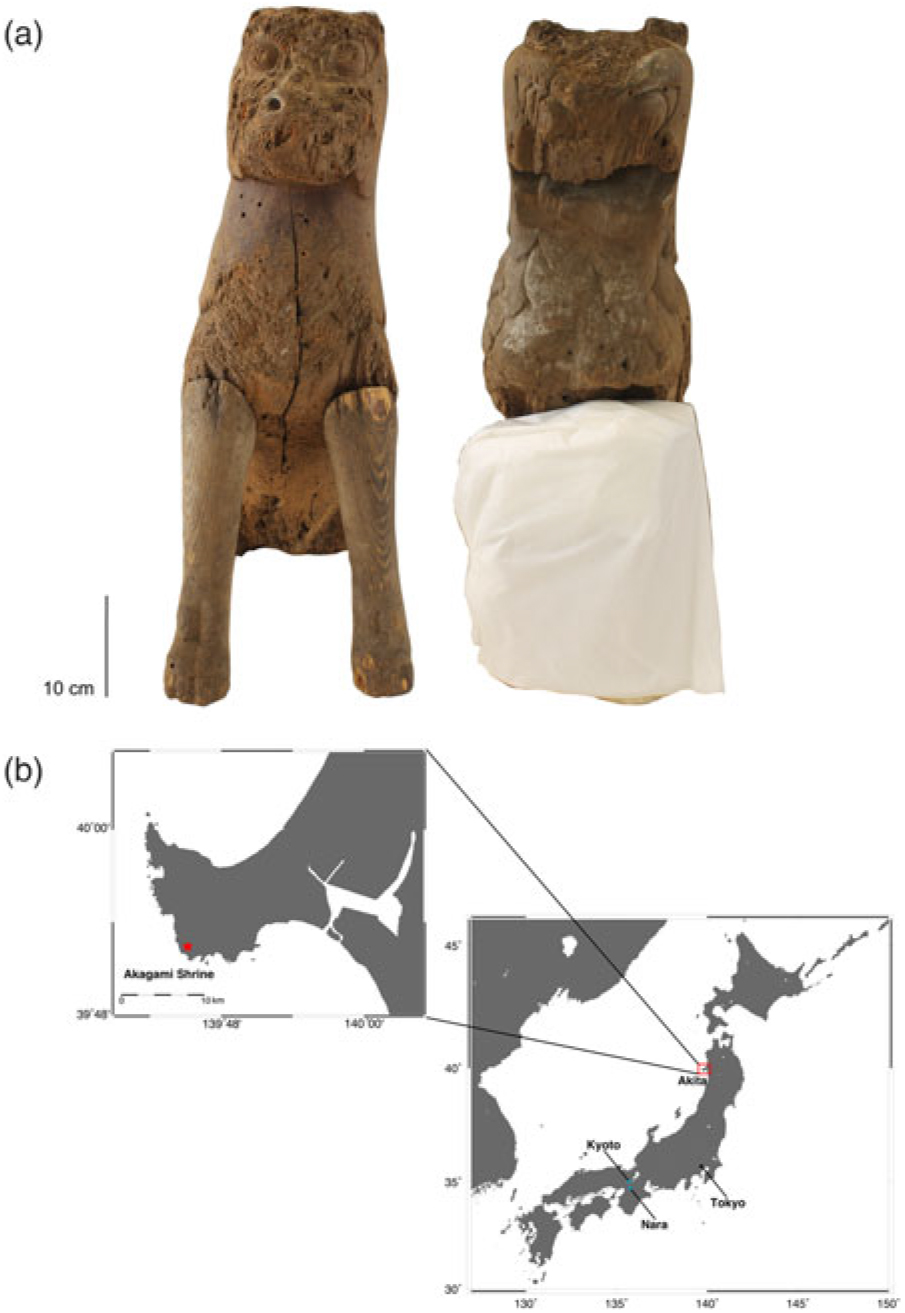
Komainu is a pair of guardian lion-dog statues (Figure 1a). From the late 8th through 14th centuries, wooden Komainu were generally installed under the roofs of gate buildings, Shinto shrines, Buddhist temples or nobles residences, or inside of these buildings (Itoh Reference Itoh1989). Thus, the study of Komainu is important to understand the histories of Shinto and Buddhist art in Japan.
(a) Komainu (a pair of guardian lion-dogs) found in Akagami shrine; left: lion-dog; right: lion. (b) Location of Akagami shrine (red star) and ancient central cities (blue points). (Please see electronic version for color figures.)

However, the Komainu are not well studied since they are often made from stone, which hampered the use of direct radiometric dating. Therefore, previous studies to determine Komainu formation ages have been based on typology or stylistic characterizations (c.f. Itoh Reference Itoh1989; Miho Museum 2014). The only study that has conducted scientific chronological research on a Komainu employed a dendro-ecological method (Okochi Reference Okochi2016). However, it requires large numbers of rings (ca. 100 years) to reduce uncertainties in ages, which inhibits the wide application of this method to many Komainu sculptures, even if they are made from wood, because they often contain much less than 50 years of tree rings (Miles Reference Miles1997). In this study, we analyzed 14C ages of wooden Komainu found at Akagami Shrine, Akita, Japan. 14C ages were then used for 14C-wiggle-matching to estimate the age of the wood.
METHODS
Akagami Shrine and Sampling
The wooden Komainu used in this study were found in Akagami shrine, Akita prefecture, Japan (Figure 1b). In traditional history, Akagami shrine was established by Ennin, a priest of the Tendai school of Buddhism, in 860 AD (Japanese Association for Conservation of Architectural Monuments 2002). The first main hall, Goshado, was constructed in 1216 CE, yet no historical documents describing the details of Komainu exist.
The height of the Komainu is approximately 60 cm. One lion-dog (Figure 1a left: AKK) has two legs with lengths of approximately 30 cm, though no legs were attached to the other Komainu sculptures (Figure 1a right: AKS). The lion-dog has 65 tree rings, whereas the lion has 75 tree rings. The numbers of tree rings for the left leg (AKL1) was 48, whereas the right one (AKL2) has 41 years of tree rings. The bodies have tree cores and their annual ring widths are about 2–4 mm. Conversely, the legs have no tree cores and their annual ring widths are about 1–2 mm. The surface of the bodies (AKK and AKS) has decayed and showed signs of insect activities in some spots, whereas the legs (AKL1 and AKL2) show little decay. To perform 14C-wiggle matching dating, we sampled between 10 and 20 years of tree rings with a scalpel, respectively for AKS, AKK, and AKL.
Sample Pretreatment and 14C Measurements
To remove surface contamination, we conducted acid-alkali-acid (AAA) treatment described in Miyairi et al. (Reference Miyairi, Yoshida, Miyazaki, Matsuzaki and Kaneoka2004). All samples were soaked in 1 M HCl for 1 hr at 80ºC to remove carbonate and fulvic acid. After HCl treatment, the samples were soaked into 0.1 M NaOH for 1 hr at room temperature to remove humic acid. Then, samples were transferred into the 1 M HCl for 1 hr at 80ºC to remove carbonate completely. After AAA treatment, an automatic combustion system (Yokoyama et al. Reference Yokoyama, Miyairi, Aze, Yamane, Sawada, Ando, de Natris, Hirabayashi, Ishiwa, Sato and Fukuyo2019) was used to collect CO2 gas using an elemental analyzer (EA Vario MICRO Cube, Elementar). The produced CO2 was then transferred to the high vacuum graphitization line which converted the CO2 gases into graphite automatically with Fe powder (approximately 4 mg) under H2 gas heated to about 630°C (Yokoyama et al. Reference Yokoyama, Miyairi, Matsuzaki and Tsunomori2007). The graphite target samples were then pressed into aluminum cathodes. The 14C contents of graphite samples were measured at Atmosphere and Ocean Research Institute, the University of Tokyo using a single stage accelerator mass spectrometer (YS-AMS) (Yokoyama et al. Reference Yokoyama, Koizumi, Matsuzaki, Miyairi and Ohkouchi2010). The calendar ages of wood were determined using wiggle-matching analysis performed using Bayesian statistics (Bronk Ramsey et al. Reference Bronk Ramsey, van der Plicht and Weninger2001). This analysis was performed with OxCal v 4.3 (Bronk Ramsey Reference Bronk Ramsey2009a) using the IntCal13 (Reimer et al. Reference Reimer, Bard, Bayliss, Beck, Blackwell, Bronk Ramsey, Buck, Cheng, Edwards, Friedrich, Grootes, Guilderson, Haflidason, Hajdas, Hatteé, Heaton, Hoffmann, Hogg, Hughen, Kaiser, Kromer, Manning, Niu, Reimer, Richards, Scott, Southon, Staff, Turney and van der Plicht2013).
RESULTS AND DISCUSSION
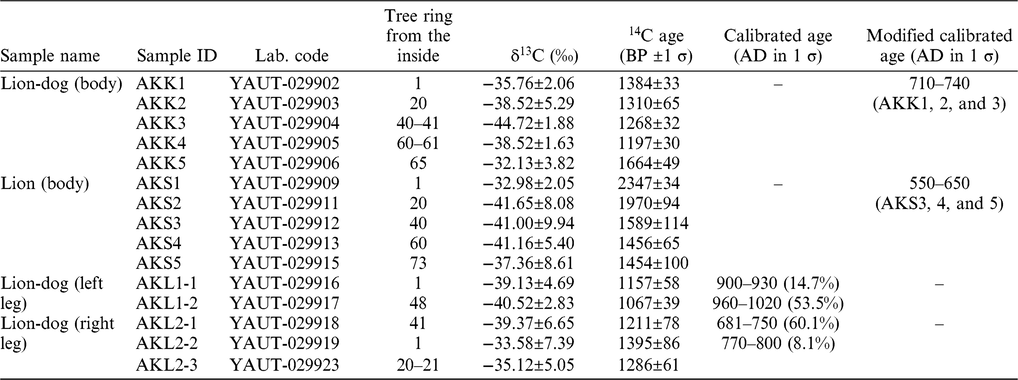
We obtained calendar ages of Komainu that were formed using 14C measurements together with wiggle-matching technique referring to the atmospheric 14C calibration curve (i.e. IntCal13: Reimer et al. Reference Reimer, Bard, Bayliss, Beck, Blackwell, Bronk Ramsey, Buck, Cheng, Edwards, Friedrich, Grootes, Guilderson, Haflidason, Hajdas, Hatteé, Heaton, Hoffmann, Hogg, Hughen, Kaiser, Kromer, Manning, Niu, Reimer, Richards, Scott, Southon, Staff, Turney and van der Plicht2013). The 14C dating results and the calibrated ages using wiggle-matching analysis are depicted in Table 1 and Figure 2. Although there are limitations of sample sizes retrieved from the surface of the sculptures, the wiggle-matching was successfully conducted to reduce uncertainties of the formation ages, but we had difficulties yielding enough graphite to conduct 14C dating for samples of AKL1-3 (lion-dog, left leg, 24 rings). All δ13C values ranged from –32.1‰ to –44.7‰, which is lower than expected for wood samples, because measurements were conducted by AMS rather than isotope ratio mass spectrometer (IRMS).
14C dating results and calibrated ages using wiggle-matching analysis.

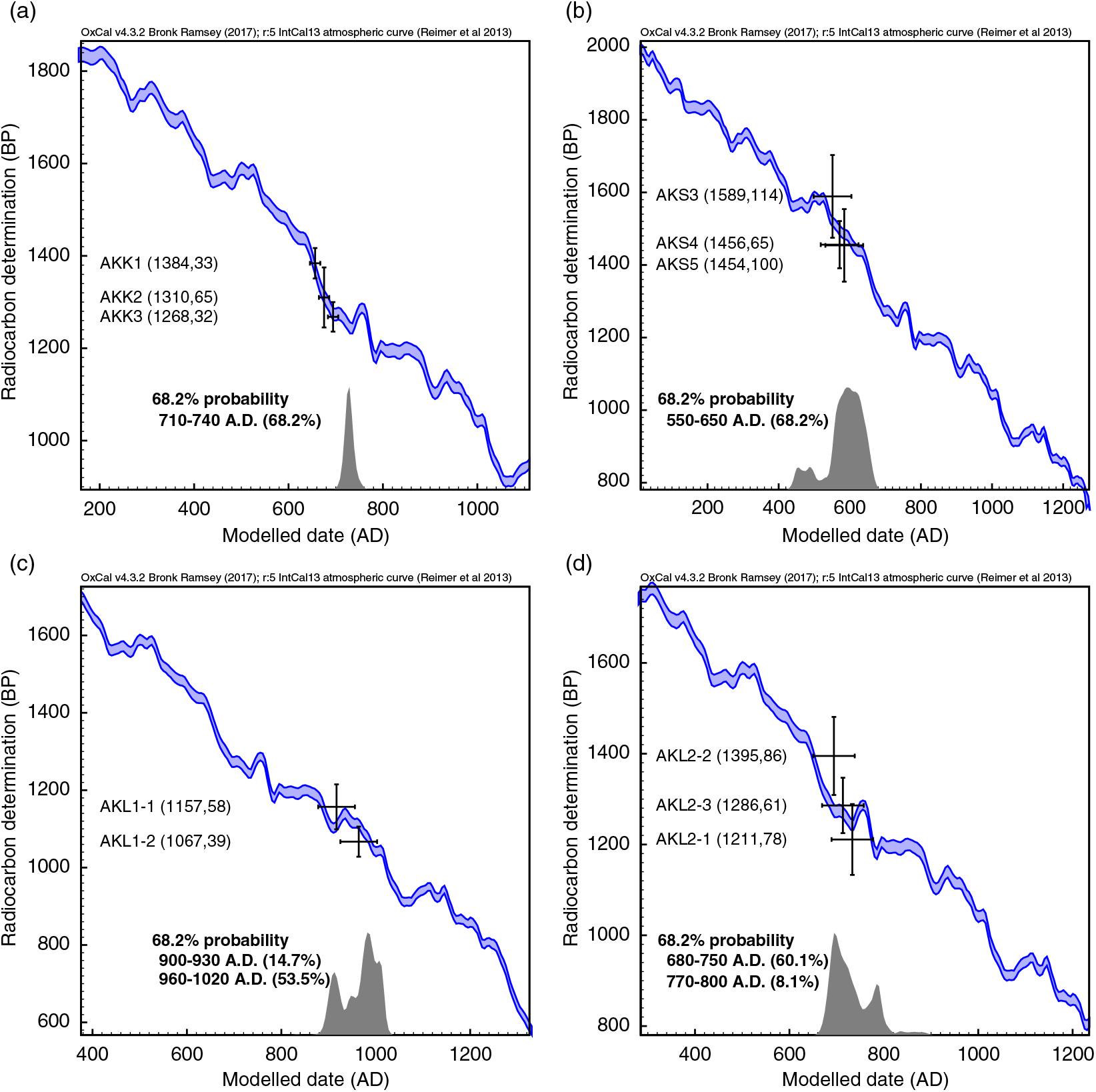
Measured 14C data from the Komainu wiggle-matched against IntCa13 (Reimer et al. Reference Reimer, Bard, Bayliss, Beck, Blackwell, Bronk Ramsey, Buck, Cheng, Edwards, Friedrich, Grootes, Guilderson, Haflidason, Hajdas, Hatteé, Heaton, Hoffmann, Hogg, Hughen, Kaiser, Kromer, Manning, Niu, Reimer, Richards, Scott, Southon, Staff, Turney and van der Plicht2013). Dark gray layers are calibrated ages (1σ). (a): AKK, (b): AKS, (c): AKL1, (d): AKL2.

AKK (Lion-Dog, Body)
We had attempted to determine the production age of the Komainu sample (lion-dog) using 14C results (5 points) employing the wiggle-matching technique. However, age reversals were found for AKK4 and AKK5 (Figure 2a). This was probably due to the fact that the ages of AKK 4 and 5 were strongly affected by younger carbon contaminations induced from bioturbation. Visual observation of the surface also supported this conclusion. Therefore, we removed those samples from wiggle-matching analysis and obtained the age as 710–740 cal CE for the age of AKK.
AKS (Lion, Body)
Five 14C results for AKS also could not be uniquely identified by the formation ages of the Lion sculpture using the wiggle-matching technique (Figure 2b). Unexpectedly, much older ages were obtained from AKS1 and AKS2 compared to other results. The preservation condition of the woods was not preferable for these samples and we omitted these two dates from interpretation, as they were significantly affected by secondary alteration which introduced much older carbon, likely from organic acids such as humic and fulvic acids produced by wood-rotting fungi (Green and Highley Reference Green and Highley1997). We therefore obtained the wiggle-matching calendar date as 550–650 cal AD for the AKS.
AKL1 (Lion-Dog, Left Leg)
We successfully obtained two 14C dates from AKL1, which were 900–930 and 960–1020 cal CE. This was approximately 100 years younger compared to the one for the body. The calibrated age of AKL1 is 900–930 and 960–1020 cal CE and the results passed the χ2 test (Figure 2c). We conclude that the leg was repaired ca. 100 years after the body was formed. This is supported by the fact that the appearance of the surface of the wooden leg is much fresher than that of the body and the design of this part is different from the main body.
AKL2 (Lion-Dog, Right Leg)
We obtained three 14C dates and wiggle-matching to the 14C calibration curve was undertaken. The results show that the age of the formation was either 681–750 or 770–800 cal CE (χ2 test passed as 5%; Figure 2d). This indicates that the age difference between the body and the leg is not significant. The leg would have been repaired after the formation of the body because of the fresher surface of AKL2 and the different style of design compared to the body.
Implication of the Ages of Komainu Sculptures
To evaluate the formation age of the Komainu, ages obtained from leg 14C results will not be considered, due to their systematically younger 14C dates compared to the body and fresher appearances. Also, the style of carving is different from the body, and it can therefore be concluded that the legs were reformed after the original Komainu formation.
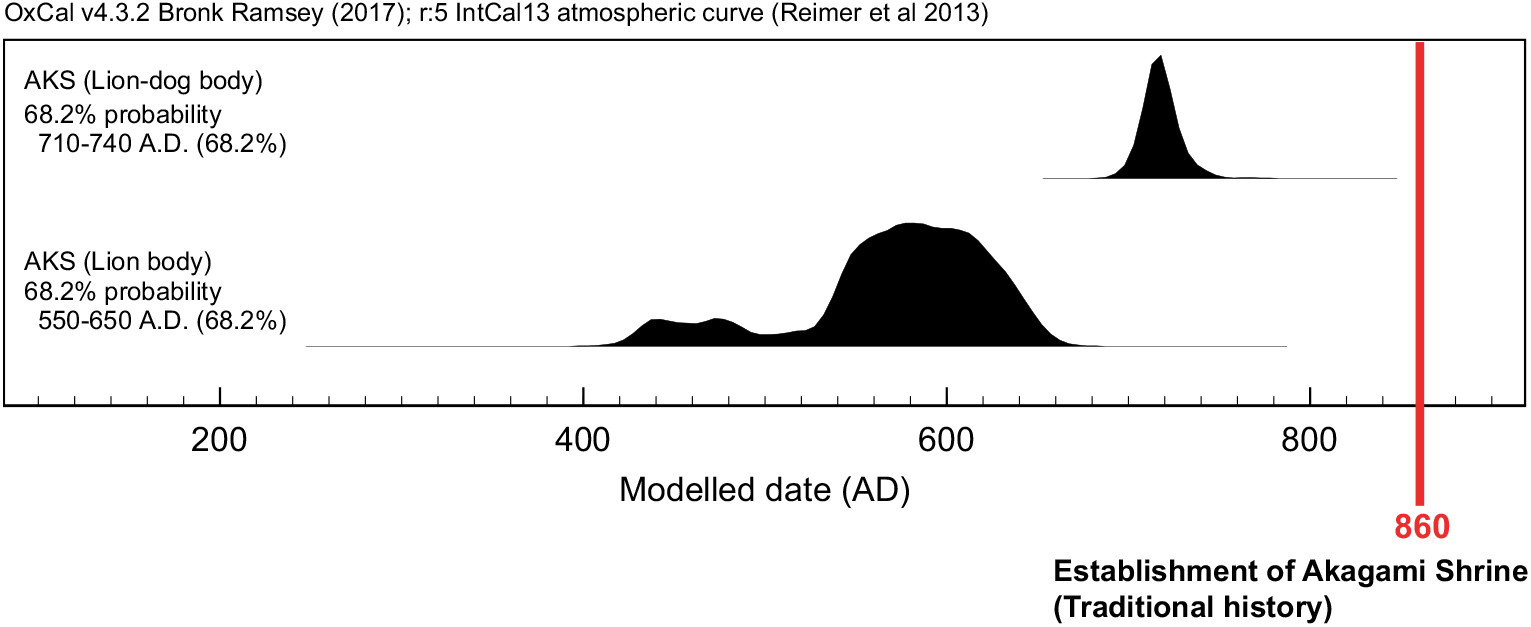
Two possible interpretations can be deduced from analyses described above regarding the ages of the sculpture body (Nakao et al. Reference Nakao, Sakamoto and Imamura2014; Nakao et al. Reference Nakao, Sakamoto, Imamura, Ozaki and Kobayashi2017). The first is the possibility of recycling old wood being cut long before the carving of Komainu sculptures. In fact, neither the Komainu-lion nor Komaimu-dog have wood skin and/or sapwood. Thus, this possibility cannot be excluded, and hence the age of the wood cannot be definitively regarded as the ages of the Komainu carvings. Given that the modern Japanese cedars utilized as a timber for buildings are all younger than 250 years (Sawata et al. Reference Sawata, Nishizono, Awaya and Nobori2007), the minimum age of Komainu formations could be estimated as 250 years younger than the body ages. Because the Komainu-lion and Komainu-dog examined in this study both have heartwood and more than 50 years of tree-rings, the cutting age of the original wood should not be older than the age obtained from wiggle-matching of Komainu body data. This was also supported by the term “Komainu” first appearing in a historical document that was published in 801 AD (Itoh Reference Itoh1989) which is younger than that of the ages for AKS, and AKK by as much as 100 years. This minimum age coincided with the establishment of Akagami shrine as recorded in available textual references (Figure 3).
Comparison between calibrated ages and a historical document.

The other possible interpretation is that the Komaimu formation was completed soon after the tree was cut. Again, we assume less than 250 years of timber age because of the above described reasons, the formation of the Komainu sculptures was similar to or older than the established age of Akagami shrine. It may be possible that available textual references recording the age of Akagami shrine are not reliable, although this can be disregarded due to the fact that there are no wooden buildings found older than 860 CE. It would therefore not be possible that the technological advancement to construct the wooden building was not established in the region by then. Instead, it may be possible that the sculptures were formed in different towns and transferred to the Akagami shrine, possibly from Kyoto, Nara (Figure 1b) or other central cities in Japan at that time.
The approximately 100 years of difference in the age of the Komaimu-dog and lion could be interpreted as either both types having been formed at the same time or different times. The former case can be explained as recycling of old timber, similar to the body as described above, and the latter as different ages of carving for two types of Komainu—namely, the lion was formed first and replaced later by the dog. This explanation is in line with the individual evidence from Japanese art history that original Komainu sculptures were pairs of two lions, but that it changed in the Heian era (around CE 794–1192) to pairs consisting of one lion and one dog (Itoh Reference Itoh1989).
CONCLUSION
We measured 14C of rare wooden Komainu sculptures found at the Akagami shrine in Akita prefecture, Japan. The 14C ages were then calibrated to calendar ages using wiggle-matching analysis. The estimated formation ages were between the 5th and 11th century. Possible cases of carving of Komainu sculptures were discussed and it was found that these Komainu sculptures are possibly among the oldest in Japan. This coincided with the time when Buddhism was first introduced in Japan and is thus an important period with regards to Japanese art history. The multiple wiggle-matching methods using a limited amount of samples can determine accurate calendar ages of historical artifacts in cases when there are no textual references available.
ACKNOWLEDGMENTS
We thank Mr. Takamichi Motoyama, the chief priest of Akagami shrine. We also thank Dr. Aze for measuring 14C dating and Dr. Sproson for revising the draft. Part of this research was supported by grant from the Japan Society for the Promotion of Science (JSPS) KAKENHI (JP15KK0151 and JP17H01168) and a Grant-in-Aid for JSPS Fellows DC1 (JP18J21630).