Disability
The Convention on the Rights of Persons with Disabilities held in New York in 2006 states that people with disabilities are those with long term physical, mental, intellectual or sensorial deficits and that, by interacting with various barriers, their full participation in society can be impeded (United Nations, UN, Reference Turner and Tajfel2006). Therefore, these types of people would include the hearing loss. Within this, we find the concept of deficiency, that according to the World Health Organization (WHO), means any permanent or temporary loss of a psychological function (mental disorders), physical (amputations, malformations, loss of mobility) or sensorial (vision, hearing or language), that produces an objective functional limitation in daily life.
Focusing on the people with hearing disability, more than 5% of the world’s population (360 million of whom 328 million are adults) have a disabling hearing loss, which implies a hearing loss of more than 40dB in better hearing adults. It should be noted that the situation of these individuals is greatly improved by early detection and the implementation of educational and social support measures. Hence, it is important to promote a sensitivity regarding the prevalence, causes and consequences of hearing loss, as well as to develop scientific instruments that help to evaluate of this group. This is the objective of the present research: To adapt three instruments (Consciousness of Stigma, Quality of Life and Social Identity) to a sample of people with hearing disability.
Stigma Consciousness
Stigma is a social process, or personal experience, characterized by exclusion, devaluation, resulting from an adverse social judgment, of a person or a group (Crocker, Major, & Steele, Reference Crocker, Major, Steele, Fiske, Gilbert and Lindzey1998). This term is often associated with people belonging to minority groups who are "marked" by some characteristic as distinct from the predominant group. Stigma does not reside in the person, but is related to a specific context, that is, it resides in a social context (Major & O’Brien, Reference Major and O´Brien2006). Steele, Spencer and Aronson (Reference Slevin, Plant, Lynch, Drinkwater and Gregory2002) believe that stigmatization can produce a threat to one’s own identity; and in addition, an identity devalued by a stigma produces greater exposure to stressful situations and a greater likelihood of seeing these situations as potentially harmful and superior to resources available to address them. The responses usually given by stigmatized people confronting these types of situations are: anxiety (Spencer, Steele, & Quinn, Reference Steele, Spencer and Aronson1999), excitement and increased vigilance (Ben-Zeev, Fein, & Inzlicht, Reference Ben-Zeev, Fein and Inzlicht2004) and consumption of cognitive resources (Klein & Boals, Reference Klein and Boals2001).
Stigmatized people recognize that group membership plays a very important role in how other people interact with them (Kleck & Strenta, Reference Kleck and Strenta1980; Major, Carrington, & Carnevale, Reference Major, Carrington and Carnevale1984). Stigma Consciousness is understood as the degree to which people belonging to a particular group expect to be stereotyped by another person or another group (Pinel, Reference Pawłowska-Cyprysiak, Konarska and Żołnierczyk-Zreda1999). Stigma Consciousness reflects individual differences in the context in which the victims of widespread stereotypes focus on their stereotyped status and believe that these dominate their experiences in life (Pinel, Reference Pawłowska-Cyprysiak, Konarska and Żołnierczyk-Zreda1999, 2004; Pinel & Paulin, Reference Pinel2005). People with high Stigma Consciousness tend to believe that stereotypes of their group are present and affect their interactions with exogroup people (Pinel & Paulin, Reference Pinel2005). Although there are authors who consider that this type of consciousness has an adaptive character by allowing an acquisition of abilities to face the stigma or to obtain a smaller emotional affectation (Bigler, Jones, & Lobliner, Reference Bigler, Jones and Lobliner1997).
Pinel (Reference Pawłowska-Cyprysiak, Konarska and Żołnierczyk-Zreda1999) developed the Stigma Consciousness Questionnaire (SCQ) in order to measure the perceived and real experiences of stereotypes in women. The test consisted of 10 Likert-type items and was cross-validated in two independent samples of women. Using an Exploratory Factor Analysis, a general factor was obtained that explained 91 to 96.5% of the common variance and 23 to 24% of the total variance. The internal consistency of the test was .72 to .74. In addition, it found that a temporary stability by means of test-retest after 5 weeks was quite high (r = .76). With regard to convergent validity, expected correlations were found with measures such as: Modern sexism (r = –.28), public self-consciousness (r = .36), and male-female relationships (r = .27).
The SCQ scale has also been applied in other populations such as gay men and lesbians, and data of convergent validity has been found to present positive correlation with related constructs such as: Private self-consciousness (r = .33), public self-consciousness (r = .33), group discrimination (r = .34 to .50) and personal discrimination (r = .57) (Pinel, Reference Pawłowska-Cyprysiak, Konarska and Żołnierczyk-Zreda1999). Pinel also validated the scale for different races (Whites, Blacks, Asians and Hispanics) obtaining positive relations with the same constructs as in gay men and lesbians. Bunn, Solomon, Miller and Forehand (Reference Bunn, Solomon, Miller and Forehand2007) validated the scale in people with HIV/AIDS using a Confirmatory Factor Analysis that confirmed an internal structure of a factor with adequate data fit values, CFI = .908, RMSEA = .072).
Therefore, the different results obtained with the SCQ scale allow us to consider Stigma Consciousness as a construct with an entity, differentiating it from other similar constructs (Pinel, Reference Pawłowska-Cyprysiak, Konarska and Żołnierczyk-Zreda1999).
Quality of life
There is a high degree of conceptual heterogeneity in the definition of Quality of Life. This concept would encompass health, food, education, work, housing, social security, clothing, leisure and human rights (Levi & Anderson, 1980). The WHO understands Quality of Life as an individual perception of position in life within one’s culture and value system and in relation to ambitions, expectations and principles (Church, Reference Church2006). Ruiz and Baca (1993) understand Quality of Life as the subjective evaluation of social support, general satisfaction, physical and psychological well-being and absence of work overload and availability of free time for leisure and rest. Quality of Life is not just a reflection of the real conditions that envelop a person, but is a result of the evaluation that the person makes of such conditions, therefore it is necessary to take into account both subjective and objective aspects (Andrews & Whithey, Reference Andrews and Withey1976; Slevin, Plant, Lynch, Drinkwater, & Gregory, Reference Ruiz and Baca1988). From a psychological point of view, Quality of Life should be understood as an individual and social response that the person gives to a set of real situations of daily life, focusing on the perception and estimation of well-being, and the analysis of what is, which leads to this satisfaction and which elements are integrated into it (Moreno & Ximénez, Reference Molero, Silván-Ferrero, García-Ael, Fernández and Tecglen1996).
Ruiz and Baca (1993) developed the Quality of Life Questionnaire (QLQ) to measure the quality of life of different groups and the impact of disease and medical therapy that are relevant from a health point of view. The test consists of 39 Likert items. The internal structure of the scale was analyzed with an analysis of principal components and varimax rotation. Four factors were identified: 1) Social Support, which reflects the relationship established with family and friends and the level of perception of social support and support; 2) General Satisfaction, which indicates the degree of overall perception of satisfaction and interest in life, work, money and character; 3) Physical/Psychological well-being, which refers to satisfaction with health to perceive levels of health, energy, sleep, restlessness and anxiety; and 4) Free time, referring to the degree to which enjoyable activities and rest are related to normal work or activities. The four factors explain 53.5% of the total variance and present correlations between .24 and .62, which speak to the authors of a global measure of Quality of Life formed by the four aggregate scales, although they do not verify the presence of this possible general factor. The internal consistency of the four scales and the total score presented high values (.81 to .95) and also the temporary stability over an interval of one month (.77 to .97). The sensitivity to change in patients suffering from insomnia who were treated for this disorder for 28 days with Zolpidem, has been analyzed, with an increase in scores on the four scales and total quality of life score after treatment. Regarding convergent validity, there are negative correlations with anxiety (r = –.33 to –.73) and depression (r = –.38 to –.74) of the different measures of QLQ. And for discriminant validity, there are significant differences between patients and non-patients in the measures of the scale with higher scores in the case of non-patients.
Boixadós, Pousada, Bueno and Valiente (Reference Boixadós, Pousada, Bueno and Valiente2009) replicated the results obtained by the authors of the QLQ using both an analysis of main components and varimax rotation. They extracted the same four factors that managed to explain a 51.72% of the total variance. In addition, they analyzed the discriminant validity of the test by finding higher values of Quality of Life in people with healthier patterns.
Social Identity
A person’s self-concept is made up of his personal identity and social identity. Social Identity is defined as that part of an individual’s self-concept that arises from his or her knowledge of belonging to a social group or groups along with the emotional value and meaning attributed to that belonging (Tajfel, Reference Steiger1978, p. 63). According to the Theory of Social Identity (Tajfel & Turner, Reference Tajfel1979), people define themselves not only by their own personal attributes, but also by the collective attributes of the group to which they belong. Along this line, Turner’s Theory of Self-categorization (Reference Tambs1982) argues that people seek to find the differential attributes of a particular group in order to associate with them and be a prototypical member of the group, that is, the psychological basis of the members of a group is the cognitive act of defining themselves as categorical members. Such categorization not only applies to the group of belonging (endogroup), but also categorizes the others (exogroups), and we compare these categories in terms of power relations and status. Through the process of social comparison, people obtain information that allows them to determine which groups or categories have more power or a better position (Tajfel & Turner, Reference Tajfel1979). If the result of the social comparison is positive for a category, the members of that category will achieve a positive self-concept, and if they also have high power and status compared to the other categories, each member’s self-esteem will increase (Garstka, Schmitt, Branscombe, & Hummert, Reference Garstka, Schmitt, Branscombe and Hummert2004).
There have been numerous studies that demonstrate the multidimensionality of Social Identity (Cameron & Lalonde, Reference Cameron and Lalonde2001; Ellemers, Kortekaas, & Ouwerkerk, Reference Ellemers, Kortekaas and Ouwerkerk1999; Hinkle, Taylor, Fox-Cardamone, & Crook, Reference Hinkle, Taylor, Fox-Cardamone and Crook1989; Jackson, Reference Jackson2002; Tajfel, Reference Spencer, Steele and Quinn1978). Tajfel’s Theory of Identity (Reference Steiger1978) proposes two components: The knowledge of belonging to the group and the value or emotional meaning attached to that belonging. Kelley (1988) also poses two dimensions related to the identification and evaluation of such identification. Other authors have proposed three-dimensional models, Hinkle et al. (Reference Hinkle, Taylor, Fox-Cardamone and Crook1989) consider that Social Identity would be composed of: (a) Emotional/affective aspects of the group members, (b) opposition between the individual and dynamic needs of the group, and (c) group perception and the feeling of belonging. Along the same line, Ellemers et al. (Reference Ellemers, Kortekaas and Ouwerkerk1999) identify three other factors called group self-esteem, self-categorization and commitment to the group. Jackson (Reference Jackson2002) also advocates three dimensions: A cognitive component that refers to self-categorization, and two emotional components, one reflecting the assessment of the group, and another that includes perceptions about coexistence and the common destiny of members of the group.
Within the three-factor models, Cameron is highlighted (Cameron, Reference Cameron2004; Cameron & Lalonde, Reference Cameron and Lalonde2001). He proposes that Social Identity is composed of three dimensions: (a) Centrality, indicates the degree to which group membership is important to the person, and refers to the frequency with which belonging to a group comes to the person’s mind and the subjective importance of the group for that person. It would, therefore, be a cognitive aspect that would refer to self-concept and the changes that occur in the process of self-categorization. (b) Ingroup Affect, refers to the degree to which the feelings for being part of the group are positive, and therefore, to specific emotions that arise from belonging to the group. This dimension would reflect the emotional valence of the group identity, since a negative identity can motivate the members of the group to try to achieve a more positive identity through different strategies. (c) Ingroup Ties, indicates the degree to which a person feels he or she belongs and is attached to the group. They are the psychological Ingroup Ties that unite oneself with the group. This dimension would also encompass perceptions of whether he or she has strong Ingroup Ties and common membership with the group or other members of the group.
Cameron (Reference Cameron2004) developed a scale, called the Three Dimensional Strength of Group Identification Scale, to try to measure the three components he organized for Social Identity. The scale consists of 17 items with Likert type responses. By means of Confirmatory Factor Analysis, the structure of three related factors was the one that best fit the data in five independent samples (GFI = .88 to .93, CFI = .88 to .96). The internal consistency obtained was also adequate (.67 to .85) in the three factors and the overall scale score formed by the three aggregate factors. It did not propose a model with a general factor of Social Identity although the first order factors had moderate correlations in some cases (–.07 to .61). The convergent validity analysis obtained positive correlations (r = .21 to .64) with other measures of Social Identity and related variables such as self-esteem, self-construal, perceived cohesion, social desirability and collective self-esteem.
Obst and White (Reference Moreno, Ximénez, Bueno and Cols2005) applied the Cameron questionnaire to several different groups of university students, and with the results obtained, they performed a confirmatory factor analysis by finding a better fit to a factorial structure of three correlated factors (CFI = .901 to .915, RMSEA = .073 a .089). The correlations between the factors were moderate (r = .29 to .57) which raises the question whether it would not be more appropriate to propose a hierarchical model.
Justification of the study
As far as we can see, there is little bibliography about the true thoughts of a collective such as people with disability. One of the possible reasons is that a study of people with disability faces several important barriers. In principle there is no single group of disabled people, as each disability is a world apart, and even within what is interpreted as the same disability, there are many different degrees which make it difficult to simplify groups in order to study them. That is to say, there are groups with significant intragroup variability (Pinel, Reference Pinel2004). In addition, when we deal with hearing loss, we can also say that hearing problems imply serious difficulties in communication, which entails a series of additional problems in their relation to the social context, such as personal restrictions, limitation in social participation, limitations in daily activities and problems in the work world. This can lead to problems of social isolation and mental disorders (Hickson et al., Reference Hickson, Allen, Beswick, Fulton, Wolf, Worrall and Scarinci2008; Strawbridge, Wallhagen, & Shema, 2000), which can ultimately lead to a loss of: quality of life (Botero Soto & Londoño Pérez, Reference Botero Soto and Londoño Pérez2013; Carrasco, Martín, & Molero, Reference Carrasco, Martín and Molero2013; Fellinger, Holzinger, Gerich, & Golberg, Reference Fellinger, Holzinger, Gerich and Goldberg2007; Hickson et al., Reference Hickson, Allen, Beswick, Fulton, Wolf, Worrall and Scarinci2008; Pawlowska-Cyprysiak, Konarska, & Zolnierczyk-Zreda, Reference Ozler and Ozler2013; Wallhagen, Reference United Nations (UN)2010; Werngren-Elgström, Dehlin, & Iwarson, Reference Wallhagen2003), mental health and well-being (Tambs, Reference Tajfel, Turner, Austin and Worchel2004), positive affect (Molero, Silván-Ferrero, García-Ael, Fernández, & Tecglen, Reference Major and O´Brien2013), psychological well-being, life satisfaction, self-esteem and personal growth (Felliger et al., Reference Fellinger, Holzinger, Gerich and Goldberg2007; Kashubeck-West & Meyer, Reference Kashubeck-West and Meyer2008) and emotional difficulties (Ozler & Ozler, Reference Obst and White2013).
Precisely, the purpose of this research is to adapt and validate three psychological instruments (Stigma Consciousness, Quality of Life and Social Identity) used in non-disabled populations to people with hearing loss in order to facilitate the evaluation of relevant aspects in this group such as the internalization of stigma, identity within the group of the hearing loss and quality of life. First, to measure the Stigma Consciousness, the SCQ of Pinel (Reference Pawłowska-Cyprysiak, Konarska and Żołnierczyk-Zreda1999) was chosen, since she is the first author that defines this construct. Second, to operationalize Quality of life, the QLQ of Ruiz and Baca (Reference Pinel and Paulin1993) was used, since it is a test that evaluates this construct within the positive health approach proposed by the World Health Organization. In addition, it includes measures of different areas of well-being and satisfaction: Work, health, emotional state, social support, sexual relations, free time and economic situation. And third, to measure Social Identity the Cameron test (Reference Cameron2004) was used, which includes the three main dimensions that form this construct: centrality, intragroup affect and intra-group ties. The three selected tests have adequate psychometric properties according to the different authors who developed them.
Method
Participants
The sample consisted of 216 persons with hearing disability from all Communities of Spain with a mean age of 38.22 (SD = 12.97 years), and of which, 53.2% of the 115 participants were women. The distribution according to level of education was the following: 13.2% had basic education, 16.1% Secondary/High school, 34.6% Vocational Training and 36.1% were university students. Regarding their marital status: 50.7% were single, 40.5% married and 8.8% separated, divorced or widowed. In relation to their professional activity: 57.8% were active workers, 20.4% students, 13.6% unemployed and the rest retired, unpaid domestic work or pensioners. Among those who worked, 20.5% did physical work, 33.3% did administrative work, 29.5% were technicians, 9.8% were coordinators and 6.8% were managers.
In relation to disability, 97.1% of the participants had a disability certificate with a certified disability rate of over 33%. 44.6% used sign language regularly. 90.5% had bilateral hearing impairment and 9.5% had lateral hearing loss. In regards to locution: 50.9% of the participants were pre-locutive, 7.6% peri-locutive and 41.5% post-locutive. Regarding the severity of the disability: 50.2% indicated that their disability was a profound deafness, 33.3% severe, 14.9% average and 1.5% mild. 29.4% of the participants acquired the disability at the time of birth or before the first year, 48.2% in childhood (between 1 and 12 years), 5.9% in adolescence (13–18 years), and 16.5% at 18 years and older. The diagnosis of the disability was made before the first year in 16.7% of the cases, between 1 and 12 years in 58.0% of the occasions, in adolescence (13–18 years) in 7.4%, and from 18 years on in 17.9%.
The collection of the sample was assisted by three Associations of persons with hearing disability: The State Conference on the Deaf, the Spanish Conference on Families of Deaf People and Associations of Cochlear Implants.
Instruments
Stigma Consciousness. The test of Pinel (Reference Pawłowska-Cyprysiak, Konarska and Żołnierczyk-Zreda1999) SCQ was adapted. This test consists of 10 items (see Annex V of Carrasco, 2015, can also be requested by mail to the authors) with a Likert response format of 5 response alternatives, from 0 (totally disagree) to 4 (totally agree). The procedure section describes the adaptation process.
Quality of life. The test of Ruiz and Baca (Reference Pinel and Paulin1993) QLQ was adapted. This test consists of 39 items of which only 35 were finally applied (see Annex V of Carrasco, 2015, can also be requested by mail to the authors) since not all applied to the hearing impaired. As in the SCQ scale the response format was Likert type with 5 alternatives.
Social Identity. The test of Cameron (Reference Cameron2004) was adapted, although it initially had 17 items, only 16 were adapted because they are the most suitable for the hearing impaired. The scale has a Likert scale response format of 5 alternatives (see Annex V of Carrasco, Reference Carrasco2015, can also be requested by mail to the authors).
Procedure
First, the questionnaires were translated from English into Spanish. A team of experts in hearing disability from State Confederation of the Deaf was formed, five of whom were deaf and hearing specialists, and two were hearing loss with sign language skills. The job of these experts was to adapt the three questionnaires to the hearing loss that were intended to be validated. For this purpose, they were explained the theoretical aspects that underpinned each questionnaire, the dimensions that formed them and what their objectives were. They held 5 meetings in which they studied the individual items of the three questionnaires so that when adapting them to the deaf, the original sense was not changed. In this process there were some items of the original questionnaires that were not considered relevant for people with hearing disability, so they decided to eliminate them. After having a first version of the three questionnaires, they were subjected to a validation of their content by seven different judges and disability experts who were not hearing loss. These judges tried to make sure that the content of each item reflected the trait that was intended to be measured. The judges made a series of recommendations to some items in order to improve the content validity of the final test. The initial team of experts in hearing disability then incorporated the recommendations of the judges as being relevant. Finally, evaluators of the associations mentioned in the section of participants, advised at all times by the research team, recruited the sample that participated in the present investigation and applied the three questionnaires in paper-and-pencil format. Based on this process we can consider that the three tests have an adequate content validity.
Statistical analysis
First, the distribution of the different items that were to be analyzed in the study was analyzed in order to see if they were distributed normally. Then, the reliability of each of the scales was calculated to see if any item was not appropriate and should be removed. Next, the internal structure of the tests was analyzed by Factorial Confirmatory Analysis for Consciousness of Stigma and Social Identity and Exploratory Factorial Analysis for Quality of Life, using the Maximum Likelihood extraction method in all cases. Finally, the convergent, discriminant and criterion validity of the three scales with linear Pearson correlations were studied. All analyzes were done with the statistical package SPSS V. 18, except the Factorial Confirmatory Analysis performed with AMOS V. 7 (Arbuckle, Reference Arbuckle2006).
Results
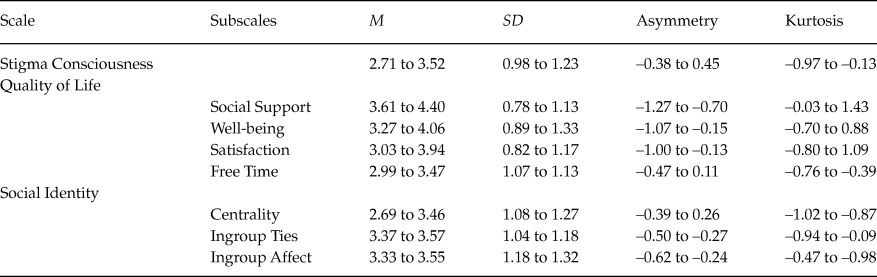
Descriptive. Table 1 shows the ranges of the descriptive and asymmetric and kurtosis indexes of the items of the three scales studied. The summarized information is provided in order to simplify it. For example, for Stigma Consciousness the items have a mean between 2.71 and 3.52, a standard deviation between 0.98 and 1.23, an asymmetry between –0.38 and 0.45, and a kurtosis between –0.97 and 0.13. Since, the method of Maximum Likelihood is used in the different factorial analyses, it is necessary that the variables are distributed normally. Following West, Finch and Curran (Reference Werngren-Elgström, Dehlin and Iwarsson1995)’s criterion, if the asymmetry is not higher than 2 (in absolute value) and the score less than 7 (in absolute value), the variables can be considered suitable for the use of Maximum Likelihood, since this procedure is sensitive to small deviations from normality. As can be seen in Table 1 all the items in our case meet the normality criteria.
Descriptors, Asymmetry and Kurtosis of the Items on the Stigma Consciousness, Quality of Life and Social Identity Scales

Reliability. The Stigma Consciousness scale presented a Cronbach alpha of .662 with the initial composition of 10 items. There were two items with a point-biserial correlation lower than .20, Item 7 (r bp = .088) and Item 10 (r bp = –.004), so it was decided to eliminate them. Once omitted, the reliability of the new scale formed with 8 items, reached an acceptable value: .714.
The Quality of Life test presented the following reliability for the four subscales that comprise it: Social Support .851, Physical/Psychological Well-being .813, General Satisfaction .901 and Free Time .807. In this case, it was not necessary to eliminate any items since the point-biserial correlation were in all cases higher than .20.
The Social Identity test had the following reliability values for each of its three subscales: Ingroup Ties .806, Centrality .680 and Group Affect .734. In the case of Centrality, reliability is low because Item 3 had a point-biserial correlation of .107, and once this item of the subscale was eliminated, reliability rose to .735.
Therefore, the three adapted tests have reliability values above .70, which is the minimum acceptable (Abad, Olea, Ponsoda, & García, Reference Abad, Olea, Ponsoda and García2011), and in some cases very high reliability (> .80).
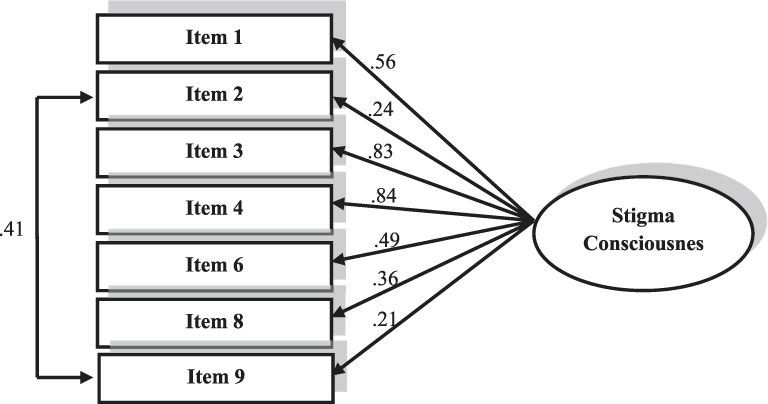
Validity of the internal structure . For the Stigma Consciousness scale, a Factorial Confirmatory Analysis was performed in order to see if the items were grouped into a single factor as was proposed theoretically by Pinel (Reference Pawłowska-Cyprysiak, Konarska and Żołnierczyk-Zreda1999). These techniques require a minimum of 100 participants and 10 times the number of observed variables (Byrne, Reference Byrne2001). In our case the sample had 216 participants and the number of indicators used were 8, so there were 216/8 = 27 participants per indicator. The procedure used to estimate the model was that of Maximun Likelihood. Once the model was estimated, a very low factorial weight was obtained for Item 5 of the scale (.16), so it was decided to eliminate this item from the final model (see Figure 1). Three adjustment indices were considered: absolute indicating the extent to which the theoretical and empirical matrix are equal, incremental which compares the results of the resulting model with null, and parsimonious, one that takes into account the complexity (number of parameters) of the contrasted model, less complex better. Absolute fit indices were adequate: The ratio χ2/df = 1.232 (a good fit with values < 3, Bentler & Bonett, Reference Bentler and Bonett1980); Root Mean Square Error of Approximation (RMSEA) (Steiger, Reference Spencer, Steele and Quinn1990) presents a value of .033, indicating good adjustment with values inferior to .05 and moderate adjustment with values inferior to .08; Goodness of Fit Index (GFI) and Adjusted Goodness of Fit Index (AGFI) proposed by Jöreskog and Sörbom (Reference Jöreskog and Sörbom1993) and Hu and Bentler (Reference Hu and Bentler1999), which were respectively .979 and .956, with values higher than .95 being considered; and the matrix of standardized residues that had none with values greater than |± 2.57|. Incremental adjustment indexes were also adequate: Bentler and Bonett’s Normed Fit Index (NFI) had a value of .955 and Bentler (Reference Bentler1990)’s Comparative Fit Index (CFI) had a value of .979, both higher than .95 which is the criterion to be considered a good fit, which would indicate that the contrasted model is clearly different from the null model. Parsimony adjustment indexes were as follows: Parsimony Goodness of Fit Index (PGFI) by Jöreskog and Sörbom (Reference Jöreskog and Sörbom1993) was .455 and Parsimony Normed Fit Index (PNFI) by James, Mulaik and Brett (Reference James, Mulaik and Brett1982) presented a value of .591, values above .50 indicating a good fit. In this case, one index offers good adjustment and the other only moderate adjustment. In general, we can consider that the model presented in Figure 1 presents a very good fit to the empirical data.
Confirmatory Factorial Analysis for the Stigma Consciousness Scale.

It is worth mentioning the correlation between the errors in Items 2 and 9. This correlation, as can be observed, is very high (.41), which would, in a way, justify its implementation in the model. In addition, in Annex V of Carrasco (2015) you can see that the two items refer to related contents, since they refer to whether people without disabilities value or consider the hearing disability as equals. However, there are certain nuances that advise keeping both items; while Item 2 measures possible prejudice toward the reality of the capacities of people with hearing disability, Item 9 measures the opinion of the equality of capacities between people with hearing disability and people without disabilities. Therefore, a ratio of the errors of these two indicators would be justified.
Since one item, namely Item 5, was eliminated from the contrasted model, the consistency of the test was recalculated with the remaining seven items, obtaining a value of .712.
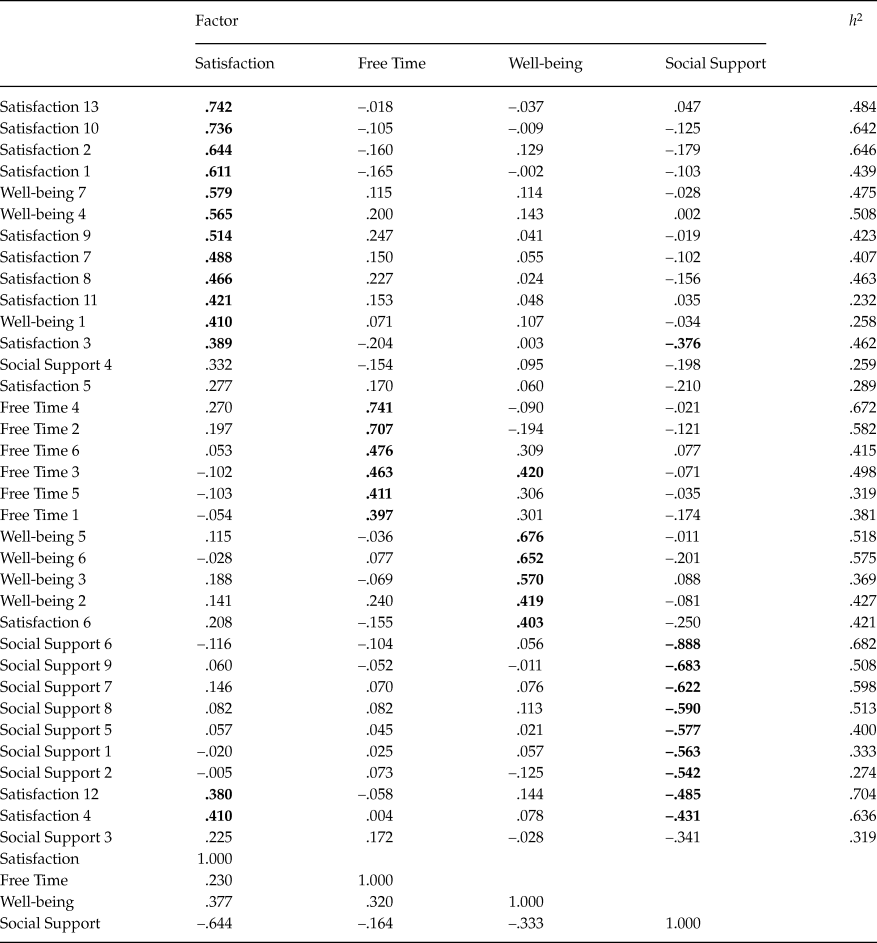
The quality of life scale of Ruiz and Baca (1993) was attempted to fit a confirmatory model of the four factors proposed by the authors, however, the adjustment indices in global terms offered a poor fit: absolute, χ2/df = 2.045, RMSEA = .070, GFI = .775 and AGFI = .741; incremental, NFI = .731 and CFI = .840; and parsimonious, PGFI = .675 and PNFI = .674. Therefore, this model was discarded and an Exploratory Factor Analysis was carried out using a Maximum Likelihood and Oblique Rotation (Oblimin Direct) extraction method in order to see which four factors were extracted from the sample evaluated. The Kaiser-Meyer-Olkin (KMO) presented a value of .912, greater than .80, so it is appropriate to perform this type of analysis for the data, the Bartlett’s sphericity test was statistically significant (χ2595 = 3,928.63, p < .001) so we can reject that the correlation matrix is an identity matrix. The communities after extraction had, in all cases, values greater than .15 (see Table 2), which would reflect that the items present a good variance in common. Four factors that managed to explain 46.09% of the total variance and with the following eigenvalues before rotation were extracted: 11.48 (32.80% of common variance), 2.44 (6.97%), 1.19 (3.39%) and 1.028 (2.94%). After the oblique rotation, the eigenvalues were as follows: 9.38, 3.74, 5.14 and 8.63. The goodness of fit test was statistically significant (χ2461 = 825.88, p < .001), although this was expected given the high number of participants (N = 216), the ratio χ2/df = 1,791 and the RMEA = .061 indicate a good fit of the data to the model of four correlated factors. Table 2 shows the saturations of each factor in the scale items. The first factor would clearly consist of items belonging to the General Satisfaction scale, the second factor exclusively by items of the Free Time scale, the third factor mainly by items of the Physical/Psychological Well-being scale and the fourth factor mainly by items of the scale of Social Support. Therefore, the results of Ruiz and Baca (1993) would be validated. The discrepancies that we have obtained may be due to the fact that these authors used the extraction methods Principal Components and Varimax rotation, whereas in our case we have considered the Maximum Likelihood procedure, more adequate when looking for latent factors, and oblique rotation in order to see if there was a higher order factor. In addition, the correlations between the factors (see Table 2) are medium-high, which would justify the use of an oblique rotation such as the one used here. The factors that correlate most with each other are General Satisfaction with Social Support (–.644) and those with less Free Time with Support Social (–.164), with the remaining correlations between factors having values between .230 and .377.
Factorial Weights in Each Item of the Four Factors Extracted for the Quality of Life Scale in the Configuration and Commonality Matrix (h2) after Extraction. Correlations between the Extracted Factors. (*)

Note: * In bold type, factorial weights higher than 0.4 (rounded to the first integer) appear. The significant factor weights at 5% are > | ± .134 |.
Given the average correlations between the first order factors in the Quality of Life scale, we attempted to perform a second-order Exploratory Factor Analysis on the first order using the Maximum likelihood and oblique rotation procedure. The results were not very satisfactory. The KMO = .652 was less than .80 which discouraged the adequacy of the analysis. In addition, the Free Time factor had a post-extraction commonality of less than .15, in particular .098, indicating that it did not possess sufficient variance common to all other factors. And the index of goodness of fit were also not satisfactory: the goodness of fit test was statistically significant (χ22 = 21.125, p < .001), χ2/df = 10.563 and RMEA = .210.
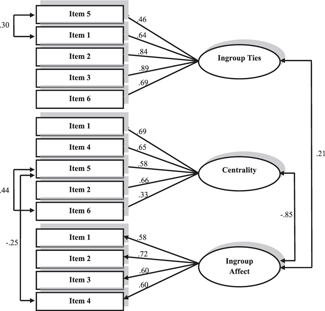
For the Social Identity Scale, a Factorial Confirmatory Analysis was performed to see if the three factors theoretically raised by Cameron (2004) were obtained. The procedure used to estimate the model was that of Maximum Likelihood. In this case the number of indicators used was 14, so there were 216/14 = 15 participants per indicator, adequate values to use this technique (Byrne, 2001). Once the model was estimated, a very low factorial weight was obtained for Item 4 of the Ingroup Ties subscale (.27). Therefore, it was decided to eliminate this item from the final model (see Figure 2). In addition, the correlation between the factor Ingroup Ties and Centrality was very low (r = –.04, p = .717), so this correlation was eliminated. The adjustment indices obtained for the final model were as follows: absolute, ratio χ2/df = 1.942, RMSEA = .066, GFI = .911, AGFI = .870 and the standardized residuals matrix does not present any value greater than |± 2.57|; incremental, NFI = .878 and CFI = .936; and parsimony, PGFI = .625 and PNFI = .694. In global terms, taking into account all adjustment indices, the model can be said to fit moderately well to the data. In the model, while the correlation between Ingroup Ties and Ingroup Affect is low and positive (.21) between Centrality and Ingroup Affect is high and negative (–.85).
Confirmatory Factorial Analysis for the Social Identity Scale.

As can be seen in Figure 2, some item errors have been correlated. In the case of the Ingroup Ties factor, the errors of Items 1 and 5 (r = .30) were related, justified by the fact that both asked about the integration of the subject with the world of people with disabilities. In Centrality, Items 5 and 6 (r = .44) have been related and a relation has been established between Item 5 of Centrality and 4 of Ingroup Affection (r = –.25) since in the other items reference is made to the internalization of being a disabled person and what it implies.
Since in the test of Ingroup Ties, Item 4 was eliminated when the model was estimated, the Cronbach’s alpha was recalculated, obtaining in this case a fairly high value of internal consistency: .835.
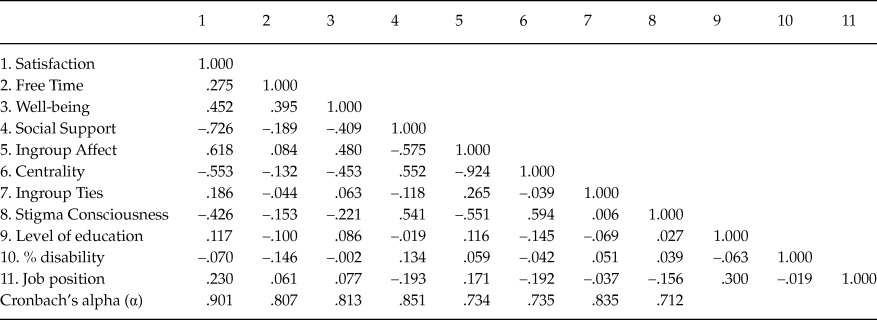
Discriminant, convergent and criterion validity. Table 3 shows the correlations between the three adapted scales, to study the convergent and discriminant validity, and with three external behaviors (work position, level of education achieved and percentage of disability of the evaluated ones) to analyze the validity reference to the criterion. The level of education considered ranged from basic studies to university and the job was graduated from lower to higher qualification as physical worker, administrative, technical, coordinator and manager.
Pearson’s Correlations between the Three Validated Scales and Percentage of Disability, Level of Education and Job Position. Reliability of the Scales. (*)

Note: * The significant factor weights at 5% are > |± .171|.
Regarding the convergent validity, General Satisfaction, Physical/Psychological Well-being, Social Support, Ingroup Affect, Centrality and Stigma Consciousness present average correlations, which would reflect that they are measurements which measure related constructs. The highest correlation is between Satisfaction and Social Support (–.726). In relation to discriminant validity, the least correlated subscale is the Ingroup Ties, the highest correlation is with Ingroup Affect (.256), but with the other measures, are less than .186. Similarly, Free Time is only moderately related to Physical/Psychological Well-Being (.395) and low with Satisfaction (.275).
The criterion validity indicates that the level of education and the percentage of disability present a very low relation to the different subscales of the three tests, and the best qualification in the best position is the Satisfaction of people with disability (r = .230), less Social Support usually have (r = –.193) and lower Centrality (r = –.192).
Discussion and conclusions
In this paper, three scales for the hearing disability have been adapted and validated: Pinel (Reference Pawłowska-Cyprysiak, Konarska and Żołnierczyk-Zreda1999)’s Stigma Consciousness, Quality of Life by Ruiz and Baca (1993) and Cameron (2004)’s Social Identity. The tests were adapted by people with hearing disabilities and communication specialists for the deaf, trained about the theory of constructs that mediate the scales, and then disability experts supervised those versions of people with disability. In this way we can ensure the content validity of the three tests. The reliability of the different subscales of the three tests are all adequate, with values greater than .70.
In the Stigma Consciousness test, it was possible to obtain a single general factor that collects the common variance of the different items composing the test, a result that coincides with previous studies that have validated the same scale in people who are not disabled but belong to other stigmatized groups: women, gay men and lesbians, and people with HIV/AIDS (Bunn et al., Reference Bunn, Solomon, Miller and Forehand2007; Pinel, Reference Pawłowska-Cyprysiak, Konarska and Żołnierczyk-Zreda1999). The adjustment of the one-factor model to the data was very good, although in our case there were three items that had to be eliminated from the scale due to low reliability (Items 7 and 10) and low factorial weight (Item 5) with the general factor.
In the case of Quality of Life, four factors have been obtained similar to those previously obtained by the authors of the scale (Ruiz & Baca, Reference Pinel and Paulin1993) and Boixadós et al. (Reference Boixadós, Pousada, Bueno and Valiente2009): General Satisfaction, Free Time, Physical/Psychological Well-being and Social Support. The model of four related factors presented an adequate adjustment to the data but it was not possible to extract a second order factor that will represent the Quality of Life. In the composition of the items that formed each of the subscales of the test, there were differences compared to previous studies (Boixadós et al., 2009; Ruiz & Baca, 1993), a possible cause of this result may be the use of the Maximum Likeness method to extract the factors, versus that of Principal Components used by the previous studies. In addition, we used an oblique type rotation, more appropriate when looking for higher order factors, whereas the previous studies used orthogonal rotation. As recommended by Hair, Black, Babin, Anderson and Tatham (Reference Hair, Black, Babin, Anderson and Tatham2006), the Maximum Likelihood procedure is more adequate when trying to find latent factors of a set of variables and in the case of psychological measures it is better to use an oblique rotation to explore possible relationships between factors. Therefore, although our results coincide with those of Ruiz and Baca (1993), they are more adequate from a methodological point of view. Another point of discrepancy with Ruiz and Baca (1993) is that these authors find positive correlations between all factors while we find negative correlations among some. This result may be due to the characteristics of the sample evaluated (hearing loss) which could be related to factors other than the non-disabled. It seems that the hearing loss with less Social Support would present more General Satisfaction, Free Time and Physical/Mental Well-being, given the negative correlations between Social Support and these factors. The other factors present positive relationships with each other: General Satisfaction, Free Time and Well-being. There could be two factors given for the results. In the first place, and previously mentioned, the fact of working with the hearing loss in a first validation of the questionnaires with people with general disability, the results were the expected ones. The second and possibly most important factor is the fact that society’s social support is being measured when there is a very strong "culture of people with hearing impairment" and is encouraged by the associations. This culture makes people with disabilities perceive social support as a form of "charity" when their true support is in partnerships.
The internal structure of the Social Identity test reflected the presence of three factors corresponding to the three subscales proposed by Cameron (2004): Centrality, Ingroup Affect and Ingroup Ties. The contrasted confirmatory model adequately matches the data confirming the structure of previous research with this scale (Cameron, 2004; Obst & White, 2005). Intra-group affection and Ingroup ties (.21) and Ingroup Affect and Centrality and Ingroup Affect (–.85), unlike previous studies where all three factors had a medium-high and always positive correlation. It could be that the sample of people with disability presents a particular pattern of relationship between these factors that would indicate that the degree to which a person feels that he/she belongs and is linked to a group (Ingroup Ties) is not relevant to the importance that the person gives to belonging to the group (Centrality) and little relevance to group feelings (Ingroup Affect). It also seems that in this group, the greater importance of the person to the membership of the disabled group has less positive feelings towards the same, given the negative relationship between Centrality and Ingroup Affect. Another difference from the original scale of Cameron (2004) is that in our study we had to eliminate two items of the test, one for low reliability (Item 3) and another for having a low factorial weight with the factor of Ingroup Ties (Item 4). These results seem to show a duality of thought, on one hand the support of associations is valued, and on the other, the individuality itself, which is logically achievable. The relationship of the three scales adapted to each other indicates that there are two subscales which have little in common with the rest: Ingroup Ties and Free Time, would be an indicator of discriminant validity, and the other measures would present medium-high relations as indicators of convergent validity. These results indicate that the extent to which a person feels that he or she belongs to a group (Ingroup Ties) seem to be positively related to the positive feelings of belonging to the group (Ingroup Affect); and that Free Time only seems to be relevant to Physical and Psychological Well-being and Satisfaction, in such a way that the greater the Free Time, the greater the Well-being and Satisfaction of people with disability would be. People with high scores in General Satisfaction would be those with more Free Time, greater Well-being, little Social Support, more Ingroup Affect, little Centrality and little Stigma Consciousness. People with high Well-being would have high Satisfaction, little Social Support, much Free Time, high Ingroup Affect and little Centrality. People with disability with high Social Support would have little Satisfaction, with little Well-being, little Ingroup Affect, high Centrality and high Stigma Consciousness. Those people with high Ingroup Affect would be satisfied, would have a sense of Well-being and group ties, but little Stigma Consciousness and would give little importance to the group membership (Centrality). People with disability with high Centrality would be dissatisfied, with little Well-being, much Social Support, little Ingroup Affect and high Stigma Awareness. And people with high Stigma Consciousness would have little Satisfaction, Well-being and Ingroup Affect, but high Social Support and Centrality.
Of the different criteria considered, only the work place occupied by people with disability seems to be relevant. Those with more qualified (managerial) jobs compared to those with lower qualifications (laborers) tend to have less Social Support and Centrality (they value belonging to the disabled group more), but are more satisfied, high-level posts generally require significant academic background having been achieved through competition with people without disabilities, so that self-assessment and self-concept of the subject is superior minimizing their perception of people with disability and their need for outside help.
This research shows how relevant it is to adapt tests designed for the non-disabled to people with disability. This fact makes it more relevant to this group and is more valued by society. This fact allows us to normalize situations that have traditionally been seen as discriminatory, but also allows us to really know the situation of people and groups usually forgotten so that society can implement individual and/or group measures that seek satisfaction and quality of life of persons with disabilities as indicated by the UN in its work.
Future research should analyze the relationship between different measures adapted to other possible criteria such as: health, happiness, psychological disorders, academic and work performance... One limitation of the present study was to focus solely on people with hearing disability, and it would be interesting to adapt these measures to others types of disabilities in order to see possible differences. Other additional limitations are: The study has focused exclusively on adults without including older people or adolescents, it has not been possible to study whether the results would be the same in people who mainly use sign language as opposed to those who do not use it, and neither it has been analyzed if there would be differences depending on the educational level.
As a general conclusion, we can indicate that we have been able to adapt to a group, people with hearing disability, three measures designed for non-disabled, offering adequate reliability and validity indexes.