One of the most pressing challenges for global governance concerns the regulation of multinational corporations (MNCs) and the problems that they create: pollution, human rights abuses, corruption, and a range of other ESG (environmental, social, and governance) issues.Footnote 1 National governments can typically regulate business activity only within their borders, and attempts by multiple governments to coordinate regulatory policy are complicated by incentives to defect. Individual states may benefit from unilaterally lowering their environmental standards, for example, in order to attract investment. Much of the international regulation of business that does exist is self-imposed;Footnote 2 MNCs set voluntary standards for themselves to appeal to discerning consumersFootnote 3 among other reasons. Critics argue that such private regulation may preempt public regulation,Footnote 4 and that the former is not a good substitute for the latter.Footnote 5
Public-private governance initiatives—collaborative efforts in which private actors opt into additional self-regulatory measures while receiving support and guidance from public bodies such as international organizations or national regulatory agencies—have arisen as a new organizational form for the governance of global business. Advocates suggest that the public-private approach may allow public actors to harness and guide the self-regulatory efforts of private actors, while building stronger norms of good corporate behavior.Footnote 6 While growth in traditional intergovernmental organizations (IGOs) has slowed,Footnote 7 more than 400 public-private governance initiatives have been created in the past twenty years.Footnote 8
However, public-private initiatives and IGOs face similar challenges. First, firm participation is voluntary, limiting the depth of any given initiative to what its members will agree to.Footnote 9 Second, given MNCs’ often complex operational structures, public actors have little ability to monitor compliance with the tenets of the initiative and thus little ability to detect or punish noncompliance. Given these challenges, can public-private governance initiatives actually help MNCs self-regulate? If so, what is the channel through which initiative membership affects firm behavior? And how can it be measured?
In this paper, I take two steps toward answering these questions. First, I argue that extant measures of firms’ ESG performance can be classified as either low-cost unilateral actions (such as adopting a corporate human rights policy) or high-cost supply-chain-level outcomes (such as improving labor conditions at developing country supplier factories). Evidence of association between initiative membership and low-cost actions is poor evidence that initiatives help firms make meaningful changes, while the lack of a short-term association between initiative membership and supply-chain-level outcomes is poor evidence that initiative membership has no effect. There is a need for a measure in between the two extremes. To fill this gap, I introduce public response to stakeholder concerns as a new ESG performance metric for firms.Footnote 10 When firms face public allegations of wrongdoing brought by nongovernmental organizations (NGOs), labor unions, or other civil society groups, they have the option of responding transparently (e.g., publicly). While more socially responsible, this option is risky for firms because it could increase the salience of the allegations and result in a hit to the firms' reputations. Public response to stakeholder concerns is a good mid-level measure of ESG performance because it legitimates the existence of a direct (e.g., not mediated by state institutions) channel of engagement between firms and stakeholders, it is costly (unlike the unilateral actions), and firms’ management have centralized control over its implementation (unlike the supply-chain-level outcomes).
Second, I argue that membership in public-private governance initiatives should make firms more likely to respond publicly to stakeholder complaints. The mechanism is legitimacy by affiliation: an initiative's public partner is typically perceived as holding legitimate authority over the governance of ESG-related issues such as corruption or pollution. By partnering with private actors via public-private governance initiatives, these public actors are deputizing member firms as legitimate participants in global governance. For firms, the ability to draw on the legitimacy gained by association with a public partner decreases the reputational cost of publicly responding to stakeholder concerns. This is because the firm can cite its initiative membership as evidence of its type. It can more credibly claim (implicitly or explicitly) that the alleged transgression was only a temporary deviation from an otherwise socially responsible course, rather than being indicative of a larger trend of bad behavior.
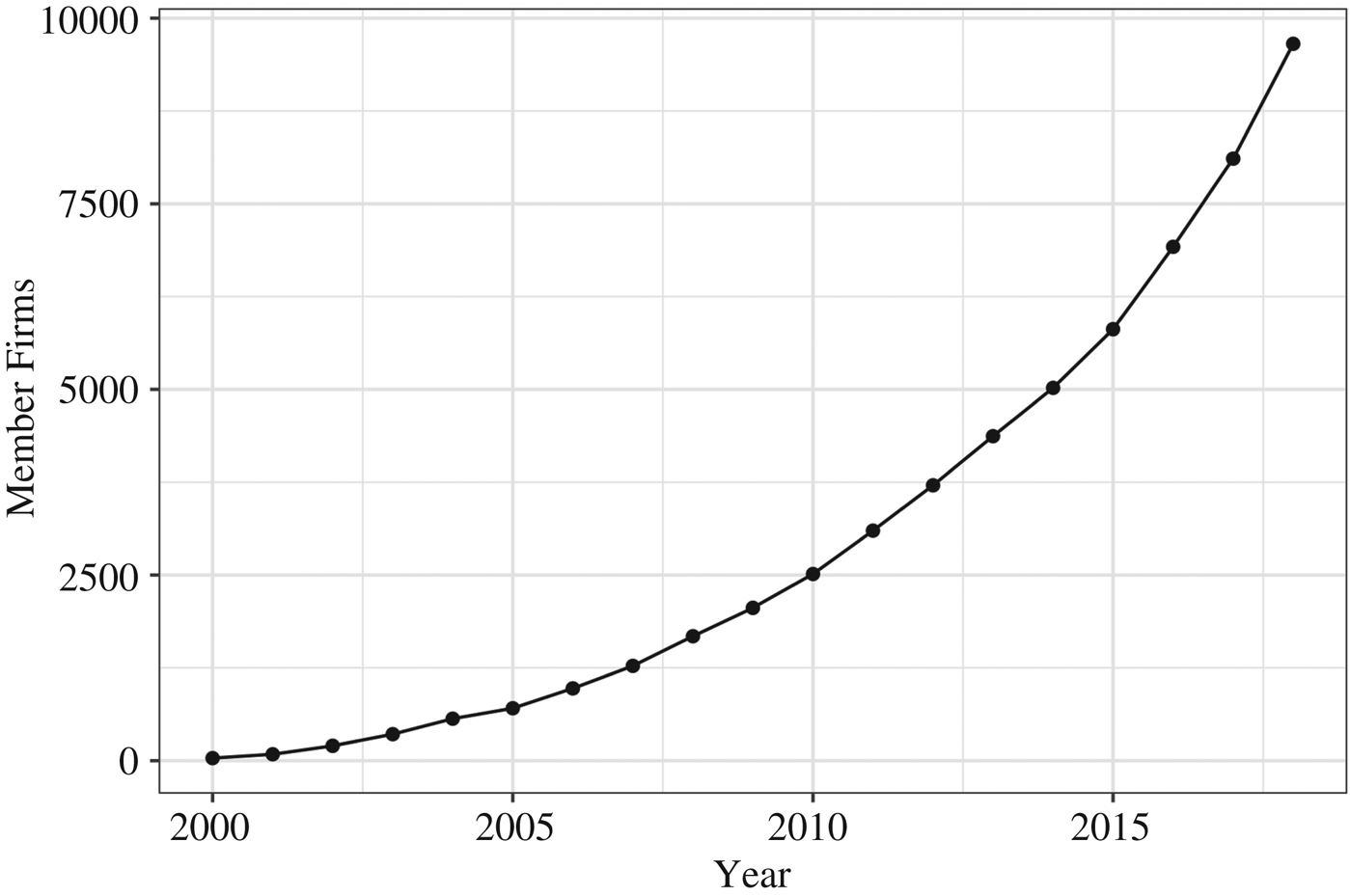
Empirically, I leverage the rapid rise to prominence of the leading public-private governance initiative—the United Nations Global Compact (UNGC)—from its creation in 1999 to the present day. The UNGC, a UN initiative created with the goal of helping member firms improve ESG practices throughout their entire supply chains (suppliers, contractors, affiliates, etc.), grew from 400 member firms in 2002 to over 10,000 at the time of writing (April 2020).Footnote 11 For comparison, the second largest initiative (the Roundtable for Sustainable Palm Oil) has approximately 2,000 members.Footnote 12 Despite its broad scope and large membership, the UNGC lacks monitoring-and-enforcement power over its member firms, creating an environment in which noncompliance is nearly costless. This is a favorable setting to test my theory in: if firms become more likely to respond publicly after joining the UNGC, even though the UNGC lacks any coercive leverage over its members, we can be more confident that the legitimacy mechanism was at play.
I use novel data on stakeholder concerns and firm responses from the Business and Human Rights Resource Center (BHRRC) to test the relationship between public-private initiative membership and public response behavior at the firm level. The BHRRC is an NGO that serves as a sort of indirect grievance mechanism for ESG claims against firms. The center searches for unresolved allegations, and then reaches out to the offending firm and requests a formal, public response. Restricting my focus to the world's largest multinational firms, I find that UNGC member firms are significantly more likely to respond to claims made against them than nonmembers are. This finding is substantively meaningful: even after controlling for a range of factors, the most conservative estimate is that UNGC members are 14.6 percentage points [5.2, 24.0] more likely to respond publicly than nonmembers are.
In addition to using different model specifications and estimation strategies, I take pains to address the potential issues of selection into UNGC membership and sample selection (e.g., some firms may be more likely to receive complaints than others). To address selection into the UNGC, I instrument UNGC membership using past rates of UNGC membership in firms’ home states and industries.Footnote 13 To address issues of sample selection, I make use of the existence of stakeholder allegations that list multiple complicit firms. I limit the sample to claims that name at least four complicit firms and replicate the main analysis using claim-level fixed effects rather than firm-level fixed effects, showing that—holding constant the substance of the allegations, as well as the stakeholder—UNGC member firms are still significantly more likely to respond publicly. Further, qualitative analysis of the text of firms’ responses provides support for the legitimacy mechanism. UNGC member firms commonly cite their UN association in their responses, even when it is not germane to the allegations themselves.
This paper speaks to two different branches of the IR literature on global governance. First, it contributes to the growing literature on the relationship between IGOs and private actors.Footnote 14 The UN's partnership with private firms to achieve the shared goal of reducing the negative externalities of global business illustrates the power of the orchestrator-intermediary theory of indirect governance.Footnote 15 The efficacy of the UNGC stems not from the UN's ability to control member firms, but instead from its ability to empower firms to act as legitimate intermediaries of the UN.
Second, I attempt to advance the debate over whether or not voluntary public-private initiatives are effective tools for incorporating global firms into global governance.Footnote 16 I first make the argument that, in order to evaluate the short-run effects of public-private initiatives on firm behavior, we must ask what good evidence of efficacy would look like. This involves tempering expectations. Initiatives such as the UNGC do not give multinational firms the tools that are necessary to immediately begin solving all of the ESG problems in their supply chains, and all evidence suggests that there is no replacement for strong domestic regulation.Footnote 17 However, I find that public-private initiative membership does empower firms to engage directly and openly with stakeholder complaints. By lowering the reputational cost of direct communication with stakeholders—in the absense of state coercion—public-private governance initiatives can motivate firms to play a role in addressing the negative externalities that they create. My results suggest that, while far from sufficiently enabling firms to self-regulate, public-private governance initiatives incentivize private actors to take an important step toward participation in global governance: communicating directly and publicly with global stakeholder groups.
The UN Global Compact: Background
The UNGC, commissioned by former UN Secretary-General Kofi Annan and engineered by political scientist John Ruggie, was designed to increase the efficacy of firms’ self-regulation on ESG issues by way of helping them align their efforts with the UN's broader ESG framework, the sustainable development goals (SDGs). Announced at the 1999 World Economic Forum in Davos and formally operational the following summer, the initiative's membership has grown from a small quorum of elite, mostly western multinationals (including Unilever, Volvo, and Nike) to a global group of over 10,000 firms of all sizes.
The UNGC's membership requirements are modest. Prospective members must first submit a brief application, including a letter of interest signed by the chief executive. Once approved, there are two requirements to maintain membership. First, members must pay a small annual fee scaled to their annual revenue (maxing out at USD 20,000 for firms with annual revenue greater than USD 5 billion). Second, each member must submit an annual communication on progress (COP)—COPs are long, detailed reports on firms’ progress toward meeting a variety of self-imposed ESG targets. All members must discuss how their efforts advance the UN's sustainable development goals, and additional reporting requirements (such as third-party audit reports) are imposed on firms in higher membership tiers (which tend to be larger multinationals). UNGC members gain access to the UN's library of documents on ESG best practices. They also have the option to join and attend local UNGC working groups, allowing them to network with other members and host workshops and seminars on ESG issues.
The UN does not set ESG performance targets for Global Compact members, and it has no capacity to verify any of the information included in firms’ COPs. The primary membership requirement is regular self-reporting on ESG topics including climate change, anticorruption, and the advancement of women's rights, among others. Likewise, membership carries few material benefits for firms other than networking opportunities and advice on ESG regulation and reporting. Thus, the UNGC is a decidedly broad but shallow initiative: it targets a wide range of issue areas, but requires relatively little of its member firms. This shallowness has drawn criticism from academics and NGOs who view the Global Compact as little more than an opportunity for firms to pay lip service to good governance without engaging in substantive reform.Footnote 18
UNGC membership has grown exponentially since its founding

Three aspects of the UNGC make it an ideal case for studying the efficacy of public-private governance initiatives. First, its shallowness—low barriers to membership, no strict regulatory targets, no independent monitoring capacity—is characteristic of public-private initiatives more broadly.Footnote 19 Any mechanisms through which the UNGC enables stronger self-regulation among its members, then, should also be applicable to other initiatives with similar structures. Second, the UNGC is a broad initiative both in membership and in scope. Unlike more specialized initiatives (such as the Global Methane Initiative or the Better Cotton Initiative), the UNGC covers a range of ESG issues so broad that any firm—regardless of industry, size, or geographic location—could plausibly become a member.Footnote 20 This allows me to test the relationship between initiative membership and self-regulation for a wide range of firm types. Finally, the UN is a highly visible and legitimate actor in global governance.Footnote 21 This provides a strong falsification opportunity for my theory: if I find no evidence of the legitimacy mechanism here, despite the fact that the UNGC offers firms a high-legitimacy public partner, we can be confident that the theory would not apply to less legitimate initiatives either.
Public-Private Initiatives: Design, Efficacy, and Measurement
For global firms, joining public-private governance initiatives is an increasingly common response to the demand for private actors to tackle ESG issues. Firms may choose to join such initiatives instead of going it alone for several reasons: initiatives can provide information on what types of self-regulation are seen as appropriate,Footnote 22 firms may receive financial returns from initiative-related labeling on their products,Footnote 23 or they may hope that voluntary self-regulation preempts future public regulation.Footnote 24 While firms might join voluntary regulatory initiatives for myriad reasons, a pressing question for global governance is whether or not these initiatives have been successful in inducing firms to improve their ESG performance. Extant answers to this question vary along two metrics: (1) how the initiative is designed, and (2) how ESG performance is operationalized.
A key insight from rationalist IR scholarship is that states tailor the design of international organizations to suit the organization's intended purpose.Footnote 25 A similar logic applies to public-private governance initiatives, which are designed around their chosen ESG problem area(s). Some initiatives target facility-specific issues such as the environmental safeguards at individual factories. These initiatives can more easily implement monitoring-and-enforcement procedures such as annual auditing, and can thus set firm regulatory requirements for member firms. Firms who join these audit-based initiatives have incentive to meet the regulatory targets because noncompliance will be discovered and punished. The International Organization for Standardization (ISO)'s 14001 standard for environmental protection, which requires a facility audit for initial certification and annual audits for recertification, provides an example. Matthew Potoski and Aseem Prakash find that certified firms are more likely to be in compliance with domestic environmental regulations.Footnote 26 In later work, the same authors find that higher rates of ISO 14001 membership at the national level lead to reduced levels of air pollution in countries with weak regulatory environments.Footnote 27
However, audit-based initiatives like the ISO 14001 are the exception rather than the rule. Only 13 percent of public-private governance initiatives have institutionalized monitoring capacity, and only 8 percent have enforcement capacity.Footnote 28 More commonly, public-private initiatives are designed to tackle transnational issues for which audit-style monitoring is either financially infeasible or literally impossible. For example, the UNGC asks member firms to report on ESG self-regulation throughout their entire corporate structures, including supplier networks. Given that some members have tens of thousands of supplier facilities,Footnote 29 it is clearly not plausible for the UN to independently verify firms’ self-reports. Instead, initiatives with transnational issue areas typically attempt to maximize business and stakeholder buy-in to foster norm creation. As Anke Hassel put it, “Multi-stakeholder processes, such as the Global Compact and the Global Reporting Initiative, aim to identify what level of obligation can be demanded from firms without deterring participation.”Footnote 30
Since these initiatives do not impose strict regulatory targets on their members and do not independently verify firms’ progress toward meeting their self-imposed targets, how can we know whether a given initiative had an impact on member firms’ self-regulation? On this question, extant literature can be roughly grouped into two camps based on operationalization of ESG performance. The first camp examines the relationship between initiative membership and unilateral ESG actions at the firm level, generally finding a positive relationship. For example, UNGC member firms have been shown to draft official human rights policiesFootnote 31 and file sustainability reportsFootnote 32 at higher rates than nonmembers.
The second camp examines the relationship between initiative membership and ESG outcomes, finding little evidence of initiative efficacy. Using a survey of workers in supplier factories, Stephanie Barrientos and Sally Smith find that factories supplying firms who are members in the Ethical Trading Initiative (a public-private initiative that governs labor conditions in supply chains) do not have stronger labor rights protections than those who do not.Footnote 33 Using expert ratings of ESG performance, Daniel Berliner and Aseem Prakash find that UNGC membership leads firms to improve only in issue areas in which they were already strong, and to decline in areas in which they were already weak. They suggest that firms join the UNGC in order to “bluewash” or benefit from the UN affiliation while failing to take steps to improve their ESG performance.Footnote 34
While both camps have furthered our understanding of public-private governance, they explore only a limited range of the potential ESG metrics with which initiative efficacy could be evaluated. It is relatively unsurprising that initiative member firms are more likely to take unilateral actions such as drafting ESG policies or filing reports because these actions are low cost and in some cases even required for initiative membership. ESG reporting is thus a most-likely case for the efficacy of public-private governance initiatives. Likewise, it is equally unsurprising that initiative membership has no effect on supply-chain-level ESG outcomes. Numerous studies highlight the difficulties inherent in regulating supplier networks, even for the most committed firms. For example, facility auditors are prone to corruption,Footnote 35 and report fewer violations when they are inexperienced or commissioned by the owner of the facility being audited.Footnote 36 Evidence also suggests that the strength of domestic public regulations is a key predictor of facility-level compliance, even when private regulation is accounted for.Footnote 37 Public-private governance initiatives simply do not offer firms resources that could be used to overcome these difficulties in the short run.
I propose a new ESG performance metric that allows for a mid-level test of the efficacy of public-private governance initiatives: public corporate response to stakeholder concerns. This measure is an improvement on prior operationalizations because it is completely within firms’ control (unlike supply-chain-level ESG outcomes) but it involves multiple actors and is potentially costly for firms (unlike unilateral ESG actions). I also propose a theory of how public-private governance initiatives might affect firms’ response behavior, despite lacking monitoring or enforcement power, through the mechanism of legitimation.
Public Response, Legitimacy, and Public-Private Governance
I contend that public corporate response to stakeholder allegations is an important ESG metric, and that responding to such allegations is not costless. I also argue that public-private governance initiative membership can increase firms’ propensity to respond publicly through the mechanism of conferred legitimacy.
Public Response Behavior As ESG Performance Metric
As employed here, public response behavior can be defined as the extent to which firms issue formal, public responses to nonsalient allegations levied against them by nonstate actors. This definition captures three features that are critical for a response to be considered socially responsible. First, the situation must be one in which the firm has the option to keep the alleged violation obscure via nonresponse. This means that responses to major scandals for which the firm is directly implicated (BP and the Deepwater Horizon oil spill of 2010, for example)Footnote 38 are not incidents of public response since firms lack the option to keep such incidents quiet by ignoring them or responding privately. Second, the actor making the claim against the firm must lack the legal power to coerce the firm into responding to their allegations. Responses to allegations made by sovereign states cannot be considered examples of public response. Finally, responses must be public. Private responses are less costly for firms because they do not raise public awareness of the issue, and thus are far more likely to be cheap talk than public responses.
I offer three justifications for public response to stakeholder allegations as a meaningful measure of ESG performance. First, public responses to alleged violations have a platforming effect: by virtue of publicly acknowledging a claim, firms are necessarily communicating the content of the alleged violation to a wider audience than the claimant would otherwise be able to reach. Many of the claims in the BHRRC data are made by workers, labor unions, or small NGOs in developing countries, and these actors typically lack the ability to make their voices heard globally in the way that large multinationals can. By responding publicly (therefore, transparently) to these actors’ allegations, even if they deny accountability for the alleged violation, firms make these claims more salient than they were before.
This platforming effect is not costless for firms—increasing a claim's salience increases the risk of public backlash against the firm, which in turn can result in reputational and even financial damage. For example, in 2013 the BHRRC requested a response from Korean trading conglomerate Posco Daewoo International to a claim made by Cotton Campaign (a new, small NGO) regarding the company's alleged use of Uzbek cotton harvested using forced labor. On 6 June the BHRRC posted Daewoo's response, in which the company acknowledged their use of Uzbek cotton and described their efforts to fight forced labor.Footnote 39 By 21 June, Daewoo's stock had fallen to its lowest value in several months. The company's response prompted headlines such as “Posco Unit Admits Using Cotton From Forced and Child Labor” in the Wall Street Journal.Footnote 40 Even though Daewoo used their response to take accountability and detail their efforts to combat forced labor in Uzbekistan, the increased salience of the issue led to public backlash.
Second, firms that publicly respond to nonsalient allegations should be more likely to go on to resolve the issue than firms that do not. One of the mechanisms driving this connection is audience costs.Footnote 41 By publicly announcing their plans for resolving the claim, as Daewoo International did, firms raise the cost of failing to implement them. Shareholders, customers, and NGOs can punish firms for failing to keep their promises once the promised actions are public knowledge. Even when firms do not admit fault or promise actions in their responses, the claim's increased salience inevitably increases the pressure being put on the firm to remedy the issue in some way. For example, in 2005 the BHRRC requested a response from Tiffany, a large commercial jeweler, regarding its exploitation of a loophole in US law that allowed it to import “blood diamonds” from Burma. Tiffany responded, claiming that it would continue to import Burmese diamonds given that it was not illegal to do so. Tiffany's response caught the attention of a wide range of NGOs, who in turn pressured the firm to discontinue sourcing from the country. Two days after the response was posted, Tiffany announced that they would no longer import Burmese diamonds.Footnote 42
Third, independently of the platforming and remediation effects, public responses to stakeholder concerns constitute good ESG performance because they reinforce the emerging norm that multinational firms should be participants in global governance.Footnote 43 When faced with allegations from stakeholder groups, firms would be well within their legal rights to ignore them and leave the resolution of the issues to the relevant domestic agencies (judiciaries, environmental agencies, etc.). However, by engaging with the stakeholders in front of a global audience via public response, firms implicitly accept their role as legitimate recipients of their stakeholders’ complaints. Even if some responses are used to deny the allegations, or to apologize without offering remediation, firms who engage in public dialogue with their stakeholders legitimate the existence of a “direct channel” between firms and the groups who are affected by their actions. This is a necessary (though not a sufficient) step toward self-regulation: if firms do not accept their responsibility to address stakeholder concerns in the absense of state coercion, they cannot possibly engage in the necessarily supranational exercise of global governance.
In sum, responding publicly to stakeholder allegations is a meaningful form of ESG performance. In addition to promoting transparency and giving a platform to often marginalized claimants, issuing a public response to allegations is often the first step toward the resolution of the grievance at hand. Perhaps most importantly, public response signals a firm's willingness to engage directly with its stakeholders in the absence of state/legal coercion. That said, public response is not costless. Firms such as Daewoo face backlash when their responses publicize their transgressions, damaging their reputations and possibly their bottom lines. However, firms are not limited in their capacity to issue responses like they are limited in their capacity to prevent violations throughout their supply chains. Thus, public response behavior is a useful outcome measure for determining the efficacy of public-private governance initiatives such as the UNGC. It is socially responsible, potentially costly, and firms who wish to change their response behavior can do so relatively quickly.
Legitimacy and Public Response
I argue that UNGC membership should make firms more likely to respond publicly to stakeholder allegations by increasing the extent to which the firms’ operations are perceived as legitimate, and thus reducing the reputational costs to firms of issuing a response. I follow Ian Hurd in defining legitimacy as “the normative belief by an actor that a rule or institution ought to be obeyed,” and agree that legitimacy “is a subjective quality, relational between actor and institution, and defined by the actor's perception of the institution.”Footnote 44 Legitimacy underscores the sovereignty of domestic governments, but is not completely absent from international politics either.Footnote 45 The concept has been of particular interest to scholars of international order, who argue that international norms and institutions are abided by when they are seen as legitimateFootnote 46 and when compliance can confer legitimacy upon the complying states.Footnote 47
International organizations (IOs) are both recipients and distributors of legitimacy in international politics. IOs are created by their member states,Footnote 48 and the extent to which they are perceived as legitimate is contingent not only on the content of their mandate but on the composition of their membership. Once created, however, IOs also serve a legitimation function. The United Nations in particular has long been recognized as a key source of legitimation.Footnote 49 The organization classifies international uses of force as legitimate or illegimate, delineates the acceptable realm of state action, and provides the normative underpinning for the postwar international order.Footnote 50 The UN's approval of an action signals to a global audience that the action was just, or at least that it was not in violation of the norms that constitute legitimate state behavior.
I contend that the Global Compact, as a UN initiative, shares the legitimation function of its parent institution. For firms, membership in the initiative sends a signal to stakeholders that the UN approves of the firms’ operations (or at least of their plans for improvement). Even though the actual provisions of the Global Compact are unlikely to be salient among certain civil society groups, the UN name is the key factor. With UN approval comes the implication that the firm is a legitimate actor under the current international order, which the UN plays a key role in upholding.
Why would the UN—or any public actor—legitimate private actors in this way? Orchestrator-intermediary theory provides an answer.Footnote 51 Abbott and coauthors introduce orchestration as a method of governance via intermediary, in which an orchestrator (in this case the UN) enlists intermediaries (firms) to work toward a shared governance goal that neither party would be able to accomplish on their own (reducing the negative externalities of business).Footnote 52 The orchestrator has no direct control over the intermediaries, but instead seeks to simultaneously shape their actions via offering guidance and problem definition (such as the UN's sustainable development goals) and empower them to take the necessary actions by deputizing them as the orchestrator's legitimate surrogates. The UNGC's designers were well aware of the benefits of legitimation. Speaking about a similar private initiative, chief architect John Ruggie wrote that “the Global Sullivan Principles for corporate social responsibility, a partnership of American firms and some NGOs, lacks the social legitimacy of the UN. As a result, the effort has picked up little support beyond the United States.”Footnote 53
This legitimation function is likely to be particularly important for firms when they are deciding whether to respond to a stakeholder concern. This is a fraught decision. If firms ignore nonsalient stakeholder concerns, they may boil over into widely publicized crises that negatively affect firm value.Footnote 54 However, by responding publicly, firms guarantee that the allegations will become more salient and thus open themselves up to potential backlash.Footnote 55 The risk is that civil society groups will identify the alleged transgressions as indicators that the firm is operating in bad faith, and that the firm will lose its social contract to operate.Footnote 56 UNGC member firms, however, can draw on the UN's legitimacy to frame their actions as minor deviations from a socially responsible course rather than being indicative of their type. For example, mining firm GCM Resources wrote in one of their public responses that “GCM continues to embrace, support and enact, within its sphere of influence, these UNGC principles—all of which are consistent with the core values of GCM.”Footnote 57
The ability to leverage the legitimacy of the UN name lowers the cost to firms of issuing public responses because it allows them to soften the reputational impact of increasing the allegations’ salience. Thus, the primary observable implication is as follows:
H1 Firms who are member to the UN Global Compact should be more likely to respond publicly to stakeholder concerns than nonmembers.
Alternative Mechanisms
UNGC membership should make firms more likely to respond publicly by lowering the reputational cost of doing so. However, there are other potential mechanisms through which UNGC membership could affect response behavior. First, it could be the case that firms who join the UNGC engage in true social learning. Through repeated interactions with their fellow members at working groups and summits, firms could be socialized into becoming better ESG performers. The social learning mechanism may very well be at play, and indeed socialization was the primary mechanism through which the UNGC was intended to change firm behavior.Footnote 58 However, I argue that social learning is likely to require continuous engagement with the initiative over a longer period, while the legitimacy mechanism that I propose carries no time lag. Empirically, I examine changes in response behavior beginning in a firm's first year of membership, at which point firms have had no chance to be socialized by the initiative (but they are still able to draw on the UN's legitimacy).
Second, it could be the case that UNGC membership raises the cost to firms of nonresponse, perhaps because member firms who fail to reply to allegations can be accused of hypocrisy, rather than lowering the cost of response. UNGC members may indeed face harsher backlash for involvement in ESG-related scandals than nonmembers, having made and then violated a public commitment to good behavior. However, recall that my definition of public response behavior requires that the stakeholder allegations be nonsalient, which excludes events that could be described as scandals. The allegations on which I focus are quite obscure despite their public nature, and claims that are not platformed by way of receiving a public response are unlikely to reach a wide global audience. I therefore expect that nonresponses should have a similarly neglible reputational effect on all firms regardless of UNGC membership status.Footnote 59
Finally, it could be that joining the UNGC empowers activists within the firm, such as senior executives or major shareholders, to exert more control over the management of ESG affairs such as handling shareholder grievances. While plausible, this mechanism would require that the firm's chief executive (whose written endorsement is required for UNGC membership) either supports the internal activists or is thoroughly overpowered by them. This alternative explanation touches on the issue of endogeneity, namely the possibility that the decision to join the Global Compact and the decision to respond publicly are driven by the same firm-level push for reform. To mitigate the possibility that my results are affected by endogeneity, I adopt an instrumental variables approach.
Research Design
Variables and Data Sources
To test my hypothesis empirically, I rely on data from the Business and Human Rights Research Center (BHRRC)'s company response data set. As noted previously, the BHRRC is an NGO that requests formal responses from firms that have been accused of misconduct by civil society groups. Since 2004, the organization has approached firms 3,846 times and published all responses (and nonresponses) on their website. A few aspects of the BHRRC company response data make it ideal for studying public response behavior. First, the BHRRC exclusively approaches firms regarding claims to which the firms have not yet responded, and thus all responses are original (and nonresponse is not a result of firms already having addressed the issue). This also means that the BHRRC data do not include responses to major scandals since firms typically respond to these issues unprompted. Second, the claimants in the BHRRC data are largely NGOs, labor unions, or other civil society groups in the host country. These groups do not typically have the ability to make their voices heard internationally, and thus their allegations can be considered nonsalient. Third, the responses are published in full on the BHRRC's website and summarized in its weekly newsletter,Footnote 60 satisfying the requirement that responses be public.
My dependent variable, then, is simply a binary indicator of whether or not a firm issued a response to the claim levied against it. The key independent variable, UNGC membership, is also a binary indicator of whether or not the firm was a member of the UNGC on the date that the response was requested. Because firms joining the Global Compact agree to implement reforms throughout their supply chains and corporate structures, firms are also coded as members of the initiative if their parent firm is a member. Most firms receive multiple claims, and some claims target multiple firms; thus, the unit of analysis is the firm-claim.
Following recent studies,Footnote 61 I limit my sample to firms on the Forbes Global 2000 list of the world's 2,000 largest publicly traded companies. In addition to capturing the population of interest (large companies with multinational operations and supplier networks), the fact that all companies on the Forbes list are public eliminates a potential confounder.Footnote 62 Further, approximately 39 percent of all firm-claims in the BHRRC data (1,515 out of 3,846) are levied toward one of these firms, which still allows me substantial degrees of freedom with which to work.
I also control for a number of potentially confounding factors. First, the majority of firms in the sample are approached by the BHRRC at least twice. It is possible that firms become more likely to respond to the organization the more that they interact with them over time; thus, I control for the number of prior claims alleged against a firm. I also take firm size into account because it could be the case that larger firms are more likely to join the UNGC and more likely to respond to allegations. To gauge firm size, I use data on firms’ total assets from Bureau van Dijk's Orbis database and FTSE Russell's Mergent Online database.
It is important to control for the domestic political climate in both the host state and the firm's home state. Firms from states with strong civil society group presence may be more likely to respond publicly; firms that face allegations from stakeholders in states with weak civil society groups may be less likely to do so. To proxy for this, I use the v2csrepress variable from the V-Dem data setFootnote 63 which measures the extent to which governments repress domestic civil society groups on a scale of -4 (most repressive) to 4 (least repressive). To measure home state civil society repression, I use the value of the v2csrepress variable for the state in which the firm is headquartered. To measure host state civil society repression, I do the same but for the state in which the alleged infraction occurred. A number of claims involve multiple host states, or even entire continents. In such cases, I take the average of each implicated state's civil society repression score in the year that the claim was made. Because higher values indicate less repression, I refer to this variable as “civil society (CS) freedom.”
Descriptive Statistics
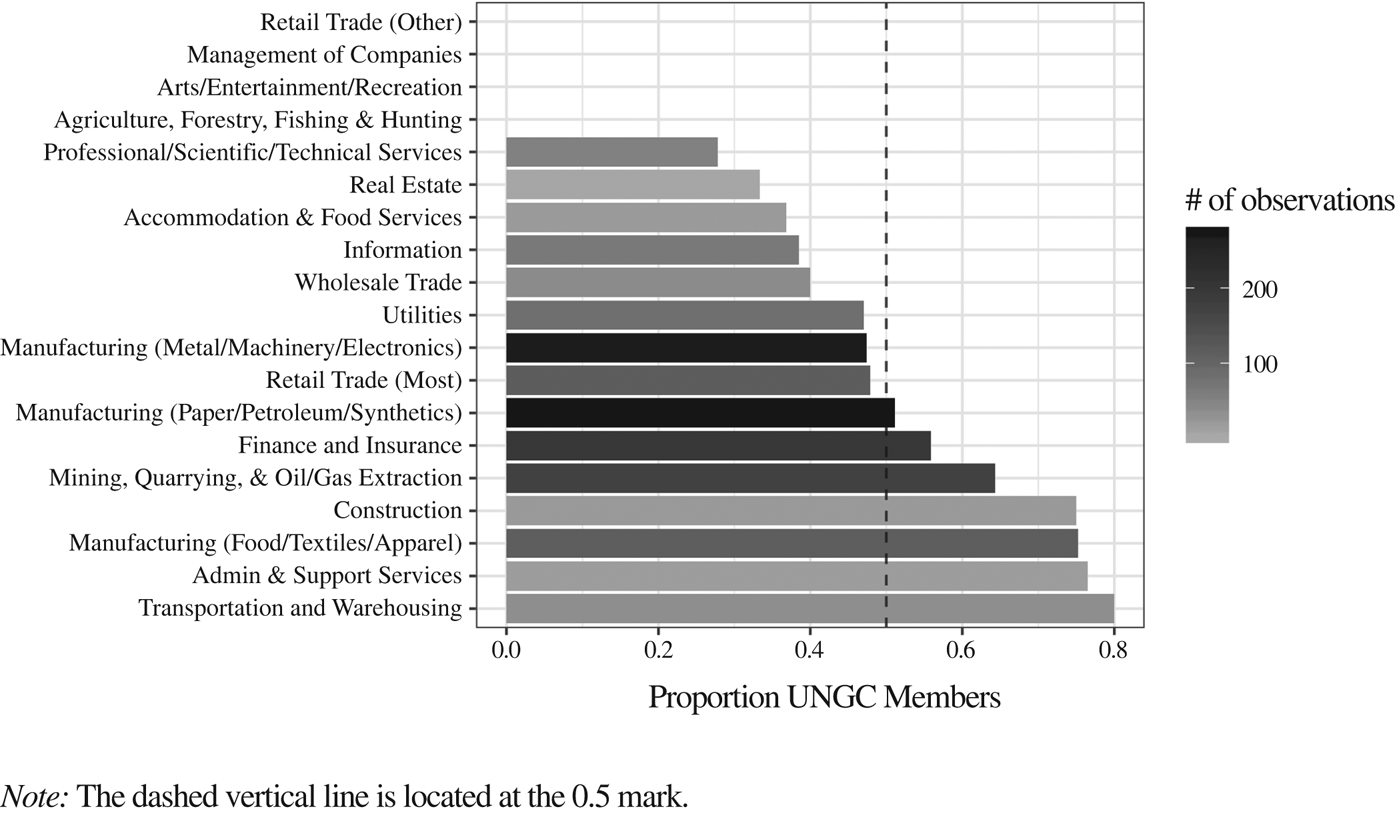
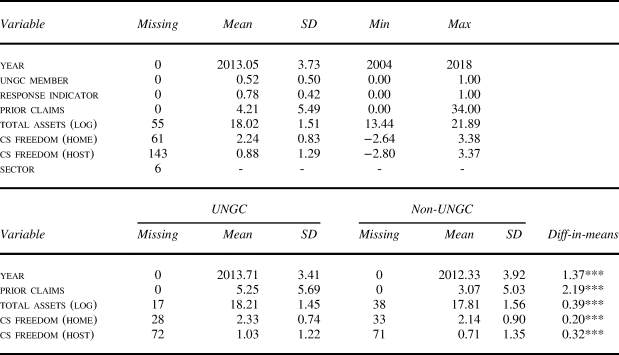
Table 1 and Figure 2 provide two important sets of information about the data. First, Table 1 offers descriptive statistics for the full sample. Second, Table 1 and Figure 2 compare average covariate values between UNGC firm-claims and non-UNGC firm-claims in order to identify potential issues of selection.
UNGC membership by NAICS two-digit sector

Descriptive statistics for full sample and UNGC versus non-UNGC balance table.

The top half of Table 1 shows the distribution and missingness of all relevant variables. Note that the sample is almost perfectly divided between UNGC member firm-claims (52%) and non-UNGC member firm-claims (48%). The overall response rate is 78 percent. The average number of prior claims is 4.21, though this is calculated at the firm-claim level rather than the firm level.Footnote 64 The high degree of missingness in the civil society freedom variables is driven both by lack of availability for some country-years, and by the fact that some claims target the entirety of a firm's operations rather than actions in a particular (set of) host state(s).
Firms are not randomly assigned to join the Global Compact, which gives rise to the possibility that those who join are systematically different than those who do not and thus that my empirical results suffer from selection bias. The bottom half of Table 1 displays the covariate balance between UNGC and non-UNGC firm-claims in order to flag potential issues of selection. If UNGC and non-UNGC firm-claims differ substantially on key variables, it may suggest that selection bias is a larger threat. Results of simple difference-in-means tests provide some reassurance: UNGC members tend to be larger, are headquartered in home states with higher CS freedom, and face claims in host states with higher CS freedom, but only by a very small margin in each case.
Initially, it may appear problematic that UNGC firm-claims are associated with 2.19 more prior claims than nonmember firm-claims on average. However, this difference can be explained by the fact that UNGC membership grew substantially between 2004 and 2018. Firms are more likely to become members as time progresses, and they are also more likely to have prior claims as time progresses. For example, if a firm received five claims prior to joining the UNGC and only one claim after joining, its pre-UNGC prior claims average would be (0 + 1+2 + 3 + 4)/5 = 2 while its post-UNGC prior claims average would be 5/1 = 5. Thus, the difference in prior claims cannot be interpreted as evidence that certain types of firms select into the UNGC, or as evidence that the BHRRC/stakeholders view UNGC members as more desirable targets.
Finally, Figure 2 illustrates the proportion of firm-claims in each two-digit NAICS sector in which the targeted firm is a UNGC member, as well as the number of firm-claims in each sector. There is substantial variation in UNGC membership across sectors: four sectors have UNGC membership rates of greater than 70 percent, and four sectors have no UNGC member firms (though these four sectors represent only twenty-seven observations). However, Figure 2 also shows substantial within-sector variation in UNGC membership, and a number of sectors are nearly equally divided into member and nonmember firm-claims. The sectors with the greatest variation represent the majority of the firm-claim observations in the data set; 979 of the 1,515 firm-claims in the data set are associated with a sector that has a UNGC membership rate between 40 and 60 percent. The extent of within-sector variation in UNGC membership provides some reassurance that my results are not driven by firms from one or two particular sectors.
Estimation
I use four different modeling approaches to estimate the effect of UNGC membership on firm response to stakeholder allegations. First, I run a series of two-way fixed effects (2FE) regression models on the full sample of claims to control for unobserved heterogeneity at the firm, sector, and time levels. Second, I run another set of 2FE models on a subsample of multifirm claims using claim-level (rather than firm-level) fixed effects to isolate the within-claim association between UNGC membership and response behavior. Third, I check the robustness of the 2FE models using fixed effects logit and conditional logit models. Finally, I use an instrumental variables approach to mitigate potential selection bias.
Results and Discussion
Main Results
The main statistical analysis consists of a set of 2FE models estimated via ordinary least squares (OLS). The general estimating equation is as follows:Footnote 65
 $$Y_{it} = \gamma _i + \lambda _t + \delta D_{it} + X_{it}^{\prime} \beta + \epsilon _{it}$$
Y it is firm i's response decision to a claim in year t, and can be equal to only 0 or 1. γ i is a set of firm (or sector, in some models) fixed effects, and λ t is a set of year fixed effects. D it is a dummy variable that indicates whether a firm was a member of the UNGC when the claim was made; δ, the parameter of interest, represents the effect of UNGC membership on response behavior.  $X_{it}^{\prime} $ is the matrix of covariates, and β is the vector of their coefficients. ε it is the error term.
The 2FE approach allows me to control for unobserved variation at the firm, sector, and year levels. It has been noted that the estimates of δ produced by 2FE models are equivalent to the weighted average of all possible two-unit, two-time-period difference-in-differences estimates.Footnote 66 This has led some scholars to refer to the 2FE setup as a generalized difference-in-differences model, and to assign a causal interpretation to δ. However, Kosuke Imai and In Song Kim show that the 2FE estimand cannot be interpreted causally without additional (strong) assumptions that I do not wish to make here.Footnote 67 For this reason, I interpret the results as well-specified observational estimates of the relationship between UNGC membership and response behavior without assuming causal identification.
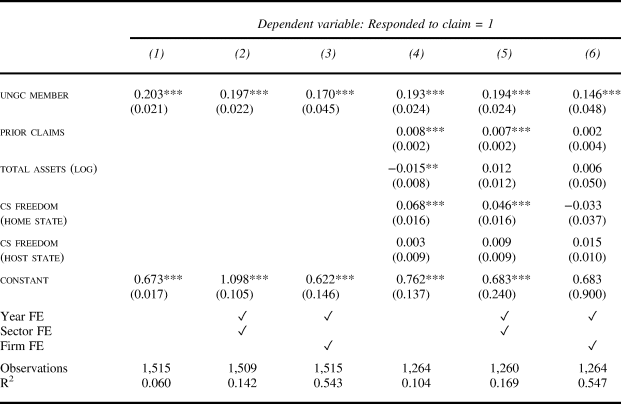
Table 2 displays the results of six models. The point estimates are standard OLS coefficients, presented with robust standard errors clustered on firm and claim.Footnote 68 As predicted, the UNGC membership variable is positive and significant across specifications. To demonstrate that the significance of the UNGC membership variable is not an artifact of arbitrary covariate selection, I first report the bivariate model.Footnote 69 The UNGC variable remains positive, significant, and of similar magnitude when firm, sector, and year fixed effects are added in models 2 and 3. Models 4, 5, and 6 replicate models 1 to 3 with the addition of covariates. The firm-level fixed effects absorb much of the variation in the dependent variable, and none of the control variables achieve significance when they are included. However, the UNGC membership variable remains positive and statistically significant. The variable is substantively significant as well: the most conservative estimate (from model 6) is that UNGC member firms are 14.6 percentage points [5.2, 24.0] more likely to respond to claims than nonmembers.
UNGC membership and response behavior; full sample 2FE results

Note: *p <.10; ** <.05; *** p <.01.
The results in Table 2 show that UNGC membership and response to stakeholder allegations are positively correlated even when firm-, sector-, and time-level variation is accounted for. This means that the relationship between the two variables holds even within the same firm over time. Again, I do not interpret these results causally. However, even if there were to be an unobserved confounder driving changes in firms’ response behavior and changes in UNGC membership status, that confounder is still moving both variables in the same direction. This is the opposite of what we would expect if firms were “bluewashing,” or using their UN affiliation to mask their poor social performance.
Multi-firm Claims
One potential concern with the evidence presented thus far is that UNGC member firms may face different types of claims than nonmembers face. Specifically, one may worry that stakeholders perceive UNGC member firms as “easier targets” than nonmembers because of their professed commitment to social responsibility. If certain types of stakeholders (or stakeholders with certain types of claims) are more likely to bring allegations against UNGC members, then the relationship that I observe between UNGC membership and public response behavior could be driven by some unobserved variation in the quality of claims faced by members versus nonmembers.
To address this concern, I present evidence from a set of claims that involve multiple firms (hereafter “multi-firm claims”). These claims tend to consist of reports, released by NGOs, that contain research on specific ESG problem areas (labor rights in Ukrainian garment factories, for example) and identify multiple complicit firms. In these cases, the BHRRC reaches out to each firm identified in the stakeholder's complaint for a response. Usefully, these multi-firm claims tend to involve both UNGC member firms and nonmember firms, allowing me to compare the response behavior of the two groups while holding the substance of the claim (and the stakeholder) constant.
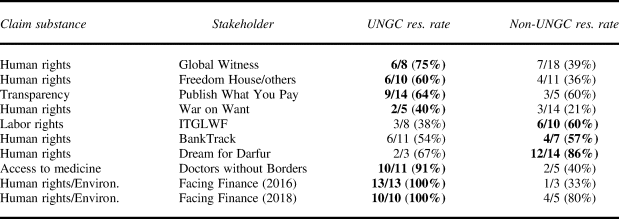
Table 3 presents descriptive evidence comparing UNGC to non-UNGC response rates from the ten largest multi-firm claims in the BHRRC data. Table 2 contains two notable pieces of information: first, for seven of the ten claims (and all of the largest four), UNGC member firms responded at a higher rate than nonmembers. Second, there is substantial heterogeneity in overall response rates across claims; the 2018 Facing Finance claim had an overall response rate of 93 percent (14/15), while the War on Want claim had an overall response rate of only 26 percent (5/19). This suggests that claim-level factors such as NGO prestige or perceived merit of the claim may factor into firms’ response decisions.
Ten largest multi-firm claims; response rates by UNGC member status

Note: Within each claim, the bolded text indicates which group (UNGC or non-UNGC) had the higher response rate.
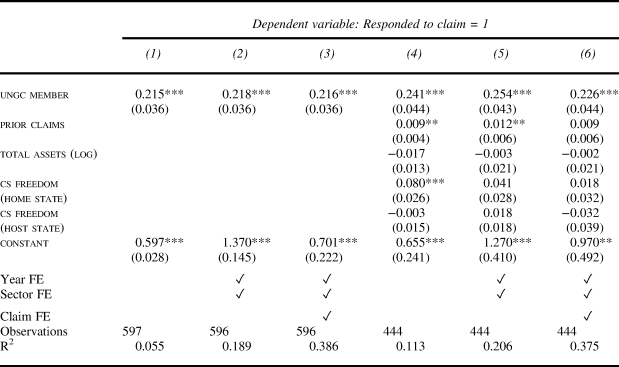
More systematically, I leverage the presence of multi-firm claims to isolate within-claim variation in response behavior by UNGC member status. To do so, I first restrict the sample to claims that include at least four firms. There are eighty-one such claims, with a total of 597 firm-claim observations. Using this sample, I then replicate the results from Table 2 by estimating additional 2FE models (of the form described in Equation 1) using claim fixed effects rather than firm fixed effects. Again, all models are presented with robust standard errors clustered on firm and claim.
Table 4 presents the results. The coefficient on UNGC membership remains positive and significant across specifications, and the results are generally quite similar to the main results presented in Table 2.Footnote 70 Even when we restrict our focus to within-claim variation, UNGC member firms still respond at higher rates than nonmember firms. These results provide reassurance that the main findings are not driven by systematic differences in the types of claims made against UNGC versus non-UNGC firms, or by systematic differences in the types of stakeholders who bring claims against UNGC compared to non-UNGC firms.
UNGC membership and response behavior; multi-claim 2FE results

Note: *p < .10; ** < .05; *** p < .01.
Robustness
Here I address two potential concerns with the previously reported 2FE results. First, I address concerns regarding the modeling of a binary process (response or no response) using OLS. Second, I address the concern that UNGC membership may simply be a proxy for a firm's underlying valuation of ESG performance.
I choose two-way fixed effects models (estimated via OLS) as my primary estimation strategy because it allows me to control for unobserved heterogeneity at the firm level, while retaining the desirable properties of consistency and efficiency. It has been noted that OLS is quite good at estimating accurate marginal effects even with binary dependent variables,Footnote 71 and economists and political scientists have long advocated for the utility of the “linear probability model” (OLS with binary outcome variable) and continue to use it in their research.Footnote 72
However, the results are not contingent on this modeling choice. I replicate Table 1 and Table 3 using logistic regression with fixed effects, and report the results in Appendix Table A1 and A2 (respectively). To address the “incidental parameter” bias that arises when many fixed effects are included in models estimated with MLE, I also replicate the main and multi-firm claim results using conditional logit models in Appendix Table A3.Footnote 73 The results are very similar to the 2FE specifications; the coefficient on UNGC membership remains positive and significant in all models.
Second, one may be concerned that UNGC membership is simply acting as a proxy for firms’ underlying strategy toward ESG issues. To mitigate this concern, I use data on expert ratings of firms’ performance on ESG issues from MSCI. Specifically, I control for firms’ ratings on “Human Rights Policies and Initiatives”—firms that experts identified as being better than average at drafting human rights policies, joining initiatives, and disclosing human rights related information were given a 1, while all others were given a 0. Unfortunately, MSCI's ratings for most firms in my sample are available from only 2013 to 2016. As a result, there is extremely little within-firm variation in UNGC membership in the limited sample: only nine of the 127 firms in the sample experience a change in UNGC membership, limiting the utility of within-unit comparisons. Despite the limitations of the MSCI data, Appendix Table A4 demonstrates that the across-unit effect of UNGC membership on firms’ public response behavior is robust to controlling for expert ratings of the firm's human rights policies.
Instrumental Variables
When attempting to gauge the effects of membership in an organization on members’ actions, it is important to confront the issue of selection. While I can control for observable confounders, firms who select into the UNGC may be systematically different than nonjoiners on some unobservable metric (latent valuation of ESG issues, etc) that leads to biased inferences. To address this issue quantitatively, I use an instrumental variables approach.
I use two instruments for UNGC membership in my analysis: the proportion of Global 2000 firms from firm i's home country that were UNGC members at time t − 1, and the proportion of Global 2000 firms from firm i's sector (measured at the NAICS two-digit level) that were UNGC members at time t − 1. The intuition behind the instruments is that firms tend to emulate the decisions of other firms in like circumstances, and often for norm-based as well as utilitarian reasons.Footnote 74 This logic of “institutional isomorphism” is nicely captured by Paul DiMaggio and Walter Powell: “As an innovation spreads, a threshold is reached beyond which adoption provides legitimacy rather than improves performance.”Footnote 75 A textile manufacturer may join the UNGC not in order to improve its ESG performance, but rather because doing so has simply become the norm in the textile industry. However, firms may also feel the need to emulate their co-national and co-sectoral competitors in order to remain competitive; competition-based diffusion processes have been well-documented by IR scholars.Footnote 76
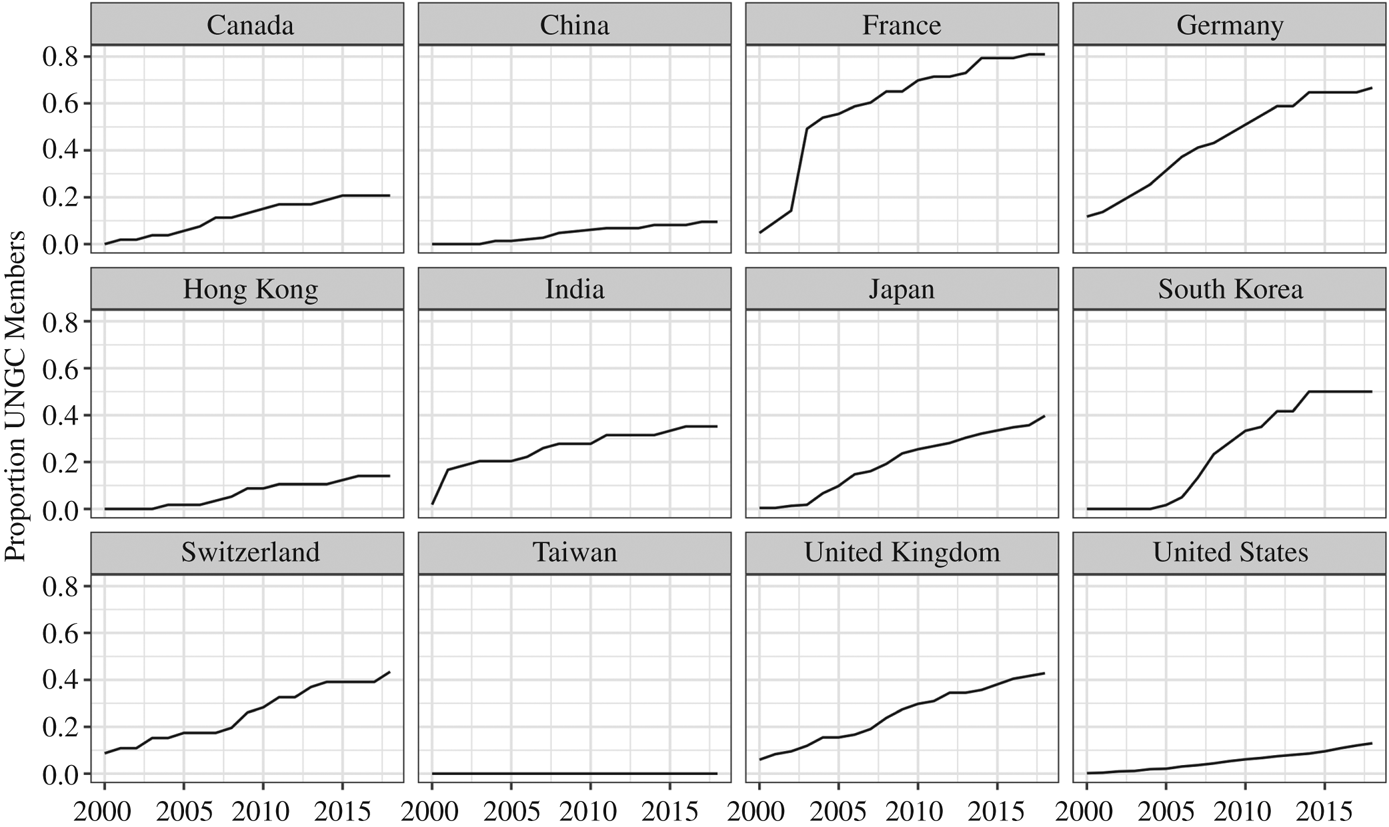
In addition to the theoretical foundations, my instruments are also empirically motivated. First, Figure 3 shows the proportion of UNGC membership among Forbes Global 2000 firms in twelve different states between 2000 and 2018.Footnote 77 Note that there is a substantial amount of state-level variation in UNGC uptake in terms of date of first adoption (compare India and South Korea), rate of adoption (compare Canada and Germany), and total uptake (compare China and Japan). Sharp national increases in UNGC membership (such as France between 2002 and 2004 or South Korea between 2005 and 2008) likely illustrate periods of domestic norm emergence, where firms emulate their co-national peers rather than independently deciding to join the initiative. Second, past studies of the determinants of UNGC membership have demonstrated the importance of national and sector-level diffusion processes.Footnote 78
UNGC uptake among Global 2000 firms, 2000–2018, in top twelve states

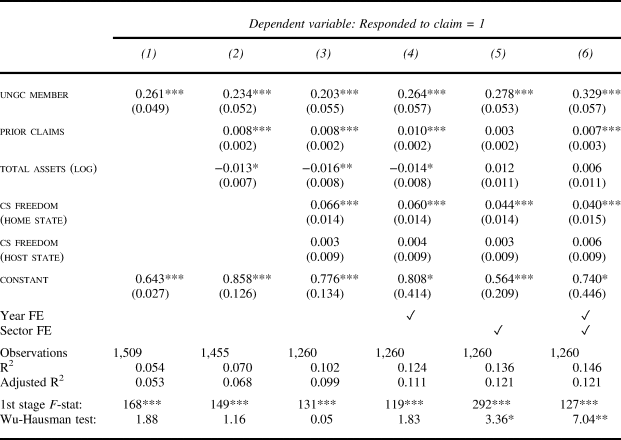
Table 5 presents the results of six instrumental variables regression models fit using two-stage least squares (2SLS).Footnote 79 The models contain the same covariates as the main 2FE models, as well as year and sector fixed effects. Unfortunately, firm-level fixed effects are omitted since their inclusion reduces the first stage F-statistic below the commonly accepted threshold of 10. Still, models 1 to 6 show that the across-firm association between UNGC membership and response behavior remains positive and significant when UNGC membership is instrumented with the (lagged) proportion of UNGC members in firm i's home state and sector. Table 5 shows that the F-statistics in all reported models are greater than 100, suggesting that the instruments are highly predictive of UNGC membership. Full first-stage results are available in Appendix Table A5.
UNGC membership and response behavior—2SLS results

Note: *p < .10; ** < .05; *** p < .01.
In order for instrumental variables analysis to produce valid causal estimates, the exclusion restriction must be satisfied: the instruments Z must affect only the outcome Y indirectly through their effect on the key endogenous regressor D, conditional on covariates X. While there is no econometric test to confirm the validity of the exclusion restriction,Footnote 80 I believe that it is plausibly satisfied in this case. How could lagged rates of UNGC membership in firms’ home states or sectors affect their response behavior, other than through encouraging them to join the Global Compact as well? It is possible that lagged UNGC membership rates could serve as a proxy for general sensitivity to ESG issues in certain states and sectors, which could affect firms’ propensity to join the UNGC and to respond to stakeholder complaints. However, by conditioning on sector and home/host state civil society freedom, I mitigate this possibility.
The results of instrumental variables analysis provide some reassurance that the relationship between UNGC membership and response behavior is not driven by selection. However, the IV results have limitations as well: I estimate only the across-firm rather than the within-firm effect, and the validity of the estimates hinges on the untestable assumption that the exclusion restriction is met. Still, taken together with the 2FE results for the full sample and the sample of multi-firm claims, the econometric evidence strongly suggests a positive and significant relationship between UNGC membership and response behavior that is not driven by selection into treatment or sample selection.
Thus far, I have provided evidence of a robust observational correlation between UNGC membership and firms’ propensity to respond publicly to stakeholder complaints. However, while I have treated response as a binary variable for the purpose of statistical analysis, I also have access to the text of each public response. I now turn to qualitative examination of the content of firms’ (non)responses in order to investigate the mechanism.
Evidence from Response Documents
I have argued that UNGC membership allows firms to coopt the UN's legitimacy, lessening the reputational costs of responding publicly relative to its benefits. Theoretically, this legitimacy boost should make responding to allegations less costly for firms regardless of the content of their responses. However, if the legitimacy mechanism that I suggest is truly at work, we should expect UNGC member firms to draw attention to their membership in their response documents at least some of the time. I highlight two instances in which firms drew upon the legitimacy of the UN in their response documents.
Maersk
In 2007, the BHRRC made its first contact with Danish transportation/logistics giant Maersk regarding the company's membership in the European Union Chamber of Commerce in China (EUCCC). The EUCCC had taken a position against a proposed Chinese labor law reform, which various labor groups and unions (including the International Textile, Garment, and Leather Worker's Federation) argued would improve the quality of labor rights in China. These groups called on the multinationals who were members of the EUCCC to denounce the organization's opinion or leave the group altogether. Maersk, who was not a UNGC member in 2007, did not respond to the BHRRC's request for response.
The next time the BHRRC approached Maersk was in 2010, regarding an unanswered claim brought forth by the International Transport Worker's Federation (ITF). The group, an NGO that works to support transport workers and their local unions, alleged that workers of a Maersk-contracted firm had physically assaulted union dockworkers in Mumbai. Unlike the previous approach, Maersk (who had since joined the UNGC in 2009) issued a public response to ITF's claims. In the response, the firm made it clear that they were aware of the violent acts and that they were being addressed: “Since we … received confirmation the incidents (referred to in the article) took place we have been working with all parties involved—which includes the ITF—towards a solution which would respect the interests of all.”Footnote 81
In the final paragraph of their response, Maersk wrote: “As AP Møller-Maersk we have signed up to the UN Global Compact. As part of this we are continuously working to ensure correct standards in the area of labour rights for all business units in our Group.” Note that this statement communicates very little other than the fact that Maersk is associated with the Global Compact, a UN initiative. Maersk's UNGC membership is not directly germane to the substantive content of the response, so why mention it? I argue that Maersk was drawing upon the legitimation function of the UNGC, citing its UN affiliation to signal that—while the company may be responsible for human rights violations from time to time—it is not a bad actor in international politics and it retains the right to do business internationally.
Maersk's ability to leverage the legitimacy of the UN, which it lacked in 2007 but had gained by 2010, may have played a key role in the firm's decision to respond to the BHRRC's second request but not to the first one. It is unlikely that Maersk's decision to respond publicly in 2010 was driven by UNGC-related social learning, since the firm had barely been a member for one year when the response was issued. It is also unlikely that the decision to respond was driven by reformers within the firm. Maersk's former CEO did retire in 2007,Footnote 82 but his replacement was already on the firm's board of directors, and long-time company head Arnold McKinney-Møller remained heavily involved in the firm's operations until his death in 2012.Footnote 83 The largest change between 2007 and 2010 was the firm's ability to claim an association with the UN, empowering them to engage their stakeholders publicly.
G4S
Unlike Maersk, British security services firm G4S has responded publicly every time it has been approached by the BHRRC. The firm was not a UNGC member when the NGO approached it the first time, but joined shortly after and was a member for all following claims. The case of G4S allows for the examination of how UNGC membership affects the language of a firm's responses, even when it does not drive the initial decision to respond.
The BHRRC first reached out to G4S in October 2010 regarding an article published on openDemocracy, an activism and social justice-focused online media site owned by the nonprofit openDemocracy Foundation for the Advancement of Global Education.Footnote 84 The article begins with the story of Jimmy Mubenga, a man who was killed during the process of his deportation by three G4S security guards, and goes on to list several other alleged human rights abuses committed by the firm's employees. In its response, G4S stated that “each of the incidents [the author] refers to have been fully investigated by the relevant authorities and G4S itself.” In addition, it detailed the UK government-approved training program that all G4S employees must complete.Footnote 85 The firm, not a member of the Global Compact at the time, did not mention any organization other than itself and the UK government in its response.
In 2012, the BHRRC approached G4S again, this time regarding the company's operations in the Israeli-occupied West Bank. In this instance, the BHRRC had found several groups (such as NGO Electronic Intifada and blog Laws of Rule) claiming that G4S was continuing to provide security services to Israeli settlements in the West Bank, in violation of international law and the group's own promises. In its response, the firm claimed that it had kept its promises to terminate its major security contracts in the West Bank, and that its continuing operations there were limited to providing security for banks/retail stores and performing maintenance on security systems. However, G4S claimed that while its continuing operations do not violate international law, “we also concluded that to ensure that our business practices remain in line with our own Business Ethics Policy, we would aim to exit a number of contracts which involved the servicing of security equipment at the barrier checkpoints, a prison and a police station in the West Bank.”Footnote 86
In its 2012 response, G4S also reprinted in full a rough English translation of an article from the Danish UN Association, a group of Danish NGOs that wish to further various UN initiatives, titled “Positive that G4S Joining the Global Compact and Withdraws from Israeli Jails and the Wall in the West Bank.” The article includes a quote from Jørgen Estrup, chairman of the Danish UN Association: “It is a clear improvement that G4S has joined the Global Compact and developing a new human rights policy. United Nations Association would have liked to G4S completely withdrew from all activities of the illegal Israeli settlements, but we believe that there is a clear difference between G4S tasks for a supermarket and a prison or at the wall.”Footnote 87
It is highly likely that G4S's decision to reprint this article in its response was driven by its desire to benefit from the legitimacy of the UN. First, the article was produced by the UN Association, a group that has UN in its name but is not actually affiliated with the United Nations. Second, the article mentions G4S's membership in the Global Compact multiple times, implying that it should be seen as evidence that the company is moving in a positive direction on human rights issues. Third, the article does not communicate any information about G4S's activities in the West Bank that was not already included in the main part of the response document. Its main takeaway is that G4S has joined the UNGC, and that this move signals improvement in the firm's orientation toward social responsibility. G4S may have hoped that stressing its UNGC membership would lend credence to its claim that its West Bank operations are not in violation of international law, or to its promise to exit further contracts in the West Bank.
It is noteworthy that, even though G4S had also issued a public response to the BHRRC prior to joining the Global Compact, it made sure to discuss its UN affiliation in detail once it gained one. This case—in which UNGC membership affected response language, but not the decision to respond publicly—provides evidence that there is not simply some unobserved variable driving both firms’ decision to join the UNGC and their decision to respond publicly. Rather, the ability to cite an affiliation with the UN is one factor that drives down the potential costliness of publicly responding to an alleged ESG violation, and firms will do so whenever possible.
Conclusion
In this paper, I re-examine the relationship between public-private governance initiatives and firm-level ESG performance. First, I propose public response to stakeholder complaints as a mid-level ESG performance metric that is better suited to capture the immediate effects of initiative membership than extant measures. Second, I theorize that public-private initiative membership should make firms more likely to respond to stakeholder concerns. By partnering with high-legitimacy public entities like the UN, firms gain the ability to more credibly frame their responses as socially responsible rather than performative. In turn, this reduces the reputational cost of public response vis-à-vis nonresponse. In a series of empirical tests, I find robust support for my theory. Firms that are member to the UN Global Compact (the leading public-private initiative) are consistently more likely to respond to stakeholder complaints than nonmembers, even when a range of other factors are accounted for. Further, I present evidence that this effect is not driven by selection into the Global Compact or by the selective targeting of complaints toward UNGC member firms.
I find that, when presented with stakeholder complaints, UNGC member firms are 14.6 percentage points [5.2, 24.0] more likely to publicly address the complaints than nonmembers. This is a substantial effect, but what can we learn from it? I do expect that firms who respond publicly to stakeholder allegations should be more likely to go on to resolve them because public response increases the salience of the allegations (the platforming effect) and firms may face backlash for failing to follow through on their promises (the audience costs effect). Although I present some anecdotal evidence of the relationship between response and remediation, I lack the data necessary to test it systematically. As a result of this limitation, I avoid interpreting the empirical results as suggesting that UNGC members are 14.6 percentage points more likely to remediate stakeholders than nonmembers.
However, the results do allow me to speak to the relationship between public-private initiative membership and corporate engagement with civil society. When firms issue public responses to stakeholder complaints—regardless of the response's content, or actions taken post-response—they legitimate the existence of a direct channel through which civil society groups can bring their concerns to firms. This direct channel can be critically important in states with weak domestic institutions, where stakeholders may not be able to engage powerful multinational firms indirectly via domestic judiciaries or regulatory agencies. For firms, the ability to engage stakeholders directly is a necessary (though not a sufficient) component of self-regulation because actions that firms take under pressure from governmental intermediaries cannot be considered self-regulatory. Voluntary self-regulation occurs when firms take action above and beyond what is legally required of them.
Past research has placed upper and lower bounds on public-private governance initiatives’ ability to help firms regulate their global operations.Footnote 88 In this paper, I find a mid-level effect: by lowering the reputational cost of direct and public response to stakeholder complaints, public-private governance initiatives incentivize firms to address the negative externalities that they create without coercion from the state. To be clear, I agree with extant work that public-private governance initiatives are no substitute for strong domestic regulation in the fight against human rights abuses, pollution, corruption, and all other negative consequences of business activity. My findings suggest a more modest, but still important role for public-private initiatives: through offering legitimacy by association, initiatives subsidize firms’ direct and open communication with aggrieved stakeholders. Importantly, this effect holds despite the initiative's lack of monitoring or enforcement power.
Although the empirical analysis here focuses exclusively on the UN Global Compact, the theoretical framework that I propose should be generalizable to a wide range of public-private initiatives. The critical element is the extent to which global audiences perceive the initiative's public partner as a legitimate steward of global governance. While the UN is a particularly high-legitimacy actor, other organizations also meet this criterion. For example, the Extractive Industries Transparency Initiative counts fifteen domestic agencies (including USAID and Japan's Ministry of Foreign Affairs) as public partners,Footnote 89 and the Ethical Trading Initiative's primary public supporter is the United Kingom's Department for International Development (DFID).Footnote 90 Another high-legitimacy IGO, the Organisation for Economic Cooperation and Development (OECD), is the leading public partner of the Global Reporting Initiative. Future research could fruitfully examine how the efficacy of different initiatives varies according to the composition of their public partners.
Data Availability Statement
Replication files for this article may be found at <https://doi.org/10.7910/DVN/YNVYO2>.
Supplementary Material
Supplementary material for this article is available at <https://doi.org/10.1017/S0020818321000199>.
Acknowledgments
Nate Jensen, Pat McDonald, Terry Chapman, Rachel Wellhausen, Clint Peinhardt, Trevor Thrall, and all participants of the Research in International Politics seminar provided valuable feedback, as did attendees of the 2020 Texas Triangle IR Conference. Special thanks to Kevin Galambos, Hillary Corwin, Carolina Moehlecke, Xin Nong, Josh Landry, Roman Hlatky, and Torben Behmer for their thoughtful critiques and for their camaraderie. Thanks also to Gregory Distelhorst, Layna Mosley, and Pablo Pinto for sharing insights on firms and voluntary regulation. Marilia Sampaio provided excellent copyediting. Finally, I am grateful to the IO editorial team and two anonymous reviewers for their guidance. All remaining errors are my own.