


Paratonia is an involuntary, variable resistance to passive movement observed in the context of dementia or cognitive impairment Reference Drenth, Zuidema, Bautmans, Marinelli, Kleiner and Hobbelen1 . Its magnitude increases with worsening cognitive impairment, and the condition becomes care-interfering in the moderate to advanced stages of dementia, where it impedes hygiene, dressing, repositioning and transfers, and increases the risk of pressure injuries and skin breakdown. Reference Drenth, Zuidema, Bautmans, Marinelli, Kleiner and Hobbelen1,Reference Hobbelen, Koopmans, Verhey, Van Peppen and de Bie2 Cross-sectional studies report prevalence rising from approximately 10% in early-stage dementia to 90%–100% in late-stage disease. Reference Van Deun, Van den Noortgate, Saucedo, Van Bladel and Cambier3 Despite this burden, paratonia is frequently misinterpreted by clinicians as wilful resistance to care, contributing to inappropriate psychotropic medication prescribing and under-recognition of an underlying treatable motor disorder. Reference Drenth, Zuidema, Bautmans, Marinelli, Kleiner and Hobbelen1,Reference Van Deun, Van den Noortgate, Saucedo, Van Bladel and Cambier3,Reference Perri, Hobbelen and Cuppage4 Evidence for treating paratonia is limited and mixed. Passive movement therapy did not benefit moderate to severe paratonia in a multicentre randomised placebo-controlled trial. Reference Hobbelen, Tan, Verhey, Koopmans and de Bie5 A randomised, blinded, placebo-controlled pilot trial of botulinum toxin A (BoNT-A) for upper-limb paratonia in advanced dementia demonstrated improved passive range of motion and reduced caregiver-rated difficulty of providing personal care. Reference Kleiner-Fisman, Khoo, Moncrieffe, Forbell, Gryfe and Fisman6 A 2025 national survey of Canadian physiatrists and neurologists corroborated these findings, with most respondents reporting routine off-label use and observed benefits in passive range of motion, ease of care and caregiver-reported burden. Reference Kleiner, Ismail, Khan, Pilieci, Truong and Boulias7 Despite this, care-interfering paratonia remains an under-recognised indication with no approved pharmacotherapy in any jurisdiction. Reference Kleiner and Lang8
In US population-based data, approximately 64% of moderately severe dementia patients receive care at home. Reference Harrison, Ritchie and Patel9 In Canada, an estimated 61% of seniors with dementia live in the community rather than long-term care, many with moderately severe to severe disease. 10 Whether community-dwelling caregivers would bring care-recipients to an outpatient clinic for paratonia treatment, and which barriers they would overcome, has not been characterised. This study addressed that gap.
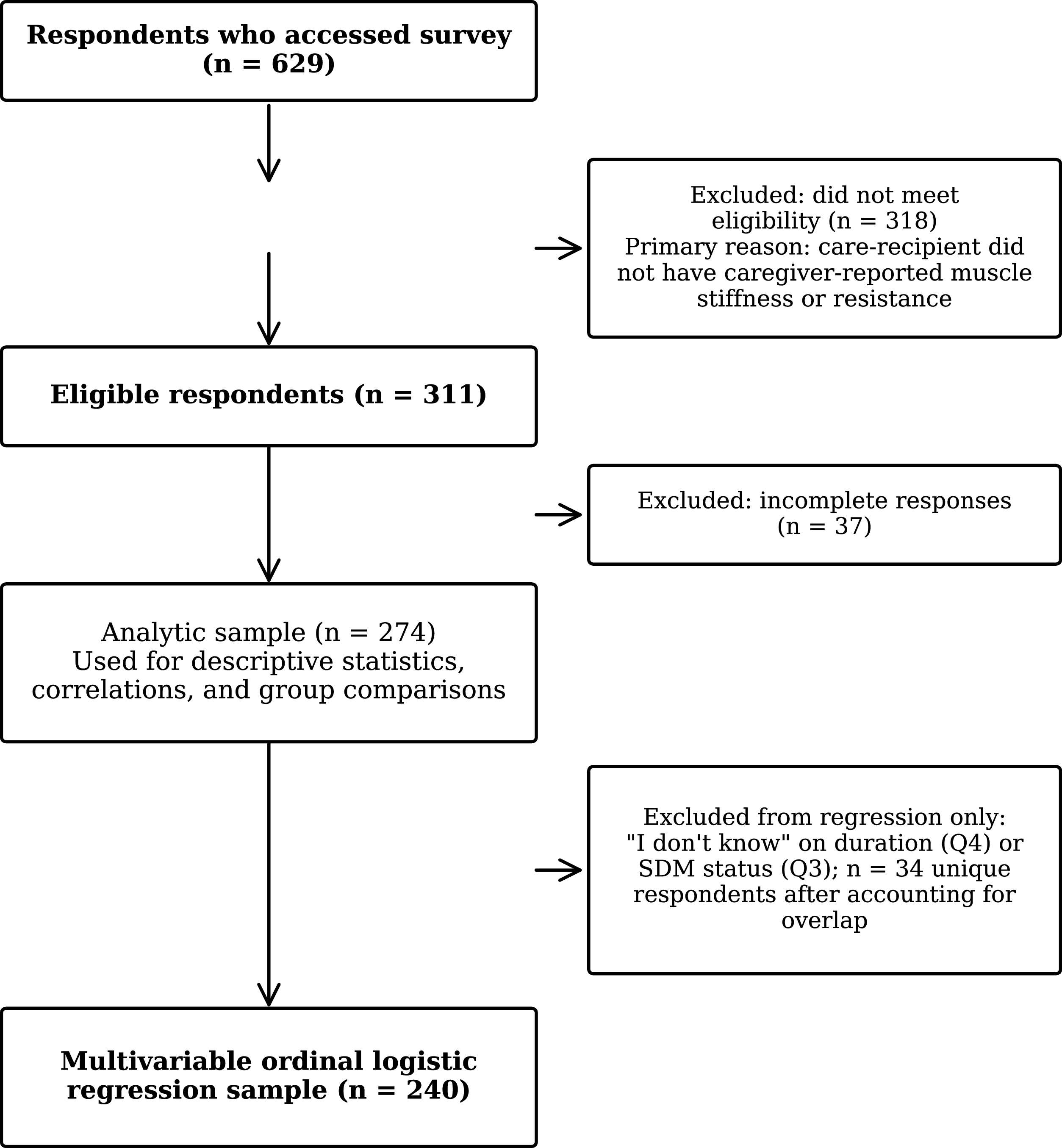
A pilot cross-sectional online survey was administered through the Centre for Aging and Brain Health Innovation (CABHI) Leap end-user engagement service, an initiative recruiting older adults, caregivers and persons with lived experience for feedback on healthcare innovations, and was distributed to informal caregivers in Canada. The survey instrument was developed by consensus of a study team representing movement disorders neurology, care-of-the-elderly medicine, palliative care, social work and end-user research methodology and was iteratively reviewed; item content drew on the paratonia and post-stroke spasticity (PSS) literature and clinical experience. The 12-item instrument covered caregiver relationship, substitute decision-maker (SDM) status, paratonia duration and severity, manifestations in daily care, personal impact, importance of treatment, perceived barriers, willingness to overcome, useful supports and likelihood of attending a quarterly specialty clinic (Supplementary material S1). Eligibility required self-identification as an informal caregiver of a person with advanced dementia currently or previously experiencing caregiver-reported muscle stiffness or resistance during care, described in lay terms. Of 629 respondents who accessed the survey, 318 did not meet eligibility, primarily because the care-recipient did not have caregiver-reported muscle stiffness or resistance, and 37 of the remaining 311 were excluded for incomplete responses, yielding a final analytic sample of 274 (Figure 1). Treatment context was provided by a brief lay description of intramuscular BoNT-A administered quarterly at a specialty outpatient clinic. Ordinal items used five-point Likert scales (Not at all to Extremely); severity used a four-point scale (Mild to Extreme) reflecting caregiver-perceived impact on daily care. Analyses included Spearman correlations with false discovery rate (FDR) adjustment, binomial tests of conditional willingness against a pre-specified 50% benchmark, representing equipoise between endorsement and rejection, Kruskal–Wallis tests across caregiver categories and ordinal logistic regression of attendance likelihood on duration, severity, personal impact, importance, caregiver relationship and SDM status. The protocol was approved by the Baycrest Hospital Research Ethics Board.
Participant flow. Flow of respondents from initial survey access to the analytic sample and the multivariable regression sample. Of 629 respondents who accessed the survey, 318 did not meet eligibility (primarily because the care-recipient did not have caregiver-reported muscle stiffness or resistance), and 37 of the remaining 311 were excluded for incomplete responses, yielding a final analytic sample of n = 274 used for descriptive statistics, correlations and group comparisons. Thirty-four respondents who selected “I do not know” on paratonia duration (Q4) or substitute decision-maker (SDM) status (Q3) were excluded from the multivariable ordinal logistic regression only, yielding a regression sample of n = 240.

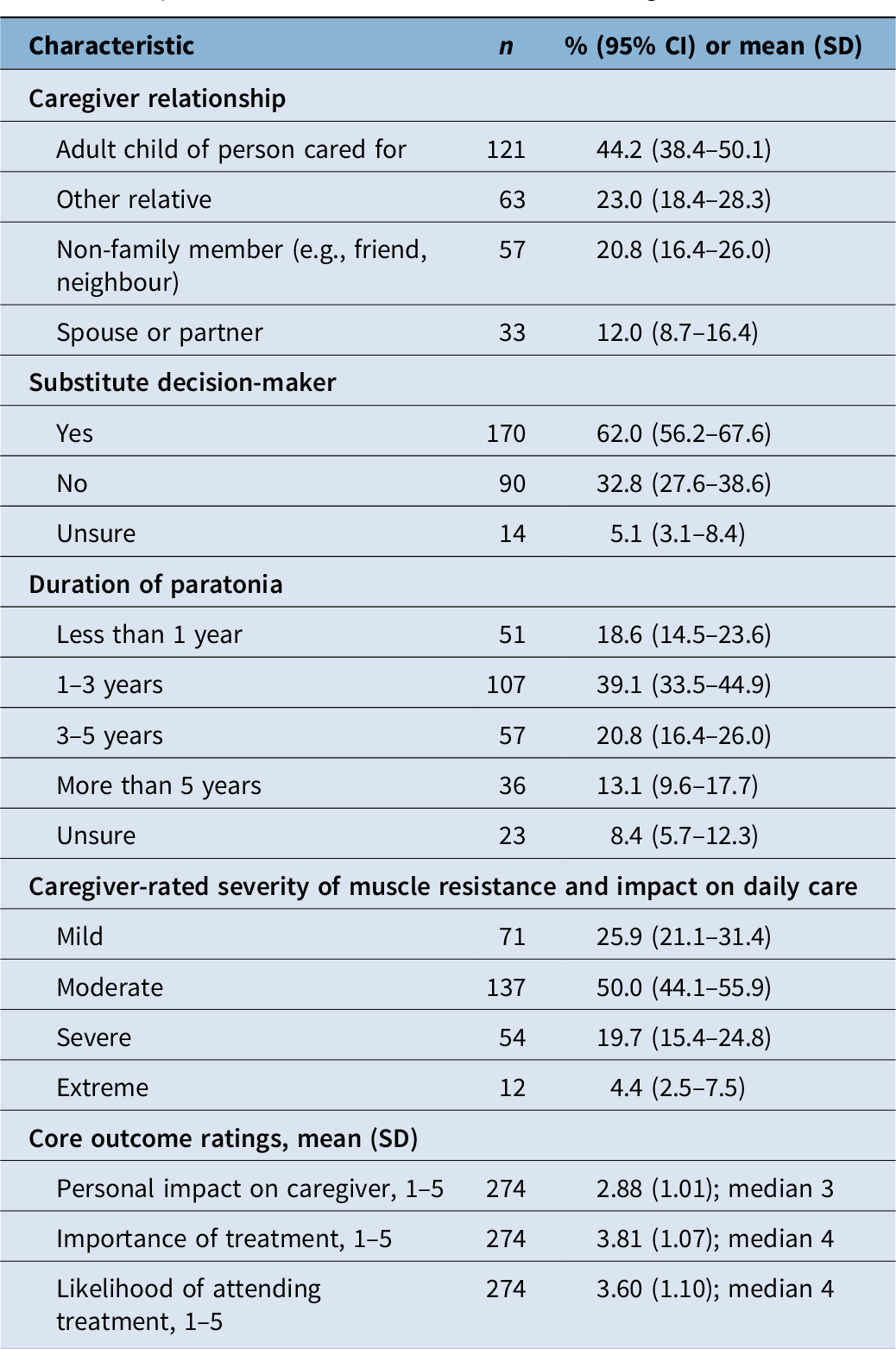
Among 274 respondents, 44.2% were the adult child of the person cared for, 23.0% were another relative, 20.8% were a non-family caregiver and 12.0% were a spouse or partner; 62.0% were SDMs. Most respondents reported a duration of 1–5 years, and 75.9% rated the caregiver-perceived severity of resistance and impact on daily care as mild or moderate. The most frequently reported manifestations in daily care were pain or discomfort (70.8%); difficulty completing bathing, dressing or repositioning (61.3%); distress during care (46.0%); abnormal limb posturing (42.3%); the need for multiple caregivers (32.5%); and skin breakdown or pressure injuries (29.2%). Sample characteristics and core outcome ratings are presented in Table 1. Caregivers reported substantial impact of the care-recipient’s paratonia on their own physical, emotional and mental well-being, with 65.3% rating this impact as moderate to extreme. Treatment was rated as moderately to extremely important by 87.5% of caregivers, and 84.6% reported they would be moderately to extremely likely to attend a quarterly specialty clinic if treatment were effective. Perceived importance of treatment showed the strongest pairwise association with likelihood of attending (Spearman r = 0.41, p < 0.001). Personal impact was positively associated with treatment importance (r = 0.36, p < 0.001) and with likelihood of attending (r = 0.17, p = 0.009). Caregiver-rated severity correlated with personal impact (r = 0.34, p < 0.001) and weakly with attendance likelihood (r = 0.15, p = 0.022).
Sample characteristics and core outcome ratings (n = 274)

Table 1. Long description
A table detailing caregiver characteristics and core outcome ratings for 274 respondents. The table has 16 rows and 3 columns. Column headers are Characteristic, n, and % (95% CI) or mean (SD). Row labels include Caregiver relationship, Substitute decision-maker, Duration of paratonia, Caregiver-rated severity of muscle resistance and impact on daily care, and Core outcome ratings. Each row provides specific data points under these headers. For example, under Caregiver relationship, 121 respondents are adult children of the person cared for, representing 44.2 percent (38.4–50.1). Under Substitute decision-maker, 170 respondents are substitute decision-makers, representing 62.0 percent (56.2–67.6). The table also includes data on the duration of paratonia, severity of muscle resistance, and core outcome ratings such as personal impact on caregiver, importance of treatment, and likelihood of attending treatment.
CI = confidence interval; SD = standard deviation. Confidence intervals calculated using Wilson’s method.
The most-endorsed perceived barriers were cost of treatment (53.3%), physical challenges of moving the person cared for (50.7%), transportation difficulties (44.9%), distance to a specialty clinic (35.4%) and uncertainty about whether the treatment would work (34.7%). Among caregivers endorsing each barrier, the proportion willing to overcome it if treatment were effective was significantly above the 50% benchmark for time away from work (68.6%, p = 0.006), physical challenges (63.8%, p = 0.008) and transportation difficulties (61.6%, p = 0.047). For the remaining barriers, willingness to overcome did not differ significantly from 50% (Figure 2). Flexible appointment times were associated with significantly higher reported likelihood of attending (mean 3.82 versus 3.35; FDR-adjusted p = 0.009), as were shorter wait times at the clinic (3.82 versus 3.39; p = 0.020) and financial assistance or insurance coverage of treatment (3.78 versus 3.42; p = 0.020). No significant difference was observed by caregiver relationship category or SDM status on the four core outcomes. SDMs endorsed on average 0.45 more perceived barriers than non-SDMs (p = 0.041), and a higher proportion endorsed distress of the care-recipient during outings as both a perceived barrier (40.6% versus 22.2%; FDR-adjusted p = 0.038) and one they would be willing to overcome (35.3% versus 16.7%; p = 0.029). In ordinal logistic regression (n = 240; Figure 1), perceived importance of treatment was the only independent predictor of likelihood of attending, with each one-unit increase associated with 48% higher odds of attendance (odds ratio 1.48, 95% confidence interval 1.28–1.71, p < 0.001). Duration of muscle resistance, caregiver-rated severity, personal impact, caregiver relationship and SDM status did not reach significance after adjustment (Supplementary material S2).
Caregiver-perceived barriers and willingness to overcome each barrier. Lighter bars represent the percentage of the full sample (n = 274) who endorsed each barrier as a perceived obstacle to attending a quarterly specialty clinic for the treatment of care-interfering paratonia. Darker bars represent the percentage of caregivers who, among those endorsing the given barrier, indicated they would be willing to overcome it if the treatment were effective. The vertical dashed line at 50% indicates the benchmark used in the binomial tests of conditional willingness. Statistical significance markers reflect binomial tests of the proportion willing to overcome each barrier (conditional on endorsement) against the 50% benchmark: *p < 0.05; **p < 0.01.

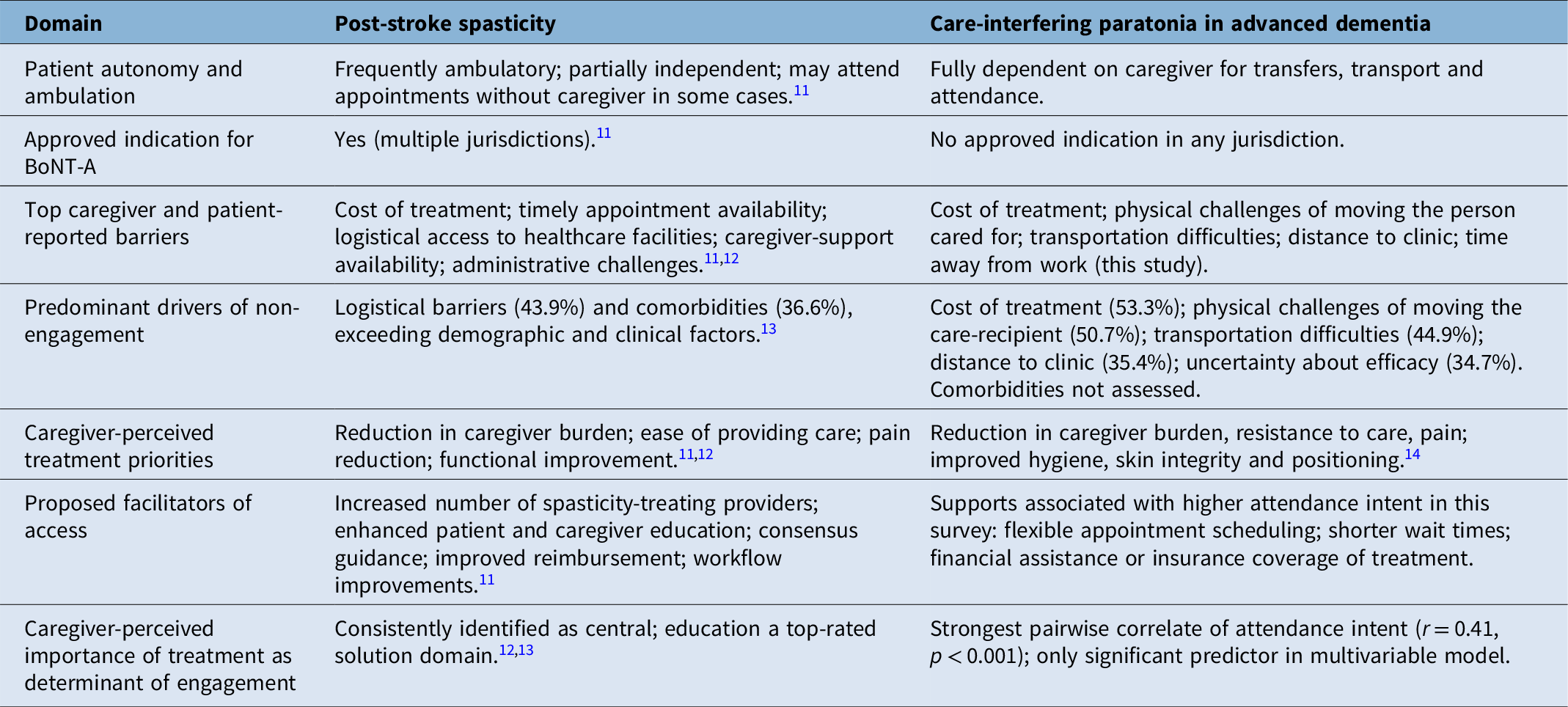
In this sample of 274 caregivers of persons with advanced dementia and caregiver-reported muscle resistance suggestive of paratonia, three findings emerged. First, most caregivers reported they would attend quarterly specialty clinic visits if treatment were effective. Second, caregivers reported the barriers of time away from work, physical handling of the care-recipient and transportation as surmountable, with most willing to overcome each if treatment were effective. Third, perceived importance of treatment, rather than duration, caregiver-rated severity or personal impact, was the dominant predictor of attendance intent in both pairwise and adjusted analyses. The barriers, priorities and facilitators caregivers reported closely resembled those documented for PSS, Reference Patel, Gellhorn, Neerukonda and Kwasnica11 a condition for which BoNT-A is already an approved treatment. Table 2 summarises the comparison. The principal difference between these two patient populations is patient mobility and functional independence. Persons with PSS are frequently ambulatory, whereas persons with care-interfering paratonia in advanced dementia are fully caregiver-dependent for transport, attendance and consent. In this sample, caregivers did not view this dependence as prohibitive when effective treatment was available. The most commonly reported access challenges were cost of treatment, physical handling of the care-recipient and transportation. Flexible scheduling, shorter wait times and financial assistance or insurance coverage of treatment were most strongly associated with reported attendance intent.
Comparison of post-stroke spasticity and care-interfering paratonia in advanced dementia: caregiver and patient-reported barriers, priorities and facilitators for botulinum toxin A (BoNT-A) treatment

Table 2. Long description
A table comparing caregiver and patient-reported barriers, priorities, and facilitators for BoNT-A treatment in post-stroke spasticity and dementia. The table has two columns: Post-stroke spasticity and Care-interfering paratonia in advanced dementia, and eight rows: Patient autonomy and ambulation, Approved indication for BoNT-A, Top caregiver and patient-reported barriers, Predominant drivers of non-engagement, Caregiver-perceived treatment priorities, Proposed facilitators of access, Caregiver-perceived importance of treatment as determinant of engagement. Row 1: Patient autonomy and ambulation, Frequently ambulatory; partially independent; may attend appointments without caregiver in some cases, Fully dependent on caregiver for transfers, transport and attendance. Row 2: Approved indication for BoNT-A, Yes (multiple jurisdictions), No approved indication in any jurisdiction. Row 3: Top caregiver and patient-reported barriers, Cost of treatment; timely appointment availability; logistical access to healthcare facilities; caregiver-support availability; administrative challenges, Cost of treatment; physical challenges of moving the person cared for; transportation difficulties; distance to clinic; time away from work (this study). Row 4: Predominant drivers of non-engagement, Logistical barriers (43.9%) and comorbidities (36.6%), exceeding demographic and clinical factors, Cost of treatment (53.3%); physical challenges of moving the care-recipient (50.7%); transportation difficulties (44.9%); distance to clinic (35.4%); uncertainty about efficacy (34.7%). Comorbidities not assessed. Row 5: Caregiver-perceived treatment priorities, Reduction in caregiver burden; ease of providing care; pain reduction; functional improvement, Reduction in caregiver burden, resistance to care, pain; improved hygiene, skin integrity and positioning. Row 6: Proposed facilitators of access, Increased number of spasticity-treating providers; enhanced patient and caregiver education; consensus guidance; improved reimbursement; workflow improvements, Supports associated with higher attendance intent in this survey: flexible appointment scheduling; shorter wait times; financial assistance or insurance coverage of treatment. Row 7: Caregiver-perceived importance of treatment as determinant of engagement, Consistently identified as central; education a top-rated solution domain, Strongest pairwise correlate of attendance intent (r = 0.41, p < 0.001); only significant predictor in multivariable model.
Superscript numerals refer to entries in the main reference list.
Several limitations frame these findings as preliminary and hypothesis-generating. Caregivers self-selecting into an end-user platform may be more engaged and digitally connected than the broader caregiver population, and the sample skewed towards milder cases, limiting generalisability to more severe presentations. Ascertainment relied on caregiver report without clinical examination or standardised severity measurement, an inherent limitation of digital caregiver surveys that does not diminish the value of caregiver-reported experience. Reference Arons, Krabbe, Schölzel-Dorenbos, van der Wilt and Olde Rikkert15 Because caregivers would not be expected to reliably distinguish paratonia from spasticity, Parkinsonian rigidity, dystonia or contractures, and because paratonia may coexist with these conditions, misclassification or coexistence cannot be excluded. Additionally, personal demographic information was not collected, precluding equity-related analyses, and the outcome captured stated intent rather than observed attendance behaviour. Finally, the cross-sectional design precludes causal inference, and the Leap dissemination denominator is not known, precluding a formal response rate.
Despite these limitations, most caregivers reported willingness to attend a specialty outpatient clinic for assessment and potential treatment of care-interfering paratonia when practical supports were in place. Caregiver-reported resistance may support referral for specialist evaluation, with clinical confirmation of paratonia and consideration of alternative or coexisting causes preceding treatment. Larger multi-jurisdictional studies combining caregiver-reported experiences with paratonia-specific clinical assessment, using the Paratonia Assessment Instrument to support identification of paratonia, would better characterise factors predicting attendance if effective treatment were to become available.
Supplementary material
The supplementary material for this article can be found at https://doi.org/10.1017/cjn.2026.10687.
Acknowledgements
The authors thank the caregiver respondents who completed the survey and the CABHI Leap team for survey delivery and data analysis. The authors acknowledge support from CABHI and the CABHI Leap Community.
Author contributions
GK: Research project – conception and organisation; Survey preparation – design and review and critique; Results – data interpretation; Manuscript preparation – writing of the first draft. JC: Research project – conception and organisation; Survey preparation – design and review and critique; Results – data interpretation; Manuscript preparation – review and critique. AS: Research project – conception and organisation; Survey preparation – design and review and critique; Results – data interpretation; Manuscript preparation – review and critique. GF: Research project – organisation; Survey preparation – design, execution and review and critique; Manuscript preparation – review and critique. SO: Survey preparation – design and execution; Manuscript preparation – review and critique. GP: Research project – conception and organisation; Survey preparation – design and review and critique; Results – data interpretation; Manuscript preparation – review and critique.
Funding statement
No financial support was received specifically for this manuscript from funding agencies in the public, commercial or not-for-profit sectors. Dr Kleiner is the recipient of a CABHI Ignite grant supporting the development of a clinical outcome assessment measure for paratonia. As part of the in-kind support package provided to grant recipients, this study received non-monetary services from CABHI’s Leap initiative, including end-user engagement, study distribution and data analysis support. No direct funding was provided for the conduct of this study or preparation of this manuscript.
Competing interests
Galit Kleiner holds an international patent portfolio for the therapeutic use of botulinum toxin A in the treatment of paratonia, shared with Baycrest Health Sciences. She has received grants/research support from MOHLTC Academic Health Sciences Centre Alternate Funding Plan (AHSC AFP) Innovation Fund, CABHI Ignite and University of Toronto Slamen-Fast New Initiatives in Neurology Award. She has served on the Speakers Bureau and received honoraria from Ipsen Pharmaceuticals and AbbVie Canada Inc.
Jessica Cuppage receives salary from Baycrest Hospital and grant funding from AHSC AFP Innovation Fund Years 17 and 18 and the CABHI Ignite Program.
Adriana Shnall receives salary from Baycrest Academy for Research and Education and the University of Toronto and grant support from the RBC Wealth Management Foundation and the Sleight Family Foundation.
Graham Flick receives salary support from the Baycrest Research Training Centre and the CABHI.
Stephanie Omonibo receives salary support from the CABHI.
Giulia-Anna Perri has received grant funding from the AHSC AFP Innovation Fund and the CABHI Ignite Program and salary support from Baycrest Health Sciences and the University of Toronto.
AI disclosure statement
An AI assistant (Claude, Anthropic) was used during the preparation of this manuscript to locate and verify published references, assist with citation formatting and provide editorial support with grammar, syntax and structural clarity. All references were independently verified against primary sources including PubMed, journal websites and official publications. The authors reviewed and confirmed the accuracy of all cited materials and take full responsibility for the content of this work.



 Open access

