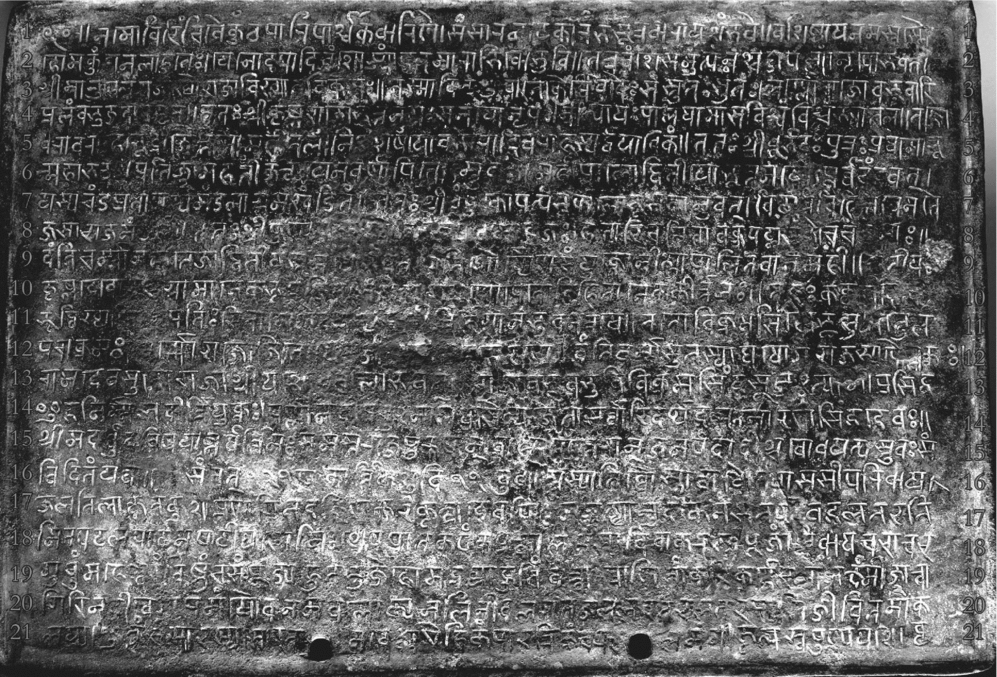
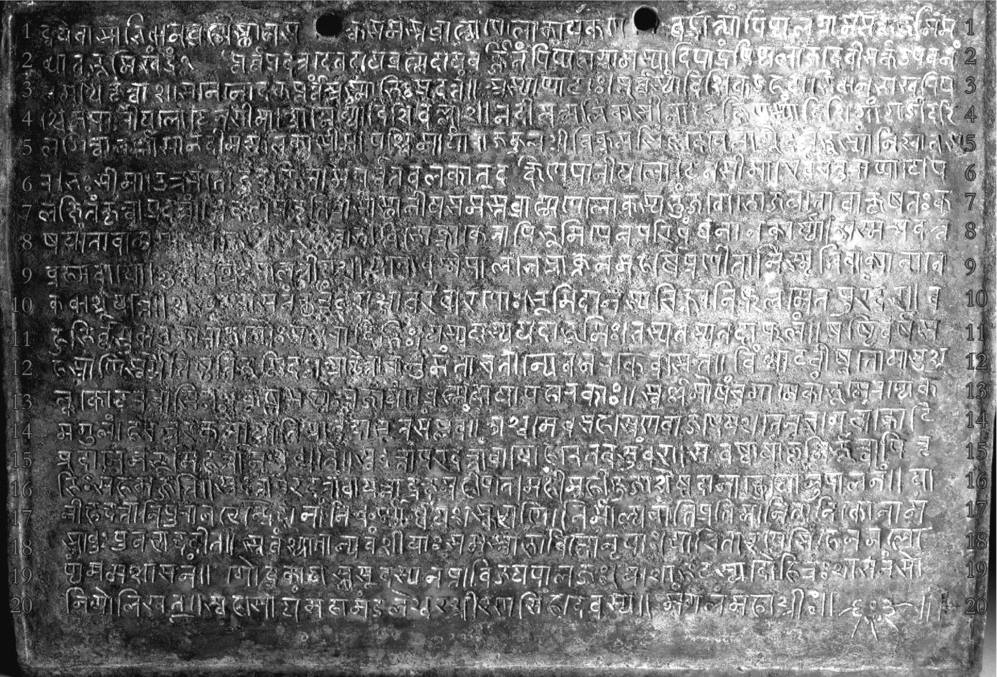
This copperplate charter of Raṇasiṃha came to my attention in the spring of 2008 when I was asked to study and translate the inscription. The plates are presently in a private collection and the direct study of the inscription has not been possible. Nonetheless, good quality digital photographs of the plates were made available to me and these form the basis of the present article.
The charter (see Figs 1 and 2) consists of two plates of copper or bronze, 275 by 390 millimetres in size and joined into a booklet by two rings on one of the longer sides. Only one ring remains, which bears no seal. Both plates are inscribed on one face only (with 21 lines on Plate (a) and 20 lines on Plate (b)); the inscribed faces were presumably the inside of the booklet. I have neither photos of, nor information about, the verso faces of the plates, but they certainly bear no inscription, and are presumably without decoration. The time, place and circumstances of their finding are not known. The plates are in fairly good condition, with one badly corroded blotch near the centre of both plates. The rims of the tablets are raised but the damaged central area may be a result of part of the surfaces rubbing against one another.
Copper plate charter of Raṇasiṃha, first plate.

Copper plate charter of Raṇasiṃha, second plate.

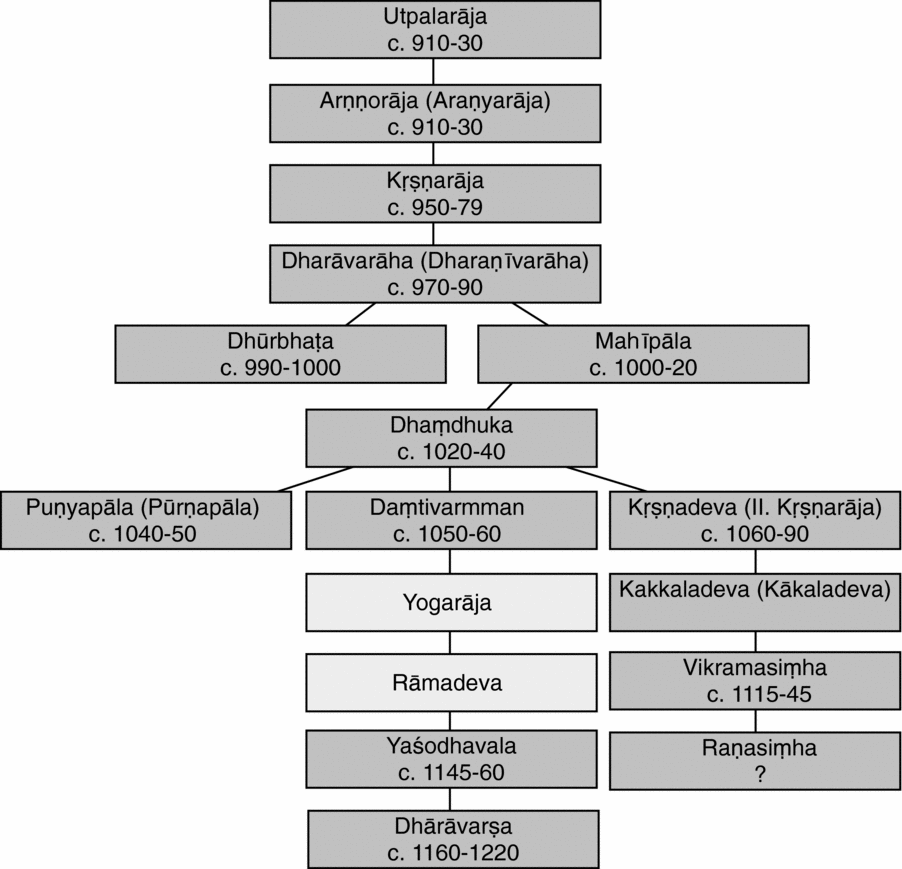
Family tree of the Candrāvatī Paramāras up to Dhārāvarṣa with approximate reign dates. Persons named in the light grey fields did not rule; see text for details.

The inscription describes a land grant made by king Raṇasiṃha or Raṇasiṃhadeva of the Candrāvatī branch of the Paramāra dynasty to a brāhmaṇa community. The text begins with an invocation to Śiva, followed by a versified description of Raṇasiṃha's genealogy. The ritual circumstances of the donation follow, going on to the specifics of the estate. The third section of the inscription is comprised of stock verses declaring the sanctity and inviolability of land grants. The text closes with a colophon naming the scribe and declaring the inscription to be of Raṇasiṃha's own hand.
The town of Candrāvatī was situated near the location of modern-day Ābū Road at the foot of the Arbuda Mountain (Mount Ābū). It was ruled by a branch of the Paramāra dynasty from the tenth to the thirteenth century. Their country, called Arbuda like the mountain, lay west of the Arāvalī Mountains in what is now southern Rājasthān and northern Gujarāt.
The name of Raṇasiṃhadeva is known only from a scant handful of published inscriptions.Footnote 1 The established view on Raṇasiṃha is that he briefly usurped the throne of Dhārāvarṣa (subsequently the greatest ruler of his dynasty) while the latter was occupied with a war in the southeast in the early years of his reign. The present inscription, however, casts a new light on the previously known sources, and intimates that Raṇasiṃha may have reigned legitimately before Dhārāvarṣa, and may even have been instrumental in the latter's succession to the throne.
For the present study, I have referred to the two plates as (a) and (b). When noting palaeographic features, or items of vocabulary, the specific places in the inscription are indicated using the plate's letter and the line number. Thus, for example, (a7) refers to line 7 in Plate (a). This system is also used to show the line numbers in the transcription of the text proper.
Epigraphy and Orthography
The text is written in nāgarī script with features resembling other known inscriptions of the Candrāvatī Paramāras.Footnote 2 The characters va and ba are not distinguished. The vowel e is generally written as a full-height vertical pṛṣṭhamātrā and o as a full-height line before and after the consonant; however, both are occasionally written above the consonant (e.g. (b16) śreṣṭha, (a8)saṃkoca). The vertical part of the mātrā of i is occasionally omitted, leaving only the curve above the consonant (e.g. (b2) varjjitaṃ, (b6) dakṣiṇa, (b16) kārttika). Of the character ra, both the earlier form (a short horizontal stroke joining the vertical stem, e.g. (a1) dhāriṇe) and the modern Devanagari form (e.g. (a1) viriṃci) are present in the text. The character ca usually has a triangular body (e.g. (a1) viriṃci), but sometimes it is rounded and practically identical to va, while at yet other times it has a form very similar to the modern Devanagari glyph, rounded with an additional horizontal stroke (e.g. (a18) carācara). The sign for dha only differs from va in that it lacks the upper rekhā, and sometimes even this difference disappears (e.g. (a3) vivudhaiḥ). The vowel mātrā of the syllables dhā and dho is joined by a horizontal stroke to the stem of the consonant.
The inscriber's work is of a rather low standard. The careless formation of characters has made va and ca as well as pa and ya easy to confuse; and ṇa, when it comes as the second consonant of a ligature, looks more like la. Virāmas are repeatedly omitted, and anusvāras are also missing from time to time, though some of these may have become indiscernible because of damage to the plates. Parts of consonant ligatures are occasionally absent. Aside from sloppy writing and missed glyphs, some characters are actually erroneous, e.g. (a7) yema for yena, (a3) nasmād for tasmād, (b5) bhūsyāṃ for bhūmyāṃ.
The orthography of the plates suits the conventions of the period. The second element of ligatures starting with r is doubled except for sibilants. The avagraha is generally omitted, though it does appear in a few cases ((a6) ‘mvudaḥ (a6) ’pūrvva). Final m is consistently written as anusvāra, including the ends of sentences and verse lines, and in some cases even before words beginning with a vowel. Saṃdhi is not always applied between words, but lack of saṃdhi probably serves punctuation rather than being another symptom of carelessness. The ends of sentences and half-verses are marked by daṇḍas; double daṇḍas are used at the end of verses and of some sentences. One other punctuation mark is used (at the end of line (a16)), which looks like the regular sign for a hyphen, but here seems to serve a function akin to the semicolon. Verses are not numbered in the inscription.
The language is Sanskrit; most of the few words that I fail to interpret (and also to discern with certainty) are probably proper names. Grammatical errors are few and minor, e.g. (a5) ṛddhayā (for ṛddhyā). Some awkward compounds and clumsy sentences intimate that the composer of the inscription was no great scholar of Sanskrit.
Time and Place
The inscription is dated saṃvat 1218 kārttika śudi 12 budha. Assuming that the number refers to elapsed (gata) years rather than the current (vartamāna) year, that a kārttikādi year was used, and that months were reckoned as amānta, the date corresponds to 1 November 1161 ce, which was indeed budha, Wednesday. The use of kārttikādi years with amānta months is generally characteristic of the geographical region,Footnote 3 and most of the available dated inscriptions of the Candrāvatī Paramāras follow this system.Footnote 4 Further, as the month of the inscription is kārttika, the conversion of the year to the Gregorian calendar is not affected by whether the year was kārttikādi or caitrādi; and as the date is in the śukla fortnight, amānta or pūrṇimānta months also make no difference. If the composer of the text had used the vartamāna year, the corresponding date would be 13 November 1160 ce – however, that day was a Saturday, so vartamāna years can also be ruled out.
The identification of most of the geographical names mentioned in the inscription is uncertain. The name Arvvuda of course refers to the kingdom, and Caṃdrāpallī seems to be an alternative name for Candrāvatī.Footnote 5 The river referred to as Varṇṇāśā (b4) and as Varṇṇāsā (b5) is in all likelihood the modern Banās, which originates in the Arāvalī Mountains and runs northeast by the foot of Mount Arbuda, finally joining the river Chambal.
I can only speculate about the rest of the place names in the text. The settlement Pippalagrāma may be equivalent to a present-day village named Pipalmat, 2 or 3 kilometres to the southwest of Candrāvatī. The village of Vāsā in the text may correspond to modern-day Vāsra, 3 or 4 kilometres to the west of Candrāvatī or to modern-day Wāsa about 25 kilometres to the northeast of Candrāvatī (and just northeast of Roheḍā).Footnote 6 However, all these settlements are on the right bank (i.e. to the southeast) of the river Banās, while the inscription clearly states that the river is to the southeast and south of the land granted in the region of Pippalagrāma. Looking at the relief of the terrain, I find it unlikely that the course of the river would have shifted so much since then.
A river by the name of Parṇṇā is mentioned both in our text and, in a similar context, in the Roheḍā inscription. Trivedi identifies this as the modern-day stream called Pūrṇā running near the village of Girvaḍ, 12 kilometres due northwest of Ābū. He also proposes that the correct reading of the name in the Roheḍā inscription should be Pūrṇṇā. However, the only detailed map available to me shows Girvaḍ 7 or 8 kilometres due south of Mount Ābū, and has no stream of this name in the area. It is possible that by Ābū, Trivedi meant the town of Candrāvatī, of which Girvaḍ is indeed to the northwest. Still, if there is or was a stream called Parṇā or Pūrṇā in this vicinity, it would probably have been too insignificant for Dhārāvarṣa's decisive battle against the army of Mālava to be remembered by its name. It is also more likely that such a battle would have been fought further away from the town of Candrāvatī, and in the direction of Mālava, i.e. to the southeast of Candrāvatī. Another possibility is that Parṇṇā is just a shorter name for the Parṇṇāśā, which is most likely to be the Banās. The remaining geographical names in the inscription are still to be identified.
Transliterated TextFootnote 7

(a1) oṃ ‖
namo viriṃcivaikuṃṭḥapāripārśvakadhāriṇe |
saṃsāranāṭakāraṃbhasūtradhārāya śaṃbhave ‖ [1Footnote 8]
vaśiṣṭhāya namas tasmai (a2) homakuṃḍānalāhuteḥ |
yenodapādi vaṃśo [’]syāṃ paramārābhidho bhuvi ‖ [2]
tatra vaṃśe samutpannaś ca[ṃ]drāpallyāṃ nṛpo bhavataFootnote 9 |
(a3) śrīmān utpaFootnote 10larājākhyo rājyavikhyātavikramaḥ ‖ [3]
nasmādFootnote 11 inraFootnote 12 ivānekair vvivudhaiḥ saṃstutaḥ sutaḥ |
arṇṇorājo vabhūvāri(a4)pralaṃvabhujada{rppa}hṛt ‖ [4]
tataḥ śrīkṛṣṇarājo [’]bhūt tanayaḥ sanayo nṛpaḥ |
nītyā yaḥ pālayām āsa viśvaṃ viśvaṃbharātalaṃ ‖ [5]
tajjo (a5) dharāvarāho [’]bhūd rājottamo mahītalaṃ |
niḥś{e}ṣaṃ yo vabhārādivarāhasyarddhayādhikaṃ ‖ [6]
tataḥ śrīdhūrbhaṭaḥ putraḥ prathamo [’]bhū(a6)nmahābhaṭaḥ |
pratijñāṃ mahatīṃ kṛtvā yena varṣāpito 'mvudaḥ ‖ [7]
mahīpālo dvitīyo [’]bhūt tanayo 'pūrvvacaṃdravat |
(a7) yasya caṃḍapratāpasya maṃḍalāgram akhaṃḍitaṃ ‖ [8]
tataḥ śrīdhaṃdhuko [’]patyaṃ bhūpālo [’]bhūt sa bhānuvat |
vichāyaṃ vihita{ṃ} yemaFootnote 13 te(a8)jasā rājamaṃ{ḍa}laṃ ‖ [9]
tataḥ śrīpuṇyap{ā}l{o [’]bhū} * * {sya} pra{tha}mo [‘]ṅgajaḥ |
hatārivanitāvaktrapadmasaṃkocacaṃ{dra}māḥ ‖ [10]
(a9)daṃtivarmmā mahātejā dvitīyas tanayo [’]bhavat |
yo [’]tiśauryyeṇa saṃyukto nītyā pālitavānaFootnote 14 mahīṃ ‖ [11]
{tṛ}tīyaḥ (a10) kṛṣṇadevo {[’]bhūt} s{aṃ}grāmānekabhūpajit |
sa{rvva} * * {gu}ṇopeto vihitānekakīrttanaḥ [12] ‖
tajjaḥ kakkaladev{o} (a11)[’]bhūd vikhyā{to} nṛpatiḥ sitā |
{gaṃg}eva ya{sya} * {k}īrttir jagāma bhuvanatraye ‖[13]
tato vikramasiṃho [’]bhūt suto [’]tula(a12)parākramaḥ |
{a}rṇṇorājo jito ye{n}a jī * * * * se raṇe ‖ [14]
daṃtivarmmasutasyādya yogarājasya pauttrakaḥ |
(a13)rāmadevasuto rājā śrīyaśodha{va}lo [’]bhavat ‖ [15]
rājā vabhūva bhuvi vikramasiṃhasūtaḥ
tyāgī prasiddha (a14)iha nirmmalakīrttiyuktaḥ |
parṇṇānadīpracuramālavasainyajetā
sarvvāridarppadalano raṇasiṃhadevaḥ ‖ [16Footnote 15]
(a15)śrīmadarvvudaviṣayāntarvvarttinaḥ samastarājapuruṣān vrāhmaṇottarān janapadādīṃś ca vodhayaty astu vaḥ saṃ(a16)viditaṃ yathā ‖(_) Footnote 16 saṃvat 1218 kārttika śudi 12 budha ‖ asyā{ṃ} tithau snātvā dhautavāsasī paridhāya(-)Footnote 17 (a17)jalatilākṣatakuśapraṇayinaṃ dakṣiṇakaraṃ kṛtvā devapitṛmanuṣyān udakena saṃtarppya vahalatarati(a18)mirapaṭalapāṭanapaṭīyaso miḥśeṣaFootnote 18pātakapaṃkaprakṣāla{ka}sya divākarasya pūjāṃ {vi}dhāya carācara(a19)guruṃ maheśvaraṃ viṣṇuṃ ca saṃpūjya hutabhuj{i} homadravyāhutiṃ dattvā prāṇināṃ vārikarṇṇaFootnote 19calāṃ lakṣmīṃ jñātvā (a20)girinadīve{go}pamaṃ yauvanam avalokya nalinīdalagatajalalavataralataraṃ prāṇijīvitamāka(a21)layya | itthaṃ saṃsārasāsyāsāratā(binding hole)m avekṣya aihikaṃ pāratrikaṃ ca pha(binding hole)lam aṃgīkṛtya svapuṇyayaśovṛ(b1)ddhaye vāsābhidhānavrahmasthānasa(binding hole)tkasamastavrāhmaṇalokāya kaṇa (binding hole) vadrāttyāṃ pippalagrāmasatkabhūmima(b2)dhyātaFootnote 20 bhūmikhaṃḍaṃ 1(__)Footnote 21 pūrvvapradattadevadāyavrahmadāyavarjjitaṃ pippalagrāmasyādipādraṃ pippalājadevīsatkaṃ upavanaṃ (b3)ca madhye kṛtvā śāsanenodakapūrvvaṃ asmābhiḥ pradattaṃ ‖
asyāghāṭāḥ | pūrvvasyāṃ diśi kaḍahaṭābhidhānabhākharipa(b4)ścimapānīyaFootnote 22loṭena sīmā | agneyyāṃ diśi varṇṇāśānadīmatmalikāFootnote 23 sīmā | dakṣiṇasyāṃ diśi gāṃgaḍīdari (b5)lagitvā varṇṇāsānadīmatsalikā sīmā [|] paścimāyāṃ rājakulaśrīvikramasiṃhadevenāgre dattabhūsyāṃFootnote 24 nikhātasu(b6)rabheḥ sīmā | uttarato jaṃvūkṣināmaparvvatavalakāt dakṣiṇapānīyaloṭena sīmā | evaṃ caturāghāṭopa(b7)lakṣitaṃ kṛtvā pradattaṃ ‖
tad adyaprabhṛti vāsāsthānīyasamastavrāhmaṇalokasya bhuṃjato bhojayato vā kṛṣataḥ ka(b8)ṣayaṃtoFootnote 25 vā a{smadva}ṃśaje{neta}re{ṇa} vā bhāvibhoktrā kenāpi bhūmipena paripaṃthanā na kāryyā | asmatpradatta(b9)vrahmadāyo |Footnote 26 [’]nu{maṃta}vyaḥ pālanīyaś ca | yato dharmmapālane prāktanamaharṣipraṇītāni smṛtivākyāny ane(b10)kadhā śrūyante ‖
śa{ṃ}kha{ṃ bhadr}āsanaṃ cchatraṃ varāśvā varavāraṇāḥ |
bhūmidānasya cihnāni phalam etaFootnote 27 puraṃdara ‖ [17Footnote 28]
va(b11)hubhir vvasudhā bhuktā rājanyaiḥ sagarādibhiḥ |
yasya yasya yadā bhūmiḥ | tasya tasya tadā phalaṃ ‖ [18]
ṣaṣṭivarṣasa(b12)hasrāṇi svarge tiṣṭhati bhūmidaḥ |
ācchettā cānumaṃtā ca tāny eva narake vaset ‖ [19]
viṃdhyāṭavīṣv atoyāsu śu(b13)lkaFootnote 29koṭaravāsinaḥ |
kṛṣṇasarppāḥ prajāyaṃte vrahmadāyāpahārakāḥ ‖ [20]
svarṇṇamāṣaṃ ca gām ekāṃ bhūmer apy eka(b14)m agulaṃFootnote 30 |
haran narakam āyāti yāvad ā bhūtasaṃplavaṃ ‖ [21]
aśvamedhasahasreṇa vājapeyaśatena ca |
gavāṃ koṭi(b15)pradānena bhūmiharttā na śudhyati ‖ [22]
svadattāṃ paradattāṃ vā yo hareta vasuṃdharāFootnote 31 |
sa vaṣṭhāyāṃFootnote 32 kṛmir bhūtvā pitṛ(b16)bhiḥ saha majjati ‖ [23]
svadattāṃ paradattāṃ vā yatnād rakṣa mahīpate |
mahīṃ mahībhujāṃ śreṣṭha dānāc chreyo[']nupālanaṃ ‖ [24]
yā(b17)nīha dattāni purā narendrair
dānāni dharmmārthayaśaskarāṇi |
nirmālyavāṃtipratimāni tāni
ko nāma(b18)sādhuḥ punar ādadīta ‖ [25Footnote 33]
svavaṃśyā vānyavaṃśīyāḥ samastā bhāvino nṛpāḥ |
yācitā raṇasiṃhena na lo(b19)pyaṃ mama śāsanaṃ ‖ [26Footnote 34]
gauḍakāyasthasūdasya naptā vijayapālajaḥ | yaśobhaṭasya dauhitraḥ śāsanaṃ so(b20)niyo [’]likhat ‖
svahasoFootnote 35 [’]yaṃ mahāmaṃḍaleśvaraśrīraṇasiṃhadevasya ‖
maṃgalaṃ mahāśrīḥ ‖ (puṣpikā) ‖
Translation
Om! Homage to Śiva, the stage director at the beginning of the play that is worldly existence, who has Brahmā and Viṣṇu as his assistants. [1] Homage to Vaśiṣṭha, to him who created the dynasty named Paramāra on this earth from an oblation into the fire of the sacrificial pit. [2] In that dynasty was born in Caṃdrāpallī a glorious king named Utpalarāja whose heroism is famed [throughout] the kingdom. [3] A son was born of him, praised by many wise men as Indra <is praised by many gods>: Arṇṇorāja who robbed his enemies of their pride over their pendulous arms. [4] From him came [his] son, glorious Kṛṣṇarāja, the prudent king who protected the entire surface of the earth with good polity. [5] From him was born Dharāvarāha, the supreme king who bore the entire earth in as much and more prosperity as the original Boar.Footnote 36 [6] After him came his first son, glorious Dhūrbhaṭa, a great soldier who had undertaken a great vow and caused the cloud to rain. [7] [Dharāvarāha's] second son was Mahīpāla, the scimitar of whose fierce valour was unbroken, like a unique moon <the surface of whose orb of brightness did not wane>. [8] Then his son became king: glorious Dhaṃdhuka who rendered the kingdom shadowless with his ardour as the sun <does with its brightness>. [9] Then [came] glorious Puṇyapāla . . . first-born son, the moon that wilts the day-lotuses that are the faces of the wives of his killed enemies. [10] [Dhaṃdhuka's] second son was Daṃtivarmman of great power, who, being endowed with great valour, protected the earth with good polity. [11] The third was Kṛṣṇadeva, defeater of numerous kings in war, endowed with all . . . virtue, to whom praise was rendered by many. [12] After him came the renowned king Kakkaladeva whose bright fame, like the <pure> Ganges, went to all three worlds. [13] From him was born his son Vikramasiṃha of matchless courage, who defeated Arṇṇorāja in . . . . . . battle. [14] Now glorious Yaśodhavala became king, [who was] the grandson of Daṃtivarmman's son Yogarāja [and] the son of Rāmadeva. [15] Raṇasiṃhadeva, begotten by Vikramasiṃha, became king on the earth: generous, famous and possessed of spotless renown in this [world], the vanquisher of Mālava's immense army [at the] river Parṇṇā and the crusher of the pride of all enemies. [16]
[Raṇasiṃha] instructs all royal officials living within the territory of glorious Arbuda, as well as the people of the country among whom brāhnaṇas are foremost: let it be known to you that:
Year 1218, 12th of the bright fortnight of Kārttika, Wednesday. On this date, having bathed and put on laundered clothes; having held in the right hand water, sesame seeds, unbroken grains and kuśa grass; having offered water to gods, ancestors and men; having given obeisance to the Sun who is adept at tearing up the veils of diverse kinds of darkness and who washes off the mud of all sins; having worshipped Śiva, the master of all things animate and inanimate, along with Viṣṇu; having given an oblation of substances in fire; realising that the fortune of living beings is as fickle as a droplet of water; beholding that youthfulness [as it rushes away] is comparable to the speed of a mountain river, and considering that life is as extremely unstable as a drop of water on a lotus petal; having thus given regard to the fact that material existence is of no essence, embracing fruits in this world and in the next, in order to augment our merit and fame, 1 sectionFootnote 37 of land belonging to Pippalagrāma in Kaṇavadrātti, including the primary villageFootnote 38 of Pippalagrāma and the grove belonging to Pippalājadevī except for estates previously donated to the gods or brāhnaṇas, has been granted by us through a decree accompanied by an offering of water, to the entirety of the brāhnaṇa community belonging to the brāhnaṇa village called Vāsā.
Its boundaries [are as follows]. In the eastern direction the limit is the western water bankFootnote 39 of the . . . called Kaḍahaṭa. In the south-eastern direction the limit is the . . . [of the] river Varṇṇāśā. In the southern direction the limit is the . . . [of the] river Varṇṇāśā adjoining the Gāṃgaḍī ravine.Footnote 40 In the western [direction] the limit is the landmark steleFootnote 41 dug down in the land which was previously donated by the glorious Vikramasiṃhadeva of [our] dynasty. To the north the limit is the water bank south of the escarpment called Jamvūkṣi. Thus it is granted, delineated with four boundaries.
Therefore from this day onward [this estate] shall not be taken away from the community of all brāhmaṇas of Vāsā, whether they consume [its produce] or feed [others on it], whether they till it or have it tilled [by others], by any king who reigns in the future, [whether] born of our dynasty or another. This gift donated by us to brāhmaṇas shall be respected and maintained. For with regard to maintaining law, countless sentences of the scriptures composed by great ancient sages are commonly known:
“A conch, a splendid throne, a parasol, good horses and choice elephants – these [royal] signs are the fruit of granting land, O Indra”. [17] “The land has been enjoyed by many princes beginning with Sagara. Whoever owns the land at a particular time, it is he who owns [its] fruit at that time”. [18] “One who grants land shall remain in heaven for sixty thousand years, while one who seizes [land] or approves [of seizing land] shall reside in hell for the same [number of years]”. [19] “Those who deprive brāhmaṇas of their granted property shall be [re]born as black snakes living in dry holes in the waterless wilderness of the Vindhya [mountains]”. [20] “One who robs a bean[-sized bit] of gold, a single cow or a finger['s breadth] of land shall go to hell until all creatures are drowned [in the deluge at the end of the world]”. [21] “The snatcher of land shall not be purified even by a thousand horse sacrifices, nor by a hundred vājapeya sacrifices, nor by donating ten million cows”. [22] “One who would seize land, whether [formerly] given by himself or another, shall sink in faeces [reborn] as a worm for sixty thousand years, along with his forefathers”. [23] “O king and best of the rulers of the land, protect that land which had been given by you or by others; safeguarding [a gift] is superior [even] to giving”. [24] “Grants conducive to righteousness, wealth and fame, that had been given by former kings, are like used garlands or vomit: what decent man would partake of them again?” [25] Raṇasiṃha begs all future kings of his own dynasty or of other dynasties: do not violate my decree. [26]
Soniya son of Vijayapāla and grandson of Sūda, a kāyastha from Gauḍa, maternal grandson of Yaśobhaṭa, has inscribed [this] decree. This is [as if in] the own hand of the great ruler, the glorious Raṇasiṃhadeva. [May there be] blessings and great prosperity.
Genealogy
The charter describes the succession of the Candrāvatī Paramāra rulers just as it is found on the Roheḍā plate, with minor variation in some of the names. The family tree in Fig. 2 indicates the approximate dates of each ruler's reign as estimated by Trivedi, with the names he uses for the rulers given in parentheses where different in more than orthography from the versions in our text.Footnote 42
The Roheḍā plate and the Vasantagaḍh inscription begin the dynasty with Utpalarāja.Footnote 43 The name is somewhat unclear on our plates, and it seems that a previously inscribed Ujjvalarāja may have been corrected to Utpalarāja, possibly by the same hand. Subsequent rulers are described rather tersely and mostly in stereotyped terms. Some of these descriptions involve fairly elaborate double entendres, and some may refer to the actual exploits of kings and might be used as a starting point for further research into the little-known history of the dynasty. What is important for our present purposes is that after Dhaṃdhuka, the sixth ruler to follow Utpalarāja, the dynasty split into parallel lines of descent through Dhaṃdhuka's sons. The eldest, Puṇyapāla or Pūrṇapāla, evidently died without issue, and rulership was inherited for a while in the line of the youngest son, Kṛṣṇadeva, succeeded by his descendants Kakkaladeva and Vikramasiṃha. However, the subsequent rulers of the dynasty again came from the lineage of the middle brother, Daṃtivarmman.
Raṇasiṃha's Reign
According to Raṇasiṃha's land grant, after Yaśodhavala's reign the throne was occupied by “Raṇasiṃhadeva [. . .] the vanquisher of Mālava's immense army at the river Parṇṇā” ((a13–14), verse 16). On the other hand, published histories of the dynasty indicate that Yaśodhavala was followed by his son Dhārāvarṣa, and mention Raṇasiṃha only as a usurper, if at all. There must have been a certain degree of strife between the rival lineages sired by Daṃtivarmman and Kṛṣṇadeva, and it is certainly feasible that whenever a member of one branch took hold of the throne he would have tried to blacken the other line's fame. However, the fact that this present inscription by Raṇasiṃha does not even mention Dhārāvarṣa at all, to some extent implies that Raṇasiṃha ruled prior to the latter's accession to the throne, rather than – as generally understood – stealing the crown of an already-enthroned Dhārāvarṣa. Nevertheless, it is also a possibility that the conventional understanding is right; in this case Raṇasiṃha's silence about Dhārāvarṣa may be seen as an attempt to forget him, and a land grant may have been made precisely to win brahmanical approval for Raṇasiṃha's illegitimate rule.
Trivedi ascribes the victory at the river Parṇṇā (or Pūrṇṇā as he reads it) to Dhārāvarṣa.Footnote 44 His interpretation of the events is that while Dhārāvarṣa was busy fighting Mālavan intruders, Raṇasiṃha snatched his throne illegitimately. However, the former regained rulership by pleasing his liege lord (the Caulūkya Kumārapāla, c. 1143–72 ce) with his astuteness, devotion and valour.
Majumdar, on the other hand, says it was Raṇasiṃha who defeated the army of Mālava on the banks of the Parṇṇā (which he calls Parlā), and that it was his (i.e. Raṇasiṃha's) favour that returned Dhārāvarṣa to the throne.Footnote 45 His conclusion is that Raṇasiṃha had obtained the crown of Candrāvatī for a period, but ceded power to Dhārāvarṣa subsequently.
Somani understands Dhārāvarṣa to have won the victory at the river (which he claims is in Mālava, but as he gives no identification, this is probably his own conjecture) and asserts that Raṇasiṃha snatched power while Dhārāvarṣa was busy waging war in Mālava.Footnote 46 He supports his thesis by stating that while inscriptions hallmarked by the name of Dhārāvarṣa prove that he was reigning in Candrāvatī in VS 1220 and 1221, we do not hear of him for a few years between VS 1222 and 1230. His conclusion is that Raṇasiṃha usurped his throne in this interval.
The idea that Raṇasiṃha seized power from Dhārāvarṣa is evidently based on the Roheḍā plate.Footnote 47 The relevant section of that inscription is worth a second look now that Raṇasiṃha's land grant provides a new perspective.Footnote 48
tatsūnuḥ paramāravaṃśatilakaḥ kṣoṇībhujām agraṇīḥ
śāstrāstrādikalākalāpakuśalo labdhānurāgo jane |
śrīmānarbudabhūmimaṃḍalapatiḥ prauḍhapratāpānvito
dhārāvarṣanareśvaro 'bhavad asau puṇyaprabhāvotkaṭaḥ ‖9‖
pūrṇṇātaṭe mālavikapravīrān
parāṅmukhān yaḥ kṛtavān śaraughaiḥ |
kṣoṇīṃ pitur vikramasiṃhasūnur
lebhe 'ntarā śrīraṇasiṃhadevaḥ ‖10‖
prasādya sa prabhoḥ pādān
buddhibhaktiparākramaiḥ
tatprasādāt punaḥ prāpa
dhārāvarṣo nijāṃ mahīṃ ‖11‖
The content of verse 9 is not relevant to the matter of hand, but it should be noted that it is a śārdūlavikrīḍita stanza and a complete sentence, which states that Dhārāvarṣa, the son of the previous ruler (i.e. Yaśodhavala) succeeded to the throne. The next verse is in the upajāti metre. Quarters (c) and (d) of verse 10 say that Raṇasiṃha, the son of Vikramasiṃha, obtained the land for a while (antarā; or possibly: “in the meanwhile,” that is to say, while Dhārāvarṣa was reigning or while he was away campaigning). It is the clause in lines (a) and (b) of this verse that allows for ambivalent interpretations: “who routed the heroes of Mālava with the flood of his arrows on the bank of the Pūrṇṇā.” This clause has been read as qualifying Dhārāvarṣa, the subject of verse 9. Now it is not impossible for a sentence to cross the verse boundary, but such a thing is unlikely in a versified genealogy, and is made even more unlikely by the fact that the two verses are in a different metre. It is thus more logical to read verse 9 and 10 independently, each on its own. This makes the clause in (10ab) qualify Raṇasiṃha. The important point here is that reading the Roheḍā plate this way eliminates the contradiction with Raṇasiṃha's land grant.
To carry on with the Roheḍā text, verse 11 is ambiguous again. Quarters (a) and (b) have no finite verb but a gerundive, so this statement (literally: “he, having pleased the feet [i.e. presence] of [his] lord by astuteness, devotion and valour. . .”) is again a subordinate clause. Lines (c) and (d) state that “by his favour Dhārāvarṣa again obtained [his] own land”. In this verse it is the pronouns that allow for ambivalence. It is more than likely that the subject of the subordinate clause in (10 ab) is Dhārāvarṣa, for this is again a new verse in a different (anuṣṭubh) metre. If so, the pronoun sa in quarter (a) is redundant, but not grammatically wrong. The other pronoun, tat- in line (c), probably refers to the lord (prabhu) in line (a) – and unfortunately grammar offers us no clue as to whether this “lord” is Raṇasiṃha from the previous verse, or a more powerful ruler (such as Kumārapāla), or simply the Lord almighty.
With nothing but the Roheḍā plate to go by, the accounts given by Trivedi, Majumdar and Somani would be equally feasible. But the land grant of Raṇasiṃha makes the picture somewhat clearer. It was probably Raṇasiṃha rather than Dhārāvarṣa who defeated the army of Mālava along the Parṇṇā. It is also likely that Raṇasiṃha ruled legitimately before Dhārāvarṣa rather than usurping the throne after the latter was anointed. The latest known dated inscription of Yaśodhavala comes from VS 1207, while Dhārāvarṣa's earliest known dated inscription is from VS 1220.Footnote 49 Between these two dates there is ample time for Raṇasiṃha's rule. The fact that the present inscription bears Raṇasiṃha's name and the date VS 1218 annuls Somani's suggestion that Raṇasiṃha usurped power sometime after VS 1221 and implies that Dhārāvarṣa's apparent “silence” in those years is more likely due to chance.
It is also noteworthy that Dhārāvarṣa's reign was unusually long (his latest known dated inscription was issued in VS 1276,Footnote 50 56 years after the earliest). This raises the possibility that he was a child when he inherited the throne from Yaśodhavala, and Raṇasiṃha may have been a regent during Dhārāvarṣa's minority, ceding power willingly when the latter came of age. This theory of regency may also explain why the victory at the Parṇnā is attributed to both rulers in different inscriptions. To enter the realm of romantic speculation, it is even possible that it was the “astuteness, devotion and valour” shown in this very campaign that convinced his guardian of Dhārāvarṣa's maturity.