In March 1917, France’s Minister of Commerce, Industry, Post and Telegraphs sounded the alarm: Europe’s agriculture was in crisis, and its fields must be made fertile again. During the First World War, phosphate-based fertilizer consumption plummeted. But France held an advantage in Europe’s post-war quest to acquire ‘all the fertilizer indispensable for re-establishing production’. Footnote 1 Due to its protectorate over Tunisia, France controlled Europe’s largest source of phosphate rock in the early twentieth century. Overlapping transnational networks of labour, commerce and capital combined to break apart the mountains of southern Tunisia, refine the mountain rock into fertilizer and scatter this chemically processed Tunisian land over Europe’s farms in ever-increasing quantities. Footnote 2
Scholars have written accounts of single commodities to shed new light on the history of capitalism, empire and global interconnectivity. A prominent subset of these histories, both academic and popular, chart how a chosen commodity – sugar, cotton, etc. – made the modern world, arguing for its privileged place in the birth of global capitalism or modern globalization. Footnote 3 Many of these works have faced critique for granting excessive explanatory power to their chosen commodities. Footnote 4 Jakes and Shokr argue that Beckert’s Empire of Cotton rests on ‘a fixation with cotton itself rather than a simultaneous analysis of the value embodied in it’. Capitalism is not purely about the production of goods. Rather, it is a web of relations through which value embeds in these goods. To understand cotton’s place in the history of capitalism, they argue, we must ‘follow the value, not just the cotton’.Footnote 5
Through a study of North African phosphates in the interwar period, I argue that following the value breaks down our very notion of what a commodity is, of what the ‘commodity’ as a unit of analysis can contain. For a substance to become a commodity, it must have value, deriving from the uses it serves (use value) and the profits garnered by buying and selling it (exchange value).Footnote 6 Both types of value stem from the commodity’s material properties, but they cannot be reduced to materiality alone. When a commodity’s use and/or exchange value alters, the boundaries around the commodity may shift. Can we write a history of phosphates without coal, at a time when their use values were defined together? In what contexts is it no longer tenable to consider different staples of cotton, blends of tobacco or grades of phosphates as one commodity?Footnote 7 The scope of any single-commodity history is not self-evident.
Modern heavy-input farming relies on phosphate-based fertilizers. But to argue that phosphates made the modern world implies that their status as a commodity is embedded in a shared material essence, that ‘phosphates’ constitute a stable unit of analysis across myriad chronologies and geographies. These assumptions are false. Instead, we must explore how the character of commodities can alter, how substances can be recommodified when the value within them changes across space and time. As units of analysis, commodities are multiform. ‘Multiform’ signals the multiple properties that a commodity can take on – across an array of contexts – when its use and/or exchange value transmutes. A particular commodity may have fewer possible forms in a given context, but no commodity constitutes a stable analytical unit.
This argument, that commodities are multiform, offers a new way to consider geographic scale. In a 2009 special issue of this journal, Hazareesingh and Curry-Machado called on commodity historians to ‘realig[n] the lens away from teleological ideas about “globalization”’ in favour of an approach inspired by Cooper: ‘thinking about the plurality of spatial linkages, networks, and connections, which were more than local but less than global’.Footnote 8 I argue that multiform and ever-changing commodities illuminate multiform and ever-changing scales. As phosphates were commodified differently, the geographic scales over which they operated changed too: between empires, regions and an assortment of localities. To follow value, we must incorporate the granular scale of Tunisia’s mining towns and the global scale of financial markets. A study centred on Pacific phosphates would view these connections differently, because it would spotlight other contexts in which value was produced. This is another reason why global commodity histories cannot use the commodity as a stable unit of analysis. To do so would ossify the geographic scales through which we view interconnections around commodities, obscuring the role of particular locations in capitalist relations of production, exploitation and exchange.
In this article’s first half, I expand the history of phosphates to include other goods beyond direct inputs in fertilizer. From 1918 to 1921, French diplomats redefined phosphates’ use value in a way that restructured European trade relationships. Through a system of bartering, they transformed Tunisia’s phosphates into myriad other commodities – including coal, quinine and labour – that France was struggling to access amidst general shortages. Moving within this global constellation of goods were migrant miners, who spread radical ideas and resistance techniques around the Mediterranean concurrent with the 1919-20 global upsurge in labour militancy. Following value demands a frame beyond phosphates alone, allowing us to stitch together a global network of commodities whose use values intertwined and within which labour resistance nested.
The article’s second half tackles the category of ‘phosphates’ itself. European stakeholders did not view all phosphates in a static way. During a period of overproduction in the 1920s, the exchange value gap between high- and low-grade phosphates dwindled, triggering a change in the use value of high-grade rock. As a result, high- and low-grade phosphates metamorphosed into two types of the same commodity, not ‘two distinct products’ as before.Footnote 9 This shift provoked new Franco-US competition in Europe, restructured regional blocs and left Tunisia’s mines vulnerable to financial crisis while Morocco’s mines absorbed their market share. By following value, we see that phosphates were not the same commodity in all contexts. Instead, the extent of the world’s phosphates that fit within the analytical unit of ‘one commodity’ changed across time and place, altering the geographic scales over which phosphates operated.
Together, both sections reveal how the character of Tunisia’s phosphates as a commodity transmuted in relation to flows of other goods, movements of labour and radical ideas, global financial exigencies, and imperial considerations. The stakes of this analysis are clear: ‘multiform commodities’ illuminate how modern capitalism emerged from processes of value-making, not from substances. Rather than reflecting in awe on phosphates’ importance, we can instead trace how value embedded within them, driving destructive colonial mining to perpetuate capital-intensive farming in Europe.
Recommodification: bartering access within a global constellation of goods
Beginning in 1917, French officials crafted a new strategy for the post-war phosphate economy. Amidst widespread food insecurity across war-torn Europe and the Ottoman Empire, disruptions in maritime transport and phosphate diversion from agriculture to munitions created fertilizer shortages for European farmers. Dreaming of a post-war market that could supply millions of tons of phosphates to Europe, French officials turned to Tunisia. In 1913, Tunisia produced approximately 30% of phosphate rock extracted globally, second only to the United States (44%) and well above the next-highest Pacific Islands (just over 9%) and Algeria (6%). A large portion of US phosphates were used domestically, making Tunisia the world’s largest phosphate exporter, with Europe the world’s largest importer.Footnote 10
But the agricultural utility of Tunisia’s phosphates relied on another commodity: coal. British coal enabled rail carriage between Tunisia’s mines and ports. From 1918 to 1921, French diplomats leveraged Tunisia’s phosphates to acquire British coal despite post-war fuel scarcities. By negotiating export quotas of coal and phosphates together, European diplomats delineated the use value of phosphates in relation to coal: how many tons of coal were worth a certain tonnage of phosphates?Footnote 11 French officials thus transformed North Africa’s phosphates into coal, first to guarantee enough fuel for phosphate export, and later to secure coal for France’s North African colonies writ large. These agreements redefined the use value of phosphates and coal in each other’s terms; they recommodified phosphates and coal in relation to each other.
Phosphates-for-coal deals began near the First World War’s end, but they laid the groundwork for the interwar phosphate economy. These deals provided a model through which other goods – including cargo space, sugar, lumber and quinine – were recommodified in relation to phosphates in 1919–21.Footnote 12 Europe’s ravenous appetite for fertilizer restructured the circulation of over half a dozen globally traded goods.
French officials began linking coal and phosphate quotas in 1917. Amidst wartime (and post-war) fertilizer shortages, French-owned phosphate companies in Tunisia and Algeria negotiated long-term contracts directly with buyers, but the French government determined export quotas to each country. In August 1917, France’s Minister of Foreign Affairs warned the British government that France would not ‘favour the execution of contracts’ unless Britain guaranteed coal-strapped Tunisia enough fuel to transport Britain’s phosphate share. Subsequently, Britain’s 1918 phosphate allotment depended on committing sufficient coal. In May 1918, Britain also agreed to provide cargo space for shipping 25,000 tons of coal to Tunisia, specifically for phosphate transport. In exchange, France guaranteed Britain 450,000 tons of Tunisian and Algerian phosphates. This surpassed other countries’ 1918 allotments, including France’s 445,000 tons, although the deal prioritized France’s needs in unforeseen shortages.Footnote 13
Exports slowly increased after the cessation of hostilities, but Tunisia could not meet Europe’s demand. Wartime transportation difficulties persisted, and mining companies faced labour shortages. Exports outpaced extraction, threatening to exhaust stocks at Tunisia’s ports. In January 1919, France’s Minister of Agriculture advocated banning Tunisian phosphate exports outside of France, since ‘phosphate supplies for French factories are compromised’. The Ministry of Agriculture would grant exceptions only after deeming stocks sufficient. After diplomatic negotiations, France announced the 1919 allotments in April, but they did not satisfy European importers.Footnote 14
In October 1919, the French government debated supplemental allotments for Britain, Italy and Portugal. The Minister of Agriculture and Supplies maintained that Britain should only receive additional phosphates by promising ‘benefits […] regarding coal, cargo transport and perhaps ammonium sulphate’.Footnote 15 Amidst negotiations, the British government nullified coal import licences for France’s colonies. Without British coal, warned the French Resident General in Tunis (the protectorate’s de facto ruler), Tunisian phosphates would remain stuck at the mines. By the month’s end, Britain agreed to supply 10,000 tons of Welsh coal for Tunisian phosphate transport. In return, the French government authorized 30,000 additional tons of phosphates for Britain in 1919.Footnote 16
The Minister of Agriculture and Supplies added ammonium sulphate – a nitrogen-based fertilizer – to his list of desired British commodities. Interwar agronomists had begun to understand that phosphates’ use value in agriculture was linked to nitrates and potassium (potash). Plants require all three nutrients; the NPK trio (K for potassium) denotes this chemical partnership. Still, agronomists did not know where the boundaries around fertilizer’s use value lay: where was the point of diminishing marginal returns? When in doubt, they reasoned, more was better. Post-war fertilizer strategies thus emphasized the mass application of all three chemicals on European fields.Footnote 17
France gained potash through its post-war acquisition of Alsace-Lorraine, but nitrates were ‘worrying’. France could not import enough Chilean sodium nitrate, and Germany’s mandatory post-war shipments of ammonium sulphate were insufficient. In exchange for upping Britain’s phosphate allotment, the minister requested that British ships provide cargo space to transport Chilean nitrates to France. Alternatively, the British government could authorize English sellers to export 15,000–20,000 tons of ammonium sulphate to French manufacturers. The Minister of Industrial Reconstruction disagreed, arguing that French diplomatic strategy should not entangle nitrate access with coal. Although phosphates’ and nitrates’ use values were materially interlinked, government officials disagreed as to whether their use values should be redefined together. Phosphates-for-coal deals abounded, while a phosphates-for-nitrates deal stalled. The constellation of goods that developed around phosphates thus transcended fertilizer inputs. Political considerations shaped these commodity networks, which were subject also to intra-governmental negotiations.Footnote 18
Modelled after the British coal arrangements, phosphate ‘quid pro quos’ (contreparties) expanded in 1920. In January, Britain agreed to allocate 200,000 tons of coal to North Africa throughout the year, provide cargo ships for transporting 200,000 tons each of phosphates and coal between North Africa and Britain, and supply smaller ships for phosphate deliveries to France pending availability. In return, the British government requested raising its 1920 phosphate allotment from 275,000 to 330,000 tons. That same month, the French Minister of Foreign Affairs predicated Sweden’s annual 5,000-ton allotment on sending France ‘an equivalent quantity of Swedish lumber’. To facilitate negotiations with a sugar vendor, the Resident General requested permission for the vendor to export 15,000 tons of Tunisian phosphates to Japan, to provide profitable freight for the return journey. In February, the Netherlands received a 3,000-ton phosphate shipment only after French pharmaceutical companies ‘had obtained satisfaction concerning quinine’, sourced from the Dutch East Indies and managed by a Dutch-controlled international cartel. By October, France’s list of quid pro quos expanded to include Belgian coal, Polish linen and petroleum, Italian pyrite, Spanish olive oil, and Czechoslovak beet seeds. When some countries under-delivered, the French government leveraged broken promises to negotiate 1921 quotas.Footnote 19 Phosphates – in the many forms they took through their conversion into other goods – now supported a vast network of commodities that transcended the fertilizer industry’s needs, all for the benefit of French interests.
Transforming phosphates into labour
France’s government also negotiated with Italy, but the Italian ‘commodity’ it most desired was labour. Italian mineworkers, mostly from Sardinia and Sicily, had worked for the Gafsa Phosphate and Railway Company (CPCFG) since Tunisia’s first phosphate exports in the early 1900s, during the early-twentieth-century global wave of working-class migration.Footnote 20 The CPCFG was Tunisia’s largest mining company and phosphate exporter. Owned by French capitalists, it held concessionary rights to Tunisia’s richest deposits in the Gafsa region. While the majority of Gafsa’s mineworkers were North African, Italian miners comprised most of the European workforce (alongside smaller numbers from France, Greece, Malta, Spain and elsewhere).Footnote 21 Sardinians were particularly prevalent, partly because metals mined on Sardinia’s southern shores required similar extraction techniques.Footnote 22 During the First World War, almost half of Tunisia’s Italian mineworkers were mobilized and left the mines. They were followed by over 4,500 Tunisian and Algerian mineworkers, who departed Tunisia in 1918 for higher salaries in France’s wartime industries. Severe labour shortages in 1919–20, along with transport problems, prevented Tunisia from meeting Europe’s phosphate demand.Footnote 23
In February 1919, Tunisia’s General Director of Public Works advocated action to regain Italians, whom he lauded as ‘the most experienced and appreciated of the skilled workers’. Furthermore, the Italian government’s closure of the Tunisian–Libyan border prevented Tripolitanian working-class migration, depriving the Gafsa mines of ‘an important reservoir of excellent labour’.Footnote 24 He urged France ‘to intervene with the Italian government to demand both that it facilitates the return to Tunisia’s mines of its nationals who were previously working there, and, simultaneously, that the [Tunisian] Regency use the labour force currently available in Tripolitania. Italy, greatly needing Tunisian phosphate of lime and many other ores, would thus be interested to assure the exploitation of the mines that provision it’.Footnote 25 To gain Tunisia’s phosphates for its fields, Italy must supply labour in return.
Throughout 1919, French officials debated a phosphates-for-labour deal with Italy. The Minister of Agriculture proposed increasing Italy’s quota in exchange for permission to recruit 200 Sardinian workers to Tunisia’s phosphate mines. However, officials at the Ministry of Foreign Affairs were hesitant to augment Tunisia’s Italian population, adding that Italy and France must ratify a general labour migration treaty first. The Resident General weighed in: the threat to French interests posed by Tunisia’s large Italian community paled in comparison to the ‘labour crisis’ that would halve Tunisia’s phosphate exports once stocks expired. He proposed that Italy permit recruiting at least 1,500 Italian miners, especially those who left Tunisia during the war, and lift restrictions on Tripolitanian working-class migration. For the Resident General, the use value of additional mine labour outweighed the political costs of expanding the Italian community.Footnote 26
On September 30, 1919, France and Italy signed a treaty delineating migrant workers’ rights. With that obstacle resolved, on October 17 the French government proposed a phosphates-for-labour deal: France could increase Italy’s allotment in exchange for ‘sending approximately 2,000 Italian workers to France, whose presence in the mines in the north of France would free up an equal number of Tunisian workers, who would return to the phosphate mines of North Africa’. This proposition addressed both the labour shortage and French anxieties about Tunisia’s Italian community. For officials in Paris, it facilitated a broader policy of forcibly deporting colonial wartime labourers and replacing them with migrant Europeans, particularly Italians and Poles. All of this was based on a barter arrangement in which diplomats agreed on the use value of Italian labour relative to phosphates, recommodifying both in relation to each other. As a result, Tunisian workers in France, who were valued less than Italians within the metropole’s racialized labour regime, would be fired and forced to return to Tunisia. There, they would sell their labour more cheaply to extract phosphates. Italian diplomats accepted France’s offer verbally in November and in writing in early December. By mid-December, the deal expanded to include minimum guarantees for Italy’s 1920 phosphate allotment.Footnote 27
French officials did not value all European workers equivalently. This, combined with dynamics local to Portugal’s rural economy, thwarted concurrent efforts to reach a phosphates-for-labour deal with Portugal. On October 16, 1919, the Ministry of Foreign Affairs leveraged arrangements with Britain and Italy to propose a deal with Portugal: 700 migrant workers in exchange for a 4,000-ton increase in Portugal’s 1919 phosphate allotment. The French government also hinted that Portugal’s 1920 allotment would depend on ‘compensation’, which Britain and Italy had provided, and which Portugal might supply ‘in the form of labour’. By mid-January, however, prospects for a deal dwindled. To avoid opposition from rural landowners and farmers, the Portuguese parliament demanded that the would-be mineworkers be recruited from Lisbon’s unemployed, not from the countryside. The French minister in Lisbon derisively responded that ‘“undesirable” workers would not be accepted’. Portugal might swap its urban unemployed for phosphates, but its farm workers were too valuable to trade for fertilizer ingredients.Footnote 28
Entwined circulations: phosphates, radical ideas and post-war labour militancy
Transnational labour migration disseminated both phosphates and radical ideas. Khuri-Makdisi has chronicled the late-nineteenth- and early-twentieth-century spread of radical ideas around the eastern Mediterranean. The wave of Italian working-class migration to Tunisia’s mines is an extension of this history.Footnote 29 From February to August 1907, the Tunis-based radical newspaper Il Minatore (The Miner) circulated throughout phosphate and other mines in both Tunisia and Algeria. Il Minatore emerged during the most intensive period of Sardinian migration to Tunisia’s mines (1904–08), concurrent with Sardinia’s economic downturn. In its columns, Italian workers decried harsh conditions. Their narratives were written in fractured Italian with strong dialectical influences and sometimes in Sardinian. Circulation peaked at 500 subscribers, and larger groups of illiterate miners heard its pages read aloud.Footnote 30 Il Minatore illustrates that trans-Mediterranean radical networks operated in North African mines as well.
Working-class resistance against Tunisia’s phosphate companies was not driven only by radical Europeans. Ideas and techniques brought by Italian workers interacted with local forms of resistance in Gafsa, where Tunisians (primarily those indigenous to the Gafsa region), Algerians, Tripolitanians and Moroccans constituted a majority of the workforce. In May 1919, concurrent with the post-war upsurge of global labour and anti-colonial resistance, almost all of Gafsa’s North African workers went on strike. Company repression ended the strike a week later, but North African workers continued organizing. In the winter of 1919–20, during the Franco-Italian phosphates-for-labour negotiations, Italian workers mobilized alongside the North Africans. In early 1920, while the Resident General advocated an additional phosphates-for-labour deal bringing Italians directly to Tunisia’s mines, Gafsa’s North African and Italian workers formed a union. On April 12, after the CPCFG fired the union’s organizers, mass strikes broke out. By April 16, approximately 3,000 of Gafsa’s 3,414 miners were refusing to work.Footnote 31
The 1920 strike disrupted Tunisia’s largest phosphate mines at a time when Europe faced acute fertilizer shortages. French officials took swift action, not only to ensure phosphate imports for fertilizer, but also to preserve the elaborate system of bartered quotas that gave access to other commodities, including labour itself. On April 24, the Resident General warned that the strike, which had spread beyond Gafsa to the smaller Kalaa Djerda mine, ‘threatens to completely stop the transport of phosphates’. Assuring the Ministry of Foreign Affairs that he had implemented ‘necessary measures to assure freedom of work and the maintenance of order’, the Resident General blamed the strike on ‘some Italians, who had made the natives (indigènes) believe that the company was holding back compensation due to them by the government for the expensive cost of living’. Four Italian workers were deported.Footnote 32
Blaming Italians while delegitimizing North Africans’ political participation did not end the strike. It continued despite repression, and French officials grew anxious. On May 7, the General Inspector of Mines blamed the strike for thwarting hoped-for improvements in 1920 phosphate exports. Sufficient extraction now required 4,000 additional workers by the year’s end. Still, the CPCFG refused workers’ demands for higher salaries. The General Inspector of Mines backed the CPCFG, drawing on the orientalist trope of indigène ‘indifference’ to argue that ‘if we raise salaries again, workers will work even less’. This colonial-ideological representation of the strike overlapped with capital’s requirement to enhance production while suppressing wages. Simultaneous with the labour crisis, Tunisia’s phosphate companies worried about elevated product costs (the costs of extracting and transporting phosphates relative to their sale price). Consequently, increasing exports depended both on recruiting workers and suppressing wages, in order to buttress phosphates’ exchange value.Footnote 33
By May 20, after thirty-nine days of repression, a large portion of the striking workers deserted the mines and relocated elsewhere, ending the strike but exacerbating Gafsa’s labour shortage. Even into July, the British ambassador complained of missed deliveries. Falling CPCFG profits forced administrators to inform shareholders. Small workforce increases in early 1920 were offset by ‘a recent strike’ that ‘incited certain natives (indigènes) to return to their countries’, administrators reported to the 1920 shareholder assembly. ‘The lack of labour remains a very serious concern for us’. Yet raises remained non-negotiable, since ‘individual productivity has greatly diminished with the general rise in salaries’. Administrators again connected shareholders’ interests with the orientalist-classist claim that North Africans would only work industriously for low wages. Footnote 34
To bolster phosphates’ exchange value, the CPCFG relied on state-backed wage suppression while prioritizing ongoing recruitment efforts. In December 1919, Tunisia’s and Algeria’s mining companies accepted a French government proposal to designate a head labour recruiter in Morocco, who would receive a fixed salary, free lodging and transportation, and bonuses for the length of new recruits’ tenures. The General Inspector of Mines predicted that Moroccan workers’ experience in Tunisia would also benefit Morocco’s nascent phosphate industry. When Moroccan recruitment stagnated, France and Italy signed a late-1920 accord bringing 700 Italian workers to Gafsa in exchange for increasing Italy’s 1921 phosphate allotment. At the CPCFG’s 1921 shareholder assembly, administrators reported that ‘the strike by Italian and native (indigène) workers and the scarcity of labour prevented the growth of extraction; but the situation happily improved on both counts, and daily production doubled’ between November 1920 and May 1921.Footnote 35
Together, phosphate quid pro quos built a transnational constellation of goods from 1918 to 1921, as French officials converted phosphates into coal, lumber, sugar, quinine, cargo space, labour and more. As phosphates took on new forms, the scales over which they operated shifted too. Phosphates now linked Gafsa with rural Portugal’s farm economy, Britain’s coal mines, southern Sardinia’s lead, zinc, and silver mines, Dutch cinchona plantations in Java, France’s wartime industrial mobilization and trans-Mediterranean labour migration. These linkages structured where phosphates travelled, but they would be invisible within a reified, single-commodity approach. Instead, we need to consider the many forms that phosphates as a commodity took, as European diplomats transformed phosphates into other goods by redefining their use value in new ways.
From the perspective of the states involved, this constellation of goods depended on the belief that Europe’s fertilizer consumption must increase. Amidst imprecise knowledge of plant metabolism, more fertilizer was always better. The CPCFG exported more phosphates, diplomats converted phosphates into a widening assortment of goods, and all of these commodities flowed through a network promoting capital accumulation for the companies that bought and sold within bartered export quotas. But networks of resistance grew too, nested within labour flows. Phosphate commodity networks must therefore be situated within the transnational history of post-war labour and anti-colonial militancy. Together, these connections determined phosphate circulation and disruption, while mining shareholders profited from Europe’s fertilized fields.
These networks faded as phosphate shortages abated in the mid-1920s, but coal–phosphate linkages continued through the interwar period. Ships carrying British coal to Tunisia returned to Europe with phosphates, but in 1926, coal strikes in Britain rerouted these ships to the United States. The resulting phosphate bottleneck delayed 1926 deliveries, followed by a 1927 rebound. By then, such irregularities registered as a mere blip in the narrative of glutted markets and low prices that the CPCFG reported to shareholders in 1928.Footnote 36 The 1926 strikes signify that commodity networks of coal, labour and cargo space underpinned phosphate circulation long after the alleviation of shortages obscured them in the written record.
A market divided? North Africa, Europe and the United States
Phosphate shortages abated by 1924, transport bottlenecks eased and overproduction flooded the market with more phosphates than Europe could consume. This overproduction ‘crisis’ resulted from another calamity that French documents ignore at best and laud at worst. Southern Tunisia’s drought from 1922 to 1928, on top of destructive colonial land policies, forced Tunisian peasants into salaried mine work. The CPCFG’s 1924 annual report credited a 295,270-ton increase in extraction ‘thanks to the abundance of labour felt throughout the entire year due to the insufficient grain harvest in southern Tunisia, the harvest of 1923 already having been very poor’. In addition to mining, the CPCFG owned land near Sfax where Tunisian labourers kept livestock and harvested olives and grain. This agricultural enterprise, while small compared to the mines, allowed the company to hedge risk. Bad harvests produced more mineworkers, forcing small-scale farmers in Gafsa and throughout southern Tunisia into exploitative and dangerous mine work. Good harvests gained farm income from the company’s landed estate, even though mining labour was lost.Footnote 37 In the mid-1920s, parched fields in Tunisia exposed the colonial dispossession and exploitation that enabled fertile fields in Europe.Footnote 38
During this period of overproduction, phosphates’ use and exchange values shifted. Phosphate grades that had been commodified separately merged into one commodity. In this instance, studying phosphates as a multiform commodity complicates prior understandings of the market’s regional groupings. Like the French officials and capitalists who advocated market division to support a French phosphate monopoly in Europe, recent literature on global phosphates also portrays regional blocs: North Africa exported to Europe; the Pacific Islands (particularly Banaba and Nauru) exported to Australia, New Zealand and Japan; and the United States consumed most of its phosphates domestically. This literature productively cautions against presuming an evenly global scale and proposes novel regional frameworks. Footnote 39 While regional divisions mattered, however, they were never absolute. When phosphates’ character as a commodity shifted, regional blocs were restructured. In the 1920s, these shifts enmeshed the United States within Europe’s market in new and deeper ways.
Although the United States has been written out of the global phosphate market, its exports to Europe were substantial, predating the First World War. In 1913, domestic buyers purchased 56% of all marketed US phosphates, but the remainder exported totalled 1,388,436 tons. Only Tunisia’s 1913 exports (1,984,319 tons) surpassed this. Most US exports arrived in Europe, and smaller quantities shipped to Japan and Canada.Footnote 40 Still, Tunisian and US phosphates were locally and regionally situated in particular ways. This structure changed in the mid-1920s when phosphates’ use and exchange values transmuted, paving the way for more intensive entanglements among French and US companies.
In the 1910s and 1920s, most US phosphates were mined in Florida and Tennessee, and Florida sourced most US exports. Substantial reserves in Wyoming, Idaho, Montana and Utah remained largely unexploited, since the south-eastern deposits were closer to domestic and transatlantic shipping lanes, Baltimore’s fertilizer factories, and eastern farmland. Phosphate-based fertilizer depends on soil moisture for efficacy, and the semi-arid agricultural regions farther west – for example, western Kansas and Nebraska – did not heavily consume chemical fertilizers until intensive irrigation in the 1960s. Use value, here, was geographically uneven. Colonialism birthed an industry that gutted Gafsa’s mountains for a product useless on southern Tunisia’s semi-arid farmland.Footnote 41
The 1918 Webb–Pomerene Act weakened US anti-trust regulation by allowing companies to form associations regulating export trade. In response, several of Florida’s leading phosphate exporters established the Phosphate Export Association (PEA) in 1919. Foreign buyers would now interface with the PEA, not individual companies. To prevent detrimental competition and expand US exports, the PEA negotiated pricing and divvied up the world market among member companies.Footnote 42 French colonialism in North Africa permitted some coordination among Tunisian, Algerian and Moroccan mines, and importing countries could interface with a common entity (the French government). The PEA structured similar coordination among US exporters, albeit managed by private firms.
Prior to and during the First World War, French officials did not view the United States as a serious competitor to Tunisia due to geological differences in their phosphate rock. Floridian and Tennessean rock contained a higher concentration of phosphates, and it supplied a niche market distinct from the lower-grade Tunisian rock consumed by most European fertilizer manufacturers. A wartime misunderstanding illustrates this distinction. In January 1918, an alarmed Ministry of Foreign Affairs official inquired about a US ship intended for provisioning Tunisia but reassigned to transport Floridian phosphates to France. Why, he asked incredulously, was this ship importing US phosphates, while stockpiles waited at Tunisia’s ports lacking cargo space? An undersecretary from the Ministry of Maritime Transport and the Merchant Navy replied: ‘It is a question, in reality, of two distinct products’. US phosphates supported wartime metallurgy, and ‘Armament has never been able to use North African phosphates for metallurgic needs’. Since France had no other high-grade phosphate source, the shipment was necessary for national defence.Footnote 43
From ‘two distinct products’ to one commodity
Ignorant of phosphates’ grades, the Ministry of Foreign Affairs official wrongly assumed that all phosphates in 1918 comprised a single commodity. After the war, however, high- and low-grade phosphates evolved from ‘two distinct products’ to interconnected types of the same commodity. Their geology did not change, but their commodification did. As boundaries between high- and low-grade phosphates slipped, so did boundaries among regional markets.
Soon after the war, vast high-grade deposits were discovered in another French protectorate: Morocco. The CPCFG raised capital for a concessionary bid, but the 1906 Act of Algeciras prevented Morocco from privileging French firms. Facing US, British and Dutch concessionary attempts, France’s government shut out foreign capital by foregoing private concessions altogether. Instead, a state-owned monopoly, administered by Morocco’s protectorate government, would export Morocco’s phosphates. Formed in 1920, this monopoly was christened the Cherifian Phosphate Office (OCP). The OCP tapped Morocco’s protectorate budget to expedite initial mining and transport infrastructure, an advantage noted in the United States. Morocco’s phosphates, the Secretary of the Interior informed the Secretary of State in 1921, ‘will almost surely affect our phosphate exportation as much as the deposits in the far Pacific Islands’, which the Australian, New Zealand and UK governments consolidated under the British Phosphate Commission (BPC) in 1919–20 after post-war Germany ceded Nauru.Footnote 44
At first, Morocco’s nascent industry worried US stakeholders more than French companies in Tunisia. If Morocco’s high-grade phosphates displaced their US counterparts in Europe, French control over European imports would grow without harming Tunisia’s low-grade mines. In mid-1925, CPCFG administrators optimistically informed shareholders that the OCP would ‘not disturb our activity’ and instead ‘apply itself, as is logical, to conquering the European high-grade market’ supplied ‘from afar’. Although State Department officials feared that Moroccan phosphates were supplanting those from the United States or the Pacific Islands, Europe’s increase in high-grade consumption from 1921 to 1925 absorbed Morocco’s exports. US exports remained relatively constant.Footnote 45
Despite CPCFG administrators’ sanguine reporting, mid-1920s changes to phosphates’ character as a commodity were already – by early 1924 – pitting low-grade Tunisian phosphates against high-grade Moroccan and US exports. Either grade can produce fertilizer, but fewer tons of high-grade rock yield the same amount of concentrated product. Before the war, when transport per ton of cargo was inexpensive, most European fertilizer manufacturers imported large tonnages of cheaper, low-grade rock. In essence, the exchange value gap between high- and low-grade rock preserved their status as ‘two distinct products’, each with its own market niche. However, high 1920s transport costs changed the calculus. Buying less high-grade rock became cost-effective when carriage comprised a substantial portion of North African phosphates’ sale price in Europe. As both grades’ exchange values converged, the use value of high-grade rock merged with its low-grade counterpart. Now, high-grade rock could supply Europe’s fertilizer factories more economically. Fertilizer companies began transitioning to high-grade phosphates.
In 1924, as high- and low-grade rock merged into interlinked types of the same commodity, France’s vision of an imperial-regional North African phosphate bloc began to fracture. Still, French officials hoped that this new intra-empire competition could be managed easily. In September, the Ministry of Agriculture remained optimistic that a low-grade market would persist. While France, Britain and Germany transitioned to high-grade phosphates, ‘the Mediterranean regions will be able to continue to make do with lower qualities’, and the Balkans might emerge as a low-grade consumer. Notwithstanding this statement on European fertilizer inequalities, the change from immediate post-war rhetoric is striking. Europe’s phosphate consumption was no longer considered limitless. As the General Director of Public Works for Morocco argued, ‘it is less than certain that [the CPCFG] would be able to sell the 3,000,000 tons it envisions’. In 1924, for the first time post-war, phosphate exports to Europe exceeded consumption. The General Director of Public Works for Tunisia complained that Europe’s phosphate glut was depressing sale prices already advantageous to buyers. The Director of Mines concluded that Moroccan phosphates had bright prospects in Europe despite US competition. This should not harm Tunisia’s and Algeria’s mines, he maintained, as long as they avoided significant export increases.Footnote 46
High- and low-grade rock’s fusion into one commodity gave US and Moroccan mines new outlets across the Atlantic. With sale prices depressed, Franco-US competition intensified, and transatlantic entanglements deepened. The French protectorate government in Morocco refused to divulge the OCP’s production cost price, forcing the US State Department to guess. US diplomats deduced that the OCP suppressed prices to consolidate market share at the expense of short-term profits. The stakes of guessing Morocco’s cost price rose in 1927 when the OCP began shipping phosphates to Baltimore’s fertilizer factories, much to the chagrin of US phosphate companies. The PEA successfully lobbied the Treasury Department to launch an anti-dumping investigation, but it was difficult to prove the OCP was artificially deflating export prices. Morocco’s phosphates, like Tunisia’s, were almost exclusively exported, precluding foreign-to-domestic price comparisons. The Treasury and State Departments tried to work around this by comparing prices across European ports. Over the objections of US officials desiring cheaper fertilizer for domestic farmers, the Treasury Department imposed anti-dumping duties on Moroccan phosphates in 1928 based on allegations of unfair pricing and the OCP’s use of convict labour. Amidst contestation, the OCP and PEA also engaged in unstructured coordination. In 1927 at the US Consulate in Casablanca, the OCP’s director mentioned ‘a “gentleman’s working agreement”’ between himself and the PEA’s London representative to prevent competition from further reducing sale prices.Footnote 47 Both the OCP and PEA manipulated phosphates’ exchange value to gain market share, reshaping regional market boundaries in the process. The resulting low sale prices further endangered French mining companies in Tunisia and Algeria.
Financial instability: extending the high-grade advantage
As high- and low-grade phosphates merged into one commodity, mid-1920s financial instability amplified high-grade rock’s advantageous position. Specifically, the French franc’s 1922–26 depreciation jeopardized colonial low-grade mines, straining the bonds that stitched France’s imperial-regional North African conglomerate together. Financial instability also paved the way for deeper US involvement. The US government responded to Europe’s 1920s financial hardships by encouraging currency stabilization and a return to the gold standard. As the franc depreciated, both the US and British central banks granted loans and traded in currency to promote these goals.Footnote 48 The United States thus altered Europe’s phosphate market as both an exporter and an agent in these fiscal policies.
To stabilize its phosphates’ exchange value amidst currency fluctuations, the CPCFG tied its fortunes to Britain. In 1925, ‘the substantial variation in exchange rates in relation to American competition’ motivated the CPCFG, along with other low-grade mines in Tunisia and Algeria, to change its pricing from French francs to British pounds for better comparability with ‘American pricing in dollars’. The CPCFG’s response to US competition linked its capital accumulation more closely with Britain’s economy. In 1926, the company profited from the pound’s appreciation relative to the franc. Conversely, when France implemented fiscal policies in 1926–27 to raise and stabilize the franc before pegging it to the gold standard in 1928, its slight appreciation relative to the pound reduced shareholders’ 1927 gains.Footnote 49
In 1926–27, French officials responded to financial instability by attempting to mend the cracks in their North African phosphate bloc. Facing continued overproduction, accelerated Moroccan exports, and low sale prices, the CPCFG and like-minded Tunisian protectorate officials advocated limiting the OCP’s European shipments. Meanwhile, the French Ministry of Agriculture sought to provide French farmers with fertilizer at below-market prices.Footnote 50 In negotiations from July to December 1926, French officials from the Ministry of Agriculture, the mining division of the Ministry of Public Works, the protectorate governments of Tunisia and Morocco, and the colonial administration in Algeria devised a solution: export caps, subsidies and fertilizer evangelizing.
The officials crafted a political–imperial agreement aimed ultimately at managing exchange values, so that French low-grade companies would accumulate capital, French farmers would enjoy cheap fertilizer and France’s imperial-regional bloc would cohere. Morocco agreed to cap export increases at 175,000 tons annually from 1927 to 1930, with post-1930 increases determined at yearly meetings. In return, low-grade companies in Tunisia and Algeria would establish a ‘propaganda fund’ under the Ministry of Agriculture, to subsidize transport to interior French farms and advertise chemical fertilizers in France and the colonies. The companies would contribute one franc per ton exported, matched by the corresponding colonial government. Morocco’s protectorate government later agreed to contribute ₣2,000,000 annually. The fund’s purpose was to create a use value for the requisite tonnage of rock, based on a belief in mass fertilization’s benefits. To support Tunisia’s and Algeria’s French-owned industries while encouraging Morocco’s, more North African rock would blanket French farmland.Footnote 51
In late 1926, French stakeholders in Tunisia and Morocco were ready to finalize the accord, but not their peers in Algeria. This dispute revolved around North African phosphates’ socio-political use value, beyond their biochemical use in agriculture. Throughout the 1920s, debate raged over the Algerian deposits at Djebel Onk, close to Gafsa and in the same geological formation. Some colonial officials advocated mining the deposits to promote Algeria’s ‘national interests’ and the region’s mise en valeur. But powerful industry stakeholders resisted. Millions more tons of low-grade phosphates on Europe’s glutted market would worsen overproduction and threaten other mines. Stakeholders in Algeria’s existing mines stalled discussions over connecting Djebel Onk to railroads. They highlighted German capitalists’ concessionary bids, since Germany lacked only phosphates in the NPK trio. In 1926, Morocco’s protectorate government refused to fix OCP export caps beyond 1930 until Djebel Onk’s fate was decided. If Algeria granted a concession, Morocco would void the accord and increase exports. The US State Department updated the PEA and the Southern Phosphate Company. One official gleefully reported the Superior Council of Algeria’s dilatory vote: ‘American phosphate companies, relieved, by the action taken, from having to meet in the near future the competition of the phosphates of the Djebel Onk with their own product in world markets, may well say, with the Superior Council of Algeria, “Amen”’.Footnote 52
The Djebel Onk and Gafsa phosphates shared their geology but not their use value. The locally situated use that some officials in Algeria imagined for Djebel Onk’s phosphates – to strengthen French control over the Djebel Onk region – jeopardized other officials’ attempts to use the rest of North Africa’s phosphates to reap political-economic benefits from dominating Europe’s market for an important commodity. This conflict hindered French government efforts to prevent detrimental competition within its North African empire, institutionalize dominance over Europe’s market and cohere regional blocs. Because phosphates, as a commodity, were multiform – depending on their location, they could be a fertilizer ingredient, a mechanism for local colonial control, and/or a means of political-economic monopoly-making – French officials failed to create a cartel that would protect the CPCFG and other French-owned low-grade mines.
The Minister of Agriculture begged colonial officials in Algeria to abandon Djebel Onk, but a deal remained elusive despite stagnating sale prices and growing production cost prices. In 1928, Europe’s annual consumption fell by 530,000 tons, and Tunisia’s and Algeria’s companies absorbed the decline. Morocco’s European exports stabilized while its extra-European exports grew. ‘We have already signalled to you how urgent it is’, read the CPCFG’s 1928 annual report, ‘that an accord take place between Algeria, Tunisia and Morocco under the auspices of the French government to coordinate the production of these three countries’. By institutionalizing regional blocs through cartelization, the CPCFG hoped to navigate the mid-1920s high-and-low-grade fusion as advantageously as possible.Footnote 53
Cartelization amidst crisis: institutionalizing high- and low-grade phosphates as one commodity
The CPCFG’s hoped-for cartelization materialized in 1933, under changed economic circumstances. In the early 1930s, Western governments responded to the Great Depression with protectionist trade policies and currency devaluations. In the phosphate industry, these measures created legal and diplomatic crises followed by a push for transatlantic cartelization. Financial crisis opened new possibilities for competition across blocs while catalysing policies to reshape and solidify market boundaries. In the end, a series of cartelization arrangements institutionalised high- and low-grade rock’s status as two variants of the same commodity.
These new regional arrangements cemented Morocco’s advantage over Tunisia. Morocco’s high-grade phosphates did not prevail on global markets merely from geological superiority. Instead, the same contextual changes that transformed high- and low-grade phosphates into competitors in the 1920s protected the OCP from the fallout of 1930s currency devaluations, exposing low-grade mines in Tunisia and Algeria to harsher consequences. Cartelization protected Tunisia’s and Algeria’s mines but solidified Morocco’s gains.
In 1931, the British government abandoned the gold standard. The pound’s subsequent devaluation was disastrous for the French phosphate companies in Tunisia and Algeria, which – unlike the OCP – priced most of their post-1925 long-term contracts in British pounds. When fertilizer manufacturers’ preferences shifted to high-grade phosphates in the 1920s, these companies tolerated higher product costs to keep their low-grade rock competitive. But devaluation diminished the real value of Tunisian and Algerian exports so drastically that it risked falling below their production cost price. The OCP’s commercial director predicted that if Tunisia’s and Algeria’s mines could no longer profitably export, ‘Moroccan phosphates would prevail on the global market, which they will, without a doubt, monopolize entirely in the very near future. This would be the death of the Algerian and Tunisian phosphate companies’, now forced to export phosphates at a negative exchange value.Footnote 54
The Ministry of Foreign Affairs’ obvious solution – curbing Morocco’s exports to manufacturers dealing in British pounds – was illegal under an 1856 Anglo-Moroccan treaty prohibiting discrimination against British buyers. To circumvent the anti-discrimination clause, Morocco’s protectorate government could limit trade to all foreign buyers, but this too ran afoul of past treaties: France could not convincingly argue that Morocco needed phosphates for its domestic economy. Since French officials could not restrict Morocco’s exports, they contemplated legal avenues for Tunisia’s and Algeria’s phosphate companies to break their long-term pricing contracts.Footnote 55
The CPCFG, to break its contracts, proposed an immediate ban on Tunisian phosphate exports. Citing a 1915 ban justified by national defence, CPCFG administrators argued that the phosphate industry’s collapse would decimate southern Tunisia. The OCP’s commercial director believed that currency devaluation could not legally justify abrogating a contract, but the CPCFG maintained that the pound’s devaluation was a government decision, and long-term phosphate contracts considered ‘government intervention as among the cases of force majeure that permit their suspension’. The CPCFG recommended that France authorize purchases of Tunisian phosphates on a case-by-case basis, contingent on pricing either in francs or ‘another currency, provided that its conditions of convertibility in gold have not been modified subsequent to fixing the export price per ton’. Lacking other viable strategies, Tunisia’s protectorate government proposed a ban matching the CPCFG’s suggestions. The Minister of Agriculture consented, since the decree would not raise fertilizer prices for French farmers.Footnote 56
French fertilizer producers agreed to re-price their contracts on condition that foreign producers would not gain an advantage. Foreign producers, however, refused amendments. Anticipating diplomatic fallout from Britain, Italy, Spain, the Netherlands and Portugal (the largest Tunisian phosphate importers after France), phosphate companies and protectorate officials bolstered arguments purporting a crisis for Tunisia’s national interests. A committee of French-owned companies in Tunisia and Algeria declared that phosphates formed part of the ‘patrimoine national’, the national heritage, and one official warned that inaction would plunge 9,500 families into unemployment while depriving the Tunisian protectorate’s already-stretched budget of tens of millions of francs. With these arguments marshalled, the ban was enacted by protectorate decree in January 1932.Footnote 57
Diplomatic fallout was intense. Between March and July, the Italian, British and Dutch governments sent a series of strong objections, calling for negotiations to equally distribute devaluation’s costs between producers and consumers.Footnote 58 The Portuguese government was particularly incensed. In February 1932, after the CPCFG and its largest Portuguese client, União Fabril, failed to renegotiate their contract, the CPCFG invoked the new decree and the contract’s force majeure clause to halt phosphate deliveries pending amended pricing. União Fabril appealed to Lisbon, and the Portuguese Legation in France protested to the French Minister of Foreign Affairs: this illegal abrogation threatened ‘paralysis of fertilizer factories’, unemployment for factory workers and catastrophic fertilizer price hikes for Portuguese farmers. In a thinly veiled critique of French colonialism, the Legation accused France of undermining the rule of law and violating ‘the proper spirit of the protectorate’. The French minister in Portugal urged the Ministry of Foreign Affairs to stand firm, calling União Fabril’s leader ‘unscrupulous’, anti-French, hostile towards French residents of Portuguese Guinea, a ‘Germanophile’ and possibly a wartime spy.Footnote 59
Before 1931, Portugal imported fewer phosphates than Italy, Britain, Spain or the Netherlands. This gave the French government leeway, but the CPCFG still feared losing its Portuguese market share. In May 1932, unrelated to the phosphate disputes, France imposed a tariff on Portuguese imports: one of many protectionist policies in response to the depression. Alarmed CPCFG administrators warned the French Minister of Foreign Affairs about Portugal’s retaliatory 15% tax on French products, including Tunisian phosphates. Contracts renegotiated post-devaluation were competitive, but the CPCFG feared Portuguese buyers would turn to foreign competition to avoid the tax. Company administrators begged the French government to emphasize that Tunisia did not tax Portuguese imports. But the tables had turned. União Fabril threatened to buy phosphates from Egypt’s mine at Quseir unless the CPCFG absorbed Portugal’s tax. The CPCFG anxiously lobbied the Ministry of Foreign Affairs to prevent the Italian interests operating the Quseir mine from supplanting a French firm, even as both company and government remained adamant on post-devaluation repricing.Footnote 60
Already weakened by the pound’s devaluation, Tunisia’s and Algeria’s mines were hit hardest when worldwide phosphate consumption plummeted with the depression. From 1930 to 1932, Moroccan and US phosphate exports to Europe fell by 55% and 46%, respectively, but Tunisian and Algerian exports sank by 61% and 74%. Dividends to CPCFG shareholders plunged to five francs per share in 1931 and fifteen in 1932, compared to thirty-five in 1928. For French companies in Tunisia and Algeria, these circumstances raised the stakes of guaranteeing a fixed market share against Moroccan competition. Djebel Onk was no longer viable and would not be mined until the 1960s. Its history exemplifies why natural resources are never inevitably commodified. The same actors and forces that gutted Gafsa’s mountains also conspired to keep Djebel Onk’s phosphates in the ground.Footnote 61
Only after the early-1930s crisis did French and US stakeholders’ interests align, enabling a cartelization arrangement. This arrangement institutionalized the 1920s transformation of high- and low-grade phosphates into one commodity, because it reflected a need for formalized regional groupings to manage the resulting competition.
In 1933, the US dollar’s devaluation provoked OCP concern that US phosphates, now cheaper in Europe, would compromise Morocco’s market share. That same year, Tunisia’s and Algeria’s mining companies formed the Comptoir des phosphates d’Algérie-Tunisie, and the Comptoir, OCP and PEA divided Europe’s market to marginally increase the United States’ share, stave off Tunisia’s and Algeria’s worst problems, and crystallize Morocco’s advantage. Although the Soviet Union’s discovery and export of phosphates from the Kola Peninsula in 1933 complicated this arrangement, it did not undermine it. These cartelization arrangements held until the Second World War broke them apart.Footnote 62
In 1934, one year after the transatlantic cartel’s inauguration, cartographers at the US Bureau of Mines visualized the geographic scales over which phosphates now operated. Their map illustrates the scalar ramifications of phosphates’ recommodification in the 1920s, immediately after 1933 cartelization institutionalized these shifts (Figure 1).
‘Phosphate Rock – 1934. World Production, Consumption, and Principal Trade Relations’. Source: Department of Agriculture to Franklin D. Roosevelt, 9 March 1937, 811.6377/13, 1930–39 CDF, RG 59, USNA.
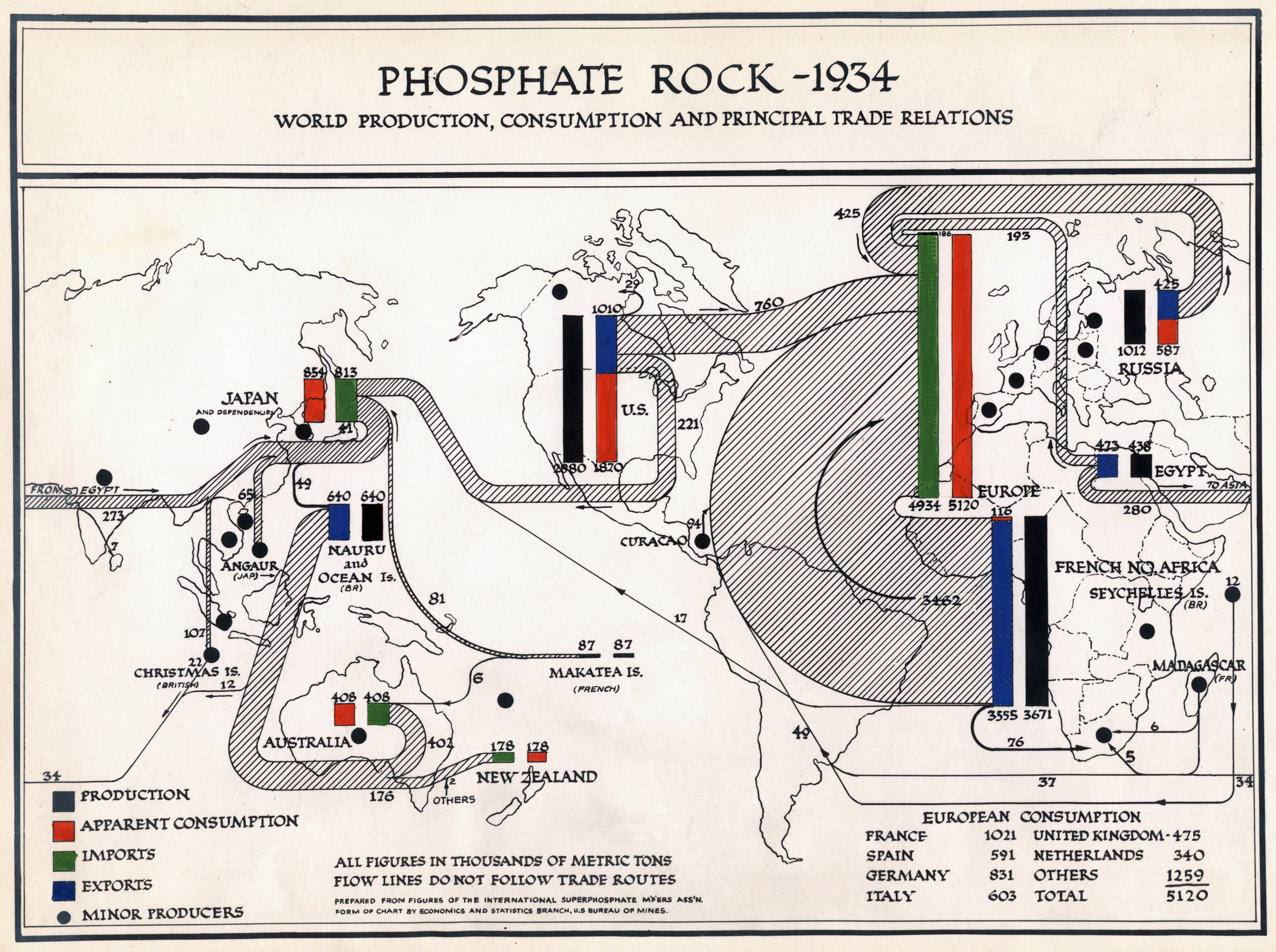
A massive phosphate flow from North Africa to Europe dominates the map. Its size so dwarfed the Mediterranean’s geographic scale that cartographers relocated it to the Atlantic, forcing ‘French North Africa’ and its corresponding bars below the Sahara. Regional markets stand out, some structured by empire. France’s imperial dominance in Europe operated in tandem with the Anglo-imperial Pacific flows that gutted the islands of Banaba and Nauru to render Australia and New Zealand fertile. Still, empire did not determine regional blocs. US exports force an analysis of Europe’s market beyond the French empire. Among French colonies in the Pacific, Makatea’s phosphates sold to Japanese buyers and to the BPC for distribution in Australia and New Zealand. The Japanese empire consumed substantial quantities not only from the Pacific but from the United States and Egypt (low ocean freight rates from Egypt’s ports made its phosphates economical for Japan despite the distance). In 1937, a new cartelization arrangement among mines in the Pacific, US, North Africa and Egypt formalized a similar division of the Japanese market, with the BPC restricting its exports to Europe in return.Footnote 63 Ultimately, many of the map’s linkages within and across regional blocs were moulded by mid-1920s shifts in phosphates’ character as a commodity, when high- and low-grade rock merged into one commodity in Europe.
The map also shows peripheralization. Evenly paired production and export bars (black and blue) signal colonial extraversion, manifest by the literal scattering of land over Europe, Japan, Australia and New Zealand, the only locations with green bars for imports. Joined by the United States and Soviet Union, these six entities comprise almost all of the red, indicating consumption. Tunisia is barely recognizable from carelessly sketched borders, while Morocco has borders missing. Precise national boundaries may be irrelevant for visualizing the statistics, but the elision of Tunisia as a mapped location also elides the extractive sites where colonial exploitation enabled fertilized fields in Europe.
Conclusion: multiform commodities
Commodities, as analytical units, are multiform. Phosphates’ forms altered across historical contexts and production sites, as the value within them transmuted. Throughout the interwar period, these changes reconfigured the geographic scales over which phosphates operated, connecting myriad localities within a bartered constellation of goods, moulding flows of migrant labour, reshaping imperial-regional constructions and interweaving within global financial circuits.
Commodities are multiform and unstable precisely because value embeds within them in intricate and contingent ways. The array of scales, actors and forces interwoven through this account ultimately reflects how complex value is. Use and exchange value are separate categories, but they influenced each other. Exchange value combined labour time with the politics of cartelization, regulation, colonial repression and global finance. And French attempts to expropriate cheap labour – the core of a commodity’s exchange value – relied on a barter system of use values that transformed phosphates into the labour that would mine more of them.
This is a way of writing the history of commodities that does not vest them with the power to make the modern world, that does not bestow upon them an agency so powerful that they appear detached from the mechanisms of value that created them and shaped their history. When we centre value, the result is not the history of a commodity-as-substance. Rather, it is a history of how the value within commodities shaped capitalist relations of production, exploitation and exchange. Ultimately, the commodity itself emerges as an historical object, one whose analytical boundaries and multiple forms change across place and time.
Acknowledgements
Research in France was generously funded by the Council of American Overseas Research Centers (CAORC) and enriched through sponsorship by the Centre d’études maghrébines à Tunis (CEMAT). For invaluable comments on earlier drafts, I am grateful to Joel Beinin, Julia Clancy-Smith, Kären Wigen, Kristen Alff, Ahmad Shokr, Basma Fahoum, Megan Formato, Aaron Jakes, Vladimir Hamed-Troyansky, Keenan Wilder, Mackenzie Cooley, Michelle Kahn, Ivan Bochkov, LeAnn House, my colleagues in the Stanford Department of History’s Ottoman Empire and Middle East Workshop, and all the participants in the 2018 Political Economy Summer Institute at George Mason University. Finally, I thank the editor and anonymous reviewers at the Journal of Global History, whose thoughtful and generous comments enriched the final version. Any errors or inaccuracies are my own.