

Introduction
In late 2002 and 2003, Severe Acute Respiratory Syndrome (SARS) became the first global pandemic of the new millennium. Originating in China, SARS sparked heated debates about Chinese politics, public health, and the efficacy of China's post-Mao medical reform.Footnote 1 Criticisms were waged against the new leadership, including that the government had inadequately adopted ‘age-old’ Maoist mass mobilization tactics and political campaigning to cope with a twenty-first century challenge. Researchers claimed that SARS was the first real epidemic of globalized Asia and was transmitted through an ‘international mobility that most of us take for granted’.Footnote 2 SARS was also seen ‘as a harbinger of future events that might be catastrophic for the global system as we know it today’.Footnote 3
Commentators on China's handling of the crisis have noted that the SARS campaign was reminiscent of public health movements in pre-reform China, such as the campaigns to eradicate schistosomiasis and the four pests (flies, mosquitoes, rats, and sparrows), as well as the Patriotic Hygiene Campaign.Footnote 4 Under the ‘mandatory’ system of the pre-reform years, once the outbreak of an infectious disease was reported, medical personnel throughout the whole medical network could be mobilized to combat the crisis immediately.Footnote 5 Ordinary citizens were ‘turned into an army of volunteer public-health and sanitation workers’.Footnote 6 Scholars argued that these programmes seemed to reflect the Chinese Communist Party's skill in both political mobilization and ideological manipulation.Footnote 7 In studies and debates about the government's handling of the SARS epidemic, public health scholars have argued that the SARS pandemic exposed serious deficiencies in China's current medical and health systems.Footnote 8 This dire situation was contrasted with the supposedly halcyon days of the Chinese medical and health system under socialism from 1949 to the early 1980s, particularly in rural China.Footnote 9 Several scholars have argued that the main cause of the spread of SARS was the state's retreat from the public health system and the public sector's dwindling financial resources.Footnote 10 As a result, the SARS pandemic was declared ‘a wake-up call’ for the Chinese government about the deterioration of its public health capacity and, in particular, the poverty of China's rural health system.Footnote 11 The SARS crisis is not the first global pandemic to have impacted health policy in significant ways in the People's Republic of China—for instance, the El Tor cholera epidemic had the same effect in the 1960s.
In contrast to SARS, which broke out in China and then spread to other parts of the world, the El Tor cholera epidemic was a global pandemic that spread into China. El Tor cholera originated in Sulawesi, Indonesia, in 1961, and became the seventh cholera pandemic in medical history. The disease infected the southeast coastal areas of China in 1962–1964. This incident occurred 12 years after the founding of the new Communist regime and well before China was a member of the World Health Organization.Footnote 12 Furthermore, at the time the pandemic hit, the country's rural social and political systems were undergoing significant adjustments following the debacle of the Great Leap Forward in 1958–1960 and the consequent famine of 1959–1961. Despite this unstable situation, the government's response to El Tor cholera would ultimately play a decisive role in shaping the national epidemic prevention system and a response scheme for medical emergencies in rural China in the following decades.
This paper has several aims. Based on archival documents and local gazetteers of the Zhejiang Province in southeastern China, it will:
• examine how the retreat from the Great Leap Forward policies impacted health systems and the people's commune system at village level;
• explore how the state strengthened its control over rural medical practitioners by institutionalizing daily practices and reducing their freedom of movement;
• investigate why and how the government adopted incentives for health care workers to motivate them to participate in a government cholera vaccination campaign;
• discuss how the reorganization of the people's commune reduced mobility for villagers and further ‘cellularized’ the health systems of village societyFootnote 13;
• address how reduced mobility facilitated the vaccination, quarantine, and epidemic reporting desired by the government's health authorities;
• reveal the complex mutual interactions between the political and medical systems under socialism.
Transnational social mobility and global cholera pandemics
The six global cholera pandemics from 1817 to the early 1900s were generally associated with population mobility, such as fairs, festivals, trade, pilgrimages, migration, and refugees, all of which were facilitated by the transport revolution.Footnote 14 After 1923, cholera was basically confined to Asia, including Afghanistan, Burma, China, India, and Iran.Footnote 15 By 1948, cholera outbreaks were common to just India and Pakistan and had shown a declining tendency in the endemic areas of these two countries.Footnote 16
In China, the first pandemic of cholera reached by sea through the Straits of Malacca in 1820 and then moved northwards from Wenzhou and Ningbo in Zhejiang. By 1932, there were 46 documented invasions of varying intensities.Footnote 17 Among them, the cholera pandemic of 1930–1932 was the most severe cholera outbreak in the early twentieth century, and its death toll reached 31,974.Footnote 18 The National Quarantine Service had just been established in July 1930 under the leadership of Wu Lien-teh. The Quarantine Service led the Central Cholera Bureau, which was created in 1930 and worked in collaboration with the National Health Administration to coordinate efforts along the coast. Together, these agencies created reports on the epidemic, administered preventive injections, quarantined passengers, and conducted patient and scientific research.Footnote 19 However, cholera still broke out sporadically during the following decade. By the early 1950s, the new socialist regime claimed it had contained the spread of cholera through the public health campaign and vaccination programme.Footnote 20
As for El Tor cholera, its strain was initially identified in Egypt in 1905 at the El-Tor quarantine camp for Muslim pilgrims to Mecca along the coast of the Sinai Peninsula facing the Gulf of Suez of the Red Sea. The cholera caused by the El Tor Vibrio had been confined to endemic foci on the island of Sulawesi (Celebes) of Indonesia, where it had broken out four times between 1937 and 1945.Footnote 21 However, the domestic and international politics of Indonesia soon resulted in the outbreak of El Tor cholera, which escalated from an endemic disease into a global pandemic. In the late 1950s, the Indonesian Sukarno government manoeuvred its troops between Makassar and Sulawesi to suppress an internal rebellion. Meanwhile, the Indonesian government issued a decree in May 1959 that revoked the trading licenses of aliens (which referred to Chinese) in rural areas. According to the decree, Chinese individuals could not run retail businesses in rural areas after 1 January 1960. The regional military commanders were also empowered to remove aliens from their places of residence for ‘security reasons’.Footnote 22 In December 1959, the Chinese government launched a campaign that called for Chinese who were overseas to return to the ‘warm bosom of the motherland’.Footnote 23 On 20 January 1960, the Indonesian and Chinese governments signed the Treaty on Dual Citizenship between Indonesia and China. According to this treaty, adults with dual citizenship from China and Indonesia had to choose one of their two citizenships within two years. This treaty was put into effect on 24 December 1960.Footnote 24 The anti-Chinese movement and the dual-citizenship treaty between the two countries unexpectedly caused both domestic and transnational mobility on a large scale. By May 1960, about 40,000 Chinese were gathered in Indonesia's ports awaiting passage to China, and roughly 17,000 repatriated to Taiwan.Footnote 25 These Indonesian Chinese returned to China by boat via Zhanjiang, Shenzhen, Guangzhou, and Shantou customs of the Guangdong Province.Footnote 26 According to a Chinese source, the banning of rural Chinese retail businesses and their relocation from rural to urban areas caused 100,000 overseas Chinese to lose their livelihood and eventually return to China.Footnote 27 Though it is uncertain which segment of the population actually spread the disease internationally, it is generally argued that troop movements and the internal and external migration of the Chinese population in Indonesia were key contributing factors to the outbreak of the El Tor cholera pandemic.Footnote 28
In June 1961, El Tor cholera first broke out in a few coastal towns of Yangjiang County in the Guangdong Province, which is located to the north of Zhanjiang. By December, when El Tor cholera was basically brought under control in Guangdong, it had inflicted 35 counties, and there were 4,318 cases in total with 429 deaths.Footnote 29 Beginning on 12 February 1962, El Tor cholera broke out sporadically again in Dongguan County of the Guangdong Province.Footnote 30 It further spread to the eastern coastal areas of Guangzhou and then to Zhejiang, Fujian, Shanghai, and Jiangsu of southeastern China. In Zhejiang Province, the first El Tor cholera case was confirmed in Ruian County on 5 July 1962.Footnote 31
The spread of El Tor cholera showed a few discernible patterns. According to the surveys and observations of the World Health Organization in Southeast Asia in 1963, the spread of El Tor cholera was restricted to individuals living in poor areas, offshore fishermen living in unsanitary conditions, and boat dwellers using subminimal sanitary facilities. The reason was that properly treated water was not available in these places.Footnote 32 Moreover, seafood was an important medium for spreading cholera.Footnote 33 Because of these transmission routes, Zhejiang Province, like other southeast coastal provinces, was vulnerable to El Tor cholera because of its geographic location. Zhejiang differs slightly from Guangdong and Fujian in that there are many lakes, rivers, and canals, particularly in the northern and central parts of the province. Public tap water did not become available in villages until the late 1980s. Furthermore, there are many fishing camps, particularly in Wenzhou and Zhoushan, which are located in the southern and eastern areas of Zhejiang Province, respectively.
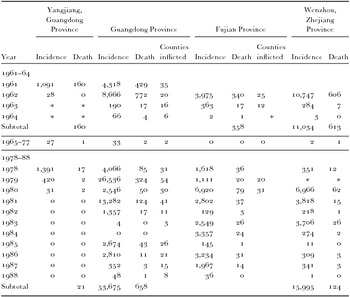
Thus, El Tor cholera was rampant when it first infected Zhejiang. By 18 August, in just one and a half months, El Tor cholera had infected nine counties and cities. In total, there were 4,965 cases, and the death toll reached 192. During this outbreak, more than 100 new cases were reported every day.Footnote 35 The disease then spread northwards along the province's rivers and roads. On 25 September, the first case of El Tor cholera in Pinghu County was documented, at the northernmost end of Zhejiang. It was reported that the first victim ate swimming crabs from infected areas.Footnote 36 In 1962, there were 10,747 reported cases in total, and 606 people had died of El Tor cholera in Wenzhou Prefecture, where the first cholera patient was confirmed (see Table 1). The figures were much higher than those in Guangdong and Fujian provinces, in which there were 8,666 and 3,975 reported cases, respectively. In the whole of Zhejiang Province, there were four prefectures and 26 counties inflicted by October 1962, according to available local gazetteers.
El Tor Cholera in the Southeast Coast of China, 1961–1988Footnote 34

Note: * means data unavailable.
Sources: Yangjiangshi difangzhi bianzhuan weiyuanhui [Editorial Board of Yangjiang Local Gazetteers] (2000). Yangjiang xianzhi [Yangjiang County Gazetteer], Guangdong renmin chubanshe, Guangzhou, pp. 938–39; Guangdong difang shizhi bianzhuan weiyuanhui, Guangdong shengzhi: weishengzhi, p. 169; Fujiansheng difangzhi bianzhuan weiyuanhui [Editorial Board of Fujian Provincial Gazetteers] (1995). Fujian shengzhi: weishengzhi [Provincial Gazetteers: Health Gazetteer], Zhonghua shuju, Beijing, p. 61; Fu, Wenzhoushi weishengzhi, pp. 131–132.
Although the pandemic was serious in Zhejiang Province in 1962, it had already been basically contained by 1963. In Wenzhou Prefecture, the number of El Tor cholera cases had plummeted from 10,747 to 284 (see Table 1). Compared with 1962, the number of cholera cases declined by 85 per cent, the death toll declined by 95 per cent, and the number of infected counties and cities declined by 40 per cent.Footnote 37 Additionally, compared with other regions, the mortality rate was lower in Zhejiang. The average incidence rate was about 4 per cent in Zhejiang province in 1962, and it was 9 per cent in Guangdong Province in 1961. According to Zhejiang Provincial Epidemic Prevention Headquarters, the average mortality rate was 30 per cent, and the figure once exceeded 90 per cent in the area in Indonesia where the pandemic first broke out.Footnote 38 During this process, the large-scale vaccination campaign and quarantine orders, which depended on the reconstructed medical system and the technology available at the time, played significant roles in containing the rampant spread of El Tor cholera.
The medical system, medical technology, and the disease-control model on the eve of the pandemic
Immediately after the outbreak of El Tor cholera in July 1962, a campaign was launched to combat the spread of the pandemic in rural Zhejiang and other provinces in southeastern China. However, containing cholera over such a vast area was a major problem. It was impossible for authorities to impose a cordon sanitaire around the affected areas as had been done in Yangjiang County in Guangdong in 1961. This plan depended upon obtaining enormous medical resources and personnel assistance from central government.Footnote 39 Therefore, vaccination and quarantine, the most effective and rapid ways to contain the spread of El Tor cholera at the time, were adopted immediately.Footnote 40According to the Zhejiang Provincial Committee of the Chinese Communist Party and the People's Commission's requirements, the entire population had to receive the cholera vaccination within 15 to 20 days, except children under 3, adults over 60, and those with allergic reactions to the inoculation. People living along rivers and roads were the key vaccination subjects.Footnote 41 As one local official file pointed out, ‘there existed the problems of very limited time, quite heavy duties, and a serious shortage of medical personnel’.Footnote 42 Under these circumstances, the critical task was to mobilize all available rural medical practitioners into the vaccination campaign as quickly and efficiently as the medical system and technology would allow.
As for the rural medical system, prior to the victory of the Communist Party, the rural medical practitioners operated independently and were geographically scattered and unregulated. Most medical encounters were home based. But the fluidity of medical services posed a serious danger to epidemic prevention, particularly in terms of locating and controlling people who were known or suspected to be infected with epidemic diseases.Footnote 43 After 1949, the new regime took over the Nationalist Public County Hospitals and renamed them People's County Hospitals; these hospitals formed the first and top level of the rural medical system. Starting from 1952, rural medical practitioners were mobilized to establish union clinics based on their own townships and formed the second level of the rural medical system. The establishment of union clinics marked the formation of a fixed medical venue in a township community. Union clinics implemented the system of ‘fees for services, individual accounting, self-responsibility for profits and losses, democratic management, and distribution according to each contribution’.Footnote 44 Generally, the establishment of union clinics initiated the process of medical institutionalization and decreased the mobility of rural medical practitioners. Nonetheless, a few independent medical practitioners still practiced medicine outside union clinics. In 1956, the founding of County Sanitation and Anti-epidemic Stations established a preliminary epidemic prevention system that was affiliated with the rural medical system. And although union clinics were self-supporting and self-managing entities,Footnote 45 they were the main force for epidemic prevention work in rural areas.Footnote 46
Accompanied with the gradual formation of the rural medical system, it was the great progress in the large-scale production and application of vaccine during the 1950s. As in the late 1940s, there were only smallpox and cholera vaccinations in the majority of counties in Zhejiang. Furthermore, due to low vaccine production, vaccination subjects were few and were limited to town residents.Footnote 47 Treatment for acute infectious diseases were inaccessible and unaffordable for common villagers, especially during the pandemic. For instance, in the case of cholera, intravenous injections of saline water were available in the early 1930s, but the masses were too poor to afford them. When cholera broke out in Xiaoshan County, Zhejiang Province in 1931, local newspapers suggested that residents receive intravenous injections of normal saline to stop frequent and serious vomiting and diarrhoea. However, most families could not afford the price, as one bottle of normal saline cost the same as a 50 kg sack of rice. One local physician proposed a quick and efficient prescription for cholera: ‘smash 8 liang (50g) of flaccid knotweed herb, slice 4 liang of China papaya, buy 2 jin (500g) of Fuzhen (wine from the Jiangsu Province), use river water to boil them into a decoction, and then use it to wash the hands, feet, and numbed areas of the body’.Footnote 48 However, the real effect of this home remedy was unclear.Footnote 49 A more serious matter was that no vaccines existed for the majority of epidemic diseases. Herbal therapy was the only solution. Dozens of prescriptions were touted as the most efficacious treatment for the disease. Materia medica for these prescriptions were often difficult to obtain, and the prescriptions usually became extremely expensive during epidemics.Footnote 50
From the early 1950s onwards, the new regime prioritized vaccine production, so for the first time, there were sufficient vaccines to carry out the government's inoculation policy.Footnote 51 Basic vaccines were soon available in sufficient supply for vaccination efforts, such as for smallpox in 1950 and cholera in 1952, and the range of available vaccines increased gradually thereafter.Footnote 52 In total, the Chinese public had been inoculated with eleven kinds of vaccines by 1961. Meanwhile, new medical technologies, such as the administration of saline solution for cholera, were widely incorporated into public disease-control treatments.Footnote 53
The gradual establishment of the rural medical system and advances in medical technology contributed to the control of cholera in China in the early 1950s. Medical historians have come to the consensus that the plague and smallpox were all but eradicated through these efforts. Typhus, relapsing fever and other notifiable infectious diseases were brought under control, and great improvements were made in the control of major parasitic diseases.Footnote 54 The Hangzhou prefecture of Zhejiang Province is an illustrative example. During the 1950s, there were 18 remaining infectious diseases, five of which accounted for 97.1 per cent of the total patients with infectious diseases in the 1950s. Of these five diseases, measles, malaria, dysentery, and pertussis (whooping cough) were the four most common, and the fifth most common was influenza.Footnote 55 Compared with these diseases, El Tor cholera was much worse in terms of how intensely it broke out and how fast and far it spread. Consequently, El Tor cholera became the first pandemic that the new Chinese communist government had to deal with and that the spread of the disease was exacerbated given that rural Chinese society had just survived a great famine following the Great Leap Forward.
Retreat, control, and institutionalization: rural medical practitioners
Though the rural medical system was gradually established during the 1950s, there was still a key deficiency. Because of loose regulations and haphazard management over the union clinics and independent medical practitioners, there were still some serious deficiencies in finding and reporting individuals who were known or suspected to have an infectious disease, as well as weaknesses in responding to potential medical emergencies. More important, the rural medical system was undergoing a radical reform and adjustment process. With the implementation of the people's commune system in the Great Leap Forward, the original township union clinics in the seats of the people's communes (formerly districts) and Management Districts (formerly townships) were renamed People's Commune Clinics and Management District Clinics, respectively.Footnote 56 All independent medical practitioners were also incorporated into the People's Commune Clinics. Following the rules for state-owned clinics, commune clinics were subsidized by the county budget, whilst a few Management District Clinics still implemented their own independent accounting and took responsibility for profit and loss. In this sense, medical personnel were more plentiful, institutionalization was heightened, and mobility was restricted. In the meantime, health care stations staffed by health care workers were also established in each production brigade. In this new system, the state played more active roles in the finances and management of medical practitioners than ever before; however, the system soon came to an end with the failure of the Great Leap Forward.Footnote 57
In 1961, according to the retrenchment principles of ‘adjustment, consolidation, enrichment and improvement’, Commune Clinics or Management District Clinics were reverted to union clinics that were responsible for their own profits and losses.Footnote 58 Clinic staff members were laid off, although they were allowed and encouraged to be full-time, independent medical practitioners or to work part-time as a doctor and part-time as a peasant. They gained legitimacy because they were ‘independent intelligent workers and complementary to socialist health work’.Footnote 59 Therefore, the state retreated from rural health in terms of investment and subsidies, and, consequently, the number of medical personnel in the medical system declined again after 1961. This reorganization had a serious impact on the medical emergency response capacity of local medical organisations. The Zhejiang Provincial Committee of the Chinese Communist Party had already issued a warning circular on 1 June 1962, when El Tor cholera was raging in Guangdong Province.Footnote 60 However, the medical system as a whole responded very slowly. It took 15 days to confirm the first cholera patient in Ruian County, Wenzhou prefecture. The delayed response caused the spread of El Tor cholera into neighbouring counties and hampered the implementation of prevention strategies. As the official document admitted, the spread of El Tor cholera exposed deficiencies in the areas of health and epidemic-prevention. First, the number and level of training of health and epidemic-prevention personnel were insufficient. Second, because the foundation of public health was underdeveloped, the public was generally not involved in health work. Therefore, when the serious cholera problem broke out, the government, local health organizations, and the public were unprepared to deal with it.Footnote 61
Notwithstanding these problems, union-clinic doctors and independent medical practitioners were mobilized into a large-scale vaccination campaign in 1962. As the coordinating and leading agency of this effort, County Epidemic Prevention Headquarters first summoned directors of county hospitals, district clinics, and commune union clinics to announce the vaccination tasks ahead. In addition, they conducted political and ‘thought’ education. Each Epidemic Headquarters divided its county into several districts. Then, each district established an El Tor cholera-vaccination leadership group, which trained vaccinators in the district clinics on vaccination skills, contraindication checks, and dosage calculation for children. At the commune level, union clinics were the main forces behind the vaccination work. Their staff coordinated vaccination drives, distributed vaccines, vaccinated villagers, taught vaccination skills to health care workers, and assisted neighbouring communes. They also guided independent medical practitioners who participated in their own communes.Footnote 62
In light of the late response and slow vaccination work of 1962, the state tightened its control over union clinics and independent medical practitioners in the campaign against El Tor cholera over the following two years. Union clinics were required to adopt the basic format of expertise division and bureaucratic management and to implement regulations for daily duties, financial work, income-distribution principles, training and staff development.Footnote 63 In particular, union clinics began implementing a 24-hour outpatient system. All staff were required to obey a work timetable.Footnote 64 As the annual work summary of Jiande County Health Bureau pointed out, union clinics all over the county had basically established better management systems.Footnote 65 These institutionalized union clinics gradually replaced the patient's home as the main venue of medical encounters between doctors and patients, and as a result, village patients were no longer scattered in disparate locations of the villages.
To find people infected with El Tor cholera, union clinics were required to establish a department of intestinal diseases in 1963. In the outpatient department, a nurse was in charge of performing a preliminary intestinal outpatient check. All patients had to consult with this nurse and were issued with a registration bamboo stick on completion of the consultation. Patients with diarrhoea and vomiting would be referred to the department of intestinal diseases. The programme of the outpatient service of the department of intestinal diseases included patient registration, case-history records, checkups, diagnosis, hospitalization, discharge, epidemic reporting, and disinfection. Per regulations, people who had or were suspected to have El Tor cholera were to be reported to a district clinic or the County Sanitation and Epidemic Prevention Station within an hour.Footnote 66 In their daily work, doctors were required to use special single-page records for patients in the department of intestinal diseases, create detailed patient registrations, count the cases, and report the cases to the upper-level medical units.Footnote 67 There were three record copies in total: one for the County Sanitation and Epidemic Prevention Station, one for the district clinic, and one to be kept at the local clinic. The department of intestinal diseases submitted case paperwork on Tuesdays and Fridays.Footnote 68 This system applied not only to El Tor cholera, but also to other epidemic diseases.
For independent medical practitioners, their daily practices came under further government control as a result of the epidemic-prevention programme. County governments issued licenses to practitioners based on an investigation of their work, and the county health bureaus assigned geographical areas for their medical services.Footnote 69 For practitioners from outside counties, their licenses were temporarily withheld, and the county health bureaus gave them introduction letters (i.e., a permit indicating the practitioner's basic information) with specific expiration dates. When they left, county health officials wrote comments on the back of the practitioners’ licenses describing their medical performance.Footnote 70 Soon after, the scope for these independent and itinerant services was reduced. The government ruled that independent medical practitioners could not cross provincial borders in 1962, could not cross prefecture borders in the first half of 1963, and could not cross county borders in the second half of 1963.Footnote 71 In addition to normal medical duties, independent practitioners were responsible for vaccinating villagers, quarantining suspects, and reporting them to local health or epidemic-prevention agencies upon finding infectious disease patients or suspects.Footnote 72 Independent medical practitioners failing to comply with this rule would have their medicine supplies from pharmaceutical companies terminated. Therefore, after the policy changes in the early 1960s, there was very little room left for independent medical practitioners in Chinese society.Footnote 73 Because of the firm control over their mobility, rural medical practitioners were forced to join the union clinics. This increase in practitioners greatly contributed to the expansion of union clinics, which were also experiencing institutionalization. The further institutionalized and expanded union clinics became the leading forces in the vaccination campaign against El Tor cholera in their own communes from 1963 to 1964.
Mobilizing by incentives: health care workers
In the early 1960s, the average number of union clinic medical staff was low, relative to the average population of each people's commune (around 10,000). For example, approximately six workers staffed each rural union clinic in Hangzhou Prefecture.Footnote 74 Of course, this number of medical personnel was insufficient to meet the demand of a mass vaccination campaign in a short time. Therefore, health care workers, who were trained on a large scale in the Great Leap Forward, were the most available personnel to assist in the vaccination work.
However, the post-Great Leap retrenchment policies had a negative impact on health care workers. In January 1961, the policy of taking ‘agriculture as the foundation of the economy and industry as the leading sector’ was formally adopted at the Ninth Plenary Session of the Eighth Central Committee of the Chinese Communist Party.Footnote 75 According to the Instructions on Reforming Rural People's Commune Basic Accounting Unit approved in February 1962, the majority of rural China started to implement ‘three-level ownership with the production team as the basic accounting unit’.Footnote 76
Under these circumstances, the production brigades banned medical and health work. Local officials suggested that it would be better if health care workers dropped their medical work and devoted themselves to agricultural tasks.Footnote 77 This brought about significant reductions in the numbers of health care workers. In Yuhang County, Zhejiang Province, a report in 1962 indicated that only a nominal form of health care organizations existed in some areas. Some cadres and commune members believed that ‘health care workers just run here and there, and do not participate in production. And there are no benefits to production teams’. Some officials and commune members had a limited understanding of the nature of the health care workers’ work. Some villagers criticized, ‘Young guys, you don't participate in agricultural production, only collect stool, and distribute medicinal tablets. It is useless and there is no future’.Footnote 78
From the perspective of the health care workers, they thought that they were disparaged by the masses simply for being health care workers. Consequently, they thought that it would be better and more practical to participate in agricultural production and earn more work points. Furthermore, there was no proper payment, spiritual reward (award of honours), or material bonus, either. For all of these reasons, health care workers began to move into other areas of work.Footnote 79 Meanwhile, union clinics were also not very willing to train health care workers. Because these units depended on treatments to make a living, they did not welcome competition. They were worried that if they trained health care workers, it would negatively affect their incomes.Footnote 80
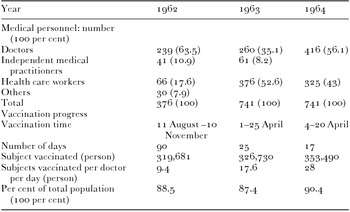
Therefore, health care workers were not mobilized on a large scale during the El Tor vaccination campaign in 1962. For example, as Table 2 indicates, only 66 health care workers participated in vaccination programmes in Fuyang County in 1962, accounting for 17.6 per cent of total vaccination personnel. For the health care workers who did participate in vaccination programmes, the summary documents on vaccination work pointed out that the payment policy was a key factor in individual health care workers finishing the assigned set of vaccination programmes within the allotted time.
Comparison of Vaccination Progress in Fuyang County, Zhejiang Province, 1962–1964Footnote 89

Sources: Xu, Fuyangxian weishengzhi, p.158; Fuyangxian weishengju, ‘Sigeyue lai fangbing zhibing gongzuo qingkuang huibao’, FYA, Vol. 74–7–9; Fuyangxian weisheng fangyizhan [Fuyang County Sanitation and Anti-Epidemic Station] (December 1963). ‘1963 nian gongzuo zongjie’ [The Work Summary in 1963], FYA, Vol. 74–1–19; Longyangqu weishengyuan, ‘Fuyangxian longyangqu 1964 nian weisheng gongzuo zongjie’, FYA, Vol. 74–1–19.
In Fuyang County, the Sanshan Commune implemented the policy properly, and the vaccinators received payment for their work. The commune even made payments in advance to health care workers facing economic difficulties. Among them, one health care worker vaccinated more than 300 people per day. In contrast, because no payments were made in another commune, the health care workers stopped the vaccination programme and went home just three days later.Footnote 81 The Fuyang County report also admitted that because the campaign did not mobilize the masses and depended completely on professional medical and health personnel to do the vaccinations, progress was quite slow, the quality was low, and progress in different areas was uneven.Footnote 82 In 1962, it took 376 medical personnel 90 days to finish vaccinating 88.5 per cent of the total population (Table 2). In a three-month campaign (from 19 August to 15 November), neighbouring Yuhang County organized 60 state-owned hospital and clinic staff, 261 union-clinic doctors, and 28 independent medical practitioners. The effective vaccination rate accounted for just 46.1 per cent of total population.Footnote 83
Under these circumstances, local health care workers were crucial to the country's overall vaccination campaign. From 1963 to 1964, health care workers were mobilized on a large scale. In 1963, Fuyang County Sanitation and Epidemic Prevention Station held an El Tor Cholera training class and trained 57 doctors from district and commune-union clinics. Then, each district and commune held El Tor Cholera prevention classes for two to three days. These classes retrained old health care workers and trained the new health care workers to learn El Tor Cholera prevention knowledge and vaccination skills. This greatly increased the number of vaccinators.
In the meantime, to guarantee a sufficient supply of cholera vaccines for this large-scale vaccination campaign, at the end of 1962 the Ministry of Health ordered that the production of cholera vaccine should reach 190,000,000 in 1963. Additionally, the ministry ordered that timely production must be guaranteed, that quality must improve, and that production facilities must conduct the work of storage, transport, and distribution more seriously. More important, in view of the deficiencies exposed in the first vaccination campaign, the Ministry of Health required that the epidemic-prevention budget should be categorized as special plans at the national, provincial, and city levels according to the principles of ‘specific budget, specific allocation and specific usage’. Footnote 84 In 1963, incentive payments were adopted in the vaccination campaigns. This method corresponded with the ethos behind the post-Great Leap retrenchment strategy, which denounced egalitarianism in the distribution of agricultural products and encouraged the use of material incentives to promote production.Footnote 85 For instance, Fuyang County utilized three main vaccination strategies.
1. County Health Bureau and vaccination teams distributed a 2.6 per cent subsidy for each injection to the worker performing the injections.
2. Production brigades provided extra work points for health care workers who vaccinated home villages.Footnote 86
3. For those health workers who were not able to perform the injection but instead helped doctors distribute vaccination certificates, they would divide the subsidies with doctors according to the ratio of three to seven. If the worker could not make 1.5 yuan per day, the union clinics had to pay the remaining portion. In addition, they were to be paid 20 to 30 cents per day.Footnote 87
In 1963, the average daily income of villagers in rural Hangzhou was approximately 50 cents. There is no doubt that this payment was very attractive. It greatly enhanced the health care workers’ enthusiasm. The summary documents of vaccination work pointed out that ‘because of the implementation of a proper payment system, the majority of health care worker's enthusiasm was extremely high’. The number of villagers vaccinated by the model health workers is one indicator of this enthusiasm. They vaccinated 200 villagers per day on average. That meant that they could earn 5.2 yuan per day, which was equivalent to the income of ten days working in the field.Footnote 88
Because of the mobilization of a large number of health care workers and the implementation of incentive payment methods, the vaccination work made dramatic progress in 1963 and 1964. In Fuyang County, the number of health care workers participating in vaccination campaigns increased from 66 in 1962 to 376 and 325 in 1963 and 1964, respectively, and accounted for 52.6 per cent (1963) and 43 per cent (1964) of the county's total vaccination personnel. In 1963, it took just 25 days to finish the vaccination tasks from 1 to 25 April. In 1964, it took just 16 days to complete the vaccination programme, even though the number of vaccinated subjects in 1964 had increased by 3.3 per cent. The average number of subjects vaccinated by each doctor per day also increased steadily, from 9.4 in 1962 to 17.6 in 1963 and then soared to 28 in 1964.
Static mobility, vaccination, and quarantine
The retrenchment of the people's commune system also had huge impacts on villagers who were the subjects of cholera vaccination and quarantine. Like other parts of the world, population mobility and displacement resulting from wars, rebellions, and social and political chaos have often resulted in the outbreak and spread of pandemics throughout Chinese history. Some examples are the plague spread by the peasant rebellion in northern China during the end of the Ming Dynasty, the cholera epidemic accompanying the Taiping Rebellion late in the Qing Dynasty, and the rampant spread of typhus, dysentery, and other communicable diseases that took advantage of distressed populations during the wars, unrest, and mass migration during the first half of the twentieth century.Footnote 90 In some cases, the death toll incurred from these diseases exceeded that of war casualties. For example, during the Taiping Rebellion, combat-related deaths accounted for only 30 per cent of all casualties, whereas cholera accounted for 70 per cent of casualties in the rebellion.Footnote 91 In this sense, the founding of the People's Republic of China was of positive significance because it ended political and social chaos and reduced this type of chaotic population movement.
Still, population mobility under socialism had its own dynamics. With the development of the Agricultural Collectivization Campaign, Chinese villagers were quickly mobilized to join primary agricultural cooperatives, advanced agricultural cooperatives, and people's communes. More significant, was the implementation of the hukou system (the household-registration system) in 1955 which divided the country's population into two categories: rural household residents and urban household residents.Footnote 92 The former group applied to commune members in the villages, and the latter to cadres, factory workers, and employees in state-owned enterprises and agencies. In this ‘caste-like system of social stratification’,Footnote 93 rural residents were denied the right to live outside of their hometown and access to a large range of welfare benefits granted by the state. This system decisively formed China's collectivist socialism in the following decades.Footnote 94
From the end of 1959, outward mobility was more and more difficult for villagers.Footnote 95 In 1960, because of the failure of the Great Leap Forward, the state began to fully implement the hukou system to regain control of the economy and society.Footnote 96 In the meantime, the sizes of production brigades and production teams were greatly reduced as part of the retrenchment policies. During the Great Leap Forward, the average people's commune comprised 5,000 households (approximately 30,000 people).Footnote 97 By 24 August 1961, the country consisted of 55,682 communes, an increase of 30,478, or 120 per cent. There were 708,912 production brigades, an increase of 225,098, or 46 per cent, and 4,549,474 production teams, an increase of 1,561,306, or 52 per cent.Footnote 98 The hukou system and the downsized people's commune system confined the rural population to villages and reduced their social mobility. This policy greatly strengthened the state's control over villagers. A peasant who left the brigade had to have a letter of authorization from a brigade official justifying the trip's purpose. Without letters and permits, they normally were unable to purchase food, especially in cities, as all basic foodstuffs required ration coupons.Footnote 99
By 1962, with the establishment of the production team as the principal unit for labour and production, peasants (i.e., commune members) were further militarized in terms of daily production and lifestyles; the slogans of the time called upon villagers to ‘collectivise’, ‘militarise’, ‘combatise’, and ‘disciplinise’.Footnote 100 Commune members were organized into battalions and marched off to labour in the fields in step with martial music blaring from loudspeakers.Footnote 101This lifestyle greatly facilitated the vaccination programme. Before starting a vaccination campaign, a meeting was held with the commune representatives, production brigade, and production team leaders to assign vaccination work. Each production brigade's party secretary accompanied the medical and health workers as they went door to door to vaccinate the villagers. Production team cadres assisted medical and health workers to issue and fill in the vaccination registration cards. As an old party secretary of one production brigade described, ‘in the old times, we usually assigned the work for the next day at the meeting in the evening. So we were very clear where commune members were, such as planting seeds in the field or collecting tea in the mountain. We just led doctors to the fields to do the vaccination’.Footnote 102
In other words, the vaccination work was conducted around the daily routines of production and life in villages, daytime field work, evening production-team meetings, and lunch and dinner times. For those who did not follow the daily production schedule in villages, medical staff vaccinated the elderly, women, and children at home in the daytime; peasants who were out of villages in the daytime at night; and naughty kids after they fell asleep at night.Footnote 103 Villagers were usually worried about developing an allergic reaction due to the vaccination as it would affect agricultural production and their incomes. A ruling was passed that villagers with allergic reactions would be granted extra work points, so these villagers were generally willing to accept the vaccination despite their allergies. After vaccination, the certificates indicating the subject's gender, age, dosage, and date and the seals of the vaccination unit were issued to the subjects.Footnote 104 One certificate was to be issued for each subject, and there was to be no repeat or incorrect certificates. Villagers were asked to keep the certificates safe and not to lend their certificates to others.Footnote 105
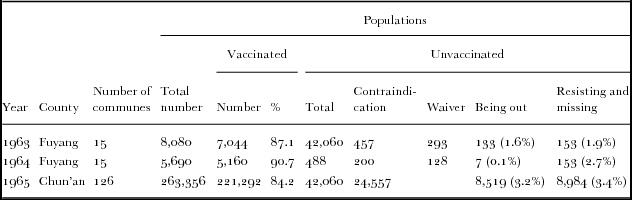
As Table 3 indicates, the number of villagers who were absent from villages only accounted for 0.1 to 3.2 per cent of the total populations of Chun’an County and Fuyang County in 1963–1965. These figures mean that the overwhelming majority of the rural population did not leave their own villages. This immobility facilitated the quarantine orders. Soon after the outbreak of El Tor cholera in July 1962, the Zhejiang Provincial Committee of the Chinese Communist Party and People's Commission started to implement transport quarantines, which required that each prefecture, county people's commission, and relevant provincial departments assigned key leaders to be in charge of quarantine work. In each county, every person, vehicle, boat, and cargo was subject to checks. Nobody could refuse except foreign guests and Chinese returning from overseas. For those who did not hold effective vaccination certificates (within six months from the sixth day after the vaccination campaign began), travel tickets would not be sold to them. Additionally, they were not allowed to board or disembark vehicles.Footnote 107 Passengers entering and leaving inflicted areas had to produce effective cholera vaccination certificates that indicated the detailed vaccination information.Footnote 108 If the passenger had not received vaccination because of the allergy reaction, they needed to have authorization letters from their work units, communes, or residential committees.Footnote 109 For other people who did not have vaccination certificates, each temporary quarantine station would order transport departments to repatriate them to the place where they had come from. Those who insisted on not being repatriated to their original place of residence, were sent to surveillance houses. Only after the surveillance period expired would they be allowed to enter their destination. The people who were detained or re-transported were responsible for paying all expenses incurred during this period.Footnote 110
Survey of El Tor Cholera Vaccination in Fuyang and Chun’an County, Zhejiang Province, 1963–1965Footnote 106
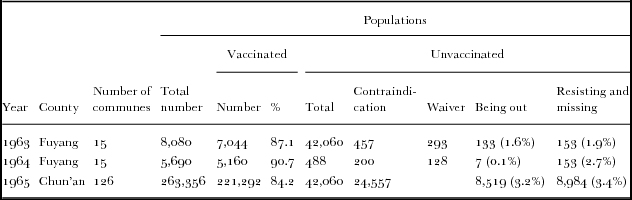
Sources: Chun’anxian weishengju [Chun’an County Health Bureau] (31 May 1965). ‘02 zhushe qingkuangbiao’ [Statistic Form of Vaccination Work], CAA, Vol. 37–11–7; Fuyangxian weishengju [Fuyang County Health Bureau] (20 January 1964). ‘Guanyu 1963 nian weisheng gongzuo qingkuang de zongjie’ [Summary of Health Work in 1963], FYA, Vol. 74–1–19; Fuyangxian weishengju [Fuyang County Health Bureau] (1964). ‘1964 nian fuhuoluan yufang gongzuo zongjie’ [Summary of El Tor Cholera Prevention Work in 1964], FYA, Vol. 74–1–19.
Meanwhile, because El Tor cholera was mainly spread through waterways, the quarantining of fishermen was also important in containing the spread of cholera. Zhejiang Province set up quarantine stations in three major archipelagos in Shengsi, Zhoushan, and Dongtou. The tasks of quarantine stations included (1) checking the vaccination certificates of fishermen and conducting statistical data work; (2) checking people suspected of being infected with El Tor cholera, reporting the epidemic disease, and isolating and disinfecting suspects; and (3) registering fishermen and vaccinating them before they went out fishing. Only those who could produce current vaccination certificates would be allowed to leave port. Additionally, medical staff were stationed on fishing boats and had to report suspects to the nearest quarantine stations.Footnote 111 These measures kept fishermen under strict control.
These strict transport quarantine measures further reduced the mobility of the rural population despite that they were already largely static. Their low mobility was fully verified by the number of quarantine subjects. Fuyang was an inland and non-coastal county with one major river winding through its territory. In 1962, its county quarantine teams found just eight guests who did not hold valid vaccination certificates. They kept 28 members of the Yueju Opera Troupe from Shaoxing Prefecture under observation surveillance and found three cases of vomiting patients.Footnote 112 Because of the reduced transregional spread of cholera, El Tor cholera was spread by movement within villages in infected areas. For example, one Daoist monk died after he hosted a funeral ceremony for an El Tor cholera victim in the Baishui Commune of Wenzhou Prefecture in 1962. His family held a funeral ceremony for him and a banquet of ten tables, inviting villagers to have dinner. Among the 70 banquet guests, 15 of them soon caught El Tor cholera.Footnote 113
For El Tor cholera patients, the treatment was essentially the same as traditional cholera,Footnote 114 that is, treatment mainly depended on replenishing body fluids and electrolytes and supplementing these efforts with antibiotics. There were two main types of cholera patients. First, for moderately and severely dehydrated patients, usually intravenous injections of saline water were applied.Footnote 115 This was the primary treatment method, and the dosage varied between 2,000 and 3,000 ml.Footnote 116 The second treatment was antibiotics because El Tor cholera virus is very sensitive to tetracycline, doxycycline, chloromycetin, kanamycin, and neomycin. These antibiotics could shorten the treatment course but could not replace hydration. Among these options, tetracycline was the most commonly applied antibiotic treatment for El Tor cholera.Footnote 117
Cellularizing epidemic reporting scheme in villages
Epidemic reporting was a crucial step in preventing the further spread of the El Tor cholera epidemic. It was still a challenge for Chinese villages that did not have a disease-reporting scheme in place.Footnote 118 As early as 1936, Chinese public health experts listed four main reasons for the difficulties encountered in epidemic reporting and the gathering of vital statistics: (1) the lack of a good household registration, no records on population, and no reliable statistical analysis; (2) no reporting of epidemic diseases despite requirements to do so; (3) an insufficient amount of statistical experts; (4) doctors, midwives, and obstetricians did not fulfil their reporting responsibilities.Footnote 119 For Chinese villagers, because of social customs and medial beliefs, they were unwilling to disclose the illnesses of their family members to outsiders. In the case of cholera, as one local official document pointed out, the epidemic prevention encountered ‘resistance from habitual forces’; that is, many people believed that it was very common and even good to have diarrhoea in the summer. There was an old saying that ‘a thousand gold coins could not buy diarrhoea in June [referring to summer]’ because diarrhoea was claimed to dispel ‘coldness’ and ‘toxins’.Footnote 120 Therefore, villagers tended not to report diseases, particularly in the summer when stomach diseases were rampant.
In the 1950s, the epidemic reporting system only reached township level. It adopted ‘regionalized reporting’. For example, in December 1953 Yuhang County established a three-level epidemic reporting system for the first time: one A-level region (county), six B-level regions (based on district clinics), and 60 C-level regions (based on union clinics or work units with medical and health facilities).Footnote 121 In the mid-1950s, with the establishment of County Sanitation and Epidemic Prevention stations, independent medical practitioners and union clinics counted and reported cases to stations directly or via district clinics.Footnote 122 However, the actual disease-reporting work was quite inconsistent because the number of missing reports was very high. In 1956, Hang County once dispatched staff to give a speech on a three-level epidemic-disease-reporting scheme at a Zhejiang Provincial Health Statistics Meeting as one of the two model counties.Footnote 123 However, in the Sandun District of Hang County, where it was claimed that the reporting work was conducted very well, the missing-report rate reached 61.22 per cent according in a retrospective survey by Zhejiang Provincial Health School in 1957.Footnote 124 In addition to the problems of the loose management of union clinics and the scattered service of independent medical practitioners discussed earlier, the key reason lay in the absence of disease reporting at the bottom level—the villages. When El Tor cholera broke out after 1962, the government implemented regulations for epidemic disease management released in 1955, which mandated that cholera be reported within 12 hours in urban areas and by the second day in rural areas.Footnote 125 However, it was very difficult for workers and residents to fulfil the duty of reporting patients or suspects of infectious diseases in just one day. As indicated earlier, it took 15 days to confirm the first cholera suspect in Ruian County, Zhejiang Province in 1962.
However, the retrenchment of the people's commune has served to facilitate the development of an epidemic reporting scheme since lower level units became the prime reporting stations. In view of the deficiencies exposed in the campaign against El Tor cholera in 1962, local governments also strengthened the epidemic-reporting scheme as part of their epidemic-prevention work in 1963. They began to train epidemic disease reporters and organized the epidemic-reporting network after the mass El Tor cholera vaccination work. According to regulations, each commune was divided into five or six regions based on their individual situations. Each region had to set up epidemic-disease report points. Each point was to train one to two reporters who were politically reliable. In different seasons, the trainees attended courses on the prevention of various epidemic diseases. To obtain the latest epidemic disease data and contain its spread, the trainees made regular and irregular reports to union clinics according to the county reporting procedure.Footnote 126 In this sense, the epidemic reporting scheme extended from communes to production brigades. More significant, as indicated earlier, the size of the people's communes was greatly reduced under the retrenchment policy, but whereas the numbers of production brigades and production teams increased, the number of epidemic reporters also increased. Therefore, the epidemic reporting scheme was cellularized.
In the meantime, the reduced people’s-commune system and the strict implementation of the hukou system brought about more careful, accurate, and complete household-registration records, which were maintained by production brigades.Footnote 127 Under these circumstances, the production-brigade accountants became the second-most available reporters after health care workers. To a great extent, this was because they were most familiar with the statistical data of the villages. Other reporters included teachers and female cadres.Footnote 128 For example, Fuyang County trained 622 epidemic-disease reporters in 1963. Among them there were 511 production-brigade accountants, who comprised 82.1 per cent of all epidemic reporters in the county.Footnote 129 Because of the increasing number of epidemic-disease reporters, villagers were under closer surveillance from the local government. The end result was that infectious-disease suspects were found and reported more quickly and timely than before.
The downward extension of the disease-reporting scheme during the campaign to control the El Tor cholera pandemic in 1963–1964 was very significant for the entire epidemic prevention system. With the adjustments to and consolidation of the epidemic reporting scheme, delayed and missing reports decreased greatly. These changes also made disease reporting more accurate. According to a random survey in the Pingyao District of Yuhang County in 1964, the ten-day report rate was 16 per cent higher than the rate in 1963. Additionally, no reports for Group-A and Group-B epidemic diseases were delayed or missing in 1964. For other epidemic diseases, the missing-report rate had also greatly reduced.Footnote 130 More significant, with the perfection of the disease-reporting scheme, statistical data of infectious diseases based on household-registration information became more accurate than before. After 1963, the county governments created a preventive-vaccination household-registration book for each production brigade.Footnote 131
Conclusion
The campaign against the spread of El Tor cholera through vaccination, quarantine, and epidemic reporting in 1962–1964 improved the epidemic-prevention system and formed the medical-emergency scheme under socialism that is still operating in the new century. The campaign also greatly impacted the development of China's rural medical and health systems, which had been rolled back after the Great Leap Forward. The policies adopted during the campaign established a few basic principles for the country's medical and health systems in the following two decades, when the state retreated from rural medicine and health in terms of investment and subsidies. Two noticeable aspects of these trends included the institutionalization of union clinics and payment for health care workers (called barefoot doctors from late 1960s to early 1980s). This campaign also reflected the mutual interaction of politics and medicine in the specific circumstance of a comprehensive reformulation of rural Chinese social, political, and economic systems.
The local governments were still capable of controlling rural medical practitioners by restricting their mobility, institutionalizing union clinics, and reducing practice space for independent medical practitioners. Following the denunciation of the egalitarian principles of the Great Leap Forward, incentive measures gained legitimacy and became the main tools for mobilizing a large number of health care workers to participate in the vaccination campaign. In the meantime, the socialist regime implanted a new strict form of political hierarchy, which penetrated every corner of China and brought rural households firmly under the control of the state.Footnote 132 The reformed people's communes and the hukou system accelerated this trend and further limited population mobility. This greatly enhanced the implementation of both vaccination and transport quarantines. The downsized people's communes and the household-registration system brought about the cellularization of epidemic reporting in villages and more accurate statistical data of epidemic diseases.
The development of the epidemic-prevention system and corresponding medical-emergencies plan also benefited the state. In the campaign against El Tor cholera, vaccination, quarantine, and epidemic reporting each contributed to state control. First, the vaccination campaign ‘established a routine politicized state penetration into people's daily life’ and ‘let people become accustomed to accepting political influence’.Footnote 133 Second, the strict quarantine policies, such as payment for the costs incurred in the surveillance houses, further contained villagers’ mobility. The state, which had just experienced the debacle of the Great Leap Forward, regained control of village societies. Third, the formation of the epidemic reporting system by the mid-1960s also put villagers under close medical surveillance. Statistics on health and disease by household-registration status gave the state the technology for ruling power.Footnote 134
Meanwhile, the vaccination campaign also destroyed local traditional customs, which were obstacles to the state's control over village societies. For example, the ceremony of welcoming the ‘dongyue emperor’ was frequently used to contain the spread of cholera in eastern Zhejiang areas. When the ‘dongyue emperor’ passed through a village, the villagers held banquets, invited the opera troupe to give performances, and set off fireworks to dispel cholera.Footnote 135 Obviously, the mobility brought about by the ceremony facilitated the spread of communicable diseases. El Tor cholera usually broke out in July and August. In the southeast coast of China, such as Fujian and southern Zhejiang, the villagers usually held pudu and 15 July festivals, during which villagers invited guests to attend banquets. During the campaign against El Tor cholera, these activities were labelled ‘superstitious activities’. Local governments asked people not to conduct these superstitious activities, disseminated circulars forbidding festivals and other large gatherings, and firmly restricted the size of banquets.Footnote 136 To a significant extent, these measures contributed to re-establishing social and political stability during the retreat from the Great Leap Forward.
Together with the social control associated with state capacity, medical technology also played a key role in containing the spread of El Tor cholera. As late as the 1930s and 1940s, ordinary urban Chinese were still not able to afford the basic cholera vaccine, not to mention the villagers. Since the early 1950s, vaccines were utilized in medical and health work on a large and unprecedented scale. During the El Tor cholera vaccination campaign in 1962–1964, supplies of cholera vaccine were not a problem—workers had access to a sufficient amount to inoculate the entire population. Furthermore, as MacPherson argued, the outbreak of El Tor cholera in 1961 helped the government overcome local reluctance to vaccinations.Footnote 137 Throughout the vaccination campaign, intravenous administrations of saline solution and antibiotics were also widely and effectively applied in the treatment of cholera patients.
The association of the spread of pandemic disease with population mobility was also confirmed by meningitis. It was generally argued that population mobility contributed to the rapid spread of meningitis. Since 1949, there have been two major spikes in population mobility in China: one during the Great Leap Forward because the rural population left their villages to participate in large construction projects, and one during the early Cultural Revolution because of the Red Guard's movement.Footnote 138 In 1967, the already massive population movements were out of control during the peak of the ‘Red Guard Contacts’. China's population experienced 3.04 million cases of meningitis, and 160,000 people died nationwide.Footnote 139 Only with the invention and application of meningitis vaccines after 1967 did the mortality rate significantly decline.
When medical technology was available, the role of the population-mobility control embedded in the people’s-commune system played a crucial role in containing the spread of El Tor cholera. The campaign against El Tor cholera in the southeast coast of China broke out in 1962 and was basically contained by 1964. During the following 14 years from 1965 to 1977, El Tor cholera did not break out except for a few sporadic cases in a few counties. Wenzhou Prefecture, Zhejiang Province had only two reported cases, and only one person died during this period. Guangdong Province had 33 cases and one death, including 27 cases in Yangjiang County where El Tor cholera first broke out. However, with the gradual disintegration of the people’s-commune system and the beginning of China's rural economic reforms in 1978, the population no longer remained static. El Tor cholera soon re-emerged and infected the southeast coast of China, reaching its peak in 1979–1980 and waning in the late 1980s. However, according to epidemic statistical data from Guangdong Province, El Tor cholera never stopped spreading in 1978–1998 (see Table 1).Footnote 140
The outbreaks of El Tor cholera in 1978 and afterwards revealed the importance of population mobility and control during the campaign against El Tor in 1962–1964. However, population mobility and control under socialism before 1978 had two sides. On the one hand, it not only contained the rampant spread of cholera, but also facilitated the institutionalization of an epidemic-prevention system and a medical-emergency-response system in rural China. On the other hand, this control relied on interrupting normal population movements, which are inherent in any modern society. In the first decade of the new millennium, the basic features of the disease-control scheme formed in the campaign against El Tor cholera in 1962–1964, such as social mobilization and control, were reflected in the government's campaign against the spread of SARS. However, the successful control of SARS was based on the strict control of population mobility, and these restrictions carried enormous social and economic costs. In contrast to the socialist era, millions of rural migrant workers are pouring into urban areas. Meanwhile, transnational mobility is also rising steadily as China is increasingly integrating into the globalized world economy. Containing new pandemics in these circumstances will be a great challenge.