Burnout and engagement have been considered the major indicators of workers’ well-being (Maslach & Leiter, Reference Maslach and Leiter2008; Seligman & Csikszentmihalyi, Reference Seligman and Csikszentmihalyi2000; Schaufeli & Bakker, Reference Schaufeli and Bakker2004). The current study focuses on studying the psychological well-being of secondary school teachers based on these indicators and how they are affected by teacher support resources and psychological need satisfaction. According to the Job Demands-Resources (JD-R) Model (Bakker & Demerouti, Reference Bakker and Demerouti2007, Reference Bakker and Demerouti2008), burnout and work engagement are two psychological states that, in the JD–R model, play a key role in the health impairment process and the motivation process, respectively. Job demands and job resources evoke two underlying psychological processes: a) an energetic process in which high job demands lead to burnout and, in turn, to ill health; b) a motivational process in which job resources promote engagement and, in turn, organizational commitment, but when job resources are lacking, burnout also increases (Schaufeli & Bakker, Reference Schaufeli and Bakker2004). The current research work centers on the latter process, basically by investigating how support resources (inside and outside the school) operate to foster teacher engagement and to reduce burnout, and how psychological needs (Self-Determination Theory, Deci & Ryan, Reference Deci and Ryan1985, Reference Deci and Ryan2000, Reference Deci and Ryan2002) may contribute to explain this process.
Teacher support resources
According to Hakanen, Bakker, and Schaufeli (2006, p. 497), “job resources refer to those physical, psychological, social, or organizational aspects of the job that may reduce job demands and the associated physiological and psychological cost, are functional in achieving work goals, and stimulate personal growth, learning and development”. As the current study was conducted in a school context, we looked in the literature at what specific job resources have been identified for teachers in previous works. Among the different job resources that we found, one appears more frequently, support and its different variants (Doménech-Betoret, Reference Doménech-Betoret2009; Lorente, Salanova, Martínez, & Schaufeli, Reference Lorente, Salanova, Martínez and Schaufeli2008; Salanova, Llorens, & García-Renedo, Reference Salanova, Llorens and García-Renedo2003; Salanova, Martínez, & Lorente, Reference Salanova, Martínez and Lorente2005). Following the classification proposed by Schwarzer and Greenglass (Reference Schwarzer, Greenglass, Vandenberghe and Huberman1999), support can be internal or external. Internal support refers to personal resources (e.g., self-efficacy, professional development, etc.). External support comes from the workplace (e.g., administrative, social, didactic resources, etc.). Administrative support comes from the school administrators (e.g., district school council, supervisor, etc.). Social support may come from either inside the school (e.g., principal, colleagues, speech therapist, psychologist, etc.) or outside the school (e.g., friends, partner, family, etc.). Didactic resources refer to teacher support resources (maps, software, computers, overhead projectors, and photocopiers) as well as school facilities (labs, library, offices). Research on external sources of support is less frequent (Achwarzer & Greenglass, 1999; Blase, Reference Blase1982; Breuse, Reference Breuse and Esteve1984) but no less important. Previous research has provided evidence that support resources from school (Achwarzer & Greenglass, 1999; Blase, Reference Blase1982; Breuse, Reference Breuse and Esteve1984; Doménech-Betoret, Reference Doménech-Betoret2006, Reference Doménech-Betoret2009) reduce teacher burnout .This study focuses on these external sources of support both inside and outside the school.
Psychological needs
According to Deci and Ryan (Reference Deci and Ryan1985, Reference Deci and Ryan2000, Reference Deci and Ryan2002), the SDT is an organism-based theory of optimal human motivation which, over the last three decades, has been extensively supported by a number of studies (Reis, Sheldon, Gable, Roscoe, & Ryan, Reference Reis, Sheldon, Gable, Roscoe and Ryan2000; Sheldon, Elliot, Kim, & Kasser, Reference Sheldon, Elliot, Kim and Kasser2001; Sheldon, Ryan, & Reis, Reference Sheldon, Ryan and Reis1996). The SDT is a meta-theory which includes several mini-theories and basic psychological needs theory is one of them.
As stated by the Self-Determination Theory (SDT, Deci & Ryan, Reference Deci and Ryan1985, Reference Deci and Ryan2000, Reference Deci and Ryan2002), the three basic psychological needs are autonomy, competence, and relatedness. Autonomy occurs when people feel they are the cause of their behavior (Deci & Ryan, Reference Deci and Ryan1985). “Autonomy is not independence or total freedom, rather an internal acceptance of, and engagement with, one’s motivated behavior. Supporting autonomy means taking the student’s perspective, offering choice, and providing a meaningful rationale when choice is not possible” (Filak & Sheldon, Reference Filak and Sheldon2003, p. 235). Competence occurs when one feels effective in one’s behavior. Competence comes close to self-efficacy and can be seen when one undertakes and masters challenging tasks. “Relatedness occurs when one feels connected to, or understood by, others”. This construct is similar to the need for belongingness posited by Baumeister and Leary (Reference Baumeister and Leary1995), but is more general and includes interpersonal and group connections (Filak & Sheldon, Reference Filak and Sheldon2003).When these three psychological needs are satisfied, they encourage psychological well-being and employees’ intrinsic motivation which, in turn, leads to effective performance (Gagné & Deci, Reference Gagné and Deci2005). So these three important needs were considered in the current study, however some other additional needs were added, coming from other theories described below.
The SDT is a recent motivational theory that has emerged in the late years of the past century. Classic theories existed before, which are closely related with this recent one. Specifically, Maslow’s Needs Theory (1954) shares common features with SDT Theory. Maslow’s Needs Theory (1954) proposes five categories of needs: physiological, safety, love and belonging, esteem and self-actualization. Bess (Reference Bess1977), based on Maslow needs identified seven needs specifically related to teacher motivation: utility, security, belongingness, self-development, achievement, competency and self-realization. As for the Maslow and for the SDT needs, the frustration of these needs could diminish or negatively affect motivation.
Given that Bess’ (Reference Bess1977) theory centers specifically on teachers needs, which are the focus of this study, and the Self-Determination Theory (Deci & Ryan, Reference Deci and Ryan1985, Reference Deci and Ryan2000, Reference Deci and Ryan2002) focuses more generally on employees or workers, we believe that the needs proposed by Bess (Reference Bess1977) better suit research on teachers. However as the three basic psychological needs of the SDT can also be considered to be relevant needs for teachers, both proposals (Bess and SDT) were taken into account in order to create a more complete measure.
Work engagement
Previous research (González-Romá, Schaufeli, Bakker, & Lloret, Reference González-Romá, Schaufeli, Bakker and Lloret2006; Schaufeli, Salanova, González-Romá, & Bakker, Reference Schaufeli, Salanova, González-Romá and Bakker2002) has verified that although work engagement is considered the opposite concept of burnout, it has a different structure. From this point of view, work engagement is defined as a positive, fulfilling, work-related state of mind characterized by vigor, dedication and absorption (Schaufeli et al., Reference Schaufeli, Salanova, González-Romá and Bakker2002, p. 74). Vigor refers to high levels of energy and mental resilience at work. Dedication is characterized by being deeply involved at work, and experiencing a sense of significance, enthusiasm and pride. Absorption is depicted as being fully concentrated and happy at work. In the present study, we followed the conceptualization proposed by Schaufeli et al. (Reference Schaufeli, Salanova, González-Romá and Bakker2002). However, recent studies have suggested that vigor and dedication constitute the core dimensions of engagement (see González-Romá et al., Reference González-Romá, Schaufeli, Bakker and Lloret2006) and that absorption is possibly a result of engagement (Lorente et al., Reference Lorente, Salanova, Martínez and Schaufeli2008).
Burnout
The burnout phenomenon among teachers is receiving increasing attention by researchers in many countries, including Spain, just as the many works which have been published in Spain in recent years reflect (Calvete & Villa, Reference Calvete and Villa1999; Doménech-Betoret, Reference Doménech-Betoret2006, Reference Doménech-Betoret2009; Durán, Extremera, Montalbán, & Rey, Reference Durán, Extremera, Rey, Montalbán and Fernández-Berrocal2005; Extremera, Durán, & Rey, Reference Extremera, Durán and Rey2010; Flores & Fernández-Castro, Reference Flores and Fernández-Castro2004; Salanova et al. Reference Salanova, Martínez and Lorente2005). Most authors consider burnout a syndrome which comprises the three dimensions proposed by Maslach and Jackson (Reference Maslach and Jackson1986), and Maslach, Jackson, and Leiter (Reference Maslach, Jackson and Leiter1996) known as the central symptoms of burnout (De Heus & Diekstra, Reference De Heus, Diekstra, Vandenberghe and Huberman1999). The first, most central aspect is emotional exhaustion, which is characterized by a feeling of being emotionally overextended and mentally drained. The second symptom, depersonalization, refers to a cynical, negative attitude toward the people with whom one works. Finally, the third symptom of burnout is reduced personal accomplishment, which indicates a feeling of reduced personal fulfillment at work.
Nonetheless, although most researchers currently use a three-dimensional structure of burnout, sometimes it is more convenient to treat the two core dimensions of burnout (emotional exhaustion and depersonalization,) for theoretical and practical reasons (see Brenninkmeijer & VanYperen, Reference Brenninkmeijer and van Yperen2003; Taris, Schreurs, & Schaufeli, Reference Taris, Schreurs and Schaufeli1999). Furthermore, substantial intercorrelations have been observed between emotional exhaustion and depersonalization, which is why burnout is defined by both symptoms as the so-called ‘core of burnout’ (Green & Walkey, Reference Green and Walkey1988; Schaufeli & Buunk, Reference Schaufeli, Buunk, Schabracq, Winnubst and Cooper2003). In the current study, we used only the two core dimensions of burnout and work engagement.
Teacher support resources, engagement and burnout
A number of studies have examined the role played by external support resources on well-being. A significant correlation between social support and burnout levels has been found (Aelterman, Engels, van Petergem, & Verhaeghe, Reference Aelterman, Engels, van Petegem and Verhaeghe2007; Browers, Evers, & Tomic, Reference Brouwers, Evers and Tomic2001; Chan, Reference Chan2002). A significant correlation has also been found between didactic support and stress/burnout (Doménech-Betoret, Reference Doménech-Betoret2006, Reference Doménech-Betoret2009; Kyriacou & Sutcliffe, Reference Kyriacou and Sutcliffe1977). They concluded that lower burnout is associated with greater use of social and didactic support.
The Conservation of Resources Theory (COR) proposed by Hobfoll (Reference Hobfoll1989) offers an appropriate framework to explain the role played by support resources in the motivational process and supports some of the paths hypothesized in the current study. According to the COR theory, subjects look to acquire and maintain resources. Stress occurs because individuals feel a threat when they perceive loss in resources or lack of expected gain in resources. Therefore, these potential or actual losses of resources may lead to burnout and affect teachers’ health. Moreover when resources become scarce, individuals try to change their situations to protect them by making less effort at work (Grandey & Cropanzano, Reference Grandey and Cropanzano1999). On the contrary, it is plausible to state that when resources are abundant, individuals’ satisfaction, effort and engagement increase in their workplace. This rationale suggests that teacher support resources (both inside and outside the school) are related positively with teacher burnout and negatively with teacher engagement.
Psychological needs, engagement and burnout
Teacher psychological needs are considered to play an important role in the study of teacher professional health and well-being (Deci & Ryan, Reference Deci and Ryan2008; Ryan & Deci, Reference Ryan and Deci2000). As stated by the SDT, any social context that satisfies psychological needs (e.g., autonomy, competence and relatedness) enhances well-being and increases commitment (Hackman & Oldham, Reference Hackman and Oldham1980; van den Broeck, Vansteenkiste, De Witte, & Lens, Reference van den Broeck, Vansteenkiste, De Witte and Lens2008). Previous research has verified the relationship between employees´ needs and professional well-being (e.g., Doménech-Betoret, Reference Doménech-Betoret2013; Gold & Roth, Reference Gold and Roth2005; van den Broeck et al., Reference van den Broeck, Vansteenkiste, De Witte and Lens2008). The research conducted by Doménech-Betoret, (2013) examined the relationships among psychological needs, locus of control and engagement in a sample of 282 Spanish secondary school teachers. Nine teacher psychological needs were identified based on the study of Bess (Reference Bess1977) and on the Self-Determination Theory. An analysis of teacher responses using hierarchical regression reveals that psychological needs have significant positive effects on the three engagement dimensions (vigor, dedication and absorption). In their study, Gold and Roth (Reference Gold and Roth2005) examined the relationship between teacher needs and professional health. They came to the conclusion that “When an individual perceives that their needs are not met over a period of time, they become discouraged, angry and depressed” (Gold & Roth, Reference Gold and Roth2005, p. 42). These authors highlighted the importance of the so-called socio-psychological needs, such as interaction and support from other colleagues, which are considered the underlying causes of teacher stress and burnout (Gold & Roth Reference Gold and Roth2005). Other studies have proved that satisfying psychological needs (autonomy, competence and relatedness) is significantly and positively related with components of engagement (vigor), but is significantly and negatively associated with components of burnout (emotional exhaustion) (see van den Broeck et al., Reference van den Broeck, Vansteenkiste, De Witte and Lens2008). Therefore, it seems that unmet or unsatisfied psychological needs provoke negative consequences in human beings, which may affect their health and efficacy at work. Conversely, satisfying these needs is associated with more effective performance and well-being (Deci & Ryan, Reference Deci and Ryan1985, Reference Deci and Ryan2000). These findings suggest that Teacher psychological need satisfaction are related negatively with teacher burnout and positively with teacher engagement.
The mediating role of psychological needs in the relationship between job support resources and well-being
According to the JD-R model, the reason for the motivational process is the motivational role played by job resources, which may be intrinsic or extrinsic. The intrinsic role played by job resources can be explained by the Self-Determination Theory (SDT) (Deci & Ryan, Reference Deci and Ryan1985, Reference Deci and Ryan2000, Reference Deci and Ryan2002) since any social context that satisfies psychological human needs (e.g., autonomy, competence and relatedness) enhances well-being and increases commitment (Hackman & Oldham, Reference Hackman and Oldham1980; van den Broeck et al., Reference van den Broeck, Vansteenkiste, De Witte and Lens2008). Based on these assumptions, it is plausible to assume that the link between teacher support resources and engagement and burnout may be mediated by psychological needs.
Studies that focus on examining the role of need satisfaction in the JDR process are scarce, but promising. Specifically, De Cooman, Stynen, van den Broeck, Sels, and De Witte (Reference De Cooman, Stynen, van den Broeck, Sels and De Witte2013) found support for basic need satisfaction as part of the process variables mediating the relationship between job design and work effort. Indeed they found that job resources promoted the fulfillment of three psychological needs. High levels of need satisfaction were, in turn, associated with autonomous motivation and, therefore, with high levels of effort. Furthermore, the study carried out by van der Elst, van den Broeck, De Witte, and De Cuyper (Reference van der Elst, van den Broeck, De Witte and De Cuyper2012), based on the Self-Determination Theory, confirmed that need satisfaction mediates the association between job insecurity and both outcomes (emotional exhaustion and vigor). Specifically, the above authors suggest that “job insecurity is related to impaired work-related well-being because it frustrates employees’ psychological needs” (p. 252).
Study Aims
In accordance with the aforementioned rationale, it is plausible to assume that the intrinsic role played by teacher support resources in the motivational process described in the JD-R Model (Bakker & Demerouti, Reference Bakker and Demerouti2007, Reference Bakker and Demerouti2008) may be explained through psychological need satisfaction, as the Self-Determination Theory (SDT) (Deci & Ryan, Reference Deci and Ryan1985, Reference Deci and Ryan2000, Reference Deci and Ryan2002) and Bess’ (Reference Bess1977) theory suggested. Thus, the objective of this study is to test this explicative mechanism of why teacher support resources affect burnout and engagement. Specifically, our proposal states that psychological need satisfaction would have a direct effect on work engagement and burnout, whereas teacher support resources would have an indirect effect through psychological needs, which means that needs would probably be better predictors of work engagement and burnout than teacher support resources. As far as we are aware, this proposal has not been tested in any other research works.
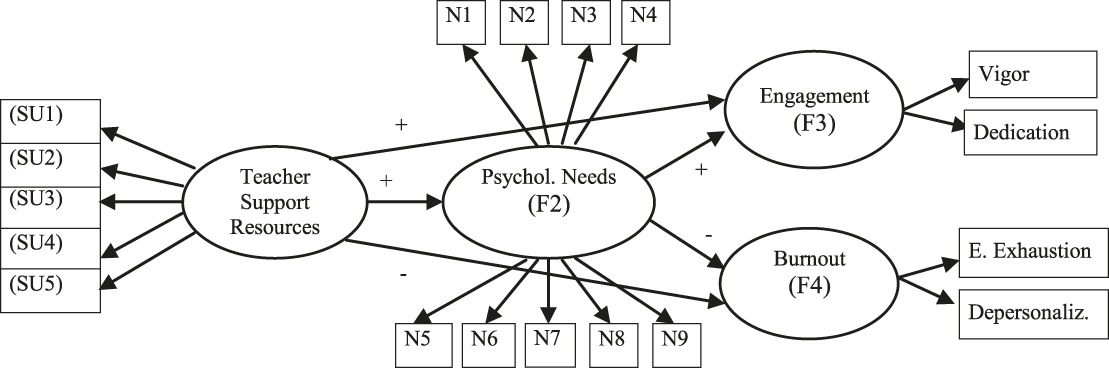
Based on the hypothesized model displayed in Figure 1, the following predictions are addressed: job resources will have a direct and positive impact on engagement (H1); teacher support resources will have a direct and negative impact on burnout (H2); the degree to which a person experiences psychological need satisfaction will have a direct and positive impact on engagement (H3); the degree to which a person experiences psychological need satisfaction will have a direct and negative impact on burnout (H4); teacher support resources will have a direct positive effect on psychological needs (H5) and, finally, it is expected that the link between teacher support resources and burnout-engagement will be mediated by psychological needs (H6).
Structure of the hypothesized model.
Note: SU1: Colleagues support (α = .86), SU2: Family and friends support (α = .82), SU3: Administration support (α = .80), SU4: Material resources support (α = .75), SU5: Psycho-pedagogical support (α = .94).
N1: Relatedness-Belonging (α = .89), N2: Utility (α = .89), N3: Security (α = .90), N4: Recognition (α = .85), N5: Autonomy (α = .76), N6: Development (α = .72), N7: Self-realization (α = .74), N8: Competency (α = .72), N9: Achievement/results (α = .56).

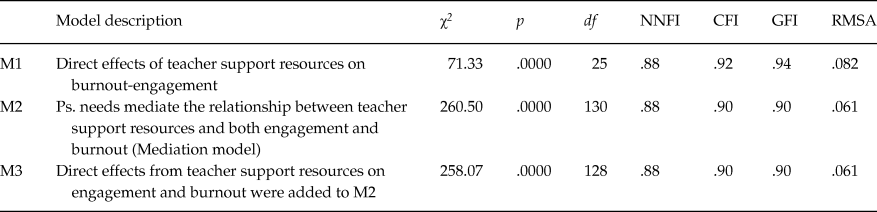
These hypotheses will be tested using SEM (structural equation modeling) procedures by means of the EQS software package (Bentler, Reference Bentler2006). These hypotheses are organized in three different structural models: M1 includes only hypotheses H1 and H2. This model will verify that teacher support resources have a direct effect on burnout and engagement. M2 includes only hypotheses H3, H4, H5 and H6. This model will verify that the effect of teacher support resources on burnout/engagement is mediated by psychological needs. M3 includes all the hypotheses put forward (H1-H6), therefore it proposes that the effects of job demands on burnout/engagement are both direct and indirect.
Method
Participants
A total sample of 282 Spanish secondary school teachers participated in this study. In gender terms, the sample consisted in 276 valid cases (124 males, 44.9% and 152 females, 55.1%) from 23 schools (19 public and 4 private) in Eastern Spain. Teachers were aged between 20 and 60 years (M = 38.6, SD = 9.20). Their professional experience ranged between 1 and 39 years (M = 15.33, SD = 8.86). Schools were randomly selected from public and private schools. The response rate was 56%.
Measuring Instruments
Teacher support resource scale (TSRS)
This scale is a revised and extended version (by adding friends, family and administration support) of that devised by Doménech-Betoret (Reference Doménech-Betoret2009) for Spanish teachers. The current scale consists of 16 items. Their factorial structure and internal consistence have been examined. First, a principal-components factor analysis with varimax rotation was conducted. This analysis yielded five factors that accounted for 73.47% of total variance. All teacher responses were scored on a 4-point Likert-type ordinal scale, with response options ranging from 1 (I quite disagree) to 4 (I quite agree). The extracted factors and an example of an item included in each factor are as follows: (a) Factor 1 (Colleagues support, 4 items, α = .86): “My colleagues are always willing to help”; (b) Factor 2 (Family and friends support, 4 items, α = .82): “My family supports me when I have problems at work”; (c) Factor 3 (Administration support, 3 items, α = .80): “The administration offers me the possibility of attending professional development courses”; (d) Factor 4 (Resources support, 3 items, α = .75): “The resources (library, computer room, laboratories, etc.) which we, as teachers, have available in the workplace are adequate to provide quality teaching”; and (e) Factor 5 (Psycho-pedagogical support, 2 items, α = .94): “I can obtain specialized support from professional workers (psycho-pedagogues, school counselors, social workers, etc.), whenever I need it”. Then we conducted a confirmatory factorial analysis. The results indicated that the expected structure showed a satisfactory fit to data. Although χ 2 was statistically significant, the relative fit indices showed a very satisfactory fit of the model to the data (χ 2 = 154.80, 94; p =.0001, df = 94; NNFI = .95; CFI = .96; RMSEA = .047) (Bentler Reference Bentler1990, Browne & Cudeck, Reference Browne, Cudeck, Bollen and Long1993, Hoyle, Reference Hoyle and Hoyle1995).
Negative items were reversed-coded and measures were constructed by averaging the items on each factor subscale. Figure 1 shows the five observed variables measuring the latent variable Teacher Support Resources, namely SU1 colleagues’ support, SU2 family and friends support, SU3 administration support, SU4 material resources support and SU5 psychopedagogical support.
Teacher psychological needs scale (TPNS)
This scale was constructed for research in the Spanish school context within which this study is framed (for details of its validation, see Doménech-Betoret (Reference Doménech-Betoret2013). It is based on the seven teaching needs proposed by Bess (Reference Bess1977) and on the three basic needs proposed by the SDT (Deci & Ryan, Reference Deci and Ryan1985, Reference Deci and Ryan2000, Reference Deci and Ryan2002). It is composed of 36 items structured in 9 needs as follows: need of relatedness-belongingness (common to both Bess and Deci & Ryan’s approaches) (e.g., “In this department, I feel that I belong to one big family”), need of utility (e.g., “I think that what I teach students will be useful for their own personal life”) need of security (e.g., “Practicing my profession is not a risk for my personal security”), need of social recognition (e.g., “Students’ parents do not appreciate our work”), need of autonomy (e.g., “I am free to decide how and what I teach in my classes”), need of professional development (e.g., “My profession offers me the possibility of developing professionally”), need of self-realization (e.g., “I feel fulfilled by practicing my profession”) need of competency (common to both Bess and Deci & Ryan’s approaches) (e.g., “I believe I am a competent enough teacher to be teaching students in the 21st century”) and need of achievement/results (e.g., “I usually meet the objectives set out in my course subject(s) for each academic year”).
As in the previous scale, the response scale was a 4-point Likert-type ordinal scale, with response options ranging from 1 (I quite disagree) to 4 (I quite agree) Also a principal-components factor analysis with varimax rotation and a subsequent Confirmatory Factor Analysis (CFA) were conducted. The nine-factor structure of the model tested through the CFA was satisfactory (see Doménech-Betoret, Reference Doménech-Betoret2013). Cronbach’s coefficient alpha reliabilities were good for all the subscales (the index of which ranged from .72 (minimum) to .90 (maximum), except for Achievement/results subscale, (which scored .56).
As in the previous scale, measures were constructed by averaging the items on each factor subscale. Figure 1 shows the nine observed variables measuring the latent variable Teacher Psychological Needs (N1-N9).
Work engagement scale (UWES)
Vigor and dedication dimensions were measured using a Spanish translated version of the Utrecht Work Engagement Scale (UWES). This version of the original scale was validated among different Spanish multi-occupational samples (Schaufeli & Bakker, Reference Schaufeli and Bakker2003; Schaufeli, Salanova et al., Reference Schaufeli, Salanova, González-Romá and Bakker2002). Vigor was formed by six items (item example: “In my work, I feel plenty of energy”) and dedication had five items (item example: “My work is challenging”). The response scale was a 7-point Likert-type ordinal scale, with response options ranging from 0 (I quite disagree) to 6 (I quite agree). In line with previous research (Durán, Extremera, & Rey, Reference Durán, Extremera and Rey2004; Schaufeli & Bakker, Reference Schaufeli and Bakker2004), the presented scale also showed good internal consistency for the present study (α = .82 for vigor; α = .88 for dedication). Measures were constructed by averaging the items on each factor subscale.
Burnout scale (MBI-Ed)
Exhaustion and depersonalization were measured using a Spanish version of the Maslach Burnout Inventory Form Ed (MBI-Ed), a form developed specifically for teachers (Maslach & Jackson, Reference Maslach and Jackson1986). The Spanish version has been employed in previous research among Spanish teachers and has shown the expected factor structure an satisfactory internal consistency (alpha coefficients ranging from .76 to .86) (see Doménech-Betoret, Reference Doménech-Betoret2009). Translations to other languages (including Spanish and Catalan Language, -which is a co-official language in Spain- have shown the invariance of the factor structure of this scale, providing support to its validity (Aluja, Blanch, & García, Reference Aluja, Blanch and Garcia2005, Doménech-Betoret, Reference Doménech-Betoret2009). Exhaustion was formed by eight items (α = .81, item example: “I am emotionally exhausted by my work”) and depersonalization had five items (α = .68, item example: “I feel that my work is making me emotionally harder”). Items were measured on a 4-point Likert scale ranging from 1 (I quite disagree) to 4 (I quite agree). This scoring procedure, an alternative to the usual 0 to 6 one, has been employed in academic research in Spanish contexts (Durán, Extremera, Rey, Fernández-Berrocal, & Montalbán, Reference Durán, Extremera, Rey, Fernández-Berrocal and Montalbán2006; Extremera, Durán, & Rey, Reference Extremera, Durán and Rey2007; Extremera et al., Reference Extremera, Durán and Rey2010). Measures were constructed by averaging the items on each factor subscale.
Results
Descriptive Analyses and Correlations among Variables
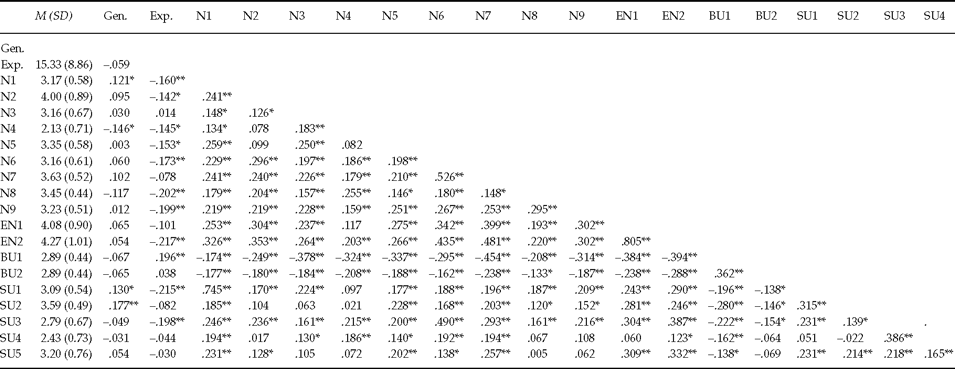
Table 1 shows the correlations, means and standard deviations and alpha coefficients for the scales used. In general, the scales presented good internal consistency indices, which ranged between .75 and .94 for the job support scale, between .72 and .90 for the need scale (except achievement/results, which obtained a lower value of .56), between .74 and .82 for the engagement scale, and between .68 and .81 for the burnout one.
Correlations among the variables followed the expected direction. Overall, the data showed that the nine psychological needs correlated positively and significantly with the dimensions of engagement (vigor and dedication), but negatively and significantly with the dimensions of burnout (emotional exhaustion and depersonalization). Moreover, most job support variables correlated positively and significantly with the dimensions of engagement, but negatively and significantly (at a low magnitude, maximum r = -.28, p < .001) with the dimensions of burnout. Finally, the two dimensions of engagement correlated negatively and significantly with the two dimensions of burnout. For more details, see Table 1.
Pearson’s bivariate correlations and descriptive statistics (N = 282)

Structural equation modeling
The procedure for testing the mediation effect of psychological needs between teacher support resources and burnout-engagement was conducted in two steps. First by establishing the significant direct effects of the latent variable teacher support resources on the latent variables Burnout/Engagement, which corresponds to the M1 test. Second by testing the mediated role of the latent variable psychological needs on these effects. This step corresponds to the test of M2 (only indirect effects, full mediation) and M3 (direct and indirect effects). A series of SEM analyses were performed to test the models formulated (Hair, Black, Babin, & Anderson, Reference Hair, Black, Babin, Anderson and Tatham2010). The standardized coefficients and fit indices obtained from the maximum likelihood method of estimation were calculated.
Since the chi-square test is sensitive to sample size, the use of relative fit indices, such as CFI, NNFI and RMSEA, is strongly recommended (Bentler, Reference Bentler1990). Values lower than .05 for RMSEA indicate a good fit, whereas those up to .08 indicate a poor fit (Browne & Cudeck, Reference Browne, Cudeck, Bollen and Long1993). For NNFI and CFI, values greater than .90 suggest a good fit (Hoyle, Reference Hoyle and Hoyle1995).
First M1 was tested. The obtained fit indices values are presented in table 2. These fit indices values (χ2 = 71.334; p = .001, df = 25; NNFI=.88; CFI = .92; GFI= .94; RMSEA = .082, see table 2) indicate that the model moderately, but satisfactorily, fitted the data. According to the data, teacher support resources had a significant effect on each dependent variable (engagement and burnout), thus this prerequisite for mediation to exist was met (Baron & Kenny, Reference Baron and Kenny1986).
Fit indices of the models tested (N = 282)

Second the mediated model M2 was tested. The fit indices values obtained for M2 (see table 2) indicate that the model fitted the data well when the covariance between two pair of errors was introduced, following the recommendations of the Wald and Lagrange test in the EQS program (χ2 = 260.505; p = .001, df = 130; NNFI = .88; CFI = .90; GFI = .90; RMSEA = .061). According to the data, latent variables teacher support resources had a significant effect on psychological needs, while psychological needs in turn had an effect on each latent variable engagement and burnout.
Then to assess if the direct effects from the latent variables teacher support resources to engagement and burnout would substantially improve the fit of the model, M3 was tested and compared to the previous model (M2). The results obtained for M3 (χ2 = 258.077; p = .001, df = 128; NNFI = .88; CFI = .90; GFI = .90; RMSEA = .061) showed that these additional paths did not improve the model fit (Δχ2(2) = 2.428, p = .29). Besides, the paths from teacher support resources to engagement and from teacher support resources to burnout were not significant (β = .17 and β = .44, p > .05 respectively).
In order to summarize the results obtained by the structural equation analyses, the description and fit indices of the three models tested are provided in Table 2.
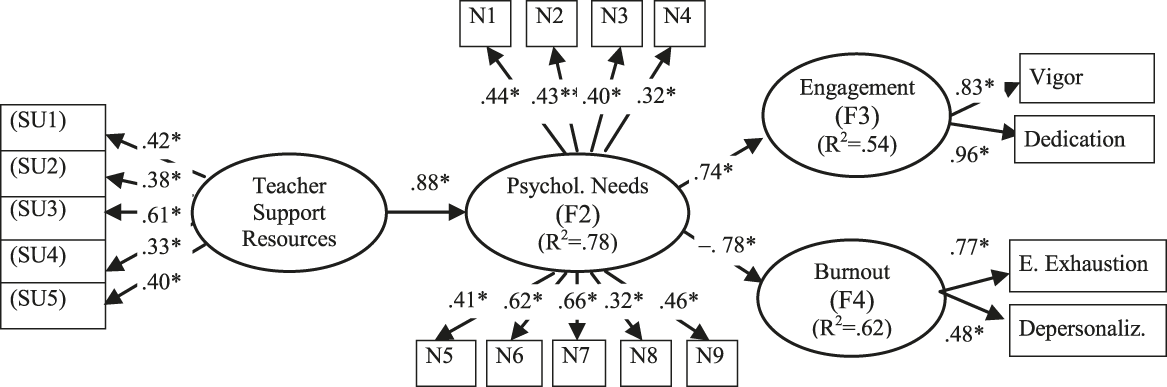
Therefore by following the parsimony criterion, Model M2 proved better. Figure 2 displays M2 along with the standardized coefficients, which were all statistically significant. Notice the strong effects of teacher support resources on psychological needs (β = .88, p < .001) and of psychological needs on Engagement and Burnout (β = .74, p < .001 and β = .78, p < .001, respectively). Note also the high percentage of variance explained for Engagement (54%) and Burnout (62%). All these results support the full mediating role of psychological needs on the model tested in this study.
Relationship among teacher support resources, teacher needs, engagement and burnout. The structural configuration and standardized coefficients of M2 model are displayed.
Note: * = p ≤ .05; n.s. = not significant.

Discussion
The current study focuses on two major objectives: First, to examine the prediction capacity of teacher psychological needs on teacher well-being (considering engagement and burnout as indicators of teacher well-being); second, to examine the mediator role played by teacher psychological needs in the relationship between teacher support resources and both engagement and burnout.
Regarding the prediction capacity of psychological needs on teacher well-being, the analyses indicate a positive, significant and strong effect of latent variable teacher psychological needs on engagement, and a negative, significant and strong effect on burnout. Both effects are therefore similar in magnitude, but opposite in sign. These findings are in line with previous research which proved that satisfying basic psychological needs enhances employees’ intrinsic motivation, whereas unmet or unsatisfied psychological needs provoke negative consequences in teachers, which may affect their health (Deci & Ryan, Reference Deci and Ryan1985, Reference Deci and Ryan2000; van den Broeck et al., Reference van den Broeck, Vansteenkiste, De Witte and Lens2008.
Regarding the mediator role played by teacher psychological needs in the relationship between teacher support resources and both engagement and burnout, the fit indices obtained in M2 support the key aspect in this study; that is, teacher psychological needs mediate the relationship between teacher support resources and both engagement and burnout. These results indicate that teacher support resources, such as colleagues, family and friends, administration, material resources, and psycho-pedagogical, affect engagement and burnout only indirectly; that is, through the fulfillment of basic psychological needs.
In line with previous studies (De Cooman et al., Reference De Cooman, Stynen, van den Broeck, Sels and De Witte2013; van der Elst et al., Reference van der Elst, van den Broeck, De Witte and De Cuyper2012), these findings suggest that psychological needs constitute a mediational mechanism through which teacher support resources relate to secondary school teachers’ well-being. That is, teacher support resources are negatively related to burnout and positively related to engagement because they cover and satisfy teachers’ psychological needs”. These results place workers in the center of the JD-R model through their needs.
On the contrary, these results refine the Conservation of Resources Theory (COR) proposed by Hobfoll (Reference Hobfoll1989), as well as the motivational process described in the JD-R Model (Bakker & Demerouti, Reference Bakker and Demerouti2007, Reference Bakker and Demerouti2008). According to these theories, the role played by teacher support resources on burnout and engagement might be direct. However, the current study does not support such direct paths. Since the mediator role of teacher psychological needs is explicitly included in the model, these direct effects become non-significant. We wonder how much research would have shown the same pattern if it had been tested.
In an educational context, these findings may contribute to a better understanding of the JD-R Model (Bakker & Demerouti, Reference Bakker and Demerouti2007, Reference Bakker and Demerouti2008), especially the motivational process, and suggest the convenience of extending this process in this way; that is, by introducing psychological needs as a mediator link between teacher support resources and engagement (and burnout from the energetic process). We also consider that it is not possible for these results to be exclusive to the educational context, but they probably indicate a general mechanism that acts in any area to which the JD-R model can be applied.
When comparing this research with others done in the JD-R model context, it is interesting to see that the job resources that have been studied sometimes closely correspond to some of the psychological needs contemplated in this study. The autonomy resource would correspond to the autonomy need, the feedback resource would correspond to the recognition need, the learning opportunities resource would correspond to the competence and development need, and the social support resource would correspond to the relatedness need, among resources we can mention. All these resources have received support in former studies as elicitors of the motivational process which leads workers to engagement and well-being at work (see Bakker & Demerouti, Reference Bakker and Demerouti2007; Lorente et al., Reference Lorente, Salanova, Martínez and Schaufeli2008; Rodriguez-Muñoz & Bakker, Reference Rodriguez-Muñoz, Bakker, Moreno-Jimenez and Garrosa Hernandez2013; Skaalvik & Skaalvik, Reference Skaalvik and Skaalvik2007). In light of our results, it is worth considering whether this motivator effect is not merely the tip of the iceberg because what is really the motivator is not the perception that the resource –autonomy, for instance- is available; rather workers feel that their need –autonomy- is covered by this resource. Some authors have already suggested that teacher support resources can have an intrinsic motivator effect which they attribute as it meets basic psychological needs (Rodriguez-Muñoz & Bakker, Reference Rodriguez-Muñoz, Bakker, Moreno-Jimenez and Garrosa Hernandez2013). In conclusion, the findings of this study suggest that support resources are efficacious in terms of promoting workers’ well-being when they cover psychological basic needs.
Finally, the study of De Cooman et al. (Reference De Cooman, Stynen, van den Broeck, Sels and De Witte2013) revealed that job resources promote the fulfillment of the three SDT basic psychological needs which, in turn, promote high levels of work effort. Now our work reveals that teacher support resources also promote the fulfillment of the SDT basic psychological needs and specific teacher psychological needs which, in turn, promote high levels of work engagement and low levels of burnout. We are unaware of any other work which has to date tested mediator mechanism within the JD-R model. However, it is a promising line of work.
The first main limitation of the present study is the size and representativeness of the study sample. A larger sample would have allowed us to test more comprehensive models. Regarding representativeness, note that teachers participated voluntarily in this study, so there is no random selection involved to ensure that the sample is representative of the population. Therefore, caution is needed when generalizing these results.
The second major limitation refers to this study’s cross-sectional design as a temporal sequence among these variables is required to establish a rigorous cause-effect relationship. It is encouraged to test the hypothesized relationships in a longitudinal study design.
We herein propose several suggestions to continue studying this line of research in the future. First further research is needed to investigate teachers’ major needs in the workplace at other levels of education and for teachers from other countries. Second, and based on the JD-R model of work engagement (Bakker & Demerouti, Reference Bakker and Demerouti2007, Reference Bakker and Demerouti2008), it would be interesting to examine the role played by psychological needs in the motivational process suggested in this proposal. Third it is encouraged to test the hypothesized relationships in a longitudinal study design. Finally, the achievement/results subscale from psychological needs should be reviewed and improved in future research.
Despite these limitations, this study extends previous research into the field of teacher well-being. Apart from providing new data, this work also presents practical implications to increase teacher engagement and to reduce burnout. The tested model suggests that the way to improve engagement and to reduce burnout is through psychological needs, and that job support resources trigger a motivational process through which employees satisfy their basic needs (van den Broeck et al., Reference van den Broeck, Vansteenkiste, De Witte and Lens2008). Accordingly, these findings suggest that providing support resources at school (social and material support) to meet teacher psychological needs is highly recommendable to increase secondary school teacher well-being. In this sense, interventions in the work environment to develop job support resources are required. Primarily, interventions should be addressed, on the one hand, to create a supportive, collaborative school climate and, on the other hand, to enhance teachers’ interpersonal efficacy (Cherniss, Reference Cherniss, Schaufeli, Maslach and Marek1993), defined by the author as teachers’ ability to work harmoniously with others, particularly service recipients, colleagues and direct supervisors. However it would firstly be recommendable to find out the most important needs to be covered in order to address any efforts made as efficiently as possible. As this study suggests, if the resource we intend to offer teachers is not susceptible to covering a need that requires being covered, it is not likely to have an impact on their well-being. Yet if we do not offer the resources that are required to cover their psychological needs, then exhaustion and emotional distance shall follow. Let us bear this in mind for future performance to be as effective as possible.