Introduction
People who speak two languages must monitor which language to use in every conversation, inhibit use of the other language, and switch or mix languages when desired or necessary. Even when speaking in monolingual contexts, both languages remain active; bilinguals cannot simply “shut off” one language and effectively function like a monolingual (e.g., Abutalebi & Green, Reference Abutalebi and Green2007; Kroll, Dussias, Bogulski, & Valdés Kroff, Reference Kroll, Dussias, Bogulski and Valdés Kroff2012). Of interest here is the idea that such continual practice with language control may generalize to nonlinguistic tasks, leading to bilingual advantages in cognitive control or “executive functions” (Bialystok, Craik, Green, & Gollan, Reference Bialystok, Craik, Green and Gollan2009).
The term executive functions covers a range of abilities, including inhibitory control, task switching, and monitoring (Miyake et al., Reference Miyake, Friedman, Emerson, Witzki, Howerter and Wager2000). Bilingual advantages have been observed in inhibition and switching (e.g., Bialystok, Craik, & Luk, Reference Bialystok, Craik and Luk2008; Carlson & Meltzoff, Reference Carlson and Meltzoff2008; Costa, Hernández, Costa-Faidella, & Sebastián-Gallés, Reference Costa, Hernández, Costa-Faidella and Sebastián-Gallés2009; Marzecová, Asanowicz, Krivá, & Wodniecka, Reference Marzecová, Asanowicz, Krivá and Wodniecka2012; Tao, Marzecová, Taft, Asanowicz, & Wodniecka, Reference Tao, Marzecová, Taft, Asanowicz and Wodniecka2011; for a review see Bialystok et al., 2009), although several recent studies have questioned the robustness of these advantages, particularly in relation to inhibition (e.g., Antón et al., Reference Antón, Duñabeitia, Estévez, Hernández, Castillo, Fuentes and Carreiras2014; Duñabeitia et al., Reference Duñabeitia, Hernández, Antón, Macizo, Estévez, Fuentes and Carreiras2014; Gathercole et al., Reference Gathercole, Thomas, Kennedy, Prys, Young, Guasch and Jones2014; Kousaie & Phillips, Reference Kousaie and Phillips2012; Paap & Greenberg, Reference Paap and Greenberg2013; Valian, Reference Valian2015). Relatively few studies have attempted to investigate the precise relationship between bilingual language use and advantages in executive functioning using objective measures of bilingual proficiency and standardized measures of executive function. Such studies are clearly important, both for development of theory and assessment of bilinguals in clinical settings, and may eventually reveal where performance differences between bilinguals and monolinguals do consistently arise.
Switching is an aspect of cognitive control that is quite transparently related to bilingual language use. In some bilingual communities, it is common to switch back and forth between languages in a single conversation, a practice that might be expected to enhance general task switching ability (assuming such an ability exists; see Yehene & Meiran, Reference Yehene and Meiran2007). The bilingual advantage in nonlinguistic task switching appears to be more replicable than advantages in other aspects of cognitive functioning, and has been observed in both behavioral (e.g., Bialystok, Craik, Binns, Ossher, & Freedman, Reference Bialystok, Craik, Binns, Ossher and Freedman2014; Prior & Gollan, Reference Prior and Gollan2011; Prior & MacWhinney, Reference Prior and MacWhinney2010; for related findings see Verreyt, Woumans, Vandelanotte, Szmalec, & Duyck, Reference Verreyt, Woumans, Vandelanotte, Szmalec and Duyck2015) and neuroimaging studies (e.g., Garbin et al., Reference Garbin, Sanjuan, Forn, Bustamante, Rodríguez-Pujadas, Belloch and Ávila2010), although with some exceptions (e.g., Hernández, Martin, Barceló, & Costa, Reference Hernández, Martin, Barceló and Costa2013; Paap & Greenberg, 2014).
Prior and colleagues used a task that required switching between color (red or green) and shape (circle or triangle) judgments. In one study, bilinguals responded more quickly than monolinguals on switch trials (i.e., when cued to switch tasks), but did not differ from monolinguals on non-switch trials, thus exhibiting smaller “switching cost” (i.e., the difference between switch and non-switch trials; Prior & MacWhinney, Reference Prior and MacWhinney2010). However, in another study Spanish-English bilinguals showed the switching advantage whereas Mandarin-English bilinguals did not (Prior & Gollan, Reference Prior and Gollan2011), suggesting that bilingual language use does not always lead to a switching advantage. Importantly, in the same study, Prior and Gollan (Reference Prior and Gollan2011) also assessed language switching ability using a paradigm in which bilinguals switched between naming digits (1–9) in either English or their L1. Spanish-English bilinguals reported greater frequency of language switching in daily use, and exhibited a significantly smaller language switching cost than Mandarin-English bilinguals. These results suggest a link between bilingual language use and nonlinguistic task switching, and suggest that experience with the former may enhance general switching abilities.
Garbin et al. (Reference Garbin, Sanjuan, Forn, Bustamante, Rodríguez-Pujadas, Belloch and Ávila2010) replicated the bilingual advantage in switching cost, and also reported neuroimaging data suggesting that bilinguals and monolinguals recruit different brain regions to perform nonlinguistic switching. Monolinguals exhibited activation in brain areas that are typically responsible for nonlinguistic monitoring and inhibitory processes, whereas bilinguals exhibited their activation in areas that are typically involved in bilingual language control. These activation patterns corroborate the behavioral data and suggest overlap in the neural networks responsible for language switching and nonlinguistic task switching for bilinguals, resulting in greater efficiency for switching in general (see also De Baene, Duyck, Brass, & Carreiras, Reference De Baene, Duyck, Brass and Carreiras2015; Weissberger, Gollan, Bondi, Clark, & Wierenga, Reference Weissberger, Gollan, Bondi, Clark and Wierenga2015).
Another study examined task switching and inhibitory control in aging bilinguals and monolinguals with dementia (Bialystok et al., Reference Bialystok, Craik, Binns, Ossher and Freedman2014) using the Color-Word Interference Test (CWIT) of the Delis-Kaplan Executive Function System battery (D-KEFS; Delis, Kaplan, & Kramer, Reference Delis, Kaplan and Kramer2001). The CWIT assesses inhibition and switching using four subtests in which participants name color patches, read words, complete a Stroop task (Stroop, Reference Stroop1935), and switch between tasks. In the inhibition subtest, participants are required to name the ink color of written color words, while inhibiting the automatic tendency to read the word that is incongruent with the ink color. In the switching subtest, participants switch back and forth between naming the incongruent ink colors and reading the words, as indicated by a cue (a box surrounding the word). Bialystok et al. (Reference Bialystok, Craik, Binns, Ossher and Freedman2014) found that bilinguals with dementia showed smaller inhibition cost (i.e., the difference between the inhibition condition and baseline naming of color patches) than monolingual patients with comparable diagnosis and symptoms. The study did not examine switching cost (i.e., the difference between the combined inhibition/switching condition and the pure inhibition condition), and found no difference between bilingual and monolingual patients in raw completion times for the inhibition and inhibition/switching conditions.
The present study aimed to clarify the relationship between bilingualism and its possible effects on switching—more specifically performance on a clinically standardized measure of switching, the CWIT—while also explicitly examining the relationship between CWIT performance and objectively measured bilingual language proficiency. Previous investigations of bilingual advantages have typically relied on group-comparisons of bilinguals to monolinguals, which obscure the possibility that cognitive control advantages may vary with different patterns of bilingual language use. Previous studies also often relied on self-report measures of bilingual language proficiency, which may be inaccurate and less powerful than objective measures. Additionally, we examined the relationship between bilingual advantages and disadvantages, and in bilinguals of two different language combinations.
Following Prior and Gollan (Reference Prior and Gollan2011), who found a switching advantage in Spanish-English but not Mandarin-English bilinguals, we tested these same two bilingual groups. Both groups were Heritage Language (HL) speakers, that is, bilinguals living in an environment with one predominant majority language (i.e., English), but with parents who spoke another language at home. HL speakers in the United States are typically English dominant, that is, they use English as their main or preferred language and have native-like English proficiency levels, but use the HL only in some restricted circumstances with a wide range of proficiency levels.
Finally, in contrast to the advantages often found for bilinguals in nonlinguistic tasks measuring executive functions, bilinguals are often slightly, but significantly, disadvantaged compared to monolinguals on linguistic tasks, such as vocabulary, verbal fluency, picture naming, and tongue-twister production (e.g., Bialystok et al., Reference Bialystok, Craik and Luk2008; Gollan & Goldrick, Reference Gollan and Goldrick2012; Gollan, Montoya, & Werner, Reference Gollan, Montoya and Werner2002; Gollan, Montoya, Fennema-Notestine, & Morris, Reference Gollan, Montoya, Fennema-Notestine and Morris2005; Luo, Luk, & Bialystok, Reference Luo, Luk and Bialystok2010; for reviews see Bialystok et al., Reference Bialystok, Craik, Green and Gollan2009; Kroll & Gollan, Reference Kroll and Gollan2014). We assessed English language production using two tasks, verbal fluency and picture naming, and asked whether bilingual disadvantages in language tasks are also associated with the same continuous measure of bilingual proficiency.
Method
Participants
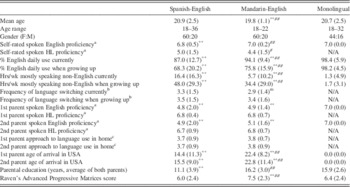
Spanish-English bilinguals (n=80), Mandarin-English bilinguals (n=80), and Monolingual English speakers (n=60), who were undergraduates at the University of California San Diego (UCSD), participated for course credit. Table 1 presents participant characteristics. All were either born in the United States or immigrated at or before age 1. Those who arrived at a later age were not included so that uniformity in the age of acquisition of the two languages was maintained. Monolinguals who had lived outside the United States for a year or more were excluded, as were those who reported either parent as being able to speak a HL, and if either parent was not born in the United States. In addition, participants were asked to list up to four people at home who interacted with them the most while growing up, and rate their pronunciation of English. Monolinguals who had family members who were identified as having a foreign accent were also excluded. Participants in both bilingual groups were dominant in English, and used English more frequently than their other language. However, Spanish-English bilinguals reported higher proficiency and greater usage of their HL than Mandarin-English bilinguals (see Table 1).
Characteristics of participant groups (standard deviation in parentheses)

Note. HL=Heritage Language.
a 1=Not at all, 2=Very poor, 3=Poor, 4=Functional, 5=Good, 6=Very good, 7=Native-like.
b 1=Never or almost never, 2=Rarely, 3=Occasionally, 4=Two or three times in each conversation, 5=Several times in each conversation, 6=A lot or sometimes even constantly.
c 1=Very strongly encouraged me to avoid speaking English, 2=Often encouraged me to avoid speaking English, 3=Sometimes encouraged me to avoid speaking English, 4=Allowed me to speak in whichever language I preferred, 5=Preferred that I speak English.
*Significant difference compared to Monolingual group, p<.05.
**Significant difference compared to Monolingual group, p<.01.
#Significant difference between Spanish-English and Mandarin-English bilinguals, p<.05.
##Significant difference between Spanish-English and Mandarin-English bilinguals, p<.01.
mMarginally significant difference between Spanish-English and Mandarin-English bilinguals, p<.10.
Materials and Procedure
After providing informed consent, participants completed a language history questionnaire, followed by a shortened version of Raven’s Advanced Progressive Matrices Set II (Raven, Raven, & Court, Reference Raven, Raven and Court1998) with 12 items, and a 10-min time-limit (see Table 1). The cognitive and linguistic tasks were then administered in the same order to all participants, as detailed below. Participants were tested individually in one testing session lasting approximately 1 hr. The study was approved by the UCSD Human Research Protection Program.
Inhibition and Switching Task
The Color-Word Interference Test (CWIT; Delis et al., Reference Delis, Kaplan and Kramer2001) has four conditions, each consisting of 50 items that all appear printed on a single page that is placed in front of participants as they complete the task. Time in seconds to complete all items on the page was recorded for each participant. Baseline conditions included Color Naming (naming color patches) and Word Reading (reading of color words printed in black ink), which assess key component skills of the other two higher-level conditions. A third condition, Inhibition, assesses participants’ ability to inhibit the automatic tendency to read the words instead of naming the incongruent ink color (e.g., say “red” in response to the written word blue printed in red ink). The fourth condition, Inhibition/Switching, requires participants to switch back and forth between the Stroop task (naming the incongruent ink colors) and reading the words. Simultaneous measurement of both inhibition and switching increases demands on executive functioning in this condition relative to the Inhibition condition (Fine et al., Reference Fine, Delis, Wetter, Jacobson, Jak, McDonald and Bondi2008).
Of greatest interest were three CWIT contrast scores (Delis et al., Reference Delis, Kaplan and Kramer2001): Inhibition Cost (i.e., Inhibition minus Color Naming), combined Inhibition/Switching Cost (i.e., Inhibition/Switching minus the sum of Naming and Reading), and Switching Cost (i.e., Inhibition/Switching minus Inhibition). The Inhibition Cost reflects the ability to inhibit the automatic tendency to read the written word to correctly name incongruent ink colors, while accounting for baseline speed in naming color patches. The combined Inhibition/Switching Cost measures both the ability to inhibit word reading and the ability to switch between naming incongruent ink colors and reading words, while accounting for baseline performance in both naming color patches and reading words printed in black ink. The Switching Cost measures the ability to switch between naming incongruent ink colors and reading words, while partialing out performance in inhibition that is required to name incongruent ink colors.
Linguistic Tasks
Verbal fluency
In the Controlled Oral Word Association Test (COWAT; Benton, Reference Benton1969) participants are given one minute to produce as many words as possible in a particular category, while avoiding proper nouns, numbers, and swear words, as well as repetition and morphological variants (e.g., after saying “create”, not to say “creating”, “creator”, etc.). Participants completed three letter categories (C, F, and L) and one semantic category (Animals). The total number of correct responses for letters C, F, and L were summed in a single letter fluency score, while the semantic fluency score was the total number of animal names produced.
English proficiency
The Multilingual Naming Test (MINT; Gollan, Weissberger, Runnqvist, Montoya, & Cera, Reference Gollan, Weissberger, Runnqvist, Montoya and Cera2012) consists of 68 black-and-white line drawings, presented in order of difficulty. The total number of pictures correctly named in English provided a measure of English proficiency. There was no time limit on this task.
Heritage language proficiency
To measure HL proficiency, Spanish-English and Mandarin-English bilinguals also completed the MINT in their respective HL at the end of the testing session. MINT scores have been shown to be significantly correlated with other proficiency measures (e.g., Oral Proficiency Interviews; Gollan et al., Reference Gollan, Weissberger, Runnqvist, Montoya and Cera2012; Sheng, Lu, & Gollan, Reference Sheng, Lu and Gollan2013). An experimenter fluent in Spanish or Mandarin administered this part of the task in the relevant language. All other interactions with participants were in English.
Results
Between-Group Comparisons
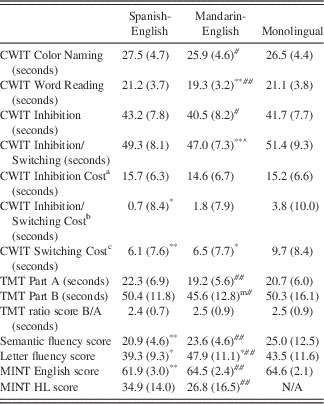
Table 2 Footnote 1 presents the means for the three groups on all of the cognitive and linguistic measures. For each measure, analyses of variance (ANOVAs) were carried out separately to compare Spanish-English bilinguals to Monolinguals, and Mandarin-English bilinguals to Monolinguals. When comparing Spanish-English bilinguals to Monolinguals, we repeated each analysis controlling socioeconomic status (SES; as indicated by parental education) as a covariate in analyses of covariance (ANCOVAs), because parental education was significantly lower in the Spanish-English bilinguals (see Table 1). Similarly, when comparing Mandarin-English bilinguals to Monolinguals, we repeated each analysis controlling for nonverbal IQ (Raven’s matrices scores), since Mandarin-English bilinguals exhibited significantly higher scores on this test (see Table 1). In addition, the Mandarin-English bilinguals were approximately 1 year younger on average than the other two groups. To assess possible age effects, analyses were carried out using age as a covariate for comparisons between Mandarin-English bilinguals and Monolinguals. Controlling age did not alter any of the outcomes, thus we do not discuss such analyses further.
Mean scores on cognitive and linguistic tasks for participant groups (standard deviation in parentheses)

Note. HL=Heritage Language.
a Inhibition minus Color Naming.
b Inhibition/Switching minus combined Color Naming and Word Reading.
c Inhibition/Switching minus Inhibition.
*Significant difference compared to Monolingual group, p<.05.
**Significant difference compared to Monolingual group, p<.01.
mMarginally significant difference compared to Monolingual group, p<.10.
#Significant difference between Spanish-English and Mandarin-English bilinguals, p<.05.
##Significant difference between Spanish-English and Mandarin-English bilinguals, p<.01.
^Marginally significant difference between Spanish-English and Mandarin-English bilinguals, p<.10.
Inhibition and Switching
Spanish-English versus Monolingual
Spanish-English bilinguals and Monolinguals did not differ significantly on any of the four conditions of the CWIT, all F’s<2, all p’s≥.17. However, Spanish-English bilinguals showed a significantly smaller Inhibition/Switching Cost, F(1,138)=3.98, MSE=331.44, p=.048, η p 2=.03, and Switching Cost, F(1,138)=6.85, MSE=438.03, p=.010, η p 2=.05, than Monolinguals. After controlling SES, the difference in Inhibition/Switching Cost was only marginally significant, F(1,137)=3.22, MSE=269.86, p=.075, η p 2=.02, but the Switching Cost difference remained robust, F(1,137)=5.69, MSE=365.97, p=.018, η p 2=.04. There was no difference between groups on Inhibition Cost, F<1.
Mandarin-English versus Monolingual
Mandarin-English bilinguals completed the Word Reading baseline, F(1,138)=9.13, MSE=110.13, p=.003, η p 2=.06, and the Inhibition/Switching condition, F(1,138)=9.75, MSE=654.60, p=.002, η p 2=.07, more quickly than Monolinguals. These differences remained significant after controlling for nonverbal IQ, F(1,137)=6.27, MSE=73.89, p=.013, η p 2=.04, and F(1,137)=7.11, MSE=470.17, p=.009, η p 2=.05, respectively. However, the two groups did not differ in the Color Naming baseline or Inhibition condition, both F’s<1. As found for Spanish-English bilinguals, Mandarin-English bilinguals exhibited a significantly smaller Switching Cost than Monolinguals, F(1,138)=5.27, MSE=338.68, p=.023, η p 2=.04, and this difference remained significant after controlling nonverbal IQ, F(1,137)=6.82, MSE=433.62, p=.010, η p 2=.05. Mandarin-English bilinguals did not differ from Monolinguals on Inhibition/Switching Cost or Inhibition Cost, F’s<2.
To facilitate interpretation of possible clinical significance of the observed differences between bilinguals and monolinguals on the Switching Cost measure, Table 3 shows the mean and standard deviation for Spanish-English and Mandarin-English bilinguals further divided into three HL proficiency groups: high (HL MINT scores greater than 40), moderate (scores from 21 to 40), and low (scores less than 20). Note that high-proficiency Mandarin-English bilinguals tended to have lower HL MINT scores than high-proficiency Spanish-English bilinguals (although this difference was not significant p=.138), and a much smaller number of Mandarin-English than Spanish-English bilinguals were classified as “high-proficiency” (see Table 3). The division of bilinguals into proficiency groups illustrates that only high-proficiency Spanish-English bilinguals exhibited a significant Switching Cost advantage relative to Monolinguals.
Mean scores on CWIT switching cost separated into levels of Heritage Language proficiency (standard deviation in parentheses)

Note. HL=Heritage Language.
a Inhibition/Switching minus Inhibition.
*Significant difference compared to Monolingual group, p<.05.
**Significant difference compared to Monolingual group, p<.01.
mMarginally significant difference compared to Monolingual group, p<.10.
##Significant difference between Spanish-English and Mandarin-English bilinguals, p<.01.
^Marginally significant difference between Spanish-English and Mandarin-English bilinguals, p<.10.
Linguistic Tasks
Spanish-English versus Monolingual
On the verbal fluency task, Spanish-English bilinguals produced significantly fewer correct responses than Monolinguals, in both semantic, F(1,138)=7.27, MSE=576.34, p=.008, η p 2=.05, and letter fluency, F(1,138)=5.574, MSE=597.62, p=.020, η p 2=.04. After controlling SES, however, the difference in semantic fluency was only marginally significant, F(1,137)=2.74, MSE=216.98, p=.100, η p 2=.02, and the letter fluency difference was not significant, F(1,137)=1.06, MSE=111.83, p=.306, η p 2=.01. On the MINT in English, Spanish-English bilinguals named significantly fewer pictures correctly than Monolinguals, F(1,138)=32.60, MSE=237.00, p<.001, η p 2=.19, and this difference remained significant after controlling SES, F(1,137)=7.16, MSE=47.21, p=.008, η p 2=.05.
Mandarin-English versus Monolingual
Compared to Monolinguals, Mandarin-English bilinguals did not produce significantly fewer responses in semantic fluency, F<1, and produced significantly more correct responses in letter fluency, F(1,138)=5.23, MSE=671.34, p=.024, η p 2=.04, although this difference was only marginally significant after controlling nonverbal IQ, F(1,137)=2.93, MSE=363.71, p=.089, η p 2=.02. There was no difference between these two groups on the MINT in English, even when controlling nonverbal IQ, F<2.
Spanish-English versus Mandarin-English
As seen in Table 1, the Spanish-English bilinguals were more proficient in their HL than the Mandarin-English bilinguals. This was confirmed in the HL MINT scores; Spanish-English bilinguals named significantly more pictures correctly in Spanish than did Mandarin-English bilinguals in Mandarin, F(1,158)=11.34, MSE=2665.06, p=.001, η p 2=.07 (see also Table 2).
Relationships among Variables
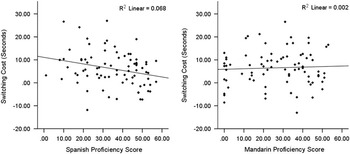
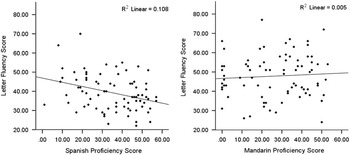
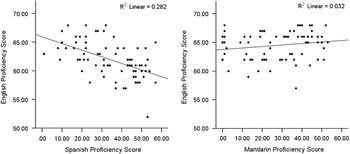
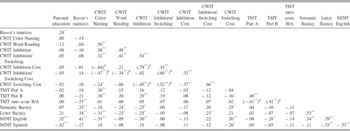
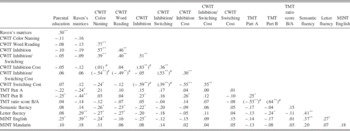
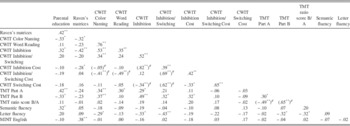
To explore the relationship between bilingualism and the above-reported advantages and disadvantages, Tables 4–6 show correlations between HL MINT scores and each of the outcome measures for the Spanish-English, Mandarin-English, and Monolingual groups respectively. Correlations of greatest interest are shown in the bottom row (i.e., the correlations between HL MINT scores and other measures). A different pattern of results emerged for the two HL groups. In Spanish-English bilinguals, higher HL proficiency was associated with smaller Switching Cost (see Figure 1), and with lower ability to produce English words (letter fluency and picture naming; see Figures 2 and 3, respectively). In contrast, the HL proficiency of the Mandarin-English bilinguals was not significantly correlated with any outcome measure (and if anything, higher HL proficiency tended to be associated with higher English proficiency, although not significantly so).
Correlations between CWIT Switching Cost and MINT Heritage Language scores, for (a) Spanish-English bilinguals and (b) Mandarin-English bilinguals.

Correlations between letter fluency scores and MINT Heritage Language scores, for (a) Spanish-English bilinguals and (b) Mandarin-English bilinguals.

Correlations between MINT English scores and MINT Heritage Language scores, for (a) Spanish-English bilinguals and (b) Mandarin-English bilinguals.

To further explore the possible mechanisms underlying individual differences in Switching Cost we conducted a regression analysis across all three participant groups, simultaneously entering nonverbal IQ, semantic fluency, English MINT, and HL MINT scores (entered as “0” for Monolinguals). The predictor variables entered were those that were significantly correlated with Switching Cost when collapsed across all participants (r’s ranging from .14 to .24; all p’s<.05; letter fluency and parental education were excluded because they were not correlated with Switching Cost, r’s<.06, p’s>.40). The total model was significant, F(4,215)=4.93, p=.001, r 2 =.08. Only MINT scores explained variance in Switching Cost, with higher English MINT scores predicting larger costs, β=0.15, p=.050, whereas higher HL MINT scores predicted marginally smaller costs, β=−0.13, p=.068. Additionally, English and HL MINT scores were themselves negatively correlated, r=−.32; p<.001. A follow-up regression analysis including only English and HL MINT scores as predictors, and only Mandarin-English bilinguals and Monolinguals, revealed a significant negative effect of English MINT scores (p=.043), and a non-significant trend in the opposite direction for HL MINT scores (p=.124). These results suggest greater consistency in the mechanism underlying the switching advantage across different bilingual groups than was suggested by the group comparisons (ANOVAs) above. We also conducted regression analyses for Inhibition Cost and Inhibition/Switching Cost, but none of the background or linguistic variables significantly predicted these two measures, p’s>.08.
Discussion
The present study examined the relationship between bilingual language proficiency and a clinically standardized measure of switching ability, in Spanish-English and Mandarin-English bilinguals. In previous research (Prior & Gollan, Reference Prior and Gollan2011), Spanish-English bilinguals exhibited smaller switching costs than monolinguals in a trial-to-trial task switching paradigm, while Mandarin-English bilinguals did not. In the current study, both Spanish-English and Mandarin-English bilinguals exhibited a smaller Switching Cost than monolinguals, although the switching advantage was clearly associated with HL proficiency only in Spanish-English bilinguals. The Spanish-English bilinguals also showed a small advantage in the combined Inhibition/Switching Cost. However, this might have been driven entirely by the switching advantage given that bilinguals and monolinguals did not differ on Inhibition Cost.
Note that Bialystok and colleagues did find bilingual advantages in Inhibition Cost using the CWIT (Bialystok et al., Reference Bialystok, Craik, Binns, Ossher and Freedman2014) and a trial-to-trial Stroop task (Bialystok et al., Reference Bialystok, Craik and Luk2008). However, the bilinguals in those studies may have had higher HL proficiency than those in the present study (e.g., self-rated speaking proficiency of 3.65 of 4 in Bialystok et al., Reference Bialystok, Craik and Luk2008, versus only 5.0 and 4.4 of 7 for the present Spanish-English and Mandarin-English bilinguals, respectively). Indeed balanced bilinguals sometimes exhibit greater executive control advantage over monolinguals than unbalanced bilinguals (Bialystok, Craik, & Ruocco, Reference Bialystok, Craik and Ruocco2006; but see Duñabeitia et al., Reference Duñabeitia, Hernández, Antón, Macizo, Estévez, Fuentes and Carreiras2014). Furthermore, Bialystok and colleagues included older bilinguals, and bilinguals with dementia. Inhibitory control abilities may be closer to ceiling level for young adults, which could lead to inconsistency in the possibility of detecting effects across studies.
The finding of a reduction in Switching Cost associated with bilingualism, and one that is more obviously related to HL proficiency in Spanish-English than in Mandarin-English bilinguals, is consistent with previous findings using experimental switching paradigms (e.g., Prior & Gollan, Reference Prior and Gollan2011; Prior & MacWhinney, Reference Prior and MacWhinney2010). The present results extend those findings to a standardized measure of switching, and suggest caution is needed when interpreting this measure in clinical settings. In particular, Table 3 shows that the average Switching Cost for monolinguals was more than half a standard deviation larger than that of highly proficient Spanish-English bilinguals (indeed it was closer to a full standard deviation larger when considering the highly proficient Spanish-English bilinguals’ mean and standard deviation). In contrast, moderate- and low-proficiency HL speakers did not differ as much from monolinguals in the size of their Switching Cost. Mandarin-English bilinguals exhibited marginally significant trends in the same direction, although in this case, the size of the difference appeared to be smaller and the relationship to HL proficiency was less systematic (high- and low-proficiency groups exhibited the trend, but moderate-proficiency Mandarin-speakers did not). Finally, the standard deviations surrounding Switching Costs were rather large (larger than the means themselves), and thus there appears to be considerable within-group variability in the range of what can be considered normal performance. Therefore, there may be limitations on the clinical utility of this measure, and this might also explain why between-group differences are not always found across studies. The switching advantage found with the CWIT may be more robust than that observed in experimental paradigms. For example, in Prior and Gollan (Reference Prior and Gollan2011), Spanish-English bilinguals exhibited significantly smaller task-switching costs than monolinguals only after controlling for SES. In the present study, the advantage was found even without this control. Furthermore, the monolinguals in the present study were arguably more profoundly monolingual, as those with family members who may have spoken an HL were excluded. This was done because exposure to multiple languages, even without the ability to speak those languages themselves, has been shown to impact cognitive and linguistic functioning (Fan, Liberman, Keysar, & Kinzler, Reference Fan, Liberman, Keysar and Kinzler2015).
Different patterns across the two bilingual groups were also found in the correlations between HL proficiency and the various outcome measures, in which only Spanish-English bilinguals exhibited disadvantages that appeared to be explicitly linked to degree of HL proficiency. That is, higher Spanish picture naming scores were associated with smaller Switching Costs, but with weaker English verbal fluency and English picture naming scores. Thus, a stronger argument can be made that bilingualism, or some experience related to knowledge of two languages, is driving performance differences in Spanish-English bilinguals, whereas in Mandarin-English bilinguals this relationship is less apparent. These results could suggest that different cognitive mechanisms underlie the cognitive advantages and linguistic disadvantages in the two bilingual groups. However, against this possibility, a regression analysis with only Mandarin-English bilinguals and monolinguals revealed a significant association between English picture naming scores and Switching Cost, such that lower English naming scores were associated with better switching ability. It is not clear why picture naming scores in Mandarin were less powerful predictors than English naming scores in this case. The latter might be more reliable because all participants named pictures in English (including both bilingual groups and monolinguals), whereas monolinguals did not name pictures in any other language, and HL naming scores involved measurement of different languages for the two bilingual groups. Importantly, Mandarin-English bilinguals still exhibited a switching advantage when controlling for their higher word reading performance, F(1,137)=6.15, MSE=395.49, p=.014, η p 2=.04. Thus, their switching advantage was not attributable to their higher word reading performance or higher nonverbal IQ.
Further investigation will be needed to identify the source of the Switching Cost advantage in Mandarin-English bilinguals. One obvious possible explanation for the different outcomes across the two bilingual groups with respect to the relationship between Switching Cost and HL proficiency is that, while both bilingual groups showed a wide range of HL proficiency levels, the Mandarin-English bilinguals on average were less proficient in their HL than the Spanish-English bilinguals, both in self-ratings and MINT scores, and also reported using English more often (see Tables 1–2). Possibly related differences between the bilingual groups were found in the linguistic tasks. Replicating previous studies, Spanish-English bilinguals produced fewer category members in the English verbal fluency (especially semantic fluency; see also Gollan et al., Reference Gollan, Montoya and Werner2002; Rosselli et al., 2002), and named fewer pictures in English, relative to monolinguals (e.g., Bialystok et al., Reference Bialystok, Craik and Luk2008; Gollan et al., Reference Gollan, Montoya, Fennema-Notestine and Morris2005; Luo et al., Reference Luo, Luk and Bialystok2010). These disadvantages could reflect negative consequences of the same mechanism that leads bilinguals to develop stronger executive control mechanism (i.e., interference between languages; Abutalebi & Green, Reference Abutalebi and Green2007; Bialystok et al., Reference Bialystok, Craik, Green and Gollan2009; Kroll et al., Reference Kroll, Dussias, Bogulski and Valdés Kroff2012), or a more emergent property of bilingual language use (which is that bilinguals use each language less frequently than monolinguals use their one language; Gollan, Montoya, Cera, & Sandoval, Reference Gollan, Montoya, Cera and Sandoval2008; Gollan et al., Reference Gollan, Slattery, Goldenberg, Van Assche, Duyck and Rayner2011; Sandoval, Gollan, Ferreira, & Salmon, Reference Sandoval, Gollan, Ferreira and Salmon2010). Of possible interest here is that the same bilinguals who did not exhibit a switching advantage, also did not exhibit a disadvantage on the English MINT (see low-proficiency Spanish-English bilinguals in Table 3; although there were only 14 such individuals).
A further challenge for the assumption that the same mechanism underlies bilingual advantages and disadvantages (for a review see Kroll & Gollan, Reference Kroll and Gollan2014) was that Mandarin-English bilinguals in the present study exhibited a Switching Cost advantage but no disadvantage in verbal fluency or picture naming (not even those highly proficient in Mandarin; see Table 3). Instead, Mandarin-English bilinguals even exhibited faster performance than monolinguals in word reading (i.e., in the Word Reading baseline and in the Inhibition/Switching condition of the CWIT which involved reading the word for half of the items), and trends toward an advantage in letter fluency (although this was only marginally significant after for controlling for nonverbal IQ scores, which were also higher for Mandarin-English bilinguals relative to monolinguals). These advantages for Mandarin-English bilinguals have not been found in previous studies (Gollan & Goldrick, Reference Gollan and Goldrick2012; Prior & Gollan, Reference Prior and Gollan2011, Reference Prior and Gollan2013), and it is not clear why they emerged in the present study. Factors other than bilingualism may have played a role.
Chinese culture places strong emphasis on academic achievement, and Chinese parents often have elevated expectations of their children, even among Chinese-American students (Zhang & Carrasquillo, Reference Zhang and Carrasquillo1995), and the prevalence of after-school private supplementary tutoring is higher among Chinese students, both within Asia and as immigrants to Western countries, compared to non-Chinese peers (e.g., Byun & Park, Reference Byun and Park2012; Feniger & Lefstein, Reference Feniger and Lefstein2014). These influences affect educational performance (e.g., Feniger & Lefstein, Reference Feniger and Lefstein2014; Zhang & Carrasquillo, Reference Zhang and Carrasquillo1995) and might help to explain some of the performance advantages observed in the Mandarin-English bilinguals, although additional work is needed to determine why this advantage has not consistently been found in this group.
Finally, in Southern California along the border with Mexico where the present study was conducted, Mandarin speakers have less access to their HL from the environment than Spanish speakers. Although there may be large numbers of Mandarin speakers in some communities, Mandarin is not as widely used in public settings as is Spanish. Therefore, it may be more difficult for Mandarin-English bilinguals to maintain usage and proficiency of their HL than it is for Spanish-English bilinguals. Similarly, consequences of bilingualism for switching may vary across language combinations if Mandarin-English bilinguals may be required to monitor switches between their two languages to a lesser degree than Spanish-English bilinguals. Given that bilinguals in the present study were residing in a largely monolingual context, the present results may not generalize to those living in a bilingual context (e.g., where two languages are used simultaneously).
In summary, the present study showed that Spanish-English bilinguals—especially those with high proficiency in Spanish—exhibited reduced switching costs relative to monolingual English speakers on a standardized measure of switching ability, despite significant disadvantages in SES (as well as English verbal fluency and picture naming). These findings are consistent with previous research that has demonstrated these same bilingual advantages and disadvantages in this group, and further build on those results by extension to a standardized measure, and by showing that both the advantages and disadvantages are explicitly associated with proficiency in the HL. In contrast, Mandarin-English bilinguals exhibited no disadvantages in lexical processing, and though they exhibited a reduced switching cost, it was less clearly linked to HL proficiency than for Spanish-English bilinguals. Thus, the present findings simultaneously demonstrate an explicit relationship between bilingual language proficiency and the bilingual switching advantage, while also demonstrating some variability across different language combinations in the consequences of bilingualism for performance. These results highlight the importance of considering many factors when interpreting the performance of bilingual groups, including language proficiency, patterns of language use, socioeconomic status, sociolinguistic variables (e.g., whether one language is used predominantly in the community or if the bilinguals are immersed in a context where two languages are used simultaneously), typological similarity between the bilingual speakers’ two languages, and perhaps cultural influences as well. Additional studies are needed to clarify the relationship between bilingual language proficiency and performance differences between bilinguals and monolinguals, and to consider the possible clinical implications by examining performance on standardized tests which in some cases show robust differences between groups.
Correlations among cognitive and linguistic tasks for the Spanish-English bilingual group

*Significant correlation, p<.05.
**Significant correlation, p<.01.
# Circular correlation (one variable subtracted or divided from the other).
Correlations among cognitive and linguistic tasks for the Mandarin-English bilingual group

*Significant correlation, p<.05.
**Significant correlation, p<.01.
# Circular correlation (one variable subtracted or divided from the other).
Correlations among cognitive and linguistic tasks for the English monolingual group

*Significant correlation, p<.05.
**Significant correlation, p<.01.
# Circular correlation (one variable subtracted or divided from the other).
Acknowledgments
We thank Mayra Murillo Beltran, Daphne Liu, and Tiffany Ho for their help with data collection. This research was supported by an Australian Postgraduate Award from the Australian Government awarded to Lily Tao, and by an R01 from NIDCD (R01 DC011492) awarded to Tamar H. Gollan. There were no conflicts of interest in completing this research.