- MLVA
-
Multiple locus variable number tandem repeats analysis
- VNTR
-
Variable number tandem repeats
Listeria monocytogenes is a foodborne pathogen that has caused several outbreaks (Swaminathan & Gerner-Smidt, Reference Swaminathan and Gerner-Smidt2007; Warriner & Namvar, Reference Warriner and Namvar2009). Even though other bacteria, like Salmonella or Campylobacter, cause far higher numbers of outbreaks and incidents (Nygaard et al. Reference Nygaard, Vold, Heier, Bruun and Kapperud2010), the severity of its resulting disease makes List. monocytogenes one of the most important foodborne pathogens, both economically and with regard to consumer health (Ivanek et al. Reference Ivanek, Grohn and Wiedmann2004; Grinstead & Cutter, Reference Grinstead and Cutter2007; Swaminathan and Gerner-Smidt, Reference Swaminathan and Gerner-Smidt2007; Drevets & Bronze, Reference Drevets and Bronze2008). List. monocytogenes is able to survive or even grow under conditions that commonly do not allow for growth of a range of other bacteria. These conditions include low temperatures and high NaCl concentrations (Larson et al. Reference Larson, Johnson and Nelson1999; Lado & Yousef, Reference Lado, Yousef, Ryser and Marth2007; Shabala et al. Reference Shabala, Lee, Cannesson and Ross2008). On the other hand, List. monocytogenes is sensitive to high temperatures and easily killed by heat treatment (Lado & Yousef, Reference Lado, Yousef, Ryser and Marth2007). Listeria spp., including List. monocytogenes are known to persist in production environments (Romanova et al. Reference Romanova, Favrin and Griffiths2002; Di Bonaventura et al. Reference Di Bonaventura, Piccolomini, Paludi, D'Orio, Vergara, Conter and Ianieri2008) and therefore may contaminate food after heat treatment. As a result of these properties, some food types are more prone to cause listeriosis than others. These foods include cold cuts and deli meats (Gottlieb et al. Reference Gottlieb, Newbern, Griffin, Graves, Hoekstra, Baker, Hunter, Holt, Ramsey, Head, Levine, Johnson, Schoonmaker-Bopp, Reddy, Kornstein, Gerwel, Nsubuga, Edwards, Stonecipher, Hurd, Austin, Jefferson, Young, Hise, Chernak, Sobel and Grp2006), fermented meat products (Uyttendaele et al. Reference Uyttendaele, De Troy and Debevere1999), smoked and fermented fish products (Huss et al. Reference Huss, BenEmbarek and Jeppesen1995; Tham et al. Reference Tham, Ericsson, Loncarevic, Unnerstad and Danielsson-Tham2000), soft cheeses (Loncarevic et al. Reference Loncarevic, Bannerman, Bille, Danielsson-Tham and Tham1998; Makino et al. Reference Makino, Kawamoto, Takeshi, Okada, Yamasaki, Yamamoto and Igimi2005; Pintado et al. Reference Pintado, Oliveira, Pampulha and Ferreira2005, Bille et al. Reference Bille, Blanc, Schmid, Boubaker, Baumgartner, Siegrist, Tritten, Lienhard, Berner, Andreau, Treboux, Ducommun, Malinverni, Genné, Erard and Waespi2006; Fretz et al. Reference Fretz, Pichler, Sagel, Much, Ruppitsch, Pietzka, Stoger, Huhulescu, Heuberger, Appl, Werber, Stark, Prager, Flieger, Karpiskova, Pfaff and Allerberger2010; Gaulin et al. Reference Gaulin, Ramsay and Bekal2012) and, more recently, fruit (McCollum et al. Reference McCollum, Cronquist, Silk, Jackson, O'Connor, Cosgrove, Gossack, Parachini, Jain, Ettestad, Ibraheem, Cantu, Joshi, DuVernoy, Fogg, Gorny, Mogen, Spires, Teitell, Joseph, Tarr, Imanishi, Neil, Tauxe and Mahon2013).
Salt brines are used in many areas of food production, among others in chilling (Boyer et al. Reference Boyer, Matak, Sumner, Meadows, Williams, Eifert and Birbari2009) and to enhance shelf-life of food products (Deleon et al. Reference Deleon, Inoue and Shinano1994; Sallam, Reference Sallam2008). They are also used to increase moisture content in meat (Bohaychuk & Greer, Reference Bohaychuk and Greer2003) and fish (Gallart-Jornet et al. Reference Gallart-Jornet, Barat, Rustad, Erikson, Escriche and Fito2007) and in the maturation process of cured meat products (Barat et al. Reference Barat, Grau, Ibanez and Fito2005; Dogruer et al. Reference Dogruer, Guner and Gurbuz2007) and traditional Norwegian fermented fish (Blom, Reference Blom and Hagen2010). In the production of cheeses, brines are used to increase the salt content of the cheese (Guinee, Reference Guinee2004). Depending on the type of cheese, the immersion may last from few minutes to several hours. Most commonly these brines are reused for several batches of products and over time, the concentrations of brine contents, like proteins, fats, salt and sugars change as a result of diffusion in and out of the immersed products (Guinee, Reference Guinee2004). As a result of this, the physical and chemical properties of cheese brines vary from producer to producer. When the brine is exchanged with fresh brine, the resulting cheese may be different and inferior in quality (Bylund, Reference Bylund1995). Hence, the same brines are used for up to several years and only fresh salt is added regularly to replenish the lost salt that has diffused into the products.
The use of brines over long periods of time harbours the risk of pathogenic bacteria contaminating the brine and thereby recontaminating the products. Among others, a severe outbreak at a Norwegian hospital in 2007 (Johnsen et al. Reference Johnsen, Lingaas, Torfoss, Strom and Nordoy2010; Nygaard et al. Reference Nygaard, Vold, Heier, Bruun and Kapperud2010) was traced to a small scale producer of soft cheeses and large amounts of List. monocytogenes were found in the salt brines. As List. monocytogenes is known to survive harsh environmental stresses, it also has potential for survival in salt brines. Indeed, several studies have documented the ability of List. monocytogenes to survive in brine (Larson et al. Reference Larson, Johnson and Nelson1999; Boyer et al. Reference Boyer, Matak, Sumner, Meadows, Williams, Eifert and Birbari2009; Durmaz et al. Reference Durmaz, Aygun and Ardic2009; Barancelli et al. Reference Barancelli, Camargo, Reis, Porto, Hofer and Oliveira2011) and both pH and NaCl concentrations are important factors when survival of List. monocytogenes is considered (Durmaz et al. Reference Durmaz, Aygun and Ardic2009).
Few studies have examined the difference between fresh and used brine in the survival of List. monocytogenes. This study aimed to examine the survival pattern of five List. monocytogenes strains in freshly prepared and used salt brines and the effects of pH and NaCl concentration on survival of List. monocytogenes. MLVA was conducted to investigate chromosomal changes that may arise during exposure to salt stress.
Materials and methods
NaCl concentrations and pH of brines used in cheese production
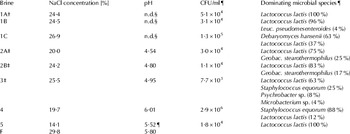
Five small-scale cheese producers were each visited once and the brines were sampled at the visit (Table 1). All producers aimed for NaCl saturation. To obtain this, NaCl was added to the brine until a precipitate was formed after stirring, but no instrumental measurement of NaCl concentrations was conducted. All brines were situated in ripening rooms at temperatures of 12 °C. Samples were taken by dipping a sterile plastic bottle in the top half of the brine vats. At two of the producers (1 and 2), samples were taken from more than one brine, each used for a different type of cheese. Samples were stored in sterile plastic bottles at 4 °C for up to eight weeks until the experiments. pH and NaCl content were determined at 20 °C using a PHM210 Standard pH meter (Radiometer Analytical SAS, Villeurbanne Cedex, France) and a Corning 926 Chloride Analyzer (Corning Limited, Essex, England), respectively.
Overview over NaCl concentration, pH and microbial background flora of sampled brines from five cheese producers (1–5) and a freshly prepared brine (F)

† Letters indicate different brines at the same producer that were used for different cheeses
‡ Brines used in survival experiments
§ Not determined
¶ Determined on PCA (Schirmer et al. Reference Schirmer, Heir, Møretrø, Skaar and Langsrud2013)
Microbial background flora in brines used in cheese production
The total microbial background flora of the brines was determined as a part of a study of the microbial background flora in Norwegian cheese farms. The method is described in detail in Schirmer et al. (Reference Schirmer, Heir, Møretrø, Skaar and Langsrud2013).
Survival of List. monocytogenes in used and freshly prepared brine
Three of the collected brines (2A, 2B and 3, Table 1) and a freshly prepared brine were used in survival studies. The absence of List. monocytogenes in the collected brines was confirmed by the use of selective growth media including two enrichment steps in 1/2 Fraser and Fraser broth followed by plating on Brilliance Listeria Agar plates (Oxoid CM1080 with supplements SR0227 and SR0228, Oxoid) as described in NMKL method no 136 (NMKL, 2007). The fresh brine was prepared by dissolving NaCl in water to saturation ([NaCl]=29·8 %, pH 5·80) and filter sterilised (0·22 μm) after preparation while the commercial brines were used without any pre-treatment. A total of five List. monocytogenes strains were used in the experiment (Table 2). For each strain, overnight cultures were prepared in Brain Heart Infusion (BHI, Oxoid, Basingstoke, UK) at 37 °C. The cells were centrifuged and washed with physiological saline three times and added to the brines to a final concentration of approximately 107 cfu/ml. Brines were then stored at 12 °C to simulate the conditions commonly found at the producers and sampled after 30, 90, 160 and 200 d. On each sampling day, serial dilutions of the brines were prepared and plated on Brilliance Listeria Agar (Oxoid) and incubated at 37 °C for 24 and 72 h.
Listeria monocytogenes strains used in the experiments

† MF refers to the Nofima strain collection
‡ Strains isolated at Nofima and serotyped at the Norwegian Veterinary Institute
Multiple locus variable number tandem-repeats analysis (MLVA)
To examine whether prolonged exposure of List. monocytogenes to cheese brines could cause genetic changes in the bacterial chromosome and thus affect molecular typing characteristics of List. monocytogenes, MLVA was conducted on all five strains before and after 200 d of exposure to the four brines according to the method described by Lindstedt et al. (Reference Lindstedt, Tham, Danielsson-Tham, Vardund, Helmersson and Kapperud2008). Briefly, five selected repetitive DNA units (Variable Number Tandem Repeats, VNTR) were sequenced and each strain was given a five-digit code (one digit for each sequence). Changes in the code indicated changes in the VNTR's.
Effect of pH and salt concentration on survival of List. monocytogenes
Survival of List. monocytogenes MF3638 in nine combinations of salt and pH was tested. The brines were prepared by dissolving 15, 20 or 25 % (w/V) NaCl in water and the pH was adjusted to 4·5, 5·25 or 6·0 using lactic acid (final concentrations in brines <0·1 mm). All brines were filter sterilised (0·22 μm) before use. Bacteria were prepared as described before and added to the brines to a final concentration of approximately 106 cfu/ml. Samples for microbial analysis were taken immediately and after 7, 24 and 45 d incubation at 12 °C. Serial dilutions of the brines were plated on BHI agar (Oxoid CM1136, Oxoid) and incubated at 37 °C for 72 h before counting of the colonies. The experiment was carried out five times with freshly prepared brines and cultures for each experiment.
Statistical analysis
For the pH and NaCl concentration experiments, an analysis of variance (ANOVA) was carried out using the SAS 9.2 software (SAS Institute, Cary, NC, USA).
Results
NaCl concentrations and pH in brines from small-scale cheese producers
Table 1 shows the NaCl content, pH and microbial composition of the eight used brines that were collected. The brines had been in use for periods ranging from three months to four years. Despite the producers’ efforts to maintain NaCl saturation, large variations could be observed both in NaCl concentrations and pH.
Survival of List. monocytogenes in fresh and used brine
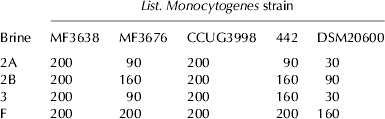
Brines 2A, 2B, 3 and a freshly prepared brine F were chosen for survival studies. Table 3 shows the survival of List. monocytogenes depending on brine and type strain used.
Last day of detection of viable Listeria monocytogenes strains in used (2A, 2B and 3) and fresh (F) cheese brines (limit of detection 20 cfu/ml). Initial concentration was 107 cfu/ml. Sampling took place on day 30, 90, 160 and 200

In general, survival was highest in the freshly prepared brine which supported survival of all strains for 200 d (with the exception of the DSM20600 strain that was detectable after 160 d, but not after 200 d storage).
The human listeriosis outbreak strains (MF3638 and CCUG3998) were the only strains that survived throughout the whole storage period in all four brines. The two food related strains (MF3676 and 442) decreased in numbers faster than the human isolates and could only be detected in the freshly prepared brine throughout the storage period. The DSM20600 strain could not be detected in any of the brines at the end of the storage period (200 d).
MLVA analysis
MLVA analyses showed no detectable alterations in the examined variable number tandem repeats (VNTR) of the genome in any of the five strains after 200 d storage in four different salt brines (data not shown).
Effect of pH and NaCl content on the survival of List. monocytogenes in brines
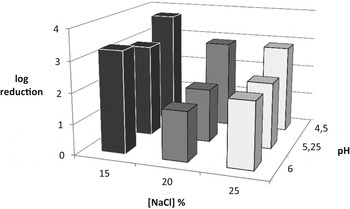
The reduction of viable List. monocytogenes strain MF3638 in freshly prepared brines of various NaCl concentrations and pH is shown in Fig. 1. Statistical analysis showed that NaCl concentration had an impact on the survival of List. monocytogenes in the brines (P=0·05) and survival of List. monocytogenes was highest at high salt concentrations. Total Listeria counts at the end of storage time varied from experiment to experiment (counts at the end of the experiment ranged from <20 to 4·2×105 CFU/ml in all experiments). However, in every experiment for any given pH, the survival of List. monocytogenes was lowest in brines containing 15 % NaCl (Table 1). pH also influenced the survival of List. monocytogenes, and for any given NaCl concentration, survival was lowest at pH 4·5 (Fig. 1). No interaction effects between NaCl concentration and pH could be detected.
Reduction of Listeria monocytogenes numbers after 45 d of storage at 12 °C in freshly prepared brines of varying pH and NaCl concentration.

Discussion
The objective of this study was to examine the survival of List. monocytogenes in fresh and used salt brines as well as brines of various combinations of pH and NaCl concentration.
Analysis of several used brines showed that there were variations in both pH and NaCl content between brines from various producers. The lowest detected NaCl concentration was as low as 14·1 %. A new sample of the same brine after stirring showed a NaCl concentration of 18·1 %, indicating that regular stirring of the brine is important to keep NaCl levels throughout the brine container high. Yet, 18·1 % was lower than the NaCl concentration in any of the other investigated brines. As common for most cheese producers, the routines of this producer did not include any direct measurement of the NaCl concentration, but was based on the presence of a salt precipitate in the brine tub. Since there was a precipitate at both sampling times, it is likely that remaining cheese slurry was mistaken for salt. As most producers rely on visual control for NaCl saturation, it is important to be aware of this possible misinterpretation.
In general, survival of List. monocytogenes was lower in used brines than in freshly prepared brines. One likely explanation is the pH, which was lower in the used brines. The low pH is probably caused by lactic acid bacteria (LAB) and their metabolic products which are formed in the cheese and hence reach the brine during immersion of the cheese (Palmai & Buchanan, Reference Palmai and Buchanan2002). Lactococcus lactis was isolated from all brines and dominated the total microbial flora, which was not surprising as it is commonly used as a starter culture in cheese. However, Lc. lactis does not grow at these NaCl concentrations (20·0–25·5 %) and the viable numbers were low (between 4·9×103 and 2·3×104 CFU/ml) (Schirmer et al. Reference Schirmer, Heir, Møretrø, Skaar and Langsrud2013, in press). It is not likely that these small differences in LAB numbers themselves were the cause of differences in survival of List. monocytogenes in these selected brines.
The five List. monocytogenes strains showed various abilities to survive in the brines. The two clinical strains that are known to have caused outbreaks (Duodu et al. Reference Duodu, Holst-Jensen, Skjerdal, Cappelier, Pilet and Loncarevic2010; Johnsen et al. Reference Johnsen, Lingaas, Torfoss, Strom and Nordoy2010) were the only ones that survived in all brines throughout the entire storage period while the DSM strain could not be detected in any of the brines after 200 d of storage. One may speculate that there may be a correlation between virulence and survival in brine and increased survival may be one of the causes for the increased ability to cause disease; however, more studies are needed to investigate this further. Earlier studies have reported increased expression of virulence factors under stress conditions including limited access to nutrition (Erdenlig et al. Reference Erdenlig, Ainsworth and Austin2000), addition of charcoal to the growth medium (Ermolaeva et al. Reference Ermolaeva, Belyi and Tartakovskii1999) and low pH (Werbrouck et al. Reference Werbrouck, Vermeulen, Van Coillie, Messens, Herman, Devlieghere and Uyttendaele2009), indicating that bacteria that survive stress conditions may be more likely to cause disease due to their exposure to stress. However, other studies showed no general differences in acid and salt tolerance between virulent and avirulent List. monocytogenes strains (Liu et al. Reference Liu, Lawrence, Ainsworth and Austin2005). Furthermore, the results showed that the DSM strain is not well suited as a model organism when survival properties of other List. monocytogenes strains are to be investigated.
Earlier studies have shown that serovar 1/2 strains differ from 4b strains in several respects, among other in resistance to various bacteriocins and heat treatment (Buncic et al. Reference Buncic, Avery, Rocourt and Dimitrijevic2001) and in growth fitness in mixed cultures (Gorski et al. Reference Gorski, Flaherty and Mandrell2006). Some previous studies showed no general correlation between serotype and survival under acid stress (De Jesus and Whiting, Reference De Jesus and Whiting2003; Lianou et al. Reference Lianou, Stopforth, Yoon, Wiedmann and Sofos2006) while another study (van der Veen et al. Reference van der Veen, Moezelaar, Abee and Wells-Bennik2008) compared growth limits for various List. monocytogenes strains at various conditions and found that 4b strains were more acid tolerant than 1/2a and 1/2b strains at 30 °C. However, at 7 °C, 1/2b strains were the most acid tolerant. The same temperature effect was observed for NaCl tolerance, with 4b strains being the most NaCl tolerant at 30 °C and 1/2b strains being the most NaCl tolerant at 7 °C (van der Veen et al. Reference van der Veen, Moezelaar, Abee and Wells-Bennik2008). Shabala et al. (Reference Shabala, Lee, Cannesson and Ross2008) also indicated that the proportion of serovar 4 strains that tolerated high salt concentrations (above 12·1 %) was higher than that of serovar 1/2 strains at 25 °C. Although a limited number of strains and serovars were included, this study supports the view that there is no general correlation between serotypes and survival in brines.at 12 °C.
MLVA is a highly discriminatory typing method used in source tracking and outbreak detection. To be applicable, it is important that the MLVA patterns of bacteria remain stable over prolonged periods of time. Earlier studies have shown that the VNTR in various List. monocytogenes serotype 4b strains remained stable during 70 d of daily passaging (Miya et al. Reference Miya, Kimura, Sato, Takahashi, Ishikawa, Suda, Takakura, Fujii and Wiedmann2008). The effect of various environmental stresses has also been investigated and while freezing and thawing did not affect the MLVA type (Malorny et al. Reference Malorny, Junker and Helmuth2008), radiation, starvation and, high temperatures may alter VNTR in bacterial DNA (Cooley et al. Reference Cooley, Carychao, Nguyen, Whitehand and Mandrell2010). No studies have earlier examined the effect of salt stress on tandem repeats in bacterial DNA. MLVA analyses in this study showed that the VNTR of five List. monocytogenes strains remained unchanged even after up to half a year of exposure to the brines. This is encouraging as it indicates that this method is suitable to relate environmental isolates that have been exposed to salt stress to clinical isolates in the search for outbreak sources. As salt concentrations were high in this study, List. monocytogenes did not grow in the brines. It is possible that lower salt concentrations that allow for List. monocytogenes growth could increase the chance of VNTR changes during bacterial replication.
As expected, in freshly prepared brines, low pH generally reduced survival of List. monocytogenes. Previous studies have shown that List. monocytogenes may survive high levels of NaCl and one study showed that no reduction in List. monocytogenes could be observed at NaCl levels as high as 13 % (Boyer et al. Reference Boyer, Matak, Sumner, Meadows, Williams, Eifert and Birbari2009). However, it has been stated that increasing NaCl concentrations are correlated with increased death of List. monocytogenes (Durmaz et al. Reference Durmaz, Aygun and Ardic2009). In contrast to these findings, this study showed that lower NaCl concentrations (15 %) seemed to be more lethal than higher concentrations (25 %). At each tested pH, survival was lowest in the brine containing 15 % NaCl, followed by 25 % and 20 %. It has been shown that List. monocytogenes may enter a long-term-survival phase that, given that the cells have been previously stressed, may increase the cell's tolerance towards new stresses (Wen et al. Reference Wen, Anantheswaran and Knabel2009). One might speculate that List. monocytogenes at harsh conditions, like extremely high NaCl concentrations, enters a dormant mode where metabolism ceases. The bacterium hence conserves energy and is able to restart metabolism when conditions are more favourable. At less extreme, but still stressful conditions, List. monocytogenes may try to uphold metabolism and result in energy depletion and death of the cell. An earlier study has shown that the growth limits for various List. monocytogenes strains ranged from NaCl concentrations of 8·5 to 13·9 % and from pH values as low as 4·1 to 4·6. (Shabala et al. Reference Shabala, Lee, Cannesson and Ross2008). Even though this study did not examine the combined effects of NaCl and pH, these values are close to the chosen conditions in selected brines (15 % NaCl and pH 4·5); it is hence plausible to assume that List. monocytogenes may attempt to maintain metabolic activity under these conditions; however, further studies are needed to confirm this theory. The results indicate that brines with low NaCl concentrations (15 %) and low pH (4·5) reduce the risk for long time survival of List. monocytogenes compared with brines with higher NaCl concentrations and pH. For practical purposes however, it is difficult to recommend low salt concentrations, as they are more difficult to control and sustain in the brines than saturation, and a further reduction in NaCl concentrations may easily result in conditions that allow for survival and growth of List. monocytogenes. It is however useful to employ pH measurement and regulation as additional control tool for cheese producers to reduce the risk of long time survival of List. monocytogenes in the brines.
In conclusion, this study showed that survival of List. monocytogenes was in general lower in used brines compared with fresh ones. It is however necessary to check the brine for the presence of List. monocytogenes regularly, as several strains of this pathogen survived for more than 200 d in various brines. Both pH and NaCl concentration affected survival of List. monocytogenes; however, high NaCl concentrations favoured survival of List. monocytogenes more than lower concentrations.
The work was funded by the Foundation for Research Levy on Agricultural Products and the Agricultural Agreement Research Fund. We would like to thank all cheese producers who volunteered to participate in this project as well as Per Lea at Nofima for the statistical analysis, Karin Solgaard at Nofima for carrying out the NaCl content measurements, the Norwegian Veterinary Institute for the Listeria Serotyping and Valérie Michel and Thierry Jouvet at Actilaît, France, for helpful discussions.