On March 11, 2011, a 9.0 magnitude earthquake and tsunamis struck the northeastern coast of Japan (the Great East Japan Earthquake). This disaster led to a series of severe nuclear accidents at the Tokyo Electric Power Company (TEPCO) Fukushima Daiichi Nuclear Power Plant (Daiichi) in Fukushima prefecture. The accident caused plant explosions and meltdowns in 3 of the 6 reactors, as well as the release of radioactive materials and mandatory evacuation in the surrounding region. This accident was the largest nuclear power plant disaster since the 1986 Chernobyl accident. Studies from the 1979 Three Mile Island and Chernobyl nuclear power plant disasters have shown that the plant workers experienced long-term adverse mental health consequences such as post-traumatic stress disorder (PTSD) and depression.Reference Kasl, Chisholm and Eskenazi 1 - Reference Loganovsky, Havenaar, Tintle, Guey, Kotov and Bromet 4 In the case of Fukushima, none of the TEPCO nuclear plant workers had acute radiation exposure symptoms. However, they were exposed to multiple stressors, such as workplace trauma, victim experiences, line-of-duty deaths, and public criticism because of their company’s post-disaster management issues.Reference Shigemura, Tanigawa, Saito and Nomura 5 Among these, experience of discrimination or slur was a key factor related to adverse psychological outcomes 2-3 months after the disaster.Reference Shigemura, Tanigawa, Saito and Nomura 5 Recovery efforts are expected to continue for decades, and the well-being of the workers is an ongoing concern.
A large amount of literature emphasizes the importance of workplace interpersonal support (WIS) in promoting psychological well-being and resilience among first responders and disaster workers following the experience of traumatic events.Reference Benedek, Fullerton and Ursano 6 , Reference Paton and Johnston 7 Prati et alReference Prati and Pietrantoni 8 reviewed the associations between social support and mental health among first responders, and report a larger effect size of perceived social support than that of received social support. Given the similarity of work roles between first responders and post-accident nuclear power plant workers, WIS – especially, perceived WIS – may also be important for protecting the mental health of the latter workers. To our knowledge, however, no studies have examined this issue, and little is known about WIS in nuclear plant workers after major accidents. To elucidate the role of WIS, we examined perceived WIS and its correlates in the Daiichi workers.
Methods
Participants and Procedure
This study was conducted as part of the Fukushima Nuclear Energy Workers’ Support (NEWS) Project, a mental health research study of the Daiichi and the nearby Daini workers.Reference Shigemura, Tanigawa, Saito and Nomura 5 , Reference Shigemura, Tanigawa, Nishi, Matsuoka, Nomura and Yoshino 9 Following approval by the ethics committees of Ehime University and National Defense Medical College, full-time TEPCO employees of Fukushima Daiichi nuclear power plant (n=1053) were invited to participate 2-3 months post-disaster (May to June 2011).
Measures
After giving written consent, the participants completed a self-report questionnaire. The questionnaire items measured sociodemographic variables, disaster-related exposures,Reference Shigemura, Tanigawa, Saito and Nomura 5 the Japanese version of the Impact of Event Scale-Revised (IES-R),Reference Weiss 10 and perceived WIS.
The IES-R is a 22-item rating scale (range: 0-88) to evaluate post-traumatic stress symptoms following the experience of traumatic events. The IES-R contains 3 symptom clusters of PTSD—intrusion, avoidance, and hypervigilance—as defined by the Diagnostic and Statistical Manual of Mental Disorders (4th edition). 11
To assess the participants’ perceived WIS, a leading question was given in Japanese language: “Which of the following items were helpful for your mental health (multiple answers allowed)?” The respondents responded to multiple checklist items in a yes or no fashion. “Support from their colleagues, supervisors, or subordinates” was among these items. We used this dichotomous variable as a measure of perceived WIS, our outcome variable.
Data Analysis
A total of 885 workers were enrolled for the analysis (response rate: 84.0 %). Among them, age data were missing for two individuals, and IES-R data were missing for 48 individuals. Bivariate analysis was first conducted to examine relations between WIS and the independent variables (sociodemographic variables, disaster-related exposures, and IES-R). Regarding age, we subdivided the whole group according to age quartiles. Multiple logistic regression analysis was subsequently performed to examine the multivariate correlates of WIS. Using a forward conditional method, we entered the following covariates of interest in the analysis model based on previous literature—basic sociodemographic characteristics, disaster-related experiences related to their post-disaster mental health, and occupational factors—in particular, supervisory work status.Reference Shigemura, Tanigawa, Saito and Nomura 5 , Reference Prati and Pietrantoni 8 , Reference Shigemura, Tanigawa, Nishi, Matsuoka, Nomura and Yoshino 9 , Reference Brooks, Dunn, Sage, Amlot, Greenberg and Rubin 12 In this process, we entered IES-R as an independent variable to adjust for the participants’ degree of post-traumatic stress responses. We used IBM SPSS Statistics version 22 (IBM Japan, Tokyo, Japan) for the statistical analysis. The significance level was set at P<0.05 (two-tailed).
Results
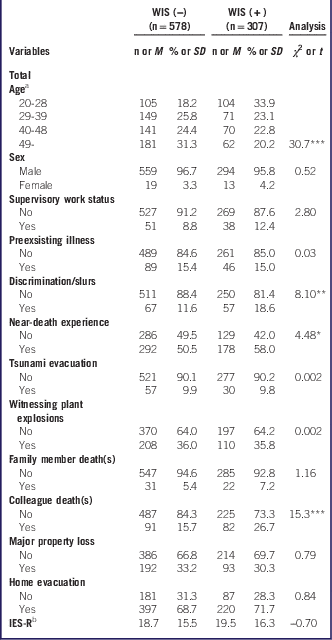
Table 1 shows the bivariate relations between independent variables and WIS. The large majority of participants was male, and age quartile distribution was as follows: 20-29 years (lowest), 29-39 years (second), 40-48 years (third), and 49-63 (fourth). Approximately 1 out of 3 participants (34.7%; 95% CI: 31.5%-37.8%) reported WIS.
Bivariate Relationships Between Perceived Workplace Interpersonal Support (WIS) and Independent Variables

N=885.
Abbreviations: IES-R, Impact of Event Scale-Revised.
a Range: 20-63. Data were missing for two individuals (0.2%).
b Range: 0-85. Data were missing for 48 individuals (5.4%).
*P<0.05, **P<0.01, ***P<0.001.
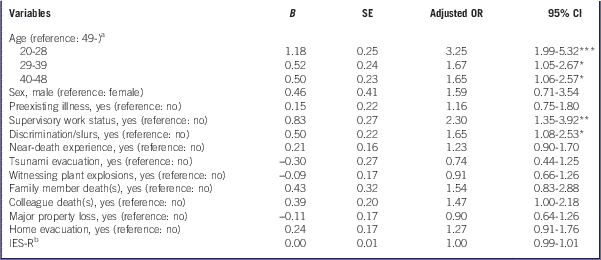
Table 2 shows the results of multivariate analysis. WIS was associated with younger age (20-28 years, 29-39 years, or 40-48 years [vs 49- years]), supervisory work status (vs non-supervisors), and discrimination or slur experience (vs no experience), but not with the degree of PTSD symptoms.
Factors Associated With Perceived Workplace Interpersonal Support

N=885.
Abbreviations: OR, odds ratio; IES-R, Impact of Events Scale-Revised.
a Data were missing for two individuals (0.2%).
b Data were missing for 48 individuals (5.4%).
*P<0.05, **P<0.01, ***P<0.001.
Discussion
In this study, Daiichi workers’ WIS was associated with discrimination or slur experience, younger age, and supervisory status. To our knowledge, no studies have reported such relations among nuclear disaster workers.
In previous studies conducted with the same data set,Reference Shigemura, Tanigawa, Saito and Nomura 5 , Reference Shigemura, Tanigawa, Nishi, Matsuoka, Nomura and Yoshino 9 we showed discrimination or slur experience to have peritraumatic or post-traumatic mental health effects. The results of the present study permit a deeper understanding of the impact of these experiences from an occupational perspective. Our findings suggest that these workers, who were the direct victims of social criticism, may have been trying to cope with this backlash by increasing their workplace cohesion. Longitudinal studies will be important to understand the chronic effects of their discrimination experiences.
Our data showed perceived WIS to be associated with younger age and supervisory status, suggesting the significance of WIS among these groups for coping with the horrific situation. For disaster workers in general, those who are younger and who have supervisory work status are vulnerable to workplace trauma.Reference Ursano, Fullerton, Vance and Kao 13 In a meta-analysis of first responders, perceived social supports were more useful for mental health than received social supports.Reference Prati and Pietrantoni 8 In the context of nuclear power plant disasters, a study of Three Mile Island workers reported that those in non-supervisory positions were likely to feel demoralization symptoms 6 months after the disaster.Reference Kasl, Chisholm and Eskenazi 1
Among our participants, we speculate that individual ability to control the situation was very limited because of the complex structures of nuclear plants. This trend is likely to be prominent among younger workers owing to their limited experience and/or work discretion. This may help to explain the tendency of younger workers to report the significance of WIS. In the same context, the chain of command was critical for responding to the crises; therefore, supervisors might have been more aware of WIS than non-supervisors. Given these findings, organizational mental health approaches to enhance workplace cohesion might be important for nuclear plant workers experiencing workplace crises.
Our results did not show relationships between perceived WIS and colleague death(s) experience. Line-of-duty deaths can have a profound impact on disaster workers’ mental health. Such effects have been reported in various occupations, such as military personnel, police officers, firefighters, and medical staff.Reference Prati and Pietrantoni 8 , Reference Keller, Greenberg, Bobo, Roberts, Jones and Orman 14 Daiichi workers had experienced multiple disaster exposures, and their stressors were not limited to line-of-duty deaths.Reference Shigemura, Tanigawa, Saito and Nomura 5 Therefore, the impact of the martyr might have been lower than that of other disaster exposures. As we do not know of other studies examining this issue among nuclear plant workers, we can only speculate at this point.
Our study has numerous limitations. The cross-sectional, self-report study design limits our understanding of the longitudinal effect of WIS. The study sample was limited to workers of a single company and cannot be generalized to Fukushima workers or nuclear plant workers in general. The outcome variable and disaster-related exposure variables were assessed using simple dichotomous questions. Further, several demographic variables (eg, marital status) were not assessed. These methodological issues limit in-depth interpretations of our findings.
Conclusions
Among Fukushima Daiichi nuclear power plant workers, WIS was associated with younger age, supervisory work status, and discrimination or slur experience 2-3 months after the disaster. Although our study is limited based on its methodological design, these findings permit a better understanding of the relations between WIS and its correlates. These findings also suggest that WIS might be an essential component for education and/or intervention programs to promote mental well-being among nuclear disaster workers, especially, younger workers, supervisors, and workers with discrimination experiences.
Acknowledgments
The authors thank Ms Tomoko Yamamoto, R.N., Ms Mariko Tanaka, R.N., Ms Yoshiko Kage, the medical staff of TEPCO Daiichi and Daini Nuclear Power Plants, and the TEPCO Head Office for their cooperation and support. The authors also thank the plant workers for their study participation, bravery, and recovery work. Authors’ Contributions: Study concept: TT, JS; study supervision: YT, SN, AY; literature search: ST, JS; manuscript drafting: ST, JS; data collection: TT, JS, SN, AY; data analysis: ST, JS; critical revision: YT, SN, AY. All authors contributed to the discussion and have seen and approved the final version of the manuscript. ST had full access to all of the study data and takes responsibility for the integrity of the data and accuracy of the data analysis.
Conflicts of Interest
ST, JS, SN, and AY provided mental health assistance to the workers of TEPCO Fukushima Daiichi and Daini Nuclear Power Plants according to official requests from the Daini plant and a Japanese government cabinet order to the Ministry of Defense. ST is a part-time psychiatrist for TEPCO Hirono Power Station. TT is a Daini plant part-time occupational physician. All other authors declare that they have no conflicts of interest.
Financial Support
This work was partly supported by Health and Labour Sciences Research Grants (Research on Occupational Safety and Health H24-001, 25-H24-001, 26-H24-001) from the Ministry of Health, Labour and Welfare of Japan. The funders had no role in the design and execution of the study; data collection, management, analysis, and interpretation; preparation, review, or approval of the paper; or in the decision to submit the paper for publication.