Introduction
Ageism or age discrimination is a concept that transcends all aspects of life, much like sexism and racism (Allen Reference Allen2016; Butler Reference Butler1969, Reference Butler1980; Minichiello, Browne and Kendig Reference Minichiello, Browne and Kendig2000). Some have argued, however, that ageism is more socially condoned than sexism or racism (North and Fiske Reference North and Fiske2012). Ageism often stems from older age being characterised or stereotyped in negative ways, including an inevitable decline in physical health, reduced cognitive capacity and the inability to adapt to present-day society (Butler Reference Butler and Maddox2001). Population-based studies of older people in the United States of America (USA) and England (participants aged 52+) have found that almost one-third of men and women had experienced age discrimination in the previous year (Rippon, Zaninotto and Steptoe Reference Rippon, Zaninotto and Steptoe2015; Rippon et al. Reference Rippon, Kneale, de Oliveira, Demakakos and Steptoe2014).
There can be a range of psychological and practical consequences of ageist attitudes, practices and policies. For example, survey-based studies have found associations between perceived age discrimination and outcomes such as emotional distress (Allen Reference Allen2016; Vogt Yuan Reference Vogt Yuan2007) and psychological wellbeing in older adults (Garstka et al. Reference Garstka, Schmitt, Branscombe and Hummert2004; Sabik Reference Sabik2015), while experimental studies have found exposure to positive or negative age stereotypes can influence a variety of behaviours including memory and handwriting (Meisner Reference Meisner2012). Furthermore, longitudinal studies have reported links between an individual's self-perceptions of ageing and measures of physical health (Levy, Slade and Kasl Reference Levy, Slade and Kasl2002; Wurm and Benyamini Reference Wurm and Benyamini2014; Wurm, Tesch-Römer and Tomasik Reference Wurm, Tesch-Römer and Tomasik2007), depressive symptoms (Wurm and Benyamini Reference Wurm and Benyamini2014) and longevity (Levy et al. Reference Levy, Slade, Kunkel and Kasl2002).
One mechanism through which greater exposure to ageism or ageist attitudes might affect individual behaviour is through internalisation – believing that common stereotypes about older people apply to oneself (Ayalon and Tesch-Römer Reference Ayalon and Tesch-Römer2017). Levy's (Reference Levy2009) stereotype embodiment theory argues that the internalisation of ageism can affect the lives of older people in at least three ways: through expectations or self-fulfilling prophecies (Levy Reference Levy2009), reduced interest in engaging in healthy practices (Levy Reference Levy2009; Nelson Reference Nelson2016) and through physiological responses triggered by repeat exposure to chronic stress (Allen Reference Allen2016; Levy Reference Levy2009). It is this internalisation of ageism that has been used to explain why greater exposure to ageism or ageist attitudes can impact on individuals and, for example, lead to poorer health outcomes and poorer cognitive performance (Levy Reference Levy2009; Nelson Reference Nelson2016).
Sexual expression and identity is an area in life where the impact of ageism (including both experiences of ageism and the internalisation of ageism) may also be evident. A number of stereotypes and attitudes exist in relation to sexuality in older age. For instance, studies have shown that health professionals can be reluctant to discuss sexuality and sexual health with their older clients (Gott, Hinchliff and Galena Reference Gott, Hinchliff and Galena2004; Hinchliff and Gott Reference Hinchliff and Gott2011). Older people are also frequently ignored in sexual health campaigns and are noticeably absent in sexual health-related policy in countries such as Australia, the USA and the United Kingdom (Gott Reference Gott2004; Kirkman, Kenny and Fox Reference Kirkman, Kenny and Fox2013). Popular culture has traditionally depicted the older body as asexual, undesirable or sexually impotent, e.g. through jokes (Bowd Reference Bowd2003) or birthday cards (Bearon Reference Bearon, Palmore, Branch and Harris2005; Dillon and Jones Reference Dillon and Jones1981; Nelson Reference Nelson, Wiener and Willborn2011). These factors work together to represent older people as less sexual and less desirable than younger populations, and it is sometimes assumed that once a person reaches a certain age they will stop having sex and stop being interested in sex.
These stereotypes, however, do not reflect the diversity of sexual experiences that are often reported in older populations. While some older people may cease sexual activity, many continue to have pleasurable and fulfilling sexual experiences well into older age (Fileborn et al. Reference Fileborn, Thorpe, Hawkes, Minichiello, Pitts and Dune2015b; Lindau et al. Reference Lindau, Schumm, Laumann, Levinson, O'Muircheartaigh and Waite2007; Schick et al. Reference Schick, Herbenick, Reece, Sanders, Dodge, Middlestadt and Fortenberry2010). Older women have also been found to contest some of the dominant stereotypes of their bodies as unattractive or undesirable when reflecting on their bodies in sexual encounters (Thorpe et al. Reference Thorpe, Fileborn, Hawkes, Pitts and Minichiello2015). Increasingly, older people, and especially the younger-old cohorts (particularly the baby-boomers born after 1945; Australian Bureau of Statistics 2016), are combating ageism and creating new discourses about later life and its everyday experiences. There is evidence to suggest these younger-old cohorts are more willing to express their sexual rights than previous generations (Beckman et al. Reference Beckman, Waern, Gustafson and Skoog2008).
It is also important to acknowledge that different types of prejudice and discrimination can interact and intersect with each other. For example, in many Western societies older women are discriminated against because of their gender and their age (Lee, Carpenter and Meyers Reference Lee, Carpenter and Meyers2007), and might therefore experience some aspects of ageism differently to older men. Older women and older men also experience quite different forms of discrimination relating to sex. Older men are sometimes seen as ‘dirty’ (particularly if they are not wealthy) or, alternatively, as fit, strong and sexually active (Calasanti and King Reference Calasanti and King2005; Hurd Clarke, Bennett and Liu Reference Hurd Clarke, Bennett and Liu2014), whereas older women are more likely to be seen as ‘asexual’ and unattractive (Calasanti and Slevin Reference Calasanti and Slevin2001; Lee, Carpenter and Meyers Reference Lee, Carpenter and Meyers2007).
Differences in ageism may also be experienced according to sexual orientation. Older lesbian, gay and bisexual (LGB) and other non-heterosexual populations, particularly gay men, experience age-related discrimination from the wider community as well as from within the gay community where ageing is often viewed negatively and age discrimination is thought to occur at an earlier age than in heterosexual populations (Lyons et al. Reference Lyons, Croy, Barrett and Whyte2015; Schope Reference Schope2005). Research on older lesbians has been limited (Averett and Jenkins Reference Averett and Jenkins2012); some, however, argue that older lesbians may experience the ‘triple threat of marginalisation’ – ageism, sexism and heterosexism (Averett, Yoon and Jenkins Reference Averett, Yoon and Jenkins2011).
In this context, it is timely to examine the impact of experiences of ageism on sexual activity and interest. We use data from a large study of older Australians to explore possible links between experiences of ageism and sexual activity/interest in later life. Specifically, we had three main aims: (a) to examine socio-demographic characteristics of participants who had experienced ageism; (b) to examine the relationships between experience of ageism and sexual activity/interest; and (c) to explore if these relationships between experience of ageism and sexual activity/interest vary according to current age, gender or sexual orientation.
Method
Sample
A nationwide survey on the sexual health and relationships of older Australians was completed by 2,137 Australian residents aged 60+ years. This cross-sectional survey was conducted as part of the ‘Sex, Age & Me’ study. The survey was conducted between July and December 2015 and was available both online and in paper form. Participants were recruited using advertisements targeting older Australians, including targeted advertising on Facebook, as well as websites, newsletters and noticeboards of ageing organisations, sexual health clinics, local governments, and senior citizens and services clubs. The study also featured in the local media. All advertisements gave participants the option of completing the survey online or on paper. This involved a direct link or Web address to the online survey as well as details of how to request a reply-paid paper version. Paper versions of the survey were also placed at physical sites for people to collect (such as national conferences targeting older people, a senior's festival and libraries). Participation was voluntary and anonymous; no rewards or incentives were offered to those who chose to complete the survey. Ethics approval for the study was granted by the La Trobe University Human Ethics Committee.
Ageism measure
Ageism was measured using the Ageism Survey developed by Palmore (Reference Palmore2001, Reference Palmore2004). This scale consists of 20 items examining the prevalence of different types of ageism (including stereotypes, attitudes, personal discrimination and institutional discrimination). Participants were asked to indicate how often they had experienced each event, e.g. ‘I was told a joke that pokes fun at old people’ and ‘I was ignored or not taken seriously because of my age’. Response options included 0 ‘never’, 1 ‘once’ or 2 ‘more than once’. There is currently no standardised way to score the Ageism Survey; however, the survey scale has good internal reliability, high face validity and the items load on to one main factor (Palmore Reference Palmore2001). For the current analysis, item scores were therefore summed to create a continuous variable ranging from 0 to 40 with higher scores indicating greater experience of different forms of ageism events. In this study, internal reliability (Cronbach's alpha) of the Ageism Survey was 0.85.
Sexual activity and interest variables
A range of key sexual activity and sexual interest variables were also assessed. Details of each measure are provided below.
Current sexual activity and interests were assessed by asking participants when they last had sex (‘Which of the following apply to you?’, response options ‘I have had sex in the past year’, ‘I had sex between one and two years ago’, ‘I had sex between two and five years ago’, ‘I had sex five or more years ago’ or ’ I have never had sex’) and to describe their current interest in sex (coded: not at all interested, somewhat interested, very interested or extremely interested). Participants were next asked how their interest in sex had changed since the age of 60 (coded: increased, stayed about the same or decreased), whether they hoped or planned to have sex in the future (coded: yes, no or not sure) and whether they wish they could have sex at a different frequency in the future than they do today (responses coded: more frequently in the future, less frequently in the future or about the same frequency in the future). For these measures, sex was self-defined by the participant.
Participants who reported sex in the past 12 months were also asked how often they had had sex in the past four weeks (coded: 0, 1–5, 6–10 or 11+ times). In this section of the survey, sex was defined as ‘any kind of contact that you feel is sexual, not just intercourse’. Sex was defined in this way to leave it open for participants to consider all forms of sexual activity.
Socio-demographic characteristics
With the exception of age, we collected all variables as categorical variables. As indicated, some categories were collapsed together to simplify the data. A range of socio-demographic characteristics were assessed including gender (coded: male, female), age (coded: 60–69, 70–79 or 80+ years), sexual orientation (coded: heterosexual or non-heterosexual), relationship status (coded: partner or no partner), education (coded: secondary/college or below, or university educated), employment (coded: employed, retired or unemployed/other), before tax yearly household income (coded: Aus $0–49,999, 50,000+ or undisclosed), residential location (coded: inner city, suburban or regional/rural) and country of birth (coded: Australia or overseas).
Studies have also shown a strong link between exposure to ageism and health outcomes (see Levy Reference Levy2009; Nelson Reference Nelson2016). We therefore decided to examine participants' current health using a one-item self-rated measure of general health (‘In general, would you say your health is:’, response options ‘excellent’, ‘very good’, ‘good’, ‘fair’ or ‘poor’?).
Analysis
Associations between the socio-demographic variables, self-rated health and ageism scores (outcome variable) were first assessed using separate univariable linear regression models. Variables where the association was found to be p < 0.25 were next entered into a multivariable model to identify which socio-demographic characteristics were independently associated with ageism after adjusting for differences in other variables. These socio-demographic characteristics were used as covariates in subsequent analyses.
Next we examined associations between each of the sexual activity/interest variables and ageism using separate linear regression models. Ageism was also the outcome variable in each of these models. We chose this approach over other options (such as treating the sexual activity/interest variables as the outcome and conducting multinominal logistic regression) for ease of analysis, interpretation and because the data were cross-sectional. First, we examined the univariable association between each sexual activity/interest variable and experience of ageism. Next, we examined the associations after adjustments for socio-demographic variables that were significantly associated with experience of ageism, before further controlling for self-rated health. We took this approach as general health has previously been shown to be associated with both ageism (Levy Reference Levy2009; Nelson Reference Nelson2016) and sexual activity in older populations (Lindau and Gavrilova Reference Lindau and Gavrilova2010; Lindau et al. Reference Lindau, Schumm, Laumann, Levinson, O'Muircheartaigh and Waite2007; Schick et al. Reference Schick, Herbenick, Reece, Sanders, Dodge, Middlestadt and Fortenberry2010). We therefore wanted to examine the impact of adjusting for general health over and above adjustments for socio-demographic differences. Finally, we tested interactions to see if the associations between each sexual activity/interest variable and experience of ageism varied according to gender, age group or sexual orientation. All analyses were conducted using Stata 14.0 (StataCorp, College Station, Texas) and all associations were treated as significant at p < 0.05.
Results
In total, 2,137 Australian residents aged 60 years and older completed the survey. Due to small numbers, participants who identified as transgender, or who stated their preferred gender identity was not listed in the questionnaire, or who did not report their gender were excluded (N = 18); as were participants who reported never having sex or did not answer the question on current sexual activity (N = 12). As there are no standardised guidelines on scoring the individual items in the Ageism Survey, we further restricted our analysis sample to participants who answered all 20 items (N = 1,817 participants).
The summary of the sample's characteristics is displayed in Table 1. Of the 1,817 participants, 76 per cent of the sample were aged in their sixties and two-thirds were men (68%). The majority (91%) of participants reported their sexual orientation as heterosexual and 77 per cent were in a relationship. The sample was almost equally distributed by level of education (45% with university education versus 55% with secondary education or below). Given the age profile, it was not surprising to find over half of the study sample (54%) were retired from active employment. A third of the sample (34%) did not disclose their income, and amongst the remaining sample 34 per cent had a yearly family income of less than Aus $50,000 and 34 per cent had a yearly family income of Aus $50,000 or more. Forty-one per cent of participants resided in regional/rural areas, 45 per cent suburban and 14 per cent inner city; and two-thirds (67%) were born in Australia. Self-rated health was reported as excellent/very good (53%), good (31%), fair (13%) and poor (3%).
Sample profile

Note: N = 1,817.
Ageism and socio-demographic characteristics
Table 2 displays differences in experience of ageism according to socio-demographic characteristics. After adjusting for differences in other variables, experience of ageism was significantly greater among participants without a partner (F(1, 1,726) = 6.73, p = 0.01), participants who reported being unemployed or having ‘other’ types of employment (F(2, 1,726) = 9.45, p < 0.001) and those who earned less than Aus $50,000 per year (F(2, 1,726) = 3.76, p = 0.02). Self-rated health was also linked to ageism experience (F(4, 1,726) = 17.42, p < 0.001). Participants who reported excellent or very good health reported significantly lower levels of ageism experiences than those who reported good health, while those who reported fair or poor health reported significantly greater experience. There were no significant differences in experience of ageism according to gender, age group and sexual orientation.
Associations between socio-demographic characteristics and ageism scores

Notes: 1. Adjusted for sexual orientation, relationship status, employment, income, country of birth and self-rated health. Overall model fit, adjusted R 2 = 0.063, F(11, 1,726) = 11.53, p < 0.001.
Significance levels: * p < 0.05, ** p < 0.01.
Ageism and sexual activity/interest
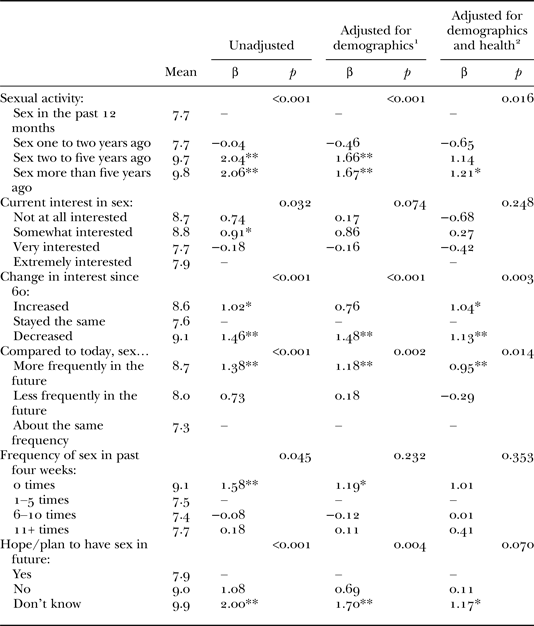
Next we examined the associations between each sexual activity/interest variable and experience of ageism. Findings are presented in Table 3. For each sexual variable we first examined the univariable unadjusted associations. We also looked at the relationships after adjusting for socio-demographic differences in experiences of ageism (relationship status, employment, income) and then further controlled for self-rated health.
Associations between sexual activity/interest variables and ageism scores

Notes: 1. Adjusted for relationship status, employment status and income. 2. Adjusted for relationship status, employment status, income and self-rated health.
Significance levels: * p < 0.05, ** p < 0.01.
Experience of ageism was associated with a variety of the sexual activity/interest variables in this sample. Specifically, participants who last had sex two or more years ago reported greater experience of ageism than those who had sex in the past 12 months (F(3, 1,813) = 9.70, p < 0.001). These findings persisted after adjusting for socio-demographic characteristics (F(3, 1,777) = 6.14, p < 0.001) and self-rated health (F(3, 1,765) = 3.47, p = 0.02).
Ageism experience was also associated with change in sexual interest since the age of 60. Greater experience of ageism was found among those who reported their sexual interest had decreased since the age of 60 but also among those who reported their sexual interest had increased (F(2, 1,806) = 8.44, p < 0.001). These findings persisted after controlling for socio-demographic characteristics (F(2, 1,771) = 7.93, p < 0.001) and self-rated health (F(2, 1,759) = 5.79, p = 0.003). Moreover, greater ageism experience was reported by participants who wanted sex more frequently in the future than those who wanted sex about the same frequency in the future (F(2, 1,797) = 8.27, p < 0.001). These findings also persisted after adjusting for socio-demographic characteristics (F(2, 1,765) = 6.13, p = 0.002) and self-rated health (F(2, 1,753) = 4.29, p = 0.01).
A number of variables were significantly associated with experience of ageism in univariable analyses but not after adjustments for socio-demographic characteristics and self-rated health. Participants who were somewhat interested in sex reported greater experience of ageism than those who were extremely interested in sex (F(3, 1,797) = 2.94, p = 0.03). These associations were no longer significant after adjusting for socio-demographic characteristics (F(3, 1,762) = 2.32, p = 0.07) and self-rated health (F(3, 1,750) = 1.38, p = 0.25). Before adjustments, participants who did not have sex in the past four weeks reported greater ageism experience than those who had sex one to five times (F(3, 1,315) = 2.69, p = 0.05). Again, the relationship was no longer statistically significant after adjusting for socio-demographic characteristics (F(3, 1,290) = 1.43, p = 0.23) and self-rated health (F(3, 1,280) = 1.09, p = 0.35). In unadjusted univariable analysis, greater experience of ageism was reported by participants who did not know if they wanted to have sex in the future compared with participants who did want to have sex in the future (F(2, 1,809) = 8.66, p < 0.001). These associations persisted after adjusting for socio-demographic characteristics (F(2, 1,774) = 5.65, p = 0.004) but were no longer significant after controlling for differences in self-rated health (F(2, 1,762) = 2.66, p = 0.07).
Finally, we examined if any of the associations were moderated by gender, age or sexual orientation. These analyses also controlled for socio-demographic characteristics associated with experience of ageism (relationship status, employment, income) and self-rated health. None of the interactions were significant at p < 0.05.
Discussion
This is one of the first Australian studies to demonstrate a correlation between experience of ageism and sexual activity/interest in later life. For some, greater experiences of ageism were associated with decreases in sexual interest since the age of 60 and reductions in sexual activity. Greater experiences of ageism were, however, also reported by those whose sexual interest had increased since the age of 60 and by those who wanted sex more frequently in the future. These associations were found even after adjusting for socio-demographic characteristics and self-rated health. While we are not aware of any studies that have directly explored the relationships between experiences of ageism and sexual activity, further research is required to understand the link between these factors, including whether these effects are the result of different mechanisms or a moderating factor not accounted for in this study, such as personality or other individual differences that might affect how people respond to ageism. Our study did not collect such data; however, it does provide evidence that sexual activity/interest in older age may be related to experiences of ageism.
Greater experience of ageism was reported by those who had not had sex in the past two years, those whose sexual interest had decreased since the age of 60 and those who were not sure about their hopes/plans to have sex in the future. These findings persisted across age groups, gender and sexual orientation. As our study was cross-sectional, we cannot know for certain the direction of these relationships. Reductions in sexual interest and activity could suggest some older people might be internalising ageist attitudes and stereotypes related to sexuality in later life, in this case stereotypes of asexuality or declining sexual interest. A recent study in the USA of adults aged 40 years and older found participants who felt older than their chronological age were less interested in sex, while those who had less positive views of ageing also had lower ratings on the quality of their sexual lives (Estill et al. Reference Estill, Mock, Schryer and Eibach2017). Alternatively, it could also be that those who have not had sex in the past two years were more sensitive to perceived ageist attitudes and behaviours or had experienced more ageist behaviour.
Interestingly, greater experience of ageism was also reported by those whose sexual interest had increased since the age of 60 and among those who wanted to have sex more frequently in the future. At first glance, these findings appear to contradict those reported above; however, it may be that these individuals are experiencing greater ageism as they are not conforming to traditional notions of older age. For example, they may be looking for new sexual partners or promoting themselves as sexual beings in the way they behave and dress. Alternatively, some might be experiencing ageism due to different stereotypes relating to older age and sexuality. For example, the ‘dirty old man’ stereotype, where sex in later life is seen as inappropriate. Again, it is impossible to interpret the direction of the effect without longitudinal data. It is also worth pointing out that greater experiences of ageism were not related to increases in actual activity or behaviour and were rather associated with reporting an increased interest in sex since the age of 60 and ideally wanting to have sex more often in the future. As reported earlier, experiences of ageism were also associated with decreased sexual interest since the age of 60, so it could also be a change in sexual interest that is important.
We did not find any significant gender differences in this study. It is possible, however, that men and women did experience ageism in different ways and for different reasons. Older men might be discriminated against if they do not have sex because they are no longer seen as sufficiently ‘masculine’ (Calasanti and King Reference Calasanti and King2005), whereas for women it may be less ‘inappropriate’ to stop having sex, particularly in light of contemporary stereotypes that as women age they are no longer perceived as ‘youthfully’ sexual or attractive. An earlier Swedish study, however, did not find conclusive evidence that ageist attitudes towards sexual attractiveness and sexual activity were gendered (Öberg and Tornstam Reference Öberg and Tornstam2003). Further research is needed to examine gender differences in Australia. As stated previously, the associations between ageism experience and sexual activity/interest were found to persist for both heterosexual and non-heterosexual participants. These findings suggest the effects of ageism may span different sexuality populations. What we currently do not know, however, is whether older people who identify as LGB experience different types of ageism. It is also important to note that we only sampled a small number of non-heterosexual participants (N = 158) and collapsed all non-heterosexual populations (lesbian, gay, bisexual, queer, pan-sexual) into one group for the analysis, so further research with larger numbers of non-heterosexual populations may be needed before drawing firm conclusions.
While ageism was associated with all sexual activity/interest variables in unadjusted analyses, the associations between experience of ageism and current interest in sex was reduced after adjustments for socio-demographic characteristics associated with ageism and was further reduced after controlling for self-rated health. Similarly, the finding that greater experience of ageism was reported by those who did not know if they wanted to have sex in the future also became non-significant after adjusting for self-rated health. These findings suggest that there are complex relationships between ageism, sexual activity/interest and general health. For example, poorer physical health might be linked to lower interest in sex in older age which may not always be due to decline in sexual desire but of reprioritisation of the value placed on sex (Gott and Hinchliff Reference Gott and Hinchliff2003). Although mental health issues are relatively under-diagnosed in older populations (World Health Organization 2001), health problems (particularly depression) may also lead to a reduction in sexual desire (Phillips and Slaughter Reference Phillips and Slaughter2000) and amongst those who are diagnosed and treated with antidepressants, one of the side-effects of such treatment can be lower sexual desire (Gregorian et al. Reference Gregorian, Golden, Bahce, Goodman, Kwong and Khan2002). There is also a growing body of literature that shows how ageist attitudes of health-care providers can impact on internalising such attitudes in general, and in particular about sexuality in older age (Chrisler, Barney and Palatino Reference Chrisler, Barney and Palatino2016; Ouchida and Lachs Reference Ouchida and Lachs2015; Taylor and Gosney Reference Taylor and Gosney2011). It can be theorised that as older people seek more health services for a range of health issues, the greater is their experience of ageism. Finally, with disease and increasing disability comes increased reliance on services and family members which results in reduced autonomy. Family members (in particular, adult children) and service providers can respond in ageist ways that can restrict sexual activity/interest. Further research examining how these biopsychosocial factors work together is therefore needed to better understand how ageism affects sexuality in later life.
Experience of ageism was also linked to a variety of demographic characteristics. Participants without a relationship partner, and participants who were unemployed or had lower income reported greater experience of ageism. These findings replicate previous research that shows looking for work (Abrams, Swift and Drury Reference Abrams, Swift and Drury2016; Dennis and Thomas Reference Dennis and Thomas2007) or seeking a partner (Fileborn et al. Reference Fileborn, Thorpe, Hawkes, Minichiello and Pitts2015a; Hurd Clarke and Griffin Reference Hurd Clarke and Griffin2008; McWilliams and Barrett Reference McWilliams and Barrett2014) are two situations where older people are more likely to experience ageism and discrimination.
This is the first Australian study, to our knowledge, that has explored the relationships between experience of ageism and sexual activity/interest in later life. A number of limitations, however, need to be considered when interpreting these findings. First, our measurement of experience of ageism, the Ageism Survey, examined a variety of different types of ageism including ageist stereotypes, attitudes, personal discrimination and institutional discrimination. It did not, however, contain any items directly relating to sexuality and sexual activity/interest in older age. The scale also did not test gender-specific experiences of ageism (e.g. feeling unattractive/disliking your body may be more likely to impact on women). This may account for the lack of gender differences in the associations reported. The Ageism Survey also only examined negative aspects of ageing, yet previous studies have shown ageing can also be a positive experience and the existence of positive ageing stereotypes (sometimes called ‘sagism’) (Levy and Macdonald Reference Levy and Macdonald2016; Minichiello, Browne and Kendig Reference Minichiello, Browne and Kendig2000). While our findings show that experience of ageism is related to and can perhaps affect sexual activity/interest in later life, further research, using more nuanced measures of ageism, is needed to better understand these relationships and their complexities. Another potential limitation of this study was that we left the definition of sex open for participants to define, it is therefore not clear what types of sexual activity the participants were referring to. Further studies are needed to examine the relationship between ageism and specific forms of sex/sexual practices.
Although we recruited a large and diverse sample of older people, we did not use population-based recruitment. Three-quarters of participants were currently in their sixties which means these findings may apply more to the ‘younger old’ and the ‘baby-boomers’ (in their sixties in 2015) rather than older generations. Previous qualitative research, however, has found experiences of ageism are not always related to chronological age but rather about how one sees oneself (Minichiello, Browne and Kendig Reference Minichiello, Browne and Kendig2000). This may partly explain why ageism was not associated with current age in this sample. Greater numbers of people over the age of 70, however, would be required to make evidence-based assertions about the impact of ageism on sexuality in this age group. Finally, the cross-sectional nature of our study prevents us from drawing conclusions about causal pathways. For example, although we would predict that experience of ageism would affect sexual activity/interest in later life to some degree (perhaps by the internalisation of age prejudice and discrimination), longitudinal studies are needed to further unpack the mechanisms by which ageism and sexuality are related. Future studies may also need to look at measures of sexual dysfunction and whether this influences these relationships and also what discourses about sex are being drawn on in intimate relationships. Data on what factors might protect against experiences of ageism are also needed and qualitative interviews could provide further insight into all of these issues.
Implications for practice and policy
Many different factors have been used to describe experiences of sexuality in older age. Studies typically focus on physiological factors such as health or partner's health or access to suitable partners, e.g. following the death of a partner (Lindau and Gavrilova Reference Lindau and Gavrilova2010; Lindau et al. Reference Lindau, Schumm, Laumann, Levinson, O'Muircheartaigh and Waite2007; Schick et al. Reference Schick, Herbenick, Reece, Sanders, Dodge, Middlestadt and Fortenberry2010). Our findings suggest it might be important to consider the effect of other social factors, such as prejudice and discrimination associated with ageing. Ageist attitudes and behaviours may affect sexuality directly, e.g. through denying or reducing opportunities for individuals to form new relationships and through health-care provider's attitudes towards older people (Gott, Hinchliff and Galena Reference Gott, Hinchliff and Galena2004; Hinchliff and Gott Reference Hinchliff and Gott2011) or through the internalisation (Levy Reference Levy2009) and adoption of these ageist attitudes and stereotypes.
A number of studies have found associations between continued sexual activity in later life and life satisfaction (Woloski-Wruble et al. Reference Woloski-Wruble, Oliel, Leefsma and Hochner-Celnikier2010), health (Lindau and Gavrilova Reference Lindau and Gavrilova2010; Lindau et al. Reference Lindau, Schumm, Laumann, Levinson, O'Muircheartaigh and Waite2007; Schick et al. Reference Schick, Herbenick, Reece, Sanders, Dodge, Middlestadt and Fortenberry2010), general wellbeing (Anderson Reference Anderson2013) and lower levels of depression (Ganong and Larson Reference Ganong and Larson2011). Furthermore, the World Health Organization (2006) has acknowledged the rights of all people to be sexual regardless of age or disability. Given these facts, the links we found between ageism and sexual activity/interest are potentially concerning and suggest a new reason to tackle ageism and its impact on older people. This could be done with at least two strategies: (a) reducing ageism by actively countering negative attitudes and stereotypes about older people, e.g. through education and awareness campaigns about ageing (Levy Reference Levy2016) – to be successful, Calasanti (Reference Calasanti2015) has argued that we need to embrace and value differences associated with older age; (b) better training of all health-care professionals, who often interact with older people in a variety of health-care settings. The aim of this training could be to improve understanding of implicit ageism that is common across the health professions. Such training could also focus on improving their communication skills about creating safe spaces to initiate discussion on sexuality with older people, rather than reinforcing stereotypes and prejudices of older people being asexual by either overt or covert silence that is currently the norm. Such strategies in turn would help prevent or reduce the psychological impact of ageism on older people, including internalisation of ageism, on their sexual lives.
Conclusion
Findings from the current study demonstrate that experiences of ageism may be related to sexual activity/interest in later life. Some older people potentially internalise stereotypes related to ageing but further work is needed to identify specific mechanisms between experiences of ageism and sexual activity. Our study has shown a link between ageism experiences and sex, and suggests that a better understanding of ageism and its effects is needed when it comes to understanding or improving sexual wellbeing among older people.
Acknowledgements
We would like to acknowledge Graham Brown and Pauline Crameri for their contributions to this project and thank the community organisations and individuals who either gave feedback on the study or who helped with promoting the study. We would also like to thank the participants who completed the survey. This work was supported by the Australian Research Council (grant number DP150100739). The funder played no role in the design, execution, analysis and interpretation of the data, or writing of the manuscript. This study was approved by the La Trobe University Human Ethics Committee. All authors declare no conflicts of interest.