Introduction
Environmental history attempts to bring environmental factors into historians’ exploration of the past, emphasizing the interrelationships between humans and nature. Forest history is a particularly interesting arena for this study, since woodlands are not simply the target of man's exploitation but also a resource base that humans can rejuvenate by cultivating trees. However, the practice of afforestation did not emerge everywhere,Footnote 1 and whether it did or did not in particular places has affected past and present living standards.
The standard of living is a central issue in recent debates on the Great Divergence, inspired by Kenneth Pomeranz's book on China and the West.Footnote 2 He argues that both east and west ends of Eurasia were seriously constrained before the age of fossil fuels and other mineral resources, rejecting the conventional claim that only East Asia faced serious population pressure on land resources. However, he seems reluctant to go beyond per-capita wood- and fuel-availability estimates: his book does not address how East Asians or Europeans responded to supposedly serious wood shortages. Nor has any critique of his thesis picked up forestry as a relevant topic.Footnote 3
This article aims to bridge forest history and the Great Divergence debate. The first section reviews concepts, interpretations, and measures in forest history. Next, Japan is compared with Lingnan (south China), and the East Asians with England and France, by looking at long-term changes in population and woodland area. The following sections focus on the two East Asian countries, examining the roles of market forces and the state with respect to early modern and modern afforestation efforts. The concluding part discusses some of the implications of the article's findings.
Concepts, interpretations, and measures
There is a widely accepted view that the rise of a civilization is accompanied by an increase in population, which eventually outstrips its material base, leading to environmental destruction. While Malthus himself did not refer to forests, he could easily have fit them into his theory of population pressure on land. Thus, woodland receded when population grew and returned when it stagnated or declined; with the advent of sustained population increase, the destruction of woodlands became continuous. Many accounts by contemporaries, as well as by recent historians, are consistent with this interpretation. For instance, peace returned to seventeenth-century Japan after a prolonged period of war; population increased, farmland expanded, castle towns were built, and the Confucian scholar Kumazawa Banzan saw a number of woodlands cut down and hills denuded. He further suggested that the country's forest cover must have followed a Malthusian-like cyclical movement corresponding to alternating periods of war and peace, which produced alternating demographic trends.Footnote 4
Two centuries later, when Prince Iwakura led a mission to Europe, its official chronicler made the following observations:
Before the advance of industry in Europe, in an age when people did not know that iron could be used in place of timber, vast woodlands were cut down and forests decimated in Greece, Spain, France and Britain.
The level plains of Prussia, too, were once covered with extensive woodlands, but population increases have led to much of this being cleared to make way for cultivation and pastureland, so that only a quarter of the forests remain and trees are now increasingly rare.Footnote 5
They learned that, in historic Europe too, human procreation and deforestation were closely associated. If unchecked, therefore, its history would never be sustainable. Indeed, a cursory look at John Richards’ estimates reveals a continuous decline in the forested area of the earth from 47% in 1700 to 38% in 1980.Footnote 6 The environmental history of China, the world's most populous country, has been called ‘three thousand years of unsustainable growth’.Footnote 7
Many parts of the world, however, have more recently seen forest rehabilitation in formerly degraded areas. England, France, and Europe as a whole are now greener than a century ago.Footnote 8 This phenomenon has generally been thought to reflect the substitution of forest and other organic resources by a mineral-centred material base.Footnote 9 While some of the ideas behind afforestation schemes have been traced to the seventeenth and eighteenth centuries, it has generally been thought that serious afforestation programmes are the consequence of modern science and modern prosperity.Footnote 10 I would like to suggest, however, that this is not entirely true. In many parts of the world, some form of regenerative woodland management was already practised before 1800. When demand for forest products increases, an entrepreneur's initial response will be to fell more trees; when the entire hill is denuded, he may simply move on to another. To meet a sustained demand for forest products, however, felling should be combined with coppicing or replanting, which allows the entrepreneur to stay with the original site, thus increasing the level of land utilization and enabling him to continue market-oriented silviculture.
Early modern East Asia was in a forestry regime of this kind, but Japan's course after the Meiji Restoration was in sharp contrast with that of modern China. Conrad Totman has argued that Tokugawa Japan witnessed a significant shift, due largely to initiatives from above, from exploitative to regenerative forestry, with a turning point in the decades surrounding 1700.Footnote 11 Following Totman, Michael Williams concludes that, in the mid eighteenth century, Japan was ‘embarking on an exciting experiment in preservation’, while China and, to a lesser extent, western Europe, were ‘nearly bankrupt of stock’.Footnote 12 John Richards concurs that, ‘despite the rise of silvicultural knowledge and practice, only Tokugawa Japan appears to have done this relatively successfully – but only with strict rationing and conservation measures’.Footnote 13 It is thus important to discover whether or not Japan was significantly different from imperial China and from early modern Europe in its relationship between deforestation and population growth, and, if so, to what extent the stringent state regulations to which Richards alludes played a central role.
One of Pomeranz's arguments is that both ends of Eurasia faced serious ecological problems in the eighteenth century, with most of their divergence coming later.Footnote 14 He makes quantitative estimates of the relationship between population and woodland in Lingnan, China's ‘second most commercialized and densely populated macro-region’, and in France, chosen to represent western Europe in this respect. He concludes that, although both regions were ecologically constrained at the end of the early modern period, Lingnan's pressure on land resources was ‘probably not much worse’ than that of France and that, ‘with respect to trees and soil, the rate of decay in China was probably slower than that seen in eighteenth-century Europe’.Footnote 15 The East–West gap became apparent only when the West switched to resource-intensive production regimes. This is a strong argument. However, I have two methodological quibbles with Pomeranz's analysis. First, it is a straightforward, two-way comparison between East and West. However carefully the areas studied may have been chosen, such a dichotomous comparison cannot rule out the possibility that pre-industrial divergence may have occurred not only between East and West but within these regions, especially in the East. Second, Pomeranz does not explicitly relate this environmental question to another issue discussed in the Great Divergence debate – market forces. While the level of commercialization in agriculture and industry is extensively surveyed for both China and the West, no investigation is made as to whether or not market forces played a part in mitigating forest degradation in East Asia.
Pomeranz's analysis also has some technical problems. One relates to measurement: Pomeranz estimated ‘percent forested’ and ‘fuel supply per capita’, which are both average measures. He also talked about the ‘rate of decay’ and includes a measure of lost forest per additional person. The use of the latter coefficient implies that Pomeranz attempted to measure the sensitivity with which deforestation reflected population growth, which he assumes affected demand for both forest resources and land clearance. However, since the coefficient of lost forest per additional person is affected by variation in the size of woodland and/or population, it would be better to compare percentage changes in woodland area and population. The second problem is one of periodization: Pomeranz compares Lingnan in the 1753–1853 period with conditions in late eighteenth-century France, whereas a much longer-term time frame would be preferable. Situations just before the dawn of a new era may not be assumed to be representative of early modern situations more generally. Moreover, the long-term relationship between the rates of change in the two variables need not be linear. Thus, the analysis should proceed period by period, covering medieval, early modern, and modern times combined.
Relating changes in population and forest cover
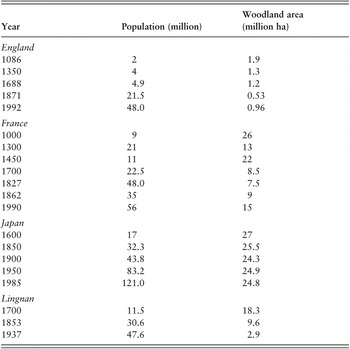
Estimates, however crude, of both population and forest areas in England and France are available for several benchmark years from the High Middle Ages onwards.Footnote 16 For Japan and China no medieval data are available but calculations are possible for early modern and modern sub-periods. For south China, figures assembled by Robert Marks and Kenneth Pomeranz about Lingnan provide us with estimates for 1700, 1853, and 1937.Footnote 17 Clearly, south China cannot represent the whole empire, either at a given moment or in trends over time.Footnote 18 However, this macro-region is sufficiently large (39 million hectares) to make comparisons with Japan and other countries significant. Its climate and flora share many characteristics with Japan, although Lingnan is a little more subtropical. Moreover, Lingnan experienced very strong eighteenth-century population growth, which will make the pre-modern Lingnan–Japan comparison particularly revealing with respect to the impact of population increase on forest cover. According to Marks and Pomeranz, the total woodland area was 18.3 million hectares in 1700, declining to 2.9 million by 1937; population estimates for the same dates are 11.5 million and 47.6 million (see Table 1).
Population and woodland area estimates for England, France, Lingnan, south China, and Japan, 1000–1992

Sources: 1. England: Population figures for 1086, 1350, and 1992 are from Henderson-Howat, ‘Great Britain’, pp.23–4; 1688 and 1871 from E. A. Wrigley and R. S. Schofield, The population history of England 1541–1871: a reconstruction, London: Edward Arnold, 1981, pp. 531–5. All woodland area figures are from Henderson-Howat, ‘Great Britain’, pp.23–4, except for 1871, which is taken from Agricultural returns of Great Britain 1871 (Parliamentary Papers, 1871, 69), pp. 54–5. Henderson-Howat's estimates for 1086 and 1350 are believed to have been made on the basis of a suggestion made by Rackham, Trees, p. 55. The 1688 figure is from Gregory King's estimates. 2. France: Both population and woodland area figures are from G.-A. Morin, ‘France’, in UN Economic Commission for Europe, Long-term historical changes, p. 19. 3. Japan: Population for 1600 is a provisional estimate by O. Saito; the 1850 estimate is from Matao Miyamoto, ‘Quantitative aspects of the Tokugawa economy’, in Akira Hayami, Osamu Saito, and Ronald P. Toby, eds., The economic history of Japan 1600–1990, vol. 1: Emergence of economic society in Japan 1600–1859, Oxford: Oxford University Press, 2004, p. 38; and the other figures are from Kokuritsu Shakai Hoshō Jinkō Mondai Kenkyūjo, Jinkō tōkei shiryōshū 2004, Tokyo: Kokuritsu Shakai Hoshō Jinkō Mondai Kenkyūjo, 2004, pp. 8–10. For estimate of woodland area in 1600, see text. Other estimates are from Nishikawa Osamu et al., Atorasu Nihon rettō no kankyō henka, Tokyo: Asakura Shoten, 1995, pp. 4, 6, 8, 10. 4. Lingnan: Population figures are from Marks, Tigers, pp. 158, 280; 1700 and 1937 are interpolated from other benchmark years. Woodland areas are Ling Daxie's estimates quoted in Pomeranz, Great Divergence, pp. 309–10; 1700 and 1937 are calculated from the percentages forested.
For Japan after 1850, there are two series of data: government land statistics and geographers' estimates using a two-kilometre mesh on the Geographical Survey Institute's 1 : 50,000 scale maps. The government data are annual but their definitions and categories change frequently. The geographers', compiled by Yukio Himiyama and his associates, are available only for 1850, 1900, 1950, and 1985. Their woodland area estimates, especially for pre-war years, are substantially higher than the government's. But Himiyama's methods are systematic and consistent, and so should accurately reflect changes in land use. Also, the Himiyama estimates start with the end of the Tokugawa; the government statistics began only in the Meiji. For the period after 1850, therefore, the Himiyama estimates will be used. They give 24,818,000 hectares for the woodland area today, which is very close to the 25,497,000 hectares estimated for 1850 (see Table 1).
No earlier estimates are available. However, a cursory look at Tokugawa historiography reveals two areas in which important moves took place. One is in the timber supply. There is evidence that woodlands were significantly depleted during 1570–1670, since population growth and town-building increased demand for construction timber. Kumazawa Banzan lamented that ‘eight out of ten mountains of the realm have been denuded’,Footnote 19 although he probably meant that ‘eight out of ten accessible mountains have been denuded’. After the late seventeenth century, plantation forestry became established. Increasingly, trees (especially conifers) were planted in cut-over places, felled some twenty years later, and sold. This emergence of regenerative forestry suggests that the forested area declined during the seventeenth century but regained its initial level by the end of the Tokugawa.Footnote 20 The other area concerns agriculture. Timber depletion coincided with a period of land reclamation but, since most new farms were created from marshy flood plains, reclamation did not deplete forests.Footnote 21 However, recent research shows that peasants did clear woods on the village common to create pastures for feeding livestock and for collecting grasses to mix with animal excrement and use as fertilizer. This homemade fertilizer, widespread in western provinces, did much to raise yields but denuded village-owned hills. Since these fertilizing practices continued, woods never returned to those grasslands.Footnote 22 Himiyama and others estimate 4.4 million hectares of ‘rough land’ in 1850, including village commons used for grass-cutting as well as fuel-gathering, fields used for shifting cultivation, completely denuded forest areas, and other types of ‘rough land’.Footnote 23 It is difficult to determine what proportion of the 4.4 million hectares had been converted from forest to the grassland type of village commons since the early seventeenth century, but we can assume that as much as one-third of the ‘rough land’ of 1850 had been wooded in 1600. This gives us 27 million hectares for Japan's woodland area at the beginning of the seventeenth century. Given the nature of our evidence, this estimate is probably on the high side. I have chosen a population figure of 17 million, which is well above Akira Hayami's widely accepted 12 million.Footnote 24 Thus my estimates probably overstate the relationship between deforestation and population increase during the Tokugawa.
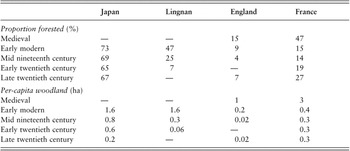
Let us now consider the average measures of deforestation for the four countries. Table 2 sets out the proportion of woodlands in relation to the total land area and the woodland per capita. Both measures broadly confirm that both England and France exhibit a U-shaped curve. For East Asia, since the time period covered is short, it is difficult to identify a long-term trend; seemingly Lingnan's is continuous deforestation, while Japan exhibits long-term stability.
Proportion of land forested and per-capita woodland: England, France, Japan, and Lingnan, 1000–1992

Sources: see Table 1.
Some other findings also merit attention. Forest cover in the British Isles of the High Middle Ages was already much thinner than on the European continent. The proportion of woodlands in England at the time of the Domesday Survey was 15%, which declined to 10% in the mid fourteenth century and to 8% by 1688. The French percentage for 1000 was 47%; even in 1700 it was 15%. This impression is confirmed by looking at broader estimates for circa 1600. The proportion was one-third in the continental European countries of France, German-speaking areas, Bohemia, and Poland, and one-quarter in Denmark, but 12% for Ireland, 6–7% for England, and 4% for Scotland.Footnote 25 The same contrast between Britain and the continent remained in the late 1860s, although general levels became noticeably lower.Footnote 26 Evidently there had already been substantial differences in medieval times, including not just those affecting plant growth but also endowments of mineral resources utilized later as substitutes for forest products.
Second, Lingnan's early modern level of 1.6 hectare woodland per capita comes between the medieval English and French levels, and its mid nineteenth-century value of 0.3 hectares lies between the early modern English and French levels. Moreover, in terms of the percentage forested, mid nineteenth-century Lingnan was clearly above France at the beginning of the eighteenth century. This seems to support Pomeranz's claim that, in the eighteenth century, China's ecological situation was ‘probably not much worse’ than that of France.
Third, Japan's initial level of forest cover was high – over 70% – and exhibits little change today (hence a steady decline in per-capita woodland). Needless to say, such comparisons between remote dates can mask changes that may have occurred in between. In fact, there is a consensus that ‘timber depletion’ took place in the seventeenth century and was particularly serious in the period before 1670.Footnote 27 The table implies, therefore, that any substantial pre-1670 depletion was later offset by an equally substantial rebound. Taken together, this suggests that the relationships between population change and deforestation in Japan were somewhat different from those in the other countries.
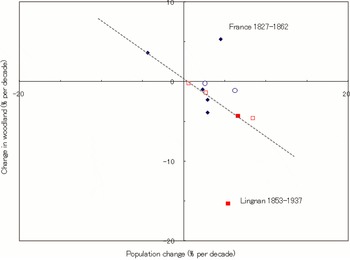
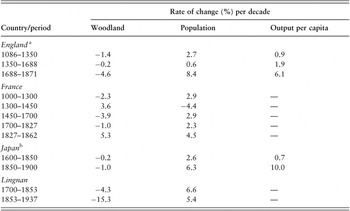
We therefore need to look more closely at how the rate of change in woodland area was affected by the rate of change in population (and thus in demand for forest resources). Since, in most of today's developed countries, afforestation has gained momentum in the twentieth century, we may concentrate on the period before 1900 for England and France, and before 1950 for East Asia. Table 3 and Figure 1 indicate how the rates of change in woodland and population were related in European and Asian pasts.
Relationships between the rates of change in population and woodland: England, France, Japan, and Lingnan, 1000–1937. Data taken from Table 3. Key: □ England; ♦ France; ○ Japan; ▪ Lingnan

Rates of change in woodland and population over the long term: England, France, Japan, and Lingnan, 1000–1937

a Data for English per-capita GDP before 1820 are van Zanden's estimates, which are linked with the Maddison estimates for the modern period.
b Japanese output data for 1600–1850 are for farm output only (the Nakamura estimates of kokudaka), while those for 1850–1900 are Maddison's estimates for GDP (both from Maddison, World economy, pp. 255, 264).
Sources: Woodland and population data are from Table 1 above, while rates of change in per-capita output are calculated from J. L. van Zanden, ‘Cobb-Douglas in pre-modern Europe: simulating early modern growth’, International Institute of Social History Working Paper, March 2005, tables 2–3, and Angus Maddison, The world economy: a millennial perspective, Paris: OECD, 2001, pp. 255, 264.
As expected, these variables were negatively correlated. The dotted regression line, stretching from the upper-left to the lower-right quadrant in Figure 1, represents a trajectory of deforestation expected from changing rates of population increase. An observation above the dotted line indicates that deforestation in that time and place was less serious than expected for its population growth; a position below the dotted line means that deforestation was more disastrous than ‘normal’. There are two ‘outliers’: France, 1827–62, is in the upper-right quadrant, suggesting that afforestation was already underway there in the mid nineteenth century. Indeed, it was in this period that ‘France came out of its intensive and often fraught forest experience’.Footnote 28 In Lingnan, 1853–1937, however, the tempo of deforestation became faster in the transition phase from early modern to modern.Footnote 29 By 1930, therefore, not much forest cover remained even in south China.Footnote 30 This Franco-Chinese contrast that emerged in the nineteenth century is consistent with the Pomeranz thesis. However, the diagram also indicates that most of the other cases do come close to the regression line. Indeed, the correlation coefficient excluding the two outliers is −0.86 (the coefficient of determination is −0.74), suggesting that, despite substantial differences in initial conditions between Europe and East Asia as well as differences within each of the regions, most of their early modern experiences in terms of change over time were actually in line with what we would expect from changing demands for forest products driven by varying rates of population increase (the implied elasticity is −0.6, which means that the woodland will shrink by 6% when population increases by 10%). This is true for Lingnan in the 1700–1853 period. Although we cannot extend the calculations back into earlier centuries, Marks' study of Lingnan points to close links between population growth, the expansion of the food base, and the clearance of forests, suggesting that, if two of the three are known, conjecture may be made about the third. According to his estimates, both population growth and arable expansion between 1700 and 1853 were the fastest of the entire period since 1400. The rates of increase in the period up to the mid seventeenth century were modest, while during the Ming–Qing transition the arable area increased only marginally and population even decreased.Footnote 31 It seems, therefore, that in Lingnan as well as in Japan pre-nineteenth century conditions were not much worse than in western Europe.
Two further comparisons may be made here. First, it seems surprising that the pattern of change depicted in Figure 1 was not very different between England and France. True, the most rapid woodland degradation in England took place between 1688 and 1871 (−4.6% per decade) whereas in France it was in the 1450–1700 period (−3.9% per decade). On the face of it, this might suggest that French deforestation occurred in early modern times while in England it took place during the industrial revolution period. However, it should be remembered that we have fewer benchmark years for England than for France. Moreover, English population growth between 1688 and 1871 was stronger than France's in 1450–1700. In fact, France's position in Figure 1 for the early modern period deviates somewhat more from the regression line than England's for the period that includes the industrial revolution.
Clearly, deforestation could be substantial in pre-nineteenth-century Europe. The ‘timber famine’ in the sixteenth and early seventeenth centuries, for which John Nef argued, may not have been a coincidence. Nef claims that widespread shortages of timber and firewood raised their relative prices, which eventually led to the substitution of coal for wood.Footnote 32 Certainly fears of wood shortage were expressed in many early modern European regions. But this does not imply that Europe was actually approaching ecological exhaustion by, say, 1700.Footnote 33 What the evidence above indicates is simply that the pace with which woods were felled exceeded the rate of population increase by more in the early modern than in the modern period. It should be remembered that early modern England already used substantial amounts of coal, helping it cope with its meagre wood supply.Footnote 34 Certainly the popular view that the charcoal iron industry destroyed England's woodland is wrong, for ‘less than 2% of the land surface of England and Wales could have sustained the maximum output of the British charcoal iron industry for ever’; as Oliver Rackham emphasizes, coppicing and other methods of woodmanship seem to have worked rather well until the late eighteenth century. Nor is it likely that shipbuilding was a predator of old-growth stands,Footnote 35 because its growing timber demand was met by increased imports from the Baltic and North America.Footnote 36 The major predator was agriculture. According to Rackham, ‘the eighteenth century was an age of much tree-destruction’ and it was ‘enlightened’ landowners in Norfolk and other parts of England who were probably responsible for much of the disappearance of natural and semi-natural woods.Footnote 37 French evidence also suggests a close negative correlation between woodland and farmland areas throughout the High Middle Ages, the post-Black Death phase, and the early modern period.Footnote 38
While state policies did not effectively curb demand, supply-side factors deserve more attention. The rise of scientific knowledge about forest management led eventually to an increase in forest yields and the advance of afforestation in various parts of nineteenth- and twentieth-century Europe, and it is here that the state was unmistakably important, except perhaps in England.Footnote 39
It is worth comparing Japan's experience with western Europe’s, especially England's. The two Japanese observations in Figure 1 are above the English ones, indicating that, even controlling for differences in population growth, deforestation in Japan was less disastrous than in England. Table 3 also provides rates of change in output per capita, making the contrast even clearer. Given the importance of agriculture in the European scene, which seems to have also played a considerable role in seventeenth- and eighteenth-century Lingnan, it is likely that the same mechanism operated in Tokugawa Japan. Although the paucity of data does not allow us to differentiate sub-periods, it would seem likely that seventeenth-century Japan – with strong population growth, an expansion of farmland, and timber depletion – experienced the same direct link between population and the clearance of woodland.Footnote 40 However, as we have seen, seventeenth-century farmland expansion was largely achieved by converting marshes in river deltas into paddy fields. The only way in which agricultural growth reduced woodlands in this period was through the clearance of woodlands on village commons in the western provinces.Footnote 41 The loss of forests caused by increased settlement in the mountains may have been relatively insignificant. Overall, the deforestation caused by timber demand was not much exacerbated by other factors.
Deforestation resumed in the late nineteenth century, when industrial demand for firewood increased. But the acceleration in this period was modest compared with early modern European and also modern Chinese deforestation, because afforestation had been under way since late Tokugawa times – having arisen, in all probability, in response to the seventeenth-century woodland crisis. Thus the relative stability in the level of forest cover was not a product of conservationist policies or cultural beliefs: it is largely explained by a supply-side response to demand change.
Woodland tree species did change substantially as plantations advanced. As in Europe, the change was from broadleaved trees to conifers. Today, there are more plantations of softwood conifers – sugi (Cryptomeria japonica) and hinoki (Japanese cypress) – than in the beginning of the Tokugawa period.
Thus in both early modern Europe and East Asia in the early modern period there were mechanisms that kept woodland degradation in check and others that furthered the degradation. These included state intervention and what Rackham calls woodmanship; the mix varied from country to country and, within the same country, effects varied across periods. In Germany, as Radkau notes, forest scientists believed that ‘Only the state manages for eternity’, whereas in England private individuals seem to have been guided by longer-term considerations.Footnote 42 It is interesting, therefore, to ask whether similar contrasts might be found within East Asia, where Japan is mentioned by Richards and others as one of the most successful cases of state intervention in support of afforestation.Footnote 43 Another area of interest is supply responses to market stimuli. For example, woodmanship in England is thought to have been responsive to growing demands for fuels. Similar techniques operated in East Asia in supplying firewood and charcoal for local and metropolitan markets. Market linkages may also have been important in timber supply, as we shall see shortly.
Market linkage: the common denominator in early modern East Asia
In early modern China and Japan, it was primarily market forces that provided both timber and fuel. Sometimes markets encouraged exploitative felling, which could lead to massive deforestation, especially where topography was not favourable for spontaneous regrowth, as on the granite hills in Japan's Inland Sea coast. However, under some circumstances the market could stimulate the emergence of regenerative forestry.
Tokugawa Japan
Let us consider the Tokugawa case first. Seventeenth-century timber depletion led to ecological degradation: judging from edicts and ordinances issued by the Tokugawa government in the late 1600s, serious erosion and floods were widespread problems. Many mountain districts responded to the shortage of timber created by this boom by felling more woodlands but eventually turned to regenerative forestry as an economically viable business pursuit.
By the 1710s, several provinces became known as market-oriented suppliers of timber to metropolises such as Kyoto, Osaka, Nagoya, and Edo, and two types of forestry districts emerged.Footnote 44 One depended largely on spontaneous rejuvenation of the woodland. This was possible only where wooded areas were large and government regulations were effective. Kiso, Hida, Akita, Tsugaru, and Tosa are notable examples, being mostly large and powerful daimyo (feudal lord) territories located in rather remote provinces. In many daimyo territories, especially those in northern and central provinces, rules introduced by the mid eighteenth century prohibited peasants from harvesting certain species of trees.Footnote 45 The short-term effect was probably to reduce output in those areas, but in the long run such conservationist measures must have enabled them to harvest and market timber products on a secure basis.Footnote 46
The other type was privately managed plantation forestry, which emphasized replanting and rotation. This entrepreneurial type of timber production was mostly found in privately owned woodlands surrounding metropolises. The district of Ome, for example, was in Edo's hinterland, while Yoshino and Tanba targeted the Osaka and Kyoto markets. According to an analysis of early Meiji silvicultural reports,Footnote 47 intensive afforestation management was found in regions between the Tanba-Yoshino line and the line connecting the Kuzuryu to the Tenryu River, and also in an area from Oku-Tama to Chichibu. The former area, which was much larger, served collectively as a supply zone to the metropolitan markets of Kyoto, Osaka, and Nagoya, while the latter was a hinterland of the Edo market. Of those districts, Yoshino led the way in regenerative forestry in the private sector. Afforestation in this area started in the mid seventeenth century on mountain sites formerly used for slash-and-burn farming, and gained momentum from the turn of the century onwards.Footnote 48 The daimyo do not seem to have intervened in this market-oriented timber trade.
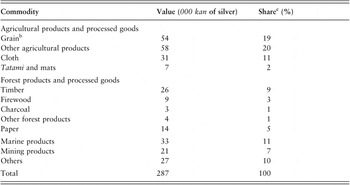
Osaka occupied a central place in Tokugawa distribution networks. Trade statistics for 1714 enable us to examine the composition of Osaka imports from various provinces.Footnote 49 Since the 1714 statistics covered all merchandise sent as ‘commodities’ to Osaka (thus excluding tax rice sent by daimyo authorities themselves), Table 4 indirectly indicates the relative importance of the timber trade to other trades in the early eighteenth century. Not surprisingly, rice and other agricultural products constituted the largest group, accounting for 39% of the total. Next came cloth and forest goods. The former group (of mostly rural-made textiles) constituted 11% of the total value of imports and the latter 13%. The forest goods included timber, firewood, and charcoal, of which timber – mostly softwood conifers for construction – outweighed the fuel group of firewood and charcoal (9% and 3% respectively). While timber included both state- and private-sector outputs, fuel came exclusively from the private sector, where coppiced woodlands were managed by villagers. According to 1736 statistics of a similar, though less comprehensive kind, timber came not only from districts surrounding Osaka but also from remote north-eastern and south-western provinces.Footnote 50 This suggests that at this stage the share of timber shipped from daimyo-controlled forestry districts was still large; but, judging from early Meiji statistics, timber imports from privately run conifer plantations around Osaka and Kyoto, such as those in Tanba, Yoshino, and Kumano, as well as firewood and charcoal imports from similar districts, later increased at a substantially faster pace than shipments from daimyo-owned forestry areas.Footnote 51 According to a case study of Tanba, the supply of timber grew fourfold, from 600–800 rafts per year in the 1670s to 3,000 two centuries later.Footnote 52
Osaka imports, 1714a

a This table differs from a similar table in W. B. Hauser, Economic institutional change in Tokugawa Japan: Osaka and the Kinai cotton trade, Cambridge: Cambridge University Press, 1974, p. 28, and another in Hiroshi Shimbo and Akira Hasegawa, ‘The dynamics of market economy and production’, in Hayami, Saito, and Toby, Emergence, p. 172. Hauser's table does not include grain in the total, while Shimbo and Hasegawa's seems to have adopted somewhat different grouping criteria for commodities (for example, their ‘forest products’ are too small).
b This does not include tax rice transported to Osaka by daimyo administrations, which amounted to nearly two-thirds of the total merchandise listed above.
c The sum of percentages is not equal to 100 because of rounding.
Source: Oishi Shinzaburo, Nihon kinsei shakai no shijō kōzō, Tokyo: Iwanami Shoten, 1975, pp.154–67.
Recent studies by development economists suggest that whether domestic timber demand stimulates afforestation depends critically on the geographic scope of the market for forest products. Whereas in open economies no systematic relationship is found between changes in national income and changes in forest cover, the two are positively correlated in closed economies.Footnote 53 Tokugawa Japan was virtually closed to international trade, and there is evidence that contemporaries saw plantation forestry as commercially viable. Farm and silvicultural manuals, published in increasing numbers during and after the seventeenth century, encouraged rural entrepreneurs to cultivate softwood conifers for construction timber. They argued that prices of good timber in metropolitan markets would rise more than proportionally to the size of timber, and that such buoyant prices would justify the increased input of labour and capital in a plantation whose growth period tended to be twenty years or even more.
Similar market linkages operated for the cultivation of fuel wood, for which coppiced woodlands of oak varieties (kunugi and konara) were maintained by peasant producers in a sustainable manner. Household demand for charcoal and firewood increased in the latter half of the Tokugawa period: in Akita in the north, for example, charcoal production for government and samurai households increased by 150% between 1806/10 and 1869.Footnote 54 Industrial demand, though much smaller than in the European past, was also met by sustainable methods. Although little is known about the relationship between the small mining and metalworking sectors and their fuel demand, there is at least one telling example. From 1691, the House of Sumitomo, which ran a copper mine at Besshi, Iyo province, extended a designated area of woodlands for fuel and timber, as its mining operations grew during the eighteenth century. Woods for fuel were coppiced as in the English iron industry, while small-scale afforestation was introduced for timber use. This system seems to have worked well during the Tokugawa period.Footnote 55
A few more remarks may be made about the emergence of market-oriented forestry. First, studies of timber production in Yoshino and Tanba suggest that local merchants, not forest owners, managed the plantations, as well as logging and transport.Footnote 56 Given the long gestation period in forestry, their financing costs must have been substantial. At this stage, we do not know to what extent their activities were self-financed, or how they were funded when borrowing became necessary. However, it is worth noting that interest rates in urban money markets generally declined – in the case of loans to daimyo – from 12–13% to about 8% between the early eighteenth and mid nineteenth centuries. Tokugawa Japan's success in regenerative forestry may, therefore, have partly been due to the evolution of capital markets.Footnote 57
Second, the case of Yoshino suggests that regenerative forestry raised the intensity of land utilization as well as labour intensity. When commercial afforestation started there, foresters cultivated on a twenty-year cycle, so that they could harvest as early as possible. Later, however, the cycle was lengthened to produce better-quality, higher-priced timber, using a more labour-intensive technique that combined dense planting with more frequent thinnings. This led to a substantial increase in land productivity. Like agriculture during the same period, forestry became labour intensive as well as land intensive.Footnote 58 The advance was thus Boserupian, and this advance in yields per hectare gave entrepreneurial farmers a competitive advantage over entrepreneurial foresters of daimyo-controlled forests, which generally had larger plots.
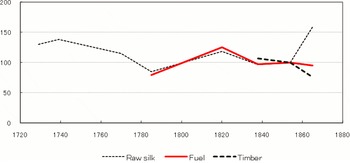
The macroeconomic significance of this productivity advance may be estimated by looking at relative price movements of forest products. Unfortunately, no price data exist for earlier periods, when timber shortage was still substantial: data become available only from 1785 for firewood and charcoal and from 1838 for timber. Even with such short time series, however, it is worth comparing the prices of forest products to the general price index and to prices for raw silk, the best performer of all commodities in the Tokugawa period. Figure 2 shows that silk prices declined relative to the general price index for almost the entire period before the 1850s. That raw silk became cheaper in comparison with other commodities suggests that the decline in its relative price was supply driven. Indeed, there is consensus that its production base in the countryside expanded and its productivity increased throughout the eighteenth and nineteenth centuries.Footnote 59 We do not know exactly how the demand for silk changed, but the stable population and slow economic growth in the period before the opening of the Treaty ports in 1859 also suggests that the supply side must have determined this relative price movement. Prior to the 1850s, the relative price curves for raw silk and forest products moved more or less together, suggesting that, if earlier data were available, the graphs for timber, firewood, and charcoal might well look much like those for raw silk. This implies a productivity-driven decline in the relative prices of forest goods, with productivity growth large enough to keep the supply to the metropolitan markets sufficiently elastic.
Relative prices of raw silk, fuel, and timber (relative to the general price index) for Japan, 1729–1865. The benchmark years are 1729 (trough), 1739 (peak), 1770 (trough), 1785 (peak), 1820 (trough), 1838 (peak), 1854 (trough), 1865 (peak). Price indices are averaged over five years centring on the benchmark year. The ‘fuel’ price index is an average of firewood and charcoal indices. For the calculation of the general price index, see Matao Miyamoto, ‘Relative prices and transformations in the industrial structure’, in Hayami, Saito, and Toby, Emergence, pp. 121–2. Source: Table 4.3 of Miyamoto, ‘Relative prices’, pp. 139–41.

Imperial China
Much has been said about continuous woodland degradation in historic China. Empirically, however, the evidence is not robust. In this respect, Bozhong Li's work on Jiangnan is invaluable. He suggests that, in the eighteenth century, timber accounted for ‘more than one fifth of the total volume of trade carried through the customs houses of the Yangzi system’.Footnote 60 This is greater than figures for Osaka in 1714 (see Table 4 above), suggesting that eighteenth-century China's long-distance trade in timber (including bamboo) must have been remarkably large. Moreover, Li maintains that economic growth in the Lower Yangzi both stimulated and was constrained by the timber trade with local economies in Fujian, Hebei, Hunan, Sichuan, Guizhou, and Yunnan. On balance, he concludes that the constraining effects of tight timber supplies may have been the most important phenomenon, as reflected in rising timber prices in Jiangnan.Footnote 61
However, there is some evidence of afforestation efforts. Li himself shows that some of the regions mentioned above had already practised regenerative forestry from early times, while Robert Marks quotes Gottlieb Fenzel, a German forestry expert, remarking that, while much of northern Guangdong had became ‘vast stretches of flat, barren hills’ by the early twentieth century, ‘the Yao tribesmen who Fenzel observed had taken to replanting trees after they moved on; but the Chinese did not do so then and probably had not in earlier times either’.Footnote 62 Ethnic minorities such as the Miao and Yao played a prominent role in the timber trade from early periods in south China,Footnote 63 and recent studies of documents concerning the Miao of Guizhou and their cultivation of Cunninghamia, a coniferous tree marketed as construction timber, suggest that their timber trade was a sustainable business. In the eighteenth century, the forestry district of Qingshui-jiang, in south-eastern Guizhou, started to cultivate Cunninghamia for urban markets in the Lower Yangzi and also established links with the public-sector procurement of building material for the palace in Beijing.Footnote 64 Both local Miao-speaking merchants and city-based Han Chinese dealers played equal parts in this commerce, making the timber trade sustainable and replanting profitable.
This may give the impression that market-oriented afforestation was practised by minority people but never by Han Chinese. Indeed, among several types of traditional Chinese forestry examined by Nicholas Menzies, logging operations in deep mountains organized by Chinese merchants were probably the most straightforward and the most exploitative form of market activity,Footnote 65 while settlers of various ethnic groups, including Hakkas in the Yangzi highlands (called pengmin or shed people), are said to have caused environmental degradation by clearing woods and digging up tree roots to convert hill slopes to fields for maize, causing erosion and flooding.Footnote 66 On the other hand, there is evidence that the ways in which woodland was managed in the Miao area of Guizhou were no different from those in Huizhou forestry districts. Mio Kishimoto's study of both Guizhou and Huizhou contract documents makes it clear that China's forestry remained in private hands throughout late imperial times; it was merchants who managed forests and the distribution of timber, as in Tokugawa Japan.Footnote 67 Hill owners, rarely involved in actual cultivation, received a share of the proceeds from tree sales at the end of the cultivation cycle. The hill owner–merchant relationship in China seems to have been somewhat more businesslike than in Tokugawa Japan. Contracts were for one cultivation cycle only and the next contract usually went to a different merchant, but there is no indication that this high turnover caused any instability in the trade. The planter's share was one-third in most cases. Although a share of one-half was not rare, the tendency seems to have been for the planter's share to decrease over time. This probably does not reflect a worsening of planters' bargaining positions but a tendency for the planters to earn extra incomes by cultivating crops such as millet and sesame.Footnote 68 Thus, as Menzies says, Cunninghamia cultivation was probably the ‘longest lived, most resilient example of forest management’ in Chinese history.Footnote 69
Outside this commercial forestry sector, there was another regime: woodland owned and carefully maintained by a corporate community. Although not for commercial purposes, as the Huizhou case shows,Footnote 70 such woodland was maintained and harvested regularly by the lineage group to earn income for maintaining ancestral halls and other projects. Villages and temples also maintained woods in a similar manner. Woodland management of this kind, therefore, must have tended to slow the long-term rate of degradation.Footnote 71 Thus, in south China prior to the mid nineteenth century, the ways in which market demand was translated into regenerative forestry were probably roughly similar to those in Tokugawa Japan. In this sense, the cultivation of trees in China and Japan exemplified what Tony Wrigley calls ‘advanced organic economy’,Footnote 72 although the evidence so far examined suggests that market-oriented plantation forestry worked somewhat better in Tokugawa Japan than in imperial China.
The long-term trend was therefore determined by whether or not depletion was slower than renewal. Unlike the Japanese case, the incentive of high market prices may not always have made up for relatively high costs of timber production.Footnote 73 Once the rate of depletion exceeded that of renewal, the pressure to harvest immature trees would start ‘a downward spiral’. Such a cash-in imperative derived from market forces. However, Elvin does note that environmental degradation in the commercial plantation sector ‘did not become clearly established until the eighteenth and the nineteenth centuries’. According to him, one critical factor in plantation managers’ cost–benefit calculations was the theft of wood: this ‘became a widely prevalent scourge, which inhibited production by small producers with inadequate means to defend themselves; and market pressures probably tended to compel not only a concentration on cultivating quick-growing species but also sales of relatively immature trees as soon as a profit could be taken’.Footnote 74 Such crimes seem to have increased in various parts of the empire in the very late Qing and Republic. Menzies notes that village and clan forests also disappeared more rapidly after 1911.Footnote 75 Thus, the real cause of the ‘downward spiral’ that is believed to have occurred in the late Qing and Republican periods was probably a breakdown in law and order, rather than market mechanisms per se.
The role of the state: divergence in modern East Asia
‘Law and order’ is closely associated with the ‘role of the state’ question. As long as what economists call ‘externalities’ exist, we cannot leave environmental issues entirely to the market. And since much woodland was owned by the state and many forest resources were procured for the state, some kinds of regulations and institution-building are of prime importance. However, the state has not always been a reliable agent of control, maintenance, and management with respect to forests. In fact, Menzies’ discussion of temple and monastic forest conservation in historic China argues that the policies of successive dynasties were inconsistent. While, in the areas of commercially oriented plantation forestry, state intervention (whether restrictive or market friendly) was minimal,Footnote 76 national interests often took precedence over concern for forests. Prohibitions could be followed by state-initiated incentives to colonization and land clearance, as in early to mid Qing Hunan, where state encouragement of land clearance via tax exemptions led to the disappearance of woodlands.Footnote 77 In contrast, the Tokugawa shogunate's policies were less inconsistent. The shogunate and daimyo administrations controlled forest resources by banning entry or access, thus allowing areas to regenerate, and by edicts regulating usage of forest products; in villages, peasants developed their own rules to regulate access to firewood, green fertilizer, and fodder. Both are interpreted by Richards and many others as measures of ‘public rationing’.Footnote 78
However, the Tokugawa state did more than just rationing. Indeed, a careful reading of Totman's The Green Archipelago reveals that institution-building in the daimyo sector was the key factor in accounting for the rise of regenerative forestry and thus for Tokugawa Japan's record of forest management in general.Footnote 79 In the decentralized Tokugawa system, local daimyo governments were increasingly interested in forest management – as a public body seeking to prevent erosion and flooding, and as a fiscal body seeking new revenue sources. What emerged in many parts of the country during the eighteenth century were agreements between daimyo governments and local farmer-entrepreneurs or village officials. Some took the form of simple, fixed-term-lease contracts between the two parties. Another method, which proved to be more important, was to share the harvest on daimyo-owned woodland. This was called ‘shared-yield forest’ (buwake-yama in Tokugawa terminology), under which the lessee planted trees and sold the timber at the market.Footnote 80 The contract was for one tree generation but was renewable in most cases. It seems that the planter's share of the harvest gradually increased as the eighteenth century progressed, from a level below one-half to the fifty-fifty mark and beyond.Footnote 81 The general level of the planters' share was higher in Tokugawa Japan than in imperial south China, and it increased rather than decreased. This Tokugawa system apparently provided an incentive to the local entrepreneur to expand the cultivation of trees that the market wanted by making a deal with the local government with respect to the state-owned woodland. The emerging system proved effective, giving the local government revenues and the local people stable profits, while keeping forest areas replanted. In other words, this can be regarded as a decentralized way in which state influence helped maintain the nation's forest cover.
Another pronounced difference between China and Japan seem to have emerged after the demise of the old regime. Given Lingnan's sudden change in the tempo of deforestation and the possibility that troubles with ‘law and order’ increased over time, it seems likely that the system of resource control and management started to crumble during the late Qing–Republican period. The Republican government attempted to tighten up woodland management and initiate afforestation campaigns, based entirely on Western ideas of forestry and state control. However, Elena Songster's study of Fujian concludes that their efforts disrupted, rather than supported, the traditional timber trade.Footnote 82 In contrast, Japan's new Meiji government took a much firmer stance on forest management, in part because of what the Iwakura mission of the 1870s learned from the West. After noting how seriously forests were under attack in the European past, the chronicler Kume added that ‘It was in light of this [state of forest degradation] that forestry systems were subsequently promoted so that nowadays, while liberal politics are increasingly practised in Europe, in forestry laws alone the freedoms of former times are actually being curtailed.’Footnote 83
After visiting Prussia, he noted that ‘As a result, laws have recently been introduced to protect the forests, and the government has been making intensive efforts to plant large quantities of saplings during the felling season’.Footnote 84 The embassy thus learned that the government should take the initiative in forest management. Subsequently, government officials and experts looked to continental Europe, especially Germany, for the science of forestry, and absorbed its protectionist philosophy. This meant centralization in policy-making, which was a clear departure from Tokugawa governance tradition. In practice, however, the central project of government policy-making was the promotion of commercially viable plantation forestry, which simply endorsed the tendency towards coniferous plantations that had been in process since late Tokugawa times. In sharp contrast with China's Republican government, moreover, the Meiji forestry bureau began to rely more on hands-off than on hands-on measures. Although the Meiji Forest Law gave a secondary importance to traditional institutional frameworks, the late Meiji government rediscovered the century-old ‘shared-yield contract’ as an effective means of promoting afforestation in the state sector and in woodlands owned by local authorities and private landlords. This functioned well, just as it had worked for local daimyo-owned woodlands in the late Tokugawa.Footnote 85
All this, however, should not be taken to imply that the central government became all important in modern Japanese forest management. First, there was a shift within the state sector: the focus of regenerative forestry shifted from state-owned woodlands to those managed by prefectural governments and those owned by village authorities. Second, in the private sector too, afforestation advanced, with rising trends in the relative prices of both timber and charcoal reversed after 1922, the year that marked the end of a wartime boom.Footnote 86 Intensive methods of afforestation that had originated in Yoshino diffused to remote regions, which now gained – thanks to the coming of the railways – better transport access to the metropolitan markets. It is true that such intensive methods were initially adopted on publicly owned woodlands and that progress in the private sector between the two world wars was stagnant, while relative prices of timber fell. However, the private-sector advances made before the 1920s were substantial and their importance should not be underestimated.Footnote 87
Third, the expansion of charcoal-producing districts should also be noted. Before the Second World War, charcoal in Japan (unlike firewood) was a commodity of comparatively high income elasticity. For the period before the First World War, it stood at 0.5 as against 0.1 for firewood (the elasticity of 0.5 is comparable to that of construction timber for the same period).Footnote 88 As income levels rose and urbanization proceeded, the household demand for charcoal also increased. Moreover, industrial demand from some traditional pursuits, such as sericulture, also increased in initial phases of development.Footnote 89 Thus, in the production of charcoal too, market demand and sustainable woodland management were closely linked, and it is worth reiterating that it had already started in the hinterlands of cities during the late Tokugawa period.
Concluding remarks
Based on a comparison between China and France, Pomeranz argued that early modern East Asia's forest degradation was ‘not much worse’ than in eighteenth-century western Europe. This article has found that most of the pre-modern observations for the four countries examined were within the range expected from varying rates of population growth in the past, and that it was in the period after the second half of the nineteenth century that China and the West became divergent. Considered together, they may be taken to imply that he was right.
However, a couple of caveats should be made. First, all this need not mean that, as Pomeranz seems to have implied, both East Asia and Europe ran into an ecological bottleneck in the eighteenth century. As we have seen, at both ends of Eurasia, mechanisms to supply forest products to industries and households continued to operate without much degradation to the existing woodland. Second, while destabilizing forces were undoubtedly operative throughout the early modern period, market linkages are likely to have exerted, under certain circumstances, positive influences on forest management and the advance of regenerative forestry. Divergence took place in the nineteenth century and widened thereafter in this area of forest history. In the West, deforestation was mostly associated with medieval and early modern agricultural development, while changes in modern times led the way to reforesting Europe. In contrast, China's early modern systems of regenerative forestry collapsed, resulting in uncontrolled deforestation in the post-imperial period. This is probably not because her resource substitution was delayed but because something more fundamental collapsed at the end of the imperial era, which in turn seriously affected the economic and social aspects of people's lives. In contrast, only Japan saw the establishment of regenerative forestry in both timber and fuel supply in an early modern setting. This was not, as Richards tried to argue, because the state took stringent restrictive measures to promote a regenerative mode of forestry, but because market linkages worked to make regenerative forestry commercially viable. Institutions that emerged during the early modern period resulted from processes in which both governments and local entrepreneurs played a part. It was those early modern institutions, as well as intensive methods of afforestation, that kept the country's forest cover from degradation throughout the modern period.
Finally, a few more points may be made for environmental history. Whenever global comparisons are attempted with respect to woodlands, geographical factors such as geology and climate should be taken into consideration. One important reason why Japan is still so green is that a combination of temperature, humidity, and landforms allows – unless deforestation is followed by severe erosion – the woodland to rejuvenate itself without much human intervention. This must certainly have aided daimyo-managed forestry, which relied entirely on natural regeneration during the Tokugawa period. By contrast, in north and north-western Europe the average temperature is much lower and the surface cover was stripped off by late Pleistocene glaciers, inhibiting natural regrowth. However, such factors are unable to explain the differences between Japanese and south Chinese forestry from the nineteenth century onwards. The two regions share much the same flora and climate. Wet rice is the principal component of farming activity in the East Asian temperate zone. Evergreen broadleaved trees such as camellia, shii (Shiia sieboldii), and camphor tree are a common characteristic, while China's Cunninghamia is similar to the Japanese conifers of cedar and cypress. Divergence in East Asian forest history, therefore, cannot be accounted for by geographical factors alone.
Furthermore, Japan's comparatively better performance in keeping forest depletion in check does not necessarily mean that its development was costless in environmental terms. One obvious price that Japan paid is that the woodland became much less diverse. Now there are far more conifer plantations than would exist had there been no human intervention. This is the end product of a long historical process of felling the old growth of broadleaved species and planting more homogeneous species of Japanese cedar and cypress instead. According to the counts by Himiyama and his associates of two-kilometre meshes on the 1 : 50,000 scale maps, 44% of the country's woodland area in 1850 was covered by broadleaved trees, 38% in 1950, and only 21% in 1985. What increased instead were ‘mixed’ meshes, but a majority of those areas were mixed with small-scale conifer plantations. Since most of the broadleaved woods had been ‘natural forests’, the shift was away from natural growth to artificial planting.Footnote 90 Indeed, this shift must have already started in the Tokugawa period. In one Inland Sea region district, a list of trees in the 1720s included red pine, evergreen oak, maple, podocarp, chestnut, cherry, and a few kinds of coniferous trees such as cedar, cypress, and Japanese hemlock – a diversity of tree species.Footnote 91 This particular area was denuded by the mid nineteenth century, with only scattered stands of red pine and Japanese hemlock left; in other similar areas not far from Osaka and Kyoto mixed forest must have been replaced by conifer plantations. There was a countervailing force operating: an expansion of small-scale plantations of oak varieties in districts of charcoal-burning. Its total area was expanding, but not sufficiently to counterbalance the strong growth of coniferous plantation forests.Footnote 92
Unlike broadleaved woodlands, coniferous plantations are monocultures. While intensive forestry of cedar and cypress plantations played a crucial role in keeping the nation's forest cover more or less intact, there must be some negative effect of having such monocultures around our living space. Understanding how such adverse effects interacted with changing economic and market circumstances and with changing standards of our life in the past will have to await further research by environmental historians.