1. Introduction
Robots are entering human spaces so fast day by day. We are no more unaware of a coexisting world where machines and humans live together, and the same is evolving more. In such times, it is important to explore all small and big problems related to the domain. The popularity of wheeled robots is ubiquitous and gaining new heights. They are successful on paved surfaces but what about uneven or jungle trails? Legs, meander better there. Hence, the importance of legged robotics takes advantage over wheeled robotics. There has been a considerable amount of work in the direction of legged robots. There exists one, two, three, four, or more legged robots this article discusses the idea of observer design for the two important variables of the single-leg hopping robot (SLHR) system [Reference Liu, Tan and Zhao1]. A similar approach can be taken for the other class of multiple-legged robots.
Just to revisit the preliminary concepts, let us go through the basic definitions and some historical perspectives. A robot is a reprogrammable, automatically controlled, multi-purpose manipulator. For the fixed in place or mobile, it is programmable in three and more than three axes [2]. The journey of robots began in the early year of 1950s. In the 1950s, an inventor George C. Devol created the first robot. Unimate reprogrammable manipulator was originated and patented by him from Universal Automation. He was known in the industry as the “Father of Robotics.” Development in the field of robotics brought the concept of a mobile robot with wheels. Wheeled robot is used because of its simple mechanism which requires less control effort, faster movement, and needs fewer energy [Reference Campion, Chung, Siciliano and Khatib3]. But as we know about more than 50% of the earth’s surface is not paved so locomotion with the wheel is quite difficult or almost impossible for that type of surface. The problem regarding the locomotion on uneven terrain legged locomotion for robots be used is neutralized.
In the year 1990, one of the initial articles featured for the SLHR type of robots [Reference Li and He4]. In this article, the method of perturbation and energy balance were applied together to observe the stability by looking at the limit cycle behavior for the vertical hopper. Then, in 1992, Berkemeir et al. proposed a technique for control of a two-link-based single-leg robot and achieved hopping and sliding gaits [Reference Berkemeir and Fearing5]. The authors have presented an example of a hopping robot, which consists of two links connected by a revolute joint. The balancing of the robot was achieved by designing a nonlinear controller where a periodic acceleration was provided to the center of mass in the vertical direction. A detailed introduction about the basic terminologies of SLHR was presented by Lebaudy in ref. [Reference Lebaudy, Presser and Kam6]. The year 1997 witnessed the design of an ARL monopod where an experimental hardware setup has been shown. The analysis of the effects of maximum torque and different radius pulleys has been presented; a controller is designed to get the fast actuation for a legged robot which contributes to an extremely energetic performance [Reference Gregorio, Ahmadi and Buehler7]. An exploratory space single-leg robot was proposed by Fiorini for a low gravity environment [Reference Fiorini, Hayati, Heverly and Gensler8]. For autonomous gait generation of SLHR, an energy-efficient technique was applied for control design by Hyon [Reference Hyon and Emura9]. The work on the SLIP model is demonstrated in ref. [Reference Cherouvim and Papadopoulos10] where a controller is designed considering the friction in leg and hip for a stable movement mechanism, theoretically. The lacunas of practical implementation have been shown and rectified. Sayyad brought an elaborated review of all the work done till 2007 which presents the journey of developing the prototype models as well as theoretical models of such hopping systems [Reference Sayyad, Seth and Seshu11]. Zhou discussed the theory for hopping of a one-leg robot at the same position and represents the torso’s angular velocity on which the correlative control method is based [Reference Zhou, Fu, Yun, Yu and Chen12]. A very rigorous article on observer design of springy-leg offset-mass model of single hopper robot was written by Sayyad et.al. where they proposed the design and tools for determination of periodic motion at one place in the vertical direction. They proposed a state observer-based feedback controller for stabilizing the robot system. They also claimed the analogy of the SLHR-type robots with inverted pendulum [Reference Sayyad, Seth and Issac13]. All these above-mentioned articles present a brief review of the work done in this domain. The applications of SLHR can be found in the subdomains of robotics like rehabilitation robotics, where a SLHR can be used as a prosthetic leg [Reference Lawson, Mitchell, Truex, Shultz, Ledoux and Goldfarb14, Reference Azocar, Mooney, Hargrove and Rouse15, Reference Kajita and Espiau16].
The primary leg locomotion is done with a single leg by hopping. As hopping be the only way for locomotion of a single-leg robot that is why the apex height is very important [Reference Cherouvim and Papadopoulos17]. The sensor is present for measuring the apex height but it is possible that the sensor cannot measure all the states. Motivated by these issues above, we propose the estimation of these important variables for the whole system which includes the apex height for proper hopping (means the actual apex height trajectory will follow the estimated apex height trajectory) and velocity in vertical direction [Reference Siradjuddin18]. We vary the spring constant and see the effect on the actual and estimated apex height of SLHR [Reference Raibert19, Reference Cherouvim and Papadopoulos20].
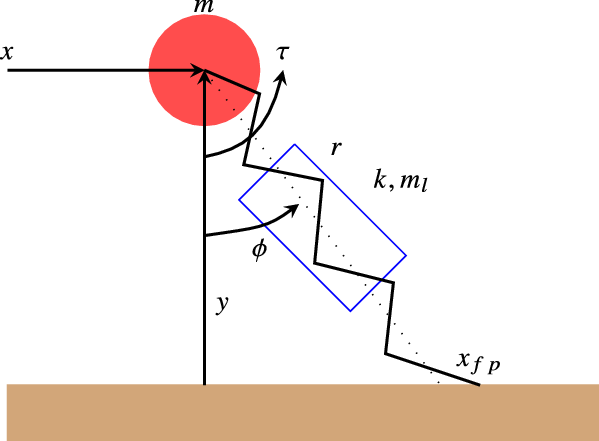
The schematic diagram of SLHR.

The main contributions of the article are as follows:
-
Obtained Euler–Lagrange (EL) dynamics of the SLHR model given in Fig. 1
-
Estimation of apex height of SLHR
-
Estimation of vertical velocity of SLHR
The rest of the article is organized as follows: In Section 2, we obtain the robot dynamics using EL equations. Section 3 discusses mathematical expressions for the evaluation of apex height. The observer design for apex height and vertical velocity of SLHR has been elaborated. Section 5 is about a detailed explanation and discussion of the simulation performed in this article for observer design. We conclude our work and present the future scope and limitations of the work done in this article in Section 6.
2. Hopping robot dynamics
This section discusses the dynamic model design of SLHR using the EL equation. For balancing the robot, an arm is pivoted to the central pivot and coerces the pitching motion of the robot body. For many-legged machines, having dynamic characteristics be captured by the robot and do not affect by the constraint of the pitching motion. The degree of freedom (DOF) of the robot leg is two. So because of one, the robot is rotating about the axis which is parallel to the support arm, that DOF is called a revolute DOF and because of another one, the robot leg compresses or extends, that DOF is called a prismatic DOF [Reference Lynch and Park21]. The revolute DOF is actuated or active while the prismatic DOF is passive and contains a linear passive spring.
Because we want to study the robot’s planar motion that is why we use 2D robot model dynamics which is shown in Fig. 1. For the same model, we have obtained the following [Reference Cherouvim and Papadopoulos22, Reference Yu, Fu and Chen23].
m = Mass due to the robot mass and partly because of the arm of support
L = Leg’s length when it is not compressed
k = Stiffness of the linear spring
 $\tau$
= Torque applied by the hip actuator
r = Length of the leg at any time
b = Co-efficient of viscous friction with which energy loss in the leg prismatic DOF is modeled
Effects due to the impacts with the ground are included in the lumped parameters k, b.
For the phase stance, by the Lagrangian approach [Reference Morin24], we find the dynamics with Cartesian coordinate x and y. The body inertial force and spring force are much more than the force which is by the leg mass. So the effect of leg mass is neglected. Because of complexity, we find the dynamics in the function of r and
 $\phi$
. We also neglect the effect of gravity because the leg is already of small length and during stance, it will be further reduced. Now we apply the Lagrangian approach, consider Fig. 1.
The total kinetic energy (T)
 \begin{equation}\nonumber T={{\frac{1}{2}}m\dot{x}^2}+{{\frac{1}{2}}m\dot{y}^2}\end{equation}
And the total potential energy is
 \begin{equation*}V={{\frac{1}{2}}k{x}^{2}}+{{\frac{1}{2}}k{y}^{2}}\end{equation*}
So the Lagrangian (
 $\mathcal{L}_a$
) is
 \begin{equation*}{\mathcal{L}}_{a}={T-V}\end{equation*}
 \begin{equation}\mathcal{L}_a=\left({{\frac{1}{2}}m\dot{x}^{2}}+{{\frac{1}{2}}m\dot{y}^{2}}\right)-\left({{\frac{1}{2}}k{x}^{2}}+{{\frac{1}{2}}k{y}^{2}}\right)\nonumber\end{equation}
The Lagrangian equation for x coordinate of form is
 \begin{equation}\frac{d}{dt}\left(\frac{\mathcal{L}_a}{\dot{x}}\right)-\frac{\mathcal{L}_a}{x}=F_x\nonumber\end{equation}
The Lagrangian equation for y coordinate of form is
 \begin{equation}\frac{d}{dt}\left(\frac{\mathcal{L}_a}{\dot{y}}\right)-\frac{\mathcal{L}_a}{y}=F_y\nonumber\end{equation}
where
 $F_x$
and
 $F_y$
are the non-conservative components of the force by viscous friction and actuator torque. The Lagrangian equation for x and y direction is
 \begin{equation}m\ddot{x}+k(L-r)sin(\phi) -b\dot{r}\;sin(\phi)=-\frac{\tau}{r}cos(\phi)\end{equation}
 \begin{equation}m\ddot{y}-k(L-r)cos(\phi) +b\dot{r}\;cos(\phi)=-\frac{\tau}{r}sin(\phi)\end{equation}
For the flight phase, only the gravitational force is acting so the speed in the horizontal direction is constant and because of gravitation, a constant acceleration is acted in the vertical direction.
 \begin{equation}\ddot{x}=0\end{equation}
 \begin{equation}\ddot{y}=-g\end{equation}
3. The apex height
As per the [Reference Cherouvim and Papadopoulos17] the apex height is the height of the robot at the topmost point of its body when it is in any of the two phase (namely, stance and flight). Hence, the correct measure of the apex height is very important when it comes to overall balanced performance of the hopping robot. If the terrain/surface on which the robot is moving is uneven, then also it should be able to figure out the necessary distance from the surface to stay in stable operating mode. The fixed distance from the ground to the top point of the robot during its operation is the apex height.
Now we will compute the rate of changes
 $\dot{\phi}$
and
 $\dot{r}$
which is used for the determination of vertical dynamics. From Fig. 1 of the stance phase, we get
 \begin{equation} x-x_{fp}=-r\;sin{\phi}\end{equation}
 \begin{equation} y=rcos{\phi}\end{equation}
where
 $x_{fp}$
is the position during stance of the foot on the ground.
By differentiating Eqs. (5) and (6), we get
 $\dot{x}$
and
 $\dot{y}$
of the robot body.
 \begin{equation} \dot{x}=-\dot{r} sin{\phi}-r\dot{\phi}cos{\phi}\end{equation}
 \begin{equation} \dot{y}=\dot{r}cos{\phi}-r\dot{\phi}sin{\phi}\end{equation}
For small leg angle, Eq. (8) becomes
 \begin{equation} \dot{y}=\dot{r}cos{\phi}\end{equation}
We initiate from Eq. (2) of dynamics, which is about the robot’s vertical motion. Substituting the leg’s length r and the leg’s angle
 $\phi$
as expressions of the coordinates x, y of the robot body, and by the use of small-angle approximations of trigonometry, the vertical dynamics becomes:
 \begin{equation}m\ddot{y}+b\dot{y}+ky=kLcos{\phi}\end{equation}
4. State observer design
Practically for feedback some of the state variables are not available. This is why the estimation of the unavailable state variables becomes important. For the unmeasurable state variable estimation is done. The process of estimation is called observation.
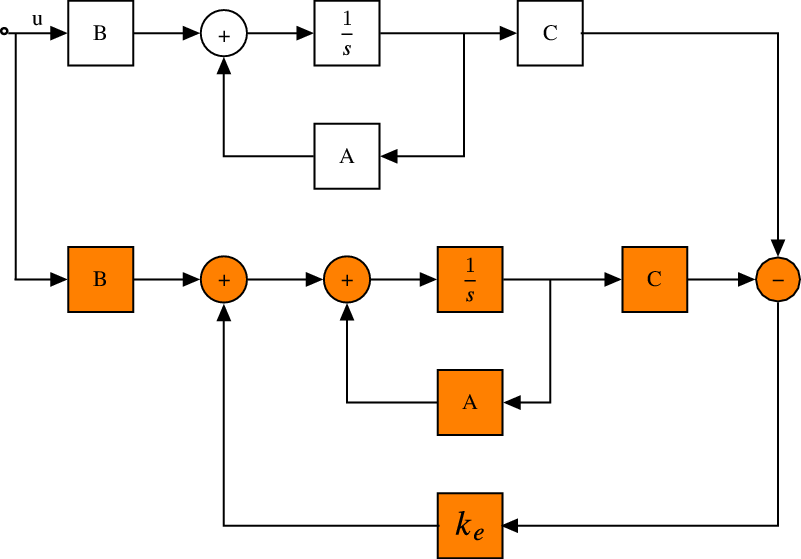
State Observer: State variables are observed or estimated by a device called a state observer or simply an observer [Reference Chen25, Reference Ogata26]. The block diagram of state observer is given in Fig. 2.
-
Based upon the output and control variables measurement, the observation of state variables is done by state observer
-
Only after satisfaction and fulfillment of the observability condition design of state observer is possible
The vertical dynamics is
 \begin{equation}m\ddot{y}+b \dot{y}+k y = k L\cos{\phi}\nonumber\end{equation}
Now,
 \begin{equation} \ddot{y} =-\frac{b}{m}\dot{y}-\frac{k}{m}y+\frac{k L}{m}\cos{\phi} \end{equation}
Block diagram of state observer (uncolored portion is the actual system and colored portion is the estimated system).

Let
 \begin{align*} x_1 & = y\\ \dot{x_1} & = x_{2} = \dot{y}\\ \dot{x_2} &= \ddot{y} \end{align*}
So,
 \begin{equation} \dot{x_1}=x_2 \end{equation}
and
 \begin{equation} \dot{x_2}=-\frac{b}{m}x_2- \frac{k}{m}x_1+\frac{k L}{m}\cos{\phi} \nonumber \end{equation}
Let
 \begin{equation*}u=\cos{\phi}\end{equation*}
Therefore,
 \begin{equation} \dot{x_2}=-\frac{b}{m}x_2- \frac{k}{m}x_1+\frac{k L}{m}u \end{equation}
Using Eqs. (12) and (13), the state equation
 $\dot{x}=Ax+Bu $
is
 \begin{equation} \begin{bmatrix}\dot{x_1} \\ \dot{x_2} \end{bmatrix}= \begin{bmatrix} 0\;\;\;\; & 1 \\-\frac{k}{m}\;\;\;\; & -\frac{b}{m} \end{bmatrix} \begin{bmatrix} x_1\\x_2 \end{bmatrix} +\begin{bmatrix} 0 \\ \frac{k L}{m} \end{bmatrix} u\end{equation}
where
 $x_1,x_2 $
are the state vector, and u is the input vector.
Hence,
 \begin{align*}A=\begin{bmatrix} 0\;\;\;\; & 1 \\-\frac{k}{m}\;\;\;\; & -\frac{b}{m} \end{bmatrix} \quad and \quad B=\begin{bmatrix} 0 \\ \frac{k L}{m} \end{bmatrix} \end{align*}
Since
 \begin{equation*}y=x_1\end{equation*}
Therefore, the output equation is
 \begin{equation}y=\begin{bmatrix} 1\;\;\;\; & 0 \end{bmatrix} \begin{bmatrix} x_1\\x_2 \end{bmatrix}\end{equation}
Hence,
 \begin{align*} C=\begin{bmatrix} 1\;\;\;\; & 0 \end{bmatrix} \quad and \quad D=0\end{align*}
Let us first check the observability condition by computing the observability matrix.
 \begin{equation}\mathcal{O}=[C^*\;:\;A^*C^*]=\begin{bmatrix} 0\;\;\;\; & 1\\1\;\;\;\; & 0\end{bmatrix}\end{equation}
It can be observed that the observability matrix
 $\mathcal{O}$
has a rank 2. Since the system is completely observable therefore it is possible to determine the required observer gain matrix.
Let us assume
 \begin{align*}u=-k\tilde{x}\end{align*}
For the system to be stable, we assume the eigenvalues of the observer matrix are
 \begin{align*} \mu_{1} &=-5 \\ \mu_{2} & = -5 \end{align*}
Hence, the characteristics equation for assumed eigenvalues is
 \begin{equation} s^2+10s+25=0\end{equation}
The model and the values of L, m and b are inspired by the article of Cherouvim [Reference Cherouvim and Papadopoulos17]. Here the variation in the spring constant for three different values like
 $k_1,k_2$
, and
 $k_3$
has been done. The changes in the apex height and vertical velocity are presented and shown in the section of simulation results. The models and analysis are as follows:
 \begin{align*}L=0.275\;{\rm m}, m = 4\;{\rm kg},\; and\quad b=6\Big(\frac{Ns}{m} \Big)\end{align*}
For
 ${{k}}_{{1}}\;\textbf{=}\;\textbf{4000}$
 $\Big(\frac{N}{m}\Big)$
So
 \begin{align*}\frac{k_1}{m}=1000,\frac{b}{m}=1.5\quad and\quad \frac{k_1 L}{m}=275\end{align*}
Therefore for the numeric value the state equation is
 \begin{align*} \begin{bmatrix}\dot{x_1} \\ \dot{x_2} \end{bmatrix}&= \begin{bmatrix} 0\;\;\;\; & 1 \\-1000\;\;\;\; & -1.5 \end{bmatrix} \begin{bmatrix} x_1\\x_2 \end{bmatrix} +\begin{bmatrix} 0 \\ 275 \end{bmatrix} u \end{align*}
Now we write
 $\dot{x_1}$
and
 $\dot{x_2}$
separately
 \begin{align} \dot{x_1}=x_2 \end{align}
 \begin{align} \dot{x_2} = -1000{x_1}-1.5{x_2}+275{u} \end{align}
For observer design of given system:
 \begin{align*}A_1=\begin{bmatrix} 0\;\;\;\; & 1 \\-1000\;\;\;\; & -1.5 \end{bmatrix},B_1=\begin{bmatrix} 0 \\ 275 \end{bmatrix} \text{and C be the same.}\end{align*}
The state observer design is reduced to the evaluation of appropriate observer gain matrix
 $k_e$
. The observer error equation is
 \begin{equation*} \dot{e}=(A_1-K_eC)e\end{equation*}
The characteristics equation of the observer becomes
 \begin{equation*}|sI-A_1+K_eC|=0\end{equation*}
where
 \begin{equation*}k_e=\begin{bmatrix} K_{e1} \\ K_{e2}\end{bmatrix}\end{equation*}
Then the characteristics equation becomes
 \begin{equation*}\Bigg| \begin{bmatrix} s\;\;\;\; & 0\\0\;\;\;\; & s\end{bmatrix}-\begin{bmatrix} 0\;\;\;\; & 1 \\-1000\;\;\;\; & -1.5 \end{bmatrix}+\begin{bmatrix} K_{e1} \\ K_{e2}\end{bmatrix}\begin{bmatrix} 1\;\;\;\; & 0 \end{bmatrix}\Bigg |=0\\\end{equation*}
 \begin{equation} s^2+(K_{e1}+1.5)s+1.5K_{e1}+K_{e2}+1000=0 \end{equation}
By comparing Eqs. (20) and (17), we get the value of
 $k_e$
.
 \begin{align*} K_{e1} &=8.5\\ K_{e2} &=-987.75\end{align*}
So the equation of full order state observer is
 \begin{equation*} \dot{\tilde{x}}=(A_1-K_e{C})\tilde{x}+B_1u+K_e{y}\end{equation*}
By putting
 $y=C{x}$
, we get
 \begin{equation} \dot{\tilde{x}}=(A_1-K_e{C})\tilde{x}+B_1u+K_e{C{x}}\end{equation}
 \begin{align*} \begin{bmatrix} \dot{\tilde{x}}_{1} \\ \dot{\tilde{x}}_{2} \end{bmatrix}=\Bigg( \begin{bmatrix} 0\;\;\;\; & 1 \\-1000\;\;\;\; & -1.5 \end{bmatrix}-\begin{bmatrix} 8.5 \\ -987.75\end{bmatrix}\begin{bmatrix} 1\;\;\;\; & 0 \end{bmatrix}\Bigg )\begin{bmatrix} \tilde{x_1} \\ \tilde{x_2} \end{bmatrix}+\begin{bmatrix} 0 \\ 275 \end{bmatrix}u+\Bigg [ \begin{bmatrix} 8.5 \\ -987.75\end{bmatrix}\begin{bmatrix} 1\;\;\;\; & 0 \end{bmatrix}\Bigg ]\begin{bmatrix} {x_1} \\ {x_2} \end{bmatrix}\end{align*}
Therefore, the
 $\dot{\tilde{x}}_{1}$
and
 $\dot{\tilde{x}}_{2}$
are
 \begin{align} \dot{\tilde{x}}_{1} =-8.5\tilde{x_1}+\tilde{x_2}+8.5x_1 \end{align}
 \begin{align} \dot{\tilde{x}}_{2} =-12.25\tilde{x_1}-1.5\tilde{x_2}-987.75x_1+275{u} \end{align}
For
 $k_{2}\,\textbf{=}\,\textbf{4800}$
 $\Big(\frac{N}{m}\Big)$
So
 \begin{align*}\frac{k_2}{m}=1200,\frac{b}{m}=1.5\quad and\quad \frac{k_2 L}{m}=330\end{align*}
Therefore for the numeric value the state equation is
 \begin{align*} \begin{bmatrix}\dot{x_1} \\ \dot{x_2} \end{bmatrix}&= \begin{bmatrix} 0\;\;\;\; & 1 \\-1200\;\;\;\; & -1.5 \end{bmatrix} \begin{bmatrix} x_1\\x_2 \end{bmatrix} +\begin{bmatrix} 0 \\ 330 \end{bmatrix} u \end{align*}
Now we write
 $\dot{x_1}$
and
 $\dot{x_2}$
separately
 \begin{align} \dot{x_1} = x_2 \end{align}
 \begin{align} \dot{x_2} = -1200{x_1}-1.5{x_2}+330{u} \end{align}
For observer design of given system:
 \begin{align*}A_2=\begin{bmatrix} 0\;\;\;\; & 1 \\-1200\;\;\;\; & -1.5 \end{bmatrix},B_2=\begin{bmatrix} 0 \\ 330 \end{bmatrix} \text{and C be the same.}\end{align*}
The observer error equation is
 \begin{equation*} \dot{e}=(A_2-K_eC)e\end{equation*}
The characteristics equation of the observer becomes
 \begin{equation*}|sI-A_2+K_eC|=0\end{equation*}
where
 \begin{equation*}k_e=\begin{bmatrix} K_{e1} \\ K_{e2}\end{bmatrix}\end{equation*}
Then the characteristics equation becomes
 \begin{equation*}\Bigg| \begin{bmatrix} s\;\;\;\; & 0\\0\;\;\;\; & s\end{bmatrix}-\begin{bmatrix} 0\;\;\;\; & 1 \\-1200\;\;\;\; & -1.5 \end{bmatrix}+\begin{bmatrix} K_{e1} \\ K_{e2}\end{bmatrix}\begin{bmatrix} 1\;\;\;\; & 0 \end{bmatrix}\Bigg |=0\\\end{equation*}
 \begin{equation} s^2+(K_{e1}+1.5)s+1.5K_{e1}+K_{e2}+1200=0 \end{equation}
By comparing Eqs. (26) and (17), we get the value of
 $k_e$
.
 \begin{align*} K_{e1} &=8.5\\ K_{e2} &=-1187.75\end{align*}
So the equation of full order state observer is
 \begin{equation*} \dot{\tilde{x}}=(A_2-K_e{C})\tilde{x}+B_2u+K_e{y} \end{equation*}
By putting
 $y=C{x}$
, we get
 \begin{equation} \dot{\tilde{x}}=(A_2-K_e{C})\tilde{x}+B_2u+K_e{C{x}}\end{equation}
 \begin{align*} \begin{bmatrix} \dot{\tilde{x}}_{1} \\ \dot{\tilde{x}}_{2} \end{bmatrix}=\Bigg( \begin{bmatrix} 0\;\;\;\; & 1 \\-1200\;\;\;\; & -1.5 \end{bmatrix}-\begin{bmatrix} 8.5 \\ -1187.75\end{bmatrix}\begin{bmatrix} 1\;\;\;\; & 0 \end{bmatrix}\Bigg )\begin{bmatrix} \tilde{x_1} \\ \tilde{x_2} \end{bmatrix}+\begin{bmatrix} 0 \\ 330 \end{bmatrix}u+\Bigg [ \begin{bmatrix} 8.5 \\ -1187.75 \end{bmatrix}\begin{bmatrix} 1\;\;\;\; & 0 \end{bmatrix}\Bigg ]\begin{bmatrix} {x_1} \\ {x_2} \end{bmatrix}\end{align*}
Therefore, the
 $\dot{\tilde{x}}_{1}$
and
 $\dot{\tilde{x}}_{2}$
are
 \begin{align} \dot{\tilde{x}}_{1} =-8.5\tilde{x_1}+\tilde{x_2}+8.5x_{1} \end{align}
 \begin{align} \dot{\tilde{x}}_{2} =-12.25\tilde{x_1}-1.5\tilde{x_2}-1187.75x_1+330{u} \end{align}
For
 $k_3\;=\;5600$
 $\Big(\frac{N}{m}\Big)$
So
 \begin{align*}\frac{k_3}{m}=1400,\frac{b}{m}=1.5\quad and\quad \frac{k_3 L}{m}=385\end{align*}
Therefore for the numeric value the state equation is
 \begin{align*} \begin{bmatrix}\dot{x_1} \\ \dot{x_2} \end{bmatrix}&= \begin{bmatrix} 0\;\;\;\; & 1 \\-1400\;\;\;\; & -1.5 \end{bmatrix} \begin{bmatrix} x_1\\x_2 \end{bmatrix} +\begin{bmatrix} 0 \\ 385 \end{bmatrix} u \end{align*}
Now we write
 $\dot{x_1}$
and
 $\dot{x_2}$
separately
 \begin{align} \dot{x_1}=x_2 \end{align}
 \begin{align} \dot{x_2}=-1400{x_1}-1.5{x_2}+385{u} \end{align}
For observer design of given system:
 \begin{align*}A_3=\begin{bmatrix} 0\;\;\;\; & 1 \\-1400\;\;\;\; & -1.5 \end{bmatrix},B_3=\begin{bmatrix} 0 \\ 385 \end{bmatrix} \text{and C be the same.}\end{align*}
The observer error equation is
 \begin{equation*} \dot{e}=(A_3-K_eC)e\end{equation*}
The characteristics equation of the observer becomes
 \begin{equation*}|sI-A_3+K_eC|=0\end{equation*}
where
 \begin{equation*}k_e=\begin{bmatrix} K_{e1} \\ K_{e2}\end{bmatrix}\end{equation*}
Then the characteristics equation becomes
 \begin{equation*}\Bigg| \begin{bmatrix} s\;\;\;\; & 0\\0\;\;\;\; & s\end{bmatrix}-\begin{bmatrix} 0\;\;\;\; & 1 \\-1400\;\;\;\; & -1.5 \end{bmatrix}+\begin{bmatrix} K_{e1} \\ K_{e2}\end{bmatrix}\begin{bmatrix} 1\;\;\;\; & 0 \end{bmatrix}\Bigg |=0\\\end{equation*}
 \begin{equation} s^2+(K_{e1}+1.5)s+1.5K_{e1}+K_{e2}+1400=0 \end{equation}
By comparing Eqs. (32) and (17), we get the value of
 $k_e$
.
 \begin{align*} K_{e1} &=8.5\\ K_{e2} &=-1387.75\end{align*}
So the equation of full order state observer is
 \begin{equation*} \dot{\tilde{x}}=(A_3-K_e{C})\tilde{x}+B_3u+K_e{y} \end{equation*}
By putting
 $y=C{x}$
, we get
 \begin{equation} \dot{\tilde{x}}=(A_3-K_e{C})\tilde{x}+B_3u+K_e{C{x}}\end{equation}
 \begin{align*} \begin{bmatrix} \dot{\tilde{x}}_{1} \\ \dot{\tilde{x}}_{2} \end{bmatrix}=\Bigg( \begin{bmatrix} 0\;\;\;\; & 1 \\-1400\;\;\;\; & -1.5 \end{bmatrix}-\begin{bmatrix} 8.5 \\ -1387.75\end{bmatrix}\begin{bmatrix} 1\;\;\;\; & 0 \end{bmatrix}\Bigg )\begin{bmatrix} \tilde{x}_{1} \\ \tilde{x}_{2} \end{bmatrix}+\begin{bmatrix} 0 \\ 385 \end{bmatrix}u+\Bigg [ \begin{bmatrix} 8.5 \\ -1387.75\end{bmatrix}\begin{bmatrix} 1\;\;\;\; & 0 \end{bmatrix}\Bigg ]\begin{bmatrix} {x_1} \\ {x_2} \end{bmatrix}\end{align*}
Therefore, the
 $\dot{\tilde{x}}_{1}$
and
 $\dot{\tilde{x}}_{2}$
are
 \begin{align} \dot{\tilde{x}}_{1} =-8.5\tilde{x_1}+\tilde{x_2}+8.5x_{1} \end{align}
 \begin{align} \dot{\tilde{x}}_{2} =-12.25\tilde{x_1}-1.5\tilde{x_2}-1387.75x_1+385{u} \end{align}
This is the required estimated dynamics with
 $k_3=5600$
. In the next section, the simulation results for all the above models have been presented.
5. Simulation results and discussion
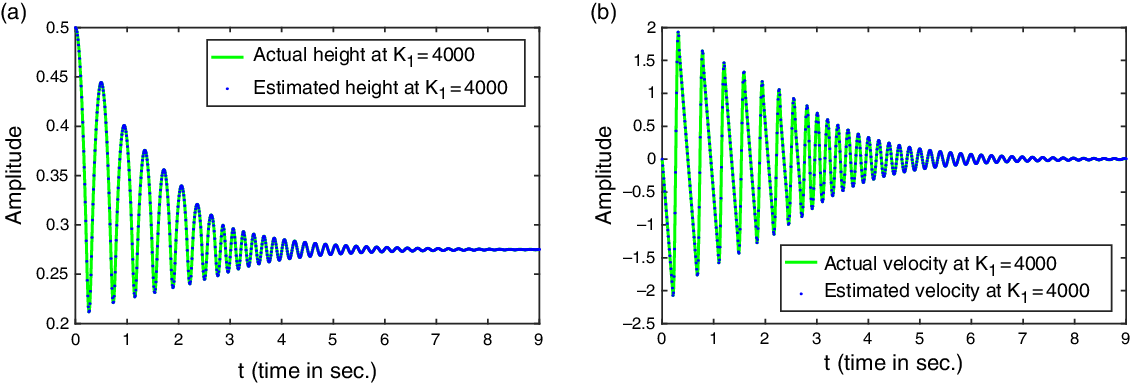
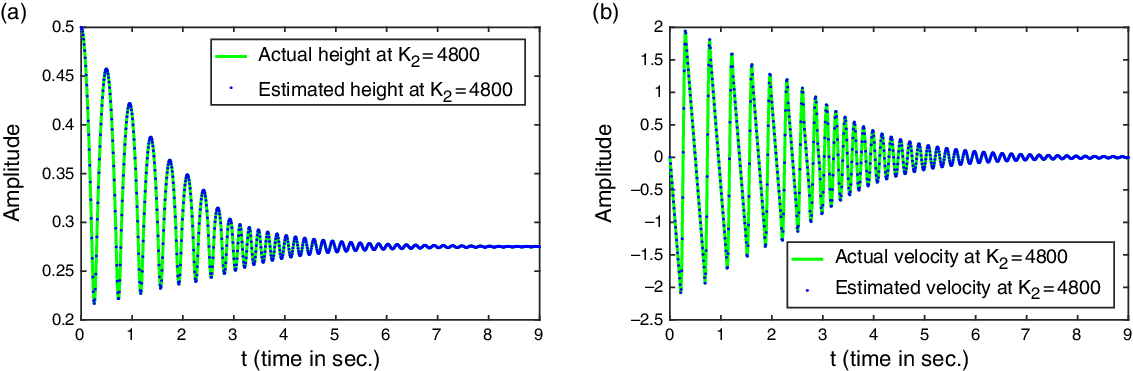
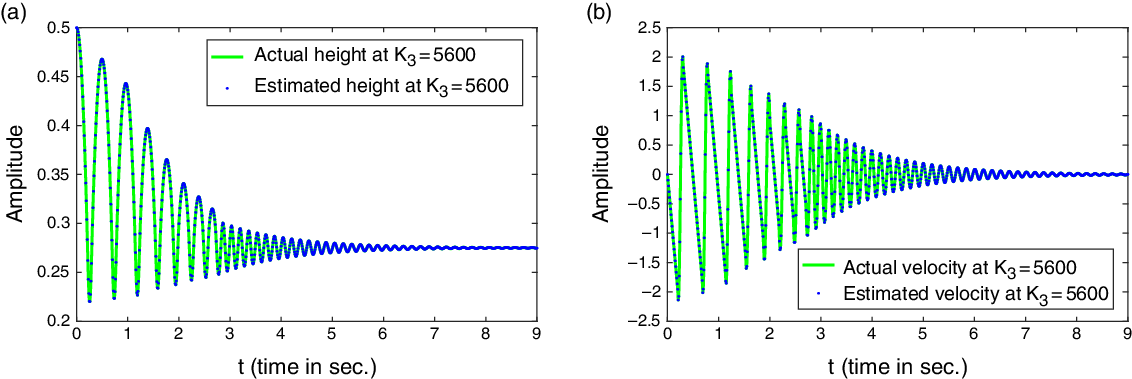
In this section, we discuss the simulation of observer design of the apex height and vertical velocity of the SLHR. For the same, we use the equation of vertical dynamics during the stance phase of SLHR using Matlab. After simulation of the vertical height and the vertical velocity of the actual system, we can compare it with the estimated system. Here we have obtained six-state trajectories which are further segregated into three parts for three different spring constants. Each part is having vertical velocity and an apex height of the actual and estimated system. As it is observed in Figs. 3(a), 4(a), and 5(a), the actual height is the same as the estimated one; this implies that our estimation is correct. It can be seen in Figs. 3(a), 4(a), and 5(a) that the robot is launched from the initial height
 $0.5$
m. It performs hopping and a few seconds later the robot acquires its original height of
 $0.275$
m because of damping. The robot apex height during hopping is large for large spring constant which we can be observed in Figs. 3(a), 4(a), and 5(a).
Estimated and actual height and velocity of SLHR for spring constant
 $k_1=4000$
. (a) Estimated and actual height and (b) estimated and actual velocity.

Estimated and actual height and velocity of SLHR for spring constant 4800. (a) Estimated and actual height and (b) estimated and actual velocity.

Estimated and actual height and velocity of SLHR for spring constant 5600. (a) Estimated and actual height and (b) estimated and actual velocity.

The vertical velocity of SLHR is following the actual system’s vertical velocity; this also implies that our estimation is correct and after 7–8 s, the vertical velocity approaches zero that means the robot is attaining rest position due to damping. Velocity is positive and negative because of the direction of movement of the robot either upward or downward. For the value of spring constant as 4000 the velocity is
 $1.99$
m/s, which can be noticed in the first spike of the oscillatory trajectory shown in Fig. 3(b). Whereas vertical velocity for spring constant 4800 and 4800 stays close to 2 m/s in the first spike and then decreases with time shown in Figs. 4(b) and 5(b). For vertical velocity, the trajectory is almost the same for all the three spring constants. There are a few limitations of the present contribution is that the span of choices of spring constant values is limited and due to physical constraints of the observer design, it is difficult for the case of flight phase to make an optimal choice of spring constant values.
6. Conclusion and future scope
By applying the Lagrangian approach, the vertical dynamics of SLHR is obtained and its estimation analysis has been done by designing observer. It has been noticed that the effect of spring constant on apex height and vertical velocity is evident. On changing the spring constant, apex height variation is more. Vertical velocity is also increasing if spring constant is increased at the first spike of the velocity trajectory. The estimation of these variables helps design a better SLHR. These studies can play a good role in the design and analysis of similar devices which can become the new convenient modes of transportation for various application. The future work can be the observer design for the forward velocity of SLHR and controller design for the apex height and forward velocity. Also, the same analysis can be extended to multiple-legged robots.