Introduction and Background
The influence of normative expectations and preferences about what constitutes the ‘ideal’ family, both in terms of size and composition, on women's reproductive behaviour has long been of interest to demographers and other social scientists. Research in a number of countries has found that these preferences play an important role in shaping reproductive desires and actions (Muhuri & Preston, Reference Muhuri and Preston1991; Park & Cho, Reference Park and Cho1995; Larsen et al., Reference Larsen, Chung and Das Gupta1998; Clark, Reference Clark2000; Yount et al., Reference Yount, Langston and Hill2000; Retherford & Roy, Reference Retherford and Roy2003; Banister, Reference Banister2004; Jayaraman et al., Reference Jayaraman, Mishra and Arnold2009). They play a particularly important role in settings such as India, where notions of the ‘ideal family’ are marked by a strong and persistent preference for sons (Pande, Reference Pande2003; Retherford & Roy, Reference Retherford and Roy2003; Pande & Astone, Reference Pande and Astone2007).
Researchers in India and elsewhere have also noted that fertility declines over the past decade or so have intensified pressure on women to act to achieve their desired family sex composition within the confines of a smaller family size (Das Gupta & Bhat, Reference Das Gupta and Bhat1997; Ganatra, Reference Ganatra2008; Das Gupta et al., Reference Das Gupta, Chung and Shuzuo2009; Guilmoto, Reference Guilmoto2009). Several studies in India show how sex composition preferences influence reproductive outcomes in this scenario. Retherford & Roy (Reference Retherford and Roy2003) find that sex ratios at birth differ substantially by birth order and the sex composition of children already born, particularly at higher parities. Jha et al. (Reference Jha, Kumar, Vasa, Dhingra, Thiruchelvam and Moineddin2006) find that sex ratios at birth favour girls in families with only sons, and boys in families with only daughters, though the balance is tipped in favour of boys in families with only daughters.
In addition to the overall influence of sex composition on reproductive outcomes, these findings also suggest that while sex preference is generally tilted towards sons, it may co-exist with a desire for daughters under specific circumstances. However, while families may want one daughter, very few want more than that and most definitely want at least one or two sons (International Institute for Population Sciences & ORC Macro, 2000; Pande & Astone, Reference Pande and Astone2007).
Retherford & Roy (Reference Retherford and Roy2003) and others attribute sex composition differentials to sex-selective abortion. Fewer studies examine the extent to which women take other reproductive actions, such as using temporary or permanent contraception, to realize their ideal family composition. Some studies also find that family sex composition preferences exert only a modest effect on aggregate contraceptive use rates (Yount et al., Reference Yount, Langston and Hill2000; Bairagi, Reference Bairagi2001). Other research finds a significant effect, particularly in terms of differential use of contraception by women in families with and without sons (Leone et al., Reference Leone, Matthews and Zuanna2003; Jayaraman et al., Reference Jayaraman, Mishra and Arnold2009) or at certain combinations of sons and daughters (Hussain et al., Reference Hussain, Fikree and Berendes2000; Khan & Khanum, Reference Khan and Khanum2000). In northern India, recent research by Jayaraman et al. (Reference Jayaraman, Mishra and Arnold2009) suggests that both desire for additional children and contraceptive use vary according to the sex composition of children. While studies on family composition and sterilization behaviour are even more limited, findings are more consistent. Studies in Nepal, Pakistan, Malaysia and India find women are more likely to stop childbearing when they have a son than otherwise (Pong, Reference Pong1994; Hussain et al., Reference Hussain, Fikree and Berendes2000; Leone et al., Reference Leone, Matthews and Zuanna2003; Jayaraman et al., Reference Jayaraman, Mishra and Arnold2009). While these studies provide important insights into the ways in which compositional and size preferences influence reproductive behaviour, very few provide a comprehensive assessment of the full range of means of reproductive control, ranging from sex-selective abortion to contraception (Junhong, Reference Junhong2001; Arnold et al., Reference Arnold, Kishor and Roy2002; Banister, Reference Banister2004).
The present study addresses this gap by analysing the full range of reproductive behaviours – temporary contraception, sterilization and abortion – that women may adopt to realize their sex-and-size preferences. Furthermore, this article examines both fertility desires and reproductive behaviours at different compositions of children, and does so in the same sample of women. To the knowledge of the authors, this is the first study to examine the influence of sex composition on every reproductive outcome (fertility desires, temporary contraception, abortion and sterilization) using a single sample. This allows a more direct comparison of the role of sex composition than is possible with separate analyses of outcomes using different samples and enables us to examine a number of questions related to the varying actions women may take in contexts of strong sex preferences and significant structural and social constraints to the realization of those preferences. Firstly, which combinations of sons and daughters prompt women to action? Secondly, to what extent do women adjust fertility desires, use temporary contraception, abortion or sterilization to achieve a desired composition? Finally, are women more likely to adopt one particular action rather than another at particular combinations of sons and daughters? The study is also able to draw on life history data that includes information on each pregnancy experienced by a woman while addressing these questions, allowing for a more rigorous examination of causal relationships than is possible in most cross-sectional studies because independent variables are ordered in proper temporal sequence such that they precede the outcomes.
The setting for this study is Madhya Pradesh, a high-poverty state in north–central India. Madhya Pradesh has a well documented history of son preference (Retherford & Roy, Reference Retherford and Roy2003) and increasing male-to-female sex ratios that have become more pronounced over time, with the ratio of males to females born in the state increasing from 1.08 for the 1981–1990 period to 1.10 for the 1996–1998 period. While the state's fertility rates have fallen in recent decades, the declines lag behind the nation as a whole (International Institute for Population Sciences & ORC Macro, 2001). The predominant method for fertility control in Madhya Pradesh is female sterilization, with 44% of women aged 15–49 reporting being sterilized, while only 7.3% report using a modern temporary method (International Institute for Population Sciences & Macro International, 2007).
As is the case for India as a whole, women's reproductive behaviour in Madhya Pradesh is complicated by significant structural and social barriers that limit their ability to achieve their reproductive goals. First and foremost, use of temporary contraceptive methods has been limited by a longstanding policy focus on female sterilization to the exclusion of temporary methods, at least until recently, combined with a lack of adequate family planning services, especially in rural areas (Khan et al., Reference Khan, Patel, Gupta, Koening and Khan1999). This is particularly true for safe abortion services, which while legal since 1972 in India for a wide range of health, social and economic circumstances, remains out of reach for many Indian women, including in Madhya Pradesh (Ganatra, Reference Ganatra, Ramasubban and Jejeebhoy2000, Reference Ganatra2008; Malhotra et al., Reference Malhotra, Nyblade, Parasuraman, MacQuarrie, Kashyap and Walia2003; Hirve, Reference Hirve2004; Patel et al., Reference Patel, Bennett, Halpern, Johnston and Suchindran2009; Singh et al., Reference Singh, Remez, Ram, Moore and Audam2009).
The poor availability of reproductive services is compounded by patriarchal gender and social norms that continue to restrict women's reproductive options and in many cases override women's own reproductive preferences (Das Gupta, Reference Das Gupta1999; Barua & Kurz, Reference Barua and Kurz2001; Barua et al., Reference Barua, Pande and Macquarrie2004; Sheth, Reference Sheth2006). These norms also limit women's ability – especially when young and newly married – to access the services they need to realize reproductive preferences (Jejeebhoy, Reference Jejeebhoy1998; Mathur et al., Reference Mathur, Greene and Malhotra2003; Jejeebhoy & Halli, Reference Jejeebhoy, Halli and Lloyd2005; MacQuarrie & Edmeades, Reference MacQuarrie and Edmeades2011). Other family members such as husbands or in-laws may decide whether, when and what types of reproductive health care married women can seek, including contraception or abortion (Sharma & Sharma, Reference Sharma and Sharma1993; Santow, Reference Santow1995; Barnett, Reference Barnett1998; Singh et al., Reference Singh, Bloom and Tsui1998; Barua & Kurz, Reference Barua and Kurz2001; Chowdhury, Reference Chowdhury, Bott and Jejeebhoy2003; Edmeades & MacQuarrie, Reference Edmeades and MacQuarrie2009).
Methods
Data
Data for this study come from a 2002 statewide representative survey conducted in Madhya Pradesh among 2444 married women between the ages of 15 and 39 years with at least one child. Respondents were selected through a stratified cluster sampling design through probability proportional to size sampling, with oversampling of urban areas to ensure sufficient cases for the analysis of rural–urban differences. Data are adjusted to account for the sampling design and are representative of the eligible population in the state.
Data were collected using a mixed-methods, ‘narrative’ survey to retrospectively compile respondents' complete reproductive life histories (for a full description of the methodology, see Edmeades et al., Reference Edmeades, Nyblade, Malhotra, MacQuarrie, Parasuraman and Walia2010). The survey was designed to elicit contextual detail more commonly found in qualitative studies and to improve recall and reporting of typically undercounted reproductive events, such as abortion. The latter was achieved by ordering pre-coded items in a natural story-telling sequence, anchored by key events and with multiple memory prompts and data checks, yielding abortion rates approximately five times higher than among comparable samples from the NFHS-2, suggesting that under-reporting is significantly reduced (Edmeades et al., Reference Edmeades, Nyblade, Malhotra, MacQuarrie, Parasuraman and Walia2010).
In addition to fixed attributes and characteristics at the time of the survey, such as age at marriage and caste, detailed data were collected retrospectively on each of the pregnancies women had experienced since marriage. Data are structured as individual pregnancy intervals; that is, the period of time between the conclusion of one pregnancy (or marriage, for the first interval) and the conclusion of the next pregnancy. The result is a dataset with information on 9127 pregnancy intervals with a known outcome (i.e. miscarriage, abortion, birth or sterilization). The dataset contains interval-specific information on the outcomes of interest – fertility desires, contraceptive use and abortion attempts – as well as on work experience, living arrangements, experience with domestic violence, women's autonomy and a range of household characteristics. As a result, this study explores in detail a wider range of women's reproductive behaviours, including abortion, and their determinants than has been possible in other studies on this topic.
Since these data capture all pregnancy intervals women have experienced, pregnancy intervals are used as the unit of analysis and include information from prior moments in the analysis. This ensures the temporal sequencing of variables such that predictor variables always precede the outcome variable, allowing causal inferences to be drawn with greater confidence than is typical in cross-sectional studies. In addition, the use of pregnancy intervals permits the construction of more nuanced measures of the social and demographic environment specific to the point in time within which reproductive actions take place rather than relying on post hoc measures taken at a later time.
Analysis
The full range of potential reproductive behaviours in individual pregnancy intervals are modelled, given women's family size and sex composition at the start of that interval. The following hypotheses are tested. First, that composition preferences will reflect a desire for children of both sexes, while emphasizing boys; second, that existing sex composition will influence both fertility desires and all three behaviours: temporary contraception, abortion and sterilization.
The analysis begins by estimating the likelihood of a woman reporting that she wanted a future pregnancy at the onset of an interval (Model 1). Though not as desirable as a true prospective measure, a measure based specifically on pregnancy desires prior to conception is less susceptible to ex post rationalization bias than one based on desires once a pregnancy or birth has occurred (Fricke & Teachman, Reference Fricke and Teachman1993; Bankole & Westoff, Reference Bankole and Westoff1998; Joyce et al., Reference Joyce, Kaestner and Korenman2002). Next, separate models are estimated for use of a modern or traditional temporary contraceptive method (Model 2); whether she attempted to abort the pregnancy (Model 3); and whether she or her husband was sterilized in the interval (Model 4). In Model 3, an abortion attempt is defined as an action taken by the woman with the explicit intention of terminating the pregnancy, regardless of the efficacy of the action. Methods by which women attempted to abort range from dilation and curettage and manual vacuum aspiration to ingesting birth control or malaria pills, herbs or insertion of objects into the vagina. At the time of the survey, medication abortion had not been introduced in India (Elul et al., Reference Elul, Sheriar, Anand and Al2006; Patel et al., Reference Patel, Bennett, Halpern, Johnston and Suchindran2009).
The dependent variable in each of the four models is a dichotomous indicator variable in a logistic regression model of the form:

where Pr(yi=1|xi) is the probability of observing outcome y=1, given the vector xi of interval-specific individual-, household- and community-level variables. Maximum likelihood procedures yield the parameter estimates. The Huber/White/Sandwich robust estimate of variance technique corrects for the potential contribution of multiple pregnancy intervals by individual women, and presents robust standard errors.
Each reproductive action is modelled separately for two reasons. First, these behaviours are not mutually exclusive alternatives, as is required in a choice model. Women may undertake multiple actions at different points within the same pregnancy interval, by using temporary contraception before abortion or sterilization, or having an abortion before sterilization. Secondly, these actions can be endogenous, as temporary contraception may predict or mediate the use of sterilization or abortion (for a discussion of this issue, see Rindfuss et al., Reference Rindfuss, Guilkey, Entwisle, Chamrathrithrong and Sawangdee1996). Because the empirical models for each reproductive action are modelled on the same sample of women, the effect of sex composition on each behaviour can be compared more effectively than in reviews synthesizing studies across behaviours or those using different samples for each behaviour.
While drawn from the same overall sample, the analytic samples used for the analyses of each outcome differ slightly, reflecting the ways in which the prevalence for each outcome shifts over the life course. The analysis of fertility desires is restricted to those intervals with at least one surviving child at the start of the interval because women with no surviving children almost universally (95%) reported wanting a pregnancy. Similarly, because temporary contraception and abortion were both rare in intervals where women had no children (5 and 2.5%, respectively), these analyses are restricted to those intervals where women had at least one surviving child and where a woman was not sterilized during the interval. The analysis of sterilization (Model 4) is restricted to those intervals in which a woman had at least two surviving children, as only seven women were sterilized prior to reaching this parity. After excluding cases with missing values on any variables in these analyses, 8498 pregnancy intervals comprise the analytic sample for the analysis of fertility desires, 7608 for temporary method use, 7629 for abortion attempts and 5394 for the analysis of sterilization.
Measures
Sex composition of a woman's surviving children at the start of an interval is the key independent variable throughout the analyses. Rather than measuring number of sons, which does not adequately capture sex preferences for one or more girls alongside that for boys, an eight-category variable with the following combinations is used: one girl child only, one boy child only, two girls only, two or more boys only, one girl and one boy, one girl and two boys, two girls and one boy, and an ‘other’ category for the remaining possible combinations of four or more children with at least one girl. The reference category is two girls only. This composition is likely to be the least desirable because it both lacks sons and approaches the ideal family size in this region. Since the study examines whether and what reproductive actions women take to reach particular sex compositions – in particular, the desired sex composition – it is posited that choosing as the reference category the least-preferred composition allows for clearer interpretation of results for other (more preferred) combinations. In particular, it is possible to more clearly gauge which of the other compositions is most preferred relative to the least-preferred option. The sex composition variable measures family size indirectly (i.e. the sum of the combinations equals the total number of children) and thus a separate family size variable is not included in the reported analyses. (Equivalent models run with a separate measure of family size, although over-specified, produced similar results.)
With the exception of the sterilization model, which omits the first two categories from the sex composition variable by virtue of being restricted to intervals with two or more children, an identical set of independent variables is specified in each model. Each independent variable was selected on the basis of evidence showing its influence on women's reproductive desires or behaviours. The analysis uses dichotomous measures of women's restricted physical mobility, experience with domestic violence, husband's fertility desires and reported pressure from in-laws for another child, each as they relate to the start of that pregnancy interval. Age at the start of the interval and its squared term are also included. The non-time-varying characteristics included in the models, as controls, are whether a woman's consummate age of marriage is older than 18 years, her and her husband's level of education, rural residence, general caste and Hindu religion. While these may be important determinants in their own right, since the focus here is on the effects of sex composition of children these other variables are not thoroughly discussed in this article.
Results
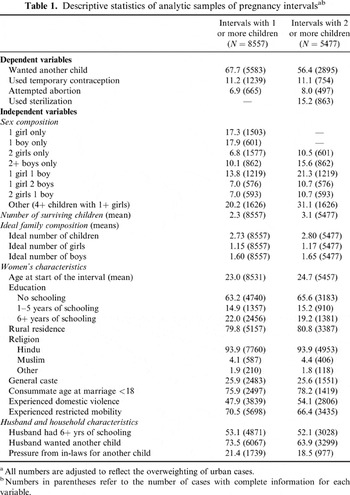
Table 1 provides a basic description of the sample. The first column describes intervals where women have one or more children (the basis for the analyses of fertility desires, temporary contraception and abortion (Models 1–3)), while the second column describes the intervals for the analysis of sterilization (Model 4).

The first sample is primarily composed of young, lower caste Hindu women with no or little education living in rural communities. Three-quarters of the intervals were contributed by women who had married before age 18 and one quarter by those married by age 15, reflecting the prevalence of early marriage in this context. Women frequently experience difficult home situations: women experience domestic violence in about half of these intervals, while women's physical mobility is restricted in a full 70%.
Women report their husbands to be somewhat more frequently pronatalist than they are (74% versus 68%), which is not an uncommon finding (Becker, Reference Becker1996; Mason & Smith, Reference Mason and Smith2000). Women also report feeling pressure to have another child from their in-laws in one-fifth of intervals. The most common composition across the intervals is four or more children with at least one girl (‘other sex composition’), followed nearly equally by one boy only and one girl only. The average number of children is 2.3. Respondents were asked what their hypothetical ideal family size and sex composition would be if they could repeat their life. In intervals with one or more children, women report a mean ideal family size of 2.73 and slightly more boys than girls. A future pregnancy was not wanted in nearly one-third of these intervals. Abortion was attempted in slightly less than 7% of all intervals with at least one child, and women used temporary contraception in 11.2%.
The characteristics of intervals in which women have two or more children are generally similar to those with one or more children, with the differences between the samples largely reflecting the slightly later stage of the life course in the former. As expected, the sample of intervals in which women have two or more children is composed of women who are slightly older on average (25 vs. 23 years). Women also have more children, and notably more boys, in these intervals. While women in the first sample of intervals have yet to reach their ideal family size, on average women in the second sample have exceeded it, though the pattern for ideal number of girls and boys is remarkably similar. Women want another child less frequently, as do their husbands and in-laws, and 15% of intervals are contributed by women who have been sterilized. A slightly greater proportion of intervals come from women with fewer restrictions on their mobility than is the case for the first sample. There is little variation between the samples in terms of education, religion, caste or rural/urban residence.
Ideal sex composition and fertility desires
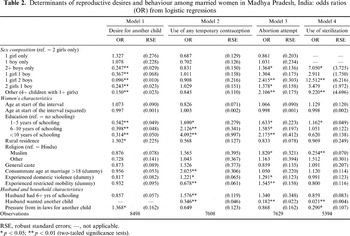
Table 2 presents results from each of the four multivariate logistic regression models showing the independent effect different sex compositions of children have on the outcomes of wanting another child (Model 1), using a temporary contraceptive method (Model 2), abortion (Model 3) and sterilization (Model 4).
Determinants of reproductive desires and behaviour among married women in Madhya Pradesh, India: odds ratios (OR) from logistic regressions

RSE, robust standard errors; —, not applicable.
*p<0.05; **p<0.01 (two-tailed significance tests).
As hypothesized, the results show that women's fertility desires are influenced by the sex composition of children, that the sex composition is biased towards sons, and that the sex composition preference is combined with a size preference for at least two children. In intervals where women have just one child, whether a girl or a boy, women are no more or less likely to want a future pregnancy than women with two girls, a result consistent with sample women reporting that their hypothetical, ideal family composition is between two and three children with more boys than girls desired.
Women with two girls and no boys (the reference category) are significantly more likely to report having wanted another pregnancy at the start of that interval than any other sex combination of two or more children, net of other factors in the model. Women are least likely to report wanting another pregnancy at the start of an interval in which they already have two surviving sons and one surviving daughter. Women with this combination are 90% less likely to report wanting an additional child than the reference category (OR 0.096). These results strongly suggest that women's ideal family size and sex composition consists of two sons paired with one daughter. Following this combination, women with two or more boys and no girls or those with two girls and one boy are significantly and considerably less likely to want another child (75% and 76% less likely, respectively), as are women with one boy and one girl (63% less likely).
While not the focus of this paper, a number of additional variables also significantly influence reproductive behaviours and intentions. Women's education influences each of the outcomes to varying degrees, as do their reports of the reproductive desires of their husbands. Other variables, including age at marriage, experiencing mobility restrictions, living in a rural area, experience with domestic violence and religion, influence one or two of the outcomes of interest while not having consistent effects across all of them.
Sons, daughters and reproductive behaviours
As hypothesized, the sex composition of children also influences most reproductive actions women take to manage childbearing in any interval. However, the degree to which women's reproductive actions follow the patterns found in the model for fertility desires varies considerably by the type of reproductive behaviour. While women's use of temporary contraception is not significantly influenced by sex composition but rather by other factors of education, age at marriage, experience with domestic violence and mobility, both abortion and sterilization behaviour are strongly influenced by the sex and number of children.
As with fertility desires, women are most likely to act to end a pregnancy through abortion or prevent a pregnancy through sterilization when they have two sons and one daughter. In intervals with this composition, as well as those where women have four or more children with at least one girl, women are over two times more likely to attempt abortion than those with two girls, further substantiating the suggestion that this is the preferred composition. Those with more than two boys are almost 40% more likely. Considering the findings from Model 1, which suggest that additional pregnancies to women with these sex compositions are less likely to have been wanted at all, these results imply that abortion is being used to manipulate not just sex composition but also family size. With the exception of women with only one child and those with one boy and one girl, women are significantly more likely to attempt an abortion for every other sex composition compared with the reference category.
Sex composition exerts its largest effects on women's sterilization behaviour. While the pattern is consistent with that for abortion and fertility desires, the magnitude of the odds ratios is substantially larger. Women are more than twelve times more likely to be sterilized in the interval when they already have one girl and two boys than when they have two girls only. Women with four or more children with at least one girl are nearly nine times more likely to be sterilized in the interval, while women with two boys and no girls at the beginning of the interval are almost seven times more likely to be sterilized than women with only two daughters.
The larger odds ratio for two sons and one daughter is statistically significantly different from the smaller odds ratios for the other categories of family composition, again indicating that the sex-and-size composition of one girl and two boys is the most preferred. That the effect of sex composition on sterilization is not significant for women with one girl and one boy or two girls and one boy suggests that these women have not achieved their ideal composition, in part, perhaps, because they do not yet have two sons. The magnitude of the effect of sex composition on sterilization as compared with the other behaviours may be partly a reflection of the fact that sterilization is the predominant means of family planning in the study area.
Finally, the larger effects of sex composition relative to the other variables in this model indicate that it is a dominant factor influencing sterilization behaviour. While the same control variables of education, domestic violence, and mobility restrictions are significantly associated with abortion as with fertility desires, none of these is significantly associated with sterilization.
Discussion
The analysis demonstrates that sex preferences and composition combine with desired family size to play a prominent role in shaping women's reproductive actions in this setting. First, the findings clearly illustrate that ‘sex preference’ is more than a singular preference for sons. Rather, women in Madhya Pradesh prefer a mixed sex-and-size composition that favours boys, with the most preferred combination being three children composed of two boys and one girl. Furthermore, the analysis shows convincingly that preferences for specific sex compositions influence both women's fertility desires and a range of reproductive behaviours.
The results also reflect the legacy of the Indian government family planning programme's historical focus on sterilization over other, temporary methods. Where women act to regulate their fertility through family planning, they typically use sterilization, rather than temporary contraception. Given the terminal nature of the method, the sheer magnitude of the likelihood of using sterilization when women already have one girl and two boys demonstrates a commitment to the pursuit of an ideal sex composition, rather than family size per se.
The findings on abortion suggest that women in Madhya Pradesh also use abortion as a means of managing fertility in the absence of access to temporary methods. Moreover, they do so in response to the sex composition of prior children in a manner similar to the other reproductive behaviours.
In contrast to sterilization and abortion, sex composition is not significantly related to the probability of using temporary contraception. Rather, it is only educated women and those married after age 18 who are likely to access temporary contraception, a distinct difference from the role of sex composition in the other reproductive behaviours. In a context of institutional and social constraints on the use of temporary methods, these findings raise the question as to whether women may prioritize the pursuit of particular sex compositions over other fertility goals, such as the spacing of pregnancies. That this is the case is supported by recent research findings that indicate that women do hasten conception when they have not yet achieved their desired sex composition and take longer to become pregnant again once attaining a more preferred sex composition (MacQuarrie, Reference MacQuarrie2009).
Implications
The findings demonstrate that in settings like Madhya Pradesh, focusing solely on family-size limitation may not be an effective strategy to promote family planning because it is women's preference for two sons and one daughter – and not just family size – that plays a key role in determining if, when and how a woman regulates her fertility. On the other hand, these results provide encouraging support for efforts already underway in India to shift the public health system's family planning approach away from an almost exclusive focus on limiting fertility via sterilization and towards providing women with a greater range of reproductive options. Finally, our finding that women with limited access to contraception use abortion to regulate the timing and number of births, rather than only for sex selection, is consistent with other studies that find that abortion in India is an important means of reproductive control beyond its use for sex selection, and, as such, initiatives to reduce sex selection should be careful not to inadvertently restrict access to legal abortion (Santhya & Verma, Reference Santhya and Verma2004; Nidadavolu & Bracken, Reference Nidadavolu and Bracken2006; Ganatra, Reference Ganatra2008).
Strengths and limitations
The ability to ascertain causality with more confidence than studies using cross-sectional data and the range of reproductive actions examined are key strengths of this study. This study is the first to the authors' knowledge that examines the influence of sex composition preferences on the full range of reproductive behaviours by studying abortion alongside multiple other actions. However, some limitations should be noted. First, recall bias may still be present, in spite of efforts to reduce recall errors, as some respondents report on pregnancies that occurred well in the past. However, given the ability of the data collection method to increase reports of abortion (Edmeades et al., Reference Edmeades, Nyblade, Malhotra, MacQuarrie, Parasuraman and Walia2010), it is reasonable to expect that the extent of recall bias is likely to be considerably smaller than in other research using retrospective data.
Second, women reporting retrospectively on unwanted pregnancies that ultimately resulted in a birth may misrepresent those pregnancies as wanted. While a prospective measure is ideal (Rosenzweig & Wolpin, Reference Rosenzweig and Wolpin1993; Koenig et al., Reference Koenig, Acharya, Singh and Roy2006), no such measure was available. As an acceptable alternative, a retrospective measure of fertility desires prior to pregnancy is used (Fricke & Teachman, Reference Fricke and Teachman1993; Bankole & Westoff, Reference Bankole and Westoff1998; Joyce et al., Reference Joyce, Kaestner and Korenman2002). The consistency of the fertility desire findings with the other models suggests that whatever bias exists did not unduly influence the findings. Third, son preference (or daughter preference) attitudes are not measured directly. Rather, preferences for a particular sex composition are inferred via the effect of those compositions on fertility desires and behavioural outcomes. Finally, the use of sex-selective abortion – an issue attracting considerable attention currently – is not explicitly addressed. Sex-selective abortion requires both sex-determination testing and an attempt to abort based on the results. Such testing – indeed, any prenatal diagnostic testing – is strikingly low in this sample (roughly 25% of all pregnancies), perhaps as a reflection of insufficient health services in rural settings like Madhya Pradesh (Santhya & Verma, Reference Santhya and Verma2004; Arnold & Parasuraman, Reference Arnold and Parasuraman2009; Desai & Wu, Reference Desai and Wu2010). As a result, there were too few cases in these data on which to base an analysis: in only 28 of the pregnancies in which abortion was attempted had women had a test that revealed the sex of the fetus. Direct reports from women, while suffering some degree of social desirability bias, indicate that only 3% of all abortions, affecting a mere 0.19% of pregnancy intervals, were motivated by the sex of the fetus. The results of the analysis further support the notion that, in this population, abortion is used to regulate fertility rather than sex selection. To the extent that abortion is used to achieve sex preferences, it is in response to an existing sex composition rather than to the sex of the current fetus.
In conclusion, the result that two boys and one girl is the most preferred sex-and-size composition supports the hypothesis that women desire a family with children of both sexes, while emphasizing boys. Having a preferred sex composition of surviving children at the start of the interval influences both fertility desires and abortion and sterilization behaviour, as hypothesized, but not temporary contraceptive use. Sex composition exerted its influence most strongly on sterilization behaviour.
Acknowledgments
Data for this study were collected by the International Center for Research on Women with support from the David and Lucile Packard Foundation and the William and Flora Hewlett Foundation. This article is partially supported by the National Science Foundation Graduate Research Fellowship under Grant No. DGE-0718124. The authors are grateful to Susan Lee-Rife for providing comments on this article. An earlier version of this article was presented at the annual meeting of the Population Association of America, April 2008.