Acute rheumatic fever is the most common cause of acquired heart disease in childhood and adolescence in the world. Inflammatory process is limited by temporarily affecting the brain, joints, and skin, but heart involvement can be life-threatening with damage to the valve tissue in the acute phase, and resulting chronic sequela with rheumatic heart disease. Rheumatic heart disease causes 200,000–250,000 premature deaths every year. It is estimated that approximately 60% of subjects with acute rheumatic fever will develop rheumatic heart disease.Reference Marijon, Mirabel, Celermajer and Jouven1,Reference Carapetis, Steer, Mulholland and Weber2
Although acute rheumatic fever has declined in Europe and North America in incidence over the past 4 to 6 decades, the disease remains one of the most important causes of cardiovascular morbidity and mortality among socially and economically disadvantaged populations all over the world, especially in the developing countries. Improvement of living conditions in developed countries, early recognition of the disease, adequate treatment of penicillin and prophylaxis, good follow-up of patients, and the use of advanced diagnostic methods such as echocardiography are the main reasons for the decrease in the incidence of the disease in the last 20 years. Although the incidence of acute rheumatic fever has remained between about 0.2 and 1.9 per 100.000 in developed countries, it can reach epidemic levels in developing countries.Reference Azevedo, Pereira and Guilherme3-Reference Narin, Mutlu and Argun6
There is no study on the incidence of acute rheumatic fever that covers all the geographical regions in Turkey. However, it is known that the percentage of children with acute rheumatic fever in Turkey is still higher than the global rate. Recently, Atalay et al. screened 2550 healthy students in the capital city of Turkey by portable echocardiography as a result of this study, the frequency of rheumatic heart disease was 15per 1000.Reference Atalay, Tutar, Uçar, Topçu, Köse and Doğan7 Our study retrospectively aims to evaluate clinical and epidemiological features of rheumatic fever using the data of last 25 years in our hospital in south-east of Turkey to investigate incidence and seasonal prevalence and to detect changes over time in clinical and epidemiological features by comparing three periods.
Patients and methods
For this research, the medical records of 377 patients with acute rheumatic fever (first attack or recurrence) who were admitted to the Pediatric Cardiology Department of Çukurova University between January 1993 and December 2017 were reviewed. Our hospital is the reference centre that provides tertiary health care services to the large population of the southern and south-eastern regions of our country. While it was the only hospital in the field of paediatric cardiology until 2000, seven paediatric cardiology centres began to serve in this region between 2001 and 2008. In recent years, acute rheumatic fever patients have not been referred to our hospital for examination and treatment. In the light of this information, the patients were divided into three periods according to their application dates. First period was between January 1993 and December 2000, the second between January 2001 and December 2008, and the third between January 2009 and December 2017.
The data of the patients about age, sex, presenting symptoms, seasonal distributions, major and minor manifestations, and additional supportive findings were recorded/determined. All patients were examined by at least one paediatric cardiologist and underwent two-dimensional and Doppler echocardiography. Laboratory tests for complete blood count, acute phase reactants, and antistreptolysin O titres were also evaluated.
The modified Jones criteria (modification by American Heart Association, 1992) was the mainstay of the diagnosis process. However, subclinic carditis was also accepted as major criteria. Since the incidence of acute rheumatic fever in our country is not known, the same criteria is continued to be used after 2015. Major manifestations were polyarthritis, carditis (clinical or subclinical), Sydenham’s chorea, erythema marginatum, and subcutaneous nodules; minor manifestations were fever, elevations in acute phase reactants, arthralgia, and electrocardiographic PR prolongation according to these modified criteria. The diagnosis of the disease was made if either there were two major manifestations or there were one major and two minor manifestations. If the diagnosis was made, secondary prophylaxis with intramuscularly administered benzathine penicillin G with three-week intervals was prescribed and initiated.
Statistical analysis was performed using SPSS for Windows. During evaluations, descriptive statistical methods (mean, standard deviation, and frequency) were used as well as the Student’s t-test, χ2, and Fisher’s exact tests for comparison of qualitative data. The results were evaluated in a 95% confidence interval at a significance level of p < 0.05
The ethical aspects were respected and the research was approved by the Committee of Ethics and Research of Çukurova University.
Results
During the 25 years span of the study, total number of 377 patients who were diagnosed with acute rheumatic fever (first attack or recurrence) were scrutinised carefully. Two hundred and ninety-two patients with acute rheumatic fever presented with first episode and 85 with recurrence. Seventy-five (88.2%) of the patients who presented with recurrence had a second attack, seven (8.2%) had a third attack, and 3 (3.5%) had a fourth attack.
There were 206 patients in the first period, 91 in the second period, and 80 in the third period.
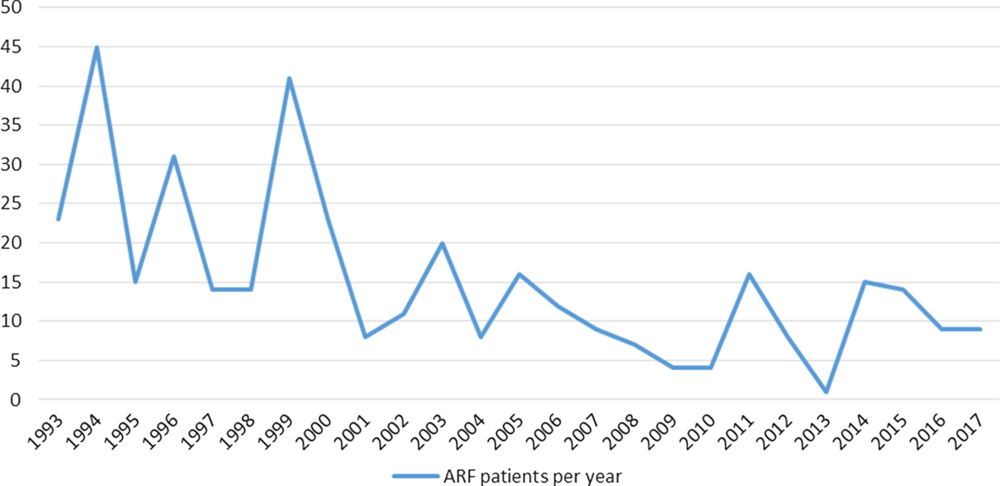
The maximum number of the patients who were diagnosed with rheumatic fever in a year were in 1994 and 1999 with 45 and 41 cases per year, respectively. Figure 1 shows the number of acute rheumatic fever patients per year.
The number of ARF patients per year.

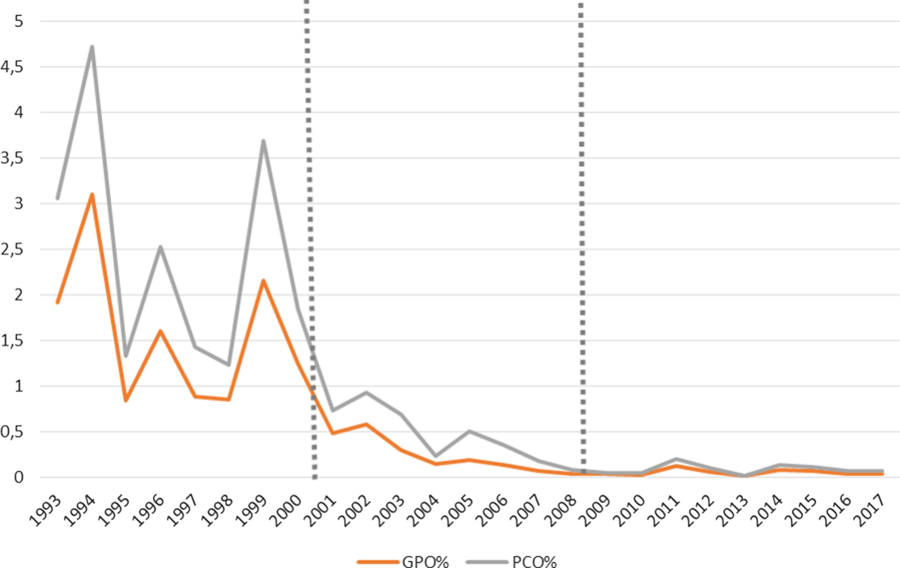
A total of 230,934 (13,370 in first period, 63,302 in second, and 154,262 in third) patients were examined between January 1993 and December 2017 at the general paediatrics outpatient department of our hospital. In the same period, the number of patients examined in the paediatric cardiology outpatient department was 127,854 (8530, 28,262, and 91,062, in the periods, respectively). While the acute rheumatic fever rate was 1.54% in the first period, 0.14% in the second period, and 0.05% in the last period at general paediatrics outpatient department, these rates were 2.42%, 0.32%, and 0.09% in the paediatric cardiology outpatient department, respectively. acute rheumatic fever frequency in our hospital was determined by comparing the number of patients with acute rheumatic fever by years to the number of patients who applied to the general paediatric and paediatric cardiology outpatient clinics (Fig 2).
The ratio of patients with ARF to the patients who applied to the general pediatrics outpatient clinic and pediatric cardiology outpatient clinic per years.

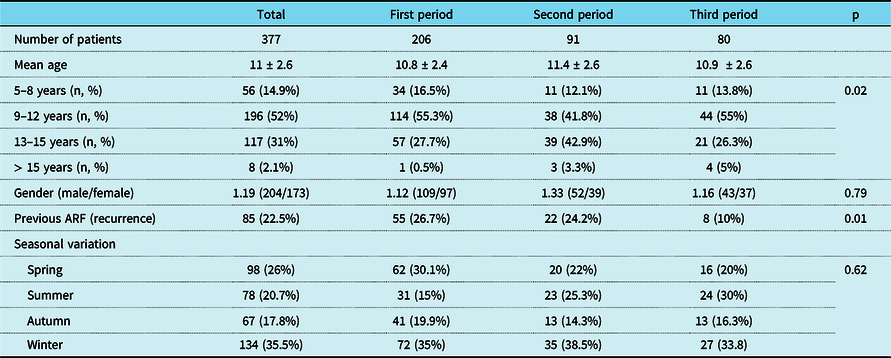
The largest age group consisted of patients who were between 9 to 12 years of age, which make up 52% (n = 196) of the patients; approximately 114 patients in the first, 38 in the second, and 44 were in the third periods of the study, respectively (Table 1). There was a significant difference in distribution of age (p = 0.02).
The distribution of patients with ARA according to Jones criteria

No significant difference was found in gender between three periods (p = 0.79).
Recurrence decreased from 26.7% in the first period to 24.2% and 10% in the second and third periods, respectively. This decrease was statistically significant (p = 0.01).
Of all the patients, 35.5% (n = 134) were admitted in winter, 26% (n = 98) in spring, 20.7% (n = 78) in summer, and 17.8% (n = 67) in autumn. Approximately two-thirds of the patients presented in the spring and winter seasons (62.8%). The peak season for the initial presentation was winter in all periods. The incidence of acute rheumatic fever was increasing in the summer season. But no significant difference was found between three periods for the seasonal variation (p = 0.62).
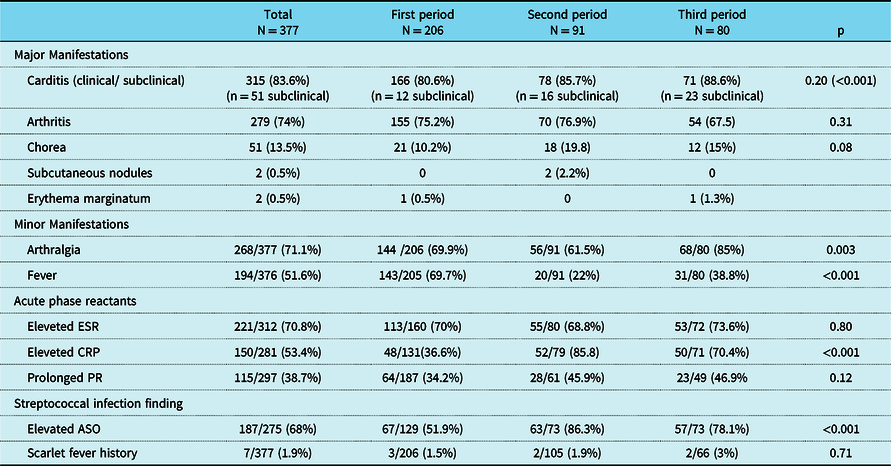
Among the major findings, the most common included carditis 83.6% (n = 315), arthritis at 74% (n = 279), Sydenham’s chorea at 13.5% (n = 51), and only two patients (0.5%) had erythema marginatum and two patients (0.5%) had subcutaneous nodule in the study. Table 2 shows the distribution of patients with ARA according to Jones criteria. There were no significant differences about the incidence rates of major findings except chorea between the periods (p > 0.05). There was a statistically significant difference in the incidence of chorea between the periods (p = 0.08)
The distribution of patients with ARA according to Jones criteria
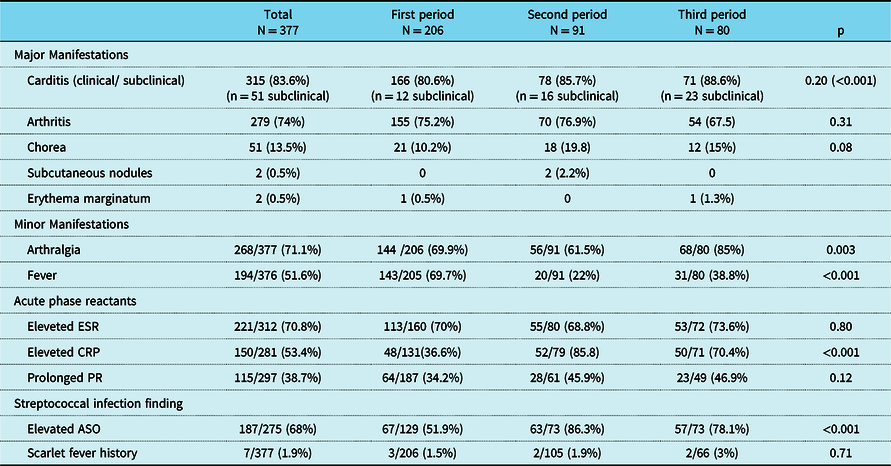
ASO = antistreptolysin O; CRP = C-reactive protein; ESR = erythrocyte sedimentation rate
Incidence of subclinical carditis increased gradually from the first period to the third period and there was a statistically significant difference in the incidence of subclinic carditis between the periods (p < 0.001).
Among the minor manifestations, arthralgia was the most common finding in all periods (Table 2). There were statistically significant differences between periods in terms of arthralgia, fever and increased CRP incidence. There were statistically significant differences between periods at increased antistreptolysin O incidence.
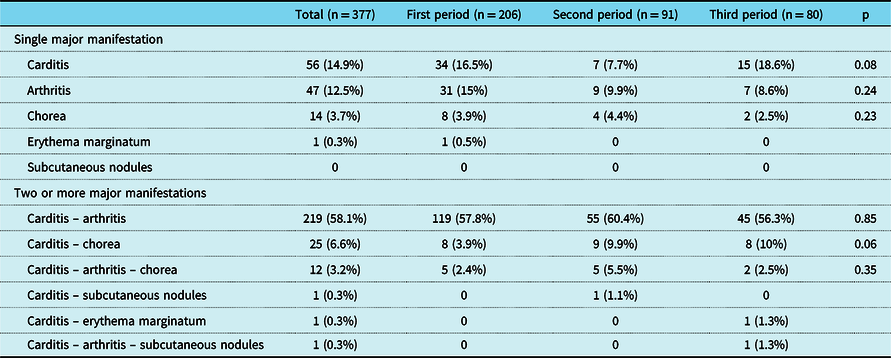
Table 3 shows the comparative analysis of major manifestations of patients with acute attack during three periods. In the study, only 14.9% of the patients had isolated carditis as a major finding, whereas 58.1% of the patients had combined carditis and arthritis and 25 (6.6%) patients had combined carditis and chorea as major findings. Only 12 patients had combined chorea, carditis, and arthritis as major findings in this study. The incidence of carditis and cardit–chorea combination was found statistically significant between the periods (p = 0.08 and p = 0.06, respectively) (Table 3).
Comparative analysis of major manifestations of patients with acute attack during two period

Carditis
Carditis was the most common manifestation observed in 315 patients (83.6%). While 56 of these patients (14.9%) were isolated, arthritis was the most common accompanying finding (61.5%). All patients with two or three major manifestations were accompanied by carditis.
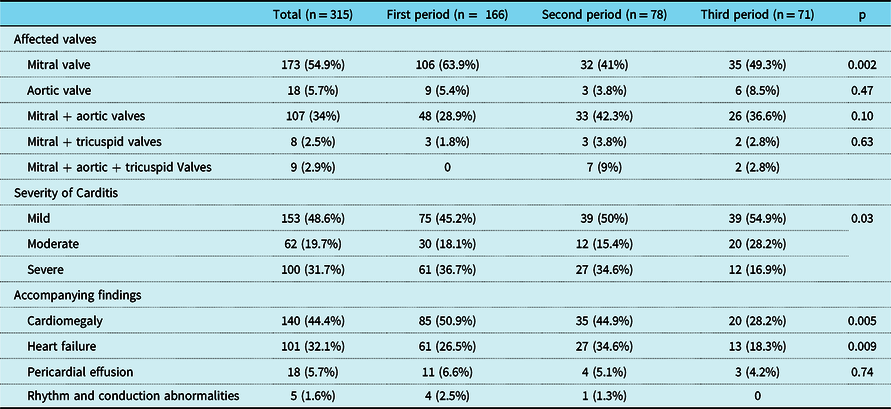
Table 4 shows the affected valves, severity of carditis, and accompanying findings in the patients with carditis. The most commonly affected valve was the mitral valve alone (54.9%), followed by a combined mitral and aortic valves (34%) and aortic valve alone (5.7%). Among the rates of the affected valves, the most commonly affected valve was mitral valve alone in all periods; however, the percentage dropped to 41% in the second period and 49.3% in the third period from 64% in the first period (p = 0.002). There was no statistically significant difference between the periods in terms of other valve involvements (Table 4).
Affected valves, severity of carditis, and accompanying findings in the patients with carditis

Of the patients with carditis, 48.6% (n = 153) had mild carditis, of which 45 had a subclinical (silent carditis). Sixty-two patients (19.7%) had moderate and 100 patients (31.7%) had severe carditis. There was a statistically significant difference between the periods in terms of carditis severity (p = 0.03). Cardiomegaly and heart failure decreased in the third period compared to other periods, and this was found statistically significant (p = 0.005 and p = 0.009, respectively).
There was no statistically significant relationship between valve involvement and the severity of carditis, also between age and sex (p > 0.05).
Electrocardiogram abnormalities (expect for first-degree atrioventricular block) were found in five patients: complete atrioventricular block in one, Mobitz type 1 block in one, atrial fibrillation in one, supraventricular tachycardia in one, and ventricular extra systole in one. All electrocardiogram abnormalities returned to normal.
Arthritis
The most commonly affected joints in those diagnosed with arthritis were the knee (72.8%), ankles (53.8%), elbows (19%), wrists (14%), hips (4.3%), and shoulders (2.5%), respectively. Forty-three (15.4%) patients had small joint (fingers) involvement. Small joint involvement was increased in the second period (5.5% versus 28.2%). Monoarthritis was found in 97 (34.8%) patients. Of the patients with arthritis, 146 (52.3%) were male and 133 (47.7%) were female.
Chorea
Fifty-one patients, 14 of whom were isolated, presented with chorea. All remaining patients are accompanied by carditis alone or with arthritis. Although there was no significant difference in the frequency of isolated chorea between the periods, there was a slight increase in the coexistence of carditis and chorea in the last two periods, but it was not found statistically significant (p = 0.06). In the patients with chorea, 31 (60.8%) were female and 20 (39.2%) were male.
The mean follow-up was 13 (range 1 to 84) months in the first period, 30.5 (1 to 168) months in the second period, and 35.6 (1 to 162) months in the third period (Table 5).
Follow-up and results of the patients with ARF

In the first period, 3 (1.8%) patients’ (11 months–2 years), in the second period 14 (17.9%) patients’ (9 months–3.6 years), and in last period 11 (15.5%) patients’valve lesion completely resolved (25 mild and 3 moderate carditis). This was found statistically significant (p = 0.0002). At the follow-up, 2 patients died and 16 patients underwent surgery (12 patients’ mitral valve replacement, 4 patients’ mitral valve replacement + aortic valve replacement). Two patients who underwent surgery in the first period, one procedure (one mitral valve replacement and one mitral valve replacement + aortic valve replacement) was performed due to irreversible heart failure during active carditis. In the first period, one of the patients with severe carditis died during the IV penicillin injection and the other with severe heart failure. No patient died in other periods.
Discussion
Acute rheumatic fever is seen worldwide; however, it is commonly detected in under-developed and developing countries and it still continues to be a major health problem in those countries. Rheumatic heart disease remains a significant cause of cardiovascular morbidity and mortality. Watkins et al. estimated that there were 319,400 (95% uncertainty interval: 297,300 to 337,300) deaths due to rheumatic heart disease in 2015.Reference Carapetis, Currie and Mathews8–Reference Watkins, Johnson and Colquhoun10 In a recent systematic review of prospective population-based studies, the reported incidence of acute rheumatic fever ranged from 5 to 51 per 100,000 population worldwide in the 5- to 15-year age group.Reference Tibazarwa, Volmink and Mayosi11 The lowest incidence rate of 0.5 to 3 per 100,000 population was found in Europe; however, focal outbreaks of acute rheumatic fever have been reported in industrialised countries in the last years.Reference Pastore, De Cunto, Benettoni, Berton, Taddio and Lepore12 The 2015 Jones criteria identified the acute rheumatic fever incidence cut-off < 2 of 100,000 school-aged children per year to distinguish between low risk and moderate- to high-risk populations.Reference Gewitz, Baltimore and Tani13 Still, to be able to apply the Jones criteria which was revised in 2015 to our country, the incidence and the prevalence rates should be known. There is no study on the incidence of acute rheumatic fever that covers all of our geographical regions. However, it is known that the percentage of children with acute rheumatic fever in Turkey is still higher than the global rate. The number of reports is not adequate for an accurate estimation of acute rheumatic fever incidence. Beyazova et al.Reference Beyazova, Benli and Beyazova14 estimated it as 56.6 per 100,000 children during 1970–1973 and 36.7 per 100,000 15 years later. Saraçlar et al.Reference Saraçlar, Ertuğrul and Özme ve Ajun15 found the incidence 20 per 100,000 children during 1972–1976. Örün et al.Reference Örün, Ceylan and Bilici16 estimated it as 37.6 per 100,000 during 1980–1989, 60 per 100,000 during 1990–1999, and 21 per 100,000 during 2000–2009 in the Central Anatolia Region of Turkey. Narin et al.Reference Narin, Mutlu and Argun6 estimated the lowest incidence rate of acute rheumatic fever in Kayseri which is in the Central Anatolia region (7.4 per 100,000). As being one of the developing countries, Turkey still suffers from acute rheumatic fever, and a comprehensive study about this disease still cannot be conducted due to the lack of reliable countrywide database of the patients who admitted to the hospitals in the country. Additionally, the patients who have admitted to more than one centre in our country causes problems on determining the exact incidence and prevalence rates of the disease. However, we tried to determine the frequency of acute rheumatic fever in our hospital by proportioning the number of the patients diagnosed with acute rheumatic fever to all patients who applied to the general paediatrics outpatien and PCO departments. When the distribution of patients diagnosed with acute rheumatic fever by years is examined, it is seen that there is a decrease in the number of patients with acute rheumatic fever over the years, despite the significant increase in the number of patients examined in both general paediatrics outpatien and PCO departments. In this study, the maximum numbers of the patients in a year were in 1994 and 1999 with more than 45 and 41 cases per year, respectively. In these years, when the number of patients was the highest, we found that the frequency in our hospital also increased. Also, the fact that some administrative factors could have (our hospital’s agreements with health institutions, refugees, etc.) played a role in the increase in the frequency of the disease in these 2 years could be noted. Moreover, it is clearly seen that the number of the cases per year dropped drastically, especially in the recent years of the study. This decline could be caused by certain factors including improvement in socio-economic conditions, health services, increase in antibiotic use, and hygienic conditions. Because secondary prophylaxis limits the progression of long-term cardiac sequelae, early diagnosis of acute rheumatic fever is essential for reducing morbidity and mortality. However, if we consider that the number of the paediatric centres and paediatric cardiologists increased drastically in second and third decades in our region, it can be said that this decrease on incidence rate may not be correct due to, as we mentioned, we do not have a reliable countrywide data banks of the patients. A multicentre epidemiological study is required to obtain more reliable statistical values.
Group A streptococcal pharyngitis and subsequent acute rheumatic fever are most frequent among children and adolescents between 5 and 15 years of age.Reference Anita, Zaidi, Goldman, Kliegman, Behrman, Jenson and Stanton17 While there were differences between the ages of the first episodes of acute rheumatic fever published in the literature, in most studies, the mean age was between 9.5–11.2 years,Reference Veasy and Lloyd18-Reference Currie and Carapetis21 and it was parallel with our results. In the present study, the rate of patients aged from 5 to 15 years was 97.9% and half of the patients’ age were between 9 and 12 years. There was no patient under 5 years of age.
Both genders were affected equally by acute rheumatic fever except for patients with chorea which was similar with the literature.Reference Saraçlar, Ertuğrul and Özme ve Ajun15,Reference Veasy and Lloyd18-Reference Bitar and Hayek20 Of the patients with chorea, 60.8% were female. Although there was a slight male predominance, no significant difference was observed between sexes in all periods. In two studies from Turkey, female/male ratio was found to have increased slightly.Reference Narin, Mutlu and Argun6,Reference Bostan and Cil22
The increased rate of admission of patients with acute rheumatic fever to hospitals is in correlation with the seasonal variability of pharyngitis, which is caused by group A beta-haemolytic streptococci and is most often diagnosed in the winter and spring.Reference Narin, Mutlu and Argun6,Reference Örün, Ceylan and Bilici16,Reference Cleonice, Mota, Aiello, Anderson, Anderson, Baker, Penny, Redington, Rigby and Wernovsky23 Approximately two-thirds of the patients admitted in the spring and winter seasons (62.8%). The peak season for the initial presentation was winter in all periods. The least common season in the study was summer with 15 % in first period; however, the occurrence rate of acute rheumatic fever increased to 25.3% in the second period and 30% in the third period. The reason for this is that most of the people of the region spend the summer months in high altitude highlands, which are colder places. In recent years, due to climate change in our region, the temperature levels in early summer were lower. This might also explain the increase in acute rheumatic fever rates throughout summer.
Universally, the most occurring major manifestations during the first episode of acute rheumatic fever remain carditis (50%–70%) and arthritis (35%–66%).Reference Seckeler and Hoke4,Reference Veasy and Lloyd18,Reference Boyarchuk, Boytsanyuk and Hariyan24-Reference Grassi, Fesslovà and Carnelli29 Our data showed the frequency of rheumatic carditis of 83.6%, which is higher than the other published data and there was a slight increase (80.6%, 85.7%, and 88.6%, respectively); however, in last periods, there was no statistically significant difference (p = 0.20). Also, the number of subclinical carditis gradually increased and this was statistically significant (p < 0.001). All patients with two or three major manifestations were accompanied by carditis and approximately two-thirds of the patients had both carditis and arthritis. Patients with carditis have been reported to be around 30–45% in previous studies.Reference Lee, Naguwa, Cheema and Gershwin30,Reference Cimen, Oran and Cimen31 All our patients had echocardiography performed at the time when acute rheumatic fever was suspected which may be the reason for such a high percentage of carditis in our cohort. The Jones criteria for the diagnosis of acute rheumatic fever were revised in 2015.Reference Gewitz, Baltimore and Tani13 Echocardiography is now recommended in all the patients with suspected or confirmed acute rheumatic fever. Subclinical carditis can be used as a major criterion for acute rheumatic fever in all populations.Reference Beaton and Carapetis32 Genetic predisposition may be a factor for development carditis and rheumatic heart disease.Reference Bitar and Hayek20,Reference Haydardedeoğlu, Tutkak, Köse and Düzgün33 In our population, the prevalence of valvar lesions were similar to the reports from other high-risk countries.Reference Azevedo, Pereira and Guilherme3,Reference Narin, Mutlu and Argun6,Reference Bitar and Hayek20,Reference Arora, Subramanyam, Khalilullah and Gupta34 Mitral involvement was predominant at diagnosis in just more than one-half of the cases (54.9%) and was associated with aortic regurgitation (34%), whereas isolated aortic involvement was rare (5.7%). Mitral insufficiency is caused by abnormal coaptation due to the annular dilatation and chordal elongation.Reference Arora, Subramanyam, Khalilullah and Gupta34,Reference Barash and Matityahu35 In the present study, about one-half of the patients had mild carditis during the initial diagnosis. Although severe carditis rate was higher in the first period, the incidence of mild carditis has increased steadily and recently reached 55%. There was a statistically significant difference between the periods in terms of carditis severity (p = 0.03). We thought that, early recognition of the disease, adequate treatment of penicillin, prophylaxis, and good follow-up of the patients caused carditis to be milder. There was no statistically significant relationship between valve involvement and the severity of carditis, also between age and sex (p > 0.05). Compared with older patients, children who presented before 5 years of age were more likely to have moderate to severe carditis and to present with arthritis or the rash of erythema marginatum and were less likely to have chorea.Reference Lloyd, Tani, George Veasy, Minich and Shaddy36 In our study, there was no patient under 5 years of age. It was not possible to tell the true relationship between carditis severity and age since we do not know the first episode ages of patients with recurrence.
Overall, 4% to 11% of all patients with acute rheumatic fever develop clinically detectable pericarditis, one of the known, but less common findings in rheumatic carditis. When present, pericarditis is most often observed with pancarditis.Reference Bitar and Hayek20,Reference Arora, Subramanyam, Khalilullah and Gupta34,Reference Rathore and Barton37 In the present study, pericardial effusion was detected in 5.7% of patients with pancarditis.
Various rhythm and conduction abnormalities also can develop during the course of the disease.Reference Kula, Olgunturk and Ozdemir38,Reference Balli, Oflaz, Kibar and Ece39 One of the most characteristic disturbances of conduction in acute rheumatic fever is first-degree heart block. First-degree atrioventricular block is a minor Jones criterion and is seen in approximately 10–75 % of the cases. In our study, excluding patients with first-degree atrioventricular block, rhythm, and conduction anomalies were observed in five patients (1.6%). All the electrocardiogram abnormities detected at onset returned to normal once the patients recovered from the acute phase, as previously described by Ballı et al.Reference Balli, Oflaz, Kibar and Ece39
The reported frequency of arthritis in children with acute rheumatic fever ranges from 60 to 80%, depending on the region.Reference Seckeler and Hoke4,Reference Martins, Veasy and Hill40 In our study, it was observed in 74% of the cases. There was a slight decrease (75.2% to 67.5%) in arthritis rates between first and last periods that could be related with the common use of anti-inflammatory drugs. Some authors described arthritis as the most common criterion (up to 70% of the cases).Reference Joseph, Madi, Kumar, Nelliyanil, Saralaya and Rai41 In the present study, the most commonly affected joints were larger ones such as knees (72.8%), ankles (53.8%), and 43 (15.4%) patients had small joint (fingers) involvement. Monoarthritis may be important as a clinical manifestation of acute rheumatic fever in selected high-risk populations.Reference Cann, Sive, Norton, McBride and Ketheesan26,Reference Carapetis and Currie42-Reference Sanyal, Thapar, Ahmed, Hooja and Tewari45 In the high-risk indigenous Australian population, monoarthritis has been found to be present in 16% to 18% of confirmed cases of acute rheumatic fever.Reference Carapetis and Currie42 In this study, monoarthritis was found in 97 (34.8%) patients and all of them were accompanied by carditis.
Chorea was seen in 13.5% cases in this study and it varied from 2.7 to 18.8% cases in other studies.Reference Arora, Subramanyam, Khalilullah and Gupta34,Reference Rayamajhi, Sharma and Shakya46-Reference Vasan, Shrivastava, Vijayakumar, Narang, Lister and Narula51 Some publications indicate rates of 6–31% and even 49%.Reference Carceller, Taoiero, Rubin and Miro52 The difficulties in the acute rheumatic fever diagnosis were described in the cases of isolated rheumatic chorea, when other major criteria of acute rheumatic fever are absent. Fourteen patients (27.5%) had isolated chorea and others (72.5%) had chorea combined with carditis and arthritis.
The low rates of detected subcutaneous nodules and erythema marginatum in acute rheumatic fever patients found in this study were likewise reported in literature.Reference Seckeler and Hoke4,Reference Joseph, Madi, Kumar, Nelliyanil, Saralaya and Rai41 Subcutaneous nodules are often observed in patients who also have carditis, and erythema marginatum, subcutaneous nodules almost never occur as the sole major manifestation of acute rheumatic fever. In our patients, only two had subcutaneous nodules with carditis. Two patients had erythema marginatum, although one of them occurred as the sole major manifestation.
In the present study, the rates of minor manifestations were consistent with the literature. The rates of arthralgia were reported as 54.6–81.1%, fever as 40–62%, prolongation of PR interval as 15.9–23%, elevated sedimentation rates as 81.8–95%, and C-reactive protein as 72–81.8%.Reference Saraçlar, Ertuğrul and Özme ve Ajun15,Reference Arora, Subramanyam, Khalilullah and Gupta34,Reference Olguntürk, Canter, Tunaoğlu and Kula53,Reference Ozer, Hallioğlu, Ozkutlu, Celiker, Alehan and Karagöz54
Secondary prophylaxis limits the progression of long-term sequelae, and early diagnosis of acute rheumatic fever is essential for reducing morbidity and mortality. For the valve regurgitation detected during the initial diagnosis, valvar lesions completely improved for three (1.8%) patients in the first period, 14 (17.9%) patients in the second period, and 11 (15.5%) patients in the last period at the follow-up period (minimum 9 months and maximum 3.6 years). This was found statistically significant (p = 0.0002). Early diagnosis, prevention of recurrence with good secondary prophylaxis, regular follow-up and treatment of patients were effective in the improvement of valvar lesions. A total of 15 patients underwent surgical intervention (11 patients mitral valve replacement, 4 patients mitral valve replacement + aortic valve replacement), and 2 of them operated during acute attack because of uncontrolled heart failure and others at the follow-up. None of the patients in our population presented valve stenosis at the follow-up, because valve stenosis is considered to be a chronic and advanced-stage lesion.Reference Remenyi, ElGuindy, Smith, Yacoub and Holmes55 The mortality rate during the acute attack in developed countries was reported to be lower than 1%; however, higher rates were reported in developing countries.Reference Qurashi56 The mortality rate was reported to be 0.5% by Ürün et al. and 1% by Özer et al.Reference Örün, Ceylan and Bilici16,Reference Ozer, Hallioğlu, Ozkutlu, Celiker, Alehan and Karagöz54 There were no deaths during the acute period in the series of Narin et al.Reference Narin, Mutlu and Argun6 In the present study, the mortality rate was 1.2% in the first period and no deaths in the second and third periods.
Conclusion
The diagnosis and adequate treatment of streptococcal pharyngitis is crucial for reducing the development of acute rheumatic fever and secondary prophylaxis to limit the cardiac valve damage and chronic sequela. Although the incidence of acute rheumatic fever decreased, it still continues to be an important disease that can lead to serious increases in morbidity and mortality rates in our country. As the frequency of acute rheumatic fever decreases, awareness about this issue may decrease and the diagnosis of acute rheumatic fever can be skipped. Therefore, the medical education should include acute rheumatic fever. In future, although genetic factors cannot be changed, changes in environmental factors and healthy policies will decrease the frequency of the disease and its complications.
Acknowledgements
None.
Financial Support
This research received no specific grant from any funding agency in the public, commercial, or not-for-profit sectors.
Conflict of Interest
None.
Ethical Approval
The study was conducted in compliance with the Declaration of Helsinki with ethics approval provided by our hospital’s ethics committees.