


Introduction
Contrary to contemporary knowledge that sugar is detrimental to our bodies, a hundred years ago it was considered a healthy and modern food. Given that sugar, unlike rice and other grains, was not a staple food, many Western observers from the late nineteenth century onward regarded the rising domestic sugar consumption as a useful measure of a nation’s level of civilization—a view later adopted in Japan as well. This idea that how “civilized” a culture was might be tied to its sugar consumption became part of the Japanese government’s larger concerns over public health, nutrition, and hygiene as it sought to modernize the country. Western-style confectionery companies conveniently took advantage of these discourses and trends through packaging and advertising that labeled their products as markers of modernity—promoting them as hygienic, nutritious, and essential for providing the necessary calories to build strong, healthy bodies.Footnote 1
This dissertation argues that beyond being a symbol of modernity, sweetness was also a taste of imperial power. These “Western-style confectionery” (yōgashi) owed their ubiquity to the growth of Japan’s empire, and more specifically to the sugar cultivated in its first colony, Taiwan. Japan’s access to refined sugar sourced from Taiwan and the advent of mass-production technologies using newly developed machines in Japanese factories were essential components of confectionery’s emergence as a consumer good. These products, such as caramels, chewing gum, candy drops, and chocolate, significantly differed from the handmade Japanese sweets (wagashi) that had defined the market for “sweets” in Japan since the seventeenth century.
Through a close study of the history of Western-style confectionery in modern Japan from the Meiji period to the early postwar years, this dissertation combines analytical frameworks from the history of empire, business history, and history of science and technology, examining how state power and imperial governance are embodied in the production processes, the marketing methods that enabled confectionery’s popularity, and the spread of knowledge about their consumption. By viewing the history of empire through the lens of commodities like sweets, we are compelled to move beyond the traditional ways of seeing empire as a single domain. Instead, we may examine how various actors were interconnected within a broader commodity chain, including businessmen, government officials, scientists, factory workers, artists, members of the military, and an extensive consumer base ranging from Japanese children to colonized subjects. Together, they were all participants in the empire’s expansion through the production and consumption of Western-style confectionery. This study offers a theoretical intervention that shifts the analysis of empire away from formal institutions and administrative structures toward the everyday practices through which imperial rule operated, foregrounding the roles of consumption and sensory experience. Empire, in this sense, was not confined to infrastructure or governance but embedded in the subtle textures of daily life, even in the savor of a piece of candy.
Commodity, Empire, and Capitalism
In light of the “commodity turn,” historians of Western empires have begun to explore how imperial power and conquests were often accompanied by material desires for products such as sugar, chocolate, coffee, and tea.Footnote 2 Inspired by Sidney Mintz’s groundbreaking work Sweetness and Power (1986), scholars have scrutinized the histories of sugar as a critical commodity deeply entrenched in the narratives of capitalism and empire in global history.Footnote 3 In East Asia, the relations between sugar and empire have been studied extensively by economic historians such as Kubo Fumikatsu, Hirai Kensuke, and Huang Shao-heng, who have focused on raw and refined sugar products as the main subjects of their analysis.Footnote 4 More recently, transpacific histories have drawn on the laborers migrating from Japan to the Americas to work on sugar plantations as a form of settler colonialism, especially in Hawaii’s case.Footnote 5 In short, scholars interested in sugar have generally focused more on the production of sugar as a raw material and less on the goods made from that sugar and consumed by average Japanese citizens and the empire’s colonial subjects.
This study of Western-style confectionery is inspired by these earlier studies to focus on the materiality of objects and their agency in history, yet at the same time I expand the scope from labor and production to include the analysis of marketing and consumption in the context of empire. Relevant studies have focused exclusively on Japan proper, attending to the social and cultural aspects of confectionery goods production and consumption, such as the rivalry between Western-style and Japanese-style confectionery, or detailed analyses of the visual motifs of confectionery advertisements and their influence in Japanese visual culture.Footnote 6 Among these studies, references to the relationships between sweets and Japan’s empire appeared mostly in the context of advertising and marketing.Footnote 7 Barak Kushner’s work is one of the few studies to foreground the role of empire in the history of sweetness in modern Japan, in which he emphasized that it is essential to consider the role of advertising in shaping Japanese consumers’ preference for sweetness.Footnote 8 Kushner also mentioned that Japan’s colonization of Taiwan was critical in changing patterns of sugar consumption in Japan. Building on this insight, my study expands the role of Taiwan, examining the colony not only as a major site of sugar production but also as a site of consumption, where new tastes for sweetness became tools of colonial governance.
This dissertation demonstrates how the making of Western-style confectionery was necessarily imperial and transnational. I argue that Western-style confectionery was more than just a symbolic representation of modern lifestyles associated with Japan’s pursuit of modernity through visual advertising. Rather, every step in the supply chain of the confectionery’s production, from obtaining raw materials to the marketing of the manufactured product, was intertwined with the multifaceted nature of Japan’s empire-building. As a latecomer empire, Japan inherited the foundations of Western science, which established the nutritional significance of sugar and linked it to the Meiji state’s ideology of “Enrich the Nation, Strengthen the Army” (fukoku kyōhei). Through the colonization of subtropical Taiwan, Japan developed its own sugar industry that was deeply intertwined with both capitalism and colonialism. This power dynamic around science and technology, economic power, and colonialism extended further across the empire through advanced factory technologies that transformed sugar into confectionery products, enhancing them with distinctive flavors, aromas, alluring colors, and designed packaging. The rise of media technology and urban advertising popularized products like chocolate and caramels, which in turn reinforced Japan’s governance in the colonies by promoting these sweets to Taiwanese consumers.
Finally, this project situates the history of the Western-style confectionery industry within the broader frameworks of commodity history and the history of capitalism, highlighting the economic forces behind its emergence as a consumer good.Footnote 9 The history of the close connections between states and corporations is well-studied, with notable examples such as the rise of company-states like the East India Company, which was a central feature of European colonialism.Footnote 10 Instead of presenting yet another example of a straightforward alliance between enterprise and state in Japan, I emphasize how these companies functioned to strengthen the empire’s “soft power.” This framework was first initiated by political scientists in response to the end of Cold War military politics, which has extended nowadays to how popular culture shapes a country’s global image.Footnote 11 In the case of Japan, for example, Nancy Stalker argues that the country’s rich culinary culture has become an important component of the “Cool Japan” campaign, alongside popular cultural exports such as Pokémon.Footnote 12
This project builds on the notion of food as a form of Japanese soft power by tracing its historical roots back to the height of the Japanese Empire. Inspired by David Todd’s concept of “Champagne Capitalism,” which describes how France used luxury goods to project influence through informal empire after France gradually lost its political control on the world stage, I argue that such kinds of “soft power” could also be found in the high ages of imperialism, as in the case of Japan.Footnote 13 In my analysis of Western-style confectionery, while it was never circulated as widely as Coca-Cola did as an emblem of American empire, or shared the luxurious symbol of French influence as champagne did, it nevertheless helped embellish Japanese imperial power and promote the empire’s civilizing mission both within the colonies and beyond.
Imagining Western-Style Confectionery in the Japanese Empire
Why Western-style confectionery, a small item that is not a necessity for daily life? Jennings’s study on vanilla (2025) suggests that small products could also illuminate larger structures: unlike sugar or coffee, vanilla was produced on a relatively small scale and did not become a major engine of the global economy. Yet its circulation from New Spain to the peripheries of the French Empire reveals how even a seemingly minor luxury commodity could register major transformations from the nineteenth century to the present.Footnote 14 Western-style confectionery played a similar role to that of vanilla: although it was not mass-consumed in the prewar years, its production and consumption nevertheless revealed other forms of imperial governance, including colonial agricultural production and the utilization of corporate marketing as colonial propaganda.
Additionally, confectionery was labeled a nonessential good (shikōhin)—a source of enjoyment and social status rather than a necessity like rice or meat, even when touted for its nutritional benefits. Oftentimes, the history of nonessential or luxury goods played a crucial role in shaping our understanding of people’s social connections and identities, offering valuable insights into the subtle shifts within a society.Footnote 15 For instance, despite the economic depression and the pressures of war, the rise of leisure activities and increased consumer goods purchases in urban Japan during the 1930s demonstrates the agency of the general public.Footnote 16 Compared to necessity food products such as salt and soy sauce, my focus on sugar and confectionery allows me to explore the role of food in consumerism and popular culture in ways that those other commodities do not.Footnote 17 Finally, confectionery goods were consumed across a wide range of age groups from children to the elderly, compared with other popular commodities such as tobacco and beer, which were consumed primarily by adults (and adult males in particular). The focus on Western-style confectionery thus illuminates the social lives of a more diverse range of actors across time and space.
Beyond providing gustatory satisfaction, Western-style confectionery also served practical functions. These goods were said to be sources of nutrition and energy and were often chosen as holiday gifts. In the 1910s, Western-style confectionery was advertised as an alternative to tobacco, presumably due to health concerns about smoking.Footnote 18 While Western-style confectionery was often viewed as a luxury good, it also served various functions beyond mere indulgence among the urban middle class. In her study of female laborers in Japan and the United States during the first half of the twentieth century, Japanese historian Yuzawa Noriko argues that it is through snacks—such as baked sweet potatoes and donuts consumed between main meals—that we may see the bonds of sisterhood and the lived experiences of these marginalized women.Footnote 19 Similarly, the history of Western-style confectionery also sheds light on the often-overlooked roles and social relationships of women, laborers, and the colonized in history.
Confectionery goods also played significant roles in critical moments throughout the history of modern Japan. In the early years of the Meiji period, bread and Western-style confectionery, particularly biscuits, turned out to be useful military foods due to their portability and nutritional benefits. They became a vital food source for government soldiers during the Satsuma Rebellion (1877) and the First Sino-Japanese War (1894–1895), with their significance growing even further after the Russo-Japanese War (1904–1905). Driven by the increased demand for military rations, this direct involvement of the state helped stabilize the confectionery industry, as confectionery goods were easily portable and had a long shelf life on the battlefield.Footnote 20 After the Great Kantō Earthquake of 1923, Morinaga Confectionery gradually rose to fame by donating its products to the disaster victims, drawing attention to its humanitarian efforts and promoting its goods at the same time.Footnote 21
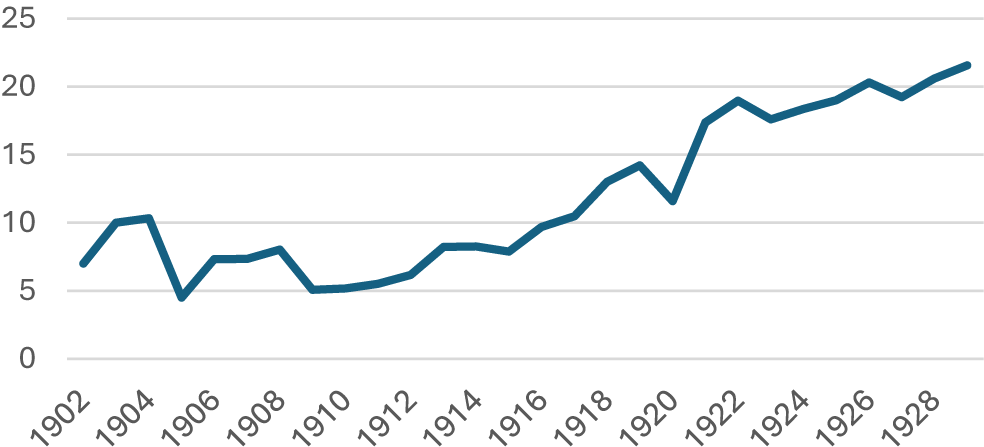
Against the backdrop of Japan’s economic rise after World War I (1914–1918), the consumption of sugar grew steadily, partly as a result of falling sugar prices (Figure 1).Footnote 22 This increase in overall sugar consumption aligned with the rapid growth of the Western-style confectionery industry in Japan. As a result of the war, major European confectionery manufacturers faced significant setbacks. This created an opportunity for Japanese companies to establish and strengthen their domestic market presence, as Japan’s economy was relatively less affected. The number of confectionery companies mushroomed: by 1919, there were 143 registered companies, or roughly twice as many as there had been before the war. Their combined capital reached 7.77 million yen, more than five times the prewar total. Caramels and chocolates grew in popularity alongside the postwar economic boom and an expanding consumer base. Such market growth was accompanied by the introduction of new technology by companies like Morinaga Confectionery that helped make mass production possible. Thanks to their successes in the field, in 1918 Morinaga contributed its milk caramels to the military again during the Japanese Siberian Intervention (Shiberia shuppei).Footnote 23 In short, many factors fueled the expanding market for Western-style confectionery, including capitalism, technology, and the increasing influence of militarism, which would become more pronounced in the years ahead.
Japan proper’s per capita consumption of sugar (national consumption rate). Unit: kin (1 kin = 0.6 kg).
Source: Kōno, Nihon-tōgyō hattatsu-shi shōhi-hen, 277.

Figure 1. Long description
The horizontal X axis represents years from 1902 to 1928, labeled at two-year intervals. The vertical Y axis represents the national consumption rate in kin, with increments of 5 from 0 to 25.
* From 1902 to 1912, the data shows a volatile but relatively low consumption rate, fluctuating between 5 and 10 kin.
* A sharp dip occurs around 1905, followed by a gradual rise.
* Starting in 1912, there is a consistent linear increase, reaching approximately 15 kin by 1919.
* A significant drop occurs in 1920, followed by a rapid surge to nearly 20 kin by 1922.
* The final period from 1922 to 1928 shows a steady upward trajectory, peaking at over 20 kin at the end of the timeline.
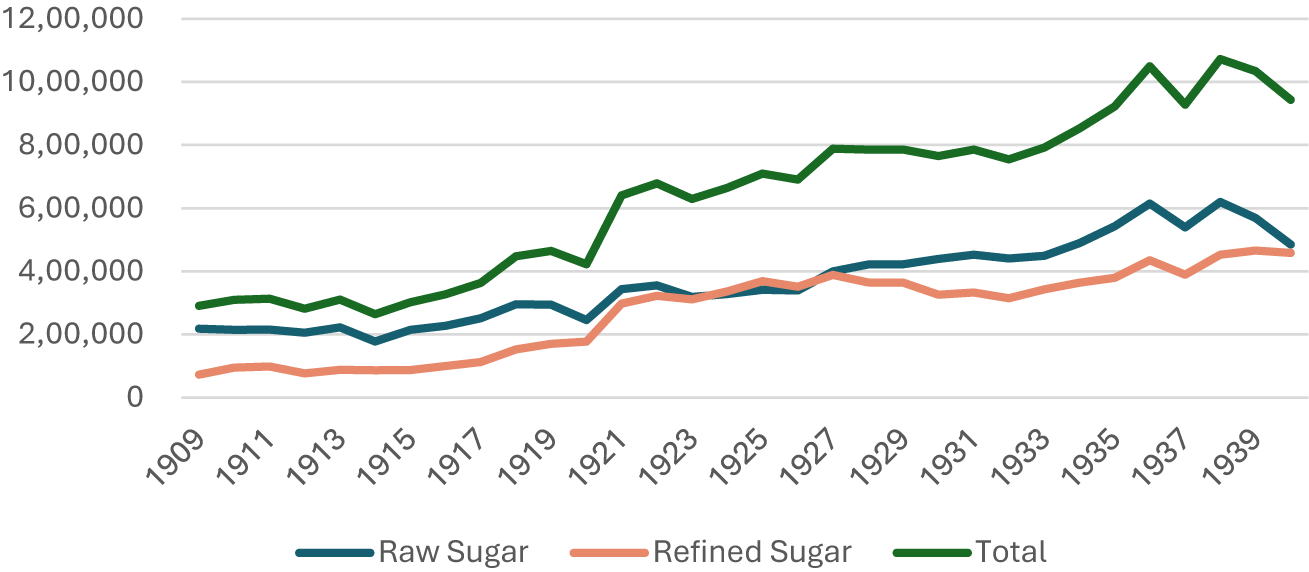
Exactly how much confectionery goods were consumed in prewar Japan is an important question, but a difficult one to answer. There were no direct surveys of confectionery consumption, so our understanding of how much was consumed in prewar Japan is based largely on estimates derived from the statistical data on sugar consumption in total. In 1928, one journalist estimated that Japan spent nearly 500 million yen annually on confectionery consumption, based on the data that some 1.3 billion kin of sugar was consumed annually in Japan.Footnote 24 Over a longer period, the total estimated confectionery production peaked at over 1 million tons in the mid-1930s. The production of confectionery made from refined sugar, which aligns more closely with our focus on Western-style sweets, accounted for slightly less than half of total sugar production. At its peak, it reached over 400,000 tons (Figure 2).Footnote 25 This estimate is in line with a 1932 report stating that the Japanese consumed 500-million-yen worth of confectionery annually, and that Western-style confectionery accounted for between 20 and 30 percent of that total.Footnote 26
Value of confectionery production estimated from sugar consumption (Unit: Ton).
Source: Long-Term Economic Statistics (LTES), Hitotsubashi University.

Figure 2. Long description
The x-axis represents years from 1909 to 1940 in two-year increments. The y-axis represents production in tons, ranging from 0 to 1,200,000 with intervals of 200,000. Three lines are plotted.
* The green line representing Total production starts at approximately 300,000 in 1909, remains relatively flat until 1917, then shows a significant upward trend with peaks in 1922, 1927, and a final peak near 1,100,000 in 1938 before a slight decline.
* The blue line representing Raw Sugar starts at approximately 200,000 in 1909, follows a similar but lower trajectory than the total, peaking at roughly 600,000 in 1938.
* The orange line representing Refined Sugar starts below 100,000 in 1909 and shows a steady, gradual increase over the thirty-year period, eventually converging with the Raw Sugar line around 1927 before continuing a slow climb to nearly 500,000 by 1940.
From a more micro perspective, the prices of Western-style confectionery may tell us much about their social position in the Japanese Empire’s economic life. In prewar Japan, the cost of a high-end bentō box meal was 60 sen in 1889 and rose to 108 sen in 1938, before the advent of wartime price controls.Footnote 27 A small box of Western-style confectionery, therefore, cost about one fifth to one tenth as much as a proper meal. In the first half of the twentieth century, the price of Morinaga Confectionery’s products remained steady at around 10–12 sen per box. However, the products were becoming more affordable as the number of pieces in each box increased over time. In 1908, a box of milk caramels priced at 10 sen contained 10 candies; by 1914, the same amount of money would buy a box with 20 candies.Footnote 28 In comparison, in 1917, a bar of soap also cost 10 sen, while a pack of Golden Bat tobacco sold for around 6 sen.Footnote 29 This price level was also maintained in the colonies of Taiwan and Korea, where advertisements for Morinaga’s caramels described them as selling for 5 sen or 10 sen per box; a few more expensive varieties were available for between 15 and 20 sen each.Footnote 30 Even during the Second Sino-Japanese War in 1940, the price of the caramels remained around 10 sen per box.Footnote 31 Considering that a public servant’s salary was 75 yen a month in 1937, a box of confectionery was not as expensive as a luxury item, yet also not necessarily affordable for everyday consumption.Footnote 32
While the consumption of Western-style confectionery remained comparatively modest in the prewar period and did not expand significantly until the postwar years, this dissertation argues that a commodity’s influence cannot be measured by consumption figures alone. It also lay in the scale of its marketing and in the desires and aspirations it generated among consumers who could not yet afford to purchase it. Even without directly consuming these goods, people could be profoundly shaped by the meanings attached to them, including particular visions of modernity and the ideologies promoted by their producers that were in line with the Japanese Empire’s discourses. This owed much to the fact that the confectionery industry was intricately tied to the exploitation of colonial capital, the adoption of new food manufacturing technologies, innovative marketing strategies, and ultimately to fervent support for war and militarism.
The Three Confectionery Companies
The focus of this study is on three confectionery companies—Morinaga Confectionery, Meiji Confectionery, and Niitaka Confectionery—given their significance in the market during the prewar period.Footnote 33 In my analysis, I specifically examine their distinctive ties to the formation of the Japanese Empire and to Japan’s colonialism in Taiwan.
The first company was Morinaga Confectionery. Founded in 1899 by Morinaga Taichirō (1865–1937), who brought back the technology of making Western-style confectionery from the United States to Japan. The company’s innovative marketing methods ultimately played a key role in popularizing products such as caramel and chocolate in prewar Japan. Mostly known for their caramels wrapped in yellow boxes today, little was known about their involvement in the empire. In Chapter Two, I explore how Morinaga Confectionery was involved in planting cocoa in East Coast Taiwan to make chocolate in collaboration with the Governor General, which resulted in the displacement of the Indigenous community. On the marketing side, the company executed many campaigns with imperial and militaristic goals, including the employment of a Korean giant as the “Caramel General,” who toured from Sakhalin to Taiwan (Chapter Five), and the organization of a drawing contest that celebrated Japan’s alliance with Nazi Germany and Mussolini’s Italy in 1938 (Chapter Six).
The second company, Meiji Confectionery, is also still thriving today and is known for its chocolates. Its founder, Sōma Hanji (1869–1946), was educated in Europe and the United States as a government-sponsored student specializing in sugar science. He also took part in the Japanese colonial government’s reform of Taiwan’s sugar industry. Sōma began his career at Meiji Sugar, one of the four major sugar companies operating in Japanese colonial Taiwan. In 1917, the company officially expanded into confectionery manufacturing with the establishment of Meiji Confectionery. Namely, the Meiji Company’s founder was involved in the reform of Taiwan’s sugar industry, which was one of Japan’s most enduring colonial assets. Over time, Meiji grew into a large conglomerate, producing everything from raw materials to finished consumer products, with its factories and commercial networks extending across the Japanese Empire. During wartime (1937–1945), Meiji Confectionery also contributed many of its products for Japanese soldiers fighting on the front line.
Finally, this is the first study in English on Niitaka Confectionery, the only major confectionery company in prewar Japan based in Taiwan but later expanded widely across the Japanese Empire from Japan proper to Manchuria.Footnote 34 The founder of the company, Mori Heitarō (1869–1946), was a Japanese man from Kyushu who immigrated to Taihoku (Taipei), the capital of Taiwan, and started his business there. Mori’s successful business in Taiwan demonstrates how settlers benefited from the colonial structure in the economic sphere (Chapter Two). Niitaka’s case thus allows me to explore the relationship between the state and businesses using emerging analytical frameworks such as those associated with the study of settler colonialism, focusing on actors who lacked direct ties to the colonizing state but profited from its structures and systems.Footnote 35
Among the three companies, Niitaka Confectionery was the only one that did not survive the fall of the Japanese Empire. Today, products of Morinaga and Meiji Confectionery still fill the taste buds of East Asian children with sweetness, while their “dark history” involving colonialism and war remains unexamined. Instead, sweet treats like the Morinaga caramel, Meiji chocolate, and candy drops have become another form of Japan’s “soft power,” akin to Nintendo’s Pokémon—harmless and nostalgic, far removed from imperial or anti-Communist propaganda. Those companies no longer rely explicitly on colonial practices in their production but rather on those associated with global capitalism. Our knowledge about sugar’s effects on the body has also changed drastically since the war.Footnote 36 As sugar and sweets are now seen as threats to our health, consuming chocolates and caramels has shifted from being a means of cultivating strong, state-aligned bodies to a guilty pleasure—something almost entirely personal. The purpose of this study is thus to remind us that power operates not only through military force and coercion, but also through forms of attraction and desire generated by capitalism—a “sweet” form of power that can sometimes be far more difficult to resist.

 Open access

