INTRODUCTION
Since the seminal paper of Bensch et al. (Reference Bensch, Sjernman, Hasselquist, Östman, Hansson, Westerdahl and Pinheiro2000), the diversity of avian malaria parasites uncovered by molecular methods is astonishing. Currently, 1545 lineages of Plasmodium, Haemoproteus and Leucocytozoon have been described from a portion of the cytochrome b gene (MalAvi database http://mbio-serv2.mbioekol.lu.se/Malavi/, consulted in October 2014, Bensch et al. Reference Bensch, Hellgren and Pérez-Tris2009), and c. 104 lineages are currently thought to occur in nature. These lineages are very variable regarding their geographical and host distributions, and even those differing by a single base-pair substitution in the analysed fragment can be associated with remarkable ecological differences (e.g. Reullier et al. Reference Reullier, Pérez-Tris, Bensch and Secondi2006), suggesting that they may represent different species. Malaria parasites can have a severe effect on the fitness of their hosts, particularly when infecting naïve species, though most often small or no effects are described (Ortego et al. Reference Ortego, Cordero, Aparicio and Calabuig2008; Atkinson and Samuel, Reference Atkinson and Samuel2010; Asghar et al. Reference Asghar, Hasselquist and Bensch2011). There is a large variation in parasite diversity and prevalence between hosts, but the factors influencing this variation are little known (Scheuerlein and Ricklefs, Reference Scheuerlein and Ricklefs2004). Hence, describing malaria parasites in as many hosts and vectors as possible and with appropriate sample sizes is needed to understand this variation, as well as to monitor the emergence and spread of new diseases, particularly in vulnerable species.
The Aquatic Warbler (Acrocephalus paludicola) is a globally-threatened, long-distance migratory passerine that breeds in fen mires across Central Europe and winters in sub-Saharan West Africa (AWCT, 1999; Flade et al. Reference Flade, Diop, Haase, Le Neve, Oppel, Tegetmeyer, Vogel and Salewski2011; Foucher et al. Reference Foucher, Boucaux, Giraudot, André, Lorrillière and Dougué2013). Its population size and range strongly declined during the past century due to habitat loss, and the current estimate is between 10 000 and 14 000 singing males (AWCT database, unpublished). In autumn, most birds migrate through Western Europe, being regular in France, Holland, Belgium and Southern Britain, and then south over Spain, Portugal and Morocco (Julliard et al. Reference Julliard, Bargain, Dubos and Jiguet2006; Neto et al. Reference Neto, Encarnação and Fearon2010), until reaching the main wintering areas in Senegal and probably elsewhere in West Africa (Flade et al. Reference Flade, Diop, Haase, Le Neve, Oppel, Tegetmeyer, Vogel and Salewski2011; Foucher et al. Reference Foucher, Boucaux, Giraudot, André, Lorrillière and Dougué2013).
In this study, we collected blood samples of Aquatic Warblers just before they left Europe, during autumn migration in Portugal, and at the wintering quarters in Senegal, and analysed them to detect infection by Plasmodium and Haemoproteus parasites. Given that parasite diversity is highly dependent on the host's population range and size (Kamiya et al. Reference Kamiya, O'Dwyer, Nakagawa and Poulin2014), threatened animals tend to harbour few parasites (Altizer et al. Reference Altizer, Nunn and Lindenfors2007). Hence, we hypothesize that, in contrast to most other Acrocephalus species analysed so far, Aquatic Warbler population size would be too small and fragmented to maintain specialized parasites. We further compare differences in Haemosporidia prevalence between Europe and Africa, as well as between adults and first-year birds.
MATERIALS AND METHODS
Blood samples were collected at Salreu marshlands (40·7333°; −8·5936°), Portugal, during August and September 2009 to 2013 (one sample c. 50 km further south at Mondego River estuary; 40·1020°; −8·7969°); as well as during the winter (December to February) at Djoudj National Park, Senegal (16·4389°; −16·2396°), from 2007 to 2009 (see Flade et al. Reference Flade, Diop, Haase, Le Neve, Oppel, Tegetmeyer, Vogel and Salewski2011 for details of the African expeditions). The birds were caught with mist nets, marked with a metal ring, measured for wing length (maximum chord) and weight, and aged (first-year/adult) following Svensson (Reference Svensson1992). Blood samples were taken by puncturing the brachial vein, stored in 70% ethanol, and the birds were released unharmed at the ringing site. The range of sampling dates and the occurrence at these sites of birds originating from multiple breeding populations buffers potential temporal and geographical variation, that is, avoids to some extent local effects and years with unusual diversity and prevalence of parasites for this host.
DNA was extracted from the blood following standard phenol or salt extraction methods, and part of the Cytochrome b gene of Plasmodium and Haemoproteus parasites was amplified through a nested PCR as described by Hellgren et al. (Reference Hellgren, Waldenström and Bensch2004). PCR products were run in an agarose gel to detect infected individuals, which were then sequenced using the same PCR primers. Sequence editing, blasting and alignment (with sequences from the MalAvi database; Bensch et al. Reference Bensch, Hellgren and Pérez-Tris2009) were performed in Geneious R6 (Biomatters, available from www.geneious.com) to identify the parasites. Positive control guaranteeing the quality of the DNA was provided by genotyping microsatellites in African samples (Flade et al. Reference Flade, Diop, Haase, Le Neve, Oppel, Tegetmeyer, Vogel and Salewski2011), and by molecular sexing of the Portuguese samples, for which the Z002 primer pairs (Dawson, Reference Dawson2007) were used following the procedures described by Neto et al. (Reference Neto, Hansson and Hasselquist2011). Four individuals for which the sex had been determined in the field (from signs of the presence of a brood patch) were correctly identified by the molecular method as females, indicating that, as with other bird species, Z002 primers work well in Aquatic Warblers (Dawson, Reference Dawson2007; Neto et al. Reference Neto, Hansson and Hasselquist2011). As a consequence, two individuals that could not be sexed and for which no parasite had been detected were excluded from the dataset.
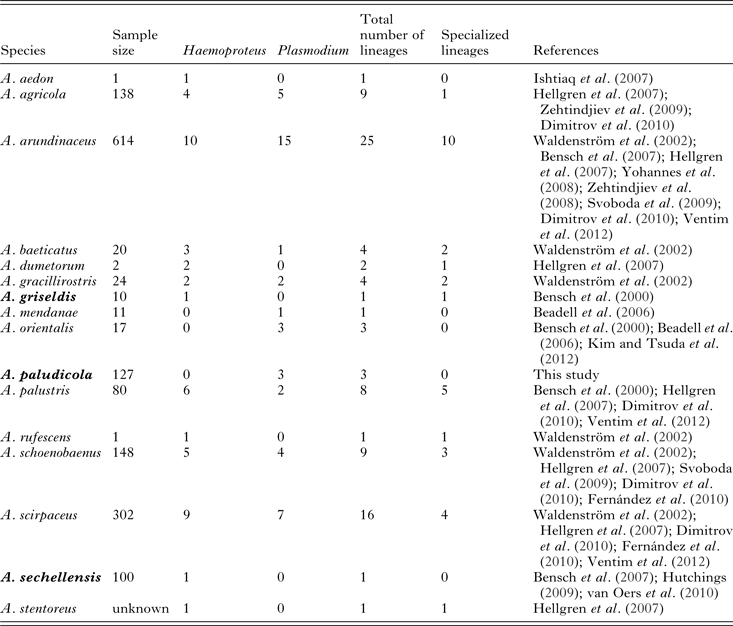
We evaluated the extent to which the threatened Acrocephalus species, in particular the Aquatic and Seychelles Warblers Acrocephalus sechellensis (but not Acrocephalus griseldis, which had a low sample size; see Table 1), showed a diversity of parasites lower than expected by fitting a regression between sample size and number of lineages per species. The diversity of malaria parasites infecting the various species of Acrocephalus warblers and the number of samples screened were extracted from the MalAvi database (Bensch et al. Reference Bensch, Hellgren and Pérez-Tris2009). However, for a few species the sample size was not available because the original studies focused only on infected individuals, the extent of overlap of samples between studies was not fully described, or sample sizes occasionally included multiple samples collected from the same individuals during their lifetime. Hence, the original articles were also consulted and, when needed, the authors contacted, but one species (Acrocephalus stentoreus) still had to be excluded from this analysis, as well as some studies for which sample sizes were not provided (implying the exclusion of two malaria parasites known to infect Acrocephalus palustris).
Host species names (genus Acrocephalus), sample size (number of different individuals screened using PCR), number of lineages of Haemoproteus and Plasmodium that were detected according to this study (for A. paludicola) and in the references. Specialized lineages are those that were detected only in host species of the genus Acrocephalus. Species in bold are globally threatened, although A. griseldis was not considered as such in our study because of its small sample size

RESULTS
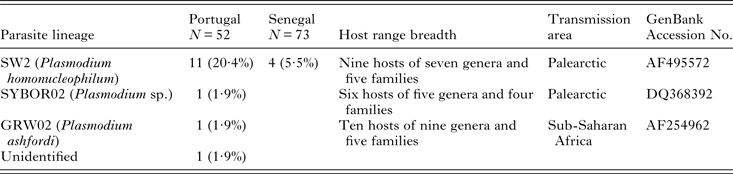
Only three parasite lineages were found in Aquatic Warblers, all of them belonging to the genus Plasmodium (Table 2): SW2 was by far the most common one and was detected both in European and African samples, whereas SYBOR02 and GRW02 were found in single individuals in Europe. These three parasites are host generalists, infecting birds belonging to multiple genera and families (Table 2). The presence of SW2 in three juveniles caught in Portugal confirms that this parasite is transmitted in Europe, as these birds had never been in Africa. No differences were found in prevalence between sexes (five out of 23 females and eight out of 28 males were infected in Europe; χ2 = 0·3, d.f. = 1: P = 0·58), but adults (10 out of 26 were infected) had significantly higher prevalence than juveniles (three out of 26 were infected; χ2 = 6·3, d.f. = 1: P = 0·012). In addition, prevalence of malaria parasites in Europe (26·9%) was significantly higher than in Africa (5·4%; χ2 = 9·1, d.f. = 1: P = 0·003; Table 2).
Number of infected birds of each parasite lineage at Salreu, Portugal, and Djoudj, Senegal. Information on morphological species, GenBank accession number, other hosts and confirmed transmission area (i.e. parasites were found in juvenile birds in the breeding region and/or in resident hosts) is also provided, using data from the MalAvi database (Bensch et al. Reference Bensch, Hellgren and Pérez-Tris2009)

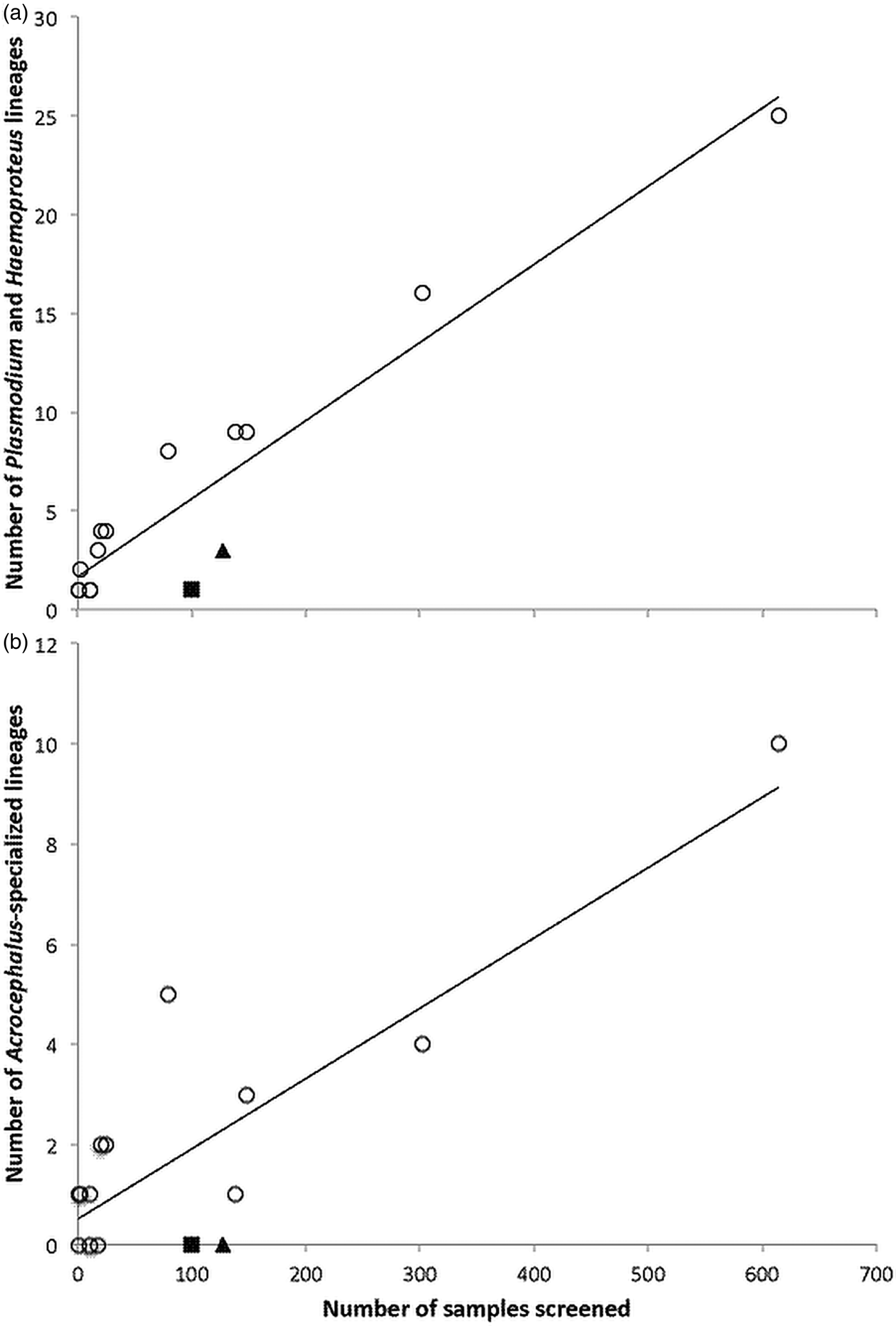
The total number of Plasmodium and Haemoproteus lineages that were found in Acrocephalus warblers increased linearly with the number of host samples screened (NH) following the function number of lineages = 1·714 + 0·039 × NH (F 1;11 = 91·6; P < 0·001; R 2 = 0·879). Relative to this function, Aquatic and Seychelles (A. sechellensis) Warblers had the most negative residuals (Fig. 1a, Table 1). That is, considering sample size, these two threatened bird species had the lowest diversity of parasites of all Acrocephalus (Fig. 1a, Table 1). Similar results were produced when only Acrocephalus-specialist lineages were included (number of lineages = 0·423 + 0·014 × NH; F 1;11 = 34·5; P < 0·001; R 2 = 0·758), as Seychelles and Aquatic Warblers were only infected by generalists, in contrast to all other Acrocephalus for which sample sizes were greater than 17 (Fig. 1b, Table 1). The inclusion of quadratic components did not improve these relationships, being non-significant (P > 0·16), and the linear relationship remained highly significant when the two most sampled species (Great Reed Warbler Acrocephalus arundinaceus and Reed Warbler Acrocephalus scirpaceus) were excluded from the dataset.
Relationship between number of samples screened and (a) total number of malaria (Haemoproteus and Plasmodium) parasite lineages or (b) number of Acrocephalus-specialized malaria lineages found among Acrocephalus warblers. Black triangle – A. paludicola (this study); black square – A. sechellensis. These data are also presented in Table S1.

DISCUSSION
Molecular methods have revealed the existence of a huge diversity of avian malaria parasites, which show a large variation in the degree of host specialization (e.g. Hellgren et al. Reference Hellgren, Waldenström, Pérez-Tris, Szöllösi, Hasselquist, Krizanauskiene, Ottosson and Bensch2007, Reference Hellgren, Pérez-Tris and Bensch2009; Drovetski et al. Reference Drovetski, Aghayan, Mata, Lopes, Mode, Harvey and Volker2014). Generally, hosts are predominantly infected by a few parasite lineages, but can have many other rare lineages that presumably spill over from other hosts where they are commoner (Hellgren et al. Reference Hellgren, Pérez-Tris and Bensch2009; Drovetski et al. Reference Drovetski, Aghayan, Mata, Lopes, Mode, Harvey and Volker2014). Here we show that the diversity of parasites in Acrocephalus warblers is so high that sample sizes over 600 (individuals) are not enough to reach an asymptote of lineages, not even when only Acrocephalus-specialized lineages are taken into account (Fig. 1, Table 1).
Hosts can be considered as the habitat where parasites live and, as with any other species, when the habitat becomes scarce, the probability of extinction increases. This is particularly true for the most specialized species, which do not tolerate other habitats or, in the case of parasites, cannot find alternative competent hosts. Generalist, vector-borne parasites are not expected to be affected by the small population size/range of any particular host, but the overall parasite diversity of these rare hosts could still be affected if the proportion of specialist parasites is generally high among the abundant hosts. Accordingly, in the globally-threatened Aquatic Warbler, which has small and fragmented populations (AWCT, 1999), we only detected very generalist parasites capable of infecting several bird species of various families. Thus, fulfilling our expectation, Aquatic Warblers, as well as the insular Seychelles Warbler, both of which are globally threatened, had the lowest diversity of parasites of all Acrocephalus species considering their sample sizes.
We found that the prevalence of Haemosporidia parasites in Aquatic Warblers was greater in Europe than in Africa. This implies that infected birds either fought the disease successfully or perished sometime during the autumn migration or early at the winter quarters. Another possibility is that many infections acquired during the breeding season might become dormant during the winter (with parasites withdrawing to other tissues or occurring at parasitaemia levels below the detection limit of our protocol) and then relapse during spring. These hypotheses are not mutually exclusive and it is very likely that they occur simultaneously. Indeed, within-individual analysis detected cases in which infections were cleared in Acrocephalus warblers (e.g. Bensch et al. Reference Bensch, Waldenström, Jonzén, Westerdahl, Hansson, Sejberg and Hasselquist2007; van Oers et al. Reference van Oers, Richardson, Sæther and Komdeur2010). On the other hand, although mortality due to disease is very difficult to detect in natural populations, van Oers et al. (Reference van Oers, Richardson, Sæther and Komdeur2010) showed that survival probability was lower in infected than in uninfected birds in the resident Seychelles Warbler (but see Hutchings, Reference Hutchings2009), although that was not the case in Great Reed Warblers (Bensch et al. Reference Bensch, Waldenström, Jonzén, Westerdahl, Hansson, Sejberg and Hasselquist2007). In Garden Warblers Sylvia borin, the overall prevalence of Haemosporidian parasites was lower during the mid-migration periods and also late in winter (Hellgren et al. Reference Hellgren, Wood, Waldenström, Hasselquist, Ottosson, Stervander and Bensch2013), suggesting that higher prevalence might be expected also in Aquatic Warblers during the breeding season. However, as shown by Cosgrove et al. (Reference Cosgrove, Wood, Day and Sheldon2008), parasites vary in their annual dynamics, making predictions very difficult without a deep knowledge of these parasites and their interactions with the host.
In contrast with Seychelles, Reed and Sedge Warblers (Hutchings, Reference Hutchings2009; Fernández et al. Reference Fernández, Rojo, Casanueva, Carrión, Hernández and Campos2010; van Oers et al. Reference van Oers, Richardson, Sæther and Komdeur2010) but similarly to other species (e.g. Willow Warblers Phylloscopus trochilus, Bensch and Åkesson 2003; and Blue Tit Cyanistes caeruleus, Cosgrove et al. Reference Cosgrove, Wood, Day and Sheldon2008; Podmokła et al. Reference Podmokła, Dubiec, Drobniak, Arct, Gustafsson and Cichoń2014), first-year Aquatic Warblers had a lower prevalence of malaria parasites than adults, and no differences were found between sexes. Differences in prevalence between age and sex classes seem to be quite variable in birds and are generally little understood. Birds can get infected very early in life, even at the nest (e.g. Weatherhead and Bennett, Reference Weatherhead and Bennett1991; but see Cosgrove et al. Reference Cosgrove, Knowles, Day and Sheldon2006). However, long-distance migrants are expected to show higher prevalence in adults than first-years, as individuals only get exposed to many of the parasites lineages when they reach the wintering areas. This might not be the case in Aquatic Warblers though, as the only parasite lineage detected in this species that is known to be transmitted in the winter quarters had a very low prevalence (Table 2). Aquatic Warblers have the lowest prevalence of malaria parasites (14·3%) of all Acrocephalus species analysed to date and for which sample sizes were higher than 50. Indeed, Reed and Sedge Warblers have very high prevalences, ranging c. 70–85% (e.g. Fernández et al. Reference Fernández, Rojo, Casanueva, Carrión, Hernández and Campos2010), Great Reed and Seychelles Warbler range from c. 43–52% (Hutchings, Reference Hutchings2009), whereas Marsh A. palustris and Paddyfield Warblers Acrocephalus agricola range c. 25–34% (Hellgren et al. Reference Hellgren, Waldenström, Pérez-Tris, Szöllösi, Hasselquist, Krizanauskiene, Ottosson and Bensch2007; Zehtindjiev et al. Reference Zehtindjiev, Ilieva, Krizanauskiene, Oparina, Oparn and Bensch2009; Dimitrov et al. Reference Dimitrov, Zahtindjiev and Bensch2010). This is surprising given that generalist malaria parasites such as the ones infecting Aquatic Warblers tend to have higher prevalence (Hellgren et al. Reference Hellgren, Pérez-Tris and Bensch2009). We suggest that the very specific habitat favoured by Aquatic Warblers throughout the year, which is shared by few other bird species, decreases the opportunity for infection. However, it is also possible that Aquatic Warblers are particular susceptible to malaria parasites, and the mortality associated with the disease (either directly or through predation) would constrain the sampling of infected birds, thereby appearing that the prevalence is low.In contrast, their immunological system could be very efficient in dealing with the infections, which could be cleared up rapidly with relatively few birds maintaining chronic infections. This could generate the same sampling bias as a high mortality, especially if (acutely) infected birds are more inactive and therefore less likely to be caught by mist netting. It would be interesting to test these hypotheses in future studies (where serological methods could be used to determine the host's exposure to Haemosporidian parasites and compared with PCR measures of active infection), which could also have important conservation implications. Differences in diversity and prevalence between species, age and sex classes can only be addressed through adequate comparative analyses, for which this study is expected to be a useful contribution.
ACKNOWLEDGEMENTS
The capture, ringing and sampling of birds was conducted under the licenses required by the corresponding national authorities, following standard protocols and releasing the birds unharmed on site. Permits and rings were provided by CEMPA, Instituto de Conservação da Natureza e Florestas (99/2011, 112/2012) for work in Portugal, and by CRBPO, Muséum National d'Histoire Naturelle, France, for work in Senegal. We are indebted to Magnus Loven Wallerius and Tommaso Biglino for performing part of the lab work, to the many members of the Aquatic Warbler Conservation Team that helped collecting samples in Africa, and to Ibrahima Diop and the staff of the Djoudj National Bird Sanctuary.
FINANCIAL SUPPORT
The African expeditions were supported by the German Ornithological Society (DO-G), RSPB, CMS Secretariat and Schmidt-Felsche-Foundation. JMN was supported by the Portuguese Foundation for Science and Technology through grant SFRH/BPD/40667/2007. APR was funded through the FPU scheme of the Spanish Ministry of Education.