INTRODUCTION
Electoral monitors are supposed to reduce fraud by deterring politicians from committing electoral wrongdoings and helping to rectify those that do occur after the fact (Donno Reference Donno2007; Hyde Reference Hyde2007; Kelley Reference Kelley2010; McFaul Reference McFaul2007). But, do citizens think that electoral monitors help make elections more democratic? Citizens’ perceptions of electoral monitors in this regard are important because how democratic people think elections are can affect people’s trust in government (Birch Reference Birch2010; Hall, Alvarez and Atkeson 2012; Norris Reference Norris2010); their likelihood of protesting elections and engaging in political violence afterwards (Beaulieu Reference Beaulieu2014; Hyde and Marinov Reference Hyde and Marinov2014; Tucker Reference Tucker2007); the willingness of people to participate in politics and turnout at the polls (Birch Reference Birch2010; Domínguez and McCann Reference Domínguez and McCann1998; Fairbanks Reference Fairbanks2004; Klesner and Lawson Reference Klesner and Lawson2001; Kerevel Reference Kerevel2009; Lott Jr. Reference Lott2006); as well as the likelihood of opposition candidates to boycott elections (Beaulieu and Hyde Reference Beaulieu and Hyde2009).
In order to test the effect of electoral monitors on citizens, I conducted a field experiment around the first round of the 2009/2010 municipal elections in Kosova in which I varied the information people had in the country about the responsibilities of electoral monitors in these elections. If people believe that electoral monitors are effective in reducing electoral malfeasance, they should believe that electoral monitors are more effective, the more responsibilities monitors have in elections and the more informed people are about these responsibilities. The more aspects of the electoral process that monitors observe, the more opportunities there are for monitors to catch would-be-cheaters, and the fewer places there are in which malfeasance can be displaced.
PARTICIPANTS
The field experiment was conducted in 15 voting centers (VC) in Kosova located in eight municipalities across all five regions of the country.Footnote 1 Prior to the experiment, VCs were matched in blocks of three representing the three experimental conditions in the study using high-dimensional blocking. The VCs were matched in terms of the issues most likely to affect people’s perceptions of electoral monitors and their propensity to vote, namely past turnout, past competitiveness, and size. The 15 VCs chosen for the experiment were those that matched most closely along these dimensions.Footnote 2 These VCs were also located at a significant physical distance from each other, minimizing any potential violations in the stable unit treatment value assumption (SUTVA). Within blocks, VCs were randomly assigned to treatment and control groups. All individuals within each VC were in the same experimental condition. The experiment included 29,020 participants (9,938 in the information treatment condition, 8,792 in the reminder condition, and 10,290 in the no contact condition). The postexperiment survey, which took place approximately two weeks after the elections, included 400 people – 200 people randomly sampled from the five VCs in the treatment condition and 100 people randomly sampled from the five VCs in each of the two control conditions. Index Kosova, an independent survey firm, conducted the survey face-to-face using the random route method to select households within VCs and the next birthday method to select individuals within households.
EXPERIMENTAL CONDITIONS
The experiment consisted of three conditions – a treatment condition (information [I]) and two control conditions (reminder [R] and no contact [NC]). Those in the treatment condition received a flyer informing people about the work of the monitors, while those in the reminder condition received a flyer announcing the elections. Those in the no contact condition received no flyer at all. All the flyers were printed in Albanian in colors that did not favor a particular political party or ethnic group. Paid volunteers hand-delivered the flyers to individual homes approximately two weeks prior to the elections.
The monitoring flyer informed people that electoral monitors would observe the elections and delineated their various responsibilities. These responsibilities included: verifying the voter registration lists, visiting the polling stations on election day, checking that ballots were secret and secure, verifying the vote count after the elections, and reporting on the overall fairness and openness of the elections. Electoral monitors were present on election day at every polling station in the country. The flyers were written in a neutral tone and staid language to inform people about the work of the monitors, and not to endorse the monitors or persuade people to value them in any way. Prior to the elections, most people were likely to have known that electoral monitors would observe the elections, but they were not likely to have known much about the monitors beyond this fact. The government had informed people before the elections that monitors would be present in the elections through its voter education materials while the local media (e.g., newspaper, radio, and television) had reported on the names and numbers of monitors accredited to observe the elections, but neither the government nor the media had discussed the responsibilities of the monitors beyond election-day observation.Footnote 3
The reminder flyer informed people of the date of the elections and the names of the 36 municipalities holding elections. The reminder flyer was identical to the monitoring flyer except that it included a map of Kosova and a list of the municipalities holding elections in the country instead of information about the responsibilities of the monitors. The language in these flyers was carefully chosen to simply remind people about the elections, not to rally them to vote in the elections. The purpose of the reminder condition was to ensure that any difference between the treatment and the two control conditions was attributable to the monitors, and not to being contacted about the election. To draw this conclusion, the results of the information condition have to be significantly different from both the reminder and no contact conditions.
RESULTS
In brief, the results show that people who received the monitoring flyer perceived the elections to be more free and fair than those in the two control conditions both prior to and after the elections occurred, and also believed pre- and postelection that the monitors helped make these elections more free and fair, although only the latter effect for the preelection period was statistically significant. However, those who received the monitoring flyer were not more likely to vote than those in the two control conditions.
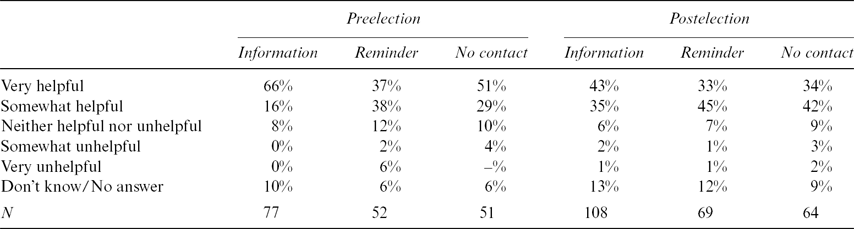
Prior to the election, 66% of those in the information condition but only 44% of those in the two control conditions (R = 37%; NC = 51%) said that they expected the electoral monitors to be “very helpful” in making the elections free and fair, a 20% difference between the conditions (χ2, p ⩽ 0.01 level). (See Table 1.) The effect of the information condition on the extent to which people expected monitors to be helpful in making the elections free and fair remains significant in an ordered logit model controlling for an individual’s interest in politics, ethnicity, and the competitiveness of the municipal election (p ⩽ 0.01 level). None of the control variables are significant in this analysis.
Overall Evaluation of the Helpfulness of Electoral Monitors
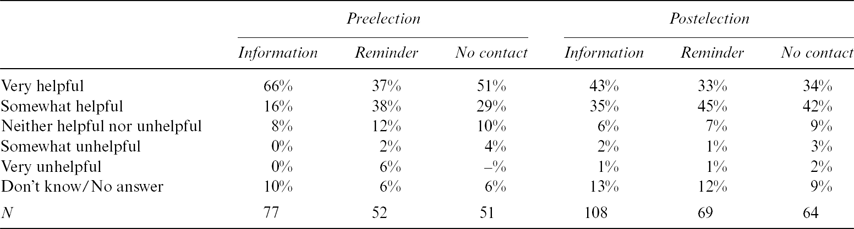
Note: Responses do not necessarily sum to 100% due to rounding. Preelection helpfulness question: Before the November 15th elections were held, how helpful did you expect electoral observers to be in making these elections “free and fair”? N = 180. Postelection helpfulness question: Now that the municipal elections are over, how helpful do you think the electoral observers actually were in making these elections “free and fair”? N = 241. Respondents were asked to evaluate the elections using the following criteria for “free and fair”: 1. All political parties and candidates have an opportunity to participate in the election; 2. All people can vote in the election and can vote for whomever they choose; 3. Voting is private and ballots are secret and secure; 4. The electoral process is transparent and free from fraud; 5. Everyone has an opportunity to report problems and irregularities in the elections and their complaints are responded to in a fair and timely manner. The results are substantively and statistically the same if Block 2 is excluded from the analysis due to distribution problems with the flyers in Randobravë.
Following the elections, the percentage of people in both the treatment and control conditions who said that the monitors were helpful in making the elections free and fair is lower, although a higher percentage of those in the treatment condition still see the monitors as “very helpful” in making the elections free and fair than those in the two control conditions. Specifically, 43% in the information condition and 34% in the two control conditions (R = 33%; NC = 34%) said that the electoral monitors were “very helpful” in making the elections free and fair after they occurred.Footnote 4 The differences among the treatment and two control conditions for this question are not statistically significant according to a χ2 test. This effect remains insignificant in an ordered logit model controlling for an individual’s interest in politics, ethnicity, satisfaction with the outcome of the election, personal observation of polling station irregularities, and competitiveness of the municipal election. None of the control variables are significant in this model.
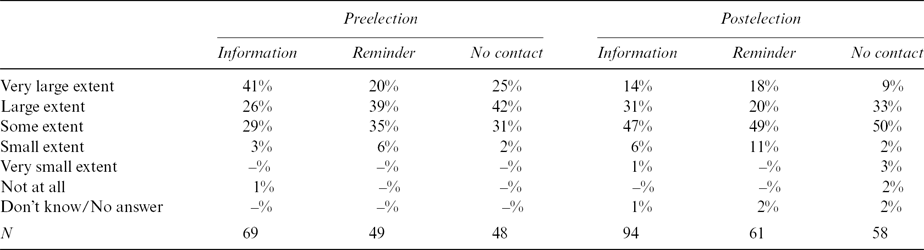
More people in the information condition also considered the elections to be more “free and fair” overall than those in the two control conditions although these differences are not significant (See Table 2).Footnote 5 Nearly twice as many people – 41% in the information condition and 23% in the two control conditions (R = 21%; NC = 25%) said that they expected the elections to be free and fair to a “very large extent” prior to them occurring. However, the differences among the treatment and control conditions for this question are not significant according to a χ2 test. They remain insignificant in an ordered logit model controlling for interest in politics, ethnicity, and competitiveness of the municipal elections. None of the control variables are significant in this model. The insignificance of these results may be due to the somewhat smaller N for this question.
Overall Evaluation of the “Free and Fairness” of Elections
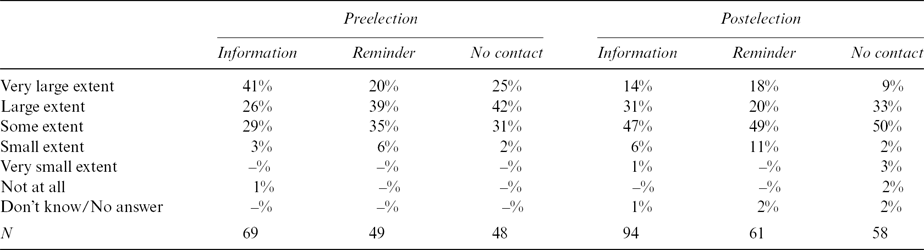
Note: Responses do not necessarily sum to 100% due to rounding. Preelection expectations: “Using this standard, to what extent did you expect the Nov. 15th elections to be ‘free and fair’ prior to them occurring?” N = 166. Postelection evaluation: “Now that the elections are over, to what extent do you feel that the November 15th municipal elections actually were ‘free and fair’?” N = 213. Respondents were asked to evaluate the elections using the following criteria for “free and fair”: 1. All political parties and candidates have an opportunity to participate in the election; 2. All people can vote in the election and can vote for whomever they choose; 3. Voting is private and ballots are secret and secure; 4. The electoral process is transparent and free from fraud; 5. Everyone has an opportunity to report problems and irregularities in the elections and their complaints are responded to in a fair and timely manner. The results are substantively and statistically the same if Block 2 is excluded from the analysis due to distribution problems with the flyers in Randobravë.
The percentage of respondents who thought that the elections were free and fair to a “very large extent” after they occurred was only 14% for the information and 13% for the two control conditions (R = 18%; NC = 9%), a significant decrease in the percentage of those who thought they would be free and fair prior to the elections taking place. The differences among the treatment and two controls conditions for this question are also not significant according to a χ2 test. People were asked to evaluate the overall quality of the elections at the beginning of the survey before they were asked any questions about the monitors so that the latter would not influence the former. The effect of the treatment remains insignificant in an ordered logit model controlling for an individual’s interest in politics, ethnicity, satisfaction with the election outcome, and personal observation of polling station irregularities. The latter two variables are significant in this model. One reason that people’s evaluations of the monitors and the overall quality of the elections may have declined after the elections is because there was more fraud in the elections than people had anticipated.
People who received the information condition were not more likely to vote, however, than those in the control conditions. I measure voting behavior in this study both in terms of reported turnout and actual turnout since the latter can be tainted by fraud although fraud is unlikely to have differentially affected the treatment and control conditions so as to have biased the results. Estimates of reported turnout also tend to be inflated upwards because people often misreport voting in elections due to social norms about voting (Holbrook and Krosnick Reference Holbrook and Krosnick2010). However, this tendency should not affect the results of the survey since people in the treatment and control conditions should both overreport turnout.
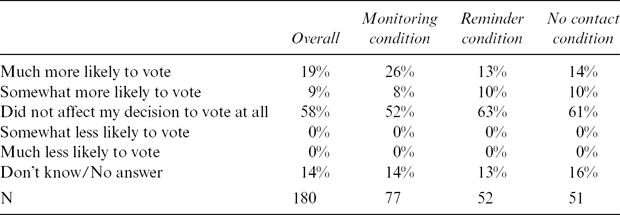
Overall, 58% of those surveyed said that knowing that electoral observers would monitor the elections “did not affect their decision to vote at all.” Only 28% of those surveyed said that it made them “more likely to vote.” (See Table 3.) Those in the information condition stated this more often than those in the two control conditions, but this difference is not significant according to a χ2 test. The effect of the information condition remains insignificant in a statistical analysis controlling for the effect of interest in politics, a person’s perceived ability to influence local politics, and the competitiveness of the elections.
Reported Influence of Electoral Monitors on Likelihood of Voting
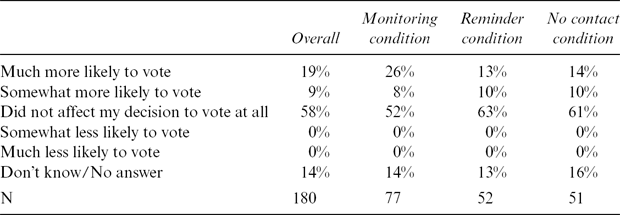
Note: Responses do not necessarily sum to 100% due to rounding. The question for which the results are reported above asked “Did knowing that election observers were going to monitor the November 15 th elections affect your decision to vote?”
Those who said that the monitors made them more likely to vote did not actually vote more often than those who said that the monitors did not influence their decision to vote at all, according to their self-reported voting behavior.Footnote 6 In explaining why electoral monitors did (or did not) influence their decision to vote, nearly two-thirds of the people surveyed mentioned other issues as their reason for (not) voting, such as civic duty/obligation, free will, and the state of Kosova’s political and economic affairs.Footnote 7
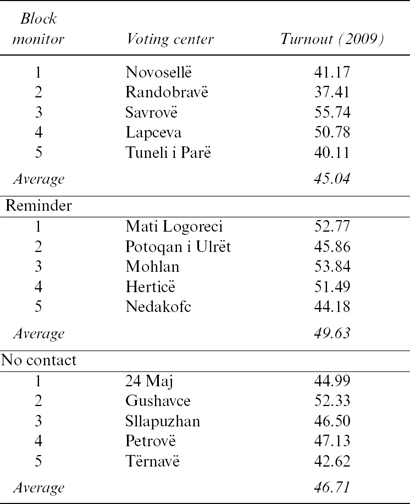
Consistent with these findings from the postelection survey, I found that information about the monitors did not affect people’s actual voting behavior based on the government’s official electoral returns. That is, those in the information condition did not vote significantly more often than those in the reminder or no contact conditions.Footnote 8 (See Table 4.)
Voter Turnout (2009)
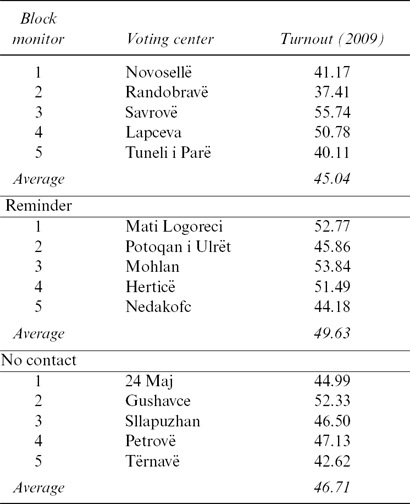
Note: Kosovars in the information condition did vote significantly more often than those in the no contact condition if Block 2 is excluded from the analysis due to distribution problems with the flyers in Randobravë. But, even after excluding this block, people in the information condition did not vote significantly more often than those in the reminder condition. As a result, I cannot conclude that this difference is attributable to the monitors per se, but to the flyers serving as a reminder about the elections. These results are based on a logistic regression analysis of actual voting as the dependent variable and the treatment condition as the independent variable and the competitiveness of the municipality (2009) as a control variable with Block 2 excluded.
CONCLUSION
The results of the experiment demonstrate that at least in the right circumstances, electoral monitors can help build people’s confidence in the integrity of elections. In Kosova, the circumstances were propitious because the government gave the monitors a wide mandate in the election and because the monitors had many resources to carry this mandate out. Future research is needed to investigate how different characteristics of electoral monitors and the context in which monitors are deployed are likely to impact the extent to which electoral monitors are able to build people’s confidence in the integrity of elections.