Hibbing et al. describe a conventional interpretation of political psychology that rests on the assumption that people who advocate different political ideals possess relatively distinct, and somewhat hard-wired or trait-like, “organizational” (i.e., cognitive) tendencies. More nuanced models of political ideology suggest instead that self-reported political opinions and judgments reflect facultative and stylistic (i.e., expressive) biases in how people advertise their “reciprocity potential,” or perceived value to other people, via basic social-signaling patterns (Vigil Reference Vigil2009). In this commentary we describe an alternative model to Hibbing et al.'s “negativity bias” model, and conduct a study to directly measure the predictive validity of the two competing models using a facial discrimination paradigm.
Our socio-relational perspective of political ideologies subsumes the following five premises: (1) social signaling (communicative) systems underlie social cognition; (2) expressive behaviors are composed of capacity cues and trustworthiness cues (see Vigil [2009] for detailed examples); (3) capacity cues (e.g., expressed confidence) are implicitly functional for attracting novel relationship partners and for maintaining larger social networks, whereas trustworthiness cues (e.g., expressed vulnerability) are better at regulating relationships within more consolidated and intimate social networks; (4) people implicitly advertise capacity cues when they experience social and/or material resource acquisition, and they instead advertise trustworthiness cues when they experience resource losses; and (5) individual and group differences in expressive styles are measurable through self-reported opinions and judgments about internal (e.g., self-esteem) and external (e.g., societal views) stimuli and/or events.
We previously showed that self-identified Democrats and Republicans report facial judgment biases that can support both the negativity bias and the socio-relational models of political ideology (Vigil Reference Vigil2010). People self-identified as Republicans were more likely to interpret ambiguous facial stimuli as expressing threatening emotions as compared to self-identified Democrats (e.g., anger and fear vs. joy and sadness). However, when participants' facial judgments were coded as either conveying capacity (e.g., dominant) or trustworthiness (e.g., submissive) attributes, we found that Republicans were more likely to report viewing capacity emotions (e.g., anger and joy), whereas Democrats were more likely to report viewing trustworthiness emotions (e.g., fear and sadness). Democrats also reported having smaller peer networks, and experiencing greater emotional distress including higher rates of crying behaviors, emotional pain, and lower life-satisfaction. We interpreted the findings as evidence that people who experience conditional hardships have adopted an expressive style that is characterized by demonstrations of vulnerabilities (e.g., low mood), as well as demonstrations of altruism (e.g., liberal platform ideals) for regulating smaller, more intimate social networks. The converse interpretation is that experiential prosperities motivate the expression of empowerment demonstrations (e.g., high confidence, conservative platform ideals) that operate to regulate larger peer networks. Thus, both models had components that appeared to be supported by our previous data.
Here we conduct a follow-up study using a more standardized facial stimuli-set to examine if self-identified liberals and conservatives show facial expression judgment biases that are more in line with either a negativity-bias model or with a socio-relational model. Eight hundred and sixty seven people from a college and community sample completed a survey designed to measure individual differences in “political attitudes” in the immediate months preceding and following the 2012 U.S., presidential election (mean age=25 yr, 39% males). Using a 1–5 scale for current voting decisions, 54% of participants described themselves as more likely to vote or having voted for the Democrat presidential candidate, 25% as more likely to vote or having voted for the Republican candidate, and 21% as completely undecided. Facial stimuli were created using FaceGen software (Modeler 2.0, Singular Inversion Inc.), which creates 3D faces programmed to display several basic facial expressions of emotion. Six ambiguous facial stimuli were created by simultaneously setting the facial expression parameters to the maximum levels for two discrete emotions, for every combination of emotions, from a total of four distinct emotions: sadness, joy, fear, and anger. Under each sketch, participants were instructed to identify the facial expression as displaying either: anger (A), joy (J), fear (F), or sadness (S). To test the negativity bias model, participants' responses were coded according to whether the reported emotion facilitates affiliation (joy or sadness coded 0) or avoidance/negativity/aversion (anger or fear coded 1). To test the socio-relational model, the responses were coded according to whether the reported emotion displays capacity (anger or joy coded 0) or trustworthiness (fear or sadness coded 1). For each set of contrasts, the facial judgment scores were summed across all six facial stimuli.
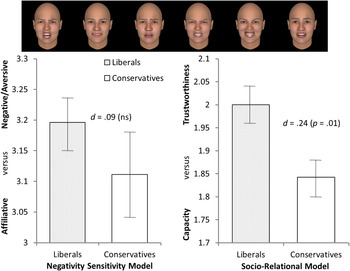
The stimuli and the results of the independent-samples t-tests examining the predictive validity of the two models among participants who indicated a voting preference (somewhat or very likely to vote either Democrat or Republican) are shown in Figure 1. No group differences in facial judgment biases were detected when the stimuli were coded as either conveying affiliative or negative/aversive emotions, t(541) = 1.09, p = .38 (Fig. 1a). In contrast, a significant group difference in facial judgments emerged when the responses were coded as either conveying capacity or trustworthiness emotions, t(541) = 2.48, p = .01 (Fig. 1b). The findings showed that conservatives were more likely to report viewing capacity emotions than were liberals, or conversely, liberals were more likely to report viewing trustworthiness emotions than were conservatives. The findings remained the same after controlling for age and sex, F(1,529) = 6.68, p = .01.
Figure 1.
Test of alternative models for predicting facial expression judgments based on political affiliation.
These findings contradict the main prediction from the negativity-bias model and provide more support for the socio-relational thesis that self-reported political affiliations (and ideals) are correlated with differential expressive styles for heuristically advertising the trustworthiness (Democrats) versus the capacity (Republicans) dimensions of reciprocity potential (Vigil Reference Vigil2009; Reference Vigil2010). From this perspective, self-reported political views are not based on distinct, traitlike dispositions or cognitive tendencies, but rather they are mere examples of content that people use as part of broader expressive styles for facultatively advertising capacity and trustworthiness cues to others. This thesis challenges many conventional explanations of political psychology.





Hibbing et al. describe a conventional interpretation of political psychology that rests on the assumption that people who advocate different political ideals possess relatively distinct, and somewhat hard-wired or trait-like, “organizational” (i.e., cognitive) tendencies. More nuanced models of political ideology suggest instead that self-reported political opinions and judgments reflect facultative and stylistic (i.e., expressive) biases in how people advertise their “reciprocity potential,” or perceived value to other people, via basic social-signaling patterns (Vigil Reference Vigil2009). In this commentary we describe an alternative model to Hibbing et al.'s “negativity bias” model, and conduct a study to directly measure the predictive validity of the two competing models using a facial discrimination paradigm.
Our socio-relational perspective of political ideologies subsumes the following five premises: (1) social signaling (communicative) systems underlie social cognition; (2) expressive behaviors are composed of capacity cues and trustworthiness cues (see Vigil [2009] for detailed examples); (3) capacity cues (e.g., expressed confidence) are implicitly functional for attracting novel relationship partners and for maintaining larger social networks, whereas trustworthiness cues (e.g., expressed vulnerability) are better at regulating relationships within more consolidated and intimate social networks; (4) people implicitly advertise capacity cues when they experience social and/or material resource acquisition, and they instead advertise trustworthiness cues when they experience resource losses; and (5) individual and group differences in expressive styles are measurable through self-reported opinions and judgments about internal (e.g., self-esteem) and external (e.g., societal views) stimuli and/or events.
We previously showed that self-identified Democrats and Republicans report facial judgment biases that can support both the negativity bias and the socio-relational models of political ideology (Vigil Reference Vigil2010). People self-identified as Republicans were more likely to interpret ambiguous facial stimuli as expressing threatening emotions as compared to self-identified Democrats (e.g., anger and fear vs. joy and sadness). However, when participants' facial judgments were coded as either conveying capacity (e.g., dominant) or trustworthiness (e.g., submissive) attributes, we found that Republicans were more likely to report viewing capacity emotions (e.g., anger and joy), whereas Democrats were more likely to report viewing trustworthiness emotions (e.g., fear and sadness). Democrats also reported having smaller peer networks, and experiencing greater emotional distress including higher rates of crying behaviors, emotional pain, and lower life-satisfaction. We interpreted the findings as evidence that people who experience conditional hardships have adopted an expressive style that is characterized by demonstrations of vulnerabilities (e.g., low mood), as well as demonstrations of altruism (e.g., liberal platform ideals) for regulating smaller, more intimate social networks. The converse interpretation is that experiential prosperities motivate the expression of empowerment demonstrations (e.g., high confidence, conservative platform ideals) that operate to regulate larger peer networks. Thus, both models had components that appeared to be supported by our previous data.
Here we conduct a follow-up study using a more standardized facial stimuli-set to examine if self-identified liberals and conservatives show facial expression judgment biases that are more in line with either a negativity-bias model or with a socio-relational model. Eight hundred and sixty seven people from a college and community sample completed a survey designed to measure individual differences in “political attitudes” in the immediate months preceding and following the 2012 U.S., presidential election (mean age=25 yr, 39% males). Using a 1–5 scale for current voting decisions, 54% of participants described themselves as more likely to vote or having voted for the Democrat presidential candidate, 25% as more likely to vote or having voted for the Republican candidate, and 21% as completely undecided. Facial stimuli were created using FaceGen software (Modeler 2.0, Singular Inversion Inc.), which creates 3D faces programmed to display several basic facial expressions of emotion. Six ambiguous facial stimuli were created by simultaneously setting the facial expression parameters to the maximum levels for two discrete emotions, for every combination of emotions, from a total of four distinct emotions: sadness, joy, fear, and anger. Under each sketch, participants were instructed to identify the facial expression as displaying either: anger (A), joy (J), fear (F), or sadness (S). To test the negativity bias model, participants' responses were coded according to whether the reported emotion facilitates affiliation (joy or sadness coded 0) or avoidance/negativity/aversion (anger or fear coded 1). To test the socio-relational model, the responses were coded according to whether the reported emotion displays capacity (anger or joy coded 0) or trustworthiness (fear or sadness coded 1). For each set of contrasts, the facial judgment scores were summed across all six facial stimuli.
The stimuli and the results of the independent-samples t-tests examining the predictive validity of the two models among participants who indicated a voting preference (somewhat or very likely to vote either Democrat or Republican) are shown in Figure 1. No group differences in facial judgment biases were detected when the stimuli were coded as either conveying affiliative or negative/aversive emotions, t(541) = 1.09, p = .38 (Fig. 1a). In contrast, a significant group difference in facial judgments emerged when the responses were coded as either conveying capacity or trustworthiness emotions, t(541) = 2.48, p = .01 (Fig. 1b). The findings showed that conservatives were more likely to report viewing capacity emotions than were liberals, or conversely, liberals were more likely to report viewing trustworthiness emotions than were conservatives. The findings remained the same after controlling for age and sex, F(1,529) = 6.68, p = .01.
Test of alternative models for predicting facial expression judgments based on political affiliation.
These findings contradict the main prediction from the negativity-bias model and provide more support for the socio-relational thesis that self-reported political affiliations (and ideals) are correlated with differential expressive styles for heuristically advertising the trustworthiness (Democrats) versus the capacity (Republicans) dimensions of reciprocity potential (Vigil Reference Vigil2009; Reference Vigil2010). From this perspective, self-reported political views are not based on distinct, traitlike dispositions or cognitive tendencies, but rather they are mere examples of content that people use as part of broader expressive styles for facultatively advertising capacity and trustworthiness cues to others. This thesis challenges many conventional explanations of political psychology.