


Introduction
It is generally agreed that multiple factors play into the development of Obsessive Compulsive Disorder (OCD). Genetic factors are supported by findings such as higher rates of OCD in first degree relatives of those with OCD (10.3–11.7%) versus first-degree relatives of controls (1.9–2.7%) (Nestadt et al., Reference Nestadt, Samuels, Riddle, Bienvenu, Liang, LaBuda, Walkup, Grados and Hoehn-Saric2000); higher concordance rates among monozygotic (MZ) than dizygotic (DZ) twins (van Grootheest, Cath, Beekman and Boomsma, Reference Van Grootheest, Cath, Beekman and Boomsma2005) and that heritability rates of OCD symptoms are 45–65% in children and 27–47% in adults (van Grootheest et al., Reference Van Grootheest, Cath, Beekman and Boomsma2005). Culture, family, and other environmental factors also play into the development and maintenance of OCD. Individuals who later develop OCD have been found to be raised in homes that model avoidance of fearful events or difficult situations and do not foster autonomy (e.g. Henin and Kendall, Reference Henin and Kendall1997). Family support affects the likelihood of treatment success (Steketee, Reference Steketee1993). Finally, a number of cognitive styles, such as inflated responsibility, have been implicated in the development and maintenance of OCD (e.g. Salkovskis Reference Salkovskis1985), coupled with lower levels of autonomy likely play into the development of OCD in twins. Thus, this issue is not as simple as “nature” versus “nurture”. The interplay between the two should be a clinical focus. For example, research has shown that exposure with ritual prevention (ERP) can produce similar changes in right caudate glucose metabolic activity as pharmacotherapy as measured by a positron emission tomography (Baxter et al., Reference Baxter, Schwartz, Bergman, Szuba, Guze, Mazziotta, Alazraki, Selin, Ferng, Munford and Phelps1992).
Case studies of twins with OCD highlight this interplay including co-occurring development of the disorder, supporting each other's disorder, and similarity of presentations including comorbid diagnoses (van Grootheest et al., Reference Van Grootheest, Cath, Beekman and Boomsma2005). The environment they share is greater than just siblings because they are the same age and likely appearance and, if raised together, shared many of the same experiences. Although the co-occurrence of OCD in twins is low, when it occurs it presents an environmental context that must be addressed in therapy. Currently, there are no available studies that provide evidence or guidance on the treatment of co-occurring cases of OCD in twins.
Measures
The Yale-Brown Obsessive Compulsive Scale (YBOCS) measures the severity of OCD. Scores range from 0 to 40. Lower scores represent less severe OCD.
The Obsessional Belief Questionnaire-Revised (OBQ-R) measures beliefs that may predispose people to OCD and allow OCD to maintain. It has three subscales: responsibility/threat estimation, importance/control of thoughts, and perfectionism/intolerance of uncertainty. Averaged overall scores range from 1 to 7 and lower scores represent a lesser amount of the construct.
The Thought Action Fusion scale (TAF) measures the extent to which participants equate thought and action on a 0 to 4 scale. It has two subscales: likelihood and moral TAF. Lower scores indicate less of this construct.
The Beck Anxiety Inventory (BAI) and the Beck Depression Inventory-II (BDI-II) are the most commonly used measures of anxiety and depression. Lower scores indicate less depression and anxiety.
Participants A and B: description and clinical outcomes
The first set of MZ twins were 33-year-old, cohabiting unmarried females who lived together for 10 years, and had a history of major depressive disorder (MDD). Both twins were sexually and physically abused by their father and also observed their mother's physical abuse. Participant A reported having OCD for 11-years involving fears of contamination and corresponding washing (approximately 3 hours of hand washing and showering per day); responsibility fears and corresponding checking (e.g. locks and appliances); and repeating activities to stop something bad from happening to a loved one.
Participant A reported that she was treated as the “older” of the twins, was more dominant, and given more responsibility. Participant B initially washed her hands only to comply with her sister's wishes, but gradually adopted her sister's fears, and 7 years later began having her own obsessions and compulsions. Participant B obsessed about contracting an illness from a contaminant and being responsible for something bad happening to others because of her “bad” thinking. Washing hands and showering occupied 3–4 hours a day; she did 25 loads of laundry per week; and had the same checking routines as her sister. Some of the checking duties were shared (e.g. alternating days responsible for checking doors).
Pre- and post-treatment assessments involved completing the SCID, YBOCS, OBQ-R, TAF, and BDI-II. Everything but the SCID was also completed at three follow-up assessments. A combination of cognitive therapy and ERP was provided conjointly in 16 one-hour sessions over 7 months. Special attention was paid to the interactions between the twins. The twins agreed to refrain from alerting each other to potentially careless behavior and questioning each other regarding their responsibilities; to not engage in compulsions or avoidance if requested by the sibling; and to live as if the sibling did not have OCD.
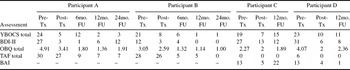
Table 1 illustrates clinical reductions in OCD and depression severity, with reductions generally being maintained. They began with clinically notable scores on the OBQ and had modest changes at post with continued improvement at follow-up points. Similar findings occurred for TAF. It appears they were immediately successful at the behavior change component as represented in the YBOCS scores, but additional time was needed to incorporate cognitive skills.
Assessment scores at for all assessment points

YBOCS = Yale-Brown Obsessive Compulsive Scale; BDI-II = Beck Depression Inventory-II; OBQ = Obsessive Belief Questionnaire total score; TAF = Thought Action Fusion Scale total score; BAI = Beck Anxiety Inventory.
Participants C and D: description and clinical outcomes
Participants C and D were 23-year-old MZ twin males of mixed ethnic heritage (Eastern Europe and Asia). They lived together at their parent's home and were full-time university students. They experienced nearly identical OCD and Tourette's disorder (TD). They reported having tics “as far back as they can remember”, and OCD consisting of perfectionism and ordering started at 6 years of age. Even when very young they supported each other's perfectionism during activities such as coloring and reading comic books. They reported an “unspoken agreement” that they were the only ones who understood each other, and that they “kept pace with each other” on OCD-like behaviors. Their parents never intervened because their mother had tics when she was younger so she was not very concerned about their tics or OCD.
OCD involved symmetry and exactness, discomfort when things were not organized, touching/checking certain things until it “felt just right”, re-reading materials or understanding every part of the page, and list making. They spent approximately 90 minutes per day on compulsions. They also found that one could sometimes more effectively engage in the other's compulsion and thereby reduce the other's obsession and anxiety. They reported a history of depression, with Participant D experiencing stronger and more frequent depressive episodes. Participant C's tics involved a grunting sound, and “twitches” of his head and arms. Participant D's tics involved clicking his jaw, rotating his left wrist and ankle, and aligning his two shoulders so they were level.
Prior to beginning treatment, the twins completed the SCID, YBOCS, BDI-II, OBQ, TAF and BAI. Assessments were completed again at post-treatment and one year later. Participant C was referred for group treatment of OCD. Part way through his treatment he reported that his twin brother was also referred, but that he was hesitant to receive treatment until he saw how his brother (Participant C) responded to treatment. Participant D began treatment 4 weeks after his brother. Both received ERP and Habit Reversal (HR).
Table 1 illustrates that both participants experienced decreases in OCD and these gains were maintained for one of the twins at 12-month follow-up. Scores on the BAI followed a similar pattern. BDI-II scores dropped and were maintained at follow-up. Total scores on the OBQ and TAF were below the clinical mean at all points. Both participants met criteria for TD at pre- but not post-treatment, although formal measures of severity were not used.
Discussion
In this case series, two sets of twins with co-occurring OCD were treated using CBT and ERP or ERP and HR. In the first case, the twins were treated at the same time, but in the second case they were treated separately. Notable reductions in OCD were seen for all four participants, with reductions being maintained at follow-up for all but one. It is somewhat unclear why Participant D did not maintain gains at follow-up; his OBQ and TAF scores remained low. He reported that the increase in OCD and anxiety were likely related to the relationship problems he was experiencing at follow-up. Notable reductions in comorbid diagnoses were seen. Slight reductions on measures of cognitive constructs were seen at post with continued gains at follow-up for the first group, and the second was already at low levels at pretreatment.
This case series offers a picture of the development, maintenance, and treatment of cohabiting MZ twins with co-occurring OCD. It is possible that these shared environments affected the development of particular cognitive styles and the development of their similar presentations of OCD. First, both sets of twins were raised in environments that may have fostered the development of OCD: an unpredictable one involving abuse for participants A and B, and acceptance of tics and compulsions because of the mother's past TD for participants C and D. It was notable that both sets of twins reported influencing their sibling's development of the disorder, and that both sets of twins developed the same types of OCD and comorbid conditions. “Enabling” or supporting the sibling's OCD was very common with both sets. Participants A and B alternated days that compulsions were performed and C and D would perform compulsions for each other. Finally, in the case of A and B their co-therapy seemed to be necessary in the long-term reductions of OCD as they originally highly supported each other's OCD. Similarly, Participant D would not start treatment until he saw improvement in Participant C. These factors highlight the social interplay between cohabiting MZ twins with OCD that may not be present in other co-occurring cases of OCD. It is hoped that the findings of this case series will shed some light on the treatment of co-occurring cases of twins with OCD.




Comments
No Comments have been published for this article.