Introduction
The family Zoogonidae Odhner, 1902 is one of the taxonomically problematic groups of trematodes, which was periodically revised on the basis of the morphological and biological features of its representatives (Bray and Gibson, Reference Bray and Gibson1986; Bray, Reference Bray1986, Bray, Reference Bray, Bray, Gibson and Jones2008, Blend et al., Reference Blend, Racz and Gardner2020; Sokolov et al., Reference Sokolov, Shchenkov, Gordeev and Ryazanova2021a, Kremnev et al., Reference Kremnev, Gonchar, Uryadova, Krapivin, Skobkina, Gubler and Krupenko2023). Bray (Reference Bray, Bray, Gibson and Jones2008) recognised two subfamilies within the family Zoogonidae: Zoogoninae Odhner, 1902 and Lepidophyllinae Stossich, 1903. Recently, the subfamilies Cephaloporinae Yamaguti, 1934 and Lecithostaphyllinae Odhner, 1911 were resurrected within Zoogonidae (Blend et al., Reference Blend, Racz and Gardner2020; Sokolov et al., Reference Sokolov, Shchenkov, Gordeev and Ryazanova2021a). According to Bray (Reference Bray, Bray, Gibson and Jones2008), the subfamily Zoogoninae comprises nine genera of intestinal trematodes of marine, anadromous, and amphidromic fishes. Among representatives of Zoogoninae, long-term studies mainly concern two species, Zoogonoides viviparus (Olsson, 1868) and Pseudozoogonoides subaequiporus (Odhner, 1911), which are type species for respective genera (Bray and Gibson, Reference Bray and Gibson1986, Bray, Reference Bray1986). These species have a wide and similar composition of definitive host species and their areas are overlapping. Morphologically, representatives of these two genera differs by vitellaria structure and arrangement and extension of caeca (Bray, Reference Bray1986). At present, according to the World Register of Marine Species database (https://www.marinespecies.org/), there are eight and two species represented within Zoogonoides and Pseudozoogonoides, respectively. The systematic of the subfamily Zoogoninae as well as the family Zoogonidae is mainly based on the morphology of adult worms. Molecular data for representatives of Zoogoninae are available only for Pseudozoogonoides subaequiporus, Zoogonoides viviparus, and Diphterostomum sp. (Olson et al., Reference Olson, Cribb, Tkach, Bray and Littlewood2003; Kremnev et al., Reference Kremnev, Gonchar, Uryadova, Krapivin, Skobkina, Gubler and Krupenko2023). Results of several phylogenetic studies based on molecular data show that Zoogonodae is non-monophyletic, but formed strongly supported monophyly with representatives of Faustulidae; the problem actively discussed and still unresolved (Hall et al., Reference Hall, Cribb and Barker1999; Sun et al., Reference Sun, Bray, Yong, Cutmore and Cribb2014; Sokolov et al., Reference Sokolov, Shchenkov, Gordeev and Ryazanova2021a; Reference Sokolov, Shchenkov and Gordeev2021b).
In the present study, we provide new morphological and molecular data for trematodes of Zoogonidae recovered from fish Pseudaspius hakonensis (Günther, 1877) caught in Gamayunova River estuary and Vostok Gulf shell waters, south of the Russian Far East (Figure 1). Using these data, we performed species identification and reconstruction of the phylogenetic relationships of the studied trematodes within the Zoogonidae.
The localities of collection of Pseudaspius hakonensis specimens on the south of Russian Far East territory. This map was prepared with the Yandex Map Constructor web service.

Material and Methods
Material collection
Three and ten fish specimens of Pseudaspius hakonensis were caught in the Gamayunova River estuary (43°13’01.9"N 132°22’47.7"E) and Vostok Bay shell waters (42°54’18.4"N 132°43’30.5"E), respectively. Adult trematodes were found in two and three fish specimens from respective localities. Infection intensity was 9 and 3 from fishes from the Gamayunova River estuary, and from 5 to 35 from the Vostok Bay fish specimens. Overall, 52 trematode specimens were collected.
Morphological analysis
Worms were defined under a microscope using temporal slides preparation technique, rinsed in pure water, and preserved in 70% ethanol. After fixation, they were replaced in 96% ethanol. Whole mounts were made by staining specimens with alum carmine, dehydrating in graded ethanol series and clearing in clove oil, followed by mounting the specimens in Canada balsam under coverslips on glass slides. All measurements of trematode morphometrics (range values) are given in micrometres.
DNA extraction, amplification and sequencing
Overall, nine specimens of Pseudozoogonoides ugui, including seven from Vostok Bay and two from Gamayunova River, were analysed with molecular approach. Total DNA of Pseudozoogonoides ugui was extracted from adult 96% ethanol-fixed specimen using a DNeasy Blood and Tissue kit (Qiagen, Toronto, ON, Canada) per the manufacturer’s instructions. The polymerase chain reaction (PCR) amplification volume amounted to 10 μL containing 5 μL GoTaq Green Master Mix, 1 μL each primer, 1 μL DNA template and 3 μL sterile deionised water. 28S ribosomal DNA (rDNA) was amplified with the primers 28SA (5′-TCG ATT CGA GCG TGA WTA CCC GC-3′) (Matejusova and Cunningham, Reference Matejusova and Cunningham2004) and 1500R (5′-GCT ATC CTG AGG GAA ACT TCG-3′) (Tkach et al., Reference Tkach, Littlewood, Olson, Kinsella and Swiderski2003) with an annealing temperature of 55°C. A ribosomal ITS1-5.8S-ITS2 fragment was amplified with primers BD1 (5’-GTC GTA ACA AGG TTT CCG TA-3’) and BD2 (5’-TAT GCT TAA ATT CAG CGG GT-3’) (Luton et al., Reference Luton, Walker and Blair1992) with an annealing temperature of 54°C. Negative and positive controls using both primers were included. Products were sequenced using the internal sequencing primers described by Tkach et al. (Reference Tkach, Littlewood, Olson, Kinsella and Swiderski2003) for 28S rDNA and Luton et al. (Reference Luton, Walker and Blair1992) for the ITS2 rDNA fragment. PCR products were directly sequenced using an ABI Big Dye Terminator v.3.1 Cycle Sequencing Kit (Applied Biosystems, USA) following the manufacturer’s recommendations. PCR product sequences were determined using an ABI 3500 genetic analyzer at the Federal Scientific Center of the East Asia Terrestrial Biodiversity FEB RAS. The sequences were submitted to the GenBank database (NCBI) (Table 1).
List of taxa incorporated in the molecular analysis of the superfamily Microphalloidea with the number of 28S rDNA sequences given in parentheses

n/a, not yet available.
Alignments and phylogenetic analysis
Ribosomal DNA sequences were assembled with SeqScapev.2.6 software provided by Applied Biosystems. Alignment and estimations of the number of variable sites and sequence differences were performed using MEGA 7.0 software (Kumar et al., Reference Kumar, Stecher and Tamura2016). After the first alignment procedure, all used data were processed with the Gblocks Server (http://phylogeny.lirmm.fr/phylo_cgi/one_task.cgi?task_type=gblocks). The values of genetic p-distances were calculated for the 28S rDNA and ITS2 rDNA fragments data set. The ITS2 sequence region had a length of 241 bp.
Phylogenetic analysis of the Zoogonidae was performed on the basis of the 28S rDNA dataset 1262 bp in length using the Maximum Likelihood (ML) and Bayesian Inference (BI) algorithms with the PhyML 3.1 and MrBayes 3.2.6. software, respectively (Guindon and Gascuel, Reference Guindon and Gascuel2003; Ronquist et al., Reference Ronquist, Teslenko, Mark, Ayres, Darling, Höhna, Larget, Liu, Suchard and Huelsenbeck2012). The best nucleotide substitution models, the TVM+I+G and GTR+I+G (Posada and Crandall, Reference Posada and Crandall1998), were estimated with jModeltest v. 2.1.5 software (Darriba et al., Reference Darriba, Taboada, Doallo and Posada2012) for 28S rDNA for Bayesian (BIC criterion) and ML (AIC criterion) algorithms, respectively (Ronquist et al., Reference Ronquist, Teslenko, Mark, Ayres, Darling, Höhna, Larget, Liu, Suchard and Huelsenbeck2012; Akaike, Reference Akaike1974). Bayesian analysis was used with the following parameters: nst = 6, rates = gamma, Revmatpr = estimate, statefreqpr = estimate, shapepr = estimate and ngen = 1000000 via four simultaneous Markov Chain Monte Carlo chains (nchains = 4) with every 100th tree saved (samplefreq = 100) and two independent runs with the standard deviation of split frequencies at 0.0035. Summary parameters and the phylogenetic tree were calculated with a burn-in of 250,000 generations. Nodal support was estimated as posterior probabilities in the Bayesian inference analyses (Huelsenbeck et al., Reference Huelsenbeck, Ronquist, Nielsen and Bollback2001) and an approximate likelihood-ratio test (Anisimova and Gascuel, Reference Anisimova and Gascuel2006) for the ML algorithm. Accession numbers, authority, and supporting information about 28S rDNA sequences from GenBank used for the phylogenetic analyses are provided in Table 1. Plagiorchis elegans and Neoglyphe sobolevi (Plagiorchioidea) were used as an outgroup. Accession numbers of the ITS2 sequences used for genetic distance calculation are: OP956013-OP956014, OP956017-OP956019 for Z. viviparus and OP956023-OP956028 for P. subaequiporus. The nucleotide sequences of ITS2 and 28S rDNA for trematodes P. ugui were submitted to the NCBI database with following accession numbers: PP317537-PP317541 and PP317542-PP317550, respectively.
Results
Description
Pseudozoogonoides ugui Shimazu, Reference Shimazu1974
Host : Pseudaspius hakonensis (Cyprinidae)
Site : Intestine
Localities : Gamayunova River estuary, Primorsky Region, south of the Russian Far East, 43°13’01.9"N 132°22’47.7"E; Vostok Bay shell waters, Primorsky Region, south of the Russian Far East, 42°54’18.4"N 132°43’30.5"E.
Intensity of infection: 3–35 worms per fish
Extensiveness of infection: 30–66%
Materials deposited. Materials no. 243-248-Tr are deposited in the parasitological collection of the Zoological Museum (deposited 20 November 2023, Federal Scientific Center of the East Asia Terrestrial Biodiversity, Far East Branch of the Russian Academy of Sciences, Vladivostok, Russia; e-mail: petrova@biosoil.ru).
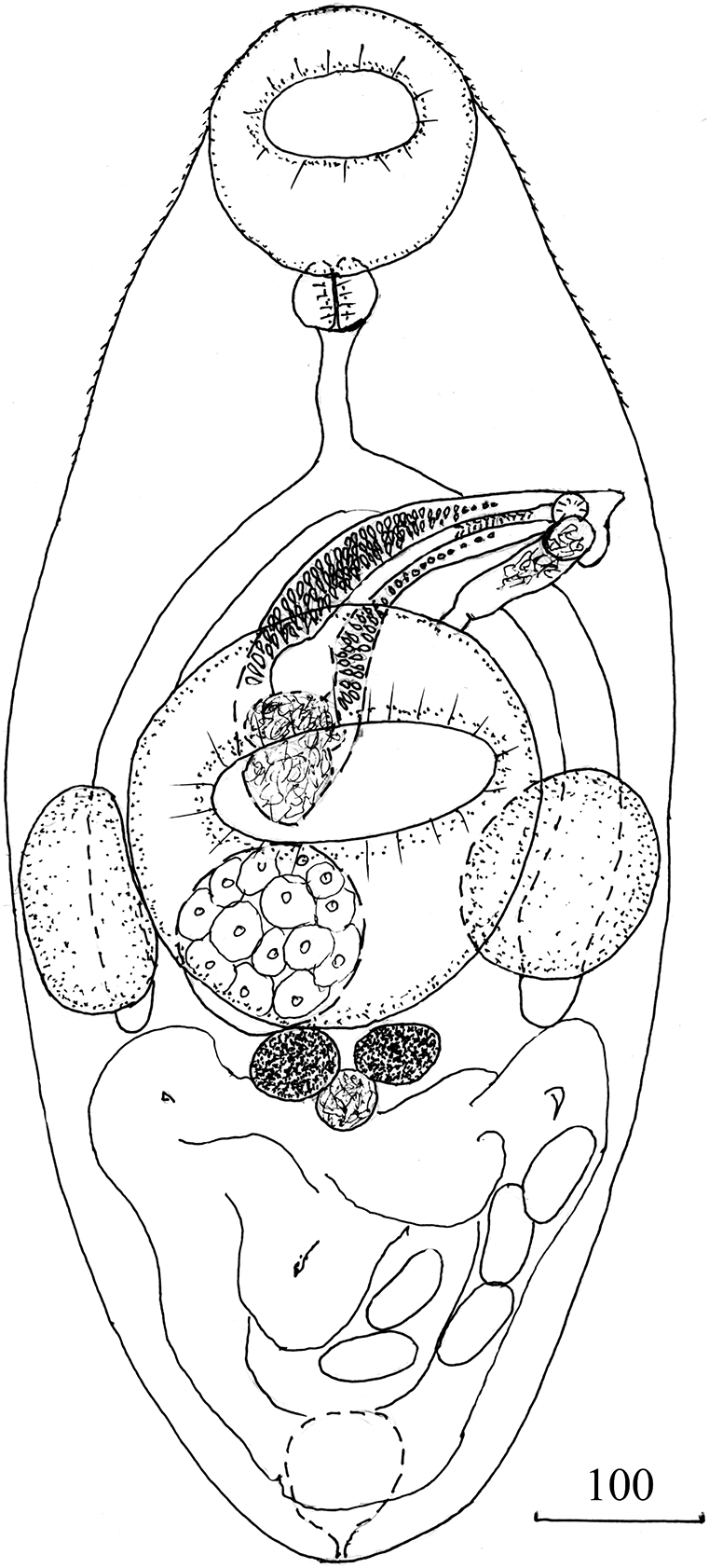
Adult worm (material examined: six specimens) (Table 2, Fig. 2)
Body fusiform. Tegument with spines. Oral sucker subterminal, round. Ventral sucker round, larger than oral sucker, equatorial. Prepharynx short. Pharynx round. Oesophagus long, bifurcating anteriorly to ventral sucker at level of midway between pharynx and ventral sucker. Caeca extending usually to level of posterior edge of ventral sucker. Testes opposite, longitudinally oval, at level of posterior half of ventral sucker and can be partially covered by ventral sucker. Cirrus sac curved, expanded proximally, reaching to level of middle of ventral sucker. Internal seminal vesicle bipartite. Pars prostatica vesicular, prostate gland cells numerous, fill up most of cirrus sac. Ejaculatory duct with spines. Genital atrium shallow. Diverticle of genital atrium present, saccular. Genital pore sinistrally lateral at level of intestinal bifurcation. Ovary spherical, at level of testes, slightly dextral to median line and more or less covered by ventral sucker. Seminal receptacle just posterior to vitellarium. Uterus occupying all posttesticular space. Metraterm tubular, without spines, anterior to ventral sucker. Eggs oval, with very thin capsules. Vitellarium composed of two symmetrical compact masses between ovary and seminal receptacle. Excretory vesicle saccate, pore terminal.
Measurements (μm) of adult worms of Pseudozoogonoides species

* Unificated data.
Adult worm of Pseudozoogonoides ugui ex Pseudaspius hakonensis from the Gamayunova River estuary, Primorsky Region, Russia. Scale bars: μm.

Molecular results
Results of ML and Bayesian phylogenetic analysis based on the 28S rDNA sequence data set showed similar tree topologies (Figure 3). Pseudozoogonoides ugui was within the clade together with Z. viviparus and P. subaequiporus. These three species formed a monophyletic clade with Diphterostomum sp., representing the subfamily Zoogoninae. Genetic p-distance values between P. ugui and Z. viviparus were 0.85±0.27% based on 28S sequence data, whereas genetic differentiation by ITS2 sequence data between these two species P. ugui and Z. viviparus was 1.39±0.59%. Based on 28S rDNA sequence dataset, P. subaequiporus had 7.19±0.7% and 6.94±0.67% differences with P. ugui with Z. viviparus, respectively. These results corresponded to results based on ITS2 rDNA sequence dataset: p-distance values were 10.89±1.6% and 9.78±1.54% for P. subaequiporus/P. ugui and P. subaequiporus/Z. viviparus species pairs, respectively.
Phylogenetic relationships reconstruction of the Microphalloidea, based on partial 28S rRNA gene sequence dataset. Nodal numbers - posterior probabilities that indicate statistical support of phylogenetic relationships for the Maximum Likelihood/the Bayesian algorithms; only significant values (0.9–1.0) are shown. Scale: average number of nucleotide substitution per site.

Discussion
Taxonomical status of Zoogonoides and Pseudozoogonoides
The morphological characteristics of the adult worms detected in Japanese dace P. hakonensis in our study correspond to those of the Zoogonidae diagnosis. In particular, these specimens are most similar to Zoogonoides and Pseudozoogonoides species. Representatives of these two genera have compatible morphology but differ from each other by the presence of one or two compact vitellarial aggregations, respectively (Bray, Reference Bray, Bray, Gibson and Jones2008). Based on this characteristic, worms from our material belong to the genus Pseudozoogonoides and are morphologically similar to P. subaequiporus and P. ugui. However, morphometrical characteristics of these worms are not efficient enough for species delimitation, except for ventral sucker size and oral/ventral sucker size ratio, which are larger for P. ugui than for P. subaequiporus (Table 2). Worms obtained in this study and P. ugui have no differences in most metric parameters; there are only minor discrepancies in some points of the metrics presented (measurements of body, testes and vitellarium). The conspecificity of these trematodes is confirmed by the presence of a spined ejaculatory duct, whereas in P. subaequiporus the ejaculatory duct has no spines. Based on these results, we conclude that trematodes recovered from P. hakonensis in the south of the Russian Far East belong to Pseudozoogonoides ugui. Moreover, P. ugui previously discovered in the River Nukui near Gabino, Hokkaido, Japan, by Shimazu (Reference Shimazu1974) was obtained in the same definitive host species, and this locality is close to coastal waters of the Japan Sea of the East Asian region where our trematodes were collected. Contrarily, Pseudozoogonoides subaequiporus is known to infect fish species of Anarhichadidae Bonaparte, 1832 from the North-Eastern Atlantic. Thus, these species have both different hosts and are geographically isolated.
Results of the phylogenetic analysis and genetic distance calculation indicate that P. ugui and Z. viviparus have interspecific differentiation level. Moreover, these species should be considered members of the same genus. In contrast, both species significantly differed from P. subaequiporus both on 28S rDNA and the ITS2 rDNA fragment; the differentiation values between these taxa corresponded to intergeneric level. However, according to generic diagnostic characteristics from Bray (Reference Bray, Bray, Gibson and Jones2008), namely, vitellarium structure, these trematodes belong to the different genera, and P. ugui was expected to be closely related to P. subaequiporus. Thus, there is an obvious disagreement between morphological and molecular data in the question of the generic taxonomy of the studied trematodes.
The first molecular data for Zoogonoides were presented by Olson et al. (Reference Olson, Cribb, Tkach, Bray and Littlewood2003), who provided the 28S rDNA sequence for Zoogonoides viviparus within the phylogenetic analysis of Digenea. Later, 28S rDNA and ITS2 rDNA sequence data were provided for Z. viviparus and Pseudozoogonoides subaequiporus from the White Sea basin (Kremnev et al., Reference Kremnev, Gonchar, Uryadova, Krapivin, Skobkina, Gubler and Krupenko2023). Unfortunately, Olson et al. (Reference Olson, Cribb, Tkach, Bray and Littlewood2003) did not describe morphological characteristics to confirm that the worm they analysed belonged to Z. viviparus. Kremnev and co-authors (Reference Kremnev, Gonchar, Uryadova, Krapivin, Skobkina, Gubler and Krupenko2023) carried out a detailed molecular analysis of representatives of different developmental stages for species recovered from the first and second intermediate hosts and were denoted as Z. viviparus and P. subaequiporus. Morphological characterization for sporocysts and cercariae and metric parameters for cercariae, metacercariae and adult worms for both species were provided as well. However, morphological characteristics for adult worms that confirm their membership to Zoogonoides or Pseudozoogonoides were not presented. We do not exclude that in the study of Kremnev et al. (Reference Kremnev, Gonchar, Uryadova, Krapivin, Skobkina, Gubler and Krupenko2023) species identification of adult worms denoted as Z. viviparus was performed based on the identity of 28S rDNA sequence data with that provided by Olson et al. (Reference Olson, Cribb, Tkach, Bray and Littlewood2003) for this species. Accepting the high morphological similarity of Zoogonoides and Pseudozoogonoides, which only differ in the structure of vitellarium, it is difficult to estimate the generic membership of trematodes, as reported in Olson et al. (Reference Olson, Cribb, Tkach, Bray and Littlewood2003) and Kremnev et al. (Reference Kremnev, Gonchar, Uryadova, Krapivin, Skobkina, Gubler and Krupenko2023) because of the absence of morphological data on adult worms in their studies. Accepting these results and the molecular data based taxonomical validity of trematodes denoted as P. subaequiporus, reported by Kremnev et al. (Reference Kremnev, Gonchar, Uryadova, Krapivin, Skobkina, Gubler and Krupenko2023), the presence of one or two compact vitellarial aggregations cannot be accepted as a reliable character for the differentiation of Zoogonoides and Pseudozoogonoides. In this case, differentiation of Zoogonoides and Pseudozoogonoides can be implemented only based on the molecular data. Based on the assumption that Olson et al. (Reference Olson, Cribb, Tkach, Bray and Littlewood2003) and Kremnev et al. (Reference Kremnev, Gonchar, Uryadova, Krapivin, Skobkina, Gubler and Krupenko2023) performed incorrect taxonomical identification of zoogonid trematodes, the question of the species and generic taxonomical status of trematodes denoted as Z. viviparus and P. subaequiporus remains open. A final conclusion with respect to this issue can only be made by analysing combined morphological and molecular data for trematodes Z. viviparus and P. subaequiporus from their hosts caught in type localities.
Phylogenetic relationships of Microphalloidea
Results of ML and BI phylogenetic analysis based on the 28S rDNA sequence data set showed that Microphalloidea Ward, 1901 is polyphyletic; members of this superfamily were divided into two clades. Most Microphalloidea specimens were gathered within a large monophyletic clade, which includes five families of true Microphalloidea and members of the ‘microphalloid’ clade of the family Faustulidae Poche, 1926 sensu lato, which was closely related to the Zoogoninae with poor support on the both ML and BI trees. Families Renicolidae Dollfus, 1939 and Eucotylidae Skrjabin, 1924 were closely related to each other within a separate subclade, as well as Microphallidae Ward, 1901 and Prosthogonimidae Lühe, 1909.
The representatives of the ‘gymnophalloid’ clade of Faustulidae s. lato, the species of the genus Pronoprymna Poche, 1926, three species of the genus Bacciger Nicoll, 1914, and Pseudobacciger cheneyae Sun, Bray, Yong, Cutmore and Cribb, Reference Sun, Bray, Yong, Cutmore and Cribb2014, formed separate clade that was highly divergent from Microphalloidea.
Results of phylogenetic analysis based on the 28S rDNA sequence data set repeated the polyphyly for the family Faustulidae s. lato, as revealed in the previous studies (Sun et al., Reference Sun, Bray, Yong, Cutmore and Cribb2014; Cutmore et al., Reference Cutmore, Bray and Cribb2018; Sokolov et al., Reference Sokolov, Shchenkov and Gordeev2021b; Belousova et al., Reference Belousova, Atopkin and Vodiadova2023). The polyphyly was expressed in the existing two distant clades of this family: the ‘microphalloid’ clade, which is closer to Microphalloidea, and the ‘gymnophalloid’ clade, which is closer to Gymnophalloidea. The problem of the polyphyly of the Faustulidae s. lato directly concerns the polyphyly of the genus Bacciger, whose members appeared both within the ‘microphalloid’ (B. lesteri) and ‘gymnophalloid’ (B. major, B. minor, B. astyanactis) clades. De Montaudouin et al. (Reference De Montaudouin, Bazairi, Mlik and Gonzalez2014) and later Cutmore et al. (Reference Cutmore, Bray and Cribb2018) provided conclusive evidence that Bacciger species from the ‘gymnophalloid’ clade are close to the type species Bacciger bacciger (Rudolphi, 1819) Nicoll, 1914 based on the ITS2 rDNA sequence data set. Sokolov et al. (Reference Sokolov, Shchenkov and Gordeev2021b) discussed in detail the polyphyletic genus Bacciger sensu lato, concluding that there are not enough molecular data to be representative for adequate phylogenetic analysis and taxonomical interpretations for both ‘gymnophalloid’ and ‘microphalloid’ clades of Faustlidae sensu lato. Nevertheless, Curran et al. (Reference Curran, Warren and Bullard2022) proposed a concept of taxonomical status incertae cedis for Bacciger lesteri Bray, 1982 within Microphalloidea, removing Bacciger sensu stricto and Pseudobacciger Nahhas & Cable, 1964 from the Faustulidae and transferring them to the Gymnophalloidea with status incertae cedis. Moreover, according to the viewpoint of Curran et al. (Reference Curran, Warren and Bullard2022), B. lesteri and close species Antorchis pomacanthi (Hafeezullah and Siddiqi, 1970) Machida, 1975 from the ‘microphalloid’ clade have shared morphological features. In our view, the problem is hidden in the absence of morphological description of trematodes for which molecular data were provided. Namely, the validity of Bacciger lesteri and Trigonocryptus conus Martin, 1958 from the study of Olson et al. (Reference Olson, Cribb, Tkach, Bray and Littlewood2003) was not confirmed morphologically. For this reason, we cannot know for certain with what species we deal. Such confusion was observed in the previous phylogenetic studies of Bucephalidae Poche, 1907 and Lissorchiidae Magath, 1917 (Atopkin et al., Reference Atopkin, Shedko, Rozhkovan, Nguyen and Besprozvannykh2022b; Reference Atopkin, Ivashko, Besprozvannykh and Zhokhov2023). We propose that final conclusions about the taxonomical status of the ‘microphalloid’ and ‘gymnophalloid’ clades of the Faustulidae s. lato, as well as familiar membership of species from the ‘microphalloid’ clade, can be reached after the availability of complex morphological and molecular data on all species from these two clades, especially B. lesteri, and a detailed comparative morphological analysis of this species with representatives of the genus Antorchis Linton, 1911.
Conclusion
Results of this study show that taxonomical status of the two zoogonid genera Zoogonoides and Pseusozoogonoides are unclear. The taxonomical problem of Faustulidae s. lato is far from being resolved as well. In our view, these questions arise because of fragmental and discrete data on general morphology and nucleotide sequences are available for representatives of previously mentioned taxa, and these data are not mutually complementary. In this respect we completely agree with the point of Sokolov et al. (Reference Sokolov, Shchenkov and Gordeev2021b). Final conclusions can be made after morphological and molecular data are revised simultaneously for respective trematode species from type localities and hosts.
Acknowledgements
The authors are deeply thankful to the Director of A.V. Zhirmunsky’s National Scientific Centre of Marine Biology FEB RAS (NSCMB FEB RAS), Corr. Member of RAS I.Y. Dolmatov, and to the Manager of the Vostok Marine Biological Station of the NSCMB FEB RAS, A.A. Mikheev, for providing a working area for parasitological field studies.
Funding information
The study was funded by the federal budget of the Russian Academy of Sciences, project no. 121031000154-4.