Introduction
Dementia is a challenge for societies and healthcare systems worldwide. Approximately, 35.6 million people were estimated to be living with dementia in 2010 and there are 7.7 million new cases of dementia each year, implying that there is a new case of dementia somewhere in the world every four seconds (Alzheimer's Disease International (ADI), 2012). In Germany, some 1.5 million people are estimated to be affected (Deutsche Alzheimer Gesellschaft e.V., 2014). Dementia is a complex syndrome affecting various physical, psychological, social, and legal issues of people PWDs. Since causal treatment of dementia is still out of sight, there is a considerable need for new and more effective ways of dementia care to address the impending healthcare crisis (Naylor et al., Reference Naylor2012). There has been a considerable amount of research conducted to identify factors that are associated with (a) the development of dementia as well as (b) the modification of the course of the disease.
One important factor associated with dementia is depression. Like dementia, depression itself is a common syndrome in the elderly. Approximately, 98.7 million people worldwide are moderately to severely impaired by depression (World Health Organisation (WHO), 2008). In Germany, the life-time prevalence of depressive symptoms is 11.6% and the point prevalence for the general population is 8.1%. For people aged 60–70 years the point prevalence is 6.1%, and 7.2% for people aged 70–80 years (Busch et al., Reference Busch, Maske, Ryl, Schlack and Hapke2013). However, figures vary heavily, especially in the elderly. In a population-based sample of people aged 75 and older, 38.2% (95% confidence interval, CI 35.2–41.2) were classified as depressed (Luppa et al., Reference Luppa2012). While prevalence for dementia differ considerably, it is evident that depression is significantly more common in persons with dementia than in the population of elderly (Gonfrier et al., Reference Gonfrier, Andrieu, Renaud, Vellas and Robert2012).
While the research literature is inconclusive on depression being a risk factor for incident dementia (Luppa et al., Reference Luppa, Luck, Ritschel, Angermeyer, Villringer and Riedel-Heller2013), there is evidence that depression can be a risk factor for conversion to dementia in mild-cognitive impaired people (Cooper et al., Reference Cooper, Sommerlad, Lyketsos and Livingston2015). A recent review has differentiated the findings of “earlier-life depression (or depressive symptoms) to be associated with more than a two-fold increase in dementia risk. By contrast, studies of late-life depression and dementia risk have been contradictory; there is support on an association, yet the nature of this association (for example, if depression is a prodrome or consequence of, or risk factor for dementia) remains unclear” (Byers and Yaffe, Reference Byers and Yaffe2011). There are biological mechanisms linking depression to dementia pointing out that treatment strategies for depression could interfere with these pathways and alter the risk of dementia. Thus, the evidence is strong enough to recommend clinicians to be skilled in identifying and managing depression to avoid the risk for cognitive impairment and other negative outcomes due to depression (Langa and Levine, Reference Langa and Levine2014).
Many people with mild cognitive impairment (MCI) or early dementia suffer from concomitant depression. In one large-scale community sample, 43% of people with MCI and 75% of PWD were reported to have psychiatric disturbances, with any depressive symptoms being present in 32.1% of the PWD and 20.1% in the MCI-group. Clinically relevant depressive symptoms were present in 16% of the PWD and 6.3% of MCI (Lyketsos et al., Reference Lyketsos, Lopez, Jones, Fitzpatrick, Breitner and DeKosky2002). Comparable data in Germany have shown that depressive symptoms were present in 36.8% (Thyrian et al., Reference Thyrian2015) and clinically relevant depressive symptoms in 15.3% of people screened positive for dementia in primary care (Teipel et al., Reference Teipel2015). Longitudinal studies have indicated that up to one-third of the patients show depressive symptoms (Aalten et al., Reference Aalten, de Vugt, Jaspers, Jolles and Verhey2005). Thus, depression in PWD is a common factor in primary care, but it is often missed or mismanaged (Curran and Loi, Reference Curran and Loi2013). Furthermore, present studies do not give more detail on whether PWD are being categorized into either showing (clinically relevant) depressive symptoms or not. Thus, there is a lack of knowledge on the frequency and severity of depressive symptoms in PWD. However, this is important to better characterize PWD with depression and help clinicians to manage depression and dementia. The samples under evaluation do not necessarily estimate the number of PWD in primary care correctly. The Inclusion criteria for samples of PWD often is based on the existence of a formal diagnosis of dementia, but since dementia is heavily underdiagnosed, this selection criteria misses a good proportion of people affected, in Germany approximately 60% (Eichler et al., Reference Eichler2014). On the other hand, there might be a selection bias towards people with depression compared to people with a formal diagnosis of dementia, since the diagnosis of depression is associated with a diagnosis of dementia.
Therefore, the aim of this analysis is to (a) describe the frequency of depressive symptoms in people screened positive for dementia, (b) describe differences between PWD with and without depressive symptoms, and (c) analyze associations between depressive symptoms and other dementia-related variables.
Methods
Study design
The analyses are based on the baseline data of the ongoing GP-based, randomized, controlled intervention trial DelpHi-MV (Dementia: life- and person-centered help in Mecklenburg-Western Pomerania). The details of the study are described elsewhere (Thyrian et al., Reference Thyrian2012). Patients are systematically screened for dementia by their general practitioner during routine visits, when they are 70 years or older and live at home, using the DemTect (Calabrese and Kessler, Reference Calabrese and Kessler2000; Thyrian and Hoffmann, Reference Thyrian and Hoffmann2012), a cognitive screening test developed for and used in the primary care setting. Patients who meet the inclusion criteria for DelpHi-MV (DemTect < 9; possibly dementia) are informed about the study by their GPs, invited to participate and asked to provide written informed consent. If the patient names a caregiver, he or she is asked to participate in the study as well. When the patient is unable to give a written informed consent, his or her legal representative is asked to sign the consent form on his or her behalf (as approved by the Ethical Committee of the Chamber of Physicians of Mecklenburg-Western Pomerania, registry number BB 20/11). GPs are randomized into either control or intervention group and participants of the study are assigned to either group depending on the assignment of the GP. The study physicians receive incentives for screening (10€ per patient) and study enrolment (100€ per patient).
The study enrollment into the main study started on January 1st in 2012 and ended on 31st of December 2014. A standardized, modular, computer-assisted comprehensive assessment is conducted face-to-face at the participants’ homes.
Study population
A total of 6,838 patients were screened for dementia in 125 participating GP practices. Of these, 1,166 patients (17.05%) were eligible for the DelpHi-trial and 634 patients (54.37%) agreed to participate in the study. One hundred and eighteen patients (1.73%) dropped out of the study before the baseline assessment due to withdrawal of informed consent (n = 85) (72.03%); death (n = 19) (16.10%); relocation (n = 5) (4.24%); or other reasons (n = 9) (7.63%) leaving n = 516 (44.25%) eligible for analysis. There were no statistically significant differences between patients included in and those who dropped-out regarding the variables DemTect score, age, and sex. A total of n = 85 (16.47%) subjects were excluded from the present analyses due to missing data (n = 18 PWD were too impaired for the GDS, n = 15 did not consent in a medication review), withdrawal of informed consent (n = 43), relocation (n = 7), or other reasons (n = 2). Thus, for this analysis n = 430 (6.29%) patients were included with complete baseline data about depressive symptoms, formal diagnosis of depression, and a full home medication review (HMR).
Procedures and Instruments
For the present analysis of depressive symptoms, we assessed variables concerning age, sex, marital status, living in partnership (yes/no), having children (yes/no), support of informal caregiver, perceived social support, cognitive status, functional status, depressive symptoms, formal diagnosis of depression, antidepressive drug treatment /yes/ no), formal diagnosis of dementia, neuropsychiatric symptoms, and quality of life.
Perceived social support was assessed using the questionnaire for social support (Fragebogen zur sozialen Unterstützung-FSozU) (Fydrich et al., Reference Fydrich, Sommer and Brähler2007). The FSozU is a psychometrically sound instrument, measuring perceived and anticipated support from the social environment. We used the 22-item short-form and for our analysis we used a mean item score that ranges from 1–5, higher number indicates more social support.
Cognitive status was assessed using the German version of the Mini-Mental State Examination (MMSE) (Kessler et al., Reference Kessler, Markowitsch and Denzler1990). The MMSE provides a total score as well as a categorization that indicates “no cognitive impairment” (score, 27–30), “mild” (score, 20–26), “moderate” (score, 10–19), and “severe cognitive impairment” (score, 0–9). Since inclusion criteria for this study was a positive screening test, we combined the categories “no cognitive impairment” and “MCI” in our analysis to account for the higher sensitivity to cognitive impairment of the DemTect. The functional status was assessed using the Bayer Activities of Daily Living Scale (B-ADL) (Hindmarch et al., Reference Hindmarch, Lehfeld, de Jongh and Erzigkeit1998; Erzigkeit et al., Reference Erzigkeit2001), which yields a mean score of 1 to 10, where 1 indicates the lowest possible impairment and 10 indicates the highest possible impairment. Depression was operationalized using the GDS (Yesavage et al., Reference Yesavage1982; Gauggel and Birkner, Reference Gauggel and Birkner1999) as dichotomized variable (“no depression”: score 0–5; “depression”: score 6–15). This German version of the GDS consists of 15 questions to be answered with either “yes” or “no.”
Formal diagnoses of dementia and depression were taken from the GP´s patient records as ICD-10 codes. Drug treatment of depression was defined as follows: a computer-based HMR encompasses all medications used by the study participants and includes questions about compliance, adverse effects, and drug administration (Fiss et al., Reference Fiss2013). The drug assignment was integrated using a master file of the Pharmaceutical Index. The drugs were classified as Anatomical Therapeutic Chemical (ATC) code (Wissenschaftliches Institut der AOK [WidO], 2013) according to the Guidelines for ATC classification and DDD assignment of World Health Organization for Drug Statistics Methodology (WHO Collaborating Centre for Drug Statistics Methodology and Nordic Council on Medicines, 1996). The antidepressive drugs considered using ATC codes are: N06A and N06C (Wissenschaftliches Institut der AOK [WidO], 2013).
Neuropsychiatric symptoms were assessed using the German version of the “Neuropsychiatric Inventory (NPI),” an internationally widely used and validated, comprehensive assessment of psychopathology in PWD (Cummings, Reference Cummings1997). The total NPI-score as well as the total distress score can be calculated.
Quality of life was assessed using the German version of the “Quality of life-AD (QuoL-AD)”-questionnaire (Logsdon et al., Reference Logsdon, Gibbons, McCurry and Teri1999). The QuoL-AD is a brief, 13-item questionnaire designed to obtain a rating of the patient's quality of life from both the patient and the caregiver. It was developed for individuals with dementia and measures the quality of life domains thought to be important for the cognitively impaired elderly. It includes assessments of the individual's relationships with friends and family, concerns about finances, physical condition, mood, and an overall assessment of life quality. Patients with MMSE scores of 10 or higher can usually complete it with no problem. Items were rated on a four point scale, with one being poor and four being excellent. Total scores are calculated by summing the individual item scores and range from 13 to 52. The higher the score, the more quality of life is experienced. For our analysis, we calculated the mean score by dividing the sum score by the number of items answered.
Statistical analysis
Variables describing the sample were summarized using descriptive statistics or were illustrated with frequencies or percentages, depending on the type of variable. Variables were analyzed for the total sample and separately for the subgroup of PWD showing clinically relevant depressive symptoms (GDS-score > 5) and PWD not showing clinically relevant GDS-scores.
Multivariate analyses were conducted to identify risk and protective factors for the presence of depressive symptoms. We calculated a multivariate logistic regression with fixed effects for the GP-practices and included age, sex, living in partnership, MMSE, formal diagnosis of depression, formal diagnosis of dementia, antidepressive drug treatment, perceived social support, functional impairment, and quality of life as predictors. Two more analyses were conducted to identify factors associated with having received a formal diagnosis of depression and receiving antidepressive drug treatment, respectively. Statistical analyses were performed using Stata/IC (StataCorp, 2014).
Results
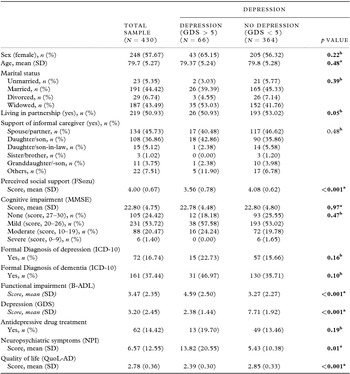
The mean score of depressive symptoms in our sample was m = 3.20 (SD = 2.45) with n = 66 of n = 430 PWD showing a depression according to GDS (15.35%). There was no statistically significant difference between PWD with and without depression regarding the cognitive status. Both groups showed MCI with an average of m = 22.78 (SD = 4.48) for PWD with depression and m= 22.80 (SD = 4.80) for people without depression (cognitive impairment measured on a scale from 0 to 30) (t = 0.03, df = 95.08, p = 0.97). A total of n = 72 (16.74%) of the sample had received a formal diagnosis of depression and n = 62 (14.42%) of the sample received antidepressive drug treatment. There was no statistical difference between people with and without depression (according to GDS) regarding a formal diagnosis of depression (ICD-10) or antidepressive drug treatment (Fisher's exact test p = 0.16).
There were statistically significant differences between PWD with and without depression regarding perceived social support (Fisher's exact test p < 0.001) living in a partnership (Fisher's exact test p = 0.05), neuropsychiatric symptoms (Fisher's exact test p = 0.01) and quality of life (Fisher's exact test p < 0.001). PWD with depression were more impaired in activities of daily living, showed neuropsychiatric symptoms more often, perceived less social support and experienced less quality of life than PWD without depression. The detailed statistics are given in Table 1.
Sociodemographic and clinical characteristics of the study sample

FSozu, Social Support Questionnaire; mean score 1–5; higher score indicates better social support; MMSE, Mini-Mental State Examination; range 0–30; higher score indicates better cognitive functioning; B-ADL, Bayer Activities of Daily Living Scale; range 0–10; lower score indicates better performance; GDS, geriatric depression scale, sum score 0–15; score ≥ 6 indicates depression; tests because of small sample size in subgroups; aWelch's t-test; bFisher's exact test.
There was a tendency that patients with depression were more often formally diagnosed with dementia (46.97%% vs. 35.71%); however, this did not reach statistical significance (p = 0.10). Likewise, there was a tendency that PWD with depression did less often live in a partnership (50.93% vs. 53.02.%) (p = 0.05). The detailed statistics are given in Table 1.
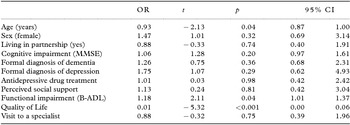
The multivariate analysis of factors associated with depressive symptoms in people screened positive for dementia revealed a statistically significant model with three significant factors: age (OR = 0.93; 95%-CI: 0.87-1.00, t = -2.13, p = 0.04), functional impairment (OR = 1.18; 95%-CI: 1.01-1.37, t = 2.11, p = 0.04) and quality of life (OR = 0.01; 95%-CI: 0.00-.06, t = -5.32, p < 0.001) and degrees of freedom for the overall model of F (11,86) = 5.09 and overall significance of p = < 0.001. The detailed model is shown in table 2. While higher age and higher quality of life seemed to be protective factors for depressive symptoms, higher functional impairment seemed to be a risk factor. Neither formal diagnosis of depression nor antidepressive drug treatment was associated with depression. While perceived social support was a significant factor in the univariate analysis, it was not in the multivariate analysis.
Factors associated with depressive symptoms (GDS >5)

Conditional random effect logistic regression analysis (with n = 430 patients assigned to n = 87 clusters): F (11,86) = 5.09; p < 0.001; OR, odds ratio, CI, confidence interval; FSozu, Social Support Questionnaire; mean score 1–5; higher score indicates better social support; MMSE, Mini-Mental State Examination; range 0–30; higher score indicates better cognitive functioning; B-ADL, Bayer Activities of Daily Living Scale; range 0–10; lower score indicates better performance; GDS, Geriatric Depression Scale, sum score 0–15; score ≥ 6 indicates depression; tests because of small sample size in subgroups; aWelch's t-test; bFisher's exact test.
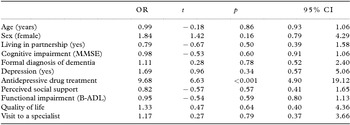
The multivariate analysis of factors associated with a formal diagnosis of depression in people screened positive for dementia revealed a statistically significant model with antidepressive drug treatment significantly associated with the presence of a formal diagnosis (OR = 9.68; 95% CI 4.90-19.12, t = 6.63, p < 0.001) and degrees of freedom for the overall model of F (11,86) = 5.35 and overall significance of p < 0.001. The model is illustrated in more detail in Table 3.
Factors associated with formal diagnosis of depression

Conditional random effect logistic regression analysis (with n = 430 patients assigned to n = 87 clusters): F (11,86) = 5.35; p < 0.001; OR, odds ratio, CI, confidence interval; FSozu, Social Support Questionnaire; mean score 1–5; higher score indicates better social support; MMSE, Mini-Mental State Examination; range 0–30; higher score indicates better cognitive functioning; B-ADL, Bayer Activities of Daily Living Scale; range 0–10; lower score indicates better performance; GDS, Geriatric Depression Scale, sum score 0–15; score≥6 indicates depression; Diagnosis of Mental and Behavioral Disorders: at least one ICD-diagnosis F04-F69; QoL- AD, Quality of life in Alzheimer's disease; mean sum score 1–4, higher score indicates better quality of life.
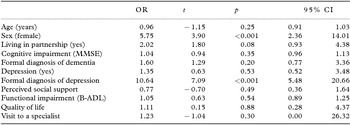
The multivariate analysis of factors associated with antidepressive drug treatment revealed two significant factors: sex and formal diagnosis of depression. The OR for sex was 5.75 (95%-CI: 2.36–14.01, t = 3.90, p < 0.001) and OR for formal diagnosis of depression 10.64 and (95%-CI: 5.48–20.66, t = 7.09, p < 0.001). Living in a partnership (yes) with an OR of 2.02 (95%-CI: 0.93–4.38, t = 1.8, p = 0.08) was close to statistical significance. Degrees of freedom for the overall model are F (11,86) = 7.95 and overall significance of p < 0.001. The detailed model is shown in Table 4. Each model included 430 patients assigned to 87 GP practices.
Factors associated with antidepressive drug treatment

Conditional random effect logistic regression analysis (with n = 430 patients assigned to n = 87 clusters): F (11,86) = 7.95; p < 0.001; OR, odds ratio, CI, confidence interval; FSozu, Social Support Questionnaire; mean score 1–5; higher score indicates better social support; MMSE, Mini-Mental State Examination; range 0–30; higher score indicates better cognitive functioning; B-ADL, Bayer Activities of Daily Living Scale; range 0–10; lower score indicates better performance; GDS, Geriatric Depression Scale, sum score 0–15; score ≥ 6 indicates depression; Diagnosis of Mental and Behavioral Disorders: at least one ICD-diagnosis F04-F69; QoL- AD, Quality of life in Alzheimer's disease; mean sum score 1–4, higher score indicates better quality of life.
Discussion
This is the first analysis of depressive symptoms and depression in people screened positive for dementia in primary care in Germany. It supports previous findings (Gonfrier et al., Reference Gonfrier, Andrieu, Renaud, Vellas and Robert2012) that clinically relevant depressive symptoms are more common in people screened positive for dementia than in the general population (15.5% vs. 6.1%–7.2% (Busch et al., Reference Busch, Maske, Ryl, Schlack and Hapke2013)). Just about 23.9% of people identified with clinically relevant symptoms of depression in our sample had received a formal diagnosis of depression, 19.4% received antidepressive drug treatment. Our results also support previous findings that depression in PWD in primary care is often missed or mismanaged (Curran and Loi, Reference Curran and Loi2013).
There was no association between a formal diagnosis of dementia and depression in people screened positive for dementia in primary care. Thus, we could not find a selection bias towards more people with depression in samples of people with a formal diagnosis of dementia. This is not contradictory to research pointing out the link between depression and dementia. It is one further finding illustrating the link between both diseases in subgroup of the general population, that of PWD in primary care. Given the cross-sectional nature of the data in our analysis, it is not possible to interpret depression as a prodrome or risk factor for dementia.” To evaluate this possibilty, longitudinal data on people without dementia would be necessary. Our findings have rather clinical implications. Depressive symptoms were associated with age, functional impairment, and quality of life. They were not associated with cognitive status. Regardless whether depressive symptoms are a risk factor or prodrome, this result underlines the importance to manage the quality of life, functional status, and depressive symptoms in people with cognitive impairment and dementia. A change in any of these targets/variables is likely to change the others as well. Antidepressive drug treatment can raise quality of life, giving support in activities of daily living can decrease depressive symptoms. Longitudinal follow-up data will allow us to evaluate these complex interrelations over time.
A formal diagnosis of depression in people screened positive for dementia in primary care was solely associated with antidepressive drug treatment. This could be due to the fact that we rely on cross-sectional data the only factor associated with antidepressive drug treatment in this population was sex. The prevalence of antidepressive drug treatment was generally low, 14.42% in the total sample and 19.70% in people with clinically relevant depressive symptoms received drug treatment. Being female increased the odds for antidepressive treatment by 5.75. Assuming that antidepressive drug treatment is generally conducted according to guidelines in our population, female PWD are more often treated and living in a partnership seems to play a role. Neither the visit to a specialist, nor formal diagnoses of dementia itself or depression were associated with antidepressive treatment.
There are limitations to the study: (a) the analyses are based on cross-sectional data. This limits any causal interpretation of our results. We can only describe associations. However, the sample under analysis is unique because not only formally diagnosed PWD are included in the sample like in many other studies. Furthermore, it is an adequate representation of the healthcare reality at a given point in time and as such the prevalences of depression and depressive symptoms are a valid representation of the situation in the primary care setting, (b) the validity of the diagnosis depression. The categorization of people into people with clinically relevant depressive symptoms is based on a questionnaire and thus not a valid clinical diagnosis of depression according to current guidelines. This is also true for the categorization of patients into people with or without a formal diagnosis of depression according to ICD-10. These data were taken from patients records and could not be validated. While this might compromise validity, it also reflects the reality in field research and healthcare reality. The questionnaire used is an internationally validated and often used questionnaire in population-based studies, where time and funding does not allow diagnostic procedures according to guidelines. The patient records are routinely used for secondary data analyses of depression in healthcare research. Since results of the questionnaire and formal diagnoses are not associated and the question of validity remains unanswered we calculated the regression models for both types of data, (c) some antidepressants (such as amitriptyline) may not only be used for the treatment of depression, but also be used in the treatment of neuropathic pain. Accordingly, the number of patients taking antidepressants in this analysis can be overestimated.
Conflict of interests
None.
Description of authors´ roles
JR Thyrian designed the study, formulated the research questions, supervised the analysis and drafted the paper; T Eichler supported data assessment and contributed to the writing of the manuscript; M Reimann conducted the statistical analysis and assisted in writing the paper; D Wucherer supported data assessment and writing the paper; A Dreier supported in designing the study and writing the manuscript, B Michalowsky supported conducting the study and assisted with writing the manuscript; W Hoffmann supervised the design of the study, the data assessment and analysis and supported writing the paper.
Acknowledgments
The assessment of data was conducted as part of the DelpHi-Trial. We thank the experienced field study team and research group, namely (in alphabetical order): Kerstin Albuerne, Aniela Angelow, Grit Assmann, Vaska Böhmann, Georgia Böwing, Kathleen Dittmer, Thomas Fiss, Sarah Gardzella, Jana Hubert, Ulrike Kempe, Viktoriya Kim, Saskia Moll, Andrea Pooch, Steffen Richter, Christiane Schnick, Christine Winckler.