INTRODUCTION
While reviewing unidentified specimens of the genus Sargassum from Polynesia and Micronesia deposited in the Herbarium Pacificum (BISH) of the Bishop Museum in May 2012, I discovered an unidentified herbarium specimen of the brown alga Hormophysa cuneiformis (J. Gmelin) P.C. Silva (in Silva et al., Reference Silva, Meñez and Moe1987) from Pohnpei filed among the Sargassum specimens. The unreported 55 year old specimens were collected by the late Benjamin C. Stone on 1 May 1957 and represented the oldest collection of this species in Micronesia. Previous collections of H. cuneiformis in Micronesia were made from Palau by Robert E. DeWreede in July 1968 and by me in January 1971 (Tsuda, Reference Tsuda2004), and from Pagan Island in the Northern Mariana Islands by Ramon Rechebei in July 1975 (Tsuda & Tobias, Reference Tsuda and Tobias1977).
This report documents the occurrence of H. cuneiformis in Pohnpei and now indicates that this monotypic genus is not restricted to the western sector of Micronesia.
MATERIALS AND METHODS
This report is based on a specimen collected in waters 0.6 m deep by wading over the seagrass (Thalassia) bed near the mangrove fringe in the Jokaj area of Pohnpei State, Federated States of Micronesia.
RESULTS
Description
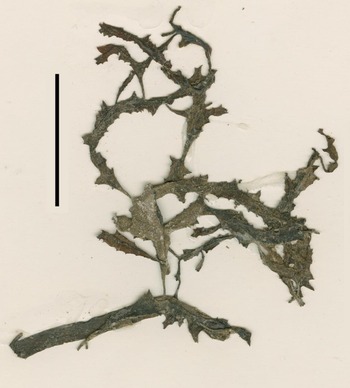
The herbarium sheet consists of 10 mountings of upright axes ranging in length from 6 to 9 cm, with most specimens lacking conspicuous holdfasts. The terete axes, less than 1 mm in diameter, develop into two-sided (Sargassum-like) and three-sided serrated winged blades, 2 to 4 mm wide (Figure 1). Vesicles which are embedded within the former rachis are rare in these specimens, perhaps due to the immaturity of the specimens or their occurrence at the mangrove fringe in Pohnpei with lower salinity (Allender & Smith, Reference Allender and Smith1978). The Pohnpei specimens appeared similar to Allender & Smith (Reference Allender and Smith1978) northern oceanic form of Hormophysa triquetra (C. Agardh) Kützing (Reference Kützing1843), now a synonym of H. cuneiformis, collected from the Western Australian coastline.
Hormophysa cuneiformis (J. Gmelin) P.C. Silva in Silva et al. (Reference Silva, Meñez and Moe1987). Image of one specimen on herbarium sheet BISH 559739. Scale bar: 3 cm.

Taxonomy and nomenclature
A comprehensive taxonomic study of the genus Hormophysa was conducted by Papenfuss (Reference Papenfuss1967). The complicated nomenclatural history of the genus was also discussed by Papenfuss (Reference Papenfuss1967) and updated by Silva et al. (Reference Silva, Meñez and Moe1987) (see Silva et al. (Reference Silva, Meñez and Moe1987, Reference Silva, Basson and Moe1996) for lists of synonyms of H. cuneiformis).
Of the four species of Hormophysa listed in Guiry & Guiry (Reference Guiry and Guiry2012), only H. cuneiformis is currently accepted taxonomically. The remaining three species, i.e. Hormophysa articulata Kützing (Reference Kützing1860), Hormophysa latifrons Kützing (Reference Kützing1860) and Hormophysa triquetra (C. Agardh) Kützing are now regarded as taxonomic synonyms of H. cuneiformis.
Pacific distribution
Philippines (Silva et al., Reference Silva, Meñez and Moe1987), Ryukyu Islands (Okamura, Reference Okamura1913 as Cystoseira articulata J. Agardh, Reference Agardh1848 and Segawa & Kamura, Reference Segawa and Kamura1960 as Cystoseira prolifera J. Agardh, Reference Agardh1848), Australia (Womersley, Reference Womersley1987 as Hormophysa triquetra), Indonesia and Papua New Guinea (Weber-van Bosse, Reference Weber-van Bosse1913 as Cystoseira prolifera), New Caledonia (Garrigue, Reference Garrigue1987 as H. triquetra), Solomon Islands (Womersley & Bailey, Reference Womersley and Bailey1970 as H. triquetra), Austral Islands in French Polynesia (Denizot, Reference Denizot1980 as H. triquetra) and Tonga (Papenfuss, Reference Papenfuss1967 as H. triquetra).
Pohnpei specimen examined
BISH 559739, lagoon bottom, Thalassia-algae association near mangrove fringe, 0.6 m deep at low tide, Jokaj, between mainland and Dakatik (Takatik) Island (Pohnpei Airport), Pohnpei State, Federated States of Micronesia, 1 May 1957, collected by Benjamin C. Stone (BCS 1872).
DISCUSSION
The presence of Hormophysa cuneiformis in the western, northern and now central volcanic islands of Micronesia indicates that this species, although rare where found, is more widely distributed in Micronesia than previously suspected (Tsuda, Reference Tsuda2004). Hodgson & McDermid (Reference Hodgson and McDermid2000) made extensive collections of marine plants from Pohnpei and nearby Ant Atoll between 1994 and 1997, but did not collect any specimens of Hormophysa. The fact that the Pohnpei specimens were collected in 1957 rules out the premise that the species is a recent introduction. Thus far, this brown macroalga has not been documented from atolls or coral islands, similar to the affinity of the genus Sargassum to high volcanic islands (Doty, Reference Doty1954) with a few exceptions (Tsuda, Reference Tsuda1976; Hodgson & McDermid, Reference Hodgson and McDermid2000).
ACKNOWLEDGEMENTS
My appreciation is extended to the late Benjamin C. Stone for collecting and retaining specimens of Hormophysa cuneiformis from Pohnpei. I acknowledge Lucius G. Eldredge, Bishop Museum, for supplying me a reference, and Nicole M. Shun and Benjamin K. Brown, Bishop Museum, for providing the image of BISH 559739. This study was partially funded by a National Science Foundation, Biological Research Collections Pacific Basin Grant DBI-1057453 to the Bishop Museum. This paper is Contribution 2012-018 of the Pacific Biological Survey, Bishop Museum.