This article explores how a South Korean transnational musical production in the mid-1990s contributed to (re)constituting the country's sense of nationhood in response to rapid globalization. The musical, Ho-Jin Yoon's The Last Empress (1995), is an ideal case study for reflecting on the nation's social and cultural development in the 1990s. By examining how Yoon's musical portrays South Korea's desire for global visibility and success, I aim to show how an idea of the national and the realm of the global have been conflated in order to reinvent national tradition and construct a new sense of Korean-ness. The underlying rationale of this production (to seek and to confirm South Korea's capability in the global arena) expresses both the nation's confidence and anxiety about its global competitiveness.
The Last Empress was created as a direct response to the demands of globalization in South Korea during the early 1990s. Director Ho-Jin Yoon conceived the production in order to create a Korean version of a Broadway musical that could also be staged in Western metropolises such as New York City, Los Angeles and London. His desire to demonstrate the competitiveness of a South Korean cultural product was such that, after the play's premiere in Seoul, he undertook an international tour without any guarantees from venues. This decision, seen as a patriotic endeavour, garnered widespread support and encouragement from the South Korean public. Albeit somewhat rash, Yoon's action appealed to the nation's intense, widely held desire to achieve international cultural recognition.
The musical has proved very popular with South Korean audiences, at least in part because it was marketed to them as the first Korean musical to be staged on Broadway. The aura of international success attached to the production resonated with the public's desire for global advancement and with its emerging sense of nationhood. Mainstream South Korean newspapers often cited The Last Empress as an example both of the allure of global development and of Western success in a South Korean context.
Yoon's determination to create a sophisticated, Broadway-style musical resulted in a musical drama that traces the life and the untimely, tragic death of Empress Myoungsung (a.k.a. Queen Min, 1851–95). As queen, Min was not only a central figure in the politics of the late nineteenth-century Korean monarchy but also an advocate for Korea's modernization. However, her ambition and ability to accommodate foreign powers also made her a target of Japanese imperialism. Condemned as a threat to Japan's colonialist goal of occupying Korea, Queen Min, the last empress of Korea, was brutally murdered by Japanese assassins.
Relying on the significance of Queen Min as a promoter of Korean modernization, Yoon centred his production on the image of her reaching for the global stage. In this interplay between the global and the national, he manoeuvres Queen Min's character as a signifier of national identity. However, despite the representation of Queen Min as a herald of globalization, her characterization is ambivalently divided between that of a proactive global pioneer and that of a carrier of repressive national tradition. Although the production makes use of her image to further the idea of South Korea as an advanced nation, it simultaneously grounds her within customary feminine domains both as a monarch and as a woman: as queen she is the bearer of tradition and as a woman she must fulfill her duty of providing a son to inherit the throne.
The obsession with the global that surrounds The Last Empress cannot obscure how the very term ‘global’ becomes an idealized, empty signifier. This production, and the way it constructs nationalistic sentiments, assumes that Korea is already part of the global. Nonetheless, both the play and its reception serve as constant reminders both of Korea's lack of global sensibility and of its need and desire to counter this lack by striving to create a global identity and presence.
The Last Empress and South Korea's globalization
The Last Empress, which offers a chronological treatment of Queen Min's life in the royal palace, presents her life and death as analogous to the final years of Chosun (an old appellation of Korea). The show traces how Chosun failed after Queen Min fell victim to imperial Japan and ends with a grand finale that stages her resurrection as she blesses Korea's eternal prosperity. It opens with the fifteen-year-old Myoungsung's marriage to King Kojong and coronation in 1866, when the new queen promises both to serve the king and to remain the faithful ‘Mother of all people of this nation’ (I, i).Footnote 1 Gradually the play discloses the conflict between the young queen and Taewongun, who is both the regent of Chosun and her father-in-law. The audience learns that Taewongun's isolationist politics prevent him from welcoming Westerners, whereas Queen Min is sympathetic to modernizers. Fearing the queen's growing influence in the court, Taewongun publicly denounces her for her inability to conceive. In response, the queen asks a female shaman, Jinryung-gun, to enact a shamanic ritual for the conception of a son. The birth of her son grants the queen full political agency.
In the latter half of the play, Taewongun retires from politics as Queen Min suggests that the king declare direct rule. Meanwhile, the play shows how all of Chosun suffers from disputes between conservative isolationists and modernizers even as it faces threats from imperial powers (mainly Japan). The queen, who is shown pursuing modernization, decides to seek support from Western powers in order to defend Chosun from Japan. Not surprisingly, the Japanese identify Queen Min as an obstacle to colonization and send ninjas to the Korean palace to assassinate her. The musical's epilogue, ‘Rise, People of Chosun’, features the ghost of Queen Min just after her brutal murder. The finale functions as a ritual of resurrection: the martyred queen ghosts the stage as a symbol both of South Korea's nationalistic ambition for undying power and longevity and of its cultural conviction that it will manifest an eternal, powerful, national destiny.
The core theme of this musical, which bolsters Korea's contemporary modernization and globalization as much as it grieves Korea's failed past, is related to governmental propaganda known as segyehwa (best translated as ‘globalization’). This nationalistic policy was declared in 1994 by the Young Sam Kim administration (1993–8), as South Korea underwent a period of intensive globalization (1994–7). Segyehwa adopted a vision of developmentalism that championed greater efficiency for society as a whole (government, corporations and citizens) as a vehicle for national growth. This developmental nationalism demanded that South Korea, through globalization, leap forward and become one of the world's advanced nations. Segyehwa discourse, predicated upon the idea of the nation as crucially in need of globalization, was ‘held by not only the corporations but also the government, public, families and individuals; [the idea] was transmitted to the whole society through columns of major newspapers and special feature broadcasts’.Footnote 2
Contrary to its emphasis on globalization, however, this official discourse tacitly called forth a deep-rooted national consciousness and demanded rejustifications of Korean history and traditional superiority. It is important to note that, in spite of segyehwa's goal of rebuilding Korean identity, the discourse itself was meant to operate within a contradictory construct of ideas and identities. On the one hand, segyehwa could pave the way for South Korean citizens to achieve world-class status as citizens of an advanced country; on the other, it could adhere to a nostalgic view of the nation's traditional past:
segyehwa must be based on Koreanization. Koreans cannot become global citizens without a good understanding of their own culture and tradition. Segyehwa in the proper sense of the word means that Koreans should march out into the world on the strength of their unique culture and traditional values. Only when national identity is maintained and intrinsic national spirit upheld will Koreans be able to successfully globalize.Footnote 3
This inherent contradiction stems from the desire to proclaim Korea's supremacy while also remedying its perceived inferiority, its weakness, in relation to ‘advanced others’ – the West, or Japan.
Segyehwa was declared at the height of Korean national confidence, which was supported by the strong economy of the early 1990s. Unfortunately, this confidence was shattered by the IMF intervention (1997–2000)Footnote 4 and its consequent damage to the myth of national development in South Korea. However, after the year 2000, the remnants of segyehwa reappeared in South Korean society, where even today its nationalistic rhetoric functions as one of the prime movers in citizens’ lives.
The Last Empress participates in segyehwa's rubric of globalization in two ways. First, from its conception the production was meant to be a response to South Korea's influx of Broadway musicals between the late 1980s and the early 1990s. As a means of competing with these musicals, the creation of The Last Empress, supported by nationalistic discourses, was favoured by a majority of South Koreans. (The production also garnered public approval because of the corporate capital associated with it, its relationship to domestic mainstream culture and the authoritative figures backing it.) Second, the musical was predicated on South Korea's nationalist desire for cultural globalization. Many aspects of the production mimic segyehwa's inculcation of public favour; in fact, the musical overtly utilizes rhetoric calling for South Korea's cultural advancement on the global stage.
Beginning in the mid-1980s, a variety of Broadway musical pieces were translated or adapted for performance by Korean actors and exported to South Korea, including The Sound of Music (1981), Oliver! (1983) and Guys and Dolls (1983–91).Footnote 5 Their popularity with South Korean audiences, which steadily increased, was further fuelled by the advent of rapid globalization in the early 1990s. Consequently, domestic theatre artists and producers sought to create and stage a well-made, Korean-brand musical.
South Korean theatre producers who saw how the power of Broadway musicals secured the local market felt the need to create a musical company along corporate lines that could attract domestic investment, train professional actors and staff and eventually pursue international as well as domestic markets. Therefore, at the start of the 1990s, a number of established theatre groups (sometimes with the assistance of television drama creators) began to produce Korean musicals such as Carmencita (1991) and Dance the Last Dance with Me (1993). However, these early attempts suffered from insufficient organizational groundwork and were therefore unable to attract writers and composers with enough technical and professional knowledge of the musical genre.Footnote 6
In 1991, several renowned theatre and literary artists and corporation owners founded Arts Communication International (A-Com) in response to the growing demands for a corporate-style musical theatre company (A-Com would produce The Last Empress four years later). Most of its founders were important cultural and semipolitical figures. For example, Ho-Jin Yoon, producer/director of The Last Empress and A-Com's current CEO, was known for his work as the artistic director of Seoul's experimental theatre group Sil-Hum Company (1976–92) and as the artistic director of the Seoul Arts Center. Another founding member of A-Com, Mun Yeol Lee, is a novelist and a notable conservative literary figure in South Korea. The Last Empress was adapted from his original drama The Fox Hunt (Yeowoo Sanyang).
The show's cast and artistic creators also came from the elite of South Korea's arts and entertainment scene. Its performers, especially those who have played Queen Min, have been trained in Western classical voice. For example, both Won Jung Kim and Tae Won Lee (the second and third actresses in the title role) received degrees in classical voice from Juilliard and have performed musical theatre and classical opera in international venues. Kwang Lim Kim, who turned Mun Yeol Lee's play into a musical, is one of South Korea's most renowned playwrights. He obtained a graduate degree in theatre studies at UCLA and is now dean of the Korean National University of Arts. Composer Hui Gap Kim, one of South Korea's veteran popular musicians, formed the A1 troupe in 1961 and sealed his reputation in 1967 with his first record, Love, My Love. Through these prestigious members, from its earliest days A-Com has communicated a model of successful globalization with images of affluence, good education, well-travelledness and upward mobility.
The company's optimistic claim that its musical would outshine Broadway highlights its desire to triumph over the very object it attempts to imitate. Against the nationalistic context in which The Last Empress was created, competition with Broadway held twofold significance both for the musical's producers and for South Korean audiences in general. For those behind the stage as well as for the domestic spectators, Broadway simultaneously represented the desire to imitate a chief competitor and a foreign rival to be conquered by an authentic Korean product.Footnote 7 For A-Com, both of these aspects enabled its establishment to be considered a momentous event in South Korean theatre: at last South Korea had obtained its first professional musical theatre company, one that would produce a glamorous, Broadway-type musical.
Visualizing unique Korean-ness on the global stage
The Last Empress portrays Queen Min primarily in a familial domain, representing her as the ‘mother’ of regal and national regeneration. As the production re-establishes Queen Min's character in terms of this dogmatic gender role, she is represented as the bearer of a distinctive Korean culture via the shamanic rite scene (actually a sut'ae gut, a shamanic ritual for women's conception) that was inserted into the production specifically for its New York premiere. Here Queen Min is significant as an elegant representation of the past that defines archaic, traditional imagery as authentically Korean while conflating these mythical ideas of Korean-ness with the nation's modern goal of global success.
The shamanic rite scene attempts both to make visible an intangible aspect of Korean culture and to prove the power of spirituality. The ways the ritual has been adapted and stylized reflect the production's need to keep within the framework of a Western musical and the director's aspirations for the musical as a global cultural commodity. Yoon's decision to stage a gendered setting, in which the childless Queen Min seeks occult aid to conceive a son, shows how the director fuses the domains of the spiritual and the feminine:
This scene was intentionally designed to set an exotic mood for the international audience in New York City. As a modern, choreographed version of an ancient Korean shamanic rite, the staging showed how The Last Empress visualizes the profound spirituality of a national tradition through an all-female performance; the significance of Queen Min as a pathetic woman is emphasized by her absorption in prayer.Footnote 8
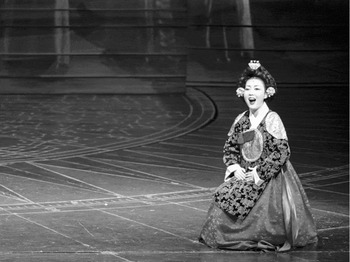
The scene consists of a group dance led by the female shaman, Jinryung-gun. She and her four assistant dancers appear in flamboyant costumes and headpieces, holding fans in their hands. A transparent screen divides the scene's foreground from the rear, where Queen Min is kept at a distance but still participates by poignantly expressing her wish (Fig. 1).
The shaman rite scene in The Last Empress. At the rear, right side of the stage, Queen Min is completely absorbed in the ritual as she expresses her wish for a son. Photo: courtesy of A-Com International.

The tempo of the dance starts slowly, with Jinryung-gun leading her assistants centre stage. Throughout the ritual, Jinryung-gun maintains a ferocious expression as she sings her incantation in a chang style, a type of traditional Korean narrative ballad. The background music coming from the orchestra below the stage assists Jinryung-gun's chang and maintains the tension of the ritual; its main melody is created by Western classical strings, including violin, cello and viola, that have been tuned pentatonically to accommodate Korean traditional melodies. Jinryung-gun's terrifying chant is heightened by woodwind and brass sounds from flute, oboe, clarinet, trumpet and trombone, and by the occasional gong.
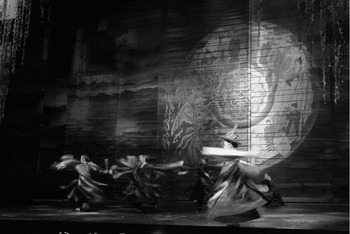
As the ritual ends, the scene goes black while Jinryung-gun shrieks her last words and falls to the floor with her assistants (Fig. 2).
The latter part of the shaman rite scene in The Last Empress. The movements of Jinryung-gun and her co-dancers quicken as they reach the end of the ritual (Photo: courtesy of A-Com International).

The shaman rite scene simultaneously erases and elevates the femininity associated with the spectacle. As the scene retrieves the daring, bold, powerful image of an ancient female practice, it also mythologizes the traditional image of self-sacrificing, pure, heartrending maternity. Similarly, the queen herself embodies the sublime beauty of national tradition: she functions as an iconic reflection of female effort (devout motherhood) assimilated into a symbol of Korea's struggle both for survival and for visibility in an era of sudden global expansion. As Jinryung-gun declares, ‘the nation's future is in the hands of the lady with manly spirit’.
Ironically, however, since the beginning of Korea's modernization in the early twentieth century, Korean elites have condemned Korean shamanism as a sign of the nation's backwardness and inferiority. Under the premise of enlightenment and civilization, shamanic rituals were said to be something Koreans should eradicate. Yet in The Last Empress Yoon reinvents these esoteric practices for an international audience as representative of Korean culture, even while, for Korean audiences, such rituals belong to a nostalgic, slightly shameful past.
In fact, the rationale behind the staging of the shamanic rite corresponds to the ways the South Korean government has treated the genre of gut (a term indicating shamanic rituals in general). Because gut, originally an expression of lowbrow folklore, were enacted mostly by lower-class females, Korean shamans and their practices – notwithstanding their popularity – were generally seen as marginal. Although shamans and shamanic practices were nearly extinguished in the twentieth century as the country began to modernize, in the 1960s and 1970s the South Korean military government preserved several forms of shamanic ritual, including gut, through the Cultural Heritage Protection Act and the National Research Institute of Cultural Heritage. According to these policies, which are still active, the government controls gut under conditions set by the Cultural Preservation Law. In this way a cultural image was created out of an indigenous, dubitable folk practice – one that the government could promote as national heritage.
Along with its literal function, the cultural implications of the shamanic ritual in The Last Empress are also complicit with the imperative for women to ‘carry this “burden of representation,” as they are constructed as the symbolic bearers of the collectivity's identity and honor, both personally and collectively’.Footnote 9 In accordance with this stereotype of women as the symbolic bearers of national culture, the performance taps into the inherent belief that women can strongly represent Korea's spiritual, inner domain as it competes with global forces.
Partha Chatterjee's explanation of how nationalist discourse manipulates the issue of femininity is relevant in this context. He writes, ‘nationalist constructions of woman . . . show how, in the confrontation between colonialist and nationalist discourses, the dichotomies of spiritual/material, home/world, feminine/masculine, while enabling the production of a nationalist discourse which is different from that of colonialism, nonetheless remain trapped within its framework of false essentialisms’.Footnote 10 This illuminates Queen Min's entrapment between the concepts enumerated by Yoon of ‘global market or Western framework’ and the ‘desire for a cultural nation’;Footnote 11 these are comparable to Chatterjee's observed dichotomy between ‘colonialist’ and ‘nationalist’ discourses. Thus the inclusion of the shamanic rite not only draws upon ‘our unique culture’ and Korean-ness, it also cements conservative representations of gender by harnessing Queen Min primarily as a national reproductive agent. In doing so, the scene repeats and even reinforces the traditional dichotomy between women and men in the name of national difference, all to secure the global market.
‘Global’ as an empty signifier
The relationship between the global and the national seen in The Last Empress is analogous to the way that, in South Korea, the meaning of globalization is totally eclipsed by manufactured narratives of national interest and success. Significantly, for instance, the play's transfer to Broadway in 1997 was immediately reported as a nationwide triumph, and its domestic popularity rose accordingly. Despite the fact that the ‘tour’ consisted of a few nights in a New York theatre, billed as a special visiting performance, and resulted in neither a share of the box office proceedings nor guarantees of another venue, the event was heralded as a global success story.Footnote 12 More importantly, the journey of The Last Empress to New York City was promoted by the Korean media as the epitome of a successful Korean cultural brand: major Korean newspapers emphasized that ‘The Last Empress’ New York premiere has to be recognized not just as an ordinary international tour event; it must be seen as “the first Korean musical's global venture . . .”’.Footnote 13 Under the rubric of segyehwa, The Last Empress was hailed as an honorable model that upheld the nation's fame by promoting Korea's exquisite culture through performance on a world stage.
However, lacking performance fees from the New York venue, The Last Empress had to rely on domestic funding and eventually faced a major financial deficit.Footnote 14 Also, nine out of ten spectators at the New York premiere of The Last Empress turned out to be Koreans or Korean Americans.Footnote 15 Therefore the inflated domestic coverage of the musical's global impact is revealed to be an empty signifier – exaggerated impressions meant to promote and validate the show's alleged global success.
Moreover, immediately after premiere of The Last Empress on Broadway, the mainstream Chosun Daily reported that New York spectators were fascinated by the newly inserted shamanic rite scene, which was cited as a prestigious example of Korean heritage; thus the performance was judged ‘a successful case of Korean culture going global’.Footnote 16 However, the New York Times review had actually focused on the show's visual qualities – mainly, and somewhat reductively, its lavish use of costume: ‘the costumes (sumptuous fabrics, rich colors) remind theatergoers how satisfying real splendor can be’.Footnote 17 The contradictions between the two news reports suggest that the Chosun Daily reporter either misread or misunderstood the show's reception in New York. If the misinterpretation was intentional, one can assume that the domestic reporting was an attempt by a Korean newspaper to satisfy its readers’ hunger for cultural globalization. In sum, the rhetoric of ‘global success’, the overblown image of The Last Empress created by the Korean press, not only appealed to the general Korean public but also reflected a patriotic effort to encourage national development and prosperity by portraying the musical as evidence that these had been achieved.
Refurbishing traditional culture for successful globalization
Yoon's determination to produce a uniquely Korean musical clearly demonstrates a ‘mechanism for selecting, defining and controlling a [Korean] identity’ that is meant to ensure the competitiveness of South Korean cultural products amidst the forces of globalization.Footnote 18 Discourse around The Last Empress illuminates an underlying logic that presumes that the global success of cultural products can be achieved by using traditional or ethnic elements. In this vein, The Last Empress is significant because it was the first play in the first generation of South Korean theatre productions that sought global audiences and created a domestic discourse about the importance of utilizing traditional elements to cultivate a global cultural market.
Other such attempts soon followed. In 1997, a nonverbal performance entitled Nanta, which has been economically successful both nationally and internationally, was conceived as a Korean version of Stomp. In Nanta, five actors create a performance using kitchen utensils such as knives, cutting boards and pots and pans, making noise and music based on samulnori (a traditional Korean performance ritual). The rhythmic patterns of samulnori are derived from ancient music performed outdoors, by farmers, with acrobatics and dance. The music of Nanta includes elements of shamanistic ritual (gut), dance and theatre in a complex array of cultural practices essential to rural agriculture, religion and entertainment in premodern Korea.Footnote 19 Unlike the ornate period drama The Last Empress, the image of a globalized traditional culture in Nanta has been constructed through the use of domestic, everyday objects. For Korean audiences, the attraction of Nanta is dependent upon the transformation of familiar, even banal, traditional elements such as samulnori into a stylish, pleasurable, global cultural product.
Similarly, Jump (2002), a comic nonverbal martial arts performance, also makes tactical use of the traditional to generate global appeal. Jump relies heavily upon complex acrobatics and prides itself as ‘a representative Korean cultural brand’; indeed, the production managed to earn both global fame and financial profit.Footnote 20 The action in this show fuses Korean traditional martial arts such as tae kwon do and taek kyon with other popular Asian martial arts (kung fu) and Western acrobatics in the service of a simple, hilarious plot about a Korean family.
In addition to the field of popular performance, the implementation of premodern Korean cultural elements can easily be observed in the genre of literary theatre, wherein traditional strains mix with global ventures. Playwrights such as Tae-sok Oh articulate the issues of ‘Korea and Korean identity in a global context’ from more serious aspects in such plays as Africa and Love with Foxes.Footnote 21 A number of Shakespeare plays have also been reworked into Korean versions via the use of traditional elements. King Uru (Uru Wang), written and directed by Myungon Kim and premiered at the Korean National Theatre in 2000, is an adaptation of King Lear that combines with a Korean folk epic, the Tale of Barideggi. Similarly, the theatre group Yohangza's A Midsummer Night's Dream (directed by Jung-wung Yang) was exported as traditional Korean theatre to London's Barbican Centre in 2006. Here, Korean elements have replaced Shakespeare's original characters as well as Western stage design and costumes: fairies became tokaebi (a type of goblin well known in Korean folk tales), rice paper and Korean cotton cloth (mumyong) were used for staging materials, and Elizabethan costumes were replaced with Korean traditional attire and headpieces. Korean newspapers have praised this production as ‘a refined Korean cultural brand that successfully projected an image of Korean-ness by transcending the language of Shakespeare’.Footnote 22
Since the late 1990s, an increasing number of Korean theatre productions have gone overseas, largely to other East and South East Asian countries such as Japan, Taiwan and Singapore. Each of these transnational productions has demonstrated both differences from and similarities to its predecessors in terms of content, marketing and production rationales, and constitutes a body of work that can be traced back to The Last Empress and the desire to perform Korean-ness on the Asian and, ultimately, global stage.
In the finale of The Last Empress, Queen Min's martyred body returns both to evoke and to accommodate South Korean audiences’ anxious wish to be world-class citizens. As she repeatedly reassures her people (as well as her contemporary domestic audiences) that all have overcome the traumatic past, the ghost of the nation's mother guides them in song to both the present and a future in which they can dream of immortality as they imagine and long for a unified nation:
Thus the queen's mutilation is used as a catharsis through which Korean audiences can purge the fear and guilt they bear from collective historical memory.
Based on a conflation of the image of the patriotic, martyred empress with that of the national body, South Korea's nationally expressed desire for global advancement is redeemed as pure and honourable progress. In the finale, Queen Min, self-sacrificing mother, ghosts the nation's glorious future and images the tension between Korea's past national failure and future victory, its past and present culture, and its contradictory traits of self-hatred and self-love.