Introduction
Although component-based blood transfusions currently remain the most widely used strategy for blood transfusions, military data have shown improved outcomes with whole blood transfusions (WBTs). Reference Spinella, Perkins, Grathwohl, Beekley and Holcomb1,Reference Spinella2 Moreover, there has been renewed interest regarding the use of WBTs for trauma patients with hemorrhagic shock in trauma centers, Reference Black, Pierce, Kerby and Holcomb3–Reference McCoy, Brenner and Duchesne5 and multiple recent publications suggest that WBT may be of similar efficacy Reference McCoy, Brenner and Duchesne5–Reference Avery, Morton, Tucker, Green, Weaver and Davenport7 or even superior to component-based transfusion. Reference Brill, Tang and Hatton8,Reference Hazelton, Cannon and Zatorski9
In the prehospital setting, with only one blood product to store and administer, WBT is simpler than component therapy, which may not be feasible for some Emergency Medical Service (EMS) systems. Indeed, some other countries, including Norway Reference Espinosa, Dybvik, Medby and Vangberg10,Reference Bjerkvig, Strandenes, Hervig, Sunde and Apelseth11 and Israel, Reference Levin, Zur and Shinar12 and some other locations within the United States, including San Antonio, Texas Reference McGinity, Zhu and Greebon13 and Pittsburgh, Pennsylvania, Reference Nawrocki, Mulcahy, Shukis and Poremba14,Reference Yazer, Cap, Spinella, Alarcon and Triulzi15 have been using WBTs for years. Data from these systems have suggested that prehospital WBT is safe Reference Levin, Zur and Shinar12,Reference Nawrocki, Mulcahy, Shukis and Poremba14 and may even improve survival. Reference Braverman, Smith and Pokorny16 Despite these data, only a few EMS systems have implemented prehospital WBT programs.
A prehospital WBT program was recently initiated in Palm Beach County, Florida (USA). Given the potential benefits of WBTs in the prehospital setting, other EMS agencies may also seek to initiate prehospital WBT programs in the near future. Therefore, to assist these other EMS agencies, the goals of this manuscript were to share how the program was initiated, how the program is operated, the barriers encountered, and the initial data.
Methods
Study Design and Setting
Palm Beach County Fire Rescue recently initiated a prehospital WBT program, and this manuscript will report the data from the initial case series of patients who received WBTs. Palm Beach County Fire Rescue employs approximately 1,500 paramedics who work out of 49 fire stations with 52 rescue trucks and two helicopters, covering a jurisdiction of nearly 1,800 square miles and a population of approximately 1.5 million people. Rescue vehicles are staffed by three paramedics, including a lieutenant. Helicopters are staffed by a registered nurse, a critical care paramedic, and a pilot. Palm Beach County Fire Rescue transports an average of 230 patients by ground per day, and responds to approximately 400 emergency scene aeromedical transports per year. The median age of transported patients is 69 years. As further described below, Palm Beach County Fire Rescue began prehospital administration of whole blood to trauma patients with suspected hemorrhagic shock as of July 6, 2022. All the patients in this system who receive prehospital WBTs are tracked for quality assurance purposes and an on-going database is maintained. De-identified data were obtained from that database for the purposes of this manuscript. The Pearl Institutional Review Board (Indianapolis, Indiana USA) reviewed the study protocol (IRB ID 2023-0067) and waived the need for a full review.
Obtaining Approval to Administer Prehospital Whole Blood
Prior to the start of this program, no blood products were being utilized in the prehospital setting by Palm Beach County Fire Rescue. Patients in hemorrhagic shock received normal saline titrated to a systolic blood pressure (SBP) of 80mmHg to 90mmHg. Already in 2018, there were several publications reporting the harms of excessive crystalloid use in trauma patients with hemorrhagic shock. Reference Cantle and Cotton17–Reference Harada, Ko and Barmparas22 Performing balanced component transfusions in the prehospital setting is logistically challenging. Therefore, Palm Beach County Fire Rescue began to seek approval for a prehospital WBT program in 2018.
Although progress towards the goal of initiating a WBT program was partially delayed by hardships associated with the coronavirus disease 2019/COVID-19 pandemic, the primary barrier to the initiation of the program was actually due to legal review of the program and its perceived potential liability for the agency. Palm Beach County attorneys and the blood bank attorneys became deadlocked over contractual issues regarding indemnification and liability for potential untoward reactions in patients receiving prehospital WBTs. Using existing published scientific evidence and clinical outcome results from similar prehospital WBT programs, such as the City of San Antonio Fire Department, Palm Beach County Fire Rescue’s leadership was successful in educating and securing the approval for the advancement of the program from the County’s elected leadership and management.
Another important part of the pre-initiation phase of the prehospital WBT program was coordinating with the receiving trauma centers. Palm Beach County Fire Rescue transports trauma activation patients to two Level I trauma centers. Currently, neither of them has in-hospital WBT programs. Therefore, some of the trauma staff were hesitant to support a prehospital WBT program, primarily because of safety concerns. However, ultimately, after much communication between the fire department staff and the trauma centers, the trauma staff (including author MS) supported and contributed substantially to the development of the prehospital WBT protocol.
Obtaining Funding
Palm Beach County Fire Rescue received a US$23,000 grant that was used to pay for the initiation costs of the WBT program.
Obtaining and Storing Whole Blood
It is estimated that 38% of Americans are blood type O+ while only seven percent are blood type O-. 23 Therefore, low titer, leukoreduced O+ whole blood is often touted as the ideal blood supply for a prehospital blood transfusion program given its relatively high prevalence in the donor supply, especially when compared with blood type O-. While O- would be desirable for Rh- women of childbearing age, its relatively scarce supply is prohibitive. Additionally, data from both Palm Beach County Fire Rescue as well as from the City of San Antonio Fire Department Reference McGinity, Zhu and Greebon13 indicate that only a very small fraction of the patients who will be candidates to receive prehospital whole blood will be Rh-negative women of childbearing age. Furthermore, even when an Rh-negative person receives O+ blood, the chance that they create anti-D antibodies is low (three percent to six percent). Reference Selleng, Jenichen and Denker24
Unlike type O packed red blood cells (where the plasma has largely been removed as component therapy), whole blood contains the antibody rich plasma. These antibodies, if present in sufficient quantity, could potentially pose risks to non-type-O blood recipients. As a result, immune-mediated transfusion reactions are of greater concern for WBTs than for component therapy. For this reason, Palm Beach County Fire Rescue uses whole blood with low levels of antibodies (“low titer” blood). The exact scientific definition of “low titer” is still unresolved, Reference Espinosa, Dybvik, Medby and Vangberg10 therefore Palm Beach County Fire Rescue relies on the definition used by the local blood bank (One Blood; Fort Lauderdale, Florida USA) to meet this criterion. Fortunately, Seheult, et al reported that the administration of ≤two units of whole blood was not associated with clinically significant changes in laboratory hemolysis markers. Reference Seheult, Triulzi, Alarcon, Sperry, Murdock and Yazer25 Palm Beach County Fire Rescue’s protocol (described below) allows for a maximum of two units of whole blood, and the receiving trauma centers therefore do not routinely perform diagnostic tests to specifically assess for hemolytic transfusion reactions in asymptomatic patients.
When whole blood is ordered from One Blood, the units arrive within 72 hours, usually sooner. While a cost is incurred from each unit of whole blood that is ordered, Palm Beach County Fire Rescue tries to maximize the cost effectiveness by storing only a small amount at a time and administering it to those most in need. For the entire Palm Beach County Fire Rescue, only four units of whole blood are stored at a time. One unit is reserved for air transport, and the other three units are strategically placed at stations that have had the highest numbers of critically ill trauma patients in previous years. Blood is initially stored in fire stations in refrigerators made by Helmer Scientific (Noblesville, Indiana USA), which costs approximately US$6000. The blood must be maintained between 2°C-9°C, and the temperature is monitored using a Temp Stick (Ideal Sciences; Bountiful, Utah USA). A Temp Stick costs approximately US$150. It measures and records the temperature of the blood every 30 minutes. There have been concerns that storing whole blood at these cold temperatures might lead to reduced platelet function, but that has not been shown to be the case for at least two weeks of storage. Reference Jobes, Wolfe and O’Neill26 Warm-stored blood should be transfused within 48 hours, which would make it logistically difficult to use (without substantial waste). Reference Espinosa, Dybvik, Medby and Vangberg10
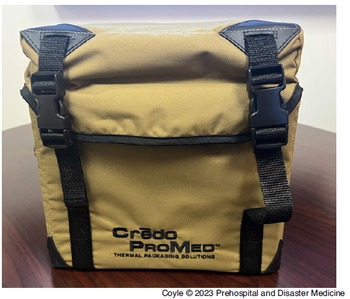
In preparation for use, the blood is transferred from the refrigerator into a Pelican Credo Cooler (Bound Tree Medical; Dublin, Ohio USA), Figure 1, on the rescue truck or helicopter. This cooler costs approximately US$500. The blood is kept cold in these coolers for extended periods of time by six cold inserts. The inserts are stored in a freezer set at -18°C and swapped out every 24 hours (at shift change).
Pelican Credo Cooler for Storing Blood on the Helicopter or Rescue Truck.

The shelf life of whole blood is approximately 21 days. Reference Espinosa, Dybvik, Medby and Vangberg10 Usually, when the whole blood arrives to Palm Beach County Fire Rescue, it only has 15-18 days left prior to expiration because of the time it takes for One Blood to perform testing and delivery. Since whole blood may have a reduced clotting efficacy after 14 days, Reference Clements, McCoy and Assen27 Palm Beach County Fire Rescue tries to use the blood within that time frame. When the blood expires, it is discarded.
Administering Whole Blood in the Prehospital Setting
Based on review of the protocols of other EMS systems that use prehospital WBTs and through discussion with the trauma surgeons at local trauma centers, Palm Beach County Fire Rescue uses the following protocol for WBT.
-
For adult trauma patients with:
SBP < 70mmHg or SBP < 90mmHg plus heart rate (HR) > 110 beats per minute.
Administer one unit of low titer, leukoreduced O+ whole blood; reassess vital signs; may repeat once (maximum two units).
-
For pediatric patients:
Five-years-old until signs of puberty with hemorrhagic shock from trauma.
Administer 10ml/kg of whole blood; may repeat once. For children <five-years-old, call the medical director.
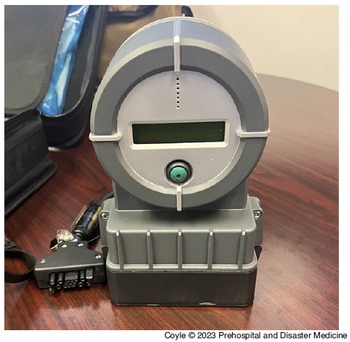
If a patient meets criteria for prehospital WBT, a unit of blood will be rapidly warmed using the “Warrior” (Quality in Flow; New Prague, Minnesota USA), which is shown in Figure 2 and costs approximately US$3500. Each unit of whole blood is roughly 500mL. The blood tubing set with filter is connected to 250mL of 0.9% saline utilizing “Y-tubing.” The blood is rapidly administered using a LifeFlow PLUS Blood & Fluid Infuser (410 Medical; Durham, North Carolina USA). It would be reasonable to use a different type of pressure infuser, but Palm Beach County Fire Rescue has had success with this device, with average infusion times of approximately three-to-five minutes.
Warrior Device for Rapid Warming of Whole Blood.

Data Collection and Analysis
For quality assurance purposes, Palm Beach County Fire Rescue prospectively tracks all patients who receive prehospital WBTs. They coordinate with two local Level 1 trauma centers to track patient outcomes. For this manuscript, descriptive data are reported from the initial case series of patients who have received prehospital WBTs in Palm Beach County since program inception (July 6, 2022) through December 31, 2022.
Results
From July 6, 2022 through December 31, 2022, Palm Beach County Fire Rescue made 39,210 transports to a hospital for all types of incidents, and transported 881 trauma activation patients to one of the local trauma centers. Of those 881 patients, 20 (2.3%) received prehospital WBTs. In total, 11 (55%) of these patients were transported by helicopter and nine (45%) were transported by ground; 17 (85%) of these patients were male. The median age of the patients who received WBTs was 27.5 years (IQR: 20-32), with minimum 15 and maximum 80 years old. Of the 20 who received whole blood, eight (40%) had a penetrating mechanism of injury while 12 (60%) had a blunt mechanism.
One-half (50%) of the patients who received whole blood were in traumatic arrest during the transport. Of those traumatic arrest patients, none survived to hospital discharge, but one traumatic arrest patient regained vital signs prior to arrival in the trauma center after receiving a WBT.
For those patients who were not in traumatic arrest during transport, nine of ten (90%) are still alive. In those ten patients, the average shock index reduced from 1.6 before the WBT to 1.0 immediately after completion of the transfusion.
Overall, 45% of patients who had received WBTs so far remain alive. No patients had documented hemolytic transfusion reactions from the whole blood.
Although the protocol allows for up to two units of whole blood to be transfused, as of December 31, 2022, all patients had received only one unit of blood. Thus, since starting the WBT program, Palm Beach County Fire Rescue had used 20 units of whole blood. At the same time, 18 units of whole blood expired and had to be wasted. One unit of whole blood had to be discarded because of a temperature issue.
Discussion
This manuscript describes how Palm Beach County Fire Rescue implemented a prehospital blood transfusion program and provides their preliminary data. This manuscript is unique in that it focuses on the details and practical issues related to starting a prehospital WBT program such that other EMS systems could use this manuscript to help initiate their own similar programs. One prior report from Norway Reference Espinosa, Dybvik, Medby and Vangberg10 similarly described how to implement a prehospital WBT program, but there are many differences in the EMS and trauma systems in Norway as compared to the United States, so this version provides a new and important perspective.
Some may argue that it would be better to use component-based transfusions in the prehospital setting rather than whole blood. However, a recently published randomized trial failed to demonstrate a benefit to component-based transfusions over crystalloid for hypotensive trauma patients in the prehospital setting. Reference Crombie, Doughty and Bishop28 Additionally, the authors of this manuscript are in agreement with the sentiments expressed in a recent publication showing the results of a survey of medical directors from air ambulance bases in Norway that whole blood is preferable to component therapy in the prehospital setting because it enables early balanced transfusion and has logistical benefits. Reference Bjerkvig, Strandenes, Hervig, Sunde and Apelseth11
Certainly, EMS systems considering prehospital blood transfusion programs must consider the administrative and financial resources required. As described above, the biggest barriers to initiation of Palm Beach County’s program were legal and logistical ones that may be less burdensome as prehospital whole blood administration becomes more common. Starting a prehospital blood transfusion program does require a financial commitment, especially initially in order to buy appropriate equipment for storage. However, the expense to maintain a program is not prohibitive. Thus, it would be feasible for many other EMS systems to start prehospital WBT programs.
Limitations
When reading this manuscript, there are some limitations to consider. First, the details of how Palm Beach County Fire Rescue implemented and operates a prehospital WBT program are reported in this manuscript, but there are likely other ways in which these things could be done. There are many aspects of Palm Beach County’s program that could be adjusted or improved, but their program is functioning well, so this report provides valuable data to other EMS systems who would like to initiate a WBT program. Second, this manuscript was not designed to prove that prehospital WBTs are beneficial for trauma patients, but rather serve as a road map for other agencies to add such a program to their systems. However, given the known harms from excessive crystalloid use in trauma patients Reference Coons, Tam, Rubsam, Stylianos and Duron20–Reference Harada, Ko and Barmparas22,Reference Zitek, Ataya, Farino, Mohammed and Miller29 and the recent suggested benefits of WBTs, Reference Malkin, Nevo, Brundage and Schreiber6–Reference Hazelton, Cannon and Zatorski9,Reference Nawrocki, Mulcahy, Shukis and Poremba14,Reference Braverman, Smith and Pokorny16 the authors of this manuscript feel that Palm Beach County’s WBT program allows for better care of critically ill trauma patients. Finally, Palm Beach County Fire Rescue’s WBT program is currently only used for trauma patients, but they plan to expand that to medical patients in hemorrhagic shock.
Conclusion
Palm Beach County Fire Rescue successfully established a prehospital blood transfusion program to be used for critically ill trauma patients. Although the initiation of this program required substantial logistical effort and some financial commitment, ultimately, maintaining the program requires only modest administrative and financial resources. Therefore, many other EMS systems could and should initiate prehospital WBT programs. Palm Beach County Fire Rescue currently use prehospital WBTs on only a small fraction (approximately two percent) of trauma alert patients, which represents less than 0.05% of all patient transports. Continued efforts will be needed to ensure that this resource is available to as many critically ill trauma patients as possible, while minimizing the amount of blood that has to be discarded.
Conflicts of interest/funding
CC, TZ, PEP, MS, KAS, PA, and DAF declare no competing interests. No funding was received for this manuscript.