Introduction
There is considerable debate about how family structures will develop in the future, and what consequences this will have for the arrangements that support older people who lose full independence (Attias-Donfut and Wolff Reference Attias-Donfut, Wolff, Arber and Attias-Donfut2000; Bengtson Reference Bengtson2001; Cicirelli Reference Cicirelli1983; Clawson and Ganong Reference Clawson and Ganong2002; Hagestad Reference Hagestad2000; de Jong Gierveld Reference De Jong and Matthijs1998; Klein Ikking Reference Klein1999; Komter and Vollebergh Reference Komter and Vollebergh2002; Popenoe Reference Popenoe1993; Silverstein and Bengtson Reference Silverstein and Bengtson1997; Stacey Reference Stacey1993). Next to partners, adult children often provide practical support by helping with housekeeping, odd jobs, transport and the management of payments and finance, and they also offer social and emotional support by calling and visiting (Cantor Reference Cantor1979; Knipscheer et al. Reference Knipscheer, Dykstra, van Tilburg and de Jong-Gierveld1998). If family solidarity is diminishing, as some fear (see Popenoe Reference Popenoe1993), support giving by adult children may be threatened. The central question addressed in this paper is whether demographic and cultural changes in family structures imply less support giving to elderly parents in the future. To answer this question, we have investigated which characteristics of parents, children and their relationship correlate with support giving. Special attention is paid to new complexities in contemporary family forms, such as parental divorce, the spread of informal partnerships, and the presence of half- or step-siblings. We also investigate two underlying motives for support giving: having a sense of filial obligation, and the quality of the parent-child relationship.
Demographic and cultural changes that may influence support giving to older parents
The most numerous informal care-givers of frail older people are their partners. If a partner is absent or unable to provide help, children are next-in-line to provide support (Cantor Reference Cantor1979; Dooghe Reference Dooghe1992; Shanas Reference Shanas1979), so children are the most important providers of help to older parents who live alone or who have a spouse unable to provide help. It is conceivable that the provision of help by adult children is influenced by the recent changes in family structures. Average life expectancy at birth in The Netherlands is now 76 years for males and 81 for females (Centraal Bureau voor de Statistiek (CBS) 2006). Longer life expectancy, combined with the effects of the ‘baby-boom’ after the Second World War and the marked decrease in Dutch fertility, has raised the ratio of older to younger people. It is expected that in 2040, almost 24 per cent of the population will be aged 65 or more years, against 14 per cent now (CBS 2006). Epidemiological trends suggest that in the future Dutch older people will suffer from fewer severely disabling conditions, but more mild morbidity at the end of life (Perenboom et al. Reference Perenboom, van Herten, van den Bos and Boshuizen2004). We may therefore assume that support by informal care-givers including adult children will remain important, and that more may be called upon to provide support to their elderly parents. At the same time, demographic and cultural changes in family structures raise questions about whether they will be able and willing to do so.
Socio-demographic changes
Nuclear families are today smaller than 50 years ago, which means that in the future, if an elderly parent needs support, fewer children will be available to provide it. Research has shown, however, that having fewer siblings correlates with more contact and support to an elderly parent (Spitze and Logan Reference Spitze and Logan1991). Although lone older people who have only stepchildren receive less support than those with biological children (Cooney and Uhlenberg Reference Cooney and Uhlenberg1990; Pezzin and Steinberg Schone Reference Pezzin and Steinberg1999), it is not clear whether the presence of half- or step-siblings has a different effect on an adult child's support giving than the presence of full siblings.
Women have customarily been more likely than men to be involved in the care of older parents (Broese van Groenou and Knipscheer Reference Broese and Knipscheer1999). With the higher female labour-force participation rate, the care-giving role of women may change. The increase in hours of paid work by women is not accompanied by a decrease in men's working hours, so time available to couples for non-work activities has reduced. Moreover, if men work part-time, they are unlikely to take up care tasks for family members other than children (Portegijs, Boelens and Olsthoorn Reference Portegijs, Boelens and Olsthoorn2004). A recent study showed that the rising number of women with paid jobs has not been accompanied by a decrease in care for family members (de Klerk and de Boer Reference De Klerk, de Boer and De Boer2005). It is, however, mainly women that perform personal-care tasks. To arrive at a better account of sons' contributions to support giving, it is important to include other types of support, such as performing odd jobs, assisting with transport, and providing company.
Another important social change has been the rising educational level of successive cohorts. The more highly educated tend to see their parents less often than those with little education (Mulder and Kalmijn Reference Mulder and Kalmijn2004). One reason is that the highly educated tend to be less family oriented, and another is that they tend to live further from their parents. The influence of partner status on support giving to older adults has been much debated. For older people who live without a partner, adult children are commonly important providers of support. Widowed older people without a new partner receive more support than others (de Jong Gierveld and Dykstra Reference De Jong and Dykstra2002), but a growing number have experienced a divorce and live alone without being widowed. In The Netherlands, one-in-three marriages end in divorce, and there no trend suggests that the fraction will reduce (CBS 2006). Divorced older people are less likely to receive support from their children than those whose marriages are intact (Dykstra Reference Dykstra1998). This finding has been corroborated for a sample of older people who needed help in the activities of daily living (ADL), irrespective of the presence of a new partner (de Jong Gierveld and Dykstra Reference De Jong and Dykstra2002). Thus, it seems that divorce has a direct effect on the care received in old age. For general types of support giving, it remains to be establised whether this effect arises from a poor parent-child relationship, from the presence of a new partner, or directly from having been divorced.
The implications of changes in partner status in the younger generation for support giving to the older generation are not clear. Although a reduction of support giving as a result of divorce has been noted by several studies, most in America (e.g. Cicirelli Reference Cicirelli1983; Kaufman and Uhlenberg Reference Kaufman and Uhlenberg1998), while others have not corroborated the finding (Dykstra Reference Dykstra1998; Spitze et al. Reference Spitze, Logan, Deane and Zerger1994). The available Dutch evidence shows no effect of divorce on the likelihood of providing support to parents (Dykstra Reference Dykstra1998). In The Netherlands, as in many other northern European countries, co-habitation is a widely accepted alternative to marriage, especially in the first years of partnership (van der Meulen and de Graaf Reference Van der Meulen and de Graaf2006). It is not known whether co-habitation in the younger generation has a different effect on support giving from marriage.
Cultural changes
Ideas about the ideal types of partnership and family life have recently changed. In their replies to a survey in The Netherlands in 2000, most respondents supported a modern family ideal, of co-habitation followed by marriage with children. Only one-quarter supported the traditional pattern of marriage followed by parenthood (Liefbroer Reference Liefbroer2002). In this, the Dutch are no different from most other western Europeans, who have experienced similar changes in socio-demographic patterns and family ideals (Allan, Hawker and Crow Reference Allan, Hawker and Crow2001). Some scholars are convinced that increasing individualisation is leading to the abandonment of filial obligation norms (Popenoe Reference Popenoe1993), but there are dissenters (Stacey Reference Stacey1993; Allan Reference Allan2001; Cowan Reference Cowan1993; Lowenstein and Daatland Reference Lowenstein and Daatland2006). It is not a priori clear that the diminishing popularity of traditional family patterns implies less closeness between generations. Allan (Reference Allan2001) suggested the opposite, that in these times of looser networks, the (more voluntarily chosen) bonds with friends and family become a way of expressing one's identity and have greater importance.
Maybe feelings of filial obligation are less pervasive than they once were, but would that be a problem? Feelings of filial obligation – an obligation for adult children to support their parents – are neither the only nor perhaps the best motivator for supporting elderly parents. A qualitative study by Pyke and Bengtson (Reference Pyke and Bengtson1996) suggested that children who provided support because of a felt obligation or because of compelling circumstances were less motivated to continue the support when difficulties arose, and were more susceptible to ‘burn-out’ than those who acted out of feelings of affection and closeness. For some adult children, the bond with their parents may be part of their identity, as Allan (Reference Allan2001) suggested. Acting out of obligation may not be part of that identity. If people's motivations differ (feelings of closeness rather than obligation), so also do the levels of provided support: there is little evidence for their connections. The focus in much research on hands-on care may, however, under-estimate the support that adult children give to their elderly parents, which underlines the importance of differentiating types of support. Practical forms of help may be difficult to realise at a distance, but keeping in touch nowadays is easier with the latest telecommunications technologies. Another reason to include different types of support involves the role of sons: they may seem absent as support givers if the focus is on housework or physical care, but including repair jobs and help with transport may show that they are more active (Calasanti Reference Calasanti, Arber, Davidson and Ginn2003).
In short, it is not certain that current socio-demographic and cultural trends necessarily lead to less support giving. In this study, we distinguish support behaviour (helping with housework, performing odd jobs, and showing an interest in the other person's life) from the motives that underlie the support, namely feelings of filial obligation and the quality of the parent-child relationship. Several circumstances of contemporary families, such as greater parent-child separation distances, more hours of work, more step-family members and more divorced parents, may be less conducive to support giving than once was the case, but even if the sense of filial obligation has declined, it is conceivable that a good parent-child relationship can overcome the problems that arise from socio-demographic and cultural changes.
The research questions
When support giving is seen ‘from the bottom up’, it seems that socio-demographic changes over recent decades imply its reduction. For instance, from the child's point of view, after a divorce the parents live in separate households, which for visits implies more trips and time. It is therefore likely that support giving by adult children is lower after parental divorce. When seen ‘from the top’, the effects may be different, because the parent may acquire stepchildren or new biological children, and may be supported by a wider range of relations. The research question, however, focuses on the motivations and circumstances of adult children and not on those of the parents, which leads to the first hypothesis:
H1. The socio-demographic characteristics of contemporary family life, such as greater parent-child residential separation distances, parental divorce, having half- or step-siblings, and working more hours imply less support giving to elderly parents of all kinds, particularly practical support.
We do not expect the characteristics of contemporary families to be the only correlates of support giving. In line with the reasoning sketched above, it is proposed that the quality of the parent-child relationship and norms of filial obligation are motivating forces and therefore correlates of support giving. Hence the second hypothesis is:
H2. The quality of the parent-child relationship and norms of filial obligation positively correlate with support giving to elderly parents.
In line with Pyke and Bengtson's (Reference Pyke and Bengtson1996) qualitative results, we expect to find quantitative support for the finding that the quality of the parent-child relationship is a more important predictor of support giving than feelings of filial obligation. Accordingly, the third hypothesis is:
H3. The quality of the parent-child relationship will be a stronger predictor of support giving by adult children than filial obligations.
The analysis was from the perspective of the adult child, and focused on the roles of the socio-demographic and cultural characteristics of contemporary families and of the motivations for giving support. We focus on the differences in support giving that stem from a good parent-child relationship, as against filial obligations, and provide a quantitative test for the idea that a good relationship is the more important determinant of support giving.
Methods
Data sources and respondents
The data were collected during 2002 to 2004 by The Netherlands Kinship Panel Study (NKPS) (Dykstra et al. Reference Dykstra, Kalmijn, Knijn, Liefbroer and Mulder2005a, Reference Dykstra, Kalmijn, Knijn, Liefbroer and Mulderb). The NKPS database is of a random sample of 8,161 independently-living adults aged 18 to 79 years who were interviewed in their homes. The response rate was 45 per cent. Of those who completed the interview, 92 per cent also completed a self-administered questionnaire with questions on family attitudes and norms.Footnote 1 We selected respondents with at least one living parent aged 75 or more years, and excluded those who were co-resident with such a parent. The age limitation was adopted because the probability of needing support increases rapidly from the age of 75 years, a consequence of worsening health (Hoeymans, van Lindert and Westert Reference Hoeymans, van Lindert and Westert2005), and because it has been the accepted age limit in other research on the ‘old old’ (e.g. Lowenstein and Daatland Reference Lowenstein and Daatland2006). We excluded respondents with missing data on any of the predictor or outcome variables. The selection identified 2,036 parent-child dyads: 1,314 mothers and 722 fathers related to 1,679 children. Because 357 respondents were included twice (when both parents were aged 75 years or over), standard errors were corrected for clustering using the clustering function of the Stata 8 program (Stata Corporation 2003).
The outcome variables
The outcome variables were the provision of four types of support to elderly parents by adult children: housework, performing odd jobs, giving advice, and showing an interest in the other person's life. The question posed was: ‘Have you ever, in the past three months, helped [target parent] with … [type of help and examples of such help]?’ The response categories were ‘no’, ‘sometimes’ and ‘several times’. For the analysis, ‘sometimes’ and ‘several times’ were collapsed to produce a dichotomy. For ‘showing an interest’, because fewer than five per cent of adult children reported no interest, the categories ‘no’ and ‘sometimes’ were grouped.
The predictor variables
Variables were included on gender, age, educational level and the partner status of children and parents. Level of education had three categories: ‘up to completed high school’, ‘up to completed vocational education’, and ‘higher education’. Information on the partner status of the parent distinguished between ‘living with the other parent of the child’, ‘single following divorce’, ‘single following widowhood’, ‘living with a new partner following divorce’ and ‘living with a new partner following widowhood’. The partner status of the adult child made a distinction between ‘first marriage’, ‘never partnered’ (i.e. never married or never having co-habited with a partner), ‘single following divorce’, ‘single following widowhood’, ‘co-habiting’, ‘being in a same-sex relationship’, ‘married following divorce’ and ‘married following widowhood’. Included in the categories ‘divorce’, ‘widowed’ and ‘new partner following divorce (or) widowhood’ were co-habiting relationships.
The remaining dependent variables all referred to the child in the dyad. Household income was categorised into the four quartiles of the sample distribution. If children had a partner, the total household income was divided by 1.41, making the income of a couple comparable to that of a single person household (Pommer, van Leeuwen and Ras Reference Pommer, van Leeuwen and Ras2003). A separate category was created if information on income was not given. Number of hours work per week was measured as the number of hours that the respondent reported they spent at work. The total number of hours work in the household was divided by the number of paid workers (maximum of two) to give the mean number of hours work per household. The variables on sibling structure included information on the number of siblings and whether they were half- or step-siblings. We also included the number of children living in the respondent's home.
The geographical distance between the parent and child was measured as the natural logarithm of the crow-flight distance in kilometres, as estimated from post-code co-ordinates. In The Netherlands postal codes are for small geographical units (e.g. unique to around 10 houses on one street). The maximum possible distance between parent and child in The Netherlands is 279 kilometres. For the 60 parents who lived abroad, the separation distance was set to 500 kilometres. In six cases the distance was unknown, and the mean distance for the entire sample was imputed (31.28 km).
Support giving motives
Two motives for giving support were recorded: the quality of the relationship with the parent and a sense of filial obligation norms. The respondents described the quality of the relationship with each surviving parent on a four-point ordinal scale: ‘not great’, ‘reasonable’, ‘good’ or ‘very good’. A four-item measure of filial obligation was derived from the level of agreement with four propositions, that ‘children should support their sick parents’, that ‘in old age, parents must be able to live in with their children’, that ‘children who live close to their parents should visit them at least once a week’, and that ‘children should take unpaid leave to look after their sick parents’. Five response categories were available, from ‘strongly agree’ (1) to ‘strongly disagree’ (5). The range of the aggregate score was therefore from 0 to 4 (mean=1.82, standard deviation (s.d.)=0.76), with high scores indicating a strong sense of filial obligation. The reliability of the aggregate score was good (Cronbach's alpha 0.75). If there were answers to at least three of the four items, the mean was calculated and used in the analyses.
The analyses
Separate multivariate logistic regression analyses were run for each of the four types of support. At the first step, the socio-demographic characteristics of the children and their parents were entered into the equation, and at the second step, the measure of filial obligation was added. At the third, the quality of the parent-child relationship was added and filial obligation removed. At the fourth and final step, both support-giving motives were included. We expected an improved fit of the model at each successive step. Unless otherwise mentioned, the five per cent level of statistical significance was used (p<0.05).
The results
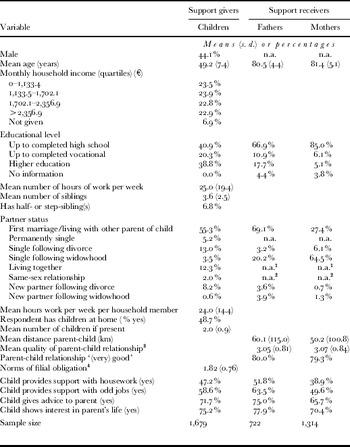
The analyses are of the 2,036 parent-child dyads, which included 933 mother-child dyads with no father present, 24 mother-child dyads with mothers married to fathers younger than 75 years, 191 father-child dyads with no mother present, 174 father-child dyads with fathers married to mothers younger than 75 years, and 714 parent-child dyads of married couples where both members were aged 75 or more years (children could recur in the dataset). Table 1 presents the summary characteristics of the adult children and parents in the sample and of the support provided, which was lowest for housework and highest for showing an interest in the parent's life.
Summary characteristics of the members of the support dyads and of the provided support, The Netherlands, 2002–04

Notes: s.d. Standard deviation. n.a. not applicable. 1. Cohabiting parents are included in the category ‘living with other parent of child’. 2. We did not include information on the sex of parent's new partner, because only one parent had a same-sex partner. 3. The range was from ‘1’ bad to ‘ 4’ very good. 4. Range from ‘0’ strongly disagree to ‘4’ strongly agree.
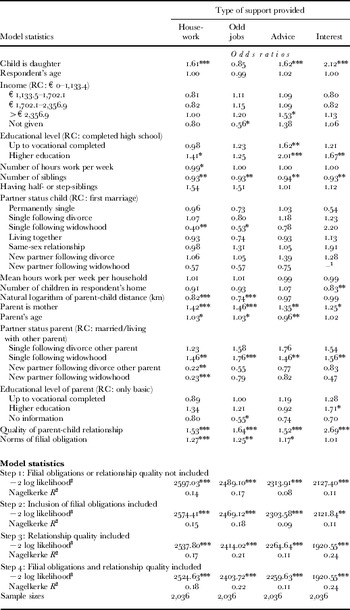
The results of the logistic regression analyses are presented in Table 2. The model without inclusion of support-giving motives produced an adequate fit for all types of support giving, as indicated by the −2 log likelihood values. An approximation of the amount of variance explained by the model is given by the Nagelkerke R 2 statistic. Inclusion of either of the support-giving motives significantly improved the model fit. The inclusion of relationship quality made a larger contribution to the fit than filial obligations, as can be seen by the differences in the −2 log likelihood values and the increased Nagelkerke R 2. The results indicate that a good relationship with the parent was an important predictor of support giving for all types of help. Another important predictor was the partner status of the parent, for widowed parents without a new partner had a significantly higher likelihood of receiving all kinds of support. Having more siblings was associated with a lower likelihood of providing all sorts of support. Mothers received support significantly more often than fathers. Daughters provided support more often than sons with housework, giving advice and showing interest. Higher education correlated with the provision of advice and showing interest, and less strongly with doing housework. A sense of filial obligation significantly correlated with doing housework, odd jobs and giving advice, but not with showing interest. For practical forms of support, a greater geographical separation distance went together with a lower likelihood of giving support. Parents of higher ages received practical support more often than those closer to 75 years, but less often received advice. Being a widowed child reduced the likelihood of giving practical support.
Likelihood of adult children providing support to their elderly parents (logistic regressions)

Notes: RC: reference category. 1. Category dropped because all 10 respondents in same category (‘yes’). 2. Level of significance: chi-squared test of inclusion of predictors against no predictors. 3. Level of significance: chi-squared test of inclusion of additional predictor(s) against Step 1.
Significance levels: * p<0.05, ** p<0.01, *** p<0.001.
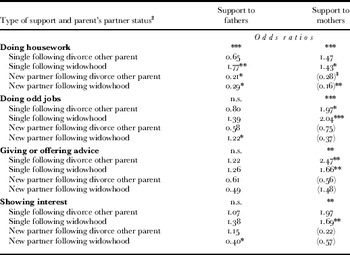
Besides these significant results, no consistent effects were found for income, the number of hours the child worked, the number of children living in the respondent's home, or the educational level of the parent. The respondent's age and the presence of half- or step-siblings were irrelevant to support giving in this sample. Closer inspection of the data on parent's partnership status, and separate analyses for fathers and mothers revealed that the mother's parental status was a major determinant of receiving support from their adult children. Table 3 shows the likelihood of providing support to mothers and fathers separately, with a focus on their partnership status. The parent's partner status was a significant predictor for all types of support for mothers, but only for housework for fathers. For mothers, a consistent pattern emerged, in which a higher likelihood of receiving support was clearly connected with the absence of a partner, irrespective of whether this resulted from divorce or widowhood. The partnership status of the fathers did not show the same consistent effect on support received, although widowers without new partners had a higher overall likelihood of receiving support. Only a few parents in the sample had new partners (e.g. nine mothers remarried after divorce, see Table 1), which explains why some of the odds ratios, although extreme, are not significant.
Likelihood of adult children providing support to their elderly parents (separate logistic regressions for mothers and fathers with a focus on partner status of the parentFootnote 1)

Note: 1. Results controlled for all other predictor variables mentioned in table 1. 2. Reference case for parent's partner status, married or living with other parent of the child. 3. numbers in brackets refer to sample sizes <20.
Significance levels: * p<0.05, ** p<0.01, *** p<0.001.
Discussion
Family interaction patterns are in constant flux and are influenced by socio-demographic and cultural changes. The adult children of older people have always played an important role in the provision of support, as the first helpers when the parent has no partner or the partner is incapable of providing support. The demographic and cultural changes of recent decades raise questions about whether this readiness to be the main supporter will continue. As for the analysed sample, the structure of the nuclear family was an important indicator of the level of support. Coming from a small nuclear family associated with a higher likelihood of support giving. If this pattern is stable, the trend towards smaller families implies that a higher percentage of adult children will in the future be engaged in some form of support giving.
The observed relationship with family size does not mean that the total number of people providing support has increased, or that an increased number of older people receive support, or that the support provided to older people with small nuclear families is greater than that provided to older people with many children. This is realised if one imagines a large and a small nuclear family in both of which only one child provides support. The likelihood of being that child is higher for those brought up in small nuclear families. For the parent, the net result is the same: support from one child. For the adult child, the combination of smaller nuclear families and more women in the workforce reduces the likelihood of having someone in the family who is the ‘obvious’ support giver, because she seems to have most time available. It is to be expected that more adult children will find themselves juggling support giving tasks and other concurrent commitments, which draws our attention to the importance of finding better ways of combining support giving and other activities, as by increasing the availability of formal service providers, or by changing work habits and living patterns.
Working more hours, both individually and by both partners in the household, did not correlate with support giving. We included the number of hours of paid work of the adult child and the mean number of working hours in a household as an inverse measure of the time available for support giving, reasoning that less time is available when both partners have paid jobs or when an individual works many hours. In line with earlier findings (de Klerk and de Boer Reference De Klerk, de Boer and De Boer2005), however, there was no relation between the amount of time spent on work and support giving. There are several possible explanations. One is that the type and amount of the forms of support that were measured do not interfere with a paid job. For instance, if performing odd jobs is done over a few weekends during the year, it interferes with leisure time not work. It is possible that providing support diverts substantial time from activities other than work.
Another explanation may lie in the dichotomisation of the outcome variables. Providing support ‘sometimes’ and ‘several times’ were aggregated, which hid the distinction between providing some or a substantial amount of support. If only the relatively small number who provided a substantial amount of support worked few hours, an overall correlation would not have been detected. Close inspection of the data indeed showed a small and gradual decrease in support giving with more work hours, both by individuals and by the household, but when corrected for gender and age, the effect largely disappeared. In The Netherlands, more men than women have a paid job, and 66 per cent of women with a job work part-time (i.e. less than 35 hours) (Lucassen Reference Lucassen2004). Among the older generations, fewer women have a paid job, and the older age of their parents makes it likely that they need more support. Because the unit of analysis was individual dyads, and because siblings could not be identified in the sample and we did not have information on the health status of the parent, it is not possible to say whether some adult children reduced their working hours to provide more support for a parent. Longitudinal data would provide more insight.Footnote 2
The gender relatedness of most of the support-giving tasks is not surprising: women give more support in household tasks, particularly the more sociable forms, ‘giving advice’ and ‘showing an interest’. More striking was the absence of a gender difference in performing ‘odd jobs’. We had expected that the inclusion of this type of support would show sons to be more active supporters than previously thought, but there was no evidence that sons were more active than daughters in these tasks. Including information on whether the respondent had given support ‘sometimes’ or ‘several times’ did not alter the finding (analysis not shown). Apparently, women provided more support than men in traditionally ‘female’ domains, and provided as much support in a domain traditionally regarded as male. Other Dutch research has reported that men spend more time on odd jobs than women (CBS 2006). A possible explanation for the contradictory finding may be that the category ‘odd jobs’ in the NKPS included help with transport and gardening, which is less gendered than, for instance, repair jobs.
Increasing geographical separation distances may pose a problem for support giving in the future, depending on how it is organised. It is important to make a distinction between practical and social forms of support: only the former negatively correlated with greater separation distance. This indicates, on the one hand, that parents and children find ways to communicate and stay in touch even when they live far apart, for which modern telecommunications must help. On the other hand, staying in touch is important, but does not solve the practical problems of daily life; after all, a telephone conversation or e-mail exchange will not clean the house or do the grocery shopping. It may even be questioned whether giving advice and showing an interest should be regarded as giving support of the same kind as housework or doing odd jobs. It is possible that those who offer interest or advice also receive it, making the support-exchange reciprocal rather than unbalanced. The exchange may be similar to the activities involved in friendships, where giving and receiving are usually in balance (Komter Reference Komter2003). The resemblance with friendships may explain why filial obligations did not correlate with showing an interest, but relationship quality was strongly associated. Friendship activities are probably less susceptible to feelings of obligation, and highly correlated with compatibility and mutual liking, which would be indicated by a good parent-child relationship.
A possible development in support giving is that adult children increasingly supervise the provision of practical support by formal and paid helpers, as with cleaning, shopping or repair services. This would change the role of the child from a face-to-face supporter or carer to a manager at a distance. More research is required on the support giving and receiving preferences and expectations of parents and children to assess the benefits and disadvantages of such a change. Preferences may vary widely for different persons and in different countries (Katz et al. Reference Katz, Daatland, Lowenstein, Bazo, Ancizu, Herlofson, Mehlhausen-Hassoen, Prilutzky, Bengtson and Lowenstein2003). Whether such arrangements will satisfy parents and children, whether enough suitable and affordable services will be available, and who will accept responsibility for the costs are open questions.
We observed no effects of the respondent's partner status, except that single and widowed children provided practical help relatively infrequently. Divorce of the child did not correlate with a lower likelihood of support to parents, which is consistent with earlier findings from The Netherlands (Dykstra Reference Dykstra1998). It is important to note that the measurement of partnership status was not limited to the usual ‘single’, ‘married’ or ‘divorced’, but more realistically also included information on co-habitation, which is very common in The Netherlands. The parent's partnership status significantly correlated with support for mothers. Single mothers were most likely to receive support, irrespective of whether their situation followed divorce or widowhood. Re-partnered mothers tended to receive less support than mothers married to the other parent of the respondent. Although this finding was not significant for the different types of support giving – probably because there were few re-partnered parents – the consistency of the pattern over several types of support suggested a pattern. Fathers' partnership status was only connected to helping with housework; widowed fathers without a partner were most likely to receive support.
The results deviate slightly from earlier findings, which have shown a strong reduction of support in association with parental divorce (Dykstra Reference Dykstra1998; de Jong Gierveld and Dykstra Reference De Jong and Dykstra2002). In these studies, however, the effect of having a new partner and of being widowed were not included (Dykstra Reference Dykstra1998), nor was the quality of the relationship measured (de Jong Gierveld and Dykstra Reference De Jong and Dykstra2002). In the present analysis it has been possible to differentiate the effects of widowhood and divorce from the effects of subsequent partner status (living alone or with a new partner) (as the analysis by de Jong Gierveld and Dykstra (Reference De Jong and Dykstra2002) also did). In addition, by separately measuring relationship quality, the possible negative effect of a bad parent-child relationship on support giving was controlled. The resulting correlation between support giving by adult children and parent's partner status can therefore be read as the ‘pure’ effects of divorce, corrected for a bad relationship. Of course, parental divorce is often accompanied by a decline in the quality of the parent-child relationship, as found in our data. But the analysis shows that for mothers, the effects of divorce are not different from the effects of widowhood when a correction for the quality of the relationship is made. The absence of a partner seems to be the major issue. The most likely explanation is that a new partner provides the necessary support, reducing the need for support from adult children.
A remaining question is why re-partnered parents apparently receive less support than parents still married to the other parent of the child (for both categories have partners). One reason may be that single parents were older than either re-partnered parents or parents still married to the other parent of the child (the respective mean ages were 82.3, 80.2 and 79.6 years). The new partners of the mothers were not younger than the fathers who still lived with the mothers of the respondent. The new partners of divorced fathers tended to be younger, however, which might explain why less support (especially housework) is provided by children of re-partnered parents. The new, younger partners of the fathers probably perform this task, making support from a child redundant. An additional explanation for the lower likelihood of support for re-partnered parents compared to parents married to the other parent of the child is a selection effect: healthier people may find a new partner more easily (Mastekaasa Reference Mastekaasa1992; Wyke and Ford Reference Wyke and Ford1992). These effects probably combine to produce the demonstrated associations. Another possibility, of course, is that parents with new partners receive support from children of the new partner.
Of the two identified support-giving motives, the quality of the relationship with the parent was a very strong correlate of support giving. Schwarz and Trommsdorff (Reference Schwarz and Trommsdorff2005) reached a similar finding, namely that securely-attached daughters provided more support to their mothers. Acceptance of the norms of filial obligation were less important correlates of support giving, especially for the more sociable forms, ‘giving advice’ and ‘showing interest in the other person's life’, for which again there are several possible explanations. The first is the nature of the measures. The statements on filial obligations were not specific for a particular person; they referred to abstract or general norms. By contrast, the question on relationship quality was targeted at each individual family member, which increased the likelihood that the revealed behaviour correlated with the person's attitude regarding the relationship. Another possible explanation lies in prominent cultural norms. Generally speaking, the Dutch live in an individualistic rather than a collectivistic society. The vast majority of respondents in our sample had Dutch nationality (99%) and had parents born in The Netherlands (96% of fathers, 94% of mothers). Norms of filial obligations are not strongly endorsed by the native Dutch, when compared with respondents from other ethnic backgrounds (Liefbroer and Mulder Reference Liefbroer and Mulder2004).
Moreover, if the course of action to be taken is considered a private matter, then even if norms are shared, they may not guide behaviour. In that case, in a specific situation it would be more likely that an individual forms an opinion on the correct course of action towards another person taking into account their particular relationship. A norm of obligation may then not be meaningful; rather, it will be the quality of the relationship and the derived personal motivation that leads to action. This would mean, for instance, that just being a daughter's father is an insufficient reason for her to provide support. She will have to ascribe a special personal meaning to the relationship to be willing to support her father, which is consistent with Allan's (Reference Allan2001) proposition. Another way to interpret the results is to suggest that general norms prescribe a course of action for others, not oneself. The respondents may have been reluctant to make firm statements about what ‘ought to be done’ in general because that may seem to be judging other people's actions. At the same time, they may have a strong sense of what they should do or want to do in their own situation. In a 2004 poll for a Dutch television programme (KRO 2004), more children were willing to provide care for their parents than parents were willing to receive care from their children. This illustrates some reluctance to express an expectation of support from children. It seems to be regarded as something that is not owed or deserved, but when given is gratefully received.
Returning to a question posed earlier, is it a problem if filial obligation norms are not widely endorsed? The answer seems to be ‘yes’ and ‘no’. As for practical support, the findings reported here indicate that norms of filial obligation correlate with support giving, so a weakening sense of filial obligations might lead to a decline of support. For the more sociable forms of support, ‘giving advice’ and ‘showing interest’, a sense of filial obligation was less important, and it can be expected that adult children will continue to provide this kind of support even if the sense of filial obligation declines, but only if parents and children form and maintain good relationships. In other words, affective feelings could take the place of a sense of filial obligation. With today's smaller nuclear families, the basis for a good relationship is probably present, as parents and children can be more involved in each other's lives. It is clear from our analyses that relationship quality is a strong basis for this type of support, and we expect this to remain important. Further research is necessary to investigate how relationships between parents and children are formed, maintained and evaluated, and to raise understanding of what it is that motivates adult children to provide support, what kinds of support they are willing to provide, and in which ways they and others in elderly parents' networks find and provide support.
The results are from a Dutch sample but are thought relevant for other countries. The mechanisms underlying support giving to older parents and the socio-demographic and cultural changes at the basis of these mechanisms are comparable in many other western countries (Wolf and Ballal Reference Wolf and Ballal2006). The trends towards more divorces, smaller nuclear families, increasing mobility and the ageing of the population are common throughout Europe (Hagestad Reference Hagestad2000). The same questions need to be addressed in many other countries, of how to take care of the needs of older people today and in the future, and what the role of adult children will and should be.
Acknowledgements
The Netherlands Kinship Panel Study is funded by grant 480-10-009 from the Major Investments Fund of The Netherlands Organisation for Scientific Research (NWO), and by The Netherlands Interdisciplinary Demographic Institute (NIDI), Utrecht University, the University of Amsterdam and Tilburg University. This study was also funded by the multi-disciplinary research programme, ‘Changing Patterns of Interdependence and Solidarity in Family Relations’ at Utrecht University. We are most grateful to the members of the Family Relations Network at Utrecht University for their helpful comments at the 2005 Fall Seminar, to Matthijs Kalmijn for his suggestion on correction of clustered data, to Peter Zuithoff for statistical advice, to Ruben van Gaalen for advice on the use of the NKPS dataset, and to Claudine Attias-Donfut and an anonymous reviewer for helpful comments on an earlier version of this paper.