Autobiographical memory represents the events and experiences of our lives. It consists of a repository of personal, family and social experiences that give us our personal identity. When we examine an entire lifespan, we find a limited number of childhood memories, a disproportionately greater amount of memories from adolescence and young adulthood, a decline of memories in adulthood, and a very representative set of memories from our most recent experiences (see Rubin, Rahhal, & Poon, Reference Rubin, Rahhal and Poon1998, for a review). What experiences take place in adolescence and early adulthood that last a lifetime? What do they represent and why are they so significant for the rest of our lives?
In this study 20-year-old participants were selected to closely examine autobiographical memory in the core of this significant stage of life because this age group has already gone through adolescence and are at a stage in life marked by change and relevant decisions for the future in all walks of life. In contrast with earlier studies that examined traumatic experiences (Christianson & Loftus, Reference Christianson and Loftus1990), specific periods of life (e.g., Pillemer, Rhinehart, & White, Reference Pillemer, Rhinehart and White1986) or important autobiographical memories elicited by single-word prompts (Rubin & Schulkind, Reference Rubin and Schulkind1997), in this study we were interested in collecting as many positive and negative emotional experiences as possible up to the age of 20. This unrestricted search will provide us with the most representative emotional experiences of the first quarter of life, allowing us to organize them into thematic categories, age and emotional intensity. An additional objective was to examine the criteria adopted by the participants when asked to choose one of their experiences to narrate it in as much detail as possible. That is, if the participants show a recency effect by narrating more recent events, whether they select more accessible experiences listed among the first positions on their lists, or if their choice is determined by the emotional level of the event. Lastly, the detailed narration of an experience, unlike previous studies that call for brief descriptions of the event (e.g., D’Argembeau & Van der Linden, Reference D’Argembeau and Van der Linden2004), will allow us to examine in detail whether there are qualitative and quantitative differences in the content and form of narrating positive and negative emotional experiences.
Nature of positive and negative experiences
What experiences mark our lives and what do they represent? Pillemer et al. (Reference Pillemer, Rhinehart and White1986) asked university students to recall memories from their freshman year in college. The memories were grouped into four categories: recreation and leisure (40%), housing, academics, and romance (each 19%). Positive, negative or mixed emotional experiences, in equal proportions, accounted for 96% of the memories, while only 4% were neutral.
Christianson and Loftus (Reference Christianson and Loftus1990), and a few years later Wessel and Merckelbach (Reference Wessel and Merckelbach1994), were the first to define content categories for the most traumatic memories. The categories included the death of family or friends, illnesses or accidents, and problems or break-ups between couples. In a more complete study, Berntsen (2002, Experiment 2) asked psychology students to recall both their happiest and their most shocking memories. Participants cited four types of shocking memories: losses of loved ones (26.5%), accidents (23%), episodes related to physical disease (15%), and let down and disappointed by trusted people (13.3%); and three types of happy memories: falling in love (29.8%), achievements in education and sports (26.3%), and pregnancy or childbirth (13.2%). Berntsen found no differences between shocking and happy memories in ratings of emotional intensity. This may be because the participants were asked to provide only the most emotional memory of each type.
Rather than asking for a single memory, in the present study the participants were given 5 minutes to write down as many of the positive or negative experiences in their lives as they could remember. This procedure should yield a larger sample of emotional experiences from birth to adulthood, and allow us to establish categories based on the nature of the event and to determine their significance in people’s lives. We used between-participants measures. Recalling emotionally-charged events can create a lasting sense of euphoria for positive events and a lasting sense of grief for negative events (Berntsen, Reference Berntsen2002, Experiment 2). Moreover, simultaneously recalling positive and negative experiences can generate strategy changes, breakdowns in the search process or associations between positive and negative events (e.g., my father gave me a motorcycle, the accident with the motorcycle), all biases that are difficult to control.
Distribution of positive and negative experiences
Do our memories of positive or negative emotional experiences characterize significant periods in our lives, such as childhood, adolescence or young adulthood? Crovitz and Schiffman (Reference Crovitz and Schiffman1974) presented the first modern study on the distribution of autobiographical memories across the life span of participants, who were 20-year-old undergraduates. The retention function was characterized by limited memories from the early years of life (childhood amnesia), progressively increasing to the most recent memories. The most significant finding in later studies was that memories from adolescence and early adulthood are consolidated for life, creating a reminiscence bump in older people (Rubin, Wetzler, & Nebes, Reference Rubin, Wetzler, Nebes and Rubin1986; for reviews: Conway, Reference Conway, Bjork and Bjork1996; Rubin, Reference Rubin, Schwarz, Park, Knäuper and Sudman1998). Berntsen and Rubin (Reference Berntsen and Rubin2002) examined for the first time whether there were differences in the distribution of different types of emotional memories. They asked their participants, aged 20 to 93, to recall their happiest, saddest, most traumatic and most important memories. They found that the reminiscence bump was prominent only for the positive memories of their youth but not for the negative memories (see Leist, Ferring, & Filipp, Reference Leist, Ferring and Filipp2010, for similar results).
Matlin and Stang (Reference Matlin and Stang1978) called the tendency for better recall of pleasant than unpleasant memories The Pollyanna Principle. The tendency to remember more positive than negative events may be because the emotional level for negative memories fades more over time than it does for positive memories (Butler & Wolfner, Reference Butler and Wolfner2000; Walker, Vogl, & Thompson, Reference Walker, Vogl and Thompson1997). As we overcome problems, the intensity of negative events may fade over time. In addition, social interaction may contribute to maintaining the emotional level of positive experiences (Walker, Skowronski, Gibbons, Vogl, & Thompson, Reference Walker, Skowronski, Gibbons, Vogl and Thompson2003). Thus, two aspects regarding emotional level are relevant in the present study: the emotional intensity of positive and negative memories at the actual time of the events, and the changes in emotional intensity from the time of the events to the present.
Content of positive and negative experiences
Retrieval of autobiographical memory can be thought of as mental time travel that allows us to relieve and recollect individual past events which can be reported as narratives. Little research has examined the characteristics of the narratives of positive or negative emotional experiences. Therefore, it is of interest to determine how the narratives are structured (e.g., length, ideas, coherence), what contents are included (e.g., actions, persons, objects, spatiotemporal or emotional details), and what the most representative cognitive processes are (e.g., perceive, think, remember). In this study the participants were given 10 minutes to narrate an event of their choice in as much detail as possible, and their narratives were then analyzed exhaustively.
Porter and Birt (Reference Porter and Birt2001) asked university students to give detailed accounts of two life experiences: their most traumatic experience and their most positive experience. Although the narratives for both types of experiences were similar in their degree of coherence, vividness and chronological organization, the negative experiences included more details (pertaining to persons, actions, location and descriptions) and references to emotional content (e.g., I was frightened, I felt rage), than the positive experiences. Berntsen (2002, Experiment 2) also found that the proportion of central details relevant to the gist or the plot of the event was greater for shocking than it was for happy events. More recently, Bohanek, Fivush, and Walker (Reference Bohanek, Fivush and Walker2005) observed that although participants recalled positive events more coherently, their narrations of negative events were longer and contained more words that denoted cognitive processing. However, the emotional level was greater for negative events than it was for positive events, a factor that may have introduced a certain bias into the results.
Phenomenological assessment of positive and negative narrated experiences
There is little evidence that self ratings and subjective assessment of memory correspond to actual performance (Berntsen, Reference Berntsen2002; Bohanek et al., Reference Bohanek, Fivush and Walker2005); nonetheless, phenomenological judgments are relevant because they represent our beliefs and convictions on how events unfold and the value we place upon them. Studies which have compared the phenomenological experience of positive and negative memories have resulted in diverging findings. Some studies have found no rating differences between negative and positive memories in vividness, amount of central and peripheral details or emotion (Butler & Wolfner Reference Butler and Wolfner2000). Findings from other studies indicate that people attribute to the positive experiences more details and more sensorial characteristics than do to the negative experiences (D’Argembeau, Comblain, & Van der Linden Reference D’Argembeau, Comblain and Van der Linden2003; Destun & Kuiper, Reference Destun and Kuiper1999; Schaefer & Philippot, Reference Schaefer and Philippot2005). In addition, people give more thought to negative than they do to positive events (Porter & Birt, Reference Porter and Birt2001), but talk more about positive events (Byrne, Hyman, & Scott, Reference Byrne, Hyman and Scott2001; Tromp, Koss, Figueredo, & Tharan, Reference Tromp, Koss, Figueredo and Tharan1995).
In summary, the present study was designed to determine the most representative positive and negative experiences to the age of 20, what they mean to people to make them last a lifetime, and how they are distributed from childhood to early adulthood. By analyzing the narratives, we examined how memories of positive and negative experiences are structured, what contents are included, and how they differ as a function of emotional valence. Additional data on the phenomenological experience of memory may also prove relevant to our understanding of emotional autobiographical memories.
Method
Participants
The participants in this study were 113 second-year Psychology students from the Universidad del País Vasco UPV/EHU, 95 females and 18 males between the age of 19 and 21 (M = 19.79; SD = 1).
Procedure
The participants completed an anonymous questionnaire, indicating only their age and gender. They were told that participation was voluntary and that they would be required to provide personal information about their lives. A group of 59 students (49 females, 10 males) worked with emotionally positive experiences, and another group of 54 students (46 females, 8 males) worked with negative experiences.
First, all of the participants were given 5 minutes to list as many positive or negative emotional experiences or events in their lives as they could. They were told that, if necessary, they should write a sentence to clearly indicate the type of experience they were referring to. For each experience they were asked to indicate the amount of time elapsed since the event (in years, months, weeks or days) and to rate the emotional level on a scale of 1 (low) to 7 (high). They then had to select only one experience from the list and were given 10 minutes to provide a detailed account of the event. Finally, the participants answered six specific questions to assess the narrated experience. The first two required yes/no answers concerned with their memory for the event. The participants stated whether their memory was vivid and if it included visual and sensory details. The next two questions assessed the emotional level at the time the event took place and now, based on a 1 (low) to 7 (high) scale. The last two questions assessed how frequently they thought or talked with other people about the event on a 1 (never) to 7 (very often) scale. The experimental session took approximately 30 minutes.
Results
The results obtained in this study were organized into four broad sections. The first section includes the positive and negative experiences produced and narrated by participants, arranged by thematic category and emotional level. The second section includes the distribution of positive and negative experiences as a function of participants’ age at the time of the events and the emotional level. The last two sections centre on narrated events, including the content of the narratives and the participants’ phenomenological ratings of their memories of the events.
Categories and emotional level of positive and negative experiences
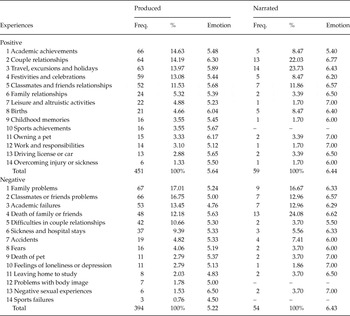
There were no significant differences between the number of positive (M = 7.63; SD = 2.50; range, 4–14) and negative experiences (M = 7.30; SD = 2.18; range, 4–12), t(111) = .79, p = .43 produced by the participants. Following the criteria and organization established in previous studies (e.g., Berntsen, Reference Berntsen2002; Bohanek et al., Reference Bohanek, Fivush and Walker2005; Butler & Wolfner, Reference Butler and Wolfner2000; Christianson & Loftus, Reference Christianson and Loftus1990; Pillemer et al., Reference Pillemer, Rhinehart and White1986), both the positive and negative experiences generated by the participants were organized into 14 thematic categories (see Table 1). Two independent judges categorized the experiences and the limited discrepancies were cleared up by a third independent judge. Interrater reliability (.94) was calculated as the number of coding agreements divided by the total number of agreements and disagreements for each recall. Not all of the categories were equally represented, F(13, 754) = 12.29, MSE = .71, p < .001. For the positive experiences the five categories with the highest production frequency, with no differences between them, were memories associated with academic achievements, couple relationships, travel, excursions and holidays, festivities and celebrations, and relationships with classmates and friends. The most representative memories of emotionally negative experiences were problems with family members, problems with classmates or friends, academic failures, death of family or loved ones, and difficulties in couple relationships. The first six categories accounted for more than 70% of the experiences produced both positive (72.72%) and negative (79.44%).
Categories for positive and negative experiences, with production frequency, percentage and emotional level of produced and narrated experiences

The participants were told to choose one of the experiences from their lists to narrate. Of all the participants, 72.56% selected an experience from among the first four on their lists, and only 12.38% chose a memory ranking in the seventh position or lower. In addition, there were no differences in the position of the event chosen between positive (M = 3.53; SD = 2.71) and negative experiences (M = 3.11; SD = 2.24), t(111) = .88, p = .38. With regard to thematic categories, more than 75% of the narratives, both positive (77.96%) and negative (75.92%), were among the first six categories.
The emotional level of the experiences produced was greater for positive (M = 5.64; SD = .62) than for negative memories (M = 5.22; SD = .67), t(111) = 3.339, p = .001. However, there were no differences in emotional level between positive (M = 6.44; SD = .68) and negative (M = 6.43; SD = .77) narratives, t(111) = .11, p = .91. The emotional level was greater for the narrated events (M = 6.43; SD = .72; range, 4–7) than for the produced events (M = 5.43; SD = .67; range, 1–7), t(112) = 11.724, p < .001. Almost all the participants (90.26%) rated the emotional level of their narrated experiences between 6 and 7, whilst only 54.59% of the produced experiences fell into this range.
Distribution of positive and negative experiences in their lives
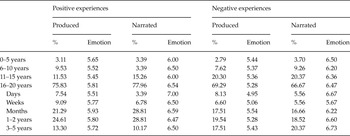
To analyze the distribution of experiences and the emotional level by participants’ age at the time of the events, we used four 5-year periods: 0–5 years old, 6–10, 11–15, and 16–20. Jansari and Parkin (Reference Jansari and Parkin1996) argued for the use of 5-years intervals instead of decades to get a clearer picture of the bump and recent memories. Table 2 shows the percentages of positive and negative memories for both produced and narrated experiences occurring at those ages, together with their emotional level rating.
Distribution of the experiences and emotional level by participants’ age at the time of the event (from 0 to 20 years), and event recency over the past 5 years (from days to 3-5 years)

Note:
The 16–20 year age period is broken down into days, weeks, months, 1–2 years and 3–5 years since the event took place.
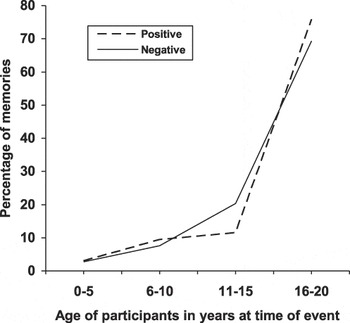
The percent of positive and negative memories produced rose significantly (p < .001) from 0–5, with only a few memories, to the 16–20 period, which accounted for over 70% of the memories produced. There was a similar pattern for positive and negative memories, except for the 11–15 period, t(111) = –2.578, p = .011. In this period, which includes adolescence, the participants produced more negative (20.30%) than positive memories (11.53%) (see Figure 1). The only significant differences between the emotional level of positive and negative memories were found in the 16–20 period, t(109) = 3.89, p < .001. Here, the participants attached greater emotional level to their more recent positive memories (M = 5.81; SD = .64) than their negative memories (M = 5.28; SD = .72). Following a similar pattern to that observed in the produced experiences, few participants narrated events from the 0–5 and 6–10 periods. Figures increased significantly (p < .05) in subsequent age-periods, with over 70% of the narratives falling into the 16–20 period. The emotional level attached to the narrated memories was equivalent for positive and negative experiences across the different age-periods.
Distribution of positive and negative memories in 5-year intervals for 20-year-olds.

Since the highest percentage of produced and narrated experiences corresponded to the last five years of the participants’ lives, the 16–20 age period was broken down into a further five periods, from most to least recent memories (after Rubin et al., Reference Rubin, Wetzler, Nebes and Rubin1986): days (up to 7), weeks (up to 4), months (up to 12), 1–2 years, and 3–5 years (see Table 2). The percentage of experiences produced, F(4, 444) = 14.83, MSE = 1.82, p < .001, and the percentage of participants that narrated them, χ2 (4) = 25.80, p < .001, was less for the more recent periods (days and weeks) than it was for months, 1–2 years and 3–5 years. Moreover, while the percentage of memories for negative experiences (produced and narrated) was distributed equally across the months, 1–2 years and 3–5 years categories, there were fewer memories for positive events (produced and narrated) that took place 3–5 years ago, i.e. in late adolescence, than in recent months and 1–2 years ago (p < .05), i.e. entering and the first years of university. The students rated the emotional level higher for positive than for negative produced experiences when they were recent: days, t(34) = 2.41, p = .041; weeks, t(37) = 2.13, p = .039; months, t(77) = 2.05, p = .043; and 1–2 years, t(83) = 2.60, p = .011. However, these differences were not observed for events which took place further in the past. For the narrated events, there were no differences in emotional level, either between the two groups or as a function of event recency.
Content analysis of positive and negative narrated experiences
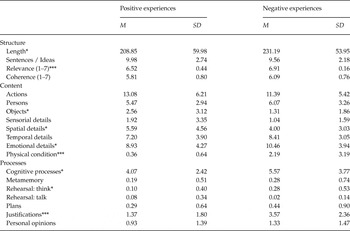
The content analysis of participants’ positive and negative narratives was based on four criteria: structure, content, processes (see Table 3) and event attribution. For this study we developed a coding system to assess recall based on the ideas and criteria proposed in previous studies of autobiographical memory (Berntsen, Reference Berntsen2002; Bohanek et al., Reference Bohanek, Fivush and Walker2005; Porter & Birt, Reference Porter and Birt2001) and on content analysis common in eyewitness memory research.
Mean frequency and standard deviations of the content of the positive and negative narratives

* p < .05; **p < .01; ***p < .001.
Four criteria were used to evaluate the structure of the narratives: length, measured by word count; number of sentences or ideas in the narrative with differential content; relevance, rating the importance of each idea or sentence to the event on a scale of 1 to 7, with 1–2 (irrelevant), 3–5 (complementary) and 6–7 (central); and coherence (1–7), i.e. the overall narrative structure of the event, with well-organized presentation, development and conclusion. The narratives were longer for negative memories than for positive memories, t(111) = –2.07, p = .04. Although there were no differences in the number of sentences or ideas, the relevance of these units to the narrated experience was greater for negative memories than it was for positive memories, t(111) = –6.15, p < .001. Coherence or overall structure of the accounts was equivalent for positive and negative experiences.
The content assessed included the typical aspects that make up a narrative (actions, persons, objects and sensorial details), contextual details (space, time), emotional details and physical aspects as a reaction to the emotional situation generated by the event. Recall was scored by assigning 1 point for each specific unique item of information. Two independent judges (interrater reliability .86), with experience in narrative protocol analysis, evaluated the content of recall and any discrepancies were cleared up by a third independent judge. Actions, emotional details, temporal details, persons and spatial details, in that order, comprised the main content of the narratives; objects, sensorial details and details about physical condition were complementary. There were no content differences between positive and negative memories in number of actions, persons, sensorial details or temporal details included in the narratives. There were more spatial details, t(111) = 2.167, p = .032, and objects, t(111) = 2.54, p = .012, in the positive memories than in the negative memories. In contrast, the negative memories contained more emotional details, t(111) = -1.98, p = .05, and aspects related to physical condition, t(111) = –4.318, p < .001, than the positive memories.
The processes evaluated included: cognitive processes, with reference to mental, perceptive and reflexive operations (e.g., then I thought that …); metamemory, which includes assessments of one’s own memory (e.g., I only vaguely remember ...); rehearsal, which entails thinking back on the event (e.g., now that I think of it …) or talking about the event with other people (e.g., when I finally felt comfortable talking about it ...); plans and intentions; justification of events, supplying reasons and explanations (e.g., because of their work, they had to leave us with my grandparents ...); and assessments, giving personal opinions. The number of cognitive processes in the narratives was notable, followed by justifications, and to a lesser extent, assessments, plans, metamemory and rehearsal. Three aspects were more representative of negative than positive memories: cognitive processes, t(111) = –2.549, p = .014, thinking about the event again, t(111) = –2.01, p = .048, and justifications, t(111) = –5.603, p < .001.
The greater justification in negative experiences is consistent with the results of event attribution. The attributions were established by determining whether the origin and development of the event were attributed to the narrator, to others, or to a combination of narrator and other people. The distribution of attributions in the positive memories was completely different from the negative memories, χ2 (2) = 70.47, p < .001. The highest proportion of attributions in the positive memories was a combination of narrator and others (76.27%), with fewer self-attributions (23.73%) and no attributions to others. Conversely, the negative memories were narrated from the perspective of other people causing the event (75.93%). Combinations of narrator and others were less frequent (16.67%), and very few cases suggested self-attribution (7.40%).
Phenomenological assessment of positive and negative narratives
Participants were presented with six questions to assess their phenomenological experience of the narrated events. Two yes/no questions assessed whether their memory was vivid and if it included sensorial details. Another two questions used a 1 (low) to 7 (high) point scale to rate the emotional level of the event at the time it took place and now. And two more questions used a 1 (never) to 7 (many times) point scale to examine whether the participants had thought about the event or talked about it with others.
There was a greater percentage of participants who attributed vividness to positive than to negative memories (positive: 98.30%, negative: 88.88%), χ2 (1) = 4.30, p = .038, and sensorial details (positive: 86.44%, negative: 70.37%), χ2 (1) = 4.35, p = .037. The two questions on the emotional level of the event revealed no differences between positive (M = 6.34; SD = 1.01) and negative (M = 6.43; SD = 1.06) memories at the time of the event. But at the time of the study, the positive memories were given higher emotional level ratings (M = 5.39; SD = 1.39) than the negative memories (M = 4.15; SD = 1.62), t(111) = 4.24, p < .001. The emotional level faded over time in both the positive (6.34 vs 5.39), t(58) = 4.46, p < .001, and the negative experiences (6.43 vs 4.15), t(53) = 8.96, p < .001, although the negative experiences did so to a greater extent (p < .001) than the positive experiences.
In the two questions on thinking or talking about the event with other people, the participants considered that they thought more about the negative M = 5.72; SD = .47) than the positive experiences (M = 4.95; SD = 1.73), t(111) = –2.524, p = .013, but talked more about the positive (M = 4.95; SD = 2.09) than the negative experiences (M = 4.04; SD = 1.72), t (111) = 2.524, p = .013. Results showed that participants considered that they thought more than they talked about negative experiences, t(53) = 7.52, p < .001, and that there were no differences in the positive experiences.
Discussion
To gain a broader perspective on the autobiographical memory of emotional experiences we adopted an integrative strategy. Not only did we examine the nature and distribution of the memories, but also the content of the positive and negative narratives, and the phenomenological qualities of the memories. A new aspect of this study is that, unlike earlier studies which ask for fewer experiences or which gear the search toward specific events, the participants freely recalled positive or negative emotional experiences of their past and freely chose one of them to describe the event in detail.
Categories and emotional level of positive and negative experiences
In the five minutes the participants were given to write down the positive or negative events in their lifetimes, they listed just over seven for each case, and rated the emotional level higher than 5 on a 7-point scale. Most of the participants then chose to narrate one of the experiences from among the first on their lists and with an emotional level rating of six or seven. In other words, they chose to narrate one of the most significant, accessible and emotional experiences of their lives.
Although 14 thematic categories were defined, more than 70% of the produced and narrated positive and negative experiences fell into six categories. Four were common to both types of experiences: academic achievements-failures, relationships-problems with classmates or friends, couple relationships-problems, and family relationships-problems; two were specific: positive (travel, excursions and holidays; festivities and celebrations), and negative (sickness and hospital stays; death of family or friends). Considered as a whole, the categories cover four basic areas of their lives: studies, friends, couple and family. We feel that these results may be more representative than findings from studies that ask for only one emotional event of each type (e.g., Berntsen, Reference Berntsen2002), or which focus on a specific period in life (e.g., Butler & Wolfner, Reference Butler and Wolfner2000; Pillemer et al., Reference Pillemer, Rhinehart and White1986; Walls, Sperling, & Weber, Reference Walls, Sperling and Weber2001) or which focus exclusively on traumatic events (e.g., Christianson & Loftus, Reference Christianson and Loftus1990).
This study is based on emotional autobiographical memories that occur from childhood up to age 20. We should not forget that many of the memories that mark a person’s life take place during early adulthood. A preference for this time of life is notable in studies in which participants are asked about important, vivid or significant memories (Berntsen & Rubin, Reference Berntsen and Rubin2002; Collins, Pillemer, Ivcevic, & Gooze, Reference Collins, Pillemer, Ivcevic and Gooze2007). We have many autobiographical experiences but not all of them are relevant to our personal life story. The memories that remain with us are those that were relevant to the self at the time they took place, those that maintain their meaning over time, or both (Bluck & Habermas, Reference Bluck and Habermas2000; Conway & Holmes, Reference Conway and Holmes2004).
Distribution of positive and negative experiences throughout their lifetimes
In both produced and narrated experiences, the number of positive and negative memories increased over the participants’ lifetimes from very few childhood memories to over 70% of the produced and narrated memories taking place in the last 5 years of the participants’ lives (age 16–20). Two aspects stand out. First, only in the early adolescence stage (11–15 years) did the participants produce more negative than positive memories. Adolescence consists of many first-time experiences and self-defining moments that impact on the identity of a person (Conway, Singer, & Tagini, Reference Conway, Singer and Tagini2004), and early adolescence can be a hard period. Teenagers have not yet learned how to make good choices and are less able than adults to weight the cost and benefits of their actions. This data shows that even though participants had moved on to another stage in their lives, evidence of that difficult period of transition still remained. Second, for the produced experiences the participants rated the emotional level of positive memories higher than negative memories only for their most recent memories (previous days to 1–2 years), but there were no differences for more distant memories. This may be because during this recent stage, coinciding with the entering and the first years of university, positive experiences were somewhat more prominent in their lives than negative experiences. Although not significant, the data in Table 2 and Figure 1 shows this tendency. The participants may also have given major importance to their positive than negative experiences, or the negative experiences may have been less serious. Another possibility is that the participants had a tendency to avoid negative experiences; this, however, is not apparent. Voluntary anonymous participation prompted students to implicate themselves fully in the task and to include highly personal and intimate experiences. They commented on how the narrated experience was the most important or difficult thing that had ever happened to them, or that it was the first time they had given an account of the experience.
Content of positive and negative narrated experiences
The structure of the positive and negative narratives included presentation, development and conclusion or outcome. In other words, both types of narratives contained a similar degree of internal coherence and organization (see also Porter & Birt, Reference Porter and Birt2001). Thus, emotional experiences were recalled as a unified coherent story rather than fragmentary isolated details. Although the narratives did not differ in the number of sentences or ideas, the negative narratives contained more words (see Bohanek et al., Reference Bohanek, Fivush and Walker2005), the ideas were more directly linked to the gist of the event and contained more plot-relevant details than the positive narratives (see also Berntsen, Reference Berntsen2002; Talarico, Berntsen, & Rubin, Reference Talarico, Berntsen and Rubin2009).
As far as content is concerned, actions, persons, emotional and spatiotemporal details, all distinctive aspects of an episodic multidimensional memory, were prominent in both types of narratives. Although no differences were found in the recall of actions and persons, there are contents that are more representative of the positive or negative experiences. Thus, more contextual information surrounding the event such as objects and spatial details were mentioned in the positive memories, and more details about emotions and physical conditions were included in the negative memories. In the narratives the cognitive processes stood out, followed by justifications. Both were more representative in the negative than the positive memories, and the participants stated that they thought more about the negative than the positive events. The greater number of justifications in negative than positive narratives concurs with the tendency to attribute negative events to other people, whereas positive events are shared (see Walls et al., Reference Walls, Sperling and Weber2001, for similar results with memories of school). This idea illustrates the role of self in the organisation of memories and coincides fully with the sin of egocentric bias which distorts our memories to favour stability and make us feel good (Schacter, Reference Schacter1999).
Phenomenological assessment of positive and negative narrated experiences
In the present study the participants attributed greater vividness and sensorial details to their positive memories than to their negative memories. These data are consistent with previous research (Destun & Kuiper, Reference Destun and Kuiper1999; Rasmussen & Berntsen, Reference Rasmussen and Berntsen2009; Schaefer & Philippot, Reference Schaefer and Philippot2005). The participants gave similar emotional level ratings to positive and negative narratives at the time of the event. They also felt that the emotional level for both types of experiences had faded over time, although more so in the case of negative events, which is consistent with the notion of a positivity bias with increasing time since the events (Berntsen, Rubin, & Siegler, Reference Berntsen, Rubin and Siegler2011; Schryer & Ross, Reference Schryer and Ross2012). Thus, emotional level ratings were higher for the positive than for the negative narrated experiences. These results may be linked to two ideas: first, the emotional level of negative events generally diminishes because problems are resolved or overcome with time; second, positive events receive stronger emotional levels because we have a greater maintenance of pleasant memories (see Butler & Wolfner, Reference Butler and Wolfner2000, for similar conclusions and data). The assessments indicated that the participants thought more often about the negative events but talked with other people more often about the positive events. Positive memories are shared more frequently in conversation suggesting that serve important functions for social bonding (Rasmussen & Berntsen, Reference Rasmussen and Berntsen2009; Talarico et al., Reference Talarico, Berntsen and Rubin2009). Although the narratives revealed very little data concerning rehearsal, the participants thought back more often on the negative than the positive memories.
The memories provided by the 20-year-old participants in this study allow us to infer that people structure their autobiographical memory in thematic areas relevant to their personal, emotional and social lives, including family, friends, partner and studies. From the distribution and emotional level of the memories we can conclude that certain positive and negative childhood memories remain vivid as if no time had passed. From the adolescence negative memories stand out over positive memories. Nevertheless, most of the emotional positive and negative memories showed a clear recency effect. Among them, the most recent memories, which coincide with entering and the first years at university, are characterized by a higher emotional level for positive than for negative memories. This may indicate the positive value given to achievements from this stage of change towards adult life.
Lastly, narratives allow us to relive our experiences. They include information not only on when, where and how an event unfolds, but also about our feelings, thoughts and emotional reactions; in other words, the experience itself. Even so, we will never be certain of whether the events happened exactly as we remember them or think we remember them. Nonetheless, our results contribute ideas that may prove useful for diagnosing emotional problems and designing therapeutic tools. For example, recalling autobiographical memories could be a powerful emotion regulation strategy that can be used to repair low mood and alleviate negative affect (see Boals, Hathaway, & Rubin, Reference Boals, Hathaway and Rubin2011; Werner-Seidler & Moulds, Reference Werner-Seidler and Moulds2012).