Introduction
A key issue in corporate governance is the power of shareholders to control and discipline managers of corporations. Shareholder rights tend to ebb and flow over time in tandem with wider societal opinions about whether corporations ought to serve shareholders, stakeholders, or society at large.Footnote 1 From the 1930s, shareholders in Dutch companies were increasingly sidelined by managers adopting various legal defenses against shareholder voices and hostile takeovers. Those defenses proved surprisingly resilient to changing opinions about the role of corporations in society, easily surviving periods of time when shareholder power and activism were in favor. An institution peculiar to the Netherlands, the administratiekantoor or trust office facilitating stock substitution, was central in this evolution. Originally an institution serving shareholders in various ways, it was first repurposed to defend Dutch corporate managers from unwanted interference, and then evolved into both a cheap and easy takeover defense for international corporations and a tax-efficient vehicle for routing global revenue flows.
Our paper asks two questions: First, why did corporate defense mechanisms in the Netherlands appear and prove so resilient; second, what made the administratiekantoor such a valuable conduit for various, highly different purposes? We argue that these defense mechanisms became and remained popular because the economic nationalism of a small country with an open economy combined with highly dispersed shareholdings to make managers seek protection from unwanted interference. Investor pressure groups, the stock exchange, and expert opinion attacked the practice in vain for two reasons. First, successive governments and Parliament favored the stakeholder view of corporate purpose over shareholder rights; second, the stock exchange proved a poor champion of shareholder power against its members’ business interests and corporate managers bent on keeping corporate governance relations cozy.
As for the trust offices, having facilitated securitization and stock substitution since the late seventeenth century, they were and remain deeply embedded in the financial system, familiar to investors, bankers, and lawyers alike, available off the shelf, and easily adapted to new forms of demand. Though the administratiekantoor is and was somewhat different in function from the trust office in the Anglo-Saxon world, we treat the terms “administratiekantoor” and “trust office” interchangeably throughout the paper.Footnote 2
We provide answers to our research questions in three steps. First, we document the deep embeddedness of trust offices in the Dutch financial system by going back to their seventeenth-century origins. Grafted onto early and highly common securitization and stock substitution practices, the initial trust offices served merchant banks and investors alike by pooling illiquid, high-denomination, or otherwise unpopular securities and issuing more liquid certificates giving rights to the income from the pooled securities. While that essential function and the associated techniques remained the same, during the second stage of their evolution, from the 1930s to the 1960s, company boards set up dedicated trust offices to mute shareholders and shield themselves against takeovers by issuing nonvoting certificates. This repurposing fit a wider corporate governance trend of adopting various legal devices against hostile takeovers in the Netherlands. Certification through administratiekantoren suited such objectives particularly well, being long-established, highly familiar institutions, easily available, efficient, and effective. From the 1970s, even though anti-takeover devices were challenged by new ideas about governance and shareholder value, Dutch trust offices retained their popularity. Moreover, refashioned as stichtingen (foundations), they were also discovered by foreign corporations, and high net worth individuals (HNWIs) as cheap and easy defenses against takeover threats and tax-efficient routing of global revenue flows.
Our analysis and findings contribute to the literature on the history of Dutch corporate governance and financial markets. The focus on certification and trust offices clarifies why the twentieth-century shift of power from shareholders to corporate boards was a smooth one: Both had been around for such a long time that their gradual repurposing encountered no resistance from investors, the stock exchange, banks, or the government. That same availability and perceived legitimacy enabled trust offices to be repurposed again from the 1970s, against strong pressure in the 1990s and early 2000s from shareholder interest groups and expert opinion, first to facilitate preferred share constructions as an additional defense, second to cater to international corporations and HNWIs.
The Netherlands is unique in several ways. First, the country has a long tradition of financial market development.Footnote 3 Second, the certificates and trust offices are unique instruments not used in other countries.Footnote 4 Third, the trust offices are favored by corporations worldwide for purposes ranging from takeover defense to the tax-efficient routing of international cash flows.Footnote 5 We demonstrate that, for more than two centuries, the trust office’s core function and modus operandi remained recognizably the same while constantly being adapted to suit new needs in a continuous interaction between investors, business corporations, and the financial system. This resulted in the Netherlands having both highly specific and highly effective takeover defenses.
Though the Dutch case is unique, it offers valuable lessons outside the specific setting. We present an example of financial system dynamics.Footnote 6 Broadly speaking, the relevant literature explaining differences between financial systems may be grouped into three schools: culture, law, and economics or political economy, respectively emphasizing the importance of informal institutions, legal traditions, or the outcome of bargaining processes between interest groups as determinants of how financial systems operate.Footnote 7 In this paper, we argue that we should pay more attention to formal institutions and institutional adaptation in the Northian sense to understand both the evolution of financial systems and persistent differences between individual systems.Footnote 8 Moreover, we argue that the adaptation of trust offices succeeded because of their perceived efficiency and legitimacy as a governance institution.Footnote 9 We argue that the administratiekantoor represents a highly flexible institution continuously adapted to suit particular circumstances as they arose, thereby creating new options and opportunities for banks, corporations, and investors, which attract new participants into the market, thereby further widening options and opportunities, and so on and so forth. In other words, the Dutch trust office also provides an example of how and why financial markets, and by extension capitalism, come to vary from one country to another.Footnote 10
Distant Roots
Trust offices had their origins in securitization and stock substitution techniques that became common on the Dutch financial market from the 1690s. The first known instance of the former was effected in 1695 by the Amsterdam merchant banker Wed. Jean Deutz & Soon. Having provided the Austrian Emperor with a 1.5 million guilder 5 percent loan backed by Hungarian mercury, the firm repackaged it and sold investors securities giving claim to an annual 5 percent payment plus redemption from the mercury revenues.Footnote 11 Deutz subsequently sold a string of similar asset-backed Austrian loans, familiarizing investors with this type of vehicle.
In 1753 the firm launched another innovation, mortgage-backed securities.Footnote 12 Deutz provided mortgages to Caribbean plantation owners and then bundled those mortgages together in a vehicle whose shares were sold to investors. This popular formula was quickly copied by other merchant bankers who sold an estimated total of 80 million guilders in mortgage-backed securities to investors all over the country. In 1774 the Amsterdam broker Abraham van Ketwich piggybacked on the widespread familiarity with securitization to introduce security substitution by launching the investment fund Eendragt Maakt Magt (best translated as United We Stand).Footnote 13 Designed in the wake of the 1772–1773 financial crisis, the fund offered investors the chance to diversify by buying participation in a nonpermanent pool of securities commonly traded on the Amsterdam exchange.Footnote 14
Van Ketwich’s pioneering fund was quickly copied by other bankers and brokers, notably for foreign loans.Footnote 15 These were usually denominated in guilders, putting the exchange risk on the borrower. The competition between merchant bankers for business together with a declining guilder enabled foreign borrowers to negotiate loans in their own currency, shifting the exchange risk to lenders. At the same time, the change of currency threatened to render loans less attractive to Dutch investors due to the transaction costs of conversion into local currency and by making price and yield calculations more difficult. To eliminate that threat, bankers and brokers repackaged foreign securities into a fund that then issued guilder-denominated securities to investors.
The security-substitution vehicle quickly became the dominant form of issuing foreign securities during Amsterdam’s late eighteenth-century heyday as an international loan-issuing center. The bankers and brokers launching them issued certificaten (certificates) representing claims on securities held in the vaults of a designated trustee, usually a notary, and distributed the flows of money generated by those securities. From there, it was only a short step to the administratiekantoor, taken during the French occupation (1795–1813). When for various reasons, securities prices collapsed across the board, brokers and bankers stepped in to support the market by creating liquidity. They bought blocks of particular securities, say French bonds, and deposited these in a trust office that then performed the customary stock substitution. That is to say, it issued certificates giving a right to the joint ownership of those securities and handled the money flows issuing from the securities.Footnote 16 In this way, a motley lot of bonds could be bundled, made more recognizable, and thereby rendered easier to trade. Additional advantages were enhancing liquidity by breaking up large-denomination bonds into smaller ones and transforming bonds made out to named persons or entities into certificates to bearer, Dutch investors’ preferred form of security. The first such offices appear to have been those set up by the prominent broker Willem Borski for French securities (1802, jointly with Ketwich & Voomberg and Van Halmael & Hagedoorn), U. S. bonds (1805, with N., J., & R. van Staphorst), and Dutch bonds (1809, again with Ketwich & Voomberg),Footnote 17 and they soon became popular for Dutch public debt as well following the reorganization of the public debt administration in 1809.Footnote 18 Amsterdam alone came to count no fewer than twelve such offices for Dutch public bonds.Footnote 19 Their success in providing easy access to foreign securities plus liquidity through stock substitution forms one explanation why mutual funds failed to make headway after their precocious start.Footnote 20
Though performing the same administrative functions as substitution vehicles, the administratiekantoor was something new. It no longer embodied the substitution itself but had become a separate, independent entity to pool, repackage, and manage securities, any securities, to enhance their liquidity. During the 1850s, the Amsterdam firm of Hope & Co. found yet another application when it entrusted the liquidation of two of its U.S. loans to offices set up for the purpose. The firm called them gemeenschappelijk bezit (joint ownership), followed by the name of the particular security issue.Footnote 21 This form and name were to have a bright future, as we will discover.
The second half of the nineteenth century saw three new trends, two minor and one major. First, the number of trust offices managing Dutch public debt declined when the government switched to a new issuing system with bearer bonds.Footnote 22 Second, during the 1880s, trust offices began reorganizing themselves from partnerships into joint-stock companies owned by the bankers and brokers interested in the securities handled by an office.Footnote 23 Third and most important, from 1864 the boom in U.S. railroads led to five new trust offices. Some of them focused on a single security or company, others had a wider scope. Most American railroad shares and bonds ended up being handled by them, because the original securities were usually registered, that is to say, made out to named persons or entities, so exchanging them for the bearer certificates customary in the Netherlands made them much more attractive for local investors.
Little noticed at the time, this repackaging of railroad shares represented a typical incremental step in the evolution of trust offices, but the opening of important new options and opportunities. Turning the shares into certificates representing claims to pooled shares split the bundle of legal claims pertaining to those shares into two parts. The ownership claims to economic yields such as dividend payments, capital gains, and share splits were vested in the certificates, while the control rights, that is to say, the voting rights, remained in the pool held by the trust office. Pooling the original securities in this way gave Dutch investors more clout in negotiations following the frequent financial mishaps which occurred in U.S. railroads, a form of proxy voting.Footnote 24 Indeed, in 1867 the bankers and brokers who had introduced Atlantic & Great Western Railroad shares in the Netherlands set up an administratiekantoor with the specific purpose of pooling them to defend Dutch investors’ rights during the company’s reorganization.Footnote 25 Splitting shareholders’ legal claims on a company into two distinct parts quickly gained legitimacy, because the market readily accepted it. Certificates and original shares traded side by side, certificates at a slight discount representing the net effect of the convenience and the trust office’s cost of exchanging certificates for shares.Footnote 26 As a result, investors and the financial system at large became used to this type of arrangement.
Summing up, trust offices developed on the back of the large Dutch capital exports into well-established and broadly accepted vehicles to support investors. They brought investors convenience to improve diversification, liquidity, and monitoring, largely for their international investments through Dutch intermediaries.Footnote 27
Certificates for Dutch Corporations
Founded by King William I in 1824, the Nederlandsche Handel-Maatschappij (NHM) had an initial capital of 37 million guilders in 1000 guilder registered shares.Footnote 28 The Dutch preference for bearer shares hampered trade, as did the high nominal value. In February 1885 the company issued shares to the Administratiekantoor van aandeelen in Vennootschappen en in binnen- en buitenlandsche leeningen, which repackaged them in the usual way into small-denomination bearer certificates. This stock substitution was a company initiative, not performed by brokers or bankers seeking to boost their trade, but it was otherwise an identical transaction that split the bundle of claims in two. The trust office kept the shares and the vote, and the certificate holders only held a claim on the economic gains. The certificates were what was called royeerbaar (redeemable), that is to say, investors wanting to obtain voting rights could get them by paying a small fee for exchanging the certificates for the original shares. The Amsterdam Stock Exchange, used as it was to trading all kinds of certificates, saw no harm in corporate securities without voting rights and listed them side by side with the shares. Investors proved sufficiently keen on the certificates for them to trade at times above the shares.Footnote 29
The same considerations, improving liquidity, drove several similar repackaging operations of Dutch corporate shares in the early twentieth century, some undertaken by the company itself, others by bankers and brokers. By 1902, for instance, the 1000 guilder shares of the Royal Dutch Shell forerunner, the Koninklijke Nederlandsche Maatschappij tot Exploitatie van Petroleumbronnen in Nederlandsch-Indië, had risen to 476 percent of par, so certificates of 100 guilders were issued to attract small investors. These certificates for one-tenth of a share could be bought for less than 500 guilders, whereas the shares were 4760 guilders each. Similar issues followed for shares in popular safe investments like Nederlandsche Bank, Deli Maatschappij, and Tabaksmaatschappij Arendsburg. The certificates were redeemable: The holders of certificates could swap them for the underlying shares upon paying a small charge to the administratiekantoor, which also levied a 1 percent charge for paying dividends received to certificate holders.Footnote 30 As a rule, holders possessed the right to reunite the economic claims with the control rights on a company, so certificates did not represent a form of separation of ownership and control through dual-class shares.
Even so, the popularity of liquidity-enhancing certificates issued by trust offices presents a puzzle. From a financial-economic perspective, one would expect companies to boost liquidity by issuing lower-denomination shares or performing stock splits. The explanation for why Dutch companies did not do this probably lies in a combination of administrative efficiency and investor attitude. Trust offices had been performing this kind of operation for a century or so and could probably do it at least as efficiently as the companies themselves. Investors did not mind either way, as long as they could rely on obtaining the vote in exceptional situations such as financial restructuring or liquidation. Most investors appear to have nursed either a blind trust or indifference toward corporate governance issues anyway, putting portfolio returns above active involvement with the companies concerned. The certification trend probably did reduce the incentive to attend shareholders’ meetings, because most investors valued liquidity over the right to vote. As we will see, low attendance was precisely one of the arguments put forward favoring defensive devices.
The Rise of Takeover Defenses
From the 1890s, real or imagined takeover threats from foreign corporations whet Dutch boards’ appetite for what came to be known as “oligarchic clauses,” statutory limits on shareholder rights designed to enhance board power and protect a company against hostile takeovers.Footnote 31 The first known instance was the adoption of dual-class shares by the Royal Dutch oil company in 1898. Considering itself threatened by Standard Oil, the board changed its statutes taking the right to appoint managers away from shareholders and giving it to hand-picked holders of priority shares created for the purpose. Opponents cried foul, clamoring that the proposal would create an illegal device at odds with centuries-old traditions of shareholder democracy.Footnote 32 Supporters of the new priority shares argued that shareholder democracy no longer worked anyway. Indeed, modern corporations needed to be saved from it, because the wide dispersion of shares coupled with poorly attended annual general meetings (AGMs) made them vulnerable to the whims of accidental majorities.Footnote 33 After two heated meetings, the Royal Dutch shareholders accepted the change with a large majority, in effect robbing themselves of control.Footnote 34 A few other companies followed suit with a range of defensive devices, including specific nationality requirements for directors or qualified majorities for selected decisions.Footnote 35 In addition to takeover threats, shareholder absenteeism at annual meetings often served as an argument for adopting such oligarchic devices.Footnote 36
During the first decade of the twentieth century chauvinist sentiment prompted calls to protect firms from foreign influence, rising to new, almost hysterical levels during World War I.Footnote 37 In response, various defense mechanisms were put into play by corporations. Priority shares with special rights, such as binding nominations for board vacancies, were the most widely used of such devices, but holding structures in the form of joint-stock companies or private associations (vereniging) were also used.Footnote 38 Called gemeenschappelijk bezit (collective ownership), or nationaal bezit (national ownership), such holdings were essentially institutionalized pyramids inserting exactly one layer between the operating entity and the shareholders, removing assets from shareholder control.Footnote 39 The 1908 Nederlandsche Scheepvaart Unie was the first such holding structure, protecting three shipping companies from hostile takeovers; two other companies followed suit in 1911 and 1915.Footnote 40 The pyramid construction never gained wide popularity, being considered complicated to set up, difficult to adapt, and needlessly comprehensive compared with available alternatives.
One potential alternative defensive measure, namely lodging mass voting power in an administratiekantoor by having it exchange shares for nonredeemable certificates, was used only sparingly before World War II, presumably because the Vereeniging voor den Effectenhandel, the brokers’ association running the Amsterdam Stock Exchange, objected to listing nonredeemable certificates, though stopping short of a formal ban.Footnote 41
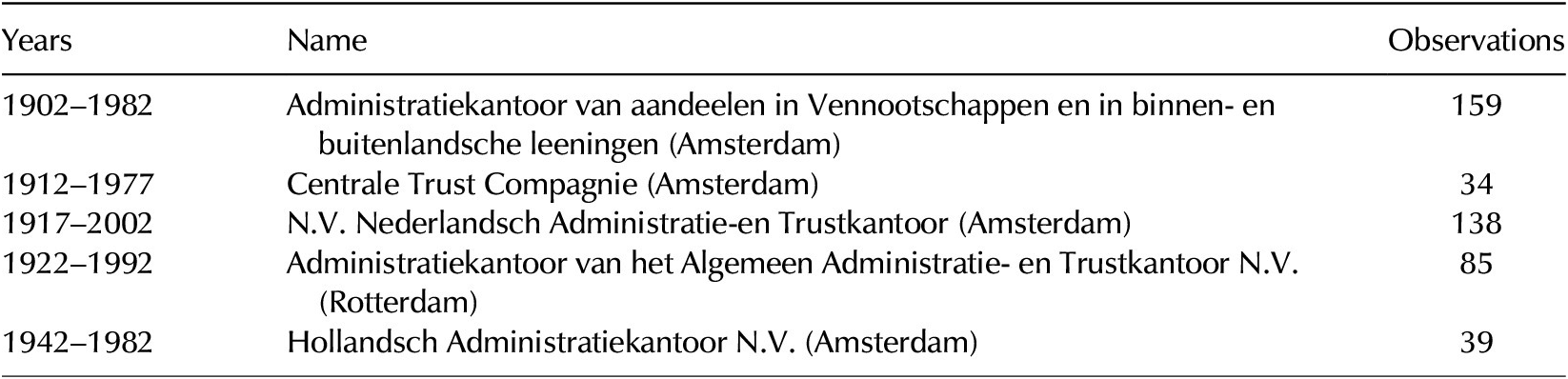
At this stage, trust offices were general purpose, that is, they dealt with a range of securities from a number of different issuers, as data on trust offices gleaned from the annual Gids bij de Prijscourant show. The stock exchange’s official publication details all listed securities, including the trust offices of certificates quoted. We collected all firms with certificates and the names of their trust offices over the period 1902–2007, taking every fifth year from 1902 onward. We use the 1949 Gids issue instead of 1947, because publication was suspended between 1944 and 1948. Table 1 shows the five administratiekantoren that dominated the field, based on the number of listed certificates they represented at five-year intervals. All five of them were general-purpose outfits issuing redeemable certificates for any number of companies; trust offices tied to a single company were rare before the war.
Administratiekantoren for Dutch shares

Note: This table shows the five largest administratiekantoren based on the number of listed certificates they represented at five-year intervals. All certificates over the period 1902–2007 are traced for every fifth year (starting in 1902; 1949 instead of 1947) and for each certificate the administratiekantoor is registered.
Source: Gids bij de Prijscourant.
The Administratiekantoor van aandeelen in Vennootschappen en in binnen- en buitenlandsche leeningen, already mentioned in connection with the NHM certificates, was by far the biggest throughout, with 159 observations over sixteen sampling years between 1902 and 1982 (i.e., an average of close to ten certificates per sampling year). It was closely followed by the Nederlandsch Administratie-en Trustkantoor and at some distance by the Centrale Trust Compagnie and the Adminstratiekantoor van het Algemeen Administratie- en Trustkantoor NV, the only Rotterdam firm among the big players. These trust offices were typically set up between 1885 and 1907 as small joint-stock companies. Moreover, at least during the 1920s, the five big trust offices were not linked to the companies whose shares and certificates they managed, so at that time they are unlikely to have functioned as levers to mobilize votes. We collected data on corporate certificates, administratiekantoren, and interlocking directorships between administratiekantoren and the companies whose shares and certificates they managed for the years 1922–1923 from the Gids bij de Prijscourant, the Financieel Adresboek, and Van Oss Effectengids. This yielded 484 firms, of which 46 (9.5 percent) had certificates managed by a total of nine administratiekantoren, seven general ones and two firm-specific ones. The seven general trust offices had a total of forty-eight executive and nonexecutive directors, almost seven on average. Those businessmen had a total of 102 interlocking directorships with other companies, but never with a company whose shares and certificates they managed, so the directors of trust offices were well connected but did not combine their certificate services with board seats. As a rule, therefore, the main goal of issuing certificates was to improve liquidity and hold the underlying securities in trust for the owners, and not to serve the issuers in one way or another.
Therefore companies wanting to use certificates as defensive devices could not use a trust office servicing redeemable certificates and had to set up their own offices. In 1907 the mining company Mijnbouwkundige Werken was the first firm to issue nonredeemable certificates, followed four years later by glue producer Lijm- en Gelatinefabriek.Footnote 42 To secure full control, the two companies deposited their shares in a private association, open to Dutch nationals only, which issued certificates to investors. In 1918 the food-processing company Calvé established a similar association (vereniging), Beheer van Aandeelen der NV Nederlandsch-Fransche oliefabrieken Nouveau Etablissements. Its members had to be either Dutch or French nationals, and its sole purpose was to hold Calvé’s shares and issue certificates. Six years later, this association also was given the right to make binding nominations for board vacancies.Footnote 43 In 1928 the Dutch East Indies plantation company Lawoe framed an explicit intention to use its certificates as a takeover defense by dropping the right to exchange them for shares and concentrate all voting rights in a trust office. Lawoe’s move was a sign of things to come. The Meneba flour-milling concern replaced its registered shares with bearer certificates in 1938, clearly intending to prevent hostile takeovers: the certificates were exchangeable for shares, but only customer-shareholders (i.e., bakers) received that right. Yet the Meneba board argued at length that the switch would give shareholders better liquidity and did not really harm their interests, because shareholders preferred liquidity and dividends to voting rights.Footnote 44
The nonredeemable certificates and trust offices created nonvoting equity participations, which were uncommon in other countries at the time. In the United States, firms could set up a voting trust, but only for a limited period of time of five or ten years.Footnote 45 Firms were also allowed to issue nonvoting stock.Footnote 46 In an overview of the two hundred largest U.S. corporations, Berle and Means show that only five had the (temporary) voting trust arrangement: another five had nonvoting stock, and two companies had both.Footnote 47 Interborough Rapid Transit Company was the most striking case, with a five-year trust agreement, renewable for five successive periods of five years. Berle and Means conclude that in 1930, the use of these devices was disputed in court and “had declined from extreme strength to practical impotence.”Footnote 48 As for the United Kingdom, in the nineteenth century, issuing shares with no, limited, or special voting rights was uncommon, though the practice has been documented as early as 1897.Footnote 49 In the first half of the twentieth century, nonvoting (preference) shares were still allowed on the London Stock Exchange.Footnote 50 Only from the middle of the century has the default rule been one share, one vote.Footnote 51
In the Netherlands, the defensive capabilities of nonredeemable certificates served the blast furnace and steel mill Hoogovens well following the German invasion of the Netherlands in 1940. Facing Nazi efforts toward Verflechtung, that is, slotting firms in occupied countries seamlessly into the war effort by having them taken over by German concerns, the Hoogovens board came under pressure from Vereinigte Stahlwerke AG during the second half of 1940. In December the board succeeded in deflecting the threat by mobilizing a shareholder majority in favor of exchanging their shares for certificates redeemable only following a supermajority shareholder vote, which was rendered impossible by lodging a majority vote in a trust office set up for the purpose. The board appealed to the Vereeniging voor den Effectenhandel to list the de facto nonredeemable certificates in the national interest, despite the stock exchange’s official dislike of them.Footnote 52 The Hoogovens trust office thus represented its full transformation from a general-purpose vehicle into a corporation-specific anti-takeover device. After the war, the support of top civil servants for the company’s clever move served proponents of such devices as an argument justifying the use of nonredeemable certificates: The government itself had sanctioned it.Footnote 53 For the Hoogovens board, this oligarchic device clearly conferred the benefit of considerable protection. A 1962 memo called the certificates “a guarantee that the company will continue to be run by a small group of persons who, given their social background, ensure that present policies will remain in place.”Footnote 54
The Heyday of Protective Devices
The 1962 Hoogovens board memo perfectly captured the postwar attitude in favor of curtailing shareholder power, illustrative of the Netherlands moving from a liberal market economy to a coordinated system.Footnote 55 In 1949 the Hoge Raad (Dutch Supreme Court) ruled that nonexecutive directors should act in the interests of their companies, even if that went against shareholders’ interests.Footnote 56 Six years later the court took a step further when ruling that the AGM of shareholders did not represent the highest authority in conflicts with the nonexecutives.Footnote 57 This was in line with broader political opinion. Members of Parliament had advocated from the late 1920s that corporate policy ought to strike a judicious balance between the interests of capital, labor, and management, thereby legitimizing the use of takeover defenses. During the 1950s, parties on the left pressed for a transfer of shareholder power to works councils representing stakeholders, an idea strongly resisted by parties on the right. An employers’ confederation did propose, however, that one-third of a company’s nonexecutives be appointed by stakeholders rather than by shareholders.Footnote 58
As a result, devices shielding boards from both takeovers and shareholder power proliferated. In addition to the devices discussed already—certificates, priority shares, and collective ownership—Dutch corporate lawyers and notaries introduced a wide array of statutory and nonstatutory devices, some of which were used by only one or a few firms.Footnote 59 By 1955 only four out of seventy publicly quoted companies with a capital of more than 10 million guilders did not limit shareholder voting rights one way or another; by 1977 almost all companies did, and some had multiple devices.Footnote 60 We have collected information about the four most common devices, based on information published in the Gids bij de Prijscourant. This overview presents a low estimate of the extent to which shareholder rights were limited, because many statutory restrictions, for example, binding nominations, could be, and were, tied to instruments other than priority or preference shares, such as unquoted founder shares.
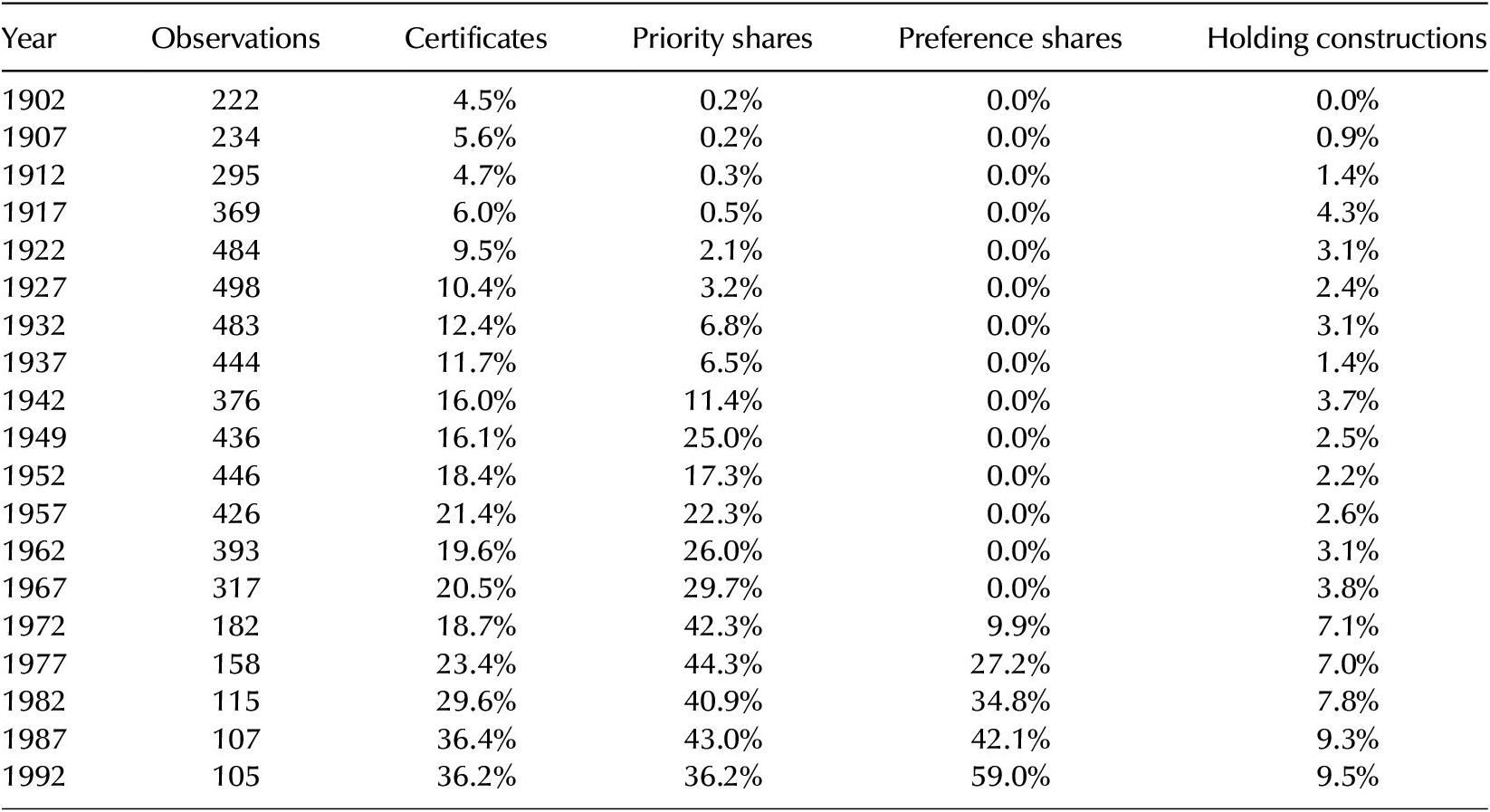
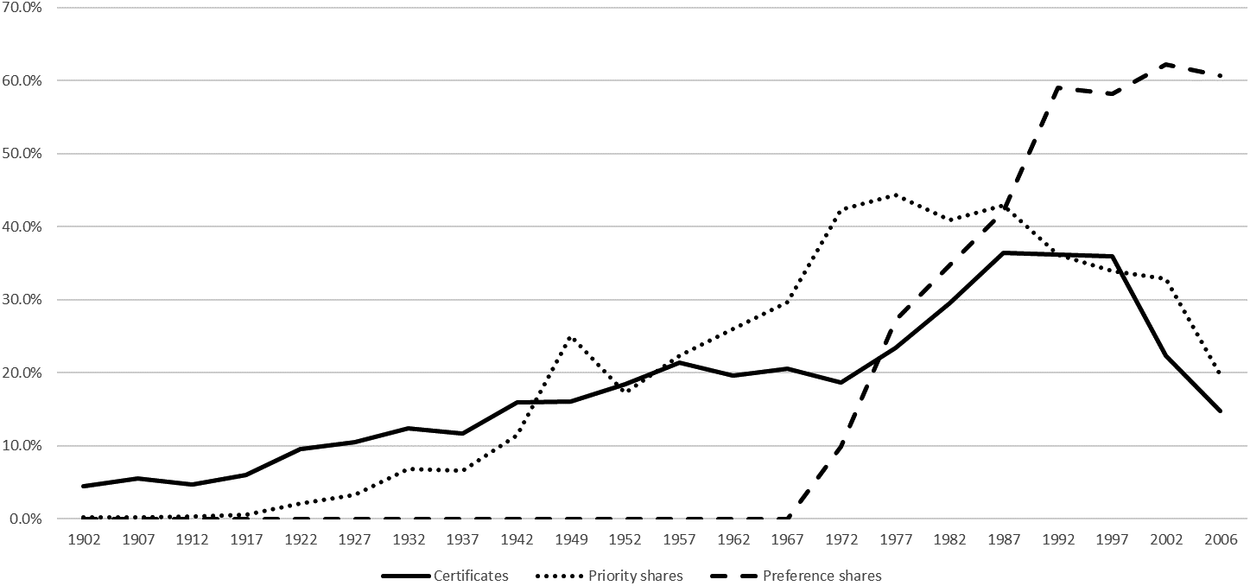
Table 2 and Figure 1 present an overview of the most important defense mechanisms. Holding constructions, collective and national ownership structures, so common elsewhere, were never very popular.Footnote 61 In countries like the United States, the paucity of such pyramid structures is explained by tax policies designed to discourage them, but none existed in the Netherlands.Footnote 62 Businessmen preferred more flexible solutions like certificates and priority shares. Initially they were by far the most popular defensive devices, but during the 1980s, preference shares won ground to become the most widely used defensive devices.Footnote 63
Takeover defenses, 1902–1992

Note: This table shows the percentage of listed firms that have one of four important takeover defenses. All listed firms over the period 1902–1992 are traced for every fifth year (starting in 1902; 1949 instead of 1947). Certificates and priority shares are mentioned in the capital structure description of the firm. Preference shares are also mentioned in the capital structure; only when less than 25 percent of the shares are placed, the preference shares are included as a takeover defense, because otherwise the shares are financing shares. Holding constructions are identified based on company names (for example, including nationaal bezit or gemeenschappelijk bezit).
Source: Gids bij de Prijscourant.
Evolution of takeover defenses, 1902–2006.

Already common in the nineteenth century to secure special voting rights, preference shares derived, and still derive, their popularity from being cheap and flexible emergency brakes that do not necessarily affect shareholder voting rights. Their return to fashion goes back to 1955, when the Bandar Rubber company thwarted a hostile takeover by issuing shares to a stichting gemeenschappelijk bezit (joint-ownership foundation) set up for the occasion and run by Bandar’s own board. The novelty lay in the vehicle’s legal form. Until then, trust offices were joint-stock companies and joint-ownership devices, sometimes a private association. A foundation possesses several advantages. Cheap to set up, it is dormant most of the time, and therefore cheap to run and to maintain. Moreover, a stichting is not subject to corporation tax nor under any duty to publish annual reports or register the beneficiaries of any assets managed. Moreover, foundations do not have members or shareholders, so once appointed, their boards can do as they please within the self-chosen statutory limits.
Initially the Bandar Rubber construction remained a fairly isolated example. Most other takeover attempts during the 1950s and early 1960s were deflected by issuing shares to loyal banks or institutional investors.Footnote 64 However, the heated takeover climate of the later 1960s combined with new EEC rules about equity issues to create foundations armed with a new and simpler takeover deterrent.Footnote 65 Issuing shares to outside investors was relatively expensive and cumbersome, while a real or imminent bid made such shares difficult to price.Footnote 66 From 1969, companies therefore switched to loading their defensive foundations with preference shares. Some of the trust offices chose to authorize them with only an option to issue such shares as and when required. This arrangement was even simpler and cheaper, because the preference shares had a low price-to-nominal value ratio and only a fraction of that needed to be paid up, so the foundation would not need to raise large amounts of money to thwart a takeover. Also, the preferred dividends were fixed, rendering debt financing easy, because cash flows were relatively stable. In 1970 such a threat proved decisive in helping the Noordelijke Industrie voor Vezelverwerking to defeat Clark and Fenn Ltd.’s hostile takeover attempt.Footnote 67 By the end of the 1980s, preference shares had become the takeover defense of first choice, and in 1992 (as shown in Table 2), 59 percent of the quoted companies examined possessed the option of issuing preference shares to a third party.
The quest for effective defensive devices also drove a fundamental repurposing of the share substitution technique practiced by trust offices, from enhancing liquidity to reducing shareholder power. That required firms to set up tied trust offices, because the traditional ones serving all comers still conceived of their fiduciary duty as to the owners, not the issuers, of the securities held in trust. As a result, general trust offices lost ground to tied ones. In 1932, 88 percent of certificates listed on the stock exchange had been issued by general trust offices, against only 7 percent by tied ones and 5 percent unknown. By 1978 the ratio was 46 percent to 49 percent and 6 percent unknown, and even 13 percent to 91 percent and 2 percent unknown fifteen years later. Following Bandar Rubber’s lead, trust offices turned themselves increasingly from joint-stock companies into foundations, a process to all intents and purposes completed by 1989.Footnote 68 The percentage of nonredeemable certificates listed on the stock exchange rose in tandem. In 1952, only 16 percent of certificates were not redeemable, but by 1972 this fraction had increased to 35 percent.Footnote 69
The stock exchange board, formerly opposed to limiting shareholder voting rights with nonredeemable shares, mustered no significant resistance to this sweeping tide, presumably because its members cared more about brisk trade than about shareholders’ rights. In the face of complaints about trust offices being too closely tied to particular corporations, the board did no more than ask expert commissions to investigate.Footnote 70 The 1955 Hellema report highlights just how far public opinion about the position of shareholders had shifted. In the committee’s telltale expression shareholders possessed medezeggenschap, the right to have a say, but not the final decision.Footnote 71 Consequently, the committee did not go further than recommending that certificates be admitted to the official list only if the trust office managing them met a string of requirements safeguarding its independence from the corporations whose shares it held. Soft though the committee’s recommendations were, the stock exchange board lacked the power or conviction to see them through. In 1961, sugar company CSM set up a tied trust office that issued nonredeemable nonvoting certificates covering 46 percent of its shares so as to neutralize block votes held by banks.Footnote 72 Despite misgivings, the stock exchange board admitted the CSM certificates to the list. During the 1960s, another report on nonredeemable certificates commissioned by the board went unpublished for reasons unknown.Footnote 73
The sharp increase in defensive devices turned the original argument against shareholder democracy into a self-fulfilling prophecy: shareholders no longer bothered to attend AGMs. A 1954 survey counted the shareholders present at forty-three AGMs. No more than six shareholders attended thirty-two of those AGMs, and at twenty-eight of them, shareholders represented less than 10 percent of shares. Fifteen years later, the situation had hardly improved.Footnote 74 In April 1968 only one shareholder attended the AGM of the Rotterdam Droogdok Maatschappij, obviously the trust office. It is no surprise that all agenda items were approved without discussion.Footnote 75
In 1971 Parliament sanctioned the curtailing of shareholder power by approving the so-called Structuurwet. Applying to all companies with capital of more than 10 million guilders, the law established as a principle that a corporation’s supreme power rested with its nonexecutive directors, who were deemed to represent its stakeholders and the interests of society at large. Consequently the Structuurwet gave nonexecutive directors the right to appoint and fire managers, approve the annual accounts, and even fill vacancies among themselves by co-optation, prerogatives previously belonging, at least in theory, to shareholders, who were now left with no powers to speak of.Footnote 76 The law’s mandatory co-optation of directors, called structuurregime, eliminated the need to have priority shares with the right to make binding board nominations, so their popularity declined in favor of other devices.
The Return of the Shareholders and New Applications for an Old Institution
During the 1980s, conceptions about the position of corporations in society began to change and so did opinions about shareholder rights. The Dutch business system became increasingly liberal, and international investors bought growing stakes in Dutch firms, giving support to mounting resistance against the extent to which shareholders were kept powerless.Footnote 77 Worried by a perception that corporate defenses kept down Dutch stock prices compared with other countries (the so-called Dutch discount), the stock exchange board finally woke up to the need to defend shareholders’ rights, but did so timidly, having to heed members’ commercial interests. New nonredeemable certificates were no longer admitted to the official list, though the board did not dare to tackle the large numbers already listed.Footnote 78 A whole chapter of the stock exchange’s 1985 annual report discussed the downsides of defensive devices for shareholders’ rights.Footnote 79
Sensing a new opinion shift, the government asked a commission headed by prominent corporate law professor W.C.L. van der Grinten to investigate the variety and impact of corporate defense devices. Though primed by the board of the stock exchange to push for a revival of shareholder power, the commission presented only the soft recommendation that the scope and number of defensive devices deployed by any one company ought to be limited.Footnote 80 Even that suggestion ran into fierce opposition from the corporate sector. Cosseted by decades of cozy corporate governance relationships, managers and nonexecutive directors cried foul at the prospect of having to face shareholder criticism, let alone activism. To preserve their prerogatives as much as possible, the association of listed companies (Vereniging van Effecten Uitgevende Ondernemingen) entered into negotiations with the board of the stock exchange and, after protracted negotiations, managed in 1992 to reach a highly favorable agreement. Henceforth, listed corporations were still permitted to arm themselves with defensive devices, as long as they accepted a limit on the number and combination of defensive devices adopted. The two sides also agreed that nonredeemable certificates should be eliminated from the stock exchange list as an anomaly in globalizing capital markets and incompatible with modern governance ideas. As a result the use of nonredeemable certificates fell from 40 percent of listed companies in 1993 to 15 percent by 2008 (Figure 1). However, several companies with nonredeemable certificates resisted, notably Hoogovens, Nutricia, and CSM. The sugar producer proved particularly stubborn. It refused to eliminate its 1961 certificates and requested an exemption from the new listing rules. In response, the stock exchange board suspended trade in CSM certificates and threatened to de-list them if CSM stuck by its guns.Footnote 81 This fell flat when the company won litigation contesting the board’s decision; the certificates remained listed.Footnote 82
Meanwhile the tide continued to turn toward enhancing shareholder rights, with a further expert committee report in 1995, the mounting concern about undervaluation of Dutch corporate shares due to restricted shareholder rights, and the Tabaksblat code of conduct for corporate governance published in 2003.Footnote 83 This committee was chaired by Morris Tabaksblat, former CEO of two British–Dutch dual-listed multinationals, Unilever and Reed Elsevier, and therefore an authoritative person to unite traditional Dutch attitudes with new Anglo-Saxon ideas. The code of conduct condemned the use of certificates held by tied trust offices and stipulated that the trust office’s board needed to have the certificate holders’ confidence.Footnote 84 That created a delicate situation for food concern Wessanen, whose trust office lost a vote of confidence in 2005.Footnote 85 Dutch law was amended that same year so as to give certificate holders the same vote as shareholders.Footnote 86 Though a 2005 study concluded that the response to the Tabaksblat code of conduct was poor, certificates had already lost most of their original attraction. CSM announced its intention to scrap them in 2006, a year after the association of securities owners Vereniging voor Effectenbezitters had concluded that certificates were dying out, having had their day.Footnote 87 During the 2000s, not a single IPO on the Amsterdam market issued certificates.Footnote 88 Only some small caps retained their certificates and trust offices. For example, the academic publisher Brill, with annual revenues of €16 million, argued that they had existed for three hundred years and their product required independence, that is, protection.Footnote 89
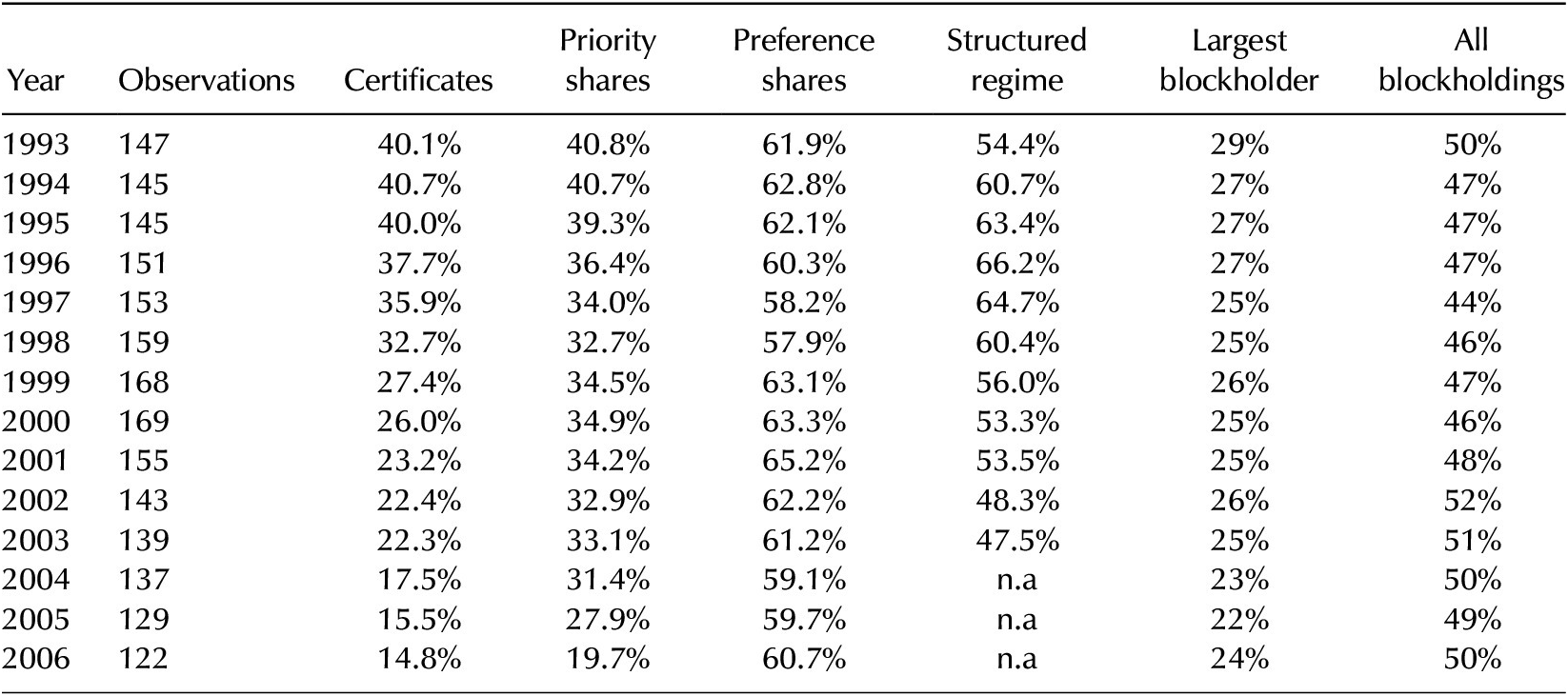
Giving up certificates was all the easier for corporations, given the wealth of alternative defensive devices that remained. Table 3 presents an annual overview of takeover defenses and ownership information.Footnote 90
Takeover defenses, 1993–2006

Note: This table shows the percentage of listed firms that have one of four important takeover defenses and ownership information for all listed nonfinancial firms over the period 1992–2006. Certificates and priority shares are mentioned in the capital structure description of the firm in the Gids bij de Prijscourant. Preference shares are also mentioned in the capital structure; only when less than 25 percent of the shares are placed, the preference shares are included as a takeover defense, because otherwise the shares are financing shares. The structured regime is inferred from the supervisory board statements in the firms’ annual reports. The blockholder information is based on annual overviews in Het Financieele Dagblad of shareholders with holdings above 5 percent. See Van der Elst, De Jong and Raaijmakers, Een Overzicht van Juridische, 46–63.
Sources: Gids bij de Prijscourant, firm annual reports, and Het Financieele Dagblad.
Companies simply shifted their main line of defense to foundations with rights to issue preferred shares as and when needed. In 2013 this highly effective device blocked the takeover of Dutch telecom company KPN by Mexican telecom magnate Carlos Slim.Footnote 91 Despite the demise of certificates, the trust office spirit and intention live on in those company-tied foundations, which retain many of the oligarchic traits that characterized certificate-issuing trust offices dedicated to a specific company. In 2005, 68 percent of those foundations had boards appointed by co-optation, while in several others the corporation’s board made the appointments. Though 50 percent of company statutes of firms with certificates gave certificate holders the right to nominate board members, only 42 percent of the foundations concerned organized meetings for them. The second line of corporate defense, maintained by about half of our sample, is formed by the so-called structuurregime introduced by the 1971 law and reserving board appointment and other rights to the nonexecutive directors. Many companies possess a third line of defense in the form of highly concentrated shareholdings. On average, Dutch firms have one largest shareholder owning a quarter, while all blockholders (defined as shareholder with over 5 percent) own between 44 percent and 50 percent.
The resulting pattern of defensive devices clearly sets the Netherlands apart from nineteen other countries surveyed in 2007, notably as the only country with certificates; one of five without ownership ceilings; and one of only three with voting preference shares, without voting ceilings, and without golden shares.Footnote 92 In other European countries, firms have also curtailed shareholder rights by adopting control-enhancing mechanisms that lead to deviations from one share, one vote. The elaborate 2007 report of 464 firms in sixteen European countries listed thirteen mechanisms, ten of which also available to Dutch firms but rarely used by them.Footnote 93 Some 44 percent of European companies have at least one defensive mechanism, most often pyramid structures (27 percent of firms) and dual-class shares (24 percent). Some countries rely more on structural barriers (pyramids in Sweden, 48 percent), while others use legal barriers (such multiple-voting shares in France, 58 percent).Footnote 94
It is therefore doubtful that the pro-shareholder rights wave of the 1980s and 1990s, for all the splash it made, really achieved anything, if only because views on shareholder influence have turned full circle in the interim. When the Dutch government sold part of its stake in the systemically important bank ABN AMRO in 2017, the transaction took the long-established form of depositing the shares in a tied trust office that then sold certificates to the public. The express desire to immunize the bank against takeovers is underlined by the fact that its trust office may ignore how certificate owners want it to vote.Footnote 95 Meanwhile, foreign corporations discovered the practicalities of a Dutch foundation as a cheap and simple anti-takeover defense. In 2015 the American pharma company Mylan set one up to fend off an unwanted bid, much to the surprise of the Wall Street Journal. Footnote 96 In September 2020 the French utilities company Suez followed suit.Footnote 97
At the same time, the old trust office spirit and intention live on in so-called Bijzondere Financiële Instellingen (special financial institutions, or SFIs), essentially trust offices repurposed as tax-efficient means of corporate control. In 1982, IKEA founder Ingvar Kamprad set up the first of an interrelated web of foundations, run by a trust office, to bind his sprawling flatpack furniture empire together at the lowest fiscal cost. Sanctioned by law in 1994, by 2002 the SFIs were estimated to number 12,500 and to have generated an estimated €1 billion in tax revenues plus €500 million in fees for specialized service providers in 2007.Footnote 98 Gross flows routed through SFIs were said to amount to €4 trillion, ten times the Dutch GDP, in 2017.Footnote 99 Defined as “foreign companies that route financial flows through the Netherlands at least partly for tax reasons,” SFIs serve to attract money flows from international corporations and HNWIs to the Netherlands with attractive tax rates and options like the age-old splitting of revenues from control rights.Footnote 100 By law, the Dutch central bank supervises the SFIs, but as foundations, they are exempt from most publication duties, rendering supervision illusory and facilitating the hiding of ultimate beneficiaries. For these reasons, multinationals including car manufacturers Fiat Chrysler and Nissan-Renault, the Russian internet giant Yandex, and the Belgian–Brazilian–American brewer AB InBev have some form of holding company in the Netherlands, the Delaware of Europe. If Fiat Chrysler and Peugeot Citroën do merge, the combination will probably choose its legal seat in the Netherlands for the same reason: fiscal optimization of their international revenues. No surprise that the Netherlands figures high on the Tax Justice Network’s Financial Secrecy Index, fourteenth in position in 2018, up from forty-first three years earlier.Footnote 101
Conclusions
Alarmed by the specter of foreign big business muscling in, Dutch corporations developed an array of devices to ward off takeover threats starting in the 1890s. A key protective device centered on stock substitution, splitting a security’s voting rights from its claims to economic rents, parking the former in a trust office and selling the latter to investors. Rooted in practices developed since the 1690s, by the early twentieth century, trust offices were long-established and familiar institutions that over time had performed useful services to bankers and investors alike, ranging from liquidity enhancement via public debt overhauls and loan liquidation to pooling shareholder votes in corporate reorganizations.
Repurposing these trust offices as takeover defenses therefore represented simply one step in a long evolution, and arguably a small one. Accustomed as they were to collecting corporate cash flows without the vote, few shareholders fought the repurposing, while the stock exchange, mindful of its trade interests, failed to offer serious resistance against the erosion of shareholder power. Nor was that erosion checked by government, Parliament, or public opinion, which, except for a brief interlude during the 1980s and 1990s, favored the broader interests of stakeholders over those of shareholders. As a result the Netherlands came to possess highly specific takeover defenses, unique in the world, as often as not lodged in trust offices refashioned as dedicated, single-purpose foundations. More or less at the same time, trust offices were also repurposed as tax-efficient and discreet foundations for routing international revenue flows, attracting corporations and HNWIs from all over the world.
Of course, we do not argue that the administratiekantoor created either the marked Dutch penchant for oligarchic corporate governance controls or the country’s present position as the Delaware of Europe. It did no more than facilitate these developments: businessmen would have found other ways of achieving cherished goals. We do argue, however, that the trust office’s easy availability, its long-established legitimacy, and its adaptability decisively shaped the Dutch financial system’s evolution; its particular configuration; its informal institutions, such as investors’ willingness to hold certificates rather than the original securities; and from the 1980s, its attraction for foreign corporations and HNWIs. As a phenomenon, trust offices predated most institutions active today, like the Dutch central bank or any of the commercial banks, and they were also less in the public view, performing vital background services.Footnote 102 However, they were arguably just as important in shaping the Dutch financial system and making it differ from other ones around the world in respects as subtle as they are fundamental.
Acknowledgements
The authors thank participants and conveners of the 2018 World Economic History Conference Boston session “The Emergence of Corporate Governance in Big Business in the 19th–20th Century” and seminar participants at Queen’s University Belfast, Utrecht University, Vrije Universiteit Brussel/HOST/Posthumus Institute, and Uppsala University. Jorrick Pieter Hassing and Merel Hoveling provided excellent research assistance.