Introduction
The bone-anchored hearing aid (BAHA) is a useful tool with which to treat conductive, mixed and sensorineural hearing loss. However, as the abutment is percutaneous there is a small but significant incidence of scalp skin pathology (ranging from minor to major) which may interfere with use of the device. Previously reported soft tissue complications include skin graft failure, cellulitis, granulation, eczematous dermatitis, hypertrophic scar and keloid formation, and soft tissue overgrowth.Reference Shirazi, Marzo and Leonetti1–Reference Gillett, Fairley, Chandrashaker, Bean and Gonzalez5 These complications may prevent the device from being offered, or used correctly once implanted.
In this paper, we present our experience with the management of post-operative soft tissue skin overgrowth following BAHA surgery. We propose that, in the small population of patients with soft tissue overgrowth following BAHA placement, use of the longer 8.5 mm abutment will reduce the need for additional surgical intervention. Additionally, we attempt to identify risk factors for post-operative soft tissue overgrowth, through analysis of patient demographics and comorbidity.
Methods
Following receipt of institutional review board approval, a retrospective review of clinic and hospital charts was performed.
Fourteen of the 80 patients undergoing BAHA placement between 2003 and 2008 were identified by the senior author (S.C.) as having had significant post-operative soft tissue problems necessitating surgical intervention.
We excluded from the study patients with minor skin healing problems treated minimally with topical cautery, topical corticosteroids or injected corticosteroids, without surgical excision of excess soft tissue.
Patient demographics were recorded, including age, gender, ethnicity and comorbid conditions. We also recorded the intra-operative findings during placement of the 5.5 mm abutment, any post-operative complications, and the time between initial and revision surgery. Finally, we recorded intra-operative findings during placement of the 8.5 mm abutment, post-operative outcomes and the length of follow up. Outcomes of relevance included healing of the surgical site, need for additional surgical procedures, ability to use the external device and occurrence of other post-operative complications. Post-operative skin reactions were graded using the Holgers classification: zero = no irritation, one = slight redness, two = red and moist, three = granulation, and four = infection leading to abutment removal.Reference Holgers, Tjellstrom, Bjursten and Erlandsson6
Results
Fourteen patients underwent surgical excision for soft tissue overgrowth. Within this group, 11 underwent placement of the longer 8.5 mm BAHA abutment. For these 11 patients, the male:female ratio was 10:1. The median age at time of BAHA placement was 45 years, with a range of nine to 62 years. Eleven patients were Caucasian, two were Hispanic and one was of south Asian ethnicity.
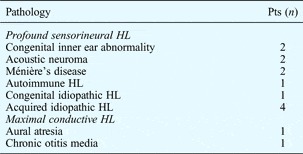
The indications for BAHA placement in our study population are listed in Table I. In our study, the majority of patients had unilateral profound sensorineural hearing loss with poor speech discrimination. Aetiologies included acoustic neuroma resection (two patients), Ménière's disease (two), congenital inner ear abnormality (two), congenital idiopathic hearing loss (one), acquired autoimmune hearing loss (one) and acquired idiopathic hearing loss (four). Two patients had maximal conductive hearing loss secondary to aural atresia (one patient) or to canal wall down mastoidectomy for chronic otitis media (one).
Indications for baha placement

BAHA = bone-anchored hearing aid; pts = patients; HL = hearing loss
Other comorbidity in our study population included diabetes mellitus (one patient), hypercholesterolaemia (five), alcoholic cirrhosis (one), CHARGE syndrome (coloboma, heart defects, atresia of nasal choanae, retardation of development, genital abnormalities, ear abnormalities) (one), microtia (one) and developmental delay (one). Two patients with acquired idiopathic profound hearing loss had a history of chronic otitis media. Information regarding smoking history was available for 13 patients; only one was an active smoker. Data regarding patient body mass index were not available at the time of review.
Placement of the BAHA implant fixture and abutment was performed as a single-stage procedure in all patients, and there were no intra-operative complications. A dermatome supplied by the BAHA manufacturer (Cochlear, Sydney, Australia) was used to create a superiorly pedicled skin graft 0.25 cm in thickness and located approximately 50 mm posterior to the external auditory canal. Subcutaneous soft tissue reduction was performed deep to the skin flap and extended 1–2 cm beyond the flap margins, with thicker scalp regions posteriorly and superiorly undergoing more extensive undermining. A small region of periosteum was removed at the site of fixture placement, and the guide hole and countersink drilled to a depth of 3 or 4 mm depending on whether enough bone was present. The titanium fixture, with external abutment attached, was then placed using a low-speed drill.
A Xeroform (Kendall Healthcare, Mansfield, USA) dressing was placed over the skin graft site and secured in position by a healing cap fastened to the abutment. The dressing and healing cap were removed one to two weeks post-operatively.
All patients were initially fitted with a 5.5 mm abutment. No patients were noted to have excessively thick scalps at the time of initial surgery.
Post-operatively, nonsurgical treatment was routinely employed for the management of impaired wound healing and/or soft tissue overgrowth. Post-operative skin reactions were noted as follows: one patient had a grade one reaction, three had grade two reactions and six had grade three reactions. No patient had a grade four reaction, necessitating abutment removal. Five patients had infection in the immediate post-operative period (i.e. less than two months) requiring oral antibiotics, and five had partial skin graft failure requiring local wound care. Wound management included topical antibiotics (Bactroban® and bacitracin), topical corticosteroids (clobetasol) and/or silver nitrate cautery of granulation tissue. Two patients had documented keloid at the surgical site and a further two had hypertrophic scar, all of whom were treated with injected corticosteroid (Kenalog®).
Of the 80 patients reviewed, 14 required surgical reduction of soft tissue overgrowth around their BAHA abutment. In these 14 patients, the mean time to the first surgical reduction was 13.6 months (range two weeks to 34 months), and the mean total number of surgical soft tissue reductions per patient was 2.1 (range one to four). Eleven patients underwent placement of an 8.5 mm abutment for persistent soft tissue overgrowth problems. The average time to placement of an 8.5 mm abutment was 23 months (range three to 40 months) from the time of initial surgery, and 12.6 months (range zero to 38 months) from the time of the first surgical reduction of soft tissue overgrowth.
In the 11 patients receiving an 8.5 mm abutment, the average length of follow up was 11.8 months (range zero to 30 months) from the time of placement of the longer abutment. All 11 patients were able to use their external BAHA device. One patient required additional surgical excision of excess granulation tissue, as well as a course of oral antibiotics for cellulitis. Another patient required silver nitrate cauterisation of granulation tissue adjacent to the abutment. A third patient required oral antibiotics for cellulitis.
Discussion
Our results suggest that the 8.5 mm BAHA abutment is successful in preventing the need for additional surgical intervention in most patients with post-operative soft tissue overgrowth. Notably, in our study population we observed a relatively high number of surgical soft tissue reductions and a prolonged time period between initial BAHA surgery and placement of the longer abutment. Significantly, after placement of an 8.5 mm abutment, only one patient required further surgery (comprising a single procedure). Our findings validate the results of a larger series by Monksfield et al. Reference Monksfield, Ho, Reid and Proops7 In their series of 81 BAHA patients requiring surgical reduction of soft tissue overgrowth, patients underwent up to four procedures prior to placement of an 8.5 mm abutment; after placement, only one required further surgical intervention. As awareness and experience with the longer 8.5 mm abutment increases, one can expect that it will be considered substantially earlier in patients with soft tissue overgrowth.
The risk of soft tissue problems following BAHA surgery is small but significant. Placement of the BAHA device causes a host reaction in adjacent soft tissue, characterised by high concentrations of inflammatory and immunocompetent cells.Reference Bonding8 In some cases, this inflammatory reaction may lead to complications such as skin graft failure, post-operative infection and soft tissue overgrowth of the BAHA abutment. Similar soft tissue problems have been observed with use of other percutaneous devices. Early cochlear implants employing percutaneous signal transmission were found to have a high incidence of post-operative wound infection, leading to eventual widespread adoption of the transcutaneous implant.Reference Berliner, Luxford and House9
Soft tissue overgrowth can hinder or prevent attachment of the BAHA external device to the abutment. Several factors predisposing to soft tissue overgrowth have been described. The majority of patients in our series were male, a characteristic also described by Monksfield et al. Reference Monksfield, Ho, Reid and Proops7 Another recent study identified obesity and male gender as risk factors for soft tissue overgrowth in their population of 10 BAHA patients.Reference Berenholz, Burkey and Lippy10 One plausible explanation is that such patients possess comparatively thicker scalps compared with the general population.
The relationship between skin graft failure and soft tissue overgrowth deserves mention. Our series demonstrated a 36 per cent incidence of previous skin graft failure, while Monksfield et al. reported a prior graft failure rate of 29.3 per cent.Reference Monksfield, Ho, Reid and Proops7 In contrast, the incidence of skin graft failure in the general population undergoing BAHA placement has been reported as 3–10 per cent.Reference Shirazi, Marzo and Leonetti1, Reference Tjellstro and Granstro2 These results suggest an association between soft tissue overgrowth and prior skin graft failure. It is conceivable that the chronic inflammatory process resulting from graft failure may, over a long period, result in soft tissue overgrowth.
Predisposition to keloid or hypertrophic scar formation may be considered a risk factor for soft tissue overgrowth of the BAHA abutment. Keloid or hypertrophic scar formation occurred in four patients in our series. Both conditions involve production of excessive collagen during wound healing, a process which may be exacerbated by chronic inflammatory mediators at the percutaneous interface of the BAHA abutment.Reference Wolfram, Tzankov, Pulzl and Piza-Katzer11
Current options for the treatment of soft tissue overgrowth include topical or injected corticosteroids, cautery of exuberant granulation tissue, and surgical excision. Local wound care combined with steroids and/or chemical cautery is a routinely employed first-line protocol. In certain instances, however, surgical intervention may be warranted. The aforementioned authors reported that approximately 10–11 per cent of patients undergoing BAHA placement subsequently required surgical excision of soft tissue overgrowth.Reference Monksfield, Ho, Reid and Proops7, Reference Berenholz, Burkey and Lippy10 Similar to our report, these studies also found that use of the longer 8.5 mm abutment reduced the need for additional surgical procedures in most patients.Reference Monksfield, Ho, Reid and Proops7, Reference Berenholz, Burkey and Lippy10
Complications specifically associated with use of the longer abutment have not been described in the literature. Although a longer abutment may theoretically increase the torque applied by the processor onto the osseointegrated implant, the commercially available 8.5 mm abutment has been tested and approved by the US Food and Drug Administration, and thus far the incidence of implant loss has not increased.
• Soft tissue overgrowth requiring treatment was seen in 14 of 80 patients receiving bone-anchored hearing aids (BAHAs)
• A longer (8.5 mm) abutment was placed at the time of tissue excision, helping avoid the need for further treatment
• Any patient requiring surgical reduction of soft tissue overgrowth should have an 8.5 mm abutment placed concurrently
• The longer abutment can also be inserted in the clinic at the onset of significant poor wound healing, before formal surgery is needed
• Use of the longer abutment should be considered during initial BAHA implantation for patients with a known history of hypertrophic scarring, and in obese male patients with an unusually thick scalp
We propose that any patient requiring surgical reduction of soft tissue overgrowth following BAHA surgery should have an 8.5 mm abutment placed at the time of excision. The longer abutment can also be placed in the clinic at the onset of significant poor wound healing, before surgical excision becomes necessary.
It is less clear which patients would benefit from receiving an 8.5 mm abutment during the initial BAHA procedure. Based on the risk factors identified in our study and others, consideration should be given to initial placement of the longer abutment in patients with a known history of hypertrophic scarring, and in obese male patients found to have an unusually thick scalp at the time of initial BAHA surgery.