Introduction
Memory deficits are common in depressed patients and may persist after clinical recovery (Burt et al. Reference Burt, Zembar and Niederehe1995; Paradiso et al. Reference Paradiso, Lamberty, Garvey and Robinson1997; Austin et al. Reference Austin, Mitchell and Goodwin2001; Taylor Tavares et al. Reference Taylor Tavares, Drevets and Sahakian2003; Chamberlain & Sahakian, Reference Chamberlain and Sahakian2006; Preiss et al. Reference Preiss, Kucerova, Stepankova, Sos, Lukavsky and Kawaciukova2007). The biological mechanisms underlying this impairment are likely to be complex but elevated cortisol levels may be a mediating factor (Brown et al. Reference Brown, Rush and McEwan1999; Lee et al. Reference Lee, Glass, McAtee, Wand, Bandeen-Roche, Bolla and Schwartz2007). For example, administration of corticosteroids, as well as stress-induced cortisol elevation, can impair declarative memory (Kirschbaum et al. Reference Kirschbaum, Wolf, May, Wippich and Hellhammer1996; Young et al. Reference Young, Sahakian, Robbins and Cowen1999) and in some studies of depressed patients, memory impairments are correlated with increased cortisol secretion (Van Londen et al. Reference Van Londen, Goekoop, Zwinderman, Lanser, Wiegant and De Wied1998; Egeland et al. Reference Egeland, Lund, Landro, Rund, Sundet and Asbjorsen2005).
If memory impairments can occur after clinical recovery from depression it is possible that they might occur in ‘at-risk’ individuals before the onset of the depressive disorder. To investigate this it is necessary to study people who are at risk of depression but who have not suffered clinical illness. Numerous risk factors for depression have been described but one of the most reliable is family inheritance. It has been estimated that, by young adulthood, up to 40% of children of parents with a clinical mood disorder will have suffered a personal episode of depression (Weissman et al. Reference Weissman, Fendrich, Warner and Wickramarante1992; Beardslee et al. Reference Beardslee, Versage and Gladstone1998).
The increased risk of depression in women starts to become apparent during adolescence (Wade et al. Reference Wade, Cairney and Pevalin2002), and there is evidence of biased information processing in girls at high risk of depression (Joormann et al. Reference Joormann, Talbot and Gotlib2007). The aim of the present study was to investigate memory function in young women who had a parent affected by depression but no personal history of depression themselves (FH+). We have previously reported that FH+ subjects have increased waking salivary cortisol levels relative to controls (Mannie et al. Reference Mannie, Harmer and Cowen2007a) and we therefore also assessed how cortisol secretion influenced memory function in both FH+ participants and controls.
A specific genetic factor that appears relevant to the development of depression is allelic variation in the promoter region of the serotonin transporter (5-HTT) gene, whereby carriers of the short allele of the 5-HTT have a greater risk of developing depression in response to stressful life events (Caspi et al. Reference Caspi, Sugden, Moffitt, Taylor, Craig, Harrington, McClay, Mill, Martin, Braithwait and Poulton2003). The short allele of the 5-HTT has been linked to increased morning cortisol secretion as well as impaired performance on the Rey Auditory Verbal Learning Test (RAVLT) in healthy elderly volunteers (O'Hara et al. Reference O'Hara, Schroder, Mahadevan, Schatzberg, Lindley, Fox, Weiner, Kraemer, Noda, Lin, Gray and Hallmayer2007). In contrast to the latter finding, however, Roiser et al. (Reference Roiser, Muller, Clark and Sahakian2007) found improved episodic memory in people with the SS genotype. In our study we therefore also assessed the influence of 5-HTT genotype on cortisol secretion and RAVLT in FH+ participants and controls.
Method
Participants
The sample was selected from a larger sample of young people (aged 16–20 years) at risk of depression (see Mannie et al. Reference Mannie, Harmer and Cowen2007a, b) through having a biological parent with major depression. Here we report on women (control, n=31 and FH+, n=35) who carried out the RAVLT and also provided samples for determination of cortisol secretion and 5-HTT genotyping. The participants also carried out tests of emotional processing that have been reported previously (Mannie et al. Reference Mannie, Bristow, Harmer and Cowen2007b). The presence or absence of major depression in a parent was assessed by the family history method using the participant as an informant (Andreasen et al. Reference Andreasen, Rice, Endicott, Reich and Coryell1986). Both groups had never personally suffered from depression as assessed with the Structured Clinical Interview for DSM-IV Axis I Disorders Schedule (SCID-I; First et al. Reference First, Spitzer, Gibbon and Williams1997) or any other Axis I disorder. Participants were also matched on IQ as assessed by the National Adult Reading Test (NART; Nelson & Willison, Reference Nelson and Willison1991). Current mood state was assessed by the Hospital Anxiety and Depression Scale (HADS; Zigmond & Snaith, Reference Zigmond and Snaith1983) and current stress was measured using the Perceived Stress Scale (PSS; Cohen et al. Reference Cohen, Kamarck and Mermelstein1983), which assesses the perception of stress in the past month. All participants gave full informed consent to the study, which was approved by the local ethics committee.
Memory testing
Participants were tested on the RAVLT (Spreen & Strauss, Reference Spreen and Strauss1998), which assesses verbal learning and memory. In this task, a list of 15 words is read aloud to participants over five trials, with immediate recall after each trial. There is also a distractor trial, a 20-min delayed trial and a recognition trial with new and old words from both lists. The number of words correctly recalled in each trial gives the score for each trial, and a total score (i.e. the sum of scores from trials 1–5) is also calculated. Immediate recall, delayed recall and recognition are then computed for statistical analyses.
Salivary cortisol sampling
Salivary cortisol sampling has been described previously in Mannie et al. (Reference Mannie, Harmer and Cowen2007a). In brief, it was performed on two separate mornings, a work morning and a non-work morning, and the same protocol was followed on both mornings. Participants began sampling as soon as they woke using a Salivette device (Sarstedt®, Leicester, UK), and took two further samples at 15-min intervals. During the sampling subjects remained resting in bed and fasting. For the purposes of the present study the amount of cortisol secreted, measured as area under the curve (AUC), on each of the two mornings was averaged.
Genotyping
DNA was extracted from buccal swabs using a standard Charge Switch kit from Invitrogen Life Technologies (Paisley, UK). Genotyping of the 5-HTT LPR short/long (S/L) promoter variant was determined using primers directed to the adjacent upstream and downstream regions of the insertion/deletion site. A 20 μl reaction volume consisted of 1.5 mm magnesium chloride; 0.2 mm of each deoxyribonucleotide triphosphate (dNTP); 10% dimethylsulfoxide (DMSO); 60 ng of each primer; and 1 U Taq DNA polymerase. The forward and reverse primers were (TGA ATG CCA GCA CCT AAC CC) and (TTC TGG TGC CAC CTA GAC GC) respectively. Cycling parameters were: 95°C for 3 min, 40 cycles of 90°C for 30 s, 61°C for 30 s and 71°C for 60 s with a final elongation step for 10 min at 72°C. Polymerase chain reaction (PCR) fragments were resolved on a 3% agarose gel and visualized with 0.5 μg/ml ethidium bromide (Pooley et al. Reference Pooley, Houston, Hawton and Harrison2003).
Statistical analysis
Immediate recall, delayed recall and recognition were analysed with between-groups ANOVAs with group (FH+ versus control) and allele (SS+SL versus LL) as between-subject factors. Cortisol data were similarly analysed. Correlations between mood state, perceived stress, cortisol secretion and memory performance were performed using Pearson's product moment.
Results
Participant characteristics, genotyping and salivary cortisol
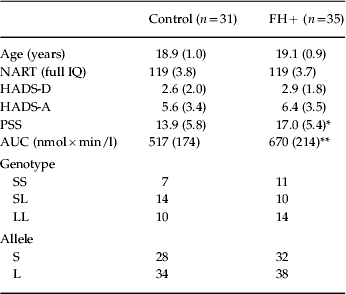
The two groups were well matched in age and scores on the HADS; however, ratings on the PSS were slightly higher in the FH+ participants (Table 1). The genotyping sample for the 5-HTT did not deviate significantly from Hardy–Weinberg equilibrium (p>0.05). There were no significant group differences in genotype or allele frequency between the FH+ participants and controls [χ2(2)=1.99, p=0.37; χ2(1)=0.43, p=0.51]. Overall, 18 subjects had an SS genotype, 24 were LS and 24 were LL. There was no allele or group by allele interactions in age, NART, PSS and the depression scale of the HADS (all p values >0.12), although a group by allele interactive trend was seen in the anxiety scale of the HADS [F(1, 62)=3.79, p=0.06], in which FH+ participants with an LL genotype tended to report more anxiety than controls with the same variant [t(22)=1.90, p=0.07], whereas the anxiety scores for S allele carriers were similar regardless of familial risk [t(40)=0.44, p=0.66].
Mean (standard deviation) symptom ratings, cortisol secretion and genotyping and 5-HTT allelic distribution in FH+ participants and controls

NART, National Adult Reading Test; HADS, Hospital Anxiety and Depression Scale (D, Depression Subscale; A, Anxiety Subscale); PSS, Perceived Stress Scale; AUC, area under the curve of salivary cortisol secretion.
* p=0.03, ** p=0.005 (ANOVA).
As reported previously (Mannie et al. Reference Mannie, Harmer and Cowen2007a), the AUC of salivary cortisol was significantly higher in the FH+ participants with a main effect of group [F(1, 62)=8.59, p=0.005] (Table 1). There was no main effect of genotype [F(1, 62)=0.19, p=0.67] or group by genotype interaction [F(1, 62)=0.001, p=1.0] on cortisol secretion.
RAVLT performance
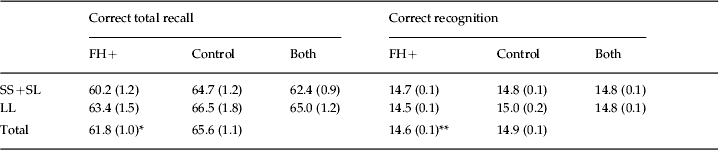
There was a main effect of group on immediate recall as measured by the total number of words remembered in trials 1 to 5 [F(1, 62)=6.91, p=0.011]; a trend effect of genotype [F(1, 62)=3.12, p=0.082], with a tendency for S allele carriers to recall fewer words than LL genotypes and no genotype by group interaction [F(1, 62)=0.24, p=0.63]. Post-hoc testing of mean scores revealed that FH+ participants recalled fewer words than controls (Table 2). RAVLT delayed recall showed no main effects of group [F(1, 62)=0.07, p=0.79], genotype [F(1, 62)=0.001, p=1.00] and no group by gene interaction [F(1, 62)=0.80, p=0.38]. For accurate recognition there was a main effect of group [F(1, 62)=6.33, p=0.015], no significant main effect of genotype [F(1, 62)=0.01, p=0.9] and a trend for group by genotype interaction [F(1, 62)=2.93, p=0.092], which was due to a tendency of FH+ participants with the LL genotype to recognize fewer words than controls with the same allelic variant. Post-hoc testing showed that recognition recall was less in the FH+ participants (Table 2).
Mean (standard error) total memory recall (trials 1–5) and accurate recognition by FH+ and control groups split by genotype

* p=0.011, ** p=0.015 (FH+ versus controls).
Correlational analyses
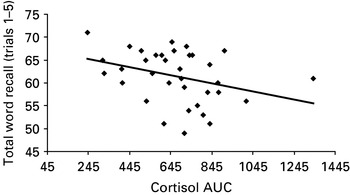
Correlations were performed between the total recall and recognition scores, cortisol AUC, total HADS and PSS on all participants. There was a negative correlation between total free recall and cortisol AUC (r=−0.296, p=0.016). When the participants were split into FH+ participants and controls, the negative correlation between cortisol and total recall remained in the FH+ subjects (r=−0.334, p=0.05) (Fig. 1) but not in the controls (r=−0.098, p=0.59). To assess whether the differences in correlations between the groups were significant, we used Fisher's z test, which showed that the negative correlation in FH+ participants between cortisol AUC and word recall was not significantly different to that of the control group (z=1.30, p>0.05). There was no significant correlation between cortisol AUC and recognition memory.
Correlation between cortisol area under the curve (AUC) and total word recall (trials 1–5) on the Rey Auditory Verbal Learning Test (RAVLT) for the FH+ group: r=−0.334, p=0.05 (Pearson correlation).

Discussion
Our findings suggest that, compared to controls, young women at increased familial risk of depression have modestly but significantly lower recall and recognition memory in the RAVLT. The impairment in recall may be correlated with the higher waking cortisol secretion seen in FH+ participants but in the present sample there was no evidence of robust interactions of RAVLT performance with 5-HTT genotype.
Patients with acute depression manifest a variety of cognitive deficits including impaired auditory verbal learning (Taylor Tavares et al. Reference Taylor Tavares, Drevets and Sahakian2003; Chamberlain & Sahakian, Reference Chamberlain and Sahakian2006). The fact that such abnormalities can persist into clinical remission (Paradiso et al. Reference Paradiso, Lamberty, Garvey and Robinson1997; Austin et al. Reference Austin, Mitchell and Goodwin2001; Preiss et al. Reference Preiss, Kucerova, Stepankova, Sos, Lukavsky and Kawaciukova2007) suggests that they are not merely consequences of the depressed state but may in part represent enduring deficits, which could impair cognitive function even during periods of clinical euthymia.
Our findings suggest that some evidence of cognitive dysfunction may also precede the onset of clinical depression in people at risk of illness. The participants in our study had never experienced clinical depression before, and in terms of current depressive symptomatology were very similar to controls. They did have slightly higher scores on the ratings of current stress but these did not correlate with RAVLT performance or cortisol AUC. Of note, a meta-analysis of cognitive testing in psychiatrically well first-degree relatives of bipolar patients also found evidence of impaired verbal memory (Arts et al. Reference Arts, Jabben, Krabbendam and van Os2008).
As reported previously (Mannie et al. Reference Mannie, Harmer and Cowen2007a), the FH+ participants had higher waking salivary cortisol secretion and in FH+ subjects waking cortisol levels correlated inversely with the total recall component of the RAVLT. Although this is only an association and of course not necessarily causal, it may suggest that elevated increased cortisol secretion in FH+ participants could be involved in some aspects of memory impairment. There is much evidence that elevated cortisol levels are associated with cognitive impairment (see McQuade & Young, Reference McQuade and Young2000), and in naturalistic studies in elderly populations increased urinary cortisol has been associated with cognitive decline (Seeman et al. Reference Seeman, McEwan, Singer, Albert and Rowe1997). However, it must be noted that, in general, laboratory studies indicate that elevated cortisol secretion typically impairs retrieval aspects of memory (see Oei et al. Reference Oei, Elzinga, Wolf, de Ruiter, Damoiseaux, Kiujer, Veltman, Scheltens and Rambouts2007), and in the current study, delayed recall was not altered in FH+ subjects. Recognition memory was impaired but did not seem to correlate with cortisol secretion.
Although the negative correlation between cortisol secretion and memory was stronger in the FH+ participants than controls, the correlations did not differ significantly from each other. Although this may be a power issue, it would seem to suggest that FH+ participants are not intrinsically more susceptible to the memory impairing effect of cortisol than controls; the key issue is that they secrete more cortisol. This is consistent with the ability of exogenous cortisol administration to impair memory in healthy controls (Kirschbaum et al. Reference Kirschbaum, Wolf, May, Wippich and Hellhammer1996; Young et al. Reference Young, Sahakian, Robbins and Cowen1999).
A previous study in healthy elderly subjects has linked possession of a 5-HTT S allele with impaired delayed recall on the RAVLT (O'Hara et al. Reference O'Hara, Schroder, Mahadevan, Schatzberg, Lindley, Fox, Weiner, Kraemer, Noda, Lin, Gray and Hallmayer2007). We saw a trend to a similar effect in the present study but on overall acute recall rather than delayed recall. In terms of delayed recall we estimate that our study had a power of 0.9 to detect a difference similar to that obtained by O'Hara et al. (Reference O'Hara, Schroder, Mahadevan, Schatzberg, Lindley, Fox, Weiner, Kraemer, Noda, Lin, Gray and Hallmayer2007). This suggests that the inconsistent findings in relation to 5-HTT genotype and memory are not simply a power issue.
O'Hara et al. (Reference O'Hara, Schroder, Mahadevan, Schatzberg, Lindley, Fox, Weiner, Kraemer, Noda, Lin, Gray and Hallmayer2007) also reported an effect of the S allele to increase waking salivary cortisol but our own data failed to reveal such an association. Clearly, our subjects were from a very different age group and it is possible that effects of the S allele on cortisol secretion and memory may become more apparent in elderly subjects. In addition, we did not measure the more recently described triallelic variant of the 5-HTT promoter, which would have added to the precision of our 5-HTT genotyping (Parsey et al. Reference Parsey, Hastings, Oquendo, Hu, Goldman, Huang, Simpson, Arcement, Huang, Ogden, Van Heertum, Arango and Mann2006). We did, however, find a trend for FH+ participants with an LL genotype to have increased anxiety scores on the HADS relative to LL controls. We suspect that this is a chance finding. Generally, in population studies the S allele has been linked with increased anxiety (see Schinka et al. Reference Schinka, Busch and Robichaux-Keene2004).
It will be important to replicate our findings on FH+ status and memory in a larger sample size and to include men at increased familial risk of depression. It would also be of interest to include functional and structural imaging of the hippocampus because the latter structure is known to play a crucial role in declarative memory and also to be vulnerable to increased levels of circulating corticosteroids (see Oei et al. Reference Oei, Elzinga, Wolf, de Ruiter, Damoiseaux, Kiujer, Veltman, Scheltens and Rambouts2007). Other brain regions are also involved in declarative memory, specifically the prefrontal cortical regions, which may also be modulated by circulating cortisol levels (Oei et al. Reference Oei, Elzinga, Wolf, de Ruiter, Damoiseaux, Kiujer, Veltman, Scheltens and Rambouts2007). Most important will be to ascertain whether impaired memory performance might predispose individuals to experience clinical mood disorders and, if so, what the underlying mechanisms might be.
Acknowledgements
We thank Alison Reed for the assay of saliva cortisol. The study was supported by the Medical Research Council (MRC).
Declaration of Interest
None.