




No CrossRef data available.
Do parents respond in different ways when children feel different emotions? The emotional context of parenting
Published online by Cambridge University Press: 12 May 2005
Abstract
When children experience emotions, do they view their primary caregiver as reacting in a different manner depending on the children's different emotions? Parental socialization of negative emotions and child psychopathology were examined among 161 inner city youth ages 11–14 years. These early adolescents were more likely to perceive their parents as responding in a different manner to different emotions than responding in the same way to different emotions. In addition, we asked if emotion-specific socialization strategies tell us more about child psychopathology than global socialization strategies do. Exploratory analyses suggest that a mixture of both emotion-specific and global socialization strategies may best predict child psychopathology. It remains important to clarify the emotional context of socialization strategies.
This research was supported by an NIMH Predoctoral Fellowship, National Research Service Award (F31 MH12322), and an NIMH Postdoctoral Fellowship, Institutional Training Grant (T32 MH19890-07). We thank the principal, parents, and students of Junior High School 275 and the Police Athletic League Brownsville Beacon Community Center for their support and participation in this project. Patrick Shrout gave invaluable feedback in the development of this paper. Colleen R. O'Neal is now at the NYU Child Study Center, NYU School of Medicine.
Information
- Type
- Research Article
- Information
- Copyright
- © 2005 Cambridge University Press
Healthy emotional development may depend, at least in part, on how parents answer the question posed by children's emotions (Cassidy, 1994; Eisenberg, Fabes, Carlo, & Karbon, 1992; Hooven, Gottman, & Katz, 1995; Malatesta–Magai, 1991; Roberts & Strayer, 1987; Stern, 1985). According to the Functionalist perspective on emotions (Barrett & Campos, 1987; Campos, Mumme, Kermoian, & Campos, 1994; Darwin, 1955; Magai & McFadden, 1995), the child's expression of an emotion carries a specific, interpersonal function. For example, the child's expression of fear may serve the purpose of eliciting comfort and reassurance from a parent while the child's expression of anger may act to elicit a parent's help in solving a frustrating problem. Consistent with the Functionalist approach, Affect theory and Differential emotions theory argue that parents use different behavioral strategies in response to children's discrete emotions (Izard, 1971, 1991; Tomkins, 1963, 1991). In turn, such emotion-specific parenting strategies are thought to shape children's emotional repertoire and contribute to subsequent healthy emotional development, on the one hand, and to psychopathology, on the other (Cassidy, 1994; Cicchetti, 1993; Eisenberg, Cumberland, & Spinrad, 1998; Gottman, Katz, & Hooven, 1996; Izard, 2002; Magai & McFadden, 1995; Stern, 1985; Tomkins, 1963, 1991; Zahn–Waxler, Klimes–Dougan, & Kendziora, 1998).
Despite a rich theoretical conceptualization of emotions and parenting, limited empirical attention has been given to how the primary caregiver responds to various emotions (i.e., emotion socialization). The socialization literature has focused on broad parenting styles rather than on differential responses to emotions (Fivush, 1998). Typically, the socialization of negative emotions has been studied as a monolithic, global construct, without distinguishing among the different negative emotions. In fact, when negative emotions have been examined separately, in research on gender-typed parenting behaviors, developmentalists have been more likely to find gender differences than when all the negative emotions are “lumped” together (Fivush, 1998). In addition, some researchers have suggested that parents may respond differently to the child's expression of anger compared to other “softer,” less provocative emotions like sadness (Eisenberg, Fabes, Shepard, Guthrie, Murphy, & Reiser, 1999; Shipman & Zeman, 2001; Zeman & Shipman, 1997). The purpose of the present study was to investigate if early adolescents either perceive parents as responding in a similar manner to different emotions (i.e., global socialization model) or perceive parents as responding in a different manner to different emotions (i.e., emotion-specific socialization model). Therefore, we compared a global socialization model (see Figure 1) to an emotion-specific socialization model (see Figure 2). The purpose of the current study was also to explore how emotion-specific socialization relates to psychopathology in early adolescence.

A global emotion socialization model.

An emotion-specific emotion socialization model.
The socialization strategies in this study were based on Tomkins' Affect theory (Tomkins, 1963, 1991) and an empirically based set of reported socialization strategies: Reward, Punish, Neglect, Override, and Magnify (Hunziker, 1995). Such emotion socialization strategies were operationalized as parental responses to the child's various expressed emotions (Tomkins, 1963). Tomkins predicted that children's healthy emotional development would only occur if parents globally accept and reward ALL emotions (“Global Reward”). In Rewarding socialization, the parent provides comfort, empathizes, and helps the child solve his problems. Punitive affect socialization occurs when a parent discourages a child's emotion expression by, for instance, showing disapproval of the child's anger and mocking the child's fear. We operationalized the Neglect affect socialization strategy as ignoring the child's emotion expression or not being available. Override was operationalized as a parent silencing a child's expressed emotion by dismissing or distracting the child. For instance, when a child is scared, the parent tells the child not to be frightened. The emotion socialization strategy Magnify occurs when the child expresses an emotion and the parent subsequently responds to the child by expressing the same emotion with equal or stronger intensity.
The models depict emotion-specific strategy scales like Reward of Fear, Punish of Anger, Neglect of Sadness, and Magnify of Shame (see Figures 1 and 2; for a list of items associated with the emotion-specific socialization strategies, see Table 1). The emotion-specific strategies were the child's perception of the parent's use of a strategy when the child experienced a specific emotion. Reward of Fear, for instance, refers to the child's perception that when s/he is fearful, the parent responds in a comforting manner.
Emotion-specific socialization strategies items

Figure 1 depicts the global socialization model in which each perceived socialization strategy (e.g., “Neglect”) was expected to be the same across various emotional contexts (e.g., the similar use of “Neglect” in the context of anger versus sadness). In other words, no differences were permitted for the loadings of each parenting strategy onto different emotional contexts.
Figure 2 depicts the emotion-specific socialization model in which each perceived socialization strategy was expected to differ in diverse emotional contexts (e.g., the different use of Reward in the context of anger vs. sadness); the loadings of each global strategy onto various emotional contexts were allowed to differ. For example, the loading of Neglect onto Neglect of Anger (i.e., c1) was permitted to differ from the loading of Neglect onto Neglect of Sad (i.e., c2; see Figure 2).
As children age, the complex nature of parent–child relations might call for a more discrete set of differential parental responses to children's emotions. With the onset of puberty, socialization takes place in the context of negative emotions aroused by the increased quantity and intensity of parent–child conflict, compared to the relatively tractable elementary-school years (Collins & Russell, 1991; Montemayor & Flannery, 1989; Zahn–Waxler et al., 1998). It has been argued that maladaptive emotional styles are well on their way toward becoming “entrenched” by the end of adolescence (e.g., Zahn–Waxler et al., 1998). Therefore, early adolescence is an emotionally vibrant, changing time when the opportunity remains for parents to influence their children's developing emotion styles, despite more parent–child conflict. However, studies of parenting in early adolescence have largely ignored the affect-specific emotional context while research on emotion socialization in early childhood and elementary school has flourished.
Zeman and Shipman's (1997) emotion-specific study of early adolescents and adolescents is an important exception to the limited body of research on discrete emotions and adolescents' perceptions of socialization. A group-administered questionnaire addressed sadness and anger-related expectancies of parent reactions and children's emotion management among 11-, 14-, and 17-year-old children. They found that older adolescents (11th grade) expected their mothers to get more upset at the adolescents' display of anger than of sadness, compared to younger adolescents. In their 2001 study, Shipman and Zeman found that 6- to 12-year-old maltreated children also expected their mothers to give more negative reactions to the child's expression of anger than to happiness or sadness.
It is difficult to draw firm conclusions about gender and age as moderators of emotion socialization (Eisenberg et al., 1998; Fivush, 1998), but some studies suggest that boys view their parents as reacting negatively to their expression of sadness (Fuchs & Thelen, 1988) and fear (Casey & Fuller, 1994). Boys may expect and experience less disapproval of the expression of anger than girls, depending on age (Fivush, 1998; Perry, Perry, & Weiss, 1989). Garside and Klimes–Dougan (2002) gave questionnaires to adults about how their parents responded to them when they were children, and, contrary to some studies with children, they found that men were more likely than women to report parental punish of anger. Women reported that parents were more likely to use Global Reward than men; specifically, fathers were reported to reward girls and punish boys for the expression of sadness and fear. Mothers were perceived by men as using the more subtle method of Override (i.e., distraction) with sadness. Some studies have suggested that older children report less Reward and more Neglect than younger children (Eisenberg et al., 1999; Fuchs & Thelen, 1988).
Emotion Socialization and Psychopathology
The way parents socialize their children has been suggested to be associated with developmental psychopathology, such as externalizing and internalizing behavior (Denham, Workman, Cole, Weissbrod, Kendziora, & Zahn–Waxler, 2000; Duggal, Carlson, Sroufe, & Egeland, 2001; Eisenberg et al., 1999; Eisenberg, Losoya, Guthrie, Murphy, Shepard, Padgett, Fabes, Poulin, & Reiser, 2001; Gottman et al., 1996; Lindahl, 1998; Zahn–Waxler et al., 1998). Rothbaum and Weisz's meta-analysis (1994) found that parental acceptance and responsiveness were associated with less child externalizing behavior, and rejecting and unresponsive parenting were associated with more child externalizing behavior. Duggal et al. (2001)found that low parental emotional support of the child in early childhood was related to later adolescent depression.
Socialization of different emotions may be related to psychopathology in different ways. There may be different relations for anger socialization (extrapunitive or hostile negative emotion) than for sadness, shame, and fear (intropunitive or “soft” negative emotions; Zahn–Waxler et al., 1998) with different forms of psychopathology. For instance, how does the socialization of anger versus sadness relate differently to aggression versus depression? In theory, when children's interactions with their parents lead the children to develop “surfeit biases” or “deficiency biases” (i.e., overuse or underuse of emotions) toward anger and sadness, for instance, then children may develop “surfeit or deficit pathologies” like aggression or depression (Malatesta & Wilson, 1988).
Although there have been some theoretical and empirical hints that different socialization strategies in response to various emotions may be differentially related to child emotion management and psychopathology (e.g., Brand, 2002; Gottman et al., 1996; Malatesta & Wilson, 1988; Shipman & Zeman, 2001; Zahn–Waxler et al., 1998), our understanding is very limited. A notable exception was an important study by Eisenberg et al. (1999) in which punitive parental reactions to emotions at ages 6–8 were related to children's problem behavior at ages 10–12. In addition, Gottman and colleagues (1996) found that the way parents think about and act on their preschool-aged child's emotions (i.e., “parental meta-emotion philosophy”) is linked to child emotion regulation, which impacts child behavioral functioning, namely peer social competence and behavior problems. Gottman found that parental encouragement of the open discussion of emotions leads to better child emotion regulation. Although both Eisenberg and Gottman's labs assessed parenting in response to specific emotions (i.e., anger and sadness), neither lab reported how the socialization of different emotions was linked to different forms of psychopathology. A study using adult retrospective accounts of their parents' differential responses to their emotions as children did find relations with a global indicator of adult psychological distress (Garside & Klimes–Dougan, 2002). Perceived parent use of Punish, Neglect, and, often, Override in response to sadness, anger, and fear as a child were related to severity of adult psychological distress. Men who were more likely to perceive paternal Reward of anger and fear as a child were less likely to report psychological distress as adults.
It has been speculated that sadness has the unique interpersonal function of eliciting comfort and positive parenting behavior (i.e., Reward) rather than punishment (Garside & Klimes–Dougan, 2002); an empathic and tolerant response to sadness may lead to better child behavioral functioning (Tomkins, 1991). Equal punishment (“Global Punish”) and neglect (“Global Neglect”) of all emotions, without diminishing punitive responses to emotions like sadness, could lead to child psychopathology.
Children's expression of anger may be viewed by children as a significantly different context for parenting (Shipman & Zeman, 2001; Zeman & Shipman, 1997). Parents may respond to children's anger-based, hostile behavior with harsh parenting behavior as part of a destructive parent–child cycle. Such “affective priming of parental action tendencies” may involve parents experiencing anger when the child is angry which then evokes the parent's automatic behavioral responses of harsh punishment, verbal criticism, or avoidance of the child when the child is angry (Dix, 1991). There has been some evidence that in early childhood, parental anger and hostility to the child is associated with the development of externalizing behavior over time (e.g., Denham et al., 2000). A secondary purpose of the present study was to explore how emotion-specific socialization relates to psychopathology, above and beyond global patterns of socialization.
Assessment of Emotion Socialization
In the past decade, innovative research has laid an important foundation for how to assess emotion socialization. In particular, the field has begun to effectively employ questionnaires or interviews to measure various strategies parents report or children expect parents to use in response to the children's discrete emotions (Fabes, Eisenberg, & Bernzweig, 1990; Zeman & Shipman, 1997). Vignettes are often employed to assess the emotional context, but it can be difficult to determine what specific emotion is being addressed in each scenario (e.g., Fabes et al., 1990). Rich emotion-specific information can also be lost when authors choose to average across the emotion-specific scales to create a global socialization scale (Eisenberg et al., 1999). Often the emotions assessed are limited to anger and sadness (e.g., Zeman & Shipman, 1997); fear and shame have been empirically neglected (Garside & Klimes–Dougan, 2002). To capture a rich emotional context, we investigated four negative emotions: Sadness, Fear, Shame, and Anger. We focused on negative emotions, rather than positive emotions, given the central role of negative emotions in preadolescent interactions with their parents and in psychopathology (Collins, 1990; Eisenberg et al., 1999; Izard & Harris, 1995; Magai, 1999).
There has been some debate over the use of self-report versus observational ratings (e.g., Moscowitz & Schwartz, 1982), but many emotion socialization researchers have expressed a preference for child report of parent reactions to negative emotions because it is very difficult to observe the rare real-life moments when parents respond to children's negative emotions (Eisenberg et al., 1999; Garside & Klimes–Dougan, 2002; Harold, Fincham, Osborne, & Conger, 1997). Early adolescents' perception of their parents' emotion-specific behavior is especially important because (a) early adolescents are the ones who are experiencing the intense negative emotions that evoke and provoke their parents' behavior, and (b) early adolescents are the recipients of their parents' reactions to the early adolescents' emotions. In addition, early adolescents may be more aware of their own emotions and better able to perceive nuances in emotion-specific parent responses than younger children (Denham & Kochanoff, 2002).
Emotion-specific socialization of children adapting to a high-risk environment has not been examined. Research with ethnically diverse and inner city families is especially important given that there may be ethnic differences in socialization (Ekman, 1984), with, for instance, more corporal punishment used by African American parents compared to Caucasian parents (Brody & Flor, 1998; McGroder, 2000; McLoyd, 1990; Pinderhughes, Dodge, Bates, Pettit, & Zelli, 2000). Also, inner city children are more likely to live in stressful, high-crime neighborhoods that puts them at particular risk for developing externalizing and internalizing behavior problems (Kliewer, Lepore, Oskin, & Johnson, 1998); the current study used a sample from a particularly high crime inner city neighborhood. The assessment of emotion socialization among inner city minority families living under the stress of being a racial and ethnic minority would help us further articulate the unique impact of stress on parenting among inner city minority families. In sum, studies of emotion socialization (e.g., Eisenberg et al., 1999; Eisenberg, Fabes, & Murphy, 1996; Fabes et al., 1990; Saarni, 1985; Shipman, Zeman, Penza, & Champion, 2000; Zeman & Shipman, 1996) often do not permit specific assessment of individual emotions in a clear manner, typically only assess through age 12, or have largely been used with rural, Caucasian samples.
Hypotheses
Hypothesis 1
Guided by Affect theory, Differential emotions theory, and the empirical literature, we posit that early adolescents are less likely to perceive parents as responding in the same way to different emotions (i.e., global socialization model) and more likely to perceive parents as responding in a different manner to different emotions (i.e., emotion-specific socialization model). To test this hypothesis, we expected that there would be a significant difference between a global socialization model (see Figure 1) and an emotion-specific socialization model (see Figure 2).
Hypothesis 2
Emotion-specific parenting, like the punishment of anger, may better explain children's aggression than simply examining global punishment, across all emotions. Unfortunately, there was no empirical literature we could use to make predictions about the relative importance of the differential use of socialization strategies versus global use of socialization in contributing to different forms of psychopathology.
Based on Tomkins' affect theory, Global Reward of all negative emotions (not an emotion-specific use of Reward) was theoretically expected to be related to more positive child behavior than differential use of Reward in response to different negative emotions. Global Punish may be associated with more problematic child behavior because equal punishment of all emotions seems problematic, without treating “softer” emotions, like sadness, fear, and shame, differently. We suspected that equal ignoring of all emotions (Global Neglect) could also be linked to worse consequences for children than the emotion-specific use of Neglect; for instance, selective ignoring of anger, in some cases, might be more adaptive for the child than ignoring sadness.
Perceived emotion-specific parenting strategies in response to “softer” negative emotions (i.e., sadness, fear, and shame) may be more related to internalizing behaviors while parenting responses to anger may be more related to externalizing behavior (Zahn–Waxler et al., 1998). We speculated that Magnification and Override of anger would be linked with more externalizing behavior while Magnification and Override of sadness, fear, and shame would be associated with more internalizing behavior; thus, we favored the emotion-specific link between Magnify, Override, and psychopathology over a global link between Magnify, Override, and psychopathology.
A minor hypothesis was that boys would be more likely to report the strategy of Global Punish than girls, and girls were predicted to report that parents were more likely to use Global Reward than boys (Garside & Klimes–Dougan, 2002). Older children were expected to report less global Reward and more global Neglect than younger children (Eisenberg et al., 1999). For emotion-specific hypotheses, girls were predicted to report more emotion-specific Reward, Magnify, and Override than boys for internalizing emotions like fear, shame, and sadness; boys were tentatively posited to report more emotion-specific Neglect for the internalizing emotions and higher emotion-specific Punish for anger than girls (Garside & Klimes–Dougan, 2002).
Method
Sample and procedure
The sample consisted of 161 children between the ages of 11 and 14 (M = 12.35 years, SD = 1.10) who lived in an inner city neighborhood; they were largely African American (70%), Caribbean American (13%), and Hispanic (9%). Fifty-four percent were female, and the mean grade was 6.91 (SD = 0.87); 40% were in sixth grade, 30% in seventh, and 30% in eighth grade.
Eighty-eight percent of the children lived with their biological mothers; the remainder did not. For the 12% of the sample who did not live with the biological mother, we do not have information about with whom they live. We do, however, have information about who the sample reports primarily takes care of them at home. Seventy-nine percent of the children report that their mothers primarily care for them at home. Only 6% report being cared for by dad; 8% report being cared for by a grandmother. In addition, 27% live with their biological fathers and 16% live with their stepfathers. Sixteen percent live with their grandmothers and 4% live with their grandfathers.
The majority of the participants come from the same urban middle school (95%). We recruited students through an after-school program, individual classrooms, and at a general school assembly; informed consent was obtained from both the individual participants and their primary caregivers. Participants were each interviewed individually in a private office by clinical psychology graduate students regarding emotion socialization strategies and child psychopathology (i.e., externalizing and internalizing behavior). Teachers completed Achenbach Child Behavior Checklist, Teacher Report Forms (TRFs; Edelbrock & Achenbach, 1984), which address externalizing and internalizing behavior, for only 95 of the participants.
Measures
Emotions as a Child Scales (EAC; Children's Version)
The EAC Inventory (Magai, 1996) can be used as an interview or questionnaire, with the child or parent as the source of information. In the present study, the EAC was adapted to be used as an interview with children (Magai & O'Neal, 1997; O'Neal, Magai, Vilker, & Rubin, 1997). The EAC includes two scales: the 64-item Emotion Socialization and the 49-item Emotion Regulation Strategies scales.
In the present study we used the Emotion Socialization Strategies subscale. The children were first asked to think of times when they felt sad, angry, fearful (scared), or ashamed (embarrassed). The participants were consistently reminded of the appropriate emotion being addressed with each item. The children rated how much their primary caregiver was likely to respond to each emotion by using a variety of socializing behaviors. Children were asked, for instance: “Think of times when you felt sad. When you felt sad, what would your mother (or primary caregiver) do?” Then, the participants indicated how much it is like their mother or another primary caregiver to behave in a certain way (i.e., use a certain socialization strategy), in response to each emotion, on a likert-type scale ranging from 1 (not at all like my mother) to 7 (exactly like my mother). The reported emotion-specific socialization strategies were elicited in the context of an earlier study using the Adult Attachment Interview (George, Kaplan, & Main, 1984; Hunziker, 1995; Magai, Hunziker, Mesias, & Culver, 2000; Main & Goldwyn, 1998) and based on Tomkins' Affect theory. To ensure that the seven possible responses on the Likert scale were recalled for each question, the participants were shown an enlarged visual aid depicting the seven responses on the Likert scale. For each question, the participants were encouraged to point to and say the response that was appropriate on the 7-point Likert scale.
The Emotion Socialization Strategies subscale included multiple questions representing each of the five global domains of socialization: Reward (e.g., “She understands why you feel sad,” “She hugs you”), Punish (e.g., “She calls you a crybaby”), Neglect (e.g., “She ignores you”), Override (“She tells you not to worry,” “She tells you to keep quiet”), and Magnify (i.e., escalate; e.g., “She gets angry with you”; see Table 1 for a list of items).
Each global socialization strategy has four emotion-based subscales embedded within it. The Emotion Socialization scales thus yield separate scores on the Punish, Reward, Override, Neglect, and Magnify socialization scales of Sadness, Anger, Fear, and Shame (e.g., Punish of Sad). Averaging across the four emotions yields a global score for Punish, Reward, Override, Neglect, and Magnify. For instance, Global Punish is an average of Punish of Sad, Punish of Anger, Punish of Fear, and Punish of Shame subscale scores. Although the EAC is a recently developed assessment tool, there is some evidence of reliability and validity among adult samples. Using an adult sample, internal reliability coefficients of the EAC socialization subscales ranged from .94 for Reward of Sad to .66 for Override of Sad; test–retest reliability coefficients ranged from .80 for Reward of Fear to .43 for Magnify of Fear (Vilker, 2000). Klimes–Dougan and colleagues (Klimes–Dougan, Brand, & Garside, 2001; Klimes–Dougan, Brand, Garside, Hastings, Kendziora, & Zahn–Waxler, 2001) found similar internal reliability and test–retest results using the EAC socialization scales among adolescents and young adults.
The Child Behavior Checklist, Youth Self-Report (YSR)
The YSR (Achenbach, 1991) was used with the present study's complete sample of 161 children. The YSR is a 112-item measure, designed for 11- to 18-year-old children. The YSR scales assessing internalizing behavior and externalizing behavior were selected for this study.
The TRF
This form (Edelbrock & Achenbach, 1984) was completed by the teachers for 95 children in the study. Only the teachers from one school were recruited to answer the TRF for this study; 95% of this sample went to the same junior high school. The TRF includes 118 specific behavior problem items that were used in the present study. The TRF scales assessing internalizing behavior and externalizing behavior were also selected for this study.
Results
Descriptive analyses and internal consistency
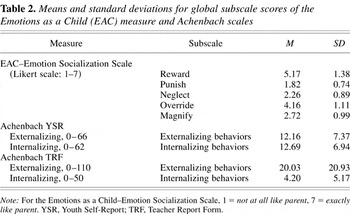
The means and standard deviations of the global subscales of the EAC and the subscales of the YSR and TRF measures are shown in Table 2. On average, children reported that their parents use fewer negative emotion socialization strategies (Punish, Neglect, and Magnify) than positive socialization strategies. The average Punish score corresponds to “Hardly like my mother.” Children reported high use of more positive subscales like Reward and Override, with the average score corresponding to “More like my mother.”
Means and standard deviations for global subscale scores of the Emotions as a Child (EAC) measure and Achenbach scales

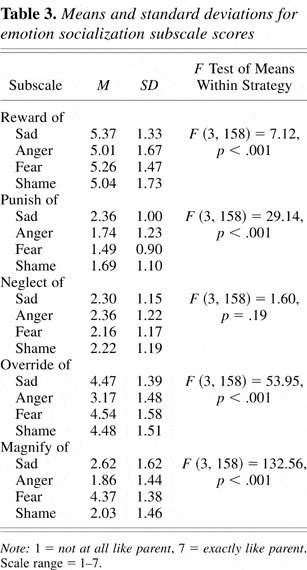
The means and standard deviations for each emotion-specific subscale are presented in Table 3. We used a repeated-measures analysis of variance (ANOVA; Statistical Package for the Social Sciences) to test a secondary question of interest: whether the average socialization reports differed across the four different emotional contexts. ANOVA revealed significant mean differences for emotion-specific subscales of Reward, Punish, Override, and Magnify but not for Neglect (F = 1.60, p = .19), suggesting that the average parent was largely seen as using strategies differently depending on the emotion the child expressed (see Table 3).
Means and standard deviations for emotion socialization subscale scores

A secondary question of interest was also which particular emotion-specific strategies, on average, seem to be socialized in a different manner, especially which emotion-specific strategies were perceived to be the most different from the others. Six post hoc pairwise comparisons (paired-samples t tests) were conducted for each emotion socialization strategy, except for Neglect, to determine which emotion-specific strategies were significantly different from the other strategies. For instance, for Reward, four of the six pairwise comparisons were significantly different from each other controlling for familywise error rate across the six comparisons at the .05 level, using the Holm's sequential Bonferroni procedure; the greatest difference was between Reward of Sad (M = 5.37, SD = 1.33) and Reward of Anger (M = 5.01, SD = 1.67). Without giving an exhaustive set of results, note that the biggest difference for Punish was between the mean of Punish of Sad and Punish of Fear. For Override, Override of Anger was lower than all the other emotion-specific strategies. For Magnify, Magnify of Fear was higher than all the other emotion-specific strategies. Although it was interesting to see average differences among emotion-specific socialization strategies, our primary question of interest was whether or not there was a significant difference between the global socialization model and the emotion-specific socialization model.
Emotion socialization internal consistency
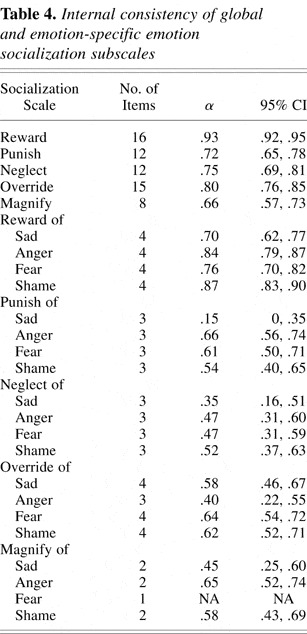
Cronbach's alpha for the global socialization factors ranged from moderate to high (.66–.93; see Table 4). The alpha results for the emotion-specific factors ranged from low to high (.15–.87; see Table 4), but the emotion-specific Reward factors were moderately high to high (.70–.87).
Internal consistency of global and emotion-specific emotion socialization subscales

Comparison of a global to an emotion-specific emotion socialization model
Model testing and analytic plan
We used confirmatory factor analysis (CFA) to compare two models (Kline, 1998): a global model with socialization strategies that were the same, regardless of the child's emotion (global strategy hypothesis; see Figure 1) was compared to a model in which emotion-specific socialization strategies were allowed to differ depending on the child's emotion (emotion-specific hypothesis; see Figure 2). Compared to other less sophisticated analyses (e.g., ANOVA), CFA has the advantage of testing if the covariation among a set of indicators (e.g., emotion-specific socialization strategy observed variables) can be explained by a common, theoretically based hypothetical construct (e.g., a global socialization strategy latent variable). Specifically, in the global strategy socialization model, we constrained the loadings of emotion-specific variables to be equal; in Figure 1, the subscripts on the loadings indicate that the loadings are the same. In the emotion-specific socialization model, we permitted the loadings of emotion-specific variables to differ; in Figure 2, the different subscripts of the loadings of the global latent factors (e.g., Reward) onto the emotion-specific observed variables (e.g., a2, Reward of Anger) indicate that the loadings were allowed to be different. For instance, the subscript of the loading of Reward onto Reward of Sad (a1) was labeled as different from the subscript of the loading onto Reward of Anger (a2).
In addition, note that high loadings of the global socialization strategy (i.e., latent variable) onto the emotion-specific strategies support the theoretical construct of a global socialization factor; low or mixed loadings suggest support for the emotion-specific model. In other words, a tendency to use the global socialization strategy is associated with being more likely to use those emotion-specific strategies with high loadings and less likely to use those specific strategies with low loadings. To improve the fit of both models, the residuals were allowed to be correlated for emotion-specific socialization strategies that used the same emotion. These correlations are shown in the arrows to the left of each figure.
Results of the comparison of a global with an emotion-specific emotion socialization model
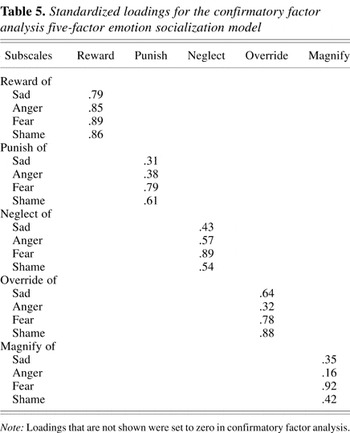
The CFA indicated that the emotion-specific socialization model (Figure 2) fit the data better than the global socialization model (Figure 1), as predicted. For each socialization strategy, we compared the emotion-specific model to the global model, and we found that the emotion-specific model was significantly different from the global model for each socialization strategy. When Reward emotion-specific factor loadings were permitted to differ and were compared to a global model with factor loadings that were constrained to be equal, there was a significant difference among the loadings, χdiff2 (3) = 15.31, p < .005. Table 5 displays the results of the CFA when emotion-specific factors were permitted to differ. The significant difference in loadings suggests that although children may see parents as having a general tendency to Reward due to high emotion-specific Reward loadings (ranging = .79–.89), the tendency does not have equivalent effects across emotions. The significant difference in emotion-specific loadings suggests that fear, anger, and shame are related to the global Reward strategy with sad being somewhat less related, for those parents viewed as using Reward often (see Table 5).
Standardized loadings for the confirmatory factor analysis five-factor emotion socialization model

For Neglect, CFA revealed that there was a significant difference between the model that permitted different emotion-specific loadings and a model with loadings constrained to be equal, χdiff2 (3) = 20.64, p < .005, suggesting differences in the use of Neglect across emotions. All loadings were moderate to high (.43–.89), which gives mixed support for the global hypothesis. The factor loadings indicate that Neglect of Fear is more related and Neglect of Sad is less related to the global Neglect factor (see Table 5).
For Override, the emotion-specific model is significantly different from the global strategy model, χdiff2 (3) = 45.63, p < .005. Override of Anger is less related to the global Override strategy compared to the other emotion-specific strategies (see Table 5). There was also a significant difference between the Magnify model, with different emotion-specific loadings, and the global model with loadings constrained to be equal, χdiff2 (3)= 23.63, p < .005 (see Table 5). The loadings indicate that the global pattern of Magnify is most related to the magnification of fear and least related to the magnification of anger. There was also a significant difference between the Punish unconstrained and constrained model results, χdiff2 (3) = 19.25, p < .005.
The relation of emotion socialization to gender, age, and child psychopathology
We examined the relation between socialization strategies and measures of developmental psychopathology in addition to gender and age. In particular, we asked if emotion-specific socialization strategies tell us more about children's developmental psychopathology than global socialization strategies do. Therefore, we investigated if certain emotion-specific socialization strategies related to developmental psychopathology above and beyond the global strategies. We also speculated that certain global socialization strategies, a more indiscriminate manner of parenting, may tell us more about psychopathology than the emotion-specific strategies would. We expected that Global Reward, Punish, and Neglect would be more likely to relate to psychopathology than emotion-specific Reward, Punish, and Neglect. We also hypothesized that emotion-specific Magnify and Override would relate to psychopathology more than Global Magnify and Override.
The relation of emotion socialization to gender and age
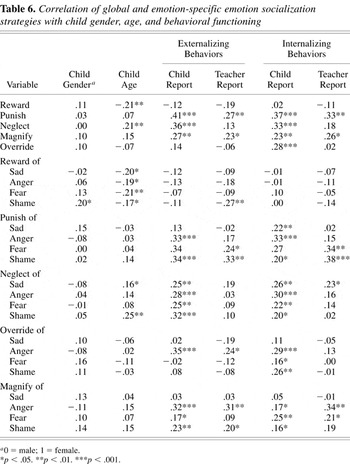
We assessed how emotion socialization strategies functioned differently for identifiable sample subgroups. There were no significant gender differences on Global Reward or Punish, contrary to expectations (see Table 6). Parents were viewed as using less Global Reward and more Global Neglect for older children in our sample, as predicted (see Table 6).
Correlation of global and emotion-specific emotion socialization strategies with child gender, age, and behavioral functioning %*p < .05. **p < .01. ***p < .001.

For emotion-specific hypotheses, girls were expected to report more Reward, Magnify, and Override than boys for internalizing emotions like fear, shame, and sadness; boys were expected to report more Neglect for the internalizing emotions and higher Punish for anger than girls (Garside & Klimes–Dougan, 2002). The only emotion-specific strategy that was significant was Reward of Shame (r = .20, p < .05), which was more likely to be reported by girls than boys. As expected, less Reward was reported for each emotion-specific strategy, and more Neglect was reported for shame and sadness as children aged (see Table 6); however, more Punish of anger did not occur with age.
The relation between emotion socialization and behavioral functioning
We also examined the relation of emotion socialization with behavioral functioning (externalizing and internalizing behaviors). For the relation of global socialization with behavior, correlation analyses revealed associations between Global Punish and both externalizing and internalizing behaviors, as one would expect. Less Global Reward was not significantly associated with more externalizing and internalizing behaviors, as one might predict. Global Magnify, Override, and Neglect were largely associated with higher levels of psychopathology (see Table 6).
Do emotion-specific socialization strategies add more to our understanding of child psychopathology than simply looking at global socialization strategies? To test this question we used stepwise regression to assess if emotion-specific strategies were significantly related to child psychopathology, above and beyond the global strategies.
The relation between emotion socialization and externalizing behavior
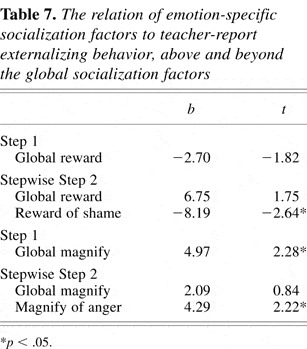
Reward was expected to be more likely to act in a global than an emotion-specific manner with psychopathology. Neither Global Reward nor emotion-specific Reward were found to be related to child-reported externalizing behavior, but Reward of Shame accounted for a negative relation with teacher-reported externalizing behavior, above and beyond Global Reward (see Table 7).
The relation of emotion-specific socialization factors to teacher-report externalizing behavior, above and beyond the global socialization factors

As predicted, Global Neglect and Punish were more related to externalizing behavior, above and beyond the relation of emotion-specific Neglect and Punish strategies to externalizing behavior. We expected that if parents magnify anger more than other emotions, then the child may exhibit more externalizing behavior, above and beyond the impact of the global magnification of anger. Indeed, Magnify of Anger did explain the variation in teacher-reported externalizing behavior, more than Global Magnify did (see Table 7); we did not find the same results for child-reported externalizing behavior. Global Magnify was no longer significantly related to teacher-reported externalizing behavior once emotion-specific Magnify of Anger was added to the equation; emotion-specific Magnify of Anger was what truly explained the global effect. Regarding Override, Override was not significantly related to externalizing behavior.
The relation between emotion socialization and internalizing behavior
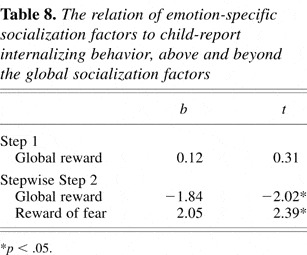
As expected, stepwise regression analyses indicated that Global Neglect and Punish were strongly related to internalizing behavior, above and beyond the emotion-specific factors (see Table 6 for bivariate correlations of global socialization with behavior). There was an unexpected finding that Global Reward was positively associated with internalizing behavior. Once the role of Reward of Fear was removed from the analysis, the relation of Global Reward and internalizing behavior was what one would expect: Global Reward became significant and negatively associated with internalizing. The stepwise regression analysis indicated that Reward of Fear was positively associated with internalizing behavior, holding constant Global Reward and other emotion-specific tendencies to Reward (see Table 8). The Global Magnify and Override factors were more related to internalizing behavior than the emotion-specific factors, in contrast to our predictions.
The relation of emotion-specific socialization factors to child-report internalizing behavior, above and beyond the global socialization factors

Discussion
Parents' reactions to children's emotions play a role in children's socioemotional development (Gottman et al., 1996; Zahn–Waxler et al., 1998; Zeman & Shipman, 1997). This study examined if early adolescents were more likely to perceive parents as responding in a different manner to different emotions (i.e., emotion-specific socialization model) than to perceive parents as responding in a similar manner to different emotions (i.e., global socialization model). We tested that question by comparing a socialization model of individual emotions to a global model of socialization, ignoring the emotional context. Overall, the results suggested that parent socialization strategies were more likely to be perceived as being used in different ways in response to children's different emotions than to be perceived as being used in the same way with each emotion. Indeed, early adolescent children seemed to be sensitive to the emotional context of parenting.
An emotion-specific versus a global socialization model
Although important theory building has been longstanding on the emotional context of parenting and children's emotional development (Tomkins, 1963, 1991), only recently have considerable empirical efforts been made to test these questions. Based on Affect theory, Tomkins articulated strategies parents employ in the socialization of children's negative emotions. Parenting was posited to differ depending on the child's expressed emotions (i.e., emotion-specific socialization model; Tomkins, 1963, 1991).
The results indicated that the emotion-specific socialization model was significantly different from the global socialization model for each socialization strategy. Indeed, we found more support for the emotion-specific socialization model, especially with emotions like anger and sadness. Specifically, the CFA loadings suggested that Punish of Anger, Override of Anger, and Magnify of Anger were perceived as being used in an emotion-specific manner.
An alternative explanation is that some differences in the wording of the scales may account for some differences found across emotions. For instance, questions used for Override of Anger, in particular, may be different in nature from the Override of Sad, Fear, and Shame items (see Table 1). The somewhat different nature of the Override of Anger questions may exaggerate the difference between the Override of Anger results and the other Override emotional contexts. Also, Magnify of Fear only has one item in its scale while the other emotion-related Magnify scales have two items. It seems premature, however, to assume that emotion-specific socialization differences found in our study were due to some differences in item-wording on the EAC. For example, even though emotion-specific Neglect scales were all worded the same, loading differences were found in the CFA.
Regarding the apparent perception of anger as being used in an emotion-specific manner, parental responses to anger are intriguing considering that the expression of anger can be a strong, interpersonally contagious emotion (Magai & McFadden, 1995). Malatesta and Haviland's (1982) work suggested that children are socialized from a very early age to minimize and control the expression of anger. Anger also seems to be a salient emotion in early adolescence when there is an increase in parent–adolescent conflict (Collins & Russell, 1991; Montemayor & Flannery, 1989). On average, when children in our sample were angry, they tended to see parents as less likely to use the positive socialization strategy of Reward; the strategies that may be seen as a mix of positive and negative were also used less with anger (i.e., Override and Magnify). Shipman and Zeman (2001) also found that 6- to 12-year-old maltreated children expected their mothers to give less positive reactions to the child's expression of anger than to happiness or sadness. Perhaps parents are less apt to give positive responses (e.g., accepting, comforting, or distracting) to anger because the anger may be directed at the parent and provoke a contagious response in the parent. Parental anger in response to children's anger may be part of a “coercive behavioral cycle” that contributes to the development of children's externalizing behavior and conduct disorder, over time (Denham et al., 2000; Dix, 1991; Patterson et al., 1992). An alternative interpretation of our anger results is that anger may be a less shameful emotion to express in adolescence, compared to sadness (Zeman & Shipman, 1997). Thus, early adolescent children may be more likely to express anger to their parents, leaving their parents more opportunity to treat anger in a different manner compared to other emotions. Because we are guided by a functionalist framework, we do not want to imply that anger, per se, is a “dysfunctional” or maladaptive emotion. Rather, some negative emotions may have problematic characteristics of strong intensity, poor timing, and a lingering nature (Watson & Clark, 1992), and anger, in particular, may carry the weight of many of these distinctive and, often, difficult qualities.
Parents were also viewed as employing Reward of Sad, Neglect of Sad, and Punish of Sad in more emotion-specific ways, compared to the stronger relation of other emotion-specific strategies to the global strategy factors. Reward, Neglect, and Punish may be used in a somewhat different way with sadness than with other emotions because parents may pay more attention to sadness and adjust their use of more positive and punitive strategies with sadness due to sadness' role of eliciting comfort and positive parenting, rather than punishment (Garside & Klimes–Dougan, 2002). Although, on average, Reward of Sad was reported to be higher than reward of the other emotions, Punish of Sad was unexpectedly higher than punish of the other emotions. For some reason, sadness was perceived as being somewhat more punished by parents, in our sample. Perhaps, given the high stress, high crime neighborhood the families live in, the parents may see sadness as an urban Achilles' heel, an emotional point of weakness that may make their children more vulnerable to bullying. Parents may think they need to “toughen up” their children when they express sadness. Our results further validate Fivush's (1998) observation that an important new direction for parenting research is a focus on the context of specific emotions.
Relation of emotion-specific strategies to behavior functioning
In our study, we also wanted to explore whether or not emotion-specific socialization strategies can explain behavior problems more than global strategies. We chose a sample that was at risk for the development of externalizing and internalizing behavior problems, due to their living in a stressful, high crime inner city neighborhood (Kliewer et al., 1998). We found that children do report global socialization tendencies that are more strongly related to behavior compared to the relation of emotion-specific socialization to the same outcomes. However, the emotional context can be telling. Under the right emotion-based conditions, children's nuanced perception of certain emotion-specific socialization strategies may, in fact, be associated with unique patterns in maladaptive behavior. Indeed, we found that the significant relations between the parenting strategies of Global Reward and Global Magnify and that of externalizing behavior were actually better explained by the emotion-specific relation of Reward of Shame and Magnify of Anger, respectively, with teacher-reported externalizing behavior. Therefore, it may be important to uncover the underlying emotional context that better accounts for the relation of global parenting strategies with child psychopathology.
There were, however, mixed results: global socialization often exhibited stronger relations with psychopathology than did emotion-specific socialization. Although it may be worth examining emotion-specific socialization, our results suggest that further examination of the relation between socialization and behavioral functioning should assess both affect-specific and nonspecific approaches to emotion socialization. In the adult affect literature, specific and global conceptualizations of emotion have often been assumed to be mutually exclusive; however, Watson and Clark (1992) observed that emotion specificity and nonspecificity are complementary. Affect researchers allied with the “general factor tradition” usually neglect the role of specific emotions. On the other hand, discrete emotion researchers ignore the general factor uniting many negative emotions (Watson & Clark, 1992), although Izard (1972) and Plutchik (1980) acknowledge that despite holding a discrete emotions perspective, pure, unique emotion states are relatively rare and brief phenomena.
In the child affect and socialization literature, Zahn–Waxler and colleagues (1998) have argued that emotion socialization models need to be more inclusive of global patterns of socialization in childhood. For instance, global climates of parental warmth, hostility, or negativity may have a unique impact on children's socioemotional development. In fact, Denham and colleagues (2000) found that global, “proactive parenting” (e.g., supportive presence and limit setting) of preschool children did predict externalizing behavior in fifth grade.
Our results suggest that emotion-specific parenting may be related to behavioral functioning among inner city African American and Caribbean American youth, depending on the child's emotion and the parenting strategy. It would be helpful to inner city parents if we understood exactly how a parent living in a stressful neighborhood could best respond to her early adolescent's diverse set of negative emotions to protect the child from the negative impact of such stress. For instance, the unique ways resilient African American families respond to their early adolescent's sadness versus anger deserves more attention given ethnic differences in socialization (Ekman, 1984). More culturally sensitive, emotion-based parenting programs would better assist innercity parents in helping their children adapt to emotions aroused by living in a high-risk environment (Coard, Wallace, Stevenson, & Brotman, 2004). Given the stress of their environment, early adolescent inner city youths' relations with their parents may be uniquely contentious. What could aid both the youth and parents most would be (a) improved identification of their emotions, (b) familial responses that promote the mutual expression of emotions, and (c) better family-based coping with emotions may prevent the early adolescents' behavior from becoming aggressive, anxious, or withdrawn.
In addition, we found no gender differences in global parenting, although we expected parents to use more punishment and less reward with boys than girls. Based on Garside and Klimes–Dougan's work (2002), we expected parents to be perceived as more rewarding of internalizing emotions for girls. Once we examined the emotional context of parenting, we did uncover a gender difference in the use of Reward: girls were more likely to perceive their parents as rewarding shame, compared to boys. Older children reported less reward and more neglect (especially of shame and sadness) than younger children, as predicted. Inner city parents may also want to be aware of ways in which they are socializing their boys and girls differently, depending on their age.
One of the limitations of this study was that there was no assessment of the extent to which the child generally gets sad, angry, fearful, and ashamed. For example, it may have been hard for a child who rarely gets angry to speculate how he and his parents react when he gets angry. Not knowing baseline negative emotion expression or arousal makes it difficult to determine reciprocal, child–parent effects. Indeed, Eisenberg and Fabes (1994) found that 4- to 6-year-old children high in negative affect and/or emotional intensity were more likely to have mothers who used punishment. A next step would be to examine possible longitudinal cycles like explosive child anger, parental Punish, then extreme child withdrawal, followed by parental Override or Neglect. It would also be helpful to determine if parents pair various strategies together like Reward and Override. Furthermore, understanding parent and children's responses to negative emotions would be greatly enhanced by observational and experimental assessments in addition to a comparison of parent versus child report of parent socialization.
Despite interviewer instructions to our sample regarding confidentiality of their responses, our sample tended to report low levels of Punish. It has been suggested that assessment of parental punishment may elicit less socially desirable responses (and more acknowledgement of punishment) if open-ended punish questions were asked or if responses were given anonymously. In the future, it may help to use this measure with a more punitive, perhaps abusive, sample of parents. In addition, while Cronbach's alpha is likely to underestimate true reliability (Lord & Novick, 1968; Raykov, 1997), we suggest using caution in interpreting the results of certain emotion-specific scales because we found low internal consistency for many of the emotion-specific scales (e.g., Punish of Sad). The internal consistency may be improved by increasing the number of items per scale and replication of this study.
Our findings for the relation of parenting with teacher report-based child psychopathology may have been sparse due to the smaller sample of teacher-report data, relative to the sample of self-report data. Or, it has been suggested that the relation between youth-based report of negative parenting and youth behavior problems may be due to shared method variance: children with behavior problems may be more likely to perceive their parents as negative parents. Finally, in the future it will be important to examine the role of peers as socializers of emotion (Saarni, 1985), differences between pre- and postpubescent emotion socialization, and gender differences in the role of parents and children in the socialization process (Garside & Klimes–Dougan, 2002; Zeman & Shipman, 1997).
In sum, early adolescents were more likely to perceive parents as responding in a different manner to different emotions (i.e., emotion-specific socialization model) than responding in the same way to different emotions (i.e., global socialization model), providing support for Affect theory (Tomkins, 1962, 1963) and Differential emotions theories of socialization (Izard, 1971; Magai & McFadden, 1995). Although global socialization strategies related to behavioral functioning in expected ways, there were some results in support of emotion-specific strategies explaining behavioral functioning above and beyond the global strategies.
References
REFERENCES
Achenbach, T. M.
(1991).
Integrative guide for the 1991 CBCL/4–18, YSR, and TRF
profiles.
Burlington, VT:
University of Vermont, Department of Psychiatry.
Barrett, K., &
Campos, J.
(1987).
Perspectives on emotional development II: A functionalist approach
to emotions. In
J. Osofsky (Ed.),
Handbook of infant development
(2nd ed., pp.
555–578).
New York:
Wiley.
Brand, A.
(2002).
The role of perceived discrepancies in parental emotion
socialization practices in the relation between marital adjustment and
adolescent psychopathology.
Unpublished manuscript,
University of North Carolina at Chapel Hill.
Brody, G. H., &
Flor, D. L.
(1998).
Maternal resources, parenting practices, and child competence in
rural, single-parent African American families.
Child Development
69,
803–816.Google Scholar
Campos, J.,
Mumme, D.,
Kermoian, R., &
Campos, R.
(1994).
A functionalist perspective on the nature of emotion.
Monographs of the Society for Research in Child Development
59,
284–303.Google Scholar
Casey, R. J., &
Fuller, L. L.
(1994).
Maternal regulation of children's emotions.
Journal of Nonverbal Behavior
18,
57–89.Google Scholar
Cassidy, J.
(1994).
Emotion regulation: Influences of attachment relationships.
Monographs of the Society for Research in Child Development
59(2–3,
Serial No. 240).Google Scholar
Cicchetti, D.
(1993).
Developmental psychopathology: Reactions, reflections,
projections.
Developmental Review
13,
471–502.Google Scholar
Coard, S. I.,
Wallace, S. A.,
Stevenson, H. C., &
Brotman, L. M.
(2004).
Towards culturally relevant preventive interventions: The
consideration of racial socialization in parent training with African
American families.
The Journal of Child and Family Studies
13,
277–293.Google Scholar
Collins, W. A.
(1990).
Parent–child relationships in the transition to adolescence:
Continuity and change in interaction, affect, and cognition. In
R. Montemayor,
G. R. Adams, &
T. P. Gullota (Eds.),
From childhood to adolescence: A transitional period? (pp.
85–106).
Newbury Park, CA:
Sage.
Collins, W. A., &
Russell, G.
(1991).
Mother–child and father–child relationships in middle
childhood and early adolescence: A developmental review.
Developmental Review
11,
99–136.Google Scholar
Darwin, C.
(1955).
Expression of emotions in man and animals.
New York:
Philosophical Library.
Denham, S., &
Kochanoff, A.
(2002).
“Why is she crying?”: Children's understanding of
emotion from preschool to preadolescence. In
L. F. Barrett &
P. Salovey (Eds).
The wisdom in feeling: Psychological processes in emotional
intelligence. Emotions and social behavior (pp.
239–270).
New York:
Guilford Press.
Denham, S.,
Workman, E.,
Cole, P. M.,
Weissbrod, C.,
Kendziora, K. T., &
Zahn–Waxler, C.
(2000).
Prediction of externalizing behavior problems from early to middle
childhood: The role of parental socialization and emotion
expression.
Development and Psychopathology,
12,
23–45.Google Scholar
Dix, T.
(1991).
The affective organization of parenting: Adaptive and maladaptive
processes.
Psychological Bulletin
110,
3–25.Google Scholar
Duggal, S.,
Carlson, E. A.,
Sroufe, A., &
Egeland, B.
(2001).
Depressive symptomatology in childhood and adolescence.
Development and Psychopathology
13,
143–164.Google Scholar
Edelbrock, C., &
Achenbach, T. M.
(1984).
The teacher version of the child behavior profile: I. Boys aged 6 to
11.
Journal of Consulting and Clinical Psychology
52,
207–217.Google Scholar
Ekman, P.
(1984).
Expression and the nature of emotion. In
K. Scherer &
P. Ekman (Eds.),
Approaches to emotion (pp.
319–343).
Hillsdale, NJ:
Erlbaum.
Eisenberg, N.,
Cumberland, A., &
Spinrad, T. L.
(1998).
Parental socialization of emotion.
Psychological Inquiry
9,
241–273.Google Scholar
Eisenberg, N., &
Fabes, R. A.
(1994).
Mothers' reactions to children's negative emotions:
Relations to children's temperament and anger behavior.
Merrill Palmer Quarterly
40,
138–156.Google Scholar
Eisenberg, N.,
Fabes, R. A.,
Carlo, G., &
Karbon, M.
(1992).
Emotional responsivity to others: Behavioral correlates and
socialization antecedents. In
N. Eisenberg &
R. A. Fabes (Eds.),
Emotion and its regulation in early development: New directions in
child development (pp.
57–73).
San Francisco, CA:
Jossey–Bass.
Eisenberg, N.,
Fabes, R. A., &
Murphy, B. C.
(1996).
Parents' reactions to children's negative emotions:
Relations to children's social competence and comforting
behavior.
Child Development
67,
2227–2247.Google Scholar
Eisenberg, N.,
Fabes, R. A.,
Shepard, S. A.,
Guthrie, I. K.,
Murphy, B. C., &
Reiser, M.
(1999).
Parental reactions to children's negative emotions:
Longitudinal relations to quality of children's social
functioning.
Child Development
70,
513–534.Google Scholar
Eisenberg, N.,
Losoya, S.,
Guthrie, I. K.,
Murphy, B.,
Shepard, S. A.,
Padgett, S. J.,
Fabes, R. A.,
Poulin, R., &
Reiser, M.
(2001).
Parental socialization of children's dysregulated expression of
emotion and externalizing problems.
Journal of Family Psychology
15,
183–205.Google Scholar
Fabes, R. A.,
Eisenberg, N., &
Bernzweig, J.
(1990).
The Coping with Children's Negative Emotions Scale (CCNES):
Procedures and scoring.
Unpublished manuscript,
Arizona State University,
Tempe, AZ.
Fivush, R.
(1998).
Methodological challenges in the study of emotion
socialization.
Psychological Inquiry
9,
317–333.Google Scholar
Fuchs, D., &
Thelen, M. H.
(1988).
Children's expected interpersonal consequences of communicating
their affective state and reported likelihood of expression.
Child Development
59,
1314–1322.Google Scholar
Garside, R. B., &
Klimes–Dougan, B.
(2002).
Socialization of discrete negative emotions: Gender differences and
links with psychological distress.
Sex Roles
47,
115–128.Google Scholar
George, C.,
Kaplan, N., &
Main, M.
(1984).
The Berkeley Adult Attachment Interview.
Unpublished manuscript,
University of California, Berkeley, Department of Psychology.
Gottman, J. M.,
Katz, L. F., &
Hooven, C.
(1996).
Parental meta-emotion philosophy and the emotional life of families:
Theoretical models and preliminary data.
Journal of Family Psychology
10,
243–268.Google Scholar
Harold, G. T.,
Fincham, F. D.,
Osborne, L. N., &
Conger, R. D.
(1997).
Mom and dad are at it again: Adolescent perceptions of marital
conflict and adolescent psychological distress.
Developmental Psychology
33,
333–350.Google Scholar
Hooven, C.,
Gottman, J. M., &
Katz, L. F.
(1995).
Parental meta-emotion structure predicts family and child
outcomes.
Cognition and Emotion
9,
229–264.Google Scholar
Hunziker, J.
(1995).
Attachment, emotion socialization, and social competence.
Unpublished doctoral dissertation,
Long Island University, Brooklyn.
Izard, C. E.
(1971).
The face of emotion.
New York:
Appleton–Century–Crofts.
Izard, C. E.
(1972).
Patterns of emotions: A new analysis of anxiety and
depression.
San Diego, CA:
Academic Press.
Izard, C. E.
(1991).
The psychology of emotions.
New York:
Plenum Press.
Izard, C. E.
(2002).
Translating emotion theory and research into preventive
interventions.
Psychological Bulletin
128,
796–824.Google Scholar
Izard, C. E., &
Harris, P.
(1995).
Emotional development and developmental psychopathology. In
D. Cicchetti &
D. J. Cohen (Eds.),
Manual of developmental psychopathology: Vol. 1. Theory and
methods (pp.
467–503).
New York:
Wiley.
Kline, R. B.
(1998).
Principles and practice of structural equation modeling.
New York:
Guilford Press.
Kliewer, W.,
Lepore, S. J.,
Oskin, D., &
Johnson, P. D.
(1998).
The role of social and cognitive processes in children's
adjustment to community violence.
Journal of Consulting and Clinical Psychology
66,
199–209.Google Scholar
Klimes–Dougan, B.,
Brand, A., &
Garside, R. B.
(2001, August).
Factor structure, reliability, and validity of an emotion
socialization scale. In
C. O'Neal (Chair), Multiple approaches to emotion
socialization: Methodology and emotional development. Symposium presented
at the Meeting of the American Psychological Association, San
Francisco.
Klimes–Dougan, B.,
Brand, A.,
Garside, R. B,
Hastings, P.,
Kendziora, K., &
Zahn–Waxler, C.
(2001).
Assessing parental emotion socialization: Factor structure,
reliability, and validity of an emotion socialization scale.
Unpublished manuscript.
Lindahl, K. M.
(1998).
Family process variables and children's disruptive behavior
problems.
Journal of Family Psychology
12,
420–436.Google Scholar
Lord, F. M., &
Novick, M. R.
(1968).
Statistical theories of mental test scores.
Reading, MA:
Addison–Wesley.
Magai, C.
(1996).
Emotions as a child.
Unpublished manuscript,
Long Island University,
Brooklyn.
Magai, C.
(1999).
Affect, imagery, and attachment: Working models of interpersonal
affect and the socialization of emotion. In
J. Cassidy &
P. R. Shaver (Eds.).
Handbook of attachment: Theory, research, and clinical
applications (pp.
787–802).
New York:
Guilford Press.
Magai, C.,
Hunziker, J.,
Mesias, W., &
Culver, L. C.
(2000).
Adult attachment styles and emotional biases.
International Journal of Behavioral Development
24,
301–309.Google Scholar
Magai, C., &
McFadden, S. H.
(1995).
The role of emotions in social and personality development: History,
theory, and research.
New York:
Plenum Press.
Magai, C., &
O'Neal, C. R.
(1997).
Emotions as a child (child version).
Unpublished manuscript,
Long Island University,
Brooklyn.
Main, M., &
Goldwyn, R.
(1998).
Adult attachment scoring and classification systems.
Unpublished manuscript,
University of California at Berkeley.
Malatesta, C. Z., &
Haviland, J. M.
(1982).
Learning display rules: The socialization of emotion expression in
infancy.
Child Development
53,
991–1003.Google Scholar
Malatesta, C. Z., &
Wilson, A.
(1988).
Emotion/cognition interaction in personality development: A
discrete emotions, functionalist analysis.
British Journal of Social Psychology
27,
91–112.Google Scholar
Malatesta–Magai, C.
(1991).
Emotion socialization: Its role in personality and developmental
psychopathology. In
D. Cicchetti &
S. L. Toth (Eds.),
Rochester Symposium on Developmental Psychopathology: Vol. 3.
Internalizing and externalizing expressions of dysfunction (pp.
203–224).
Hillsdale, NJ:
Erlbaum.
McGroder, S. M.
(2000).
Parenting among low-income, African American single mothers with
preschool-age children: Patterns, predictors, and developmental
correlates.
Child Development
71,
752–771.Google Scholar
McLoyd, V.
(1990).
The impact of economic hardship on Black families and children:
Psychological distress, parenting and socioemotional development: Minority
children.
Child Development
61,
311–346.Google Scholar
Montemayor, R., &
Flannery, D. J.
(1989).
A naturalistic study of the involvement of children and adolescents
with their mothers and friends: Developmental differences in expressive
behavior.
Journal of Adolescent Research
4,
3–14.Google Scholar
Moscowitz, D., &
Schwartz, J.
(1982).
A validity comparison of behavior counts and ratings by
knowledgeable informants.
Journal of Personality and Social Psychology
42,
518–528.Google Scholar
O'Neal, C. R.,
Magai, C. L.,
Vilker, R. D., &
Rubin, S.
(1997).
Emotions as a Child measure: A pilot study with inner city middle
school students.
Unpublished manuscript,
Long Island University,
Brooklyn.
Patterson, G. R.,
Reid, J. B., &
Dishion, T. J.
(1992).
Antisocial boys.
Eugene, OR:
Castalia.
Perry, D. G.,
Perry, L. C., &
Weiss, R.
(1989).
Sex differences in the consequences that children anticipate for
aggression.
Developmental Psychology
25,
312–319.Google Scholar
Pinderhughes, E. E.,
Dodge, K. A.,
Bates, J. E.,
Pettit, G. S., &
Zelli, A.
(2000).
Discipline responses: Influences of parents' socioeconomic
status, ethnicity, beliefs about parenting, stress, and
cognitive-emotional processes.
Journal of Family Psychology
14,
380–400.Google Scholar
Plutchik, R.
(1980).
Emotion: A psychoevolutionary synthesis.
New York:
Harper & Row.
Radke–Yarrow, M., &
Kochanska, G.
(1990).
Anger in young children. In
N. L. Stein,
B. Leventhal, &
T. Trabasso (Eds.),
Psychological and biological approaches to emotion (pp.
297–310).
Hillsdale, NJ:
Erlbaum.
Raykov, T.
(1997).
Scale reliability, Cronbach's coefficient alpha, and violations
of essential tau-equivalence with fixed congeneric components.
Multivariate Behavioral Research
32,
329–353.Google Scholar
Roberts, W., &
Strayer, J.
(1987).
Parental responses to the emotional distress of their children:
Relations with children's competence.
Developmental Psychology
23,
415–422.Google Scholar
Rothbaum, F., &
Weisz, J.
(1994).
Parental caregiving and child externalizing behavior in nonclinical
samples: A meta-analysis.
Psychological Bulletin
116,
55–74.Google Scholar
Saarni, C.
(1985).
Indirect processes in affect socialization. In
M. Lewis &
C. Saarni (Eds.),
The socialization of emotions (pp.
187–209).
New York:
Plenum Press.
Shipman, K., &
Zeman, J.
(2001).
Socialization of children's emotion regulation in
mother–child dyads: A developmental psychopathology
perspective.
Development and Psychopathology
13,
317–336.Google Scholar
Shipman, K.,
Zeman, J.,
Penza, S., &
Champion, K.
(2000).
Emotion management skills in sexually maltreated and nonmaltreated
girls: A developmental psychopathology perspective.
Development and Psychopathology
12,
47–62.Google Scholar
Stern, D.
(1985).
The interpersonal world of the infant.
New York:
Basic Books.
Tomkins, S. S.
(1962).
Affect, imagery, consciousness: Vol. 1. The positive affects.
New York:
Springer.
Tomkins, S. S.
(1963).
Affect, imagery, consciousness: Vol. 2. Negative affects.
New York:
Springer.
Tomkins, S. S.
(1991).
Affect, imagery, consciousness: Vol. 3. Anger and fear.
New York:
Springer.
Vilker, R.
(2000).
Adult attachment and the socialization of emotions.
Unpublished manuscript,
Long Island University,
Brooklyn.
Watson, D., &
Clark, L. A.
(1992).
Affects separable and inseparable: On the hierarchical arrangement
of the negative affects.
Journal of Personality and Social Psychology
62,
489–505.Google Scholar
Zahn–Waxler, C.,
Klimes–Dougan, B., &
Kendziora, K. T.
(1998).
The study of emotion socialization: Conceptual, methodological, and
developmental considerations.
Psychological Inquiry
9,
313–316.Google Scholar
Zeman, J., &
Shipman, K.
(1996).
Children's expression of negative affect: Reasons and
methods.
Developmental Psychology
5,
842–849.Google Scholar
Zeman, J., &
Shipman, K.
(1997).
Social–contextual influences on expectancies for managing
anger and sadness: The transition from middle childhood to
adolescence.
Developmental Psychology
33,
917–924.Google Scholar
Means and standard deviations for global subscale scores of the Emotions as a Child (EAC) measure and Achenbach scales
Means and standard deviations for emotion socialization subscale scores
Internal consistency of global and emotion-specific emotion socialization subscales
Standardized loadings for the confirmatory factor analysis five-factor emotion socialization model
Correlation of global and emotion-specific emotion socialization strategies with child gender, age, and behavioral functioning %*p < .05. **p < .01. ***p < .001.
The relation of emotion-specific socialization factors to teacher-report externalizing behavior, above and beyond the global socialization factors
The relation of emotion-specific socialization factors to child-report internalizing behavior, above and beyond the global socialization factors
 You have
Access
- 128
- Cited by