Ethics has been identified as a key element in health technology assessment (HTA) since its inception in the 1970s (Reference Banta1;Reference Banta and Perry2). Early definitions of technology assessment include ethics: “Technology assessment is comprehensive in scope, examining impacts on social, ethical, legal, and other systems …” (3) and this also applies to more recent definitions of HTA (Reference Liberati, Sheldon and Banta4–6). In addition, a wide variety of methods for addressing ethical issues in HTA are available. Some of these are specifically developed for HTA (Reference Burls, Caron and Cleret de Langavant7–Reference Droste, Dintsios and Gerber9). The reasons for integrating ethics are also argued for (Reference Hofmann10). However, ethical issues are still not frequently addressed explicitly in HTA (Reference Droste, Dintsios and Gerber9;Reference Lavis, Wilson and Grimshaw11–Reference Assasi, Schwartz and Tarride13). Among the potential reasons for this are: (i) Existing approaches for ethical inquiry are not suitable for HTA. (ii) Technologies are often considered by HTA producers as being value-free. (iii) The only questions perceived as relevant in a HTA are technical and economical ones. (iv) Value issues may be acknowledged to be present at all levels in HTA, but ethics is not needed to address these issues. (v) It is practically difficult to integrate ethical considerations in HTA. (iv) HTA experts are not trained to make ethical assessments and there is too little expertise on ethics and HTA. (vii) Limited resources available to conduct ethical analyses (Reference ten Have14).
Hence, we know that ethics is expected to be integrated in HTA, we know that it is possible to do so, and that there are many methods available, but that it is relatively rarely done. Therefore, the key question in this article is how to integrate ethics in HTA. That is, how can ethics as an explicit activity and a discipline with its various methods be part of HTA? This question will be addressed in two steps: first by exploring several meanings of integration, and then to investigate how existing approaches in ethics are suited to integrate ethics in HTA according to standard understandings of integration.
WHAT DOES IT MEAN TO INTEGRATE ETHICAL INQUIRY IN HTA?
The word integrate stems from integrare (lat.), to incorporate parts in a whole, and is associated with inter-agere (lat.), that is, to interact. According to four ordinary conceptions of integrate (see e.g., Merriam Webster's Dictionary), ethics can be integrated in HTA in at least the following ways:
-
1 To subsume something as part of something more comprehensive. Accordingly, ethics is a subsidiary activity, a sub-project of an HTA, resulting in a separate (subordinate) chapter in a HTA publication/report. Both the activity and the end result (chapter in report or published article) may be less important in the subsequent decision making process. The assessment of ethical aspects of welfare technology may serve as one example of this (Reference Hofmann15). Another example is the Health Care Efficiency Programme (HTA) in the Netherlands. In the call for proposals for conducting HTAs, assessment of ethical aspects is seen as a separate task for which researchers should submit a separate application (Reference Zon16).
-
2 To combine (unite) parts or processes. Assessment of the ethical issues is a separate activity (project) on equal terms with the assessment of efficacy, effectiveness, safety, and efficiency. Ethics is an autonomous part of the HTA in its' own right. Its role in the decision making process is on the same footing as other parts of HTA. The assessment of bariatric treatment for obesity may be an example of this type of integration, for example, by Institute of Health Economics (IHE) in Canada (Reference Hofmann17). Another example may be the assessments of the 13-valent pneumococcal conjugated vaccine (Reference Kheiraoui, de Waure and Specchia18)
-
3 To coordinate parts or processes, for example, in horizontal or vertical integration. Ethics is still a separate part or process in HTA, but its role and importance may vary depending on the context, for example, the technology to be assessed, the patient group involved, the assessment of efficacy, effectiveness, and safety, etc. The role of ethics may be different in the assessment of whole genome sequencing of cell free fetal DNA in pregnant women's blood and the assessment of pulse oxymetry in anesthesiology. Results from the assessment of safety may influence the ethics assessment, and conversely, ethically controversial issues may direct the safety assessment. Although ethics is a defined and context sensitive part of HTA, it still is an autonomous activity. The content of the various parts of HTA may influence each other, but not the methods as such. Economists assess efficiency the way they find suitable, and ethicists define their core concepts and do ethics they way they think are the best, independent of the other disciplines. The assessment of non-invasive prenatal diagnosis (NIPD) in several countries may serve as an example of this perspective on integration.
-
4 Interaction (emergence, synergy): Constitutive interaction between ethics and other disciplines. The ethics assessment influences, is influenced by, re-defines and is re-defined by other parts and elements of HTA. For example, the selection of end-points is informed by and influenced by ethical concerns or patient perspectives. Economic evaluation may be redefined by ethical considerations of equity and non-discrimination, and ethical considerations may be informed and influenced by challenges with elaborating models in economics. While coordination involves mutual adjustments, interaction encompasses reciprocal re-definition. Assessment of cochlear implants in the Netherlands may serve as an example of this perspective on integration (Reference Reuzel, van der Wilt and HA19;Reference Reuzel, van der Wilt and ten Have20).
Hence, to integrate ethics in HTA has at least four different meanings. The two first forms of integration are related, while the two latter are substantially different from each other and from the others. In practice, the choice of integrative approach depends on the framing of the HTA agency and what type of HTA is to be performed. How then, do existing approaches for conducting ethics in HTA work with respect to these understandings of integration?
INTEGRATING STANDARD ETHICS METHODS IN HTA
One way of integrating ethics in HTA is by applying one of the well-founded methods of moral philosophy and to implement this in the process of HTA. Below we present relevant existing approaches (methods, theories, positions) in ethics and assess how suitable they are for integration in HTA according to the four identified meanings of integration. As few of the standard approaches have been explicitly used in HTAs, we cannot analyze empirical studies (e.g., in HTA reports), but have to rely on analyzing conceptual feasibility. Due to restricted space only the core characteristics of the methods are mentioned here, but a more elaborated description is given in the Supplementary Information.
UTILITARIANISM
Utilitarianism is a form of consequentialism that aims at maximizing the total utility. It is at the core of HTA's analyses of effectiveness, safety, and cost-effectiveness, and as such inherent in HTA. However, the ethical nature of this may not be recognized and ethical aspects may not be explicitly addressed. Integrating equity concerns in cost-effectiveness analysis is one example. This does not mean that ethics is integrated in a subsumed manner, only that some ethical aspects can be included in other disiplines of HTA. Utilitarianism has not been integrated in HTA in any of the four listed manners. Because utilitarianism is the normative basis of HTA, the question of integrating it as a separate ethical discipline may appear nonsensical, as it would be like asking how to integrate something into itself. However, one can easily expand utilitarian analysis to other social implications than effectiveness, safety, and cost-effectiveness, for example, investigating the implications of screening for trisomy 21 on the attitudes toward persons with Down's syndrome.
DEONTOLOGY
Deontology is the branch of ethics inferring right action from norms based on rationally justified duties. Such basic duties (imperatives) are to treat people equally and as ends in themselves. Deontology can be used both subsumed to and combined with other parts of the HTA process, as it can analyze a certain health technology (HT) in the light of a set of moral imperatives rooted in “basic” values/goods or to verify how moral imperatives could be pursued, fulfilled, respected in practical conditions, that is, with respect to the technology assessed. This could also be coordinated with other parts of the HTA process, for example, as it is done with several of the questions in EUneHTA Core model's Ethical domain (F0002, F0008, F0009, F0014) (Reference Lampe, Makela and Garrido21). Deontological approaches may be less appropriate in an interactive approach, as the norms often are fixed and not open to negotiation.
CASUISTRY
Casuistry is an approach in ethics for developing and justifying moral judgments with high affinity to medicine, law, and religion. The key is to find solutions to new and challenging cases based on similar cases where solutions exist. Casuistry can be used subsumed or combined, as it may be organized alongside other inquiries of effectiveness, safety, and cost-effectiveness. It could be commissioned when researchers acknowledge that the healthcare technology may violate certain moral values, and acknowledge that this cannot be established through deductive argument. Casuistry can also be used in a coordinate way, adjusted to and adjusting to the other parts of the HTA process. Casuistry is a conservative method, in that it bases the handling of new cases on solved solutions. Hence, the background values and principles may not be challenged. It is, therefore, not obvious that casuistry can be used in an interactive manner.
PRINCIPLISM
Principlism is an approach applying four important, but not absolute (prima facie), principles, that is, respect for autonomy, beneficence, non-malfeasance, and justice. It may be necessary to infringe single principles when the principles conflict. Ethical assessments adopting Principlism are generally performed in a top–down manner. Ethical assessments usually result in a separate chapter in the HTA report and they just consist of identifying ethical issues through an independent work of comparison of some aspects of the use of a certain technology with the set of principles. Therefore, Principlism is predominantly used in a subsumed/combined manner. As the principles are fixed, it may be difficult to apply in an interactive manner. However, it may be argued that the interpretation of the principles may be subject to interaction, but this would be to stretch principlism, according to many adherents.
DISCOURSE ETHICS
The central thesis of discourse ethics is that there is a “force of the better argument” driving toward consensus on certain norms and giving universal validity to some presuppositions of a moral discourse. It is based on impartial judgment and on arriving at consensus among those who are affected. Discourse ethics has not been explicitly used in HTA, but it inspires consensus oriented methods in deriving legitimacy of any particular rule. One example is the Interactive, participatory HTA approach (iHTA). Discourse ethics can be used through an “argumentative discourse” among the HTA experts and other stakeholders, where all (present and future) interests of each potential stakeholder are taken into account. Ethical assessments adopting discourse ethics will be performed in a bottom–up manner. Each stakeholders' perspective would influence “argumentative discourse”, informing/(re)defining the overall HTA process. Used this way, discourse ethics would be implemented in a coordinated or interactive manner.
WIDE REFLECTIVE EQUILIBRIUM
Wide reflective equilibrium (WRE) is a method of moral argumentation that starts with gathering existing judgments about a given case and identifies which moral principles are at stake and that guide the judgments. Then it finds (potential) background theories that support the ethical principles and tries to obtain optimal coherence between judgments, principles, and background theories. WRE may not be efficient if used in a subsumed and combined manner, as this could generate tensions with other parts of the HTA, for example, if the analysis goes against what is found in the systematic review on outcomes or in the economic analysis. According to its process, WRE is more naturally used in a coordinated manner. As the reflective process also can alter principles, values, and background theories, WRE could be used interactively.
INTEGRATING METHODS ESPECIALLY DEVELOPED FOR TECHNOLOGY ASSESSMENT
In addition to many methods, approaches, and positions in moral philosophy, several ethics approaches and methods have been directly developed and used for (health) technology assessment (Reference Burls, Caron and Cleret de Langavant7;Reference Saarni, Braunack-Mayer and Hofmann8;Reference Assasi, Schwartz and Tarride13). Here we only give a short description of them to assess their integrative assets.
SOCRATIC APPROACH
The Socratic approach aims at highlighting and addressing the overt and covert norms and values involved in the implementation, use, and assessment of a health technology (HT), as it sees science and technology as social activities governed by norms and values of various kinds (Reference Hofmann22;Reference Hofmann, Droste and Oortwijn23). It sets out with identifying characteristics of the HT and its assessment, as well as the involved stakeholders. To guide the exposure and analysis of value issues involved with a HT, seven main questions and thirty-three explanatory and guiding questions are addressed. Not all of the questions are relevant for all technologies. The Socratic approach has been used for a variety of HTs, both in a subsumed or a combined manner, where ethical issues have been addressed independent of and isolated from the other parts of the HTA process, usually resulting in a separate chapter in the HTA report. In other projects, the ethics assessment has been coordinated with other parts of the HTA process, and has played a significant role in the HTA process as well as the forming of the report and its conclusions. The questions in the question list, as well as end-points, evidence level, and other value related issues, have then been discussed with stakeholders and participants of the expert groups, in an iterative process. In an ongoing project where non-invasive prenatal diagnosis (NIPD) is assessed, ethical issues have been highlighted at an early stage, and may (re)define the HTA objectives in an interactive manner.
SOCIAL SHAPING OF TECHNOLOGY
Within the framework of science and technology studies (SST), technology is viewed as the product of societal processes within industry, research institutes, governmental bodies, and society at large, rather than an independent artifact that has a certain, measurable impact on its target. Therefore, it is important to understand the engagement and strategies of various actors, and the way various problems are defined and resolved. Assessing the role, merit, and value of technology becomes crucial. If technology in fact is technology-in-context, then both technology and its context can be influenced or adjusted to improve the outcomes of using technology. SST has not been used subsumed/combined or coordinated, as it is interactive by nature. If it were to be used in these ways, it would not be truly SST. As SST takes the social context into account to shape the technology according to norms and values that are jointly elaborated, it involves relevant stakeholders in an interactive process. One reason that it is so seldom used, despite its obvious integrative (interactive) merits, may be that it is foreign to HTA rationality (see reasons Reference Banta and Perry2–Reference Liberati, Sheldon and Banta4 in the introduction), although well established in parliamentary technology assessment, (P)TA.
CONSTRUCTIVE TECHNOLOGY ASSESSMENT
Constructive technology assessment (CTA) wants to narrow the gap between innovation and assessment by taking the socio-dynamic processes into account. The core of the approach is an assessed implement technology in society to improve the robustness of decisions about technology and to learn about and avoid possible harmful impacts. CTA includes four stages. First, a “socio-technical” map identifying the most relevant social actors involved. The second stage includes early and controlled experiments, through which unanticipated impacts can be identified. Third, a debate between the various actors involved is organized. Finally, a synthesis report is written aiming at letting societal aspects of innovation become additional design criteria. CTA has been adopted as an approach to technology assessment by public organizations. The CTA approach aims to provide a broad assessment at an early stage of technology development. Discussions between researchers, engineers, manufacturers, and future users are used in the development and diffusion of a technology to improve its (potential) effectiveness. In this way, the approach can be seen as a truly integrative method. As with SST, CTA has not been used subsumed/combined or coordinated, as it is interactive by nature. It is, however, seldom used in HTA for the same reasons as for SST.
ETHICAL MATRIX
The objective of the ethical matrix (EM) is to facilitate ethical decisions in situations where different, and conflicting, interests are at stake. It seeks common sense reasonable and justifiable principles to guide our actions. It uses a matrix where the x-axis lists the principles modified from the principlist approach (autonomy, well-being, justice) and the y-axis expands the moral realm appropriate for the technology to assess, such as the stakeholders and their perspectives, interests, and values. EM has mainly been used for the assessment of food, for example, genetically modified food, but it has also been used for the assessment of xeno-transplantation. It is argued that the EM is helpful for fact-finding in ethical debates relating to food ethics; but that it is much less helpful in for weighing the different ethical problems that it uncovers. EMs have been used subsumed/combined and coordinated for technology assessment outside health care. As the principles in EM are fairly fixed it is not suited for integration in the interactive sense. It may be argued that the principles that are part of the EM also are open for debate and refinement, and hence, that the method could be used in an interactive manner.
EUNETHTA CORE MODEL
The European Network for Health Technology Assessment (EUnetHTA) Core Model is a standardized synthesis of available methods intended to address ethical considerations in the whole HTA process (Reference Lampe, Makela and Garrido21). It emphasizes the value-ladenness of technology and HTA, and intends to be practical, transferable, and to consider ethical issues already in the planning phase of the HTA. A range of ethical issues are identified using a question-based format, adapted from the Socratic method (Reference Hofmann22). An ethical analysis is based on a reflection on stakeholders' interests, the purpose of the HTA, the characteristics of the specific technology, and the questions, as well as results from the domains of effectiveness, safety, and economy. The result of this analysis may be fed back to experts after stakeholder hearings. Conclusions are reported in a structured format to enhance both transparency of the argumentation and international transferability. This approach can be used both in a subsumed/combined and coordinated manner. The EUnetHTA Core Model has not been used in an interactive manner yet. However, there appear to be no major obstacles to use it interactively. Like the Socratic approach, the questions (and the underlying value issues) are not carved in stone.
INTERACTIVE HTA
Interactive health technology assessment (iHTA) is a specific type of HTA which seeks the active participation and interaction of stakeholders in the process of evaluating a technology. It aims at agreement on what needs to be researched (relevance), how this can best be done (methodology), and how the results should be interpreted and acted upon (practical reason). As such, iHTA is a specific type of participatory evaluation, with a strong emphasis on social learning. The role of the researcher is to identify stakeholders, engage them in the evaluation process, and reconstruct the interpretative frames that they bring to bear on the technology. The aim is to build a research agenda which is considered relevant and feasible by all stakeholders and to foster ownership of the evaluation. iHTA is not suitable for a subsumption or combined type of integration, as it requires close interplay between stakeholders throughout the HTA process. It is very well suited for tight coordination of ethics in HTA, as ethical issues feed into other parts of the HTA process. As the name indicates iHTA is interactive. However, there may be limits to which aspects of HTA that are open for negotiation and (re)definition in the HTA process.
COMPARISON
As the previous analysis indicates, the different approaches, have various assets with regard to integrating ethics in HTA. Most traditional and summative approaches are suitable for subordination and combination, and to some extent also for coordination, of ethics in HTA, but very few are merged in the HTA process and even fewer are expected to work in an interactive manner. Correspondingly, processual (formative) methods appear to be more suitable for interactive understandings of integration.
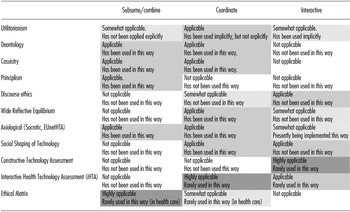
Table 1 compares the described approaches with respect to the identified interpretations of integration.
Assessment of Merits of Various Ethics Approaches According to Various Meanings of Integration

Note. White fields indicate not applicable, light gray indicates somewhat applicable, gray indicates applicable, and dark gray indicates highly applicable. The text additionally indicates to what extent it has been used in this way and qualifies the four categories.
The table shows that no one approach appears to cover all aspects of integration equally well; hence, there is no “universal” method for integrating ethics in HTA. However, there are some methods that appear to be less suitable for subsumption and combination, that is, processual approaches, and some are less suitable for an interactive conception of integration. Accordingly, it is important to select the approach which is suitable for the specific health technology to be assessed and the HTA context.
DISCUSSION
This article has presented and assessed a wide range of positions, methods, and approaches for ethical inquiry in HTA, according to four conceptions of integration. There may of course be other conceptions of integration that may be relevant. However, this article covers the most ordinary conceptions. Moreover, it may also be argued that more interesting than how to integrate ethics in HTA is the question “which ethical theories/approaches are most suitable for which types of HTA?” This may well be the case, but to do so, one would need a way to categorize the different types of HTA, which may not be easy. Here, the different types of integration may become very fruitful.
It would, of course, have been much better to study how the various approaches in ethics have been integrated in HTA, but the empirical applications of the various methods are scarce. In fact there seem to be more methods than uses (Reference Droste, Dintsios and Gerber9;Reference Hofmann, Droste and Oortwijn23). Although we have referred to some applications of some of the methods, the outcome may be more dependent on the HTA context including the person who performed the ethical analysis, than the ethics method. Hence, we hope that this assessment can be of some value, as the methods have been assessed according their own merits.
We have not addressed all methods or approaches in ethics identified in the literature (Reference Assasi, Schwartz and Tarride13). Although we have addressed the most renown and the most frequently used methods, there may be many other methods that could be investigated as well. We very much welcome further studies, especially assessments based on empirical studies.
Other professionals may of course have presented and assessed the various ethics approaches in different manner. They may also find ways to implement and modify the existing methods extending the ways they can be integrated in HTA. We most welcome such approaches. Most of all we welcome more examples of ethics integrated in HTA. We also admit that we may have preferences toward more coordinated and interactive modes of integration, as we think they may be more effective in highlighting the values involved in implementing health technology and pay more attention to stakeholders' perspectives, especially patients.
There may be many reasons why the interactive integration of ethics is not widespread. One reason can be that this may disturb or even threaten traditional and well-established HTA procedures. HTA may become less rigorous and predictable when used interactively. The power of framing the aim, process, and the output of the HTA may change hands. Hence, the reason that ethics is not used interactively in HTA may not be due to the various approaches in ethics, but in HTA itself. However, with the increasing assessment of complex health technologies, having more wide-reaching implications (Reference Petticrew, Anderson and R24), interactive assessments may become more suitable.
CONCLUSION: HOW TO INTEGRATE ETHICS IN HTA
The various approaches in HTA have different merits with respect to various conceptions of integration in HTA, that is, whether we think of integration as subsumption, combination, coordination, or interactive processes. Traditional approaches in moral philosophy, that have been performed independent of or abstracted from the practical context, tend to be most suited to be subsumed or combined, while processual approaches, that depend on being close to the process, appear to be most suited to coordinated and combined types of integration. Hence, depending on how the goals of the HTA and how the HTA process is planned, the most suitable ethics approach can be selected. For assessments that aim at framing and forming technology implementation, SST, CTA, and iHTA seem more suitable than assessments that aim at more independent and distanced assessment of a health technology. Here deontology, casuistry, principlism, and axiological approaches appear to be more appropriate.
ACKNOWLEDGMENTS
This work is part of a research project, INTEGRATE-HTA, which is co-funded by the European Union under the Seventh Framework Programme (Grant Agreement No. 306141). The sole responsibility for the content of this article lies with the authors. It does not necessarily reflect the opinion of the European Union. The European Commission is not responsible for any use that may be made of the information contained therein.
SUPPLEMENTARY MATERIAL
Supplementary File http://dx.doi.org/10.1017/S0266462315000276
CONFLICTS OF INTEREST
All the authors declare that they do not have conflicting interests with regards to this manuscript.