Introduction
Resilience traditionally has been considered in developmental terms in the psychological literature. It has been discussed either as a protective factor among children who experience extremely adverse events (Luthar, Doernberger and Zigler Reference Luthar, Doernberger and Zigler1993; Rutter Reference Rutter1999) or as a pathological reaction to trauma or bereavement (Bowlby Reference Bowlby1980). Evidence has recently emerged from two lines of research, however, that resilient individuals are more common than has been thought (Bonnano Reference Bonanno2004; Moore and Stratton Reference Moore and Stratton2003). Whilst both investigations found that resilience amongst older widowed adults is not infrequent, their focus, methods and concepts differed. The focus of Bonanno's work is on bereavement, whilst that of Moore and Stratton is on widowhood. Bonanno used quantitative methods, whereas Moore and Stratton used a qualitative approach, and the authors drew on different literatures to develop their conceptual frameworks. This paper attempts to show that, despite these contrasts, there are more similarities than differences in the two conceptualisations of resilience. Further, I demonstrate two pathways to achieving resilience: gradually and following a turning point.
Bonanno has made extensive theoretical and empirical contributions on resilience amongst adults following traumatic events including bereavement (Bonanno Reference Bonanno2004; Bonanno and Kaltman Reference Bonanno and Kaltman2001; Bonanno, Papa and O'Neill Reference Bonanno, Papa and O'Neill2002; Bonnano, Wortman and Nesse Reference Bonanno, Wortman and Nesse2004; Bonanno et al. Reference Bonanno, Papa and O'Neill2002, Reference Bonanno, Moskowitz, Papa and Folkman2005). He draws his theoretical inferences from discussions in the bereavement literature, especially the debate about grief work (for a review seeBonanno and Kaltman Reference Bonanno and Kaltman1999). He argues that not all bereaved individuals need to undertake grief work to adapt successfully to their loss (Bonanno, Papa and O'Neill Reference Bonanno, Papa and O'Neill2002). Using data from the Changing Lives of Older People Study (CLOC) (180 women, 25 men), he and colleagues identified five common types of reaction following spousal bereavement: common grief; chronic grief; chronic depression; depressed-improved; and resilient. The last was indicated when there was no significant change in depression between pre-loss and either six or 18 months post-loss. It is important to note that the investigators do not argue that the bereaved have no depressive or grief symptoms, rather that they found no statistically significant changes in symptoms – the changes were small or transient, rather than statistically significant or long term. They found that a resilient reaction to spousal bereavement was a common response but observed in less than a majority (45.9%) of their participants (Bonnano et al. Reference Bonanno, Wortman, Lehman, Tweed, Haring, Sonnega, Carr and Nesse2002). Thus, although many widowed older people are resilient, not all of those who appear to adjust appear to be resilient.
Bonanno, Papa and O'Neill (Reference Bonanno, Papa and O'Neill2002) argued that most bereaved people do not require professional help and do not have prolonged grief reactions. They outlined a number of factors that contribute to resilience, including worldview, self-enhancement, continuity of identity, continuing bonds and concrete aspects of the self such as roles and behaviours. In his 2004 discussion paper, Bonanno argued that resilience is more common than has been thought, and that the absence of distress does not equate to problematic grieving or a delayed grief reaction. Finally, he suggested that there are multiple and somewhat unexpected pathways to resilience. Some people display hardiness, others self-enhancement, others positive affect and humour, and yet others successfully use repressive coping. In Bonanno (Reference Bonanno2004: 20), he argued that resilience is the ‘ability to maintain a stable [psychological] equilibrium’ following the loss, without long-term consequences (see also Boerner, Wortman and Bonanno Reference Boerner, Wortman and Bonanno2005). Thus, the focus is on the ability to withstand the stress of bereavement.
Whilst methodologically and statistically elegant, Bonanno's empirical work has limitations. First, for the Bonanno et al. (Reference Bonanno, Papa and O'Neill2002) paper, measurements were taken at six and 18 months post-bereavement, and for the Bonanno et al. (Reference Bonanno, Moskowitz, Papa and Folkman2005) paper, the measurements were at four and 18 months post-bereavement, which means there is no information about what happened during the intervening months. It would have been possible, for example, for an individual to have had a crisis associated with the bereavement and for it to have been resolved between the interview waves. Second, there is evidence that some measures of depression are not as sensitive for widowers as for widows, and it is possible that depression was undetected by the self-report measures that were used (Bennett, Hughes and Smith Reference Bennett, Hughes and Smith2005). Third, there was no qualitative assessment of the distress felt by widowed people, nor an assessment of the ways in which they overcame that distress. Nevertheless, the work of Bonanno is valuable and emphasises that for most widowed people grief is ‘normal’ and does not warrant intervention.
Moore and Stratton (Reference Moore and Stratton2003) interviewed 51 older widowers for their book Resilient Widowers: Older Men Adjusting to a New Life. This qualitative work drew on a different literature to that consulted by Bonanno, and from their review they identified four models of behaviour associated with resilience in widowhood: reorganisation (Rubinstein Reference Rubinstein1986); adaptation (Moore and Stratton Reference Moore and Stratton2003); finding positive benefit (Janoff-Bulman Reference Janoff-Bulman1992; McMillen Reference McMillen1999); and compensation (Ferraro, Mutran and Barresi Reference Ferraro, Mutran and Barresi1984). For example, resilient widowers might believe that life was good (Rubinstein Reference Rubinstein1986), or change their lives to accommodate their newfound status (McMillen Reference McMillen1999). Ferraro, Mutran and Barresi (Reference Ferraro, Mutran and Barresi1984) found that over time widowed people increased the number of friends and their involvement with them. Of the 51 widowers studied, many were identified as resilient, and they shared a number of characteristics including: initial painful awareness of loss; the sense of a continuing ‘hole in their lives’ despite being engaged in meaningful activities; an integrated belief and value system; an optimistic and positive personality; and an ability to get social support. They concluded by suggesting that resilient men had made three adjustments: a change in themselves in some way, a change in their environment, and finding a new companion. Moore and Stratton emphasised that resilience is the ability to bounce back from the stressor, a view that is not at odds with Bonanno's. Their work also has limitations: they provide no quantitative measures of adjustment, did not focus on bereavement but on widowhood, and the durations of the men's widowhood varied greatly – indeed some had remarried. In addition, Moore and Stratton acknowledged that it is sometimes difficult to classify a widower as resilient or not.
For one widower, Alvin, it was particularly difficult to decide if he was resilient or not, as Moore and Stratton (Reference Moore and Stratton2005) reported at the annual meeting of the Gerontological Society of America in 2005. Their paper was the starting point for a re-examination of my own data. At first glance, Alvin did not appear to be resilient since his greatest wish was to find a wife, with the implication that he could not manage on his own, but on closer examination Alvin was managing quite well, and once he found his new wife, he lived life to its full. The question remains, was Alvin resilient or not? Moore and Stratton were unsure, and Bonanno would argue that Alvin was not resilient, but I believe that Alvin might be resilient. In my own data, there are men who at first glance are like Alvin. In the light of these uncertainties, I have re-examined 60 interviews with widowers to identify those who were resilient and those who were not, and to consider the processes involved in achieving resilience and the influencing factors.
The work of Bonanno and of Moore and Stratton suggests that a resilient widower is someone who is particularly well adjusted to life following spousal loss. Where they differ is in the methods used, the time interval that was considered, and in their perspectives – the last deriving from the difference between bereavement and widowhood. Bonanno focused on resilience in bereavement; Moore and Stratton focused on widowhood. Spousal bereavement is the objective state of experiencing the death of one's spouse and is considered a relatively short-term state. On the other hand, widowhood refers to a continuing and in many cases long-term state. Thus, ‘the distinction between bereavement and widowhood is an important one in the consideration of depressive feelings’ and, by extension, in the consideration of resilience (Bennett, Hughes and Smith Reference Bennett, Hughes and Smith2005: 348). It is possible that there are resilient widowers who are not resilient in bereavement, as well as widowed people, like those identified by Bonanno, that are resilient in bereavement. One might view Bonanno's resilient widowers as a subset of Moore and Stratton's.
Methods
Participants
The respondents were recruited for two studies of older widowed men, the first of 15 men conducted in the East Midlands of England (denoted Mr.+letter), and the second of 45 men in Merseyside, North West England (denoted Man+number). They were recruited through various organisations concerned with older people, including widows' clubs, trades unions, Age Concern local groups and local authority social service departments. Many respondents were living in their own homes, and several were in sheltered accommodation. The data were collected through tape-recorded interviews with the 60 widowers, who were aged between 55 and 98 years (mean 79) and had been widowed for between 0.25 and 25 years (mean 7). The long perspective on widowhood of some of these men is useful in understanding resilience, since it is likely to be the case that the time needed to adjust to bereavement varies considerably (Bennett Reference Bennett1997, Reference Bennett1998). The participants came from diverse social and economic backgrounds and were broadly representative of the Merseyside and East Midlands populations. The socio-economic status distribution of the participants was representative of the British population (Office of National Statistics 2001), and they held various religious, spiritual and secular beliefs, with no single religion or denomination being dominant.
The interviews
The interviews were semi-structured and undertaken in the respondents' own homes, tape-recorded, and lasted between 45 and 90 minutes. Before beginning the interview, the respondent was given an information sheet to read and asked to sign a consent form; confidentiality and anonymity were assured. The interviews were not tightly structured, rather the aim was to learn what was important to the informants. The approach was ‘we are the novices and you have the experience’. Both studies were interested in two broad questions, ‘how did you feel?’ and ‘what did you do?’ The interviews led the participants chronologically through their experiences of bereavement and widowhood. They were asked first to describe their lives with their spouses, then to describe the events immediately surrounding the spouse's death, thirdly to talk about their lives a year after the death, and finally to discuss their current lives.
It was possible, therefore, when analysing the interviews to associate particular feelings and behaviours with particular times in the chronology of widowhood. While recognising that memory can be fallible, I also believe that the recollections of widowed people are important for understanding the ways in which they adapt to the new situation. To prompt responses to the broad questions, they were also asked about the hobbies that the spouses had pursued together, the spousal division of labour, the quality of the marriage, a typical day before and after the bereavement, whether they went out together, social support, affect including depression, loneliness and grief, what changes had taken place, whether they enjoyed being able to spend time alone, and whether they looked forward to the future. In the North West England study, in addition to the interview we collected two measures of depression and anxiety: the Hospital Anxiety and Depression Scale (HADS: Zigmond and Snaith Reference Zigmond and Snaith1983); and the Symptoms of Anxiety and Depression Scale (SAD: Bedford, Foulds and Sheffield Reference Bedford, Foulds and Sheffield1976). The two measure depression and anxiety in different ways. Data from these measures have been presented elsewhere (Bennett, Hughes and Smith Reference Bennett, Hughes and Smith2005).
The analysis
Stage 1
This method was the same for both studies. As the interviews were completed, they were transcribed and analysed using a grounded theory approach (Bennett and Vidal-Hall Reference Bennett and Vidal-Hall2000; Charmaz Reference Charmaz, Smith, Harré and Van Langenhove1995; Smith Reference Smith, Smith, Harré and Van Langenhove1995). More specifically, the interviews were read line-by-line to give a holistic impression and then re-read and coded. This process was reflexive, and as new codes and themes emerged, the interviews were recoded. Although the two studies were independent, the content of the interviews had many similarities. The codes included presentation of the wife, death narrative, grief, and staying away from the house. The codes were then grouped into domains that were common to most interviews, which included: death, social, emotional, and life together. All interviews were coded blind by other members of the research team so that reliability across interviews could be assessed – it was found satisfactory. In addition, in the North West England study, coping was assessed by expert reading of the interviews, and consideration of the non-verbal content of the interviews. For example, coders looked for reports of medication, contact with primary health-care services, and reports of not coping. They were classified as either coping well or not coping well (referred to subsequently as ‘coper’ or ‘non-coper’). Characteristically the copers had developed a life without their spouse, were not unduly distressed during the interview, were able to discuss the issues surrounding the bereavement in positive as well as negative terms, and described the events surrounding the bereavement with a certain distance. Two members of the team made this assessment independently and there was agreement in 95 per cent of the cases. Of the 45 men in the North West England study, 12 were found to be not coping well and 33 were coping well (Bennett, Hughes and Smith Reference Bennett, Hughes and Smith2005).
Stage 2
In the secondary analysis, the interviews were re-read with a view to identifying widowers who met the criteria for resilience. Moore and Stratton's four criteria were used to classify the widowers as resilient: they viewed their current life positively; they were currently actively participating in life; they had returned to a life that had meaning and satisfaction; and they were coping. This had already been done for the North West England study participants but was extended to the East Midlands interviews. Eleven of the East Midlands men were identified as coping and four as not coping well.
Stage 3
The interviews from those widowers identified as resilient were then re-analysed with a focus on three aspects. First, did any of the widowers meet Bonanno's criteria of resilience? The analysis focused on the sections of the interview that asked about circumstances around the time of the death and a year later. It was also determined whether, in later sections of the interview, the participants mentioned a particular time interval by or after which they started to feel better. If the participants reported that they carried on without much distress, or grieved briefly before their mood returned more or less to normal, and there was no mention of later distress (thus ruling out a delayed reaction), then they were classified as resilient in bereavement. Second, I considered the time taken to achieve resilience. Resilient widowers had of course to be resilient at the time of interview. Two patterns were identified. Some had achieved resilience gradually, and for others it was achieved following a specific event or turning point. Third, the interviews were analysed to identify the factors that enabled the achievement of resilience. Reliability of coding was assessed and the agreement between the three coders was 78 per cent.
Results and discussion
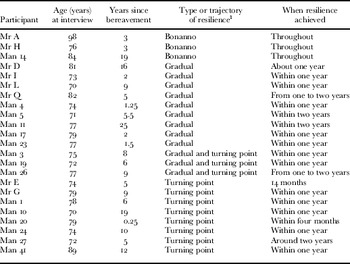
Twenty-three (38%) of the 60 widowers demonstrated resilience, 16 (27%) were identified as not coping well and not resilient, and the remaining 21 (35%) did not meet the criteria for resilience although some might have been resilient; but the interview did not determine this outcome. Further analysis focused on the 23 who met the criteria for resilience and distinguished four groups. Three men appeared to meet Bonanno's criteria and demonstrated resilience throughout (13% of the resilient widowers). Nine men appeared to achieve resilience gradually (39%). Another eight achieved resilience following a turning point (35%). Finally, three men achieved resilience through a combination of the two trajectories (13%). The men's ages and the chronologies of their bereavement and resilience are summarised in Table 1. In all but six cases, resilience was achieved within the first year, and the six others attained it within two years.
Ages, timing of bereavement and forms of resilience among the informants

Note: 1. Bonnano: met Bonnano's criteria for resilience; for details see text.
Resilience in bereavement
Three of the widowers met Bonanno's criteria for resilience in bereavement. In each case, there was no mention of distress, grief or depression when they were asked about their lives a year after the wife's death, although there were mentions of low mood or grief close to the time of the death. Such was clearly expressed clearly by Mr H: ‘Grief comes out and all that, that didn't happen for six weeks … all of a sudden I just cried. And then it just stopped’ [Mr H's emphasis]. Another excellent example of a widower who fits Bonanno's criteria is Man 14. He summed up a positive attitude towards life and bereavement with, ‘You've got to get cracking and live your life’.
Gradually achieving resilience
For 12 widowers, resilience was achieved more gradually. These men experienced grief and emotional lows, including depressive symptoms. In all these cases, the death was a shock (even when expected). There were two types of experience, one involving some thought, the other more automatic. There were men who deliberated on their situation and looked at the alternatives, much in the manner of the way they considered the value of their lives (seeBennett Reference Bennett2005). For example, Mr D said, ‘I got to get on with life the best I could’. Other men achieved resilience more automatically and subtly, without any deliberation, either as an essential part of their make up, as in the case of Mr L, who said, ‘It came naturally to me’, or as something external to a widower, as in the case of Mr I, who said, ‘Each day has been made a bit easier by something unseen’.
This gradual acquisition of resilience was achieved in two ways. For some men it was through the exercise of practical skills and emotional ties, and for others it derived from their personal characteristics. There were men whose practical skills facilitated the achievement of resilience. Not having to worry about acquiring new skills (such as cooking) may remove one of the stressors of bereavement and of widowhood. Several of the widowed men had experience of caring for a spouse and for others it was simply that they knew how to manage. Mr Q summed it up simply, ‘I just lived. How did I do it? I had a microwave’. It was also the case that where the widowers had family at home they did not have time to become depressed and needed to focus their emotional energies on their children. As Man 11 explained, ‘[with the] children, I hadn't time to sort of mope about’. For other men, it was their personal characteristics that allowed them to achieve resilience. In the case of Mr L some inherent part of his personality allowed him to achieve resilience effortlessly or ‘naturally’. For others, it was a philosophy of life. For example, not lamenting over what could not be changed or a drive for life helped them achieve resilience. Man 23 uttered the familiar cliché, ‘There's no use crying over spilled milk’.
Resilience achieved following a turning point
For nine of the widowers, resilience was achieved following a turning point, which in a few cases was a dramatic event. Mr E experienced the most extraordinary turning point. When I first heard Moore and Stratton discuss Alvin's case, I was immediately reminded of Mr E. His own words illustrate the drama of his experience and the importance of the turning point. It is also striking that he could say precisely when the turning point occurred:
And the next thing I was in hospital … erh, got around and, erh, they said, ‘Leave Brown Road’ [where he lived]. … And within an hour she sent me down here the same, the same woman, to look at this place. … one year and two months.
Another example of a dramatic turning point was Man 1's experience. He had asked for help from a bereavement counselling service and, as he related, ‘I got a phone call to make an arrangement and when Mr Anderson came he was absolutely brilliant’. Of the more prosaic turning points, many were associated with joining clubs or going to concerts and other social activities. For example, Man 10 loved classical music, and sometime after his wife's death, he went to a concert. Remembering his reaction, he said, ‘I realised that was therapy for me’. Similarly, following prompting from friends, Man 24 joined an organisation for people on their own, ‘but eventually I did go out and I enjoyed myself’. Man 41's description of the way in which he reached a turning point, ‘It's like in a sense you've got a big job to do’, made clear that he saw widowhood as a job and recalls Lopata's view of women embarking on a ‘career of widowhood’ (Lopata Reference Lopata1996: 15).
Many men who experienced turning points achieved resilience because someone offered support. For example, someone suggested that Mr E move house, and then helped organise the move with the local council. For Man 1 it was support from a bereavement organisation. Several men were encouraged to join clubs or chose by themselves to go out. For example, Man 10 began going to concerts and Men 24 and 27 joined organisations, respectively for people on their own and a political organisation. For other men, the turning point was triggered by an internal trait. For example, Man 41 turned his life around by using his work ethic – widowhood was a job to be undertaken, while Mr G said ‘I'll get over it in my own way’.
Men who experienced both gradual change and turning points
Two men achieved resilience through a combination of gradual change and turning points. Man 19, aged 72 years, described how his philosophy of life was important to dealing with his widowhood, and thus enabled gradual change:
Before I was 40 you [thought] by the time you were 40 you'd be dead … but when I was 40 I thought, oh, I'm not dead. The rest of your life is now a bonus. Enjoy it.
After being a widower for some time, he decided one evening how he was going to move forward, which amounted to a personal turning point. He explained, ‘You're going to climb up these walls [if you don't do something], so I went down and joined the club’. As with the second case, a personal quality, especially the man's philosophy of life, facilitated his resilience, rather than external agencies. In another case of both gradual change and a turning point, it was both the widower's personal characteristics and the intervention of an external agency that helped to achieve resilience. Unusually for the widowers in these studies, he sought help for depression from the family doctor, who prescribed anti-depressants. While waiting in the pharmacy for his medication, he began talking to an old man. During the interview, he related what happened next:
The man said, ‘Do some hard work. In about a month's time, you'll feel it going out of your hair and your fingernails’, which it did.
At the same time he also made downward comparisons with others, as with ‘You've only got to look sideways and there's someone a damn sight worse off than you are’. He called the device looking ‘sideways’ when thinking of his own experiences. As in other negative life events, downward comparisons can be a useful strategy (Taylor, Lichtman and Wood Reference Taylor, Lichtman and Wood1984).
Conclusions
Nearly 40 per cent of the widowers from the two independent samples were seen to be resilient around two years after bereavement, and 30 per cent attained resilience within one year. The other interviewees were not recognised as resilient at the time of the interviews. There were four groups of resilient widowers: those who appeared to meet Bonanno's criteria of resilience throughout; those who achieved resilience gradually; those who did so following a turning point; and those who achieved resilience both with a turning point and gradually. In all cases, resilience was achieved through social support, joining clubs or getting out of the house, or through personal characteristics such as a personality trait or a philosophy of life. It is clear from the interviews that some men could achieve resilience by drawing on internal resources but that others were only able to achieve resilience through external intervention, either intentional or accidental.
This observation raises further questions. The published literature suggests that people need to be agents of their resilience; that is, to draw on some personal characteristic (Bonanno Reference Bonanno2004), but there were resilient men in the samples who were essentially passive. Mr E, for example, needed someone to make the suggestion and to arrange moving house. Mr I, although the change was gradual, talked about it being ‘made easier by something unseen’. Thus, it would be valuable to understand whether agency is a necessary condition for resilience. If it is not, then there are interesting opportunities for therapeutic interventions. For example, one could identify widowers who were struggling to adapt and examine the factors that were making it difficult, such as their housing, lack of domestic skills or a specific grief reaction, and then target an individualised intervention. It also appears that the ‘time has to be right’. In the interviews of both groups of men, there is evidence that the timing of changes is important. Many of their narratives included phrases such as ‘got to the fact’ or ‘I started to’, statements that allude to a point at which the men could move towards resilience. This too needs investigation and has implications for intervention and bereavement support. It may be the case that widowed men may reject support if it is offered too early. It might be possible to train those working with widowers to identify the time at which an offer of support is likely to be welcome and acted upon.
Bereavement and widowhood
An important difference between the work of Bonanno and that of Moore and Stratton lies in the distinction between bereavement and widowhood. The implications were briefly discussed in the introduction but, in essence, the former focuses on the loss of the spouse and the latter on the life afterwards without the spouse. The chronological interview used in both of the studies reported here allowed, with limitations, some sense of progression from feelings associated with bereavement to feelings more particular to being widowed. Three of the men who were identified as resilient had achieved it within the six months stipulated by Bonanno's criteria, and the majority (21) achieved it in the first year. All in all, 38 per cent of the men interviewed in this study were identified as resilient, similar to the 46 per cent found by Bonanno et al. (Reference Bonanno, Papa and O'Neill2002).
Limitations
The study has been limited by the secondary use of the data. Although I undertook both studies, the interviews were not designed to examine resilience. Had that been the case, specific questions would have been asked regarding resilience, such as whether the widowers felt that they had experienced a turning point in their adaptation to bereavement, whether they felt that they had particular skills which helped them adjust, and whether they were looking forward to the future. Since this was not the case it is possible that amongst the men who were not identified as resilient, there may be some who were, and who did not have the opportunity to demonstrate it. Thus, one must regard the findings as provisional and future research needs to be conducted which specifically considers resilience. Another limitation is that the study was of men only. There is no reason why widows cannot also be resilient – indeed one can assume, since only 25 of Bonanno's entire sample were men, that women also demonstrate resilience. It would also be valuable to use a mixed-methods approach with both qualitative and quantitative measures of resilience, and a more precise timescale to identify the gestation period for resilience. To sum up, the findings presented here suggest that resilience is more common than has been previously thought and represents a broader concept than described by Bonanno (Reference Bonanno2004). Resilience can be achieved either gradually or following a turning point. Further investigation is necessary and the implications for bereavement support need to be explored in more detail.
Acknowledgements
Thanks are due to the men who participated in this study, and to Alinde Moore and Dorothy Stratton whose work inspired me. I also thank the Department of Human Communication, De Montfort University, Leicester, for its support. This research was also supported by the Economic and Social Research Council (Award L480254034) as part of the Growing Older Programme. The presented interpretations are entirely the responsibility of the author.