Metamorphosis
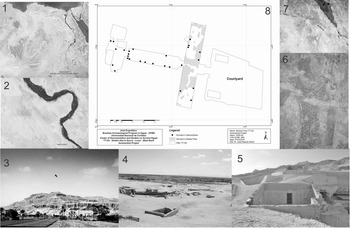
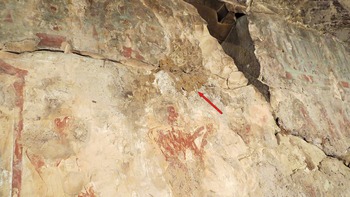
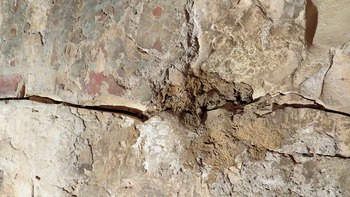
In 2019, the Brazilian Archaeological Program in Egypt of the Federal University of Minas Gerais (BAPE/UFMG) held a fifth fieldwork season at Theban Tomb TT123 (Fig. 1). The project has the participation of the National University of Córdoba, Argentina, and the Centre of Documentation on Ancient Egypt from the Ministry of Tourism and Antiquities, Egypt. During this fieldwork, we began a stratigraphic analysis of the tomb walls to determine the structural changes that the tomb has undergone over time. Lucas Ghecco, an archaeologist at the University of San Martin in Argentina, oversaw the job. He is an expert in this technique but knew little about the specifics of a pharaonic tomb, which for us was an advantage and one of the strategies of the project, since it brings an unfamiliar eye to the research. My bet was that he would see what I—already used to working in Egyptian tombs—do not see. One day, Lucas pointed with a worried face to what seemed to be an inlay on the top of one of the tomb's walls and asked me if I had ever seen anything like it. I looked closely and was unable to determine what it was. I climbed the stairs and tried to look more closely. I replied to him that I had never noticed that specific inlay, but that it seemed adobe. That was strange. It was at this moment that Lucas said: ‘Don't you think this looks like dung?’ I looked at him in amazement and exclaimed: ‘Dung? No, of course not’. Lucas insisted and asked me to look more closely. As intriguing as the possibility was, I could only see adobe. Faced with the impasse, we decided to walk round the tomb to see if we could see any fragments of dung that we could use to compare. We did not even have to go far, because right next to the tomb there were remains of dried donkey dung. We collected it and went to compare it with the inlays on the wall. After a few minutes, we could see that they were identical. I looked more closely and even in disbelief I could not deny it, it really looked like donkey dung with straw or maybe sugar cane (Figs 2 & 3). We spent days and days thinking, and no solution calmed us down. After all, why did the tomb wall have dry animal dung? The question itself seemed unusual; trying to find an explanation seemed even more unusual.
(1) Egypt; (2) Luxor; (3) Sheikh Abd el Qurna; (4) Near TT123; (5) TT123; (6) Amenemhet; (7) dung; (8) sectors of TT123.

Dung on the wall.

Dung on the wall (detail).

Two weeks later, when we were almost going crazy with the questions that lay around our heads, we were invited to visit a tomb next to ours that was being researched by a group of Egyptian archaeologists. This is a remarkably interesting practice that happens at the West Bank of Luxor, as it allows the exchange of information between the countless teams working in this area of Egypt. At one point during the visit, we noticed that there was the same type of inlay on the tomb wall that we had identified on TT123. We were excited and soon I asked the coordinator of the works what he thought it was. He told us quite naturally that it was donkey dung. Without going too far on the subject, he told us that the former residents of the village of Qurna—the village located in the middle of the pharaonic tombs, which used the tombs as a residence or barn—did not have fuel, so they used the pats of animal dung mixed with straw to light bonfires and keep warm. Being a Qurnawi himself, he told us that he saw this happen a few times. We wanted to know more details of this practice, but apparently there was not much more to know, unless that the inlays of dung would be removed during the tomb restoration process.
On the way back I commented to Lucas that what most caught my attention on our visit was not the confirmation that the encrustations were donkey dung, but the naturalness with which the coordinator spoke about the subject and especially his insistence on saying that the dung would be removed and the wall would be cleaned. For the coordinator, the dung on the wall was not information; it was just a mess that needed to be removed in the name of the tomb's restoration, in the name of an extremely specific vision of how that tomb should be presented in the future.
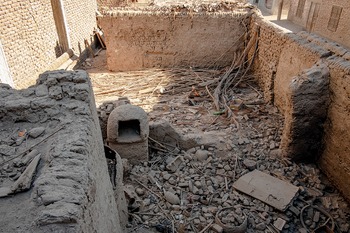
Near the end of the fieldwork season, Sameh Zaki, representative of the Centre of Documentation, suggested that we invite a Qurnawi friend of his, Sheikh Laati, to visit the tomb. The idea was to discuss thoroughly the modern occupation of the tombs of the West Bank and about the dung traces on the TT123 wall. Sheikh Laati is well known in Qurna, especially among archaeologists. He has worked with several foreign missions since he was 18 years old. Born and raised in the village of Qurna, the Sheikh, now 75, told us more details about the dung on the walls. He explained that in the winter the cold is very intense in the desert, so the Qurnawis who were going to take care of their animals inside the tombs used dry dung as fuel to light a small fire and keep warm. He said the animals’ dung was mixed with straw or sugar-cane stalks and then placed directly on the tomb wall to dry. According to him, this process lasted a week. Then the dry dung was removed and stored until used. For Sheikh Laati, the fact that dung inlays are concentrated on a specific side of the corridor indicates that this was the side on which larger animals (such as donkeys and cows) were kept. According to him, the Qurnawis used not only donkey dung, but also dung of other animals. He told us that this was a widespread practice not only in Qurna, but in other parts of the West Bank, such as Gezira Beirat (Fig. 4). Finally, he told us that the dung was not only used as fuel but also to close the mouths of the ovens during the bread-baking process or, when mixed with mud, to make bread boards to rise the dough on when making ‘aish-shamsi, a kind of local bread.
House at Gezirah Bairat.

As the Sheikh walked around the tomb and answered our questions or commented on the daily lives of the families that inhabited the pharaonic tombs of the West Bank, I realized that I had some difficulty in visualizing what he was telling. His gaze recognized information that was not so evident to me. He spoke of things that I had difficulty identifying. What for me were simple adobe marks, for the Sheikh was a bed or a door frame, maybe a chicken-coop door, maybe a bedroom door; what for me was a sign of soot on the ceiling, of dirt accumulated over the years, for the Sheikh was the testimony of a fire built to warm up or prepare food; what for me was the cross corridor of the tomb—where Amenemhet represented his main occupations in life—for the Sheikh was a stable where, until very recently, families left their donkeys and cows. Little by little the tomb ceased to be a tomb and became a home. In fact, for the Sheikh, this was not a tomb that became a house, but a house that archaeologists insisted on transforming into a tomb. It felt like we were in different places. Today I understand that although the Sheikh and I were side by side, apparently in the same place, we were indeed in different places: me in a tomb and he in a house. It is not for nothing that the Sheikh referred to the tomb as beit al-hagar or stone-house.
Differences that matter
Situations like this that I experienced with Sheikh Laati are common in Luxor, especially when we consider the Qurnawis’ experience in Luxor's West Bank landscape. This is the case, for example, of the Medinet Habu temple. For archaeologists, the Medinet Habu temple is the temple built by Ramses III during the New Kingdom and, therefore, is configured as an archaeological and a heritage site. For the local population, especially for women, the temple is a sacred place, a place that has baraka, something that we can translate as a blessing, a tangible force that passes from one body to another (Laird Reference Laird and Cormack2012; Meri Reference Meri1999). Many in Qurna believe that drinking the water from the well beneath the temple can cure illnesses, especially those related to infertility. So, for the local population, Habu is much more than just an archaeological site: it is a healing centre, a place that has baraka. If for an archaeologist Habu is just an archaeological site, for a Qurnawi, it is even an archaeological site because, for the local population, the fact that Habu is a place of healing does not exclude the possibility that it is also a temple from the past, even because it is highly likely that it is precisely its longevity that turns it into a source of baraka (El Daly, Reference El Daly2005). In this context, Medinet Habu as an archaeological site and Medinet Habu as a healing site, are different places, that is, archaeologists and Qurnawis are talking about different things when they refer to Habu as a place of healing and Habu as an archaeological site.
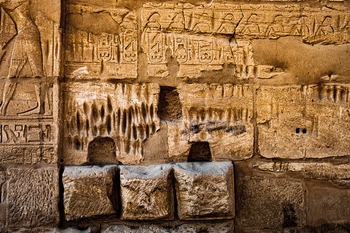
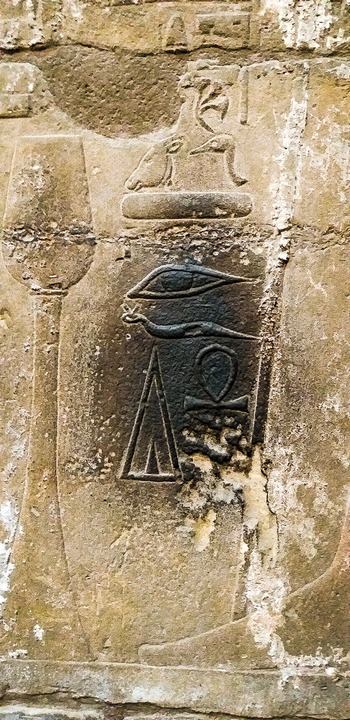
The same can be said of other places in Luxor. In the temple of Seti I in Tarif, as well as in the temples of Amun in Karnak and Luxor, we can see columns and walls that have been scraped, leaving deep grooves (Fig. 5). This practice aims to obtain the sand from the walls and columns to obtain the baraka present in the place (Gonnella Reference Gonnella2010). The dust obtained by the scraping can be consumed with some liquid or carried in small boxes as a protective amulet. A variation of this practice involves the removal and consumption of paintings from the tomb scenes (Blackman Reference Blackman2000; Van Der Spek Reference Van der Spek2011). Following the same principle, in the Luxor temple, we see that certain hieroglyphics—such as an ankh in the inner part of the temple—are completely blackened from being touched (Fig. 6). According to local belief, touch transmits the baraka contained in the symbol to the individual. While for archaeologists such practices are superstitions that damage the heritage, for the local population such practice is not seen as harmful, but as an act that seeks to heal an individual through the mediation of the baraka contained on the site.
Scratches at Karnak.

Luxor Temple 1.

In all these cases, temples, tombs, objects and images are not only seen as archaeological sites or remains, just as the hieroglyphs touched are not seen only as symbols of ancient writing; they are seen as something more, something that perhaps because of their permanence and longevity have a healing or apotropaic energy or even as places that are inhabited by spiritual beings, as in the case of the Harwa and Akhamunru complex, a tomb considered to be inhabited by Jinns (Tiradritti 2015). So, when a Qurnawi talks about Medinet Habu, he is not just talking about the Temple of Millions of Years of Ramses III. When he talks about the ankh, he is not just referring to a hieroglyph; when he comments on Karnak or Luxor, he is not referring only to Pharaonic temples, but he is talking about different things, places and materialities. In the same way, when a Qurnawi talks about TT123, he is not necessarily referring to the archaeological site, but to a house or stable. In this sense, archaeologists, Egyptologists, tourists, government officials and local communities are often talking about different things when referring to pharaonic tombs, temples and objects.
My difficulty as a man, cisgender, white and archaeologist, in seeing TT123 as a house or Medinet Habu as a healing centre reflects the difficulty that archaeology as science has in considering such spaces as multiple. This is because in archaeology, at least in its most hegemonic currents, predominates the belief that subjects and objects are ontologically distinct and independent elements. Here predominates the belief that there is an ontological distinction between representations and what the representations represent, where what is represented does not depend on the forms of representation. In this model the reality is taken for granted, it is pre-existing and universal and only its reading is variable. In this model of thought, TT123 is thought of as a fixed and pre-existing element, that is, it is already a tomb, even before data collection and analysis process have begun. This is because the ontological separability between subject and object determines in advance what are the roles of each of the elements of the relationship. So even though different people or social groups have, over time, appropriated this space to themselves in different ways, it remains essentially the tomb of a priest named Amenemhet who lived during the rule of Tutmosis III. Here the role of the researcher is only to identify differences in something that has previously been identified and recognized as a pharaonic tomb. In a model like this, where subject and object are independent elements and the tomb pre-exists as a material category, there is no room for TT123 to be anything other than the tomb of Amenemhet. There is no room here for the Sheikh to see this space as a house or a stable.
In contrast to this model that thinks of subjects and objects as independent, fixed and universal elements, many Qurnawis, as well as other Muslims throughout the country, think of the world from the idea of multiplicity, especially when we consider the domains of the visible and the invisible (el-Aswad Reference el-Aswad2002). Although the domain of the invisible is inaccessible to human senses, it does not establish itself in opposition to the domain of the visible. In metaphysics and Islamic cosmology, the invisible domain (al-ghaib) is a fundamental element of existence, without which the visible domain (ash-shahada) has no meaning. The visible and invisible elements of the world are inseparable domains of everyday life; that is, ontologically, the visible does not exist without the invisible and the universe only exists from the relationship between these two domains (el-Aswad Reference el-Aswad2002). In this sense, far from being a discursive element, the immaterial element is not only inseparable from the material but is a critical domain in the formation of thought and everyday material experiences.
In addition to the visible and invisible domains, there is an intermediate domain called bazarakh, which Corbin (Reference Corbin1964) calls mundus imaginalis. Imaginal here does not refer to imagination or fantasy, since for Muslims the imaginal world is a real world in its own right. The imaginal world is a world with extension, but without matter. Due to its extension, it resembles the world of bodies and, due to its immateriality, it resembles the world of spirits. The imaginal world is, therefore, an intermediate world between the physical and the metaphysical, the plane where spirits and bodies exchange qualities: spirits materialize and bodies spiritualize. This is a world of immaterial materiality and material immateriality, a world where rational impossibilities are possible (Pellini Reference Pellini2018). In the imaginal world, there are no absolute truths because the images are and are not, which means that the images simultaneously contain attributes of the material and of the immaterial and only the imagination recognizes that they are simultaneously true and false, or neither true nor false (Ibn al-Arabi Reference Ibn al-Arabi1968). This is a world where TT123 is not a fixed and pre-existing material element, but it is a space that can be a tomb, a house, a stable or anything else, including nothing and everything simultaneously. For most Qurnawis, the landscape is not just formed by visible elements, because in addition to the monumentality of the Pharaonic temples and tombs, the electricity transmission lines, the brick and adobe houses, the restaurants and hotels, there is a landscape integrated by powerful and ambiguous spirits within which the chapels of the saints, the sacred wells, the geniuses, the tombs and the pharaonic temples with baraka act as mediators between the domains of the visible and the invisible, being a constituent part of the imaginal world (Pellini Reference Pellini2020). Those who are unemployed, sick, penniless, with marriage problems and who are going to drink the sacred water from Medinet Habu's underground, who dig the walls of Karnak for sand or who touch the ankh of the Luxor temple in search of a cure, are seeing and experiencing in these places in a completely different way than archaeologists. For these people, these spaces exceed their physicality, are spaces that connect the spiritual world with the material world, spaces that are in themselves intermediate worlds. So, for the Qurnawis, the West Bank of Luxor is not an inert landscape, a background scenario characterized by fixed and invariable elements, but a space inhabited by dynamic beings and forces in a continuous state of becoming, which are constituted and materialized from particular and relational bonds (Deleuze Reference Deleuze1987).
Equivocation
Nothing would be too problematic if these different ways of thinking about the landscape, the TT123 and other monuments in Egypt lived together in harmony, but unfortunately, that is not what has happened: Egyptian archaeology in general not only does not recognize the plasticity of the landscape, objects and monuments as it defends the return of such materiality to a supposed original situation, but it also uses its position of power to try to impose a unique and universal view on the past and the present. Hence, it fails to recognize that the Qurna landscape is not just the archaeological landscape, and that the relationships that the local population develops with it enhance beings and energies that are experienced as real and not as an exotic fantasy or superstition.
This is a situation marked by what the anthropologist Eduardo Viveiros de Castro (Reference Viveiros de Castro2004) calls equivocation. According to him (2004, 11), ‘an equivocation is not just a “failure to understand”, but a failure to understand that understandings are necessarily not the same, and that they are not related to imaginary ways of seeing the world but to the real worlds that are being seen’. That is, equivocation is the failure to recognize that the other's truths are truths. An equivocation is not an illusion or a lie: its opposite is not the truth but the univocal.
At the origin of the equivocations between archaeologists working in Luxor and Qurnawis is the fact that, for archaeologists, the Qurnawis population has always been only specialized labour agents. As Ikram and Hanna (Reference Ikram and Hanna2013) show us, the Egyptian population, especially those who live close to archaeological sites, are seen only as a workforce. The fact that many of the archaeologists working in Egypt do not speak Arabic (Lazaridis & Helmy Reference Lazaridis and Helmy2011) only reinforces this idea and shows that there is no intention on the part of archaeologists to establish a relationship with the local population so that the knowledge and local teachings are shared and thus become part of the knowledge-building process. The lack of significant relationships between archaeologists and Qurnawis prevents an archaeologist from seeing in Medinet Habu something more than a pharaonic temple and in TT123 something more than a tomb. It prevents an archaeologist from understanding that scraping the columns of a temple is not superstition or harm, but the search for protection and healing. At the same time, it also prevents Qurnawis from creating a greater sense of belonging in relation to their own heritage.
Equivocations are created not only by archaeologists, but also by the tourism industry. As the image that is propagated about Egypt is directly associated with the Pharaonic past, as if this were the only possible past, what tourists expect to see when they arrive in Luxor is precisely the monumental temples and the richly decorated tombs, and not houses of adobe covering the landscape. By prioritizing the interest of the tourist industry and tourists, archaeology ends up ignoring the demands of the local population (Meskell Reference Meskell, Labadi and Long2010). In this context, both the past and the heritage are thought of as products and thus become merchandise (Zarankin & Pellini Reference Zarankin and Pellini2012). At this moment, the archaeologist becomes an entrepreneur, who treats the past as an object of exchange. In the specific case of Qurna, as shown by Mitchell (Reference Mitchell2002), the project to promote tourism necessarily involved not only the adaptation of the tourist experience to the Western tourism model, but also the elimination of everything that might disturb or did not correspond to the image that the tourists had of Egypt. In practice, this meant the removal of the Qurnawis´ houses, the exposition of the Pharaonic tombs and the segregation of the villagers.
The expropriation process that took place in Qurna and that resulted in the demolition of Qurnawi houses and the expulsion of 3200 families and almost 10,000 people may be the very materialization of the equivocations. Under the argument that houses located in the middle of or even above the Pharaonic tombs caused damage to heritage and that many Qurnawi used their privileged position at the West Bank to loot and sell material associated with the Pharaonic past, entire families were removed from their homes and forced to move to a distant village. The silence on the part of the scientific community in the face of the expropriation process confirmed the idea that Qurna was an anomaly that needed to be erased in the name of the perpetuation of a landscape considered to be original and true. This is the same process that thinks that the dung on the walls of TT123 should be removed. The few attempts to find a way in which Egyptologists, tourists and Qurnawis could overcome the mistakes created and nurtured for decades—and thus, to be able to share this landscape—have not worked. As demonstrated by Nassar and Duggan (Reference Nassar and Duggan2016), the assemblies created to discuss the process of expropriation not only did not have the presence of Egyptologists, but were used only to communicate the phases of the population withdrawal process.
Taking things seriously
More than 10 years after the expropriation of the Qurnawi community, much remains to be understood, and the way to do this is to seek to understand how equivocations and relationships are created by the multiple voices present in Luxor. But for that, we need to recognize, in the first place, that the past and heritage are not hermetically sealed elements that represent a fixed and universal reality. If we can learn something from the relationship that the Qurnawi have with their environment, it is that subjects and objects are not fixed and pre-determined entities; they are fluid elements that are born from encounters and relationships. As demonstrated by Barad (Reference Barad2007), objects do not carry with them properties that pre-exist to the phenomenon in which they manifest themselves; they are not independent entities with clear and defined limits, since the properties of objects are properties of the phenomena in which subject and object are constituent parts. If objects cease their relationship action, they cease to exist. In this model, subject and object, the human and the non-human, matter and discourse are relational phenomena whose continuous intra-actions produce an infinite series of local and contingent configurations and reconfigurations of reality (McNay Reference McNay, Disch and Hawkesworth2016). Barad (Reference Barad2007) uses the term intra-action instead of interaction because interaction presupposes the pre-existence of two entities that are related; in contrast, intra-action is the ‘mutual constitution of entangled agencies’ (Barad Reference Barad2007, 33). At each new intra-action, we and other forms of existence update the potentialities of the world and materialize the reality of our surroundings through sense-affective processes.
Different intra-actions imply different reconfigurations of the assembly. Take, for example, a Qurnawi´s house. The house involves an assembly which includes, but is not limited to, the history of the process of occupation of the plain of Qurna, the arrival of the first European antique dealers to Luxor, the need for housing and protection, the ties of kinship, the traditional knowledge and the handling of adobe and building materials, the cattle, the chickens and ducks, the need for water, heat and fuel, the internal and external changes to the structure, the development of a courtyard lifestyle, and so on. In contrast, the TT123 archaeological site involves the idea of an ancient Egypt, the history of Egyptology and its policies and agenda, the archaeological knowledge, the social and economic elements associated with an archaeological excavation, archaeologists with their ontologies, the relationship with workers and state agents, the touristic policies, etc. It is not the simple summation and relationship of all these elements that simply creates the idea of house or archaeological site, since it is the house that creates dung as fuel, the white lime marks as doors, the adobe marks as bed. That is, instead of thinking of the house as an assembly of pre-existing entities, we should think that the house itself is a phenomenon that produces these different entities, just as the archaeological site TT123 is a phenomenon that produces dung as damage. The dung as fuel, the soot of smoke on the ceiling, the bed and the lifestyle of the courtyard are not elements that pre-exist to the house but are formed within the phenomenon called home. In the same way, the dung as damage, the archaeological record, the stratigraphy, the trowel and archaeologists do not pre-exist to the archaeological site but are the result of relationships within the phenomenon called archaeological site. We could say the same thing about the dung. The dung as fuel is a phenomenon that involves the Qurnawis’ traditional knowledge, gender differences (since it was women who made the paste), the care and feeding of large animals, the sugar cane, sediment collection, etc. Dung as damage is a phenomenon that involves the idea of archaeological record and damage, the idea of a pharaonic tomb, archaeologists, and so on.
Barad's notion of ‘agential cut’ is useful in this context, since the split between subject and object, fuel or damage, house or archaeological site is not given, but is performed within the phenomenon from the intra-action process. In contrast to the Cartesian cut, which takes the distinction between fuel/damage for granted, the agential cut enacts a resolution within the phenomenon of the ‘inherent ontological or semantic indeterminacy’ (Barad Reference Barad2007, 139–40). Arlander (Reference Arlander2014) uses a simple example to demonstrate this idea. Imagine a person recording a video of a landscape. The camera produces the image by framing it, by creating a cut between what is within and what is outside the frame. This division does not pre-exist in the landscape, but emerges through the action of video recording (Arlander Reference Arlander2014, 29). This whole process involves material-discursive practices that concern the lens and the camera, the knowledge to record and edit the video, what is or is not a good image, what is or is not landscape. In this way, reality is the result of agential cuts that reorganize the potential of material-discursive assemblies through intra-action processes. Agential cuts are specific intra-actions and, therefore, border creation practices (Barad Reference Barad2007, 148). In this sense none of these realities takes precedence over the others because they are realities in themselves and that arise due to the different intra-actions and agential cuts that took place in this space.
Secondly, we need to recognize that our scientific practices interfere materially in the world, generating effects that are politically relevant (Barad Reference Barad2007; Haraway Reference Haraway1997; Lenz Taguchi Reference Lenz Taguchi2012). As Murris and Bozalek (Reference Murris and Bozalek2019) suggest, concepts are not abstractions or objective descriptions of an external world, but practices of creating boundaries that interfere and work in the reconfiguration of the material-discursive world. For example, by thinking and acting on monuments like TT123, from the premises of ontological separability between subjects and objects, we are reinforcing the idea that TT123 is a fixed and pre-existing element. This refers to the idea of an ideal past and an original materiality that represents that ideal past. In this line of thought, all alternative intra-actions are considered damage that alter and destroy the original reality. In the case of the West Bank of Luxor, the idea of damage had as its main material effect the expropriation of the entire Qurnawi community in the area, since the idea that the residents of Qurna caused damage to the heritage was the political-scientific justification for the expropriation of the community. Here the idea of damage is associated with the idea of the existence of an original condition that needs to be preserved, even if it means the relocation of thousands of families.
We, as scientists, create our classification categories, our data and our own research object. All research is what Barad (Reference Barad2007, 183) calls apparatus, that is, a practice that determines agential cuts that produce limits and properties within a relationship. To understand how an apparatus defines the limits of a relationship as well as the elements within the relationship, rather than offering another point of view regarding the perspectives that have epistemic privilege and think the world as something given, we invoke other material-discursive realities that can lead us to new understandings of the different intra-actions that occur in this space of the West Bank of Luxor. Thus, thinking about TT123 not as a fixed material category, but as a potential element that is updated based on agential cuts produced by different apparatus, allows us to go beyond traditional knowledge. This gives us the possibility not only to explore and question our scientific practice and the effects it has on the material-discursive world, but also to understand TT123 better as well as the different relationships that are present in the West Bank of Luxor. As Lenz Taguchi (Reference Lenz Taguchi2012) points out, a different reality is not reality, but only a potential alternative material-discursive reality.
An applied New Materialism
We have tried to apply these concepts in practice, a kind of applied new materialism, because we believe that relating and experiencing this space as an archaeological site transforms and sediments this space into an archaeological site; relating and experiencing this space in other ways opens possibilities for the new. When we assume the role of archaeologists, we arrive at the tomb at a certain time, leave our personal belongings in the tent, take over our workplaces and perform our research activities. Such performance presupposes specific encounters with this space, based on certain postures and body movements, specific knowledge and political agenda, tools and instruments. But on certain occasions we tried to experience this space in different ways, eating in the tomb's courtyard, resting and sleeping inside, talking and meeting in the corridors or in the room of statues. On other occasions we closed the front door of the tomb with a fabric that cuts the light and stayed inside the tomb either in situations of complete absence of light or in situations where the only illumination comes from small electronic candles that simulate the flickering light of the old oil lamps.
Much more than a phenomenological experience, these exercises aim to let this space speak to us, affect us. Many times it was possible to observe, for example, that the flickering light of the lamps created a sensation of movement in the painted scenes on the walls (had this been perceived in the past by Pharaonic, Coptic or Islamist populations? How could each of these groups have thought about the movement of these images? Is it magic or Jinns, as Mohamed Farouk, an Egyptian friend of mine, told me when he participated in the experiment with us?); that the movement of the shadows generated the sensation of co-presence (did the people who frequented this space at night, for example at the Beautiful Feast of Valley in the Pharaonic period, or when they went to feed the cattle that slept in this space in the modern period, have the same feeling?); that the light positioned in certain places on the walls created shadows that erased the paintings (was this done intentionally to erase the spirits of the past?); that, depending on the type of lighting, the statues of Amenemhet and his wife Henutiri seemed to smile or want to talk (was that why the images inside this space had their eyes, mouths and noses broken in the past or in modernity?); that, depending on the season of the year, the room of the statues is completely dark with only the statue of Amenemhet and Henutiri illuminated, giving the feeling that both are coming out of the darkness, coming from the other world to this one; that the tomb is colder in summer than in winter; that the temperature of the rock in the shafts allows you to store food without it spoiling. When we walked through the tomb in the daily work, we hardly realized the differences between the unevenness of the rock floor of the central corridor and the smoothness and regularity of the modern adobe floor of the transverse corridor, but when we sat or lay down on the floor, that difference became stark; not coincidentally the cattle, according to Sheikh Laati, were exactly in the transverse corridor, and the place was regulated with adobe to give more stability and comfort to the animals and those who slept there. These exercises showed us that houses, archaeological sites, tombs, are material-discursive practices, that is, they are the result of relationships in a complex network of intra-actions.
Our proposal with these material-discursive actions is to exercise the new materialism in practice, in loco and not in the laboratory or just in the scientific paper, because I believe that such experiences can generate sense-affective situations that allow us to relate to TT123 in different ways (Pellini Reference Pellini2018). According to Bissell (Reference Bissell2010, 277), how a particular body affects us is important because ‘affects do not reside in the body of individuals, materials or places. Rather, they reflect the dynamic interrelationship of bodies caught up within momentary encounters where neither human nor non-human body can be accurately described as subject or object’.
Evidently, we know that we are different people, that come from different traditions and ontologies from those who have experienced such places in the past and present, but the affections and sensual perceptions that arise from these encounters and corporal exercises have opened several questions about the different uses and conceptions of this space. This allows us to be more attentive to details that go unnoticed when we work only with the idea that this is just an archaeological site. If we want to understand how material-discursive practices shaped and still shape specific realities and existences, we need take other ways of relating to space more seriously.
Strangeness
Allied to the exercises of experiencing this space in other ways, we have also tried to get closer to the knowledge of the Qurnawis and Egyptians in general. As demonstrated by Lazaridis and Helmy (Reference Lazaridis and Helmy2011), an effort needs to be made by archaeologists and Egyptologists to try to understand local modern Egyptian culture better, its language, norms, conventions and ontologies. Without this, it is impossible to understand the equivocations that mark the relationship between them. The experience of the Brazilian Project in the TT123 has shown that the exchange of knowledge between archaeologists, anthropologists, Egyptologists, government agents and the local community can bear fruit in understanding the equivocations present in the relationships established between the different agents in Luxor West Bank, whether human or non-human. From the expansion of knowledge involved in the construction of knowledge, we have been able to understand the different universes present in Qurna. However, it must be said that involvement with the local community is not an easy task, just as it is not always easy to be involved with other archaeologists or agents of the state. Listening and being heard is an exchange that presupposes trust, and trust is something that is built within a relationship. It is in this process of listening and being heard that we can truly build knowledge.
I remember, for example, that at the beginning of the project in 2016, our attempts at approximation were viewed with suspicion and the questions we asked, mainly associated with modern materialities, were often left unanswered. The impression is that with each question we asked, with each discussion we proposed, our image as archaeologists, doctors of knowledge, was weakened. People just did not expect the questions to come from us. What they expected from us was not doubt, but the certainties that are built in the academy. Questioning, having doubts, took everyone out of their safe place, generated confrontations, but also generated the possibility of new knowledge, new openings. For example, when we opened tomb TT266, an undecorated tomb that had been bricked-up for over 20 years and that we would use as a storage area, we could see that the cross-corridor near the entrance was full of blocks, sand and modern material remains. Ahmed, a worker who has been with us since the beginning of the project, soon started cleaning by removing modern remains and throwing them in the trash. In him, as in almost all workers, the idea that the modern was garbage was normalized. Not that the workers do not recognize their own immediate past in these objects, in the adobe or dung on the wall; the problem is that they start from the assumption that archaeologists are not interested in these and so that past becomes trash. They start from the idea that archeologists working in Luxor are only interested in the evidence of the Pharaonic past and thus only collect what is Pharaonic. This is a direct reflection of the fact that archaeological projects developed in Luxor, or even in Egypt, that seek to discuss the recent past are rare (Górecki Reference Górecki2014; Németh Reference Németh, Bechtold, Gulyás and Hasznos2011). When I saw the materialities of the recent past being collected and thrown away, we stopped work and explained that those remains were as important to us as a piece of sarcophagus or an ushabti. Ahmed, who has worked with archaeology for over 30 years, found this strange and questioned Sameh Zaki, one of the representatives of the CEDAE in our project. Sameh asked him to collect the objects and Ahmed did so, not without suspicion. Over the days, Ahmed and other Egyptians realized that our concern with recent objects was true and step by step they approached us to explain timidly what each collected object was and what it was for. So, a can of sardines became a lamp, and an old paper an electric bill. We wrote down and discussed what he and other workers said, and this was generating a feeling of belonging. Ahmed went on to teach younger workers that the modern was as important to us as the old, and in this way the notion of what was or was not information was being reconstructed. Questioning modern trash undoubtedly generated a strangeness, since no one was used to seeing remains of dung on the wall, soda cans, clothes and shoes, pieces of newspaper or school notebooks as sources of information. But over the years, trusting relationships have been established and people have come to understand that our interest in their knowledge is real. More than that, members of the local community began to help us understand these materialities and became more deeply involved with the project. This opened a new window of questions and answers that made us penetrate more into the daily lives of both ancient and modern Egypt.
All this involvement with the different material-discursive practices in the West Bank of Luxor has led to a more symmetrical discussion of what is or is not damage, what is or is not heritage, inheritance, information. The TT123 project is still in its infancy and many things still need to be done and discussed, for example: could heritage policies respect the rights of beings like Jinns? How to differentiate damage from modern religious practices? Should a tomb turned into a house be restored to a supposed previous condition? When we choose to preserve the tomb and not the house, are we not consciously erasing recent history? What are the social, political, economic and humanitarian consequences of this choice? Thinking of the tomb as a potential, as a fluid space, opens the possibility of other strategies for the management of this space, since it ceases to be a fixed and pre-determined category, an essential category. I know that in practice it is difficult, but the work at TT123 has shown us that it is possible to establish a meeting without pre-definitions, without thinking about closed and absolute categories.
Transgression
Who would have thought that an Egyptian tomb, shrouded in imagery of mystery, luxury and glamour, that attracts tourists from all over the world, that catches the interest of the media, that moves hundreds of millions of dollars every year, could be used to dry dung or to raise chickens? This is not the image we have of an Egyptian tomb from the Pharaonic period; it is not the image that circulates in documentaries and among tourists. Although the Qurnawi houses have been demolished and there is an attempt to erase their existence to meet the expectations of Egyptologists and tourists, Qurna continues to exist. It continues to exist through local practices, in visits to the sacred source of Medinet Habu, in the touching of the hieroglyphics of the Luxor temple, in the scratches of Karnak, in the ruins of the houses that are still seen in the West Bank and mainly in the donkey dung on the wall of the TT123 tomb. For this reason, for me, the dung on the wall of the tomb was the most impactful and important finding of all our work until now at TT123, because in a provocative way it challenges the hegemonic narratives about the Egyptian past. TT123's dung is transgressive, because it provokes us out of the commonplace, makes us think and understand that reality is not a fixed and given element; it makes us question history, memory, the way we build knowledge within archaeology. It makes us question archaeology itself.