Introduction
The nose is prone to injury due to its prominent position on the face. Nasal bone fractures are the commonest type of bony injury of the facial skeleton.Reference Rohrich and Adams1 Facial injuries in general constitute approximately 500 000 attendances to UK accident and emergency departments annually.Reference Hutchinson, Magennis, Shepard and Brown2 Assault and alcohol consumption have been identified as the two major factors responsible for serious facial injuries in adults.Reference Magennis, Shepherd, Hutchinson and Brown3 The high prevalence of nasal trauma presents a clinical challenge to the surgeon, as these injuries often bear long-term consequences, with the potential need for later reconstructive surgery.
The impact of nasal trauma should not be underestimated. Although nasal fractures are often considered as minor injuries, the incidence of unsatisfactory nasal aesthetics, even after fracture manipulation, is not insignificant.Reference Mondin, Rinaldo and Ferlito4 Up to one-third of these patients have post-reduction deformities which require reconstruction by rhinoplasty or septorhinoplasty.Reference Green5 In addition, the psychological impact of nasal trauma can persist long after the injury has occurred. The low self-esteem resulting from patients' perception of their deformity may limit their ability to achieve their full potential.Reference Hern, Hamann, Tostevin, Rowe-Jones and Hinton6, Reference Girotto, MacKenzie, Fowler, Redett, Robertson and Manson7
The primary aim of nasal fracture manipulation is to reduce the cosmetic deformity resulting from nasal bone fracture. While post-traumatic nasal deformity clearly has an impact on facial aesthetics, there is at present no ‘gold standard’ for assessing nasal deformity, such assessment being largely a subjective exercise. The effect of trauma on the aesthetic dimensions of the nose is poorly described in literature. The aim of this study was to identify the effect of nasal trauma and fracture manipulation on the aesthetic proportions of the nose.
Method
Ethical approval was obtained from the Tayside medical research ethics committee to recruit patients attending the nasal fracture clinic at Ninewells Hospital and Medical School. Patients with any additional maxillo-facial injuries were excluded, as were those with a history of nasal or facial surgery. To reduce the potential for inter-racial variation, the study was restricted to subjects of Caucasian racial origin. Consecutive patients meeting the study criteria were recruited over a three-month period.
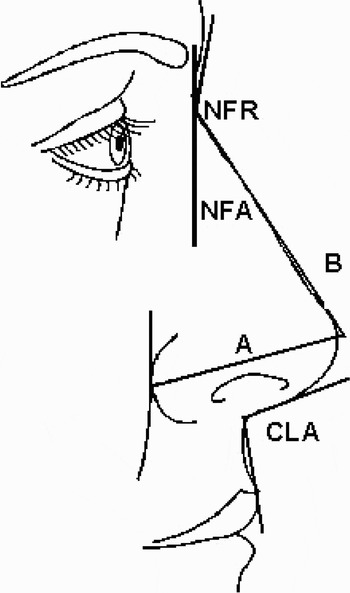
All patients underwent standard closed nasal manipulation under local anaesthetic, as described previously,Reference Newton and White8 7 to 10 days after the initial injury. This was performed as a day case in an operating theatre setting. A standard rhinoplasty series of four studio photographs was taken for each patient; the first prior to manipulation and the second prior to discharge. The following aesthetic measurements were taken: nasal bones alignment angle, nasal tip projection (by Goode's method), naso-frontal angle, naso-facial angle and naso-labial angle (Figures 1 and 2).
The nasal deviation alignment angle, representing the angle between lines ABD and ABC. A = glabella; B = nasion; C = mid lip; D = bony deviation

Aesthetic parameters measured in the lateral view, including the naso-labial angle (CLA), naso-frontal angle (NFR), naso-facial angle (NFA) and Goode's method for assessing tip projection (i.e. the ratio of lines A vs B).

For statistical analysis, the paired samples t-test (parametric) was used, as the measurements were normally distributed. The results were compared with aesthetic ideals as published in mainstream facial plastic surgery literature.Reference Powell9
Results
Thirty-two patients fulfilled the inclusion criteria, 26 men and 6 women. The pre- and post-manipulation nasal measurement results are compared in Tables I and II.
Nasal bone alignment angle before and after fracture manipulation

SD = standard deviation
Nasal proportions in the fractured nose and the aesthetic ideal

SD = standard deviation; manip = manipulation
Nasal bones alignment angle
Nasal bones alignment angle was defined as the deviation of the bony nose from the longitudinal midline. This was a vertical line drawn from the nasion. In a true ‘straight’ nose, this line will align with the nasal tip. As this was not a standard measurement used in the study of nasal aesthetics, the ‘normal’ value was set at 0°. The mean pre-manipulation angle of the study cohort was 35.2° (Table I). This angle was reduced to 9.9° (p < 0.001) following manipulation, giving a 72 per cent reduction in the mean alignment deformity.
Nasal tip projection
Many techniques have been described to assess nasal tip projection. This study used Goode's method, which compares the distance from the alar groove to the tip with a second line from the nasion to the tip. A higher ratio reflects greater tip projection. Our cohort exhibited greater tip projection, with mean ratios ranging from 0.76 to 0.82, compared with the aesthetic ideal range of 0.55 to 0.62 (Table II). Tip projection did not change significantly after manipulation.
Naso-labial angle
The naso-labial angle is the angular inclination of the columella as it blends with the upper lip. In our patients, the post-traumatic mean was 110.4° for men and 111.7° for women. We observed no significant change in the naso-labial angle in either group following treatment. The post-traumatic averages were slightly more obtuse than the ideal.
Naso-facial angle
The ideal naso-facial angle is between 30 and 40°. In addition, Powell and Humphreys suggested that the female profile be preferably at the lower end of the ideal range and the male profile at the upper end. In our patients, both men and women had closely similar mean pre-manipulation naso-facial angles, which were within the ideal range at 36.7 and 39.2°, respectively. The mean naso-facial angle increased following manipulation as a result of soft tissue trauma, to 50.1° in the men (p = 0.004) and to 60.1° in the women (p = 0.02).
Naso-frontal angle
The naso-frontal angle is found by drawing a line tangent to the glabella through the nasion, which will intersect a line drawn tangent to the nasal dorsum. Angles in an aesthetically pleasing profile range from 115 to 130°. The average naso-frontal angle in our cohort was not within the ideal range (130.4°). The angle became more obtuse as a result of manipulation-related soft tissue trauma.
Discussion
The neo-classical canon of the face is that it should be symmetrical, with completely straight nasal alignment. We are not aware of any other studies that have assessed the effect of nasal trauma on facial aesthetics. In this study, we have shown, as expected, that trauma is associated with nasal deviation. Other differences related to nasal profile, and included the presence of a more obtuse mean naso-labial angle, both before and after fracture manipulation (Table II). Tip projection was also greater than the aesthetic ideal and did not change with manipulation. Although this may be attributed to soft tissue swelling, we were unable to ascertain whether this was an effect of trauma or a more normal attribute of the cohort. The small number of ‘normal’ cohort studies that have been doneReference Leong and White10 demonstrate that Caucasians appear to have greater tip projection than the aesthetic ideal. This raises a question over whether the aesthetic ideal should continue to be the main or only standard used in studies on facial aesthetics.Reference Powell9, Reference Leong and White10 The other profile parameters (the mean naso-facial and mean naso-frontal angles) were both greater than the ideal mean, and both angles increased following fracture manipulation.
Although the effect of manipulation was to successfully reduce deviation, persistent deviation, of almost 10° on average, occurred. Persistent deviation has traditionally been attributed to drifting of the nasal bones back to the pre-manipulation position, due to torque from a still deviated nasal septum.Reference Illum11 In an attempt to rectify this, some authors advocate a more conscientious approach, rather than just fracture manipulation alone. Staffel concluded that optimising the treatment of the fractured nose by the use of an individually tailored protocol yielded significantly better results than treatment by closed reduction alone.Reference Staffel12 Staffel suggested that, where appropriate, the aesthetic results of the post-reduction nose could be enhanced by a graduated protocol involving what is effectively early rhinoplastic intervention.
• Nasal bone fractures are the commonest type of bony injury of the facial skeleton. They cause significant aesthetic deformity and are thus a common reason for reconstructive surgery
• In this study, the main changes to nasal aesthetics following nasal trauma were nasal deviation and an obtuse naso-labial angle
• Nasal fracture manipulation successfully reduced deviation from an average of 35° pre-manipulation to an average of 9° post-manipulation
• There was no change to nasal tip projection following trauma. Nasal tip projection was greater than the aesthetic ideal, which was consistent with the average Caucasian nose
Whatever the method used to reduce nasal fractures, unfavourable changes in nasal appearance occur when there is loss of structural integrity. It would appear from our results that a nasal fracture, as one would expect, is associated with lateral deviation. Our nasal trauma cohort also exhibited differences in mean nasal profile aesthetics when compared with the aesthetic ideal. Some of these differences may be due to the early effects of trauma, while others, such as increased tip projection, may be due to the Caucasian population's variance from the aesthetic ideal.
Conclusions
This cohort of nasal trauma patients, when compared with the aesthetic ideal, demonstrated changes in both nasal alignment and nasal profile aesthetics. These changes reflect the early effects of trauma, but those affecting nasal profile may also reflect the way in which the Caucasian nose varies from the aesthetic ideal. Nasal fracture manipulation successfully reduced deviation from an average of 35° pre-manipulation to an average of 9° post-manipulation.