1. Introduction
John Earman has suggested that there is a simple formulation of Curie’s principle that is not only deeply intuitive but “virtually analytic” (Earman Reference Earman2004, 173). He is not the only one to take this view but gives one of its clearest statements.Footnote 1 Earman formulates Curie’s principle as the following claim: If
(CP1) the laws of motion/field equations governing the system are deterministic;
(CP2) the laws of motion/field equations governing the system are invariant under a symmetry transformation; and
(CP3) the initial state of the system is invariant under said symmetry; then
(CP4) the final state of the system is also invariant under said symmetry. (Earman Reference Earman2004, 176)
Speaking intuitively, one might summarize the principle as follows: if no asymmetry goes in, then no asymmetry comes out.
I would like to point out a simple sense in which this formulation of Curie’s principle fails, when the language therein is interpreted in the standard way, and the symmetry transformation is time reversal. I will begin by illustrating a very simple counterexample in classical Hamiltonian mechanics. Such counterexamples are then shown to be endemic to quantum mechanics and quantum field theory. I discuss three alternative interpretations of Curie’s principle that aim to resist the conclusion that the principle fails for time reversal and argue that none are satisfying. I conclude that one must apply Curie’s principle with care as it applies for only a particular kind of symmetry transformation that does not include time reversal.
2. Failure in Classical Mechanics.
2.1. In Pictures
Take a harmonic oscillator, such as a bob on a spring. It is manifestly time reversal invariant in that for every possible motion of the bob, there is a “time-reversed motion” that is also possible.
How does the instantaneous state of an ordinary classical system like this one change under time reversal? The standard textbook answer is that the position of the state remains unchanged while the direction of the momentum is reversed. One can get the intuition for this by imagining that we film the motion of the bob and then play the film in reverse. To determine what time reversal does at an instant, we look at a single “frame” of the film and ask how it changes when we view the reversed film. The answer is that, since rightward motion in the original film becomes leftward in the reversed film, the momenta simply reverse sign. We thus say that an instantaneous state of an ordinary classical system is “invariant” (or “unchanged” or “preserved”) under time reversal if and only if the momentum of that state is zero.
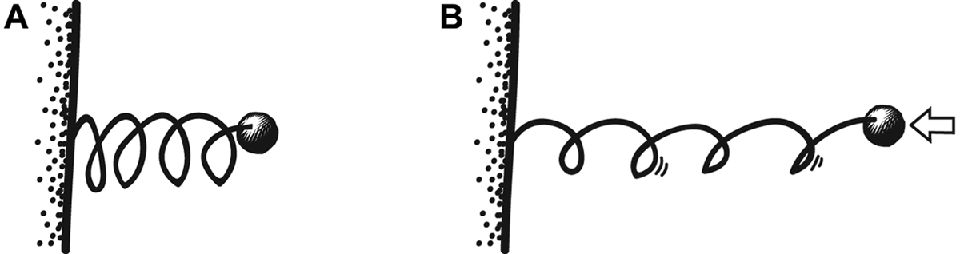
Let us now suppose that this particular bob-spring system begins its motion at time  with the spring compressed out of equilibrium, and with no initial momentum, as in figure 1A. The bob then springs back in the other direction, acquiring some nonzero momentum, as in figure 1B. How does time reversal transform these initial and final states?
A, Harmonic oscillator initially compressed out of equilibrium with zero momentum. B, Final state for which the system has nonzero momentum.

Our initial state has zero momentum, so it is preserved by the time reversal operator, as in figure 2A. But the final state has nonzero momentum, which reverses direction under the time reversal operator, as in figure 2B. The result: the laws of motion for the harmonic oscillator are time reversal invariant and the initial state is preserved by the time reversal operator, but the final state is not. Curie’s principle fails when the symmetry is time reversal in systems as simple as the harmonic oscillator.
A, Initial state has no momentum and so is preserved by time reversal. B, Final state has nonzero momentum and so is not preserved by time reversal.

2.2. Mathematical Verification
Let us do the exercise of checking this result in Hamiltonian mechanics. The possible states of the harmonic oscillator are the possible values for the position and momentum (q, p) of the bob in phase space. The laws of motion for the system are Hamilton’s equations,

The Hamiltonian  for the harmonic oscillator is
 , where m and k are constants. For simplicity, consider an oscillator for which
 and
 , so that
 . The laws of motion for this system are manifestly time reversal invariant in that if
 is a possible trajectory, then
 is a possible trajectory as well.Footnote 2
We now need to check that there is a trajectory with an initial state that is preserved by time reversal and a final state that is not. One such trajectory is the following, which one can check is a solution to the laws of motion above:Footnote 3

At time  , this system has zero momentum since
 . But it has nonzero momentum for the subsequent times
 . The time reversal operator
 therefore preserves the initial state but not all later states.
2.3. Summary
Here is what we have observed in the example above:
1. The harmonic oscillator is time reversal invariant. This is a simple mathematical fact about the law of motion for the harmonic oscillator.
2. We chose a trajectory with an initial state that is preserved by time reversal. In particular, we chose a trajectory for which the harmonic oscillator is not always in equilibrium and then picked an initial state with zero momentum.
3. Not all later states of that trajectory are so preserved. The later states of the harmonic oscillator have nonzero momentum and so are not preserved by the time reversal operator.
Curie’s principle thus fails when the symmetry transformation is time reversal. Let me now say briefly what the origin of this failure is in mathematical terms.
Hamiltonian mechanics comes equipped with an object called a symplectic form; it can be written  in Darboux coordinates. Symmetry transformations in Hamiltonian mechanics include not only symplectic transformations, which leave the symplectic form invariant, but also antisymplectic transformations, which reverse its sign. It is easy to see that the time reversal transformation
 is antisymplectic because it reverses the sign of the symplectic form.
Mathematically, the problem for Curie’s principle comes down to this. A system with a Hamiltonian h might be invariant under a transformation  that is symplectic or antisymplectic. It would be standard parlance to call the transformation a “symmetry” either way. If S is symplectic, then it follows that S-invariant states evolve to S-invariant states. But this conclusion does not follow when S is antisymplectic. Time reversing the harmonic oscillator provides just one simple example of this.
3. Failure in Quantum Theory
Curie’s principle fails just as badly in quantum theory. Before illustrating this, I will describe the standard definition of time reversal and time reversal invariance in the quantum context since they may be unfamiliar. Then, rather than redo the harmonic oscillator example above in the context of quantum theory, I will illustrate a general class of systems (of which the harmonic oscillator is just one example) for which Curie’s principle fails. I will then summarize the character of this failure just as I did for the classical case.
3.1. Time Reversal in Quantum Theory
Curie’s principle fails quite generally in both nonrelativistic quantum mechanics and relativistic quantum field theory. To keep the discussion general enough to apply to both, I will characterize the space-time on which quantum theory takes place as an affine space  , which admits a foliation into spacelike hypersurfaces. This will allow us to think of
 as either a nonrelativistic space-time (such as Newtonian or Galilei space-time) or a relativistic space-time (such as Minkowski space-time).
The vector states of a quantum system will be described by vectors in a Hilbert space  . For any foliation
 of the space-time
 into spacelike hypersurfaces, we take there to be a continuous one-parameter group of unitary operators
 , which describes how a state
 changes by the rule

In differential form, this law becomes the familiar Schrödinger equation  , which holds for all
 in the domain of H.
What do time reversal and time reversal invariance mean in this context? Time reversal in quantum mechanics takes a trajectory  to a new trajectory
 , where
 is a bijection called the time reversal operator. This operator T has the special property of being antiunitary. Like a unitary operator, an antiunitary operator satisfies
 . But unlike a unitary operator, it is antilinear, meaning that for any two vectors
 and
 and for any complex constants a and b,

For completeness, let me briefly rehearse one simple argument for why time reversal has this unusual property. We will make use of a representation of the canonical commutation relations  , although such a representation is not necessary as considerably more general arguments can be given.Footnote 4 As before, assume that by reversing time “at an instant,” we preserve positions while reversing momenta:
 and
 . Applying T to both sides of the commutation relations then immediately implies that

No linear operator can reverse the sign of the complex constant i. Moreover, Wigner’s theorem requires that all candidates for symmetry transformations be linear or antilinear. So, since T cannot be linear, it must be antilinear.
What now does it mean to say that a quantum system is time reversal invariant? As in classical mechanics, we say that a quantum system  is time reversal invariant if and only if, whenever
 is a solution to the law of motion, then so is
 . This is equivalent to the statement

where H is the generator (the “Hamiltonian”) appearing in the unitary dynamics  .Footnote 5
3.2. Curie’s Principle in Quantum Theory
The quantum harmonic oscillator provides a counterexample to Curie’s principle just as the classical harmonic oscillator does. Carrying the example over into the quantum context is a simple exercise. So instead of doing this, let me illustrate a more general class of quantum system  for which Curie’s principle fails. This class will include the harmonic oscillator as a special case. Namely, consider any quantum system that satisfies (i) time reversal invariance,
 , and (ii) nondegeneracy, that
 and
 only if
 for some
 . Nondegeneracy says that if two states have the same value of energy, then they must be related by a phase factor
 and thus actually represent the same probabilistic state.Footnote 6 A Hamiltonian is nondegenerate if two distinct energy states never occupy the same energy level.
I will show that for the time reversal symmetry transformation, any system satisfying points i and ii provides a counterexample to Curie’s principle. I first construct an initial state  that is preserved by T and then exhibit a final state
 that is not preserved by T. The first step will make use of the following fact about such systems: these systems generally admit at least two distinct states
 such that
 and
 . This fact can be derived by noting that if
 is an energy eigenvector (
 ), then by time reversal invariance,

That is,  is also an eigenstate of H with eigenvalue
 . But since H is nondegenerate, this implies that
 for some phase factor
 . Let
 . Since T is antilinear,
 . The energy eigenstate
 thus has the property that

By repeating this procedure with an energy eigenvector  that is orthogonal to
 , we get a second state
 such that
 as well.
The violation of Curie’s principle can now be seen by setting our initial state  to be the superposition of the two orthogonal energy eigenvectors
 and
 :

Since  and
 , it follows that
 as well. So our initial state
 is preserved by the time reversal operator. Indeed, this initial state is preserved by T in a more general sense as well in that the ray
 is left unchanged by the transformation that applies T to each element.
We can now verify that the final state  is not generally preserved by T, contrary to the conclusion of Curie’s principle. After a length of time t, the state
 evolves to

where  and
 are the energy eigenvalues of
 and
 , respectively. Again applying the consequence of antilinearity that
 , we get that

This expression is not equal to  when
 . It does not even lie on the same ray. So although T preserves the initial state defined in equation (3), it does not generally preserve the final state defined in equation (4) in spite of the fact that the system is time reversal invariant.
Thus, any system that is both time reversal invariant and nondegenerate provides a counterexample to Curie’s principle. As is well known (see Messiah Reference Messiah1999, sec. 7.4), the quantum harmonic oscillator satisfies both these conditions and is therefore just a special case of this general failure.
3.3. Summary
By considering an arbitrary time reversal invariant system with a nondegenerate Hamiltonian, we have observed the following:
1. Such systems are time reversal invariant by explicit assumption.
2. We chose a trajectory with an initial state that is preserved by time reversal. In particular, we constructed a superposition of energy eigenstates that is preserved by the time reversal operator T.
3. Not all later states on that trajectory are so preserved. We showed that this superposition evolves to states that are not preserved by T.
Thus, Curie’s principle fails for quantum mechanics as well. As in the classical case, the mathematical root of the problem lies in the special nature of time reversal in quantum theory. This time it is the antiunitary character of time reversal.
According to standard usage of the term, a transformation is a “symmetry” if it is unitary or if it is antiunitary. If a system is invariant under a symmetry S that is unitary, then we can immediately conclude that S-symmetric states evolve to S-symmetric states. This is because, for unitary operators,  implies that
 and hence that

In other words, Curie’s principle is true for unitary operators. But the conclusion does not follow for antiunitary operators. In particular, if T is antiunitary, then  implies that
 because conjugating the complex number reverses its sign. One can infer from
 that

But it is not generally the case that  as Curie’s principle would have it. Indeed, this conclusion would be true in general only if
 , which holds only of a trajectory
 that remains unchanged for all time.Footnote 7 So if a time reversal invariant quantum system is interesting enough to allow a state that is preserved by time reversal to change over time, then that system is a counterexample to Curie’s principle.
4. Three Attempts to Resist Failure
The simple conclusion that I would like to defend is that Curie’s principle is not generally true: the principle is formulated for an arbitrary symmetry, but it is false when that symmetry is time reversal. I would now like to discuss several true principles that are in the neighborhood of Curie’s. Given their similarity to the formulation discussed so far, one might wonder if it is possible to resist the failure of Curie’s principle through some clever interpretive maneuvering. I will argue here that it is not. There are at least three ways to reinterpret Curie’s principle to get a true proposition. None appear to provide a satisfactory interpretation of the principle.
4.1. Argue Time Reversal Is Not a Symmetry
One way to reinterpret Curie’s principle is to modify what counts as a “symmetry transformation.” The basic strategy is to say that, in the context of quantum theory, only unitary transformations can be symmetry transformations, and time reversal is not unitary. This allows one to avoid the counterexamples altogether by expelling time reversal (and all antiunitary transformations) from the garden of symmetries.
The strategy can be applied in classical mechanics as well. Curie’s principle fails for antisymplectic transformations in classical mechanics in just the same way that it fails for antiunitary transformations in quantum mechanics. So by requiring that all symmetries be symplectic, we can make the world safe for Curie’s principle in classical mechanics too.
Earman has formulated a statement of Curie’s principle that might be seen as adopting this view in the algebraic framework for quantum field theory. He begins with an algebra of observables, together with an automorphism group  describing the dynamics. His approach is then to characterize a “symmetry transformation” in quantum field theory as a (linear) automorphism
 of the
 algebra. In this framework, Earman writes:
Proposition 2 (Curie’s principle). Suppose that the initial state  is
 -symmetric (i.e.,
 ) and that the dynamics
 is also
 -symmetric (i.e.,
 ). Then the evolved state
 is
 -symmetric. (Earman Reference Earman2004, 198)
This certainly resembles Curie’s principle: the dynamics are deterministic (CP1), the dynamics are preserved by a symmetry (CP2), the initial state is preserved by the symmetry (CP3), and we conclude that the final state is preserved by the same symmetry (CP4). An easier special case of this can be formulated in nonrelativistic quantum mechanics. There, the approach would be to characterize a symmetry transformation  as a (linear) unitary transformation on a Hilbert space
 . Then we have:
Nonrelativistic Proposition 2 Suppose that the initial state  is
 -symmetric (i.e.,
 ) and that the unitary group
 generating the dynamics is also
 -symmetric (i.e.,
 ). Then the evolved state
 is
 -symmetric.
Both of these propositions are mathematically correct, and their proofs are trivial.Footnote 8 Time reversal is excluded from the content of both propositions because it is antilinear.
Although Earman’s approach results in a Curie-like principle, it is at the expense of the orthodox definition of symmetry transformations. In quantum theory, symmetry transformations include not only the unitary transformations (which are linear) but also antiunitary transformations (which are antilinear). In the algebraic framework in which Earman works, symmetry transformations include both automorphisms and anti-automorphisms. This is the orthodox view of symmetries, arising out of Wigner’s theorem and its generalizations.Footnote 9 In classical mechanics, the situation is similar: both symplectic and antisymplectic transformations are considered symmetries. So this approach saves Curie’s principle only by using standard language in a nonstandard way.
4.2. Argue for a Nonstandard Notion of Invariance
A clever response is to notice that, although Earman’s discussion does not mention antilinear operators, the above two propositions actually do hold when  is antilinear. (Their proofs go through in the very same way.) However, when
 is the time reversal operator, the premise corresponding to (CP2) that
 (or
 in Earman’s language) does not capture the usual notion of “invariance under time reversal.” As we saw in section 3.1, time reversal invariance is equivalent to the statement that
 , and since T is antiunitary, this is equivalent to
 . So time reversal invariance does not mean that the dynamics is unchanged but that it is reversed in time.
But suppose we modify our notion of invariance. One might interpret “invariance” to mean that  is preserved and adopt this principle instead of Earman’s premise (CP2). Then we would have:
(CP2′) The laws of motion/field equations governing the system are such that if an initial state is invariant under a symmetry, then so is every final state; in particular, in quantum theory,  .
This statement, together with Earman’s (CP3), “the initial state of the system is invariant under said symmetry transformation,” obviously implies (CP4): “the final state of the system is also invariant under said symmetry transformation” by simple modus ponens. In particular, we can verify in quantum theory that if  and
 , then
 . So we have another true statement that resembles Curie’s principle.
Earman may have had this condition in mind in suggesting the equivalent statement that we “understand the invariance of laws of motion/field equations to mean that if an initial state is evolved for any chosen  to produce a final state and then the symmetry operation is applied to the final state, the resulting state is the same as obtained by first applying the symmetry operation to the initial state and then evolving the resulting state for the same
 ” (Earman Reference Earman2004, 176). On this reading of “invariance,” Earman’s proposition 2 provides a correct statement, which resembles Curie’s principle and which applies to both linear and antilinear operators.
The price of this response is that one must give up the standard meaning of “time reversal invariance” in favor of a property that is almost never satisfied. The nonstandard interpretation of time reversal invariance holds whenever  . But the standard interpretation of time reversal invariance is that
 . It is easy to verify that a system can be simultaneously time reversal invariant in both the standard and the nonstandard senses only if the dynamics is trivial,
 .Footnote 10 So since almost all known quantum systems satisfy the standard definition of time reversal invariance, it follows that almost none of them satisfy the nonstandard definition. In other words, the price of this approach is really to render Curie’s principle inapplicable to almost every quantum system.
4.3. Argue That Curie’s Principle Is about Trajectories
A third response is to retain the orthodox definitions of symmetry and invariance but to modify the kind of object that Curie’s principle is about. The last premise and the conclusion of Curie’s principle (Earman’s CP3 and CP4) are about states. They read:
(CP3) The initial state of the system is invariant under the symmetry.
(CP4) The final state of the system is invariant under said symmetry.
But premise (CP2) is about invariance of the laws, which on the standard interpretation refers to an entire trajectory. In particular (as discussed in sec. 3.1), the laws are invariant under a transformation if whenever  is a possible trajectory, then so is the transformed trajectory
 . So we can view the trouble with Curie’s principle as one of discord between two objects of interest: states in one premise and trajectories in another.
One can bring these objects of interest into closer agreement by making all the premises of Curie’s principle about trajectories. To do this, let us write  to denote the trajectory with initial state
 . We begin by distinguishing two senses in which a state
 in that trajectory can be “symmetric” with respect to a symmetry transformation.
1. A state
 at a time t is S-symmetric in the original order if .
2. A state
at a time t is S-symmetric in the reverse order if .
 at a time t is S-symmetric in the original order if
 .
 at a time t is S-symmetric in the reverse order if
 .
This is not such an unusual distinction when one recalls (from the end of sec. 4.1) that the standard definition of time reversal invariance entails a similar reversal of sign:  .
We can now express a revision of Curie’s principle: If
(CP1) the laws of motion/field equations governing the system are deterministic,
(CP2) the laws of motion/field equations governing the system are invariant under a symmetry transformation, and
(CP3′) the state of the system at some fixed time  is symmetric under said symmetry (in the original or reverse order), then
(CP4′) the state of the system at any time t is symmetric under said symmetry (in the same order).
In the context of ordinary quantum mechanics, this statement corresponds to the following two facts.Footnote 11
Fact 1 Suppose a state  at a fixed time
 is
 -symmetric in the original order (i.e.,
 ) and that the unitary group
 generating the dynamics is invariant under
 in the original order (i.e.,
 ). Then for all times t, the state
 is
 -symmetric in the same order.
Fact 2 Suppose a state  at a fixed time
 is
 -symmetric in the reverse order (i.e.,
 ) and that the unitary group
 generating the dynamics is invariant under
 in the reverse order (i.e.,
 ). Then for all times t, the state
 is
 -symmetric in the reverse order.
We have again arrived at a correct mathematical statement. Time reversal is no longer excluded, being captured now by fact 2. We have moreover retained the usual definition of a “symmetry/invariance” of the laws. But is this Curie’s principle? Strictly speaking, Curie’s principle says that if the initial state is preserved by a symmetry transformation, then so is the final state. This is not what is described by fact 2 above, where the symmetry transformation “flips” each state about the temporal origin. Facts 1 and 2 perhaps express a more natural principle in bringing the premises into closer alignment. But they do not capture the original expression of Curie’s principle.
5. Conclusion
If one reads “symmetry” in the statement of Curie’s principle to include time reversal symmetry, then Curie’s principle is false. In particular, when we try to apply it to time reversal, Curie’s principle fails for systems as elementary as the harmonic oscillator. It fails in the context of Hamiltonian mechanics, and it fails in the context of quantum theory.
There remain at least three statements in the neighborhood of Curie’s principle that are mathematically correct. They can be achieved either by excluding symmetry transformations such as time reversal or by modifying the statements (CP2)–(CP4) appearing in the principle. But although these modifications may be of independent interest, I do not see that any one provides a plausible way to interpret Curie’s principle. The correct conclusion, I submit, is that Curie’s principle simply fails for time reversal symmetry.
 be a solution to Hamilton’s equations. The Hamiltonian
 has the property that
 . So Hamilton’s equations also hold for
 . But Hamilton’s equations hold for all values of t and therefore under the substitution
 . Making this substitution, we thus find that
 and hence that
 ; similarly,
 , and hence
 . That is,
 is also a solution to Hamilton’s equations.
 and

 . Vectors on the same ray have the same probabilistic content in that the transition probability
 remains the same when
 is replaced with another vector
 on the same ray (and similarly for
 ). It is for this reason we often say that a pure state in ordinary quantum mechanics is best represented by a ray rather than a vector.
 (for
 ) be a trajectory. Suppose that for every choice of initial state
 on that trajectory,
 for all t, where
 . For any fixed time t, define
 . Then by assumption,
 . But
 while
 Therefore,
 .

 algebra.
 and
 , then
 . But Stone’s theorem implies that this group has a unique generator, so
 . This is possible only if
 , and hence
 .