INTRODUCTION
Rock sea urchins have been highly valued as seafood since ancient times (e.g. Gutiérrez-Zugasti et al., Reference Gutiérrez-Zugasti, Cuenca-Solana, Rasines del Río, Muñoz, Santamaría and Morlote2013). Several species of these echinoderms are intensively harvested worldwide, as their roe constitutes a very valuable marine resource (Keesing & Hall, Reference Keesing and Hall1998; Andrew et al., Reference Andrew, Agatsuma, Ballesteros, Bazhin, Creaser, Barnes, Botsford, Bradbury, Campbell, Dixon, Einarsson, Gerring, Hebert, Hunter, Hur, Johnson, Juinio-Menez, Kalvass, Miller, Moreno, Palleiro, Rivas, Robinson, Schroeter, Steneck, Vadas, Woodby and Xiaoqi2002). However, since 1995, when global production peaked, total catches have declined quickly (Andrew et al., Reference Andrew, Agatsuma, Ballesteros, Bazhin, Creaser, Barnes, Botsford, Bradbury, Campbell, Dixon, Einarsson, Gerring, Hebert, Hunter, Hur, Johnson, Juinio-Menez, Kalvass, Miller, Moreno, Palleiro, Rivas, Robinson, Schroeter, Steneck, Vadas, Woodby and Xiaoqi2002). Subsequent data from the FAO (www.fao.org) confirm this decrease, which is mainly attributed to the reduction in catches of the two main producers, Chile and the USA (González-Irusta, Reference González-Irusta2009). Apart from the commercial value of sea urchins, they act as key organisms in many ecosystems due to their grazing activity, which constitutes an important controlling factor in benthic algal communities (see reviews by Lawrence, Reference Lawrence1975; Filbee-Dexter & Scheibling, Reference Filbee-Dexter and Scheibling2014) and, indirectly, over other organisms (see review by Andrew et al., Reference Andrew, Agatsuma, Ballesteros, Bazhin, Creaser, Barnes, Botsford, Bradbury, Campbell, Dixon, Einarsson, Gerring, Hebert, Hunter, Hur, Johnson, Juinio-Menez, Kalvass, Miller, Moreno, Palleiro, Rivas, Robinson, Schroeter, Steneck, Vadas, Woodby and Xiaoqi2002).
In southern European regions, the purple sea urchin Paracentrotus lividus is the most important commercial species of echinoid (Keesing & Hall, Reference Keesing and Hall1998). This species is widely distributed in the Mediterranean and the north-eastern Atlantic, from Scotland to Morocco, including the Azores and Canary Islands (Boudouresque & Verlaque, Reference Boudouresque, Verlaque and Lawrence2013). As an edible species, it is intensively harvested in many European countries, such as Ireland (Byrne, Reference Byrne1990; Barnes & Crook, Reference Barnes and Crook2001), Portugal (Bertocci et al., Reference Bertocci, Dominguez, Machado, Freitas, Domínguez Godino, Sousa-Pinto, Gonçalves and Gaspar2014), France (Régis et al., Reference Régis, Pérès and Gras1986), Italy (Gianguzza et al., Reference Gianguzza, Chiantore, Bonaviri, Cattaneo-Vietti, Vielmini and Riggio2006; Pais et al., Reference Pais, Chessa, Serra, Ruiu, Meloni and Donno2007) and Spain (Palacín et al., Reference Palacín, Turon, Ballesteros, Giribet and López1998; Sala et al., Reference Sala, Ribes, Hereu, Zabala, Alvà, Coma and Garrabou1998; Menchaca & Bald, Reference Menchaca and Bald2011; Fernández-Boán et al., Reference Fernández-Boán, Fernández and Freire2012; Ouréns, Reference Ouréns2013). Due to its economic and ecological importance, P. lividus has been studied widely along the Atlantic and Mediterranean coasts, revealing great variability in its life history. Boudouresque & Verlaque (Reference Boudouresque, Verlaque and Lawrence2013) compiled many of these works. Ouréns et al. (Reference Ouréns, Fernández and Freire2011) synthesized the data from 52 publications on the reproductive parameters of P. lividus throughout its geographic range. These works reveal clear differences between the Atlantic and the Mediterranean populations, showing, among other results: (i) increasing gonad size at higher latitudes; (ii) single vs successive spawnings in the Atlantic and the Mediterranean, respectively; (iii) higher growth rates and body size among Atlantic populations, according to Naya (Reference Naya2007).
On the northern coasts of Spain, the edible sea urchin P. lividus constitutes an important fishery resource. The western communities of Galicia and Asturias support intensive commercial activity, with catches of hundreds of tons every year (González-Irusta, Reference González-Irusta2009; Ouréns, Reference Ouréns2013). In the neighbouring region of Cantabria, this activity is forbidden and limited to a few recreational catches (González-Irusta, Reference González-Irusta2009). Recently, the search for new commercial activities has led to the possibility of opening a P. lividus fishery in Cantabria. However, in order to avoid overexploitation, basic biological information on species distribution, population structure, temporal dynamics and reproductive characteristics is necessary to establish adequate management strategies (Sparre & Venema, Reference Sparre and Venema1997; Perry et al., Reference Perry, Walters and Boutillier1999; Molares & Freire, Reference Molares and Freire2003; Antoniadou & Vafidis, Reference Antoniadou and Vafidis2009). In the case of the Cantabrian P. lividus populations, information regarding reproductive aspects has been described in detail by several authors (e.g. Garmendia et al., Reference Garmendia, Menchaca, Belzunce, Franco and Revilla2010; González-Irusta et al., Reference González-Irusta, Goñi de Cerio and Canteras2010; Ouréns et al., Reference Ouréns, Fernández and Freire2011, Reference Ouréns, Fernández, Fernández-Boán, Naya and Freire2013). However, information regarding distribution and structure has usually been restricted to local populations (e.g. Fernández-Boán, Reference Fernández-Boán2007; González-Irusta, Reference González-Irusta2009; Menchaca & Bald, Reference Menchaca and Bald2011, Reference Menchaca and Bald2012; Fernández-Boán et al., Reference Fernández-Boán, Fernández and Freire2012), which might be inefficient for management on a larger scale. As mentioned by Ouréns et al. (Reference Ouréns, Naya and Freire2015), fisheries constitute a complex system of integrated human and ecological subsystems, which are not always matched adequately. These authors suggest that the mismatch is evident in echinoids, whose strong spatial structure demonstrates the relevance of spatial management, in addition to temporal and quantitative measures. Thus, in addition to the best fishing periods and the total amount of exploitable biomass, the most suitable fishing grounds must be identified.
Preliminary studies carried out by the Regional Government of Cantabria determined that the most suitable areas for the harvesting of P. lividus were located in the western part of the region (GESHA, 2005; IH Cantabria, 2011). These studies were carried out in a rapid and semi-quantitative manner, as their objective was to obtain general knowledge of the spatial distribution of P. lividus in the region, in order to identify potentially exploitable zones. However, to ensure sustainability and effective management of a fishery, it is essential to have accurate information regarding the standing stocks and their dynamics (Sparre & Venema, Reference Sparre and Venema1997; Molares & Freire, Reference Molares and Freire2003).
Considering the scarcity of information available regarding Cantabrian P. lividus populations, the objective of this work is to analyse the organism's spatial distribution patterns and population structure on the coastal region of Cantabria (Bay of Biscay), in order to identify the most appropriate zones for a sustainable fishery and to facilitate the establishment of adequate management strategies.
MATERIALS AND METHODS
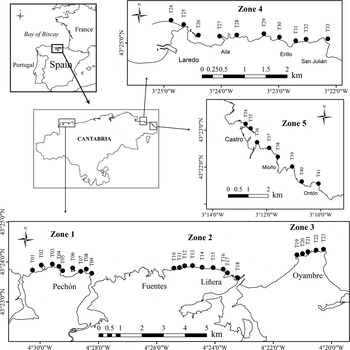
The study was carried out during August 2013 in five coastal zones of the region of Cantabria (Figure 1). These zones had previously been considered as the most suitable for the commercial harvesting of P. lividus (GESHA, 2005; IH Cantabria, 2011). Three of these zones (Pechón, Liñera and Oyambre) were located in the western part of the region, which is characterized by colder waters (15.89°C on average) and higher exposure to dominant swells coming from the north-west (average significant wave height (Hs) = 1.45 m) (Ramos et al., Reference Ramos, Puente and Juanes2016, Reference Ramos, Puente, Guinda and Juanesin press). The other two zones (Laredo and Castro) were located in the eastern region, which has warmer waters on average (16.13°C) and is less exposed to large swells (Hs = 1.14 m).
Location of the sampling stations at each of the five coastal zones (1: Pechón, 2: Liñera, 3: Oyambre, 4: Laredo, 5: Castro).

At each of the five coastal zones an average of three transects per linear km of coastline were established, creating a total of 41. Transects were laid down perpendicular to the shoreline in areas with rocky substrates suitable to host populations of sea urchins. The surveys were carried out by scuba diving and snorkelling at two depth ranges: a shallow level, below 5 metres depth, and a deep level, from 5–10 metres depth. Due to the aggregative distribution pattern of sea urchins, the abundance of sea urchins was estimated using a two-phase approach. First, the general coverage of sea urchins in the area was estimated using a semi-quantitative scale of six levels: 0, absence of individuals (0% of cover); 1, isolated individuals (~15% of cover); 2, presence of a few individuals hidden in crevices and caves (~30% of cover); 3, several individuals hidden in crevices and a few in open areas (~45% of cover); 4, many individuals both in crevices and in open areas (~60% of cover); 5, high densities of individuals in crevices and open areas (~75% of cover). Secondly, the density of sea urchins (number of individuals per square metre) was estimated using 50 × 50 cm quadrats. Five replicates were randomly established at each of the sampling stations where the sea urchins were present. Finally, a corrected density (number of individuals per square metre) was estimated from the coverage and density data obtained in the field according to equation (1).
 $$CD_i = C_i \times \overline D _i $$
CD i : Corrected density at the ‘i’ station (n m−2).
C i : Sea urchin coverage distribution at the ‘i’ station. This was calculated according to Step 1 of the described method and transformed into a scale ranging from 0 (0% coverage) to 1 (100% coverage).
 $\overline D _i $
: Average density of sea urchins measured in the field at the ‘i’ station (n m−2). Calculated according to step 2 of the described method.
In order to perform the biometric study, two quantitative samples of 10 individuals were collected (one at each depth range) at 21 of the 41 transects. Sea urchins under 20 mm were not sampled since they are very cryptic and unusual at subtidal areas. The quantitative transects were established alternately and a total of 326 individuals were collected. The parameters measured included (a) the diameter of the test without spines as a measure of the body size (mm), (b) the total body fresh weight (g) and (c) the gonad fresh weight (g). The last two parameters were used to calculate the gonad index (%) according to equation (2), which is the most common form to express this parameter found in the literature (Ouréns et al., Reference Ouréns, Fernández and Freire2011).
 $$GI = \displaystyle{{FW_{gon}} \over {FW_{tot}}} \times 100$$
GI: Gonad index (%).
FW gon : Gonad fresh weight (g).
FW tot : Total fresh weight (g).
The statistical analyses performed included the construction of percentage frequency distribution histograms of the biometric variables and correlation analyses of length–weight relationships. Sexual ratios were also estimated. Additionally, a two-way Analysis of Variance (ANOVA) was used in order to find significant differences in the biometric variables among coastal areas and depth ranges. Normality and homoscedasticity had previously been checked using the Shapiro–Wilk and Levene tests, respectively. In the case of the test size variable a square root transformation was applied in order to fulfil the required assumptions. Otherwise, as was the case for the gonad fresh weight and gonad index, the non-parametric Kruskal–Wallis test was applied. Significant differences were subsequently evaluated by Bonferroni and Mann–Whitney post-hoc tests in order to detect pairwise differences.
Finally, the commercial stocks of P. lividus were estimated for each of the coastal zones according to equation (3). The total stock of the region was estimated as the sum of the partial stocks. The commercial size considered was 55 mm of test diameter, according to the minimum capture size established in the regional legislation (Cantabrian Government, 2013).
 $$\eqalign{{\rm Stock}({\gt}55)_i &= \left[ {{\rm Area}_i \cdot CD_i \cdot \displaystyle{{\% {\rm ind}({\gt}55)_i} \over {100}}} \right] \cr & \quad \times FW_{tot} ({\gt}55)_i \cdot 1 \cdot 10^{ - 6}}$$
Stock (>55) i : Stock of commercial individuals at the ‘i’ coastal zone (t).
Area i : Extension of the ‘i’ coastal zone (m2). Calculated as the length of the coastal zone multiplied by a strip of 100 m wide.
CD i : Corrected density of sea urchins at the ‘i’ coastal zone (n m−2).
%ind (>55) i : Percentage of commercial individuals at the ‘i’ coastal zone (%).
FW tot (>55) i : Average fresh weight of the commercial individuals at the ‘i’ coastal zone (g).
RESULTS
The study results have revealed marked differences in the distribution patterns and structure of P. lividus populations along the Cantabrian coast. Pechón and Liñera showed the highest sea urchin densities on average, with 23.4 and 15.4 ind m−2, respectively (Table 1). On the other hand, the densities at Oyambre, Castro and Laredo were below 3.5 ind m−2 in all cases. Due to the aggregative distribution pattern of the populations, all assessments showed elevated values of variability (up to 300% in the case of Castro and up to 200% in Laredo and Pechón). In some transects, mainly located in the westernmost part of the region, extremely high densities were found (e.g. a maximum value of 144 ind m−2 counted in the transect T07 of Pechón). All the density values were higher in the shallow depth range except in Laredo, where they were similar for both depth ranges.
Results of the biometric variables and sea urchin densities obtained at each of the coastal zones (mean ± SD).

FW, Fresh Weight; GI, Gonad Index; CD, Corrected density of individuals per m2.
The largest individuals, with average test size values above 60 mm, were found in Oyambre and Laredo, while the smallest ones, with values between 54.4 and 57.8 mm, corresponded to Pechón, Liñera and Castro (Table 1). Similar patterns were observed for the total body and the gonad fresh weights. However, the highest gonad index values were found in Liñera and Pechón, both of which are located in the westernmost part of the region and coincide with the higher-density areas. The average test size of all the measured individuals was 58.9 mm, which lies above the commercial size (55 mm). This value was reduced to 56.4 mm when data were weighted by the proportion of sea urchins corresponding to each of the coastal zones (estimated from the density and area values shown in Tables 1 and 3).
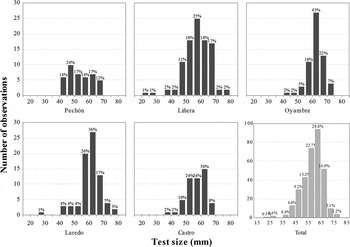
The percentage frequency distribution histograms of the biometrical variables indicated that 73.6% of the measured individuals exceeded the 55 mm (Figure 2). However, this percentage differed enormously among coastal zones, varying between 46.3% of Pechón and 91.7% in Oyambre (Figure 2). Thus, the real percentage of commercial individuals, using all data weighted by coastal zones, was reduced to 58.3%. The total fresh weight frequency distribution histograms reflect adequately the relation with the test size distribution, showing a 71.8% of commercial individuals, corresponding to a 62.7 g weight according to the length–weight relation shown in Figure 3. The gonad fresh weight histograms show that nearly 90% of the measured individuals have a gonad fresh weight below 10 g, which is in accordance with the low gonad index results obtained (82.3% of individuals below a 10% GI).
Test size–frequency distribution histograms of the sea urchins measured at each of the coastal zones and total data.

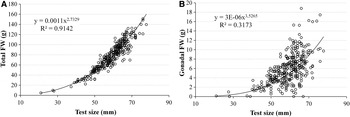
Length–weight relations between the test size, total fresh weight (A) and gonad fresh weight (B) (N = 326).

The relationship between the test size (mm) and the total fresh weight (g) followed a potential regression model, which explained 91% of variability (Figure 3A). Similar relationships were found by several authors at different European regions (e.g. Ballesteros, Reference Ballesteros1981; Haya de la Sierra, Reference Haya de la Sierra1990; Pais et al., Reference Pais, Chessa, Serra, Meloni, Ruiu and Manunza2006; Antoniadou & Vafidis, Reference Antoniadou and Vafidis2009). The same type of relation was found between the gonad fresh weight and the total fresh weight, but with a higher variability (only 31% of it was explained by the model) (Figure 3B). The relationship between test size and gonad index showed no pattern. The sexual ratio was equally distributed between males (51.4%) and females (46.1%), with 2.5% of undetermined individuals. The highest difference in this sense was found in Oyambre, with 60% of males.
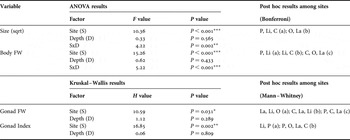
The ANOVA and Kruskal–Wallis tests showed significant differences for all the biometric variables among sites but not among depth ranges (Table 2). The Bonferroni post-hoc tests made a clear distinction between sites with small and light individuals (grouping Pechón and Liñera), vs large and heavy individuals (grouping Oyambre and Laredo). Castro is located between these two types, being included in the group of small individuals but also in that corresponding to heavy individuals. The Mann–Whitney post-hoc tests distinguished sites with higher gonad weights (Oyambre and Liñera) from sites with lower gonad weights (Pechón and Castro), while Laredo was included in all groups due to its high variability. Regarding the gonad index, only Liñera was different from the rest due to its relatively higher values.
ANOVA and Kruskal–Wallis results for the biometrical variables analysed, including Bonferroni and Mann–Whitney post hoc tests.

Size (sqrt), Square root of the test size; FW, fresh weight.
(a), (b) and (c) groups with no significant pairwise differences at P < 0.05.
Significant differences: *P < 0.05, **P < 0.01, ***P < 0.001.
The total stock of commercial size individuals (>55 mm) was estimated in 802.7 t of fresh weight for the five coastal zones (Table 3). Most of this stock (76%) is shared between Pechón and Liñera, both located in the westernmost part of the region. Despite the lower percentage of commercial size individuals present in these two zones (46.3 and 65.7%, respectively), the markedly higher densities of sea urchins found there (23.4 and 15.4 ind m−2) make them the most interesting zones from a commercial point of view. In contrast, Oyambre, Laredo and, to a limited extent, Castro have an elevated percentage of commercial-size individuals (91.7, 88.2 and 68%, respectively), but densities are so low (below 3.5 ind m−2 in all cases) that the commercial interest is minimal.
Results of the parameters used for the stock assessment at each coastal zone (mean ± SD).

Area (m2), Exploitable area corresponding to each of the coastal zones; CD, Corrected density of individuals per m2; % ind >55 mm: Percentage of individuals higher than 55 mm of test size; Avg. Size (mm) >55 mm, Average test size of the individuals higher than 55 mm; Avg. FW (g) >55 mm, Average fresh weight of the individuals higher than 55 mm; Stock (t) >55 mm, Stock of individuals higher than 55 mm.
DISCUSSION
The results obtained in the present study allowed us to identify the most suitable zones for the establishment of a commercial fishery of P. lividus on the coast of Cantabria. Despite the scarcity of stock assessment publications found in the literature, commercial stocks estimated in the studied coastal zones seem to be higher than those reported for the neighbouring community of the Basque Country (Menchaca & Bald, Reference Menchaca and Bald2011, Reference Menchaca and Bald2012; Riquelme et al., Reference Riquelme, Bald, Galparsoro, Liria, Menchaca and Rodríguez2013) and might be similar to those found in Galicia (Fernández-Boán, Reference Fernández-Boán2007; Fernández-Boán et al., Reference Fernández-Boán, Fernández and Freire2012) and Asturias (Haya de la Sierra, Reference Haya de la Sierra1990), where the species is exposed to intensive fishing. The lower stocks of the Basque Country, bordered by Cantabria in the west, are in accordance with the lower stocks found on the eastern coast of Cantabria. However, while the low stocks found in Cantabria are mainly due to low sea urchin density (below 3.2 ind m−2), the low stocks of the Basque Country are mainly explained by a low percentage of large individuals (0–23% of individuals >50 mm).
The low sea urchin densities found in Cantabria (ranging from 1.5–23 ind m−2) contrast with the high densities (35–215 ind m−2) found by Menchaca & Bald (Reference Menchaca and Bald2011, Reference Menchaca and Bald2012) in the Basque Country. Previous studies carried out in Cantabria by González–Irusta (Reference González-Irusta2009) obtained an average sea urchin density of 13.9 ind m−2, which is similar to the average density obtained in the present work (9.3 ind m−2 weighted for all coastal zones). Similar densities (about 20 ind m−2) were found by Pais et al. (Reference Pais, Chessa, Serra, Ruiu, Meloni and Donno2007) in a Marine Protected Area in Sardinia (Italy). In the Mediterranean sea, Turon et al. (Reference Turon, Giribet, Lopez and Palacin1995) found lower densities (2–11 ind m−2) in a similar subtidal location off the Catalonian coast. Gianguzza et al. (Reference Gianguzza, Chiantore, Bonaviri, Cattaneo-Vietti, Vielmini and Riggio2006) found even lower densities (average 4 ind m−2) in a protected site in Italy. In contrast, Bertocci et al. (Reference Bertocci, Dominguez, Machado, Freitas, Domínguez Godino, Sousa-Pinto, Gonçalves and Gaspar2014) reported densities ranging from 80–280 ind m−2 in the intertidal of Portugal. In general terms, Boudouresque & Verlaque (Reference Boudouresque, Verlaque and Lawrence2013) mention that the typical average density of P. lividus ranges from a few individuals to a dozen per m2, although high densities over 50–100 ind m−2 can be reached. In the present work, a maximum density value of 144 ind m−2 was found in Pechón.
The spatial distribution of P. lividus populations showed an aggregative pattern, which is reflected in the high variability of density values (Table 3). This pattern, together with the variability associated with other factors, such as the average fresh weight of the individuals, constitutes a serious problem for stock assessment, resulting in wide confidence intervals. In this work, the average percentage of variability ranged from 122% in Oyambre to 326% in Castro, yielding average variability of 263% for the global stock assessment. González–Irusta (Reference González-Irusta2009) reported high values of variability for the distribution of P. lividus populations in Cantabria and determined that 67% of the surface had no individuals. These high percentages of variability are also characteristic of other commercial species, such as the gooseneck barnacle Pollicipes pollicipes, whose populations follow an aggregative distribution pattern (Bidegain et al., submitted; Sousa et al., Reference Sousa, Jacinto, Penteado, Martins, Fernandes, Silva, Castro and Cruz2013).
With regard to sea urchin size, the small sizes observed in the Basque Country differ enormously from the high percentages of commercial individuals found in Cantabria (46.3–91.7% of individuals larger than 55 mm), which is in accordance with the values obtained by González–Irusta (Reference González-Irusta2009) in the same coastal region (65% of individuals above 55 mm). The size distributions observed in neighbouring regions of Asturias, Galicia and Portugal, where commercial individuals (>40 mm) range from 25–50% in control areas (Bertocci et al., Reference Bertocci, Dominguez, Machado, Freitas, Domínguez Godino, Sousa-Pinto, Gonçalves and Gaspar2014), are similar to the results obtained in the present study. The results from the Basque Country are more similar to those found in the Mediterranean sea by Gianguzza et al. (Reference Gianguzza, Chiantore, Bonaviri, Cattaneo-Vietti, Vielmini and Riggio2006), who reported an average size of 45 mm in protected sites and 35 mm in fishing areas. Even smaller individuals were reported by Guidetti et al. (Reference Guidetti, Terlizzi and Boero2004) in southern Italy, where the size mode corresponded to individuals of 20–30 mm, and the percentage of commercial individuals (>40 mm) was ~30% at control sites and rare at fished locations. From these studies, it can be inferred that the Atlantic P. lividus populations seem to comprise individuals of larger size than those that make up Mediterranean populations, as has been suggested by some authors (e.g. Naya, Reference Naya2007; González-Irusta, Reference González-Irusta2009). The exception of the Basque Country might be explained by the meridional character of the inner part of the Bay of Biscay, as described by Sauvageau (Reference Sauvageau1897) and Fischer–Piette (Reference Fischer-Piette1955). The biological communities of the Basque Country show certain similarities with those found in the Mediterranean as a consequence of the higher temperatures found in this region (Borja et al., Reference Borja, Aguirrezabalaga, Martínez, Sola, García-Arberas, Gorostiaga, Borja and Collins2004). This is also the case for macroalgae communities (e.g. Guinda et al., Reference Guinda, Juanes, Puente and Echavarri-Erasun2012; Ramos et al., Reference Ramos, Puente and Juanes2016), which constitute the main trophic resource of sea urchins. In this sense, Riquelme et al. (Reference Riquelme, Bald, Galparsoro, Liria, Menchaca and Rodríguez2013) found a significant relationship between population and biometric parameters of P. lividus and macroalgae composition in the Basque Country. However, to confirm the hypothesis of this meridional character, further research will be needed.
Regarding reproductive characteristics of the Basque P. lividus populations, Garmendia et al. (Reference Garmendia, Menchaca, Belzunce, Franco and Revilla2010) reported higher similarities to Atlantic populations than to Mediterranean ones, due to high gonad indices and a single spawning period from April to May. These results contrast slightly with those obtained in Cantabria, where the breeding season is characterized by one or two spawning periods at the beginning of the spring and in the summer (González-Irusta et al., Reference González-Irusta, Goñi de Cerio and Canteras2010). The low gonad index values obtained in the present work (average of 7.5% GI) confirm that the survey carried out during August corresponded to a body condition commonly found after the spawning period. González–Irusta et al. (Reference González-Irusta, Goñi de Cerio and Canteras2010) obtained similar GI values in a subtidal population of P. lividus located in the western part of Cantabria and even lower values (~5% GI) in another subtidal population located in the eastern region, close to the Basque Country.
Notably, the highest GI values were found in Liñera and Pechón, which have the highest sea urchin densities. This result contrasts with that obtained by Tomas et al. (Reference Tomas, Romero and Turon2005), who showed lower GI values in high-density populations. According to the authors, the intraspecific competition under food scarcity conditions would ultimately result in reduced gonad mass due to a reduction in their reserve content. This effect could decrease the sea urchins’ reproductive capacity, reducing their survival capacity over the long term and thus regulating their populations. In contrast, Ouréns et al. (Reference Ouréns, Fernández, Fernández-Boán, Naya and Freire2013) found higher gonad indices in sea urchins living in high-density patches, which is consistent with the results obtained in the present study. According to the authors, a high-quality habitat and the absence of intraspecific competition would explain this situation, which is also consistent with other documented advantages of living in patches, such as protection against predation, resistance to wave action and increasing reproduction rates, generating an Allee effect (Pearse & Arch, Reference Pearse and Arch1969; Freeman, Reference Freeman2003; Berec et al., Reference Berec, Angulo and Courchamp2007; Kramer et al., Reference Kramer, Dennis, Liebhold and Drake2009; Vega Suárez & Romero Kutzner, Reference Vega Suárez and Romero Kutzner2011). The higher GI values obtained at Liñera and Pechón could confirm the absence of intraspecific competition due to food scarcity in this case. This assumption is consistent with the absence of sea urchin barrens and the well-developed macroalgae communities found all along the Cantabrian coast (Guinda et al., Reference Guinda, Juanes, Puente and Echavarri-Erasun2012). Even at sites with maximal sea urchin densities (e.g. transect T07), several macroalgae species persist among the sea urchins, which were commonly sheltered in rocky holes (personal observation during the surveys).
Management measures
The basic concept of analytical models for a sustainable fishery is based on the idea that, if a population has too many old individuals, the stock is underexploited, and therefore the fishing pressure could be increased. Conversely, if there are a few old individuals, the stock is overexploited, and the fishing pressure should be stopped (Sparre & Venema, Reference Sparre and Venema1997). The elevated densities and high percentages of commercial individuals found in the present study constitute clear evidence of the low fishing pressure applied on the Cantabrian sea urchin populations, which is limited to a few traditional catches (González-Irusta et al., Reference González-Irusta, Canteras and Ansorena2008). Therefore, it can be assumed that a commercial fishery can be sustained in the region until a maximum sustainable yield is achieved. In this sense, Pechon and Liñera represent the most suitable zones for the exploitation of P. lividus.
However, in order to avoid the high fishing impacts described by several authors (e.g. Guidetti et al., Reference Guidetti, Terlizzi and Boero2004; Gianguzza et al., Reference Gianguzza, Chiantore, Bonaviri, Cattaneo-Vietti, Vielmini and Riggio2006; Pais et al., Reference Pais, Chessa, Serra, Ruiu, Meloni and Donno2007; Bertocci et al., Reference Bertocci, Dominguez, Machado, Freitas, Domínguez Godino, Sousa-Pinto, Gonçalves and Gaspar2014), adequate management measures should be established before a commercial fishery is opened in the region. Information regarding the standing stocks and their dynamics constitutes the first requirement to ensure the sustainability of a fishery (Sparre & Venema, Reference Sparre and Venema1997), and therefore, the data gathered in the present study could be considered as a necessary step in the management of the P. lividus fishery in Cantabria.
At successive steps, several management measures can be implemented. For example, the establishment of a minimum capture size that warrants several spawning periods before the harvesting constitutes a basic precautionary measure for sustainable harvesting. The minimum capture size established in Cantabria and other regions of Spain (55 mm) is higher than the minimum size established in countries such as Italy and Portugal (40 mm), thus providing greater protection against overexploitation. This higher capture size seems to be in accordance with the higher sizes observed in the Atlantic as compared with the Mediterranean. According to González–Irusta (Reference González-Irusta2009), the size of first maturity in Cantabrian sea urchins is ~27–30 mm, which corresponds to individuals of 2–2.4 years, while the commercial size (55 mm) is achieved at 6–7 years. This means that individuals become sexually mature far before they can be commercially exploited, which contributes to their sustainability. Nevertheless, a new suitable catch size might be explored based on the maximum yield in weight from the fishery, as has been done for other marine resources (e.g. Sestelo & Roca-Pardiñas, Reference Sestelo and Roca-Pardiñas2011; Bidegain et al., Reference Bidegain, Sestelo, Roca-Pardiñas and Juanes2013, Reference Bidegain, Guinda, Sestelo, Roca-Pardiñas, Puente and Juanes2015).
Other protection measures, such as the establishment of limited capture quotas (e.g. a certain percentage of the commercial stock) and closure of the fisheries during delicate periods, such as the spawning season, might also be important measures. According to Ouréns et al. (Reference Ouréns, Fernández, Fernández-Boán, Naya and Freire2013, Reference Ouréns, Fernández and Freire2011), maximum fishery productivity in the Atlantic populations could be obtained in the months before spawning. In addition, the quality of the gonad during the spawning season is low in terms of marketability (Spirlet et al., Reference Spirlet, Grosjean and Jangoux2000; González-Irusta, Reference González-Irusta2009; González-Irusta et al., Reference González-Irusta, Goñi de Cerio and Canteras2010), therefore protecting the species during this period could be sensible not only from an ecological point of view but also recommendable from an economic perspective. This is in accordance with the regional legislation in Cantabria, which establishes a closure season from April to October (Cantabrian Government, 2014), just after the months with the highest gonadal yields and during the spawning season (González-Irusta, Reference González-Irusta2009; González-Irusta et al., Reference González-Irusta, Goñi de Cerio and Canteras2010).
In addition to temporal closures, spatial regulations, such as the rotation of fishing areas and the establishment of marine reserves, can be even more important measures for the effective management of marine resources. This can be especially meaningful for echinoids, which show a strong spatial structure (Ouréns et al., Reference Ouréns, Naya and Freire2015). In this sense, Ouréns et al. (Reference Ouréns, Naya and Freire2015) mention the importance of maintaining a minimum population density of sea urchins, which facilitates effective reproduction and recruitment. Botsford et al. (Reference Botsford, Quinn, Wing, Brittnacher, Kruse, Eggers, Marasco, Pautzke and Quinn II1993) estimated a minimum density of 0.7 ind m−2 for Strongylocentrotus franciscanus, using information from the experiments carried out by Levitan et al. (Reference Levitan, Sewell and Chia1992). According to these results, the densities found in the present study would guarantee effective reproduction at all studied sites. However, the less populated sites (Laredo, Castro and Oyambre) would have to be managed with care in order to avoid overexploitation. The establishment of marine reserves at these sites would be highly recommendable. Another possibility suggested by Ouréns et al. (Reference Ouréns, Naya and Freire2015) is the establishment of multiple reserves in shallow habitats (intertidal and subtidal <5 m deep). Because the recruitment of this species is mainly in shallow waters, due to its inverse density dependence (Ouréns et al., Reference Ouréns, Freire, Vilar and Fernández2014), the protection of these populations would enhance reproduction and larval dispersal, as well as the spill-over of commercial biomass towards deeper fishing areas. Finally, specific measures oriented to fishermen, such as the requirement of fishing licences, the establishment of individual fishing quotas, and the limitation of harvesting methods, could contribute to control and reduce the fishing effort exerted on the resource.
All these measures may be useless if they are not accompanied by strict observance of the regulations, as the fishing pressure created by poachers may have a strong impact on marine resources (Bidegain et al., Reference Bidegain, Guinda, Puente and Juanessubmitted; Byers & Noonburg, Reference Byers and Noonburg2007; Sethi & Hilborn, Reference Sethi and Hilborn2008). Co-management between the fishermen organizations and the fisheries authorities can contribute to reduce this problem and has many other benefits, allowing fishers to participate in the management of the resources they exploit (Fernández-Boán et al., Reference Fernández-Boán, Fernández and Freire2012). Good communication and information exchange between scientists and decision-makers are essential for the effective management of marine resources (Cvitanovic et al., Reference Cvitanovic, Hobday, van Kerkhoff, Wilson, Dobbs and Marshall2015). In this sense, the periodic monitoring of P. lividus populations at exploited and control sites would allow researchers to detect the possible occurrence of excessive pressure on the resource and report it to the authorities in order to take additional measures for its conservation. Additionally, analyses of the capture data provided by fishermen, together with biological information on the stocks, would allow for better management of the fishery and the establishment of more accurate measures in order to achieve a maximum sustainable yield.
Apart from the fishing pressure, the sustainability of marine resources depends on the ecology of the species and the environmental conditions at the fishing area. Therefore, management measures should be specific and oriented directly to the target populations. In this sense, the availability of precise information regarding the stocks, population dynamics, and environmental conditions are fundamental for the precise management of marine biological resources. Given the scarcity of information regarding sea urchin populations and ecology in Cantabria, a stronger research effort should be carried out in order to elucidate the causes of the differences observed between western and eastern populations (e.g. illegal fisheries, environmental conditions, intraspecific competence). This knowledge will eventually allow experts to establish the most appropriate management measures for a regional P. lividus fishery.
CONCLUSIONS
The present study constitutes a necessary step in the management of the P. lividus fishery in Cantabria. The results obtained suggest that the resource is underexploited and indicate that Pechón and Liñera constitute the most suitable zones for a commercial fishery in the region. Despite the smaller average sizes found at these coastal zones, they account for 76% of the stock of commercial individuals due to their high sea urchin density. The heterogeneous distribution of sea urchins in aggregate produced great variability in the stock assessment results, thus generating elevated uncertainty in the study. In order to reduce the risk of overexploitation of P. lividus populations, a precautionary approach should be adopted from the outset. Among other measures, the high capture size limit established in Cantabria (55 mm) warrants several spawning periods for the individuals. In addition, protecting the species during the months before and during the spawning season (April to October) constitutes an appropriate measure, from both an ecological and an economic perspective. The establishment of spatial regulations, such as the rotation of fishing areas and the establishment of marine reserves (e.g. at the less populated sites and at shallow habitats), could also be important measures to guarantee the sustainability of the fishery. Finally, regular monitoring of the stocks and analyses of the capture data will allow for improved management of the fishery for better conservation of the resource and for more profitable and sustainable fishery.
Acknowledgements
This research was funded by the Fisheries and Agriculture Department of the Regional Government of Cantabria (Spain). We are grateful for the useful comments provided by the reviewers.