Introduction
Epididymal sperm has been widely used in several species, including dogs (Angrimani et al., Reference Angrimani, Lucio, Veiga, Silva, Regazzi, Nichi and Vannucchi2014), boars (Monton et al., Reference Monton, Gil, Malo, Olaciregui, Gonzalez and de Blas2015), rams (Ehling et al., Reference Ehling, Rath, Struckmann, Frenzel, Schindler and Niemann2006) and bulls (Nichi et al., Reference Nichi, Goovaerts, Cortada, Barnabe, De Clercq and Bols2007). The genetic material obtained from the epididymis has major importance in animal breeding because this technique allows samples to be collected from high zootechnical value animals, even post mortem (Nichitailo & Furmanov, Reference Nichitailo and Furmanov2007). For this purpose, more studies that aim to improve the technologies involved in the cryopreservation of epididymal sperm are required.
The plasma membrane of the spermatozoa is essentially composed of polyunsaturated fatty acids (PUFAs), which play essential roles in the fertilization process (Mandal et al., Reference Mandal, Badyakar and Chakrabarty2014). Docosahexaenoic acid (DHA) is an essential PUFA for plasma membrane fluidity and therefore for the acquisition of sperm motility and acrosome reaction (Rooke et al., Reference Rooke, Shao and Speake2001).
Moreover, PUFAs are involved in protecting sperm membrane during the cryopreservation process (Agarwal et al., Reference Agarwal, Saleh and Bedaiwy2003; Lenzi et al., Reference Lenzi, Gandini, Picardo, Tramer, Sandri and Panfili2000b). Therefore, a possible alternative would be to supplement sperm samples with PUFAs during cryopreservation to protect the cells against cryoinjury. However, a high amount of PUFAs could increase sperm susceptibility to lipid peroxidation promotion by reactive oxygen species (ROS) (Aitken et al., Reference Aitken, Wingate, De Iuliis, Koppers and McLaughlin2006; Vernet et al., Reference Vernet, Aitken and Drevet2004). Lipid peroxidation products, such as malondialdehyde, can be as deleterious as ROS and may even cause DNA damage (Birben et al., Reference Birben, Sahiner, Sackesen and Erzurum2012). Therefore, PUFA supplementation given in association with an antioxidant treatment to reduce the deleterious oxidative effects of PUFAs may be an alternative to improve the sperm cryopreservation process for bull epididymis samples.
Therefore, the aim of this study was to evaluate the addition of docosahexaenoic acid associated with glutathione peroxidase and/or superoxide dismutase as a cryoprotectant for epididymal sperm cryopreservation in bulls.
Materials and Methods
Animals
Testicles were collected at slaughter from 10 European bulls (Bos taurus taurus; 1–5 years old) of different breeds (Belgian Blue, Limousin and Charolais). Ten randomly selected testicles were used for each experiment. The present study was approved by the Bioethics Committee of the School of Veterinary Medicine and Animal Science – University of São Paulo (protocol number: 1034/2006). Unless otherwise stated, all chemicals and reagents were purchased from Sigma-Aldrich (St. Louis, MO, USA).
Sample collection
Sperm samples were collected by dissecting the epididymis cauda with a scalpel blade, similar to a previously described protocol (Kaabi et al., Reference Kaabi, Paz, Alvarez, Anel, Boixo, Rouissi, Herraez and Anel2003). To limit blood contamination, dissection was performed carefully to avoid sectioning blood vessels. The flowing epididymal fluid was collected with an automatic pipette, and the total volume of the obtained epididymal sample was resuspended in 1 ml of physiological saline solution (NaCl 0.9%). Then, the samples were cryopreserved as the different treatments proposed.
Experiment 1: Effect of docosahexaenoic acid (DHA) supplementation
The volume of the epididymal sperm was partitioned into four equal aliquots and distributed into cryotubes containing the following extenders: Bovimix® (Nutricell Nutrientes Celulares®, Campinas, São Paulo, Brazil); Bovimix® added to DHA (1 µM); Bovimix® added to DHA 5 µM; and Bovimix® added to DHA (10 µM). After dilution, samples were submitted to cryopreservation.
Experiment 2: Effect of docosahexaenoic acid (DHA) and antioxidants (glutathione peroxidase and superoxide dismutase) supplementation
After experiment 1, the DHA concentration of 5 µM was selected for use in the following experiment. For this purpose, the volume of epididymal sperm was partitioned into four equal aliquots and distributed into cryotubes containing the following extenders: Bovimix® (Nutricell Nutrientes Celulares®, Campinas, São Paulo, Brazil); Bovimix® added to DHA (5 µM) and GPx (5 IU/ml); Bovimix® added to DHA (5 µM) and SOD (20 IU/ml); and Bovimix® added to DHA (5 µM), GPx (5 IU/ml) and SOD (20 IU/ml). After dilution, samples were submitted to cryopreservation.
Cryopreservation and thawing
After dilution, the samples reached a final concentration of 20 × 106 sperm/ml; this sperm number was estimated using a haemocytometer counting chamber. Diluted epididymal sperm were packaged in 0.5 ml straws, and the samples at 37°C were then submitted to slow cooling to 5°C for 1 h. After this period, the semen was kept in nitrogen vapour (−70°C) for 20 min and sequentially immersed and stored in liquid nitrogen. After at least a week, samples were thawed at 37°C for 30 s, and one straw per group was thawed, one at a time.
Assessment of sperm motility
After thawing, samples were immediately evaluated for sperm percentage motility (%) and vigour (arbitrary scale from 0 to 5) using 5 µl of sperm placed on a pre-warmed glass slide with coverslip. Evaluation was performed under light microscopy (Nikon®, Eclipse E200, Japan) at ×400 magnification.
Membrane and acrosome integrity analysis
To evaluate the plasma membrane integrity, eosin/nigrosin stain was used. Briefly, 5 µl of semen and 5 µl of the previously prepared stain were placed in a pre-warmed glass slide. The sperm smear was evaluated under light microscopy (Nikon®, Eclipse E200, Japan) at ×1000 magnification. Pink-coloured cells were considered damaged sperm (membrane lesion), and intact sperm (membrane integrity) presented no stain (Lagergren, Reference Lagergren1953).
Sperm acrosome integrity was assessed using the modified protocol of Fast Green/Rose Bengal stain that was described by Pope et al. (Reference Pope, Zhang and Dresser1991) and adapted for bulls. In brief, 5 µl of semen was mixed with 5 µl of Fast Green/Rose Bengal stain in a pre-warmed glass slide. Smears were evaluated under light microscopy (Nikon®, Eclipse E200, Japan) at ×1000 magnification. If the sperm acrosomal region stained purple or became darker than the post-acrosomal area, the spermatozoa acrosome was considered intact. Whenever the acrosomal region remained unstained or brighter than the post-acrosomal area, the acrosome was considered damaged. The percentage of stained sperm for plasma membrane and acrosomal integrity was analysed by counting 200 cells.
Evaluation of mitochondrial activity
To assess mitochondrial activity, the cytochemical technique of 3,3′-diaminobenzidine solution (1 mg/ml of DAB in PBS) was used, which categorized the sperm into four classes of mitochondrial activity: high (DAB – Class I), medium (DAB – Class II), low (DAB – Class III) and absence (DAB – Class IV) (Hrudka, Reference Hrudka1987). For this purpose, a sperm sample aliquot was incubated under light at 37°C for 1 h with DAB in a ratio of 1:1 (25 µl of sample in 25 µl of DAB). After this period, smears were made on glass slides with subsequent fixation in 10% formalin for 15 min. Evaluation was under a microscope with transmitted light under oil immersion objective (Nikon®, Eclipse E200, Japan) at ×1000 magnification, with 200 sperm counted. The results were expressed as a percentage (%).
Assay of the sperm chromatin structure
The Guava EasyCyte™ Mini System (Guava® Technologies, Hayward, CA, USA) was used with a fluorescent probe to analyse chromatin with a 488 nm laser argon and the following filters (photodetector): PM1 (583 nm) for yellow fluorescence, PM2 (680 nm) for red and PM3 (525 nm) for green. A minimum of 20,000 spermatozoa was examined in each assay. All data were analysed using the FlowJo v8.7 Software (Flow Cytometry Analysis Software – Tree Star Inc., Ashland, OR, USA).
Chromatin susceptibility to acid-induced denaturation was assessed using a protocol (Simoes et al., Reference Simoes, Feitosa, Siqueira, Nichi, Paula-Lopes, Marques, Peres, Barnabe, Visintin and Assumpcao2013) based on the sperm chromatin structure assay (SCSA) (Evenson & Jost, Reference Evenson and Jost2000). Chromatin instability was quantified by a flow cytometric measurement of the metachromatic shift from green (double-stranded DNA) to red (denatured single-stranded DNA) of acridine orange (AO) fluorescence. The samples were diluted with 100 μl TNE buffer (0.01 M Tris–HCl, 0.15 M NaCl, 1 mM EDTA, pH 7.4) and mixed with 400 μl of an acidified detergent solution (0.08 M HCl, 0.1% Triton X-100, 0.15 M NaCl, pH 1.2). After 30 s, spermatozoa were stained by adding 600 μl of an AO staining solution (0.037 M citric acid, 0.126 M Na2HPO4, 0.0011 M disodium EDTA, 0.15 M NaCl, pH 6.0). After 3–5 min of staining, the samples were examined by flow cytometry. DNA fragmentation was calculated based on the percentage of spermatozoa outside the main population in a histogram of αT (ratio between red fluorescence and total fluorescence) and then calculated using FlowJo Version Mac (Evenson & Jost, Reference Evenson and Jost2000; Minervini et al., Reference Minervini, Guastamacchia, Pizzi, Dell'Aquila and Barile2013).
Sperm resistance to oxidative stress
After thawing, the epididymal sperm was centrifuged (800 g, 10 min, 4°C) twice to remove the remains of the extender, and it was then resuspended in physiological saline solution (NaCl 0.9%). Lipid peroxidation was induced by adding ferrous sulphate (100 µl; 4 mM) and sodium ascorbate (100 µl; 20 mM) to 0.4 ml of the sperm suspension; subsequently, the mixture was incubated for 2 h at 37°C (Gomez et al., Reference Gomez, Irvine and Aitken1998). Subsequently, the levels of thiobarbituric acid reactive substances (TBARS) were assessed in accordance with a protocol first described by Ohkawa et al. (Reference Ohkawa, Ohishi and Yagi1979) and used by this group (Nichi et al., Reference Nichi, Goovaerts, Cortada, Barnabe, De Clercq and Bols2007). The method is based on the reaction of two molecules of thiobarbituric acid with one molecule of malondialdehyde, at high temperatures and low pH, which results in a pink chromogen that can be quantified with a spectrophotometer. After a 2-hour period, 500 µl of the incubation mixture and 1000 µl of a 10% solution (v:v) of trichloroacetic acid (TCA 10%) were mixed and centrifuged (18,000 g, 15 min, 15°C), with the purpose of precipitating protein. Subsequently, 500 µl of the supernatant was mixed with 500 µl of 1% (v:v) thiobarbituric acid (TBA, 1% diluted in 0.05 N sodium hydroxide) in a glass tube, placed in a boiling water bath (100°C) for 20 min, and then immediately cooled in an ice bath (0°C) to stop the chemical reaction. The TBARS were then quantified using a spectrophotometer (U-2001 spectrophotometer, Hitachi High Technologies America, Inc., San Jose, CA, USA) at a wavelength of 532 nm. The results were compared with a standard curve that had previously been prepared with a standard solution of malondialdehyde. The TBARS concentration was determined using the value of 1.56 × 10⁵ × M/ml as the MDA extinction coefficient (Buege & Aust, Reference Buege and Aust1978). The lipid peroxidation index is described as nanograms of TBARS/106 sperm.
Statistical analysis
All data were analysed using SAS for Windows (SAS Institute Inc., Cary, NC, USA, 2000). The effect of treatments (Exp 1: Control × DHA 1 µM × DHA 5 µM × DHA 10 µM; Exp 2: Control × DHA 5 µM + GPx 5 UI × DHA 5 µM + SOD 20 UI × DHA 5 µM + GPx 5 UI + SOD 20 UI) was determined using parametric (LSD test) and non-parametric (Wilcoxon) tests, according to the residual normality (Gaussian distribution) and variance homogeneity of each variable. For the effects of DHA at different concentrations, the variables of motility, acrosome and plasma membrane integrity, mitochondrial activity (Class I, Class II, Class III and Class IV) and TBARS were log transformed. For the effects of DHA and associations (GPx and SOD), the variable of motility was square root transformed. The variable of DNA fragmentation was log transformed and TBARS was inverse transformed. A probability value of P < 0.05 was considered statistically significant. The results are reported as untransformed means ± standard error of the mean (SEM).
Results
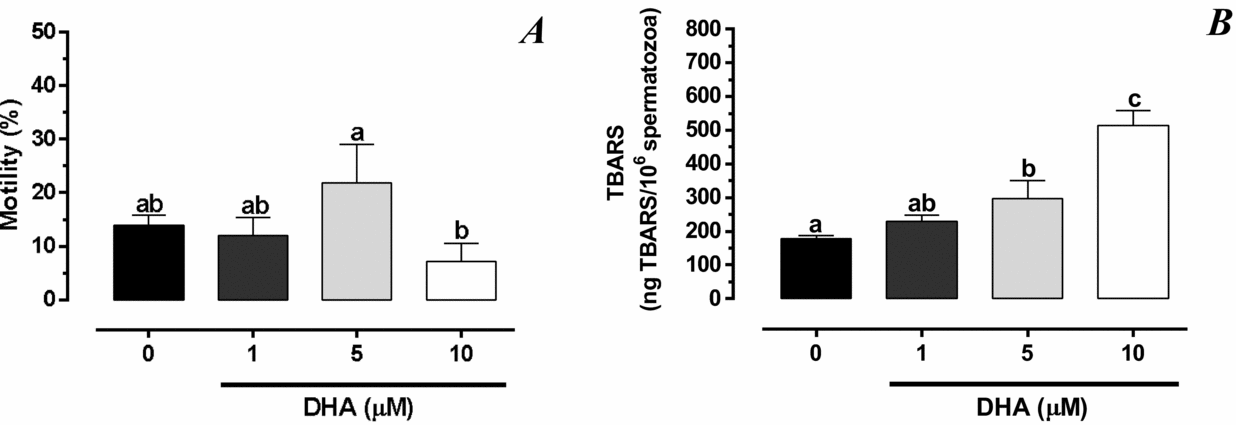
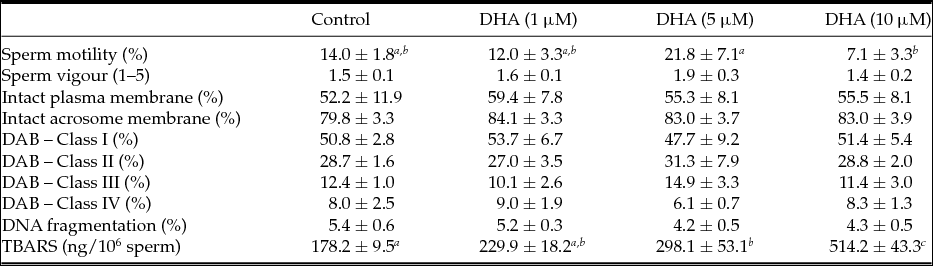
Higher motility was observed in the group treated with DHA 5 µM compared with the group treated with DHA 10 µM. Although not different statistically, this group was numerically superior to both DHA 1 µM and Control (Fig. 1; Table 1 – Control: 14.00 ± 1.87%, DHA 1 µM: 12.00 ± 3.39%, DHA 5 µM: 21.83 ± 7.17%, DHA 10 µM: 7.17 ± 3.39%). Further, we verified in the samples treated with DHA a concentration-dependent effect on the susceptibility to lipid peroxidation (Fig. 1; Table 1 – Control: 178.26 ± 9.55 ng/sperm per million, DHA 1 µM: 229.97 ± 18.26 ng/sperm per million, DHA 5 µM: 298.15 ± 53.19 ng/sperm per million, DHA 10 µM: 514.28 ± 43.34 ng/sperm per million). Moreover, no differences between groups were observed between the remain variables, such as sperm vigour, intact plasma and acrosome membrane, mitochondrial activity and DNA fragmentation index (Table 1). Therefore, the concentration of 5 μM DHA was chosen for use in the following experiment because this DHA was associated with glutathione peroxidase (GPx) and/or superoxide dismutase (SOD) antioxidant, aiming to prevent lipid peroxidation promoted by this treatment.
Effect of docosahexaenoic acid (DHA) concentration in the response variables motility (A) and thiobarbituric acid reactive substances (TBARS) as susceptibility to oxidative stress index (B) in sperm collected from the bovine cauda epididymis and submitted to cryopreservation. a,bDifferent letters indicate statistical difference between treatments (LSD test; P < 0.05).

Effect of docosahexaenoic acid (DHA) concentration in the response variables motility, vigour, plasmatic and acrosomal membranes, mitochondrial activity (DAB I, II, III and IV) and thiobarbituric acid reactive substances (TBARS) as susceptibility oxidative stress index in sperm collected from the bovine cauda epididymis and submitted to cryopreservation

Different superscripts in the same line indicate significant differences (P < 0.05).
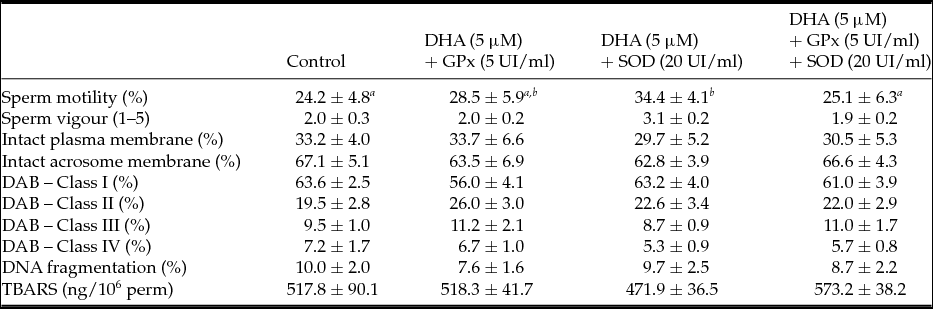
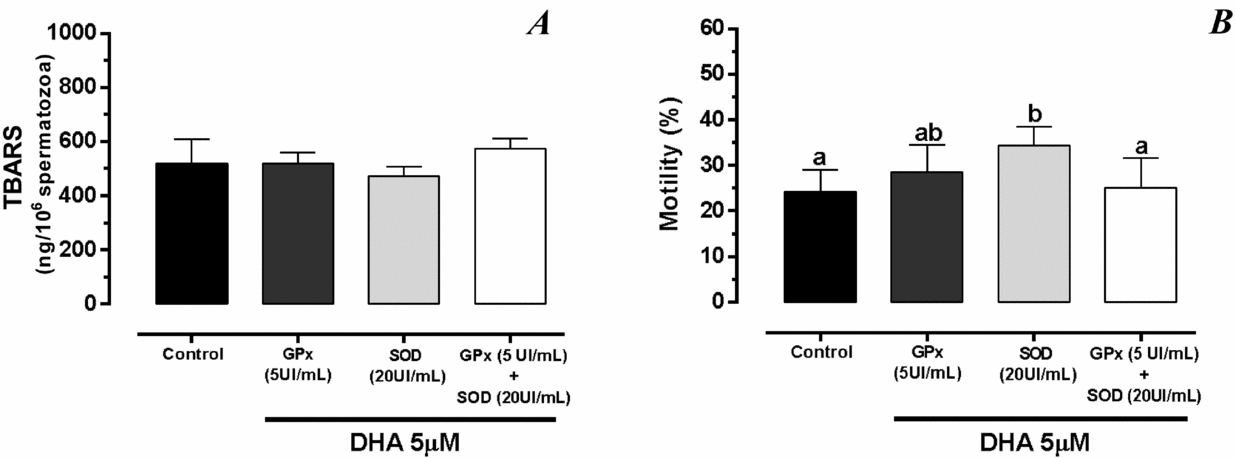
Thus, we verified an improvement in the motility of the group treated with DHA 5 µM associated with SOD 20 IU/ml when compared with the control group and the DHA 5 µM + SOD 20 IU/ml + GPx 20 IU/ml group (Table 2 and Fig. 2 – Control: 24.28 ± 4.82%, DHA 5 µM + GPx 5 UI/ml: 28.57 ± 5.95%, DHA 5 µM + SOD 20 UI/ml: 34.43 ± 4.12%, DHA 5 µM + GPx 5 UI/ml + SOD 20 UI/ml: 25.14 ± 6.36%). Additionally, we observed no differences in the index of lipid peroxidation, mitochondrial activity, sperm vigour, DNA fragmentation index and intact plasma and acrosome membrane when DHA was associated with these antioxidants (Table 2 and Fig. 2).
Effect of docosahexaenoic acid (DHA) concentration associated with the antioxidants glutathione peroxidase (GPx) and superoxide dismutase (SOD) combined or not, in the response variables motility, vigour, plasmatic and acrosomal membranes, mitochondrial activity (DAB I, II, III and IV) and thiobarbituric acid reactive substances (TBARS) as susceptibility oxidative stress index in sperm collected from the bovine cauda epididymis and subjected to cryopreservation
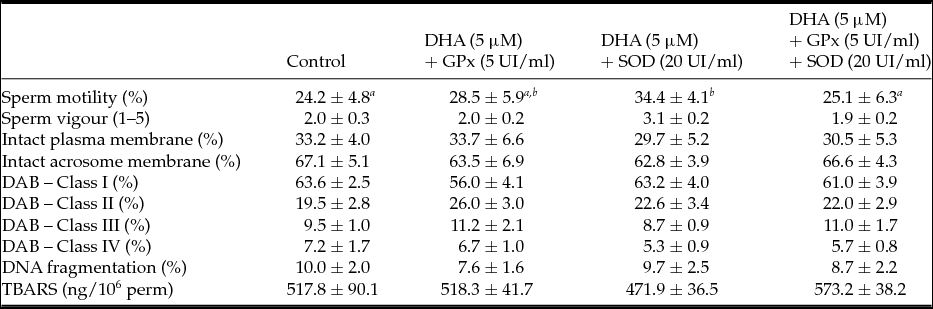
Different superscripts in the same line indicate significant differences (P < 0.05).
Effect of docosahexaenoic acid (DHA) concentration associated with the antioxidants glutathione peroxidase (GPx) and superoxide dismutase (SOD) combined or not, in the response variables motility (B) and thiobarbituric acid reactive substances (TBARS) (A) as susceptibility index of oxidative stress in sperm collected from the bovine cauda epididymis and subjected to cryopreservation. a,bDifferent letters indicate statistical difference between treatments (LSD test; P < 0.05).

Discussion
This novel study evaluated the synergistic effect among DHA and antioxidants (GPx and SOD). This association between PUFA and antioxidants aimed to reduce the deleterious oxidative effects (by GPx and SOD) and also improve sperm quality (by DHA), therefore this supplementation can be an alternative approach to improve sperm quality after thawing for bull epididymal sperm.
Epididymal sperm confers the possibility of genetic preservation for breeding animals, even post mortem (Nichitailo & Furmanov, Reference Nichitailo and Furmanov2007). Therefore, the development of new extenders for seminal cryopreservation is crucial to obtain higher sperm quality after thawing (Lucio et al., Reference Lucio, Silva, Regazzi, Angrimani, Nichi, Assumpcao and Vannucchi2016). The use of a polyunsaturated fatty acid in the extender composition sounds interesting because mature sperm cells present a high quantity of PUFAs at the plasma membrane level (Lenzi et al., Reference Lenzi, Picardo, Gandini, Lombardo, Terminali, Passi and Dondero1994), thereby providing sperm integrity (Lenzi et al., Reference Lenzi, Gandini, Maresca, Rago, Sgro, Dondero and Picardo2000a), progressive motility (Nissen & Kreysel, Reference Nissen and Kreysel1983) and being essential for plasma membrane fluidity (Rooke et al., Reference Rooke, Shao and Speake2001). In fact, our results show higher motility and vigour (numerically different – Table 1) in samples that were supplemented with DHA 5 µM. A similar effect was observed by Kaka et al. (Reference Kaka, Haron, Yusoff, Yimer, Khumran, Sarsaifi, Behan, Kaka, Memon and Ebrahimi2015) in semen samples from bulls (collected using an electro-ejaculator).
In contrast, lower motility rates were observed in samples supplemented with 10 μM DHA, despite the rates of plasma membrane and mitochondrial activity did not change. Thus, this decrease in motility possibly is related to the higher TBARS concentration in this group, which occurred due to a dose-dependent effect of DHA concentration on the susceptibility to lipid peroxidation. Our results indicated that the TBARS rates are higher in all DHA-supplemented groups but that concentrations up to 5 µM appear to be tolerated by the epididymal bull spermatozoa during the cryopreservation process. However, higher DHA concentrations (10 µM) may be toxic to sperm, promoting adversely effects to the sperm quality (i.e., motility). In this context, the improvement in sperm quality at DHA 5 µM may be due to its influence on membrane fluidity in cryopreserved and thawed spermatozoa, which increases the tolerance to the cryopreservation and thawing process and protects the sperm cell membrane from damage, as can be observed in the results obtained for the plasma and acrosome integrity, mitochondrial activity or even DNA fragmentation rates (Kaka et al., Reference Kaka, Haron, Yusoff, Yimer, Khumran, Sarsaifi, Behan, Kaka, Memon and Ebrahimi2015; Nasiri et al., Reference Nasiri, Towhidi and Zeinoaldini2012).
However, the higher TBARS rates in all DHA-supplemented groups indicated the occurrence of lipid peroxidation; this result may show a triggering of premature sperm capacitation (Lenzi et al., Reference Lenzi, Gandini, Lombardo, Picardo, Maresca, Panfili, Tramer, Boitani and Dondero2002) during the cryopreservation or thawing process (Halliwell, Reference Halliwell1991; Sharma et al., Reference Sharma, Jha, Dubey and Pessarakli2012). Therefore, to avoid these effects, antioxidant (GPx and SOD) supplementation was performed in the DHA 5 µM group. Although no significant differences were observed in the lipid peroxidation rates, the sperm motility was higher in the DHA 5 µM + SOD 20 IU/ml group, which had a lower numerical concentration of TBARS.
The mechanism of action of SOD is closely related to sperm functions such as motility, resistance against oxidative stress, DNA integrity and fertility (Kobayashi et al., Reference Kobayashi, Miyazaki, Natori and Nozawa1991; Neagu et al., Reference Neagu, García, Rodriguez, Ferrusola, Bolanos, Fernandez, Tapia and Pena2011; Roca et al., Reference Roca, Rodriguez, Gil, Carvajal, Garcia, Cuello, Vazquez and Martinez2005). In fact, this phenomenon was observed in our data because plasma and acrosome membranes, mitochondrial function and DNA structure were all maintained in samples supplemented with SOD. The presence of SOD has been described in several tissues of the reproductive tract, including testicles, seminal vesicle and prostate (Jow et al., Reference Jow, Schlegel, Cichon, Phillips, Goldstein and Bardin1993). In bovines, superoxide dismutase was previously described in seminal plasma (Gurler et al., Reference Gurler, Calisici and Bollwein2015; Nair et al., Reference Nair, Brar, Ahuja, Sangha and Chaudhary2006). Thus, it is possible that the supplementation of epididymal sperm with SOD mimics the contact of cells with seminal plasma and improves sperm features (i.e., motility), even in the samples to which DHA 5 µM added. This increase in the motility rates could be observed in this study, even in samples that no differences occurred in the mitochondrial activity. We believe that this phenomenon occurs due to the sperm motility in bulls are mediated also by a glycolytic pathway which cannot be evaluated by the diaminobenzidine technique (Losano et al., Reference Losano, Padín, Méndez-Lópes, Angrimani, García, Barnabe and Nichi2017). Furthermore, no significant effects on motility were observed from GPx supplementation alone or even concomitant with SOD, which indicates that SOD (20 IU/ml) could be an interesting option for bovine epididymal sperm cryopreservation.
In conclusion, our data show that docosahexaenoic acid (at a concentration of 5 µM) in association with superoxide dismutase (at a concentration of 20 IU/ml) appears to be an option for increasing epididymal sperm features in bulls. Such information should be considered in cryopreservation protocols for epididymal sperm.
Conflict of interest
We have no conflicts of interest to disclose.
Financial support
This research received no specific grant from any funding agency, commercial or not-for-profit sectors.
Ethical standards
Not applicable