Introduction
On 20–21 June 1880 one of the bloodiest conflicts in Argentine history broke out in the outskirts of the city of Buenos Aires. About 10,000 porteños fought against a similar number of federal soldiers in the fields of Barracas, Puente Alsina and Los Corrales. Although the number of fatalities was high – there were approximately 3,000 casualties – the struggle was short-lived. The federal army quickly defeated the enthusiastic but ill-prepared provincial militias.Footnote 1
Historians have recognised the relevance of this movement largely in terms of its consequences. After the revolution was defeated the national government federalised the city of Buenos Aires and declared the organisation of provincial militias illegal. Such forces had been the pillar of the caudillos' military power in previous decades. In the aftermath of the revolution, Argentina entered into an age of institutional stability and extraordinary economic growth that contrasted sharply with the uncertainties and conflicts of the preceding decades.
Although the outcome of the revolution has attracted the attention of historians, less consideration has been given to the process of revolutionary organisation and mobilisation. Who participated in this movement? What mechanisms did they use to channel their support? Why did they do it? Two interpretations have been put forward to answer these questions. Some historians have argued that porteños rose up against the national government in order to oppose the federalisation of Buenos Aires.Footnote 2 Others have criticised this argument for confusing the causes of the revolution with its consequences. Such historians have focused instead on the dispute between Governor Carlos Tejedor and General Julio A. Roca for the presidency in 1880. Such an analysis implies that the revolution was an elite struggle that lacked any significant ideological content or relevance for the larger population of Buenos Aires.Footnote 3
This essay provides an alternative interpretation. It argues that the revolution mobilised the people of Buenos Aires beyond established elites and clienteles.Footnote 4 It contends that the revolutionary elite led a wide and socially heterogeneous social coalition.Footnote 5 Clientelism, coercion and charisma, although important, do not alone explain the wide support it gathered. Porteños also joined the movement because its leadership successfully linked their anxieties about the declining power of Buenos Aires with well-established traditions that legitimised an uprising against a government that was perceived to be tyrannical and corrupt. In order to gain support, therefore, this movement had to distinguish itself from those labelled as ‘insurrections’, ‘seditions’ and ‘rebellions’, since these terms referred to actions that were aimed at seizing power for the personal gain of their leaders. As Paula Alonso states, at that time ‘these acts were considered illegitimate, since their goal was only the change of men in power using unconstitutional mechanisms, betraying traditions and political habits’. Revolutions, instead, were legitimate movements whose goal was the restoration of fundamental freedoms and rights of the people.Footnote 6
This interpretation reinforces a growing body of historical writing that is currently reappraising the extent and limits of popular agency in nineteenth-century Latin American politics. The traditional historiography generally considered the politics of this period to be the exclusive realm of elite groups in command of small clienteles.Footnote 7 More recent works have been challenging this paradigm, emphasising the agency of subaltern groups in these processes. These studies have shown that such groups regularly participated in factional struggles in order to pursue an agenda of their own. In this process, they repeatedly appropriated and reinterpreted elite discourses in order to legitimise their own claims.Footnote 8
Yet, if historians are currently challenging interpretations of popular politics that stress its restrictive, coactive and clientelistic character, they are less in agreement when analysing the limits of popular agency. In this respect some scholars have stressed the danger of overemphasising the strength of los de abajo.Footnote 9
For the Argentine case, several recent studies have reshaped our knowledge on this subject. They have analysed the mechanisms and institutions – mainly electoral processes, public opinion, civic associations and civic militias – through which different constituencies influenced politics throughout the nineteenth century. They have also shown that political participation was generally wider, more popular, and less instrumental than historians have traditionally implied.Footnote 10 Studies on the independence period and its aftermath, for instance, have underlined the political relevance of the participation of subalterns in civic militias.Footnote 11 Other works have also shown the development of an incipient civil society and a public sphere in Buenos Aires in the second half of the nineteenth century that included the active participation of a diverse array of social sectors.Footnote 12
These studies, though, also highlight the limits imposed on the agency of the non-elites. Although the independence movement and the ensuing civil wars opened many possibilities for the plebeians of Buenos Aires, Juan Manuel de Rosas took great pains to discipline them during his long tenure as governor of Buenos Aires (roughly 1829–1852).Footnote 13 The explosion of multi-class civic participation that surged after Rosas' departure was also led by an emerging elite that rapidly and successfully defined its relationship with the rest of society.Footnote 14 This article suggests that the relationship between the political elites and the people of Buenos Aires in the revolution of 1880 should be seen in similar terms. Although the revolution was more actively and widely supported than has traditionally been implied, this participation proved to be under the firm grasp of the local political elite, who controlled its agenda and its mechanisms of mobilisation.
The Presidential Campaign of 1880
The tensions that led to the revolution of 1880 originated in the difficult process of consolidation of the Argentine state after Juan Manuel de Rosas left the governorship of the province in 1852. General Bartolomé Mitre's Liberal Party succeeded Rosas in the province, and led its secession from the Argentine Confederation, which lasted until 1861, when Mitre's army defeated the Confederation and reunited the nation.
A bitter partisan conflict ensued after Mitre, the elected president of the country from 1862 until 1868, appropriated massive resources from Buenos Aires to lay the foundations of the federal state.Footnote 15 Mitre's Liberal Party then split into two opposing factions: the Autonomista Party, which resisted Mitre's nation-building policies, and the Nacionalista Party, which remained loyal to him. The autonomistas capitalised successfully upon the resentment of many porteños against Mitre. Allied with provincial parties, they defeated the nacionalistas in the presidential elections of 1868 and 1874. In both cases the autonomistas had to cede the presidency to a provincial candidate. In exchange, they were able to appoint one of their members to the vice-presidency.Footnote 16
These electoral defeats frustrated the nacionalistas, who decided to challenge President Nicolás Avellaneda (1874–1880). Even before Avellaneda was sworn in, Mitre's nacionalistas had risen in response to a scandalous fraud in Buenos Aires in the February congressional election. After the mitristas were defeated, they continued their criticism of Avellaneda's government, denouncing its illegitimacy and conspiring against it.
In order to prevent a larger political crisis, Avellaneda attempted an agreement between the two parties in 1877. He granted amnesty to the mitristas and gave them posts in his cabinet. Yet, this strategy was short-lived. The sudden death of Adolfo Alsina, the autonomista leader, ended the process of conciliation and divided porteños along new lines. One autonomista faction remained allied with the nacionalistas and nominated Carlos Tejedor, the governor of Buenos Aires, for the presidential ticket. The majority of the autonomistas, however, supported the nomination of Julio A. Roca, a young general from Tucumán, who had gathered a coalition of provinces on his side.
A successful candidature in Buenos Aires required more than just being nominated by the political elites, though. A contender had to prove that he was also a candidato de opinión, that is, a candidate supported by local public opinion. For that purpose, potential nominees mobilised their supporters in the streets and sought the adherence of local newspapers. Once nominated, candidates needed to secure the support of voters and electoral officials. These were mostly collected from a relatively small group of people. Although many followed electoral processes closely, violence and fraud made electoral officers and clienteles the most decisive elements on election day.Footnote 17
Roca failed to become a candidato de opinión in Buenos Aires. He was instead perceived as an inexperienced provinciano whose candidacy had been rubber-stamped by provincial governors. Not surprisingly, autonomista leaders who had backed him at the beginning of the electoral campaign rapidly showed their lack of commitment. They did not provide enough money to support his campaign. According to Manuel C. Icaze, a member of the autonomista committee, party notables supplied Roca with only a fraction of the money they had given Avellaneda in 1874.Footnote 18 Some other leaders even supported alternate autonomista candidates like Domingo F. Sarmiento and Bernardo de Irigoyen.
Roca also failed to gain active support from the rich. Although he had a positive reputation among porteño landowners after leading a campaign against the Patagonia Indians in 1879, that was not enough to overcome the negative campaign launched against him by his adversaries.Footnote 19 The biggest newspapers of Buenos Aires did not sympathise with Roca either. They backed other candidates or remained neutral. Public meetings to support his candidacy – another fundamental instrument of political agitation at that time – were organised only at the beginning of the campaign, but ceased after young tejedoristas attacked the roquista clubs.Footnote 20
Roca also lacked control of the local sources of patronage. During the registration process provincial policemen were registered to vote, even though they were not allowed legally to do so. Other employees were forcefully induced to vote for Tejedor or to abstain from participating for fear of losing their jobs. In still other cases, foreign workers were replaced with Argentines, who were the only ones allowed to vote in national elections. Worst of all for the roquistas, they had no influence over the local electoral authorities, who had been carefully appointed by Tejedor.Footnote 21
Roca was not able to match this formidable control on the part of provincial officials with the mobilisation of federal employees living in Buenos Aires, who divided their allegiance among all the candidates. Domingo F. Sarmiento's El Nacional, for instance, denounced the persecution of those Post Office employees who did not side with Tejedor.Footnote 22 Sarmiento organised his own group of supporters among the staff of the Customs Office and the Finance Ministry.
Not surprisingly, Tejedor and the mitristas won by a landslide in Buenos Aires in the elections of February-April 1880. A friend of Roca provided a vivid description of the city during the congressional election day in February:
Here today there are poll stations without voters. It is possible to see caporales (ward bosses) driving horse-carts and looking for people … Also, in front of each parish there are twenty watchmen and a police chief armed with Remingtons. Among our people, no one will go, although they [the tejedoristas] might give us some votes, to pretend that there was competition.Footnote 23
The provincial legislative election in March and the presidential election in April were no different. Roca's followers did not even dare to participate in Buenos Aires. In the city, Tejedor won in a landslide. But Roca did not need the porteño vote to secure the presidency. His supporters, using similar forceful methods, defeated Tejedor in almost all the remaining provinces and thereby secured the votes he needed in the Electoral College.
The Mobilisation of Local Militias
The fact that porteños did not vote in these elections did not mean that they were disengaged from the political crisis that was unfolding. The electoral campaign actually led to their massive mobilisation, which started in September 1879, when Governor Tejedor called for the reorganisation of the National Guard of Buenos Aires as a response to the violence unleashed in several provinces against those who opposed Roca's nomination there. Tejedor and the nacionalistas accused President Avellaneda of siding with the roquistas in these conflicts.Footnote 24
The federal government, in turn, responded by decreeing this reorganisation illegal, since the provinces could only recall the National Guard at the request of the national government.Footnote 25 Avoiding an immediate confrontation, Tejedor then replaced the National Guard with a volunteer firemen's association (Bomberos Voluntarios) and a shooting club (Gimnasia y Tiro Nacional), justifying them as civic associations with no ulterior purposes. Yet, the real goals of these two institutions were scarcely concealed. In October 1879, the mitrista newspaper, La Nación, for example, openly defined them as instruments for the defence of the electoral freedoms of Buenos Aires against the impositions of President Avellaneda.Footnote 26 The members of these associations, as well as the provincial police and jail guards, began regular military training during the days that followed.
Avellaneda retaliated by requesting the disarmament of the Tiro and the Bomberos in early February 1880. Determined to enforce this decree, the national army impeded the provincial militias from celebrating their regular Sunday practice scheduled for 15 February in Palermo Park. In response thousands of militiamen, massively supported by unarmed civilians (among them many women and foreigners), paraded through downtown Buenos Aires and challenged the national army's intention of disarming them. After failing to enforce the president's decree, the national army left the city.Footnote 27
The successful standoff against the federal army boosted the enthusiasm of the challengers. New battalions of the Tiro and the Bomberos were added in the following days. One roquista vividly described the popularity of the movement at that time:
[On February 15] everybody wanted to participate and to wear the uniform of those brave men, who had almost no weapons and who, in small numbers, had come to defy the power of the Nation. On the following day, there was no block without a committee … [Even] foreigners were entering to side with [them] … The rebellious movement was now eminently popular. Everybody contributed something, even the tailors, who made the suits for free …
This source concluded that, even though Tejedor had never been very popular personally, he now ‘dominated public opinion’.Footnote 28
The organisation of the Tiro and Bomberos continued in the following weeks. Mitristas and autonomistas launched a comprehensive fund-raising campaign to support the troops. Parishioners of ‘well-known patriotism and honour’ visited each house, collecting money for weapons and uniforms.Footnote 29 The campaign was quite popular. In the parish of San Nicolás, for example, money collected from just two blocks, and 68 donors, totalled 1,580 pesos. This was not a small sum of money, if we consider that 23 pesos was the average monthly wage for an unskilled labourer or just under half the wage of a clerk working for the federal government.Footnote 30 The list of donors included names of prominent families and members of the lower classes alike (such as the workers of the Fábrica Nacional de Calzado), as well as those of many foreigners (including a ‘Republican Spaniard’ and several Frenchmen).Footnote 31 The campaign was not only successful financially. Newspapers published the extensive lists of contributors as a way of displaying the broad support that the movement had among the local population. Similarly, the Tiro and Bomberos organised in the hinterland. Rich and poor people donated money to the cause too. Some affluent supporters demonstrated their enthusiasm by giving away thousands of pesos and Footnote 32 the mobilisation was so successful that Tejedor hoped their units would become the basis of his military forces.Footnote 33
The anticipated defeat of Tejedor in the presidential election in April did not subdue his supporters.Footnote 34 To the contrary, it only made them more openly violent in their confrontation with the federal government. A few days after the election, President Avellaneda's house was set on fire. In early May, provincial militiamen prevented local representatives from being sworn in. Meanwhile, the provision of weapons and the organisation of new contingents of militias continued quite openly.Footnote 35
The confrontation between the federal and provincial forces finally occurred on 2 June 1880 when a national coastguard attempted to stop a clandestine shipment of weapons to Buenos Aires. After an exchange of fire, President Avellaneda left the city, established his government in the neighbouring town of Belgrano, and declared the province in state of rebellion. The revolutionary forces then prepared the city to withstand the siege. Troops gathered in the barracks and engineers directed the digging of trenches in the streets. Freemasons, the Red Cross, and the foreign associations organised themselves to provide first aid. Foreign merchants donated goods to the revolutionary forces.Footnote 36 Newspapers, even those who had scorned the Tiro and Bomberos in previous months, turned almost unanimously in favour of the revolution and against the national government.
Many women played a fundamental role in this mobilisation. Their most important venue became the ‘Damas del Socorro’ association. Directed by upper-class porteñas, the Damas put themselves in charge of collecting and distributing donations, taking care of those fallen ‘in the defence of our saintly cause’, and helping the families of the combatants.Footnote 37 Other women expressed their support for the troops too. Lidia Olmos, for example, modestly offered cloth and bandages that she and her two young brothers made for ‘the brave defenders of the heroic Buenos Aires’. Isabel Rivera de Thompson, daughter of a military notable, proposed to carry the national flag for any of the civic battalions that requested it.Footnote 38 While waiting for the rural troops to arrive, the porteño population enthusiastically prepared to fight.
The Militias: Social Composition and Organisation
By mid-June, porteños were ready to defend their city with around 20,000 militiamen, evenly distributed between the city and the hinterland. The core of their forces was composed of professional battalions, voluntary bodies and the National Guard. The professional bodies of the Provincial Guard and the police, although theoretically in charge of police duties, were de facto permanent army forces with ample military experience. By late 1879, their chiefs, prominent veterans of the national army, had replaced civilian officers with former regular soldiers and organised the members into military corps.Footnote 39
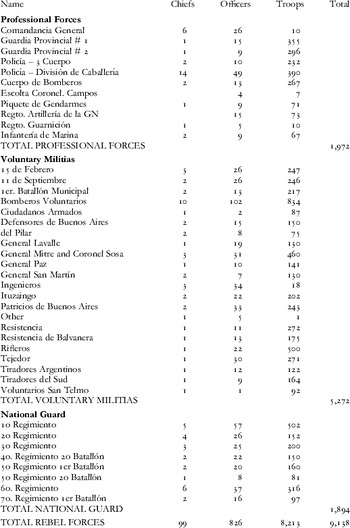
The Tiro Nacional and the Bomberos Voluntarios became the main channel of civil participation (as shown in Table 1). Initially, the Tiro was filled with young members of prominent mitrista families, whereas the Bomberos units were composed of Tejedor's autonomistas.Footnote 40 In the following months, and especially after the stand-off of 15 February, both organisations expanded substantially their numbers beyond active partisans. The National Guard, meanwhile, included civilians drafted to resist the siege in early June.
Rebel forces in the City of Buenos Aires in June 1880

Source: Buenos Aires, 12 June 1880; ‘Estado General de las fuerzas del Ejercito de Buenos Aires. Fddo: [Cdte. General de Milicias de la ciudad de Buenos Aires, Julio A.] Campos’, AGN MHN, leg. 54, doc. 9238.
The social composition of these forces varied. The Rifleros battalion was the most selective of all the voluntary bodies that participated. It included ‘lawyers, merchants, journalists, physicians, salesmen’, judges and provincial deputies.Footnote 41 Being a member of the Rifleros became a mark of distinction, as the press stated repeatedly. Describing one of their social events, for instance, La Patria Argentina underlined the status of its members and supporters by emphasising that ‘there was nobody unknown to the rest of the audience’.Footnote 42 Members of the economic and intellectual elites were present in other battalions too. Engineering and medical students organised technical and medical support. Students of the elitist Nacional high school petitioned to suspend classes to be able to ‘defend our rights as sons of the noble Buenos Aires, under the attack of the infamous traitor Avellaneda and his cronies’.Footnote 43 White-collar civil servants also actively took part in these militias. Municipal administrative officers, for instance, organised their own battalion. Many federal employees also joined the revolution. A list of 265 officers dismissed by the federal government shows that two-thirds of its members were bureaucrats or liberal professionals.Footnote 44
Lower-class militiamen also filled the ranks of the civilian bodies. Colonel Angel Montero referred to them, when describing the members of the Adolfo Alsina battalion in San Cristóbal parish:
The enthusiasm of this people has no equal. As a proof of this I will tell you that most of them are journeymen who start working at five in the morning and finish at six in the evening. Nonetheless, every night we have been standing with our rifles … ready to defend our rights and our offended honour, our threatened freedoms.Footnote 45
Blue-collar workers in the public administration took part too. Members of the Western railroad, the Customs House, and the Post Office – agencies crowded with manual workers – formed their own units. Afro-Argentines also created their militia, the Colonel Sosa battalion.Footnote 46
European immigrants also had a sizeable presence. Italians organised two well-numbered battalions of around 1,000 militiamen. Spaniards created a legion of around 800 members. French immigrants volunteered to create one of their own. Their ranks included notable members of their communities, as well as former military men and manual workers in charge of building up trenches.Footnote 47
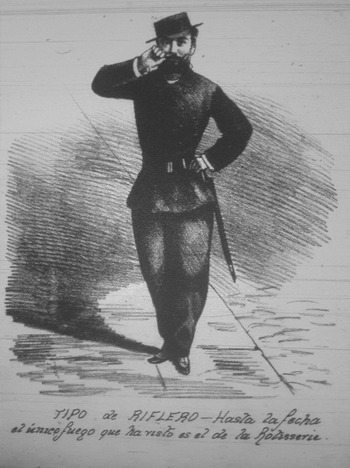
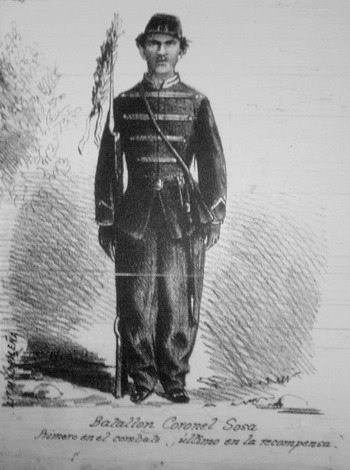
Two portraits of archetypical members of the Riflero and Colonel Sosa battalions that appeared in the satirical journal, El Mosquito, provide a vivid representation of the wide social spectrum encompassed by the revolutionary forces. The Riflero was drawn as a man of Caucasian features and impeccable dress (see Picture 1). The militiamen of the Colonel Sosa unit, instead, had a darker complexion and wore a modest uniform (see Picture 2). Their attitudes differ too. Whereas the Riflero played with his meticulously groomed moustache, the soldier of the Sosa battalion was firmly at attention. The subscript of each picture reinforces the suggested contrast between the two: ‘Colonel Sosa: First in battle; last in compensation … A Riflero type: so far, the only fire he has seen is from the rotisserie’.Footnote 48 The revolutionary forces were, without doubt, a socially heterogeneous group.
‘A Typical Riflero – Until now, the only fire he has seen is that of the rotisserie’

‘Battalion Colonel Sosa – First in fighting – Last in compensation’

Coercion, Clientelism and Personal Allegiance
The reasons for joining the rebellion were also heterogeneous. Although coercion, clientelism and personal allegiance played a role in the recruitment of porteños, their actual relevance should be placed in context. The use of coercion played a much larger role in the hinterland than in the city. Significantly, the number of draftees in the National Guard was a fairly small and late addition to the civic voluntary militias of the City of Buenos Aires.Footnote 49 There are several reasons for this restraint in the use of coercion. The provincial government was simply too weak to enforce a massive draft. An active public opinion would also have opposed massive abuses. Significantly, though, the private correspondence of contending groups did not describe any relevant difficulties in the process of recruitment in the city.
Threats of coercion affected larger parts of the population in rural Buenos Aires, however. Already, in the elections of February-April, the Tejedoristas had spread the word that a draft was coming in order ‘to frighten the poor fellows to make them vote’ in their favour.Footnote 50 Justices of the peace and rural policemen – the officials traditionally in charge of the draft – played an active role in the organisation of these militias.Footnote 51 Yet, voluntary militiamen also filled the ranks of the local branches of the Tiro Nacional and the Bomberos. Their enthusiasm in some places was evident. For instance, Colonel Angel Montero wrote in his private correspondence that his successful efforts at recruiting militiamen was fundamentally aided by the willingness of ‘the most brilliant youth of this Pueblo [who] joined me with no distinction of political colour … and enlisted voluntarily before I even called them’.Footnote 52
Personal allegiance also played a role in obtaining support for the rebellion. The most common cries spontaneously uttered by the revolutionaries (‘Long live Buenos Aires!’, ‘Long live Tejedor!’, ‘Long live Mitre!’) show a direct identification of the cause of Buenos Aires with the political leaders of the rebellion. Hints of the popular appeal of the upper echelons of the revolutionary army also appeared regularly in the newspapers, and it was even acknowledged by the opposition press.Footnote 53 Recurrent displays of affection for these leaders burst out during parades, target practices and meetings. Julio A. Costa, for example, recalled a night during the siege when commander Julián Martínez, a veteran of the Paraguayan war and member of a prestigious military family, found himself enthusiastically hailed and carried through the streets by a group of Italian volunteers he had never met before.Footnote 54 This popularity enjoyed by the revolutionary leaders also appears to have been prominent in the hinterland. A song that circulated among gauchos demonstrates it:
Though exaggerating the unanimity of their support as well as the absence of coercion against the gauchos (see below), the song underlines that their commitment to the revolutionary military leaders was a major reason to join the movement willingly (‘They are passionate for Arias and for Leyria; for Lagos the laziest gaucho would die’).
The ascendance of middle-rank militia leaders responded to more complex motives. Commanders of the civic battalions were voted ‘unanimously’ in not-so spontaneous assemblies organised by the central revolutionary committee in the parishes and towns. These elections actually sanctioned already established political leaders. Most of these commanders were well-known ward bosses and/or senior public employees. Riflero commander Joaquín Montaña, for example, was the president of the tejedorista-mitrista committee in the parish of San Nicolás. Senior officials Cruz y Frutos Martín and Alberto Hansen were leaders of the Customs House and Post Office battalions respectively.Footnote 56 Although the origins of the linkages between leaders and rank-and-file followers are very difficult to unveil, it is possible to approach the analysis by gauging the role that clientelism played in it.
Clientelism was important at times when the recruitment of public officials to the militias occurred. Tejedor exerted open pressure on provincial employees to join his movement. Municipal officials, for example, were publicly told that ‘Disobedience of such order, which must be sacred for the municipal employees under the present circumstances, will be penalised as it deserves to be’.Footnote 57 Yet, the pressure placed upon provincial officials was by no means always necessary. Provincial employees had already been selected among Tejedor's committed supporters, making their motivations to participate in the militias inextricably linked to their already proven partisan affinity with the governor.
Federal employees, in contrast, acted with more independence, even after knowing of Avellaneda's decision to dismiss anyone who joined the voluntary militias or who decided to remain in Buenos Aires after the city was put under siege.Footnote 58 Engineer Pastor Tapia, for instance, publicly justified his decision to resign from his post in the federal administration because of his conviction that he did not want to do anything that by ‘helping the national government, would go against the interests of Buenos Aires’.Footnote 59 Despite the intense pressure exerted against them, many federal employees supported the uprising.
Clientelism is more difficult to detect amongst those who did not hold public office. Some members of the militias made the case emphatically that they were not there for the money. A member of the Bomberos, for example, wrote an open letter attacking the roquista newspaper, El Pueblo Argentino, and rejecting accusations that people had joined the militias for materialistic reasons: ‘Of the three hundred and nine registered … most of them do not need the government … to give us anything at all … We do not want public jobs either, as those supporters of that cheap newspaper do’.Footnote 60 Additional evidence of the limited relevance of clientelism in the recruitment process was the fact that the roquistas rarely used it to explain the widespread support for the opposition that they were witnessing. The accusation made by El Pueblo Argentino was quite exceptional in this regard. Instead, the roquistas explained the revolutionary movement's popularity by accusing porteños of being blinded by a localist sentiment that they labelled ‘porteñismo’. It is time now to discuss what this porteñismo meant for the supporters of the revolution.
The ‘Porteño Cause’ and the ‘Right to Rebel’
A fundamental theme in the revolutionary discourse was the sense of frustration that was shown with regard to the waning power of Buenos Aires in national politics. The tejedorista newspaper, Buenos Aires, stated this quite bluntly: ‘Buenos Aires has taken arms to reject a forceful imposition and to state a fundamental principle: its influence must weigh in the destiny of the nation’.Footnote 61 The nomination of Roca was perceived as another step in the disempowerment of porteños at the national level and rightly so. Buenos Aires had continued to lose its political influence since Mitre's presidency, as proven by the fact that provincial candidates had been victorious in the presidential elections of 1868 and 1874. In 1880 provincial parties were even able to win the national elections without needing support from any significant political faction of Buenos Aires.
The disproportionate fiscal contribution of the province to the nation was also still perceived as a sign that the remainder of the country was taking advantage of Buenos Aires. Eduardo Wilde described this sentiment in a letter to his friend Roca:
The ultra porteños don't see that here [in Buenos Aires … the national state] invests 15,000,000 pesos of its income. They do not see that the Comisaría de Guerra allows five thousand families to live, that the Parque de Artillería maintains one thousand more, that the national administration in its different branches pays for half of the city's population. They only see … what the local customs office yields and believe that that product belongs to Buenos Aires.Footnote 62
The revolutionary press echoed this interpretation and predicted that Buenos Aires would suffer even more if Roca became president. An editorial in the newspaper, Buenos Aires, denounced a supposed plan which, under his presidency, would divide Buenos Aires into two, federalise the city, and impose extremely severe limitations on the civic freedoms its population enjoyed.Footnote 63
Yet, this dissatisfaction alone was not sufficient to legitimise an uprising against a constitutional government. The revolutionary propaganda also accused President Avellaneda of betraying constitutional procedures and driving the country towards tyranny. In their view, the nomination of Roca was an imposition on the part of President Avellaneda and the governors of the interior provinces. Unable to impose his will over Buenos Aires, Avellaneda was trying to subdue the attempts of porteños to defend their freedoms and autonomy. In response, ‘the province’ as a whole (not some of its factions) organised itself to defend constitutional freedoms. Buenos Aires was, for the revolutionary press, the last stronghold against tyranny in the country.
This call to arms in defence of freedom in 1880 was certainly not a complete innovation. On the contrary, it had been an integral part of the political culture of the Río de la Plata since the wars of independence and continued to legitimise caudillo uprisings in the decades that followed. The 1853 constitution even sanctioned such action as part of the rights and duties of Argentine citizens.Footnote 64 In Buenos Aires, the invocation of the rights and duties of the ‘citizen-soldier’ had been always a mobilising motive that acquired a renewed importance after the fall of Rosas in 1852. Civic militias (now called the ‘National Guard’) then became the main military body of the province during the period when it seceded from the Argentine Confederation (1852–1861). At that time, being a member of the National Guard was a motive of enormous civic pride for its members.Footnote 65
The exaltation of the National Guard as an honorific institution that citizens should proudly cherish started to wane after 1861, once Buenos Aires was reincorporated into the nation and the basis of a professional army was laid down. Increasingly, the National Guard served more as an instrument to discipline the lower classes than as a badge of honour. By this time, it was clear to those serving in it that the high mission of the Guard did not coincide at all with the realities of the draft.Footnote 66
Yet, the rhetoric that exalted a noble role for the participation of citizens in civic militias would not disappear from public discourse. Mitre used it again in 1874, when his party arose against the federal government to defend ‘the purity of suffrage’.Footnote 67 In 1880 tejedoristas and mitristas appealed to the memories and traditions of the porteño National Guard to legitimise the organisation of the revolutionary militias. Challenging Avellaneda's siege, La Patria Argentina, for example, asserted the right of Buenos Aires to organise its militias since ‘the people in arms are the basis and warranty of a free nation (gobierno libre)’.Footnote 68El Porteño, meanwhile, traced the origins of these militias to the National Guard of 1852.Footnote 69 Even publications that opposed the revolution acknowledged its relevance when challenging the rebels' appropriation of this institution for factional purposes.
Doctrinaire arguments about the constitutional right to rebel against despotism were supplemented with a rhetoric intended to increase the prejudices of porteños against the interior provinces. The tejedorista newspaper, Buenos Aires, for example, stated bluntly that the consequences of defeat would be a return to the dark era when ‘civilised’ Buenos Aires suffered the ‘barbarism’ of the interior provinces:
[Roca's] victory would be that of ignorance over intelligence, brutality over [established] law, the bombachas [gaucho pants], and his earring over the suit of the cultivated men … The defeat of Buenos Aires would extend the shadow of the caudillo system [caudillaje] all over the country. For a long time, there would remain only the memory of our civilised and free life.Footnote 70
This very stylised description of the perceived differences between Buenos Aires and the provinces, expressed most famously in Sarmiento's Facundo: Civilisation and Barbarism [1845], appealed to well-rooted prejudices against the provinces that porteño parties had used repeatedly in the past in order to legitimise their policies. Mitre, for example, had justified the repression of interior caudillos during his presidency as a necessary step to disseminate the freedoms of Buenos Aires to the rest of the country. Autonomistas proclaimed their desire to defend Buenos Aires' autonomy, using similar arguments.Footnote 71
The principal motifs of the revolutionary discourses proved adaptable to different constituencies. For the Italian legion, for instance, the speeches of revolutionary leaders focused on the perceived links between the cause of Buenos Aires and that of liberal and nationalist Italians. Commander Achille D'Atri, for instance, stated in a speech to his legion:
The cause of Buenos Aires is a vital cause for the republic, that of freedom. Our future in this country depends on the victory of Buenos Aires … we give our support to the city that gives us its hospitality; we will defend our families this way … and will show the liberal porteños that, when it is a matter of fighting for freedom, Italians do not fail.Footnote 72
Governor Tejedor expressed these linkages in similar terms: ‘Sons of Italy: In your beautiful patria, you have fought for the unity of Italy. Now we are fighting for the unity of the Argentine Republic’.Footnote 73 These appeals were not unfamiliar to these immigrants. The leaders of their associations and their newspapers repeatedly used similar ones when engaging in local affairs.
All these discourses were disseminated profusely through newspaper articles, pamphlets, speeches and street parades. From the beginning of the electoral campaign, newspapers reported regularly on the ideas of Tejedor and Mitre. Their circulation skyrocketed as the crisis unfolded. On 8 June 1880, for example, El Porteño boasted that its first edition of 5,500 issues was already sold out at eight o'clock in the morning. Its circulation apparently had increased by more than 2,000 issues in just four days.Footnote 74 Pamphlets also became an important source of agitation at peak times. During the stand-off of 15 February, El Nacional stated: ‘there has appeared a new industry … It consists of the circulation of bulletins printed by anonymous presses. They contain, in general, all sorts of lies and insults’.Footnote 75 After President Avellaneda put Buenos Aires under siege, newspapers also added two additional daily bulletins to their regular editions.
Street parades played an important role by disseminating symbols that conveyed the contents of the revolutionary discourse. These symbols emphasised the linkages between the current movement and the National Guard, the alleged unanimous support of Buenos Aires for the revolution, and the role of the province as sole defender of the Argentine constitution. The tejedorista newspaper, Buenos Aires, for instance, described a parade in which the Bomberos of Catedral al Norte displayed their uniform. Consisting of a blue shirt and hat, and white trousers (the colours of the Argentine flag), the uniform took its inspiration from ‘the glorious uniform of the National Guard of 1852’.Footnote 76 The same group organised another gathering with veterans of the National Guard of 1852 as special guests. One veteran, Pedro M. Espinosa, gave thanks for the invitation by praising the ‘eminently Argentine’ character of the meeting as well as his joy about the fact that its organisers were all ‘members of the great Liberal Party’, which Tejedor and Mitre had reunited after so many years in order to defend the porteño cause again.Footnote 77 These symbols contributed to reinforce the appeal of the revolutionary message among porteños.
Limits and Ambiguities
The call to defend ‘the freedoms of Buenos Aires’ did not appeal to all porteños, however.Footnote 78 In a series of newspaper articles directed against the mitrista newspaper, La Nación, Domingo F. Sarmiento, the former president and self-proclaimed alternative candidate of the autonomistas, summarised the arguments of those who opposed the revolution. Sarmiento criticised La Nación for stirring up the masses to take arms in defence of freedom and the purity of suffrage. For Sarmiento, La Nación's call to arms was based on outdated ideas, mainly the contractualism of Jean-Jacques Rousseau. Inspired by Rousseau, the mitristas asserted their right to launch a revolution on the grounds that the social contract that secured the freedoms of the people (the national constitution) had been violated by a corrupt government.
This contractualist argument, Sarmiento stated, was very dangerous. It allowed ‘any ambitious person in Mexico or Buenos Aires to say: “this is a de facto government”’ and then launch his own insurrection.Footnote 79 Revolutions were not the solution, therefore, but the problem, since ‘a triumphant … [revolution], suggests the idea of another one … [and consequently] rights and public tranquillity are lost’.Footnote 80
Sarmiento used the modern experiences of France and England to substantiate his ideas. France, which in 1789 invoked the right of the people to topple any government that hijacked their original freedoms, had provoked the ‘mobilisation and fanatisation of the ignorant masses, [and] the succession of revolutions and dictatorships’. One hundred years later, Sarmiento observed, France was still feeling ‘mutilated, defeated … disenchanted by the social pact; looking for other ideas on which to found their system of government’.Footnote 81 England, instead, had been evolving slowly, ‘advancing little by little in their electoral rights, safety and justice’. Modern liberalism, according to Sarmiento, should embrace the English example. A constitution should be regarded not as a contract whose potential violation gave room to start all over again, but as a law ‘that creates an Executive Power with the material force to obligate states and private citizens to obey, without asking them if they found this authority fair or unfair, legitimate or illegitimate.’Footnote 82
Reversing his positive depiction of Buenos Aires in Facundo, Sarmiento now accused Buenos Aires of being an agent of disorder in the region: the province had created political anarchy in the early years of the independence; it had engendered Rosas's tyranny; and it had repeatedly risen up against the national government since.Footnote 83 Buenos Aires was again bringing anarchy to the country in the name of defending its freedoms, at times when its leaders were committing the same frauds and abuses that they denounced.Footnote 84 Tejedor and Mitre's cynical calls for revolution in the name of electoral purity and freedom, Sarmiento concluded, would only keep the country in a state of perennial instability.Footnote 85
Many porteños also rejected the revolution with their feet. Most immigrants sought to remain neutral by requesting safe-conducts from their consulates in order to avoid a draft.Footnote 86 In some cases, gauchos escaped to the sierras or to more isolated towns.Footnote 87 According to Commander Servando García, in the area of Dolores, ‘poverty and general dissatisfaction’ made people migrate to more unpopulated areas.Footnote 88 In the district of Almirante Brown, the local commander of the National Guard of Buenos Aires complained about the difficulties he was encountering at recruiting. Only the fourteen men who had participated actively in the electoral campaign in favour of Tejedor had joined the militia promptly. Of those, only three militiamen were finally incorporated.Footnote 89 Others, such as the indigenous tribes of Chiefs Coliqueo and Pichiunca, joined the federal army in the repression of the uprising.Footnote 90
Some other actors displayed a more ambivalent disposition toward the revolution. On 10 May, a so-called ‘Meeting for Peace’, organised by a committee of merchants and members of the Stock Exchange, gathered an impressive number of people (30,000) to request a pacific resolution to the conflict. A few days later, two large parades sponsored by the national government again put several thousand porteños in the streets.
Although impressive, these mobilisations were not an indication of a lack of support for the revolutionary movement. Instead they became events in which opposing factions jockeyed for the public support of porteño civil society. The two meetings sponsored by the federal government were organised to honour the return of the remains of the independence hero, José de San Martín, and the liberal president, Bernardino Rivadavia. These gatherings, attended by leaders of both the federal and the provincial governments, actually allowed opposing sides to reaffirm their commitment to patriotism and to liberal ideas by pledging allegiance to their founding fathers and heroes. The Meeting for Peace, meanwhile, although presented as a non-partisan gathering of ‘the whole people of Buenos Aires’, coincided with the political needs of Roca's adversaries. Mitristas and tejedoristas actively took part in its organisation, speculating that Roca would withdraw his name if porteño civil society came out en masse to ask him to renounce his nomination.Footnote 91 Their newspapers actually interpreted the meeting as a vote of confidence for their policy. La Patria Argentina, for example, asked its readers if their participation in the ‘most grandiose popular meeting in memory’ was a sign that they opposed the uprising. Nothing was farther from the truth, the newspaper said:
The merchants of Buenos Aires; the men whose brilliance, services and intelligence stand out at the vanguard of society; the foreign associations; the pueblo, thoughtful youth, and all of those who are the noblest of the nation had met with just one wish: peace for the Republic; and with that, the end to a bloody era that is being brought back by two men: Avellaneda and Roca!Footnote 92
In the end, the attempt to mobilise the porteño civil society in peaceful demonstrations against Roca could not stop the military conflict.
The Resolution
After President Avellaneda decreed the siege of the city on 2 June, a military clash became imminent. This finally broke out on 17 June, after the national army attacked the porteño troops led by Colonel José I. Arias in Puente de Olivera, about 55 miles west of Buenos Aires City. The national army forced the provincial troops to retreat as far as Puente Alsina, a strategic entrance to the southern side of Buenos Aires City. In this chaotic manoeuvre half of the revolutionary rural troops abandoned the provincial forces.Footnote 93
The next clash occurred on 20 June, when the national army unsuccessfully attempted to cross the Puente Barracas, another strategic entrance to the southern part of the city. Using heavy artillery, the provincial troops repelled the attack. Finally, the decisive battle took place on 21 June. Federal troops entered the city at Barracas and reached the fields of La Convalescencia. After a bloody and anarchic battle, the national forces defeated the provincial militias, capturing two of their valuable Krupp cannons. Meanwhile, federal troops made a surprise attack on the forces of Colonel José I. Arias, at Puente Alsina. The provincial troops then retreated inside the city as far as the Corrales de Mataderos. There a heavy combat left serious casualties on both sides.
The battles of 21 June proved to be decisive. After an armistice, Buenos Aires acknowledged defeat. For some this came as a surprise, since the offensive of the federal army had not been overwhelming. Yet, the revolutionary leadership knew that their defeat in La Convalescencia, only twenty blocks from the Plaza de la Victoria (today the Plaza de Mayo), had allowed the federal troops to penetrate deep into the city. Buenos Aires, surrounded by the national army, unable to get supplies from abroad, and unlikely to receive support from other provinces, as originally expected, found the continuation of the war ultimately futile. Governor Tejedor resigned, and the porteño troops proceeded to disarm. President Avellaneda returned to the city. The national congress pressed for the governing bodies of the province to resign. Revolutionary leaders lost their posts in the national and provincial legislatures. The city of Buenos Aires was finally and definitively declared the capital of Argentina. Julio A. Roca was sworn in as president in October 1880, with the defeated porteños watching.
Conclusions
The revolutionary movement, although quickly defeated, had built a wide base of support, as indicated by the large number of porteños who enthusiastically participated in the militias, provided resources to the revolution, and mobilised in its favour. As Gregorio Torres, one of Roca's aides, stated after the province was defeated:
If instead of Tejedor and the other four incompetents around him, there had been a good leader in Buenos Aires, I assure you that things would have become very difficult. There were more than enough men. There were 18,000 men in the square, but they did not have weapons or ammunition.Footnote 94
The uprising appealed to many porteños, well beyond those who regularly participated in electoral politics. As witness Julio A. Costa recalled years later, the revolution of 1880 was ‘a violent tremor that shook everything it touched … old and young, citizens and foreigners, soldiers and civilians, women and children’.Footnote 95
Its appeal should not be explained solely by personal allegiance, clientelism or coercion. The revolutionary leaders successfully immersed their partisan conflict for the presidency into a larger dispute for the rights of their citizens and the province they lived in. Porteños saw themselves as the sole defenders of the constitutional rights and freedoms of the whole country and accused President Avellaneda, the provincial governors, and General Roca of attempting to reinstate despotism for their own benefit. Although widely supported, the revolution was always under the firm control of the political elites, who led its organisation and ideology.
Analysing this uprising allows us to discuss larger issues regarding the characteristics of popular mobilisations in nineteenth-century Latin America. If historiography has been increasingly abandoning ‘top-down’ approaches to political processes in favour of considering the role of non-elites more fully, this analysis benefits most when historians carefully gauge how, in the words of Richard Warren, the ‘complex interplay between elite machinations, the actions of intermediaries, and popular aspirations, yield mass action’.Footnote 96 In other words, the relative influence and power of each of these actors should not be dismissed or overemphasised without analysing them concretely.
Similar attention must be paid to the current re-evaluation of the way in which elite political discourses were reshaped in the nineteenth century in Latin America to accommodate popular demands. The landmark work of Guy P. C. Thomson, for example, shows how the communities of Puebla (Mexico) reinterpreted liberalism during the Reforma in the pursuit of their own military, political and economic autonomy. James E. Sanders' recent analysis of popular republicanism in nineteenth-century Colombia also shows that subalterns reinterpreted republicanism when negotiating their participation in the struggles between Conservative and Liberals in that country. These processes, amongst others currently under study, prove that public discourses could be popular and mobilising in nineteenth-century Latin America. This work also shows that popular groups were aware of the most important tenets of these discourses and appropriated them for their own purposes.Footnote 97 The revolution of 1880 incorporated a wide array of supporters from different social groups, including its popular classes. Its discourse proved to be mobilising and flexible enough to adapt to different audiences and changing political circumstances. Yet participation in the revolutionary movement did not allow the popular forces the possibility of renegotiating its agenda or challenging the authority of the established political leadership. In this regard, the revolution was not a breaking point with the existing political culture of Buenos Aires.Footnote 98
The military defeat of Buenos Aires in 1880 accelerated the decline of the radical notions that gave meaning to this movement. The development of a professional army definitively replaced the possibility of a ‘citizenry in arms’. The federalisation of the city of Buenos Aires linked local politics inextricably to the dynamics of the federal state. Nevertheless, some of the ideas that mobilised porteños in 1880 would continue to play a role in the following years. The perceived political corruption of the federal government resurfaced as a major issue in the revolution of 1890 and in the actions of the Radical Party thereafter.