Introduction
Suicide rates in China are among the highest in the world. A study published in 2002 reported suicide in China as the fifth leading cause of death, with an estimated mean annual rate of 23 per 100 000 and a total of 287 000 suicide deaths per year (3.6% of all deaths) (Phillips et al. Reference Phillips, Li and Zhang2002a). The demographic pattern of suicide in China, with rural rates two- to threefold greater than urban rates, and rates among women higher than among men, is different from that reported in Western countries, where rates in urban and rural areas are roughly equivalent and rates of suicide in men are two- to fourfold higher than in women (Durkheim, 1897/Reference Durkheim1951; Wang et al. Reference Wang, Li, Chi, Xiao, Ozanne-Smith, Stevenson and Phillips2008). The age pattern of Chinese suicide is generally a bimodal one, with peaks in young adulthood and among the elderly (Ji et al. Reference Ji, Kleinman and Becker2001; Phillips et al. Reference Phillips, Li and Zhang2002a; Zhang et al. Reference Zhang, Jia, Wieczorek and Jiang2002). Among young adults 15–34 years of age, suicide is the leading cause of death, accounting for 19% of all deaths in this age group (Phillips et al. Reference Phillips, Li and Zhang2002a).
In general, the male/female ratios of suicides are lower in Asian societies than in the West: Hong Kong (1.1), Singapore (1.3), Japan (1.8), Taiwan (1.5), India (1.4), Philippines (1.5), South Korea (2.2) (Canetto & Sakinofsky, Reference Canetto and Sakinofsky1998; WHO, 1999; Taiwan Government, 2003). The inverse ratio in China may be a reflection of Asian culture and additional factors specific to its communist ideology, reinforced in Chinese society since 1949 when the communists gained control of the country.
To investigate the mechanism behind rural Chinese suicides, and to identify potentially innovative, culture-specific prevention measures for rural China, we conducted a case-control psychological autopsy (PA) study with a focus on cultural and other risk factors for this subpopulation. We hypothesized that Confucianism, which is considered to be the cultural foundation of most Asian societies including China, partially explains the suicide risk for young women. We posited that the deep-rooted Confucian patriarchy and its sexist orientation that denigrates women, coupled with the communist egalitarianism advocated in China, creates frustration or strain in the daily life of some young rural women.
Method
Study population and design
Persons aged 15–34 years and living in rural areas of China were the focus of our study. We examined young rural women and men who had died by suicide in comparison with community-living controls from the same specific populations. Pilot studies had demonstrated the feasibility of studying suicide by the PA method in Chinese social and cultural environments (Zhang & Norvilitis, Reference Zhang and Norvilitis2002), and that the Western developed instruments are reliable and valid with the Chinese samples (Zhang et al. Reference Zhang, Conwell, Wieczorek, Jiang, Jia and Zhou2003). We used established PA methods and a case-control design to investigate the environmental and other characteristics of young rural suicides and controls.
Sampling
We selected three provinces in China for the study. Liaoning is an industrial province located in northeast China, Hunan an agricultural province in central-south China, and Shandong is a province with economic prosperity in both industry and agriculture located on the east coast of China mid-way between Liaoning and Hunan. Sixteen rural counties were selected randomly from the three provinces (six from Liaoning, five from Hunan, and five from Shandong). In each of the 16 counties, suicides aged 15–34 years were sampled consecutively from October 2005 to June 2008. Similar numbers of community-living controls were recruited in the same counties for the same time periods.
Recognizing the need for clearly defined criteria for suicide as a manner of death (Younger et al. Reference Younger, Clark, Oehmig-Lindroth and Stein1990), we excluded cases of accidental or natural death in which suicidal intent was questioned. As China does not have a medical examiner system and all deaths are required to be sent to a health agency for a death certificate, hospitals are the primary place for the Centers for Disease Control and Prevention (CDC) to locate cases for the study. Each hospital uses a standard protocol to determine the cause of death. In remote rural areas far away from a hospital, village doctors are responsible for furnishing death certificates and are required to report the death to the Xiang (township) health agency. The county CDC oversees all the hospitals and clinics in the county. For our study, all suicidal deaths were required to be reported to each county CDC by telephone or fax on a daily basis, and the information gathered at the county CDC was then forwarded on a monthly basis to the provincial CDC. For those suicidal deaths that were not recognized by any health agency, our mortality registry system allowed the village treasurers, who collect fees for each burial or cremation and are aware of all the deaths in the village, to notify the Xiang health agency or the county CDC. Whenever necessary, an investigation with the village board and villagers was conducted by the research team to try to ensure that no suicide cases were missed, or reported erroneously. These procedures were implemented to minimize false classifications.
The epidemiological assumption is that controls are representative of the general population in terms of probability of exposure (suicide risk) and that controls have the same possibility of being selected or exposed as the cases (Timmreck, Reference Timmreck2002). To optimize the scientific validity of our study, we did not use accidental deaths for the control group because they might be biased in certain ways (e.g. higher likelihood of substance misuse or impulsive risk-taking behavior). Instead, the controls were from the same counties and from among the living general population within the same age group of the suicides. The fact that proxy informants for controls were not affected by bereavement must, however, be taken into consideration in interpreting the results. There was no significant difference in age distribution of the controls and the 2005 Chinese national census database, supporting the representativeness of the controls in our study.
The community-living control group was a random sample stratified by age range and county. In each province, we used the 2005 census database of the counties in our research. For each suicide, we used the database of the county where the deceased lived to randomly select a living control in the same age range (i.e. 15–34 years). With regard to gender, the random selection of controls aged 15–34 years from each county database yielded approximately equal numbers of males and females, which approximated to the gender distribution of suicide cases in the study. The control sample did not exclude individuals who had been diagnosed with mental disorders or previous suicide attempts. Thus, the prevalence of mental disorders and suicidal attempts could be assessed in the rural general population aged 15–34, and more importantly, the effects (direct, moderating and intervening) of mental disorders on completed suicide could also be studied.
Information sources
For each suicide and each control, we interviewed two informants, with very few exceptions (for two subjects only one informant was available for each). However, we recognized that the type rather than the number of informants used in PA studies is an important and complex consideration (Kraemer et al. Reference Kraemer, Measelle, Ablow, Essex, Boyce and Kupfer2003). We selected the informants based on the context or environment (how people observe the target; for example, home versus non-home setting). In this way, each informant was carefully selected to optimize the information available on each case so that home, work, family and non-family aspects were included in the data.
Based on the above considerations, we used the following four guidelines for the inclusion of informants: (1) suicide informants were recommended by the village head and the village doctor and then selected by the research team based on familiarity with the subject's life and circumstances, availability for and willingness to consent to in-person interviews, whereas control group informants were recommended by the controls themselves and then selected by the research team with similar principles. (2) Although target persons could be as young as 15 years of age, informants had to be aged ⩾18 years. Characteristics of the informants for both suicides and controls were noted in a standardized fashion (i.e. most recent contact, number of contacts in the past month, frequency of contacts in the past year, number of years informant has known the target, relationships, and the informant's impression of their familiarity with target persons). (3) For both suicides and controls, the first informant was always a parent, spouse or another important family member, and the second informant was always a friend, co-worker or neighbor. (4) Wherever possible, we avoided recruiting husbands and in-laws of those female suicides associated with family disputes. Interviewing these people could result in very biased reports, if marital infidelity and family oppression were possible causes of suicide. Similarly, in selecting the male suicide informants and the control informants we tried to avoid this type of biased informant when family disputes were noted beforehand.
Interviewing procedures
Informants were first approached by the local health agency or the village administration by a personal visit. Upon their agreement by written informed consent, the interview was scheduled between 2 and 6 months after suicide incident. Interviews with informants regarding living controls were scheduled as soon as the control targets and their informants were identified. Each informant was interviewed separately by one trained interviewer, in a private place in a hospital/clinic or the informant's home. The average time for each interview was 2.5 h.
As the cases were deceased and controls were living, blinding of raters to case status was not possible. Inter-rater reliability was established and maintained by limiting the principal data-gathering role to the 24 trained clinical interviewers and by comparison of duplicate ratings of the interviewers on a regular basis. The same interviewers participated in data collection for both case and control samples, promoting inter-rater reliability across the study.
Measures
The case-control status was the dependent variable. Predicting variables under this study included age, education, family annual income, marital and dating status, religion, pesticide availability, traditional gender values, modern gender values, gender value strain, impulsivity, and mental disorder.
We divided subjects into younger (<25 years) and older (⩾25 years) age groups. Duration of education ranged from 0 to 16 years for the cases and from 2 to 18 years for the controls. The cases and controls were categorized into low (<7 years) and high (⩾7 years) education level as the first 6 years of formal education in China is elementary. The family annual income was measured in Chinese Renminbi (RMB). One US dollar was equivalent to about 7.00 RMB.
To investigate the effect of marriage and marital experience on young rural Chinese suicides, we computed a variable with three categories. The group of ‘never married and not dating’ included those young people who had been unattached in their life, the group ‘never married but dating’ comprised those who had been involved in a love relationship but never married, and the group of ‘ever married’ covered the currently married (n=421), separated (n=12), divorced (n=18) and widowed (n=1). There were four items in the protocol to assess religion and religiosity of the cases and controls. The first asked what religion the target person believed in, and the choices were Taoism, Islam, Protestantism, Catholicism, Buddhism, other, and none. The second item asked about how many times in an average month the target person attended religious events. The third and fourth questions asked if the target person believed in God and an afterlife. The variable of religion/religiosity was the sum total of the four items, with all positive responses as ‘yes’ and negative responses as ‘no’. Pesticide availability was assessed with a single item asking if any types of farming chemicals were stored at home.
The traditional gender value scale was a measure of Confucian paternalism denigrating women in Chinese culture. It was measured on Likert categories (1=strongly disagree, 2=disagree, 3=neutral, 4=agree and 5=strongly agree). Respondents were asked to what extent the target person agreed with the following statements: (1) women should stay at home and work only at home; (2) caring for her husband; (3) bearing a son; (4) keeping marriage without divorce; (5) arranged marriage; (6) obedience to men; (7) no education for women; (8) no social life; (9) women at home and men outside; (10) a woman should not exceed her husband in education; (11) a man is more important than a woman; and (12) a woman should be with only one man, live or dead. The modern gender value scale was a measure of communist gender equalitarianism promoting women's social status. It was also measured on Likert categories, and respondents were asked to what extent the target person agreed with the following statements: (1) going out to work; (2) equality for men and women; (3) marriage by self-choice; (4) a woman to receive education; (5) equal pay for equal work; (6) women uphold half the sky; (7) women can do all that men can do; and (8) men and women are equally important.
The gender value strain was computed from the above two value scales: Confucian paternalism denigrating women (referred to here as the ‘traditional’ scale) and communist gender equalitarianism promoting women's social status (the ‘modern’ scale). We used the mean score for each of the two scales. Responses for the traditional scale were divided into three levels based on the scale mean: low (0–2.5), middle (>2.5 to <3.5) and high (3.5–5), and each level consists of approximately one-third of the respondents. Responses for the modern scale skewed to the high end of the measurement. About 90% of the responses were between the means of 4 and 5, and the rest of the responses were between the means of 3 and 4. Therefore, we divided the responses into only two levels: low (0–4) and high (>4–5). The final strain variable was created by integrating the two recoded traditional and modern variables. Thus, strain was an ordinal measure with two categories. When both traditional and modern values were high, the strain was coded as high. For all other combinations, the strain was coded as low or no. The Chinese traditional and modern gender value scales and the value strain conceptualization were tested earlier among 487 young people in rural China, and the tests yielded excellent reliability scores (α=0.69 for the traditional scale; α=0.88 for the modern scale) and good validity evidence (r=0.27) for the computed strain variable (Zhang & Song, Reference Zhang and Song2006).
Impulsivity was measured by the 12-item scale developed and validated in English by Dickman (Reference Dickman1990) and then translated into Chinese for the current project. We used only the 12 items for dysfunctional impulsivity in the scale and excluded the functional impulsivity items from the current measurement. The response for each of the 12 impulsivity items was ‘yes’ (1) or ‘no’ (0), with the highest possible score being 12 and the lowest being 0. As 49.4% of the responses had a score of ⩽4, we arbitrarily categorized those with a score of ⩽4 into the group of low impulsivity and the rest into the group of high impulsivity.
We used the Chinese version of the Structured Clinical Interview for the DSM-III-R (SCID; Spitzer et al. Reference Spitzer, Williams, Gibbon and First1988; Gu & Chen, Reference Gu and Chen1993) to generate diagnoses for both suicides and living controls. Diagnoses were made by the psychiatrists on each team in a consensus meeting at which all responses from each informant were presented by the interviewers. All interviewers had received formal training in using the SCID to obtain information on mental disorders. Tests on the inter-rater consistency and reliability and validity of the interviews had been conducted prior to the formal data collection, and the excellent test scores indicated that the Chinese version of the SCID is an adequate instrument for Chinese populations.
Integrating the information from different sources
There were two proxy interviews for each suicide case and each living control. The vast majority of the responses for the target person were the same or fairly similar. For different responses pertaining to the target person, data were integrated with the following three principles based on previous experiences (Kraemer et al. Reference Kraemer, Measelle, Ablow, Essex, Boyce and Kupfer2003). For demographic information, we relied on the answers by the informant who had the best access to the information. For example, a family member should be able to tell the target person's age and birth date more accurately than does a friend. Second, in estimating the cultural values of the target person, we used the higher score of the two informants' responses if they were different. Finally, to determine a diagnosis with the SCID, we selected the response representing a positive symptom, because the other informant may not have had an opportunity to observe the specific characteristic or behavior. These three guidelines were applied in integrating responses of both cases and controls.
Results
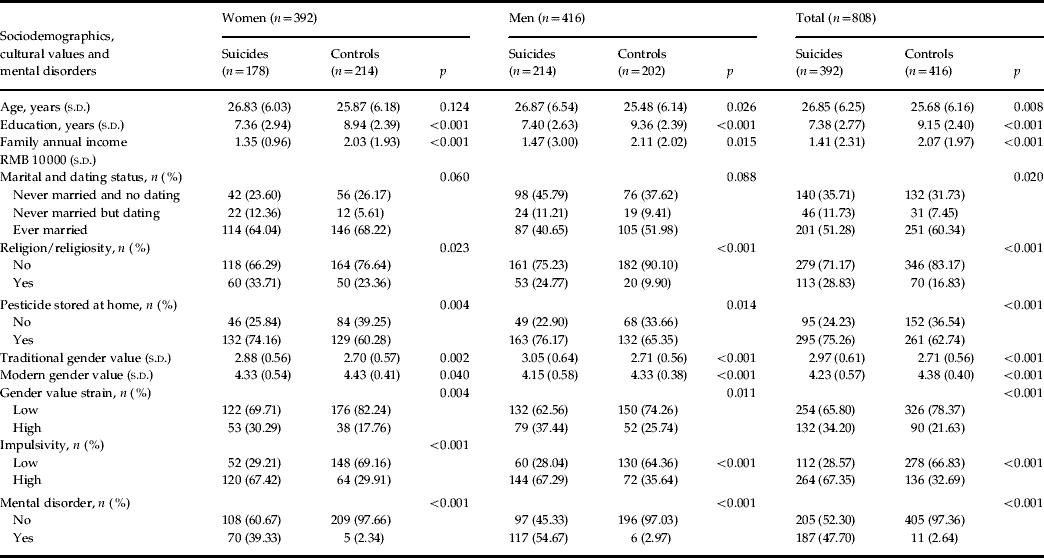
The final samples from the three provinces consisted of 392 suicides (178 females and 214 males) and 416 living controls (214 females and 202 males). They were all from rural China and aged between 15 and 34 years at the time of death or interview. Table 1 shows that the suicide group and the control group differed significantly on a wide range of factors: education, family income, marital status and dating, religion/religiosity, pesticide stored at home, gender value strains, impulsivity, and mental disorder. For example, 47.7% (n=187) of the suicides were diagnosed with at least one mental disorder including alcohol and substance abuse, whereas only 2.6% (n=11) of the living controls were diagnosed with any kind of mental disease including alcohol and substance abuse.
Case-control comparisons of the demographic characteristics, cultural values and mental disorders by gender (frequencies or means)

s.d., Standard deviation; RMB, Chinese Renminbi (US$1≌7.00 RMB).
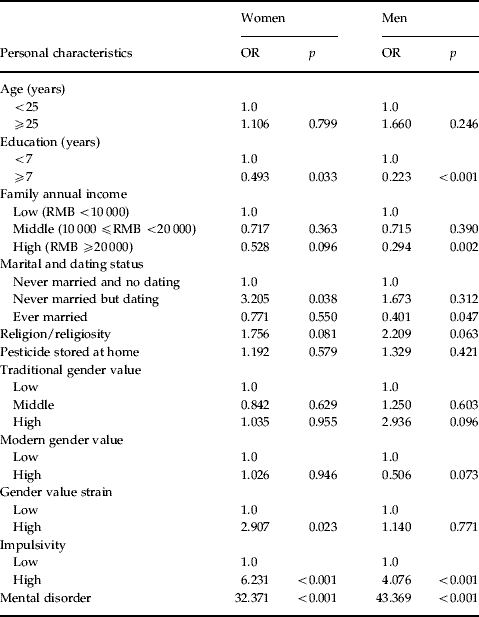
Logistic regressions were performed with our variables of interest included in the model. We performed the analyses separately for men and women. As Table 2 illustrates, the strongest predictor of suicide was mental disorder, for both men and women. Impulsivity remained a strong correlate of suicide, also for both women and men. Education and family annual income were protecting factors for suicide, and they were more powerful for men than for women. Being married, although a protective factor for men, was not protective for women. Instead, if a single woman was dating or in a love relationship, her suicide risk was about three times greater than that of a single woman who was not in a relationship. Religion/religiosity was not a protecting factor for suicide among the young people. Instead, it might be a risk factor, as the odds ratio significant levels were very close to 0.05 for both women and men in the sample. Although suicides were more likely than the living controls to have had pesticides or farming chemicals stored at home, the effect on suicide of the availability of these poisons at home was not significant in the multivariate logistic regression model. The traditional and modern value scores did not predict suicide in the logistic multiple regression model, but the value strain, the interactive effect of the two conflicting cultural values, did predict young rural Chinese women's suicide. The women in the high-value strain group were about three times more likely to commit suicide than their counterparts in the low- or no-value strain group.
Multiple logistic regressions for the effects of female gender role-related value strain, mental disorder, and selected demographic characteristics on suicide risk

OR, Odds ratio; RMB, Chinese Renminbi (US$1≌7.00 RMB).
Nagelkerke R 2 is 0.507 for the women's model and 0.644 for the men's model.
Discussion
The results from this comprehensive PA study of suicide risk factors in rural China are based on the careful application of field methods to this population. The current study is one of the largest and most rigorous PA studies conducted in China. Other major PA studies with Chinese populations include those by Cheng et al. (Reference Cheng, Chen, Chen and Jenkins2000) and Phillips et al. (Reference Phillips, Yang, Zhang, Wang, Ji and Zhou2002b).
Previous PA studies of Chinese suicide have usually focused on mental diseases, negative life events, lower social status of women, and lack of control by women (Pritchard, Reference Pritchard1996). We gave more attention to the understudied risk factors. We focused on culture, risk factors and completed suicide by young people (aged 15–34 years) in rural China, although psychiatric diagnosis of the suicides and controls was also a focus of the study. It is not surprising to find a lower prevalence of mental disorders, including alcohol and substance abuse, among the young suicides in rural China than among suicides in the West. The instrument we used to make psychiatric diagnoses for each suicide and control through proxy informants was the Chinese version of the SCID. Earlier studies of Chinese suicide samples also found lower rates of mental disorder than those in the West (Phillips et al. Reference Phillips, Yang, Zhang, Wang, Ji and Zhou2002b; Zhang et al. Reference Zhang, Conwell, Zhou and Jiang2004), indicating that risk factors other than mental illnesses were strongly relevant for Chinese suicides, although mental disorder is also a strong predictor of suicide and remains a potent target for prevention in China. It is also noted that the Chinese version of the SCID is a valid measure of mental disorders in Chinese populations, although there is still the question of how the diagnostic system maps onto psychopathological presentations in China (Kleinman, Reference Kleinman1986).
The uniqueness of young rural Chinese female suicide lies in the effects of marriage and marital experience, religion/religiosity, impulsivity, and psychological strain. Among young rural Chinese women, being married or the marital experience is not necessarily a protective factor as it is in the West (Durkheim, 1897/Reference Durkheim1951). The Chinese women who had never been married but were involved in a relationship were at higher suicide risk than their counterparts who were unattached. In traditional culture of rural China, young women being in a love and dating relationship even before marriage can be confined to the bond – a relationship equivalent to marriage. A majority of the family conflicts are either with their husbands or in-laws. In traditional Chinese culture, when problems arise in the family and marital arena, women are usually the first to be blamed and held responsible for whatever caused the problems. Therefore, young rural Chinese women may be more likely to feel suppressed and helpless in this patriarchal society and may go to extremes to resolve the problem (Zhang, Reference Zhang1996). This effect of marital status on women's suicide may be culture specific. A recent study with Chinese samples in Taiwan areas reported that females who never married, were aged <35 and ⩾65 years, and widowed at ⩾65 years had lower suicide odds than females of other marital categories, and divorced status was the strongest risk factor for suicide, with males showing the stronger effect size (Yeh et al. Reference Yeh, Xirasagar, Liu, Li and Lin2008). All these findings indicate that, for a Chinese woman, staying single or becoming single by either divorce or widowing is not necessarily detrimental for suicide propensity.
Unlike most other societies in the world, religion could be a risk factor for suicide in rural China. Previous studies noted that suicide rates are lower in religious countries than in secular ones (Stack, Reference Stack1983; Breault, Reference Breault1986) and low religiosity is associated with suicidal ideation and suicidal behaviors (Cook et al. Reference Cook, Pearson, Thompson, Black and Rabins2002), although no studies have established an association between specific religious denomination (i.e. Catholic versus Protestant) and suicidal behavior (Dervic et al. Reference Dervic, Oquendo, Grunebaum, Ellis, Burke and Mann2004). In China, Buddhism and Taoism, as the foundation of traditional Chinese culture, are different from Western religions in terms of supernatural being, afterlife, rituals and organization (Zhang & Xu, Reference Zhang and Xu2007). In Chinese religions, there is not a single God to worship and there is a lack of social support system and coping mechanisms as the majority of the religious people do not meet regularly. Unlike all of the mainstream religions in the West, Chinese religions are often associated with superstition as the saying of zongjiao mixin (religious superstition). To some Chinese individuals, being religious is equivalent to being superstitious, and death is a solution to all the problems and the beginning of a new life. Therefore, it is possible that those who take religion to the extreme are likely to think about starting a new life by ending this current one quickly.
Our data supported earlier findings on the effect of impulsivity on Chinese suicide. Phillips et al. (Reference Phillips, Yang, Zhang, Wang, Ji and Zhou2002b) found that about 29% of the suicides had had a severe life event, most often intense interpersonal conflict, in the 2 days before suicide death. In an anthropological study of a group of youth suicides in rural north China, Wu (Reference Wu2005) found the cause of suicide to be impulsivity. Engaging in conflicts on family politics, which were often trivial quarrels, those young people could behave in an extreme way without deliberating about the result, to win self-dignity (Wu, Reference Wu2005). The current study used a standardized instrument evaluating the impulsivity levels of both suicides and controls and supports the hypothesis that impulsivity is strongly related to suicide in China. However, the availability of pesticides and farming chemicals is not significantly related to rural Chinese suicide in the multivariate logistic regression model. Although 76% of the suicides died by swallowing pesticides or other poison, those poisonous chemicals were also available to other rural people who did not use them for suicide.
Cultural value strain (psychological frustration) is a risk factor. In this study we focused on female gender role-related value strain. When modern values (gender equalitarianism) and traditional values (Confucian paternalism) clash in a rural Chinese woman's beliefs, strain results. Confucianism, with its derogatory judgment on women, had been harmonious in Chinese history until the communist ideology of gender equalitarianism was enforced in modern China. This value strain partially explains suicides among young rural Chinese women. Strain involves frustration so unbearable that some solution must be taken to reduce the psychological pressure. Strain can lead to criminal behaviors towards others (Merton, Reference Merton1957; Agnew, Reference Agnew2001), and when the aggression is inwards, suicide takes place (Henry & Short, Reference Henry and Short1954). Motivation to kill oneself could be a function of severe strain and a lack of social integration. Suicide prevention may have to consider monitoring and curbing the strains in society.
The results from this research have implications for suicide prevention in China and elsewhere. The four steps in the United Nations (1996) suicide prevention guidelines (limiting means, treating mental illness, enhancing social support networks, and changing social norms) are supported by the current study. Changing social norms in China may focus on cultural reconstruction in the areas of family, marriage and religious beliefs and on strategies to reduce value strains.
Acknowledgements
This research was supported by the United States National Institute of Mental Health (US NIMH): R01 MH68560. The US NIMH had no role in the study design, data collection, data analyses, data interpretation, or writing of the paper.
Declaration of Interest
None.