Introduction
The Merensky Reef consists of a horizon of medium to coarse-grained cumulate feldspathic pyroxenites, anorthosite and chromitite along with interstitial sulfides (Barnes and Maier, Reference Barnes and Maier2002). There is a wide range of platinum-group minerals (PGM) occurring in the Merensky Reef (e.g. Brynard et al., Reference Brynard, de Villiers and Viljoen1976; Vermaak and Hendriks, Reference Vermaak and Hendriks1976; Kinloch, Reference Kinloch1982; Oberthür et al., Reference Oberthür, Melcher, Gast, Wöhrl and Lodziak2004, Reference Oberthür, Malte, Rudashevsky, de Meyer and Gutter2016) and it is a type or co-type locality for PGM like cooperite, braggite, merenskyite, atokite and rustenburgite (Wagner, Reference Wagner1929; Bannister and Hey, Reference Bannister and Hey1932; Kingston, Reference Kingston1966; Mihálik et al., Reference Mihálik, Hiemstra and De Villiers1975).
During the examination of a sample collected by one of the authors (G.G.) during the third International Platinum Symposium held in Pretoria (South Africa) from 6 to 10 July 1981 (Vermaak and Von Gruenewaldt, Reference Vermaak and Von Gruenewaldt1981), a PGM with the chemical composition PtSnS was detected. A mineral with this composition does not correspond to any valid or invalid unnamed mineral listed in Smith and Nickel (Reference Smith and Nickel2007).
A mineral with the same chemical composition as bowlesite was first mentioned by Cousins and Kinloch (Reference Cousins and Kinloch1976) from the Merensky Reef, Bushveld complex, and later by Kinloch (Reference Kinloch1982) from the Platreef of the Bushveld complex, by Barkov et al. (Reference Barkov, Martin, Kaukonen and Alapieti2001), Osbahr (Reference Osbahr2012) and Osbahr et al. (Reference Osbahr, Klemd, Oberthür, Brätz and Schouwstra2013) from the Merensky Reef. In addition, a PtSnS compound was described from the Hartley platinum mine of the Great Dyke in Zimbabwe (Oberthür et al., Reference Oberthür, Weiser, Gast and Kojonen2003).
Both the mineral and its name were approved by the Commission on New Minerals, Nomenclature and Classification of the International Mineralogical Association, under the number IMA 2019-079 (Vymazalová et al., Reference Vymazalová, Zaccarini, Garuti, Laufek, Mauro, Stanley and Biagioni2019). The mineral is named to honour John Frederick William Bowles (b. 1941), honorary visitor at Manchester University, UK, for his contributions to ore mineralogy and mineral deposits related to mafic–ultramafic rocks.
Holotype material (polished section), along with its synthetic analogue (experiment number Pt13_600), is deposited at the Department of Earth Sciences of the Natural History Museum, London, UK, catalogue number BM 2019,11. Anthropotype material is also kept in the mineralogical collection of the Museo di Storia Naturale, Università di Pisa, Italy, under the catalogue number 19909.
Occurrence
Bowlesite was found in the Merensky Reef of the Bushveld layered intrusion of South Africa. The Bushveld complex occurs north of Pretoria (Fig. 1a) and is divided into three major limbs: eastern, western and northern (Fig. 1b). The studied sample was collected underground in the Rustenburg mine (Rustenburg Section) by one of the authors (G.G.). Rustenburg platinum mine (25°32′S, 27°11′E) is located in the western limb of the Bushveld complex, ~100 km west of Pretoria (Fig. 1).
The Bushveld complex, South Africa (a) and location of the Rustenburg mine (b) in the western limb. Simplified after Cawthorn (Reference Cawthorn2010).

Bowlesite was discovered in two square polished blocks (each ca. 2.5 cm × 2.5 cm), representing a portion of the typical Merensky reef exposed in the Rustenburg Section. It consists of a mineralised layer ~0.30 m thick between two thin chromitite layers, marking the top and the bottom contacts of the reef (Vermaak and Von Gruenewaldt, Reference Vermaak and Von Gruenewaldt1981).
Confirming the petrographic description provided by Ballhaus and Stumpfl (Reference Ballhaus and Stumpfl1986) and Nicholson and Mathez (Reference Nicholson and Mathez1991), the studied polished blocks comprise a thin layer of cumulitic chromitite, ~0.2 cm thick, in contact with a pegmatoidal feldspathic pyroxenite that contains accessory actinolite, micas, talc, chlorite and a serpentine-subgroup mineral. The plagioclase shows a composition corresponding to ‘andesine’, while the pyroxenes can be classified as augite and enstatite.
The investigated polished blocks contain up to 25% interstitial sulfides, mainly pyrrhotite, pentlandite and chalcopyrite. A reflected-light microphotograph showing chromite, silicates and sulfides occurring in the holotype material is presented in Fig. 2.
Reflected-light microphotograph of the studied sample containing bowlesite. Abbreviations: Po = pyrrhotite, Pn = pentlandite, Ccp = chalcopyrite, Chr = chromite, Pl = plagioclase, Px = pyroxene. Field of view: 4 mm, sample no. MR 4.

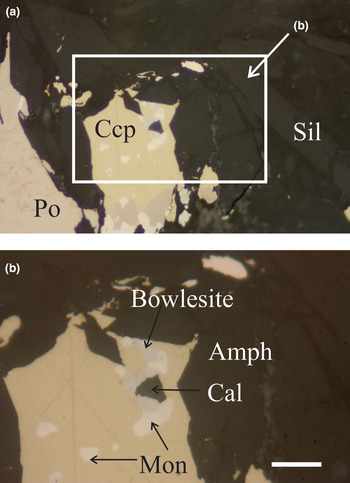
Bowlesite is hosted within sulfides only and it occurs in contact with the interstitial silicates, mainly represented by plagioclase, pyroxene, minor serpentine-subgroup and amphibole-supergroup minerals and rare calcite (Fig. 3). In the sample studied bowlesite was never found included in chromite, but is associated typically with chalcopyrite; the association with pyrrhotite is rarer. It was also observed in contact with moncheite (Fig. 3).
(a) Reflected-light microphotograph showing the mineralogical assemblage in which bowlesite occurs. (b) Enlargement of (a). Abbreviations: Ccp = chalcopyrite, Amph = amphibole, Cal = calcite and Mon = moncheite. Scale bar is 20 μm., sample no. MR 4

Appearance, and physical and optical properties
In polished sections, bowlesite occurs as anhedral to subhedral tiny grains (from a few μm up to ~20 μm), associated with chalcopyrite, pyrrhotite and pentlandite. It occurs in contact with the interstitial silicates, mainly plagioclase, pyroxene and minor serpentine-subgroup and amphibole-supergroup minerals (Fig. 3).
Bowlesite is brittle and has a metallic lustre. In plane-polarised light, in association with chalcopyrite, pyrrhotite, pentlandite and moncheite, bowlesite has a pale bluish grey colour. It is very weakly bireflectant and has no pleochroism. It has a very weak anisotropism with indeterminate rotation tints. Internal reflections were not observed.
The reflectance measurements on bowlesite and its synthetic equivalent were carried-out using a WTiC standard and a J&M TIDAS diode array spectrophotometer at the Natural History Museum in London, UK. Reflectance values of bowlesite and its synthetic analogue in air (R 1, R 2 in %) are listed in Table 1 and illustrated in Fig. 4.
Reflectance data of bowlesite and its synthetic analogue PtSnS in air. Reflectance values (R%) are plotted versus wavelength (λ, in nm).

Reflectance values for bowlesite and the synthetic PtSnS in air.

The values required by the Commission on Ore Mineralogy are given in bold.
Density was not measured because of the small amount of available material and the presence of fine intergrowths with moncheite. The calculated density is 10.06 g.cm-3, based on the empirical composition and unit-cell volume refined from powder X-ray diffraction data of the synthetic analogue.
Synthetic analogue
The small size of available grains of bowlesite prevented its extraction and isolation in an amount sufficient for the relevant crystallographic and structural investigations. Therefore, these investigations were performed on its synthetic analogue.
Synthetic PtSnS was prepared using the evacuated silica glass tube method in the Laboratory of Experimental Mineralogy of the Czech Geological Survey in Prague. Platinum (99.95%), tin (99.9999%) and sulfur (99.9999%) were used as starting materials for the synthesis. The evacuated tube with its charge was sealed, heated at 300°C for 1 month and afterwards annealed at 1000°C for 2 days. After cooling in a cold-water bath, the charge was ground to powder in acetone using an agate mortar, and mixed thoroughly to homogenise. The pulverised charge was sealed in an evacuated silica-glass tube again, and re-heated at 600°C for 7 months. The experimental product was quenched rapidly in cold water. The experimental product was first investigated by a field emission scanning electron microscope and by means of the powder X-ray diffraction analyses.
Chemical composition
Quantitative chemical analyses and acquisition of back-scattered electron images of bowlesite were performed with a JEOL JXA-8200 electron-microprobe, installed in the E. F. Stumpfl laboratory, Leoben University, Austria, operating in WDS (wavelength dispersive spectrometry) mode. Major and minor elements were determined at 20 kV accelerating voltage and 10 nA beam current, with 20 s as the counting time for the peaks and 10 s for the backgrounds. The beam diameter was ~1 μm in size. The Kα line was used for S and Lα for Pt, Pd and Sn. The following diffracting crystals were selected: PETJ for S, LIFH for Pt and PETH for Pd and Sn. Synthetic standards were: PtSn for Pt and Sn; PtS for S; and metallic palladium for Pd. The ZAF correction method was applied.
In order to verify the homogeneity and composition, the synthetic analogue of bowlesite was analysed using a CAMECA SX-100 electron probe microanalyser in WDS mode, at the Geological Institute of the Czech Academy of Sciences, Czech Republic. Pure elements and marcasite were used as standards and the spectral lines measured were Kα for S, Lα for Sn, and Mα for Pt, with an accelerating voltage of 15 kV, and a beam current of 10 nA measured on the Faraday cup.
Quantitative chemical analysis (Table 2) proved that bowlesite is characterised by the empirical formula (Pt1.001Pd0.001)Σ1.002Sn0.997S1.001, based on 3 atoms per formula unit and by the ideal and simplified formula PtSnS corresponding to (in wt.%) Pt 56.41, Sn 34.32, S 9.27, total 100.00. This composition fits perfectly with those of the synthetic Pt0.97Sn1.02S0.95: Pt 55.47, Sn 35.23 and S 9.43 (wt.%), Table 2.
Chemical composition (in wt.%) for bowlesite and the synthetic PtSnS.

S.D. – standard deviation
X-ray crystallography
Crystal structure investigations were performed on synthetic PtSnS only. Powder X-ray diffraction data were collected in Bragg-Brentano geometry using a Bruker D8 Advance powder diffractometer. Nickel-filtered CuKα radiation was used, as well as 10 mm automatic divergence slit and a Lynx Eye-XE detector. Data were collected in the angular range from 10 to 140° of 2θ with 0.007° steps. The details of data collection and basic crystallographic data are given in Table 3.
Powder diffraction data collection and Rietveld analysis of the synthetic analogue of bowlesite, PtSnS.

Weihrich et al. (Reference Weihrich, Kurowski, Stückl, Matar, Rau and Bernert2004) performed density functional theory (DFT) calculations of synthetic PtSnS and mentioned that this phase belongs to the pyrite structural family (FeS2, Pa  $\bar{3}$), which is characterised by octahedral coordination of transitional metals and S–S bonds, in a ‘dumbbell’ configuration. Other well-known members of this structural-type family are the minerals ullmannite (NiSbS, P213) and cobaltite (CoAsS, Pca21) (Weihrich et al., Reference Weihrich, Kurowski, Stückl, Matar, Rau and Bernert2004; Bachhuber et al., Reference Bachhuber, Krach, Furtner, Söhnel, Peter, Rothballer and Weihrich2015; Bayliss, Reference Bayliss1989). Weihrich et al. (Reference Weihrich, Kurowski, Stückl, Matar, Rau and Bernert2004) reported another related structure with R3 symmetry. A lowering of symmetry from Pa
 $\bar{3}$ (pyrite-type structure) to P213 (ullmannite-type structure), to Pca21 (cobaltite-type structure) or R3 structure is achieved through the replacement of homoatomic S–S dumbbells with heteroatomic X–Y pairs (X = Sb, As, Sn, Ge, Pb and Si; Y = S, Se and Te) and related X and Y structural ordering. The three above-mentioned structures (ullmannite, cobaltite-type and R3 structure) differ by a distinct ordering scheme of X and Y atoms.
According to the DFT calculation of Weihrich et al. (Reference Weihrich, Kurowski, Stückl, Matar, Rau and Bernert2004), PtSnS should have the R3 structure, which is a relatively uncommon structure-type. Although they mentioned small energy differences from DFT calculations between the considered three structural models, no direct crystallographic study was performed by Weihrich et al. (Reference Weihrich, Kurowski, Stückl, Matar, Rau and Bernert2004).
In this work, the four possible structural models for PtSnS have been tested through Rietveld refinement on powder X-ray diffraction data of synthetic PtSnS. Rietveld refinement was performed by means of the Topas 5 program (Bruker AXS, Reference Bruker2014) and involved refinement of unit-cell parameters, atomic coordinates, isotropic size and strain. Isotropic displacement parameters were fixed during the refinement (B iso = 0.2 Å2 for all atoms). Background was determined by means of a Chebyshev polynomial function of the 5th order. The following structural models have been taken into account: (1) pyrite-type structure (Pa  $\bar{3}$): Pt at 4a; Sn and S disordered at 8c positions; (2) ullmannite-type structure (P213): Pt, Sn and S at three distinct 4a positions; (3) cobaltite-type structure (Pca21): Pt, Sn and S at three distinct 4a positions; and (4) R3 structure: Pt at 1a and 3b, Sn at 1a and 3b, S at 1a and 3b distinct positions.
Although the powder X-ray diffraction patterns of phases with pyrite, ullmannite and cobaltite type structures look similar, using diffraction data measured up to a high diffraction angle (145°2θ) and on a diffractometer with a high resolution (e.g. compared to a Gandolfi camera), it is possible to distinguish between all the above-mentioned four structure models. Rietveld refinement (Fig. 5) shows unambiguously that PtSnS adopts the cobaltite structure type (Pca21). The cubic models with pyrite- and ullmannite-type structures cannot fit either the observed reflections in the powder pattern of PtSnS or the apparent peak splitting. This indicates unambiguously the Pca21 symmetry. Neither can the structure model proposed by Weihrich et al. (Reference Weihrich, Kurowski, Stückl, Matar, Rau and Bernert2004) in R3 space group fit all observed reflections (see Fig. 6). Only the cobaltite-structure model explains all observed reflections, giving a good fit with the split peaks and achieving a significantly lower R wp agreement factor (8.975%) than those for disordered pyrite, ullmannite and R3 structure models (32.071, 39.401 and 31.132%, respectively). Therefore, the final refinement of synthetic PtSnS was performed in the Pca21 symmetry using the cobaltite structure model. Crystal structure and powder-diffraction data are presented in Tables 4 and 5, respectively. The crystallographic information files have been deposited with the Principal Editor of Mineralogical Magazine and are available as Supplementary material (see below).
The final Rietveld fit for synthetic equivalent of bowlesite, PtSnS.

Details of the Rietveld refinement of the synthetic analogue of bowlesite, PtSnS, using structure models of (a) cobaltite, (b) pyrite, (c) ullmannite and (d) theoretical R3 structure. Only the cobaltite-type structure model can fit all observed reflections in the powder X-ray diffraction pattern. The unfitted reflections in other structural models are indicated by arrows. Note the significant difference in R wp agreement factors.

Atomic positions (space group Pca21) for the synthetic analogue of bowlesite, PtSnS.

The isotropic displacement parameter B iso was fixed at 0.2 Å for all atoms during the refinement.
X-ray powder diffraction data (d in Å) for PtSnS, the synthetic analogue of bowlesite (CuKα radiation, Bruker D8 Advance, Bragg-Brentano geometry).

The strongest lines are given in bold.
Structure description
The crystal structure of bowlesite contains octahedrally coordinated Pt with three S and Sn atoms as ligands. The Sn and S atoms form covalent pairs, with bond distances of 2.548(5) Å. This is slightly longer than the Pt–S distances ranging from 2.459(4) to 2.478(4) Å and at the same time shorter than Pt–Sn distances (2.607(2)–2.632(2) Å). Slightly shorter Pt–S distances were observed in the synthetic analogue of cooperite, PtS (2.312 Å), where Pt shows a square-planar coordination (Groenvold et al., Reference Groenvold, Haraldsen and Kjekshus1960). The structure is formed by corner-sharing [PtSn3S3] octahedra (Fig 7). There are three Pt octahedra sharing every anion.
Crystal structure of synthetic analogue of bowlesite, PtSnS, showing the corner-sharing [PtSn3S3] octahedra (in blue). Note the dumbbell configuration, with localised Sn–S bonds (red lines).

The crystal structure of bowlesite is a homeotype of the pyrite structure (Pa) and is isotypic with cobaltite. Its structure can be viewed as an ordered ternary variant of the pyrite-type structure with an ordered distribution of Sn and S atoms, replacing the S–S dumbbells in the pyrite structure. Its derivation from the pyrite-type structure and the corresponding group–subgroup relations are shown in Fig 8. In addition to cobaltite, the most closely related mineral species are milotaite, PdSbSe (Paar et al., Reference Paar, Topa, Makovicky and Culetto2005) and maslovite, PtBiS (Kovalenker et al., Reference Kovalenker, Begizov, Evstigneeva, Troneva and Ryabikin1979). However, both minerals show cubic symmetry and hence a different ordering scheme of anions.
Symmetry relations for the pyrite-type and the bowlesite crystal structure including splitting of the Wyckoff positions during the reduction of the symmetry. The space group of bowlesite (Pca21) is a subgroup of the pyrite-type structure (Pa).

Bowlesite belongs to the cobaltite group (2.EB.10) of the metal sulfides (M:S ≤ 1:2, 2.E) of the Nickel and Strunz classification.
Verification of identity of bowlesite and its synthetic analogue
The structural identity of bowlesite and its synthetic analogue PtSnS was confirmed by Raman spectroscopy and electron back-scattering diffraction.
Raman Spectroscopy
Micro-Raman spectra were obtained on polished samples in nearly back-scattered geometry with a Jobin-Yvon Horiba XploRA Plus apparatus (Dipartimento di Scienze della Terra, Università di Pisa), equipped with an Olympus BX41 microscope with an 100× objective and a motorised x-y stage. The 532 nm line of a solid-state laser was used. The minimum lateral and depth resolution was set to a few μm. The system was calibrated using the 520.6 cm–1 Raman band of silicon before each experimental session.
Raman spectra were collected, in the spectral range between 50 and 1200 cm–1, through multiple acquisitions with single counting times of 60 s. The laser power was filtered at 1%, 10% and 25%, i.e. 0.25, 2.5 and 6.25 mW, respectively. No change was observed on the surface of the samples at the end of the acquisitions and all the collected Raman spectra are in excellent agreement. The backscattered radiation was analysed with a 1200 gr mm–1 grating monochromator.
The Raman spectrum of bowlesite is characterised by bands in the region below 600 cm–1, in agreement with other sulfides (e.g. Mernagh and Trudu, Reference Mernagh and Trudu1993). Figure 9 shows the comparison between bowlesite and its synthetic counterpart. Bowlesite and synthetic PtSnS show the strongest band at 90 cm–1 and several other discernible bands at 125, 156, 184, 214, 273, 307 and 323 cm–1 (Fig. 9).
Raman spectra of bowlesite and its synthetic analogue PtSnS.

Electron back-scattering diffraction
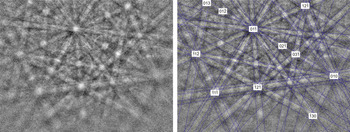
A TESCAN Mira 3GMU scanning electron microscope combined with electron back-scattering diffraction (EBSD) system (NordlysNano detector, Oxford Instruments) available at the Czech Geological Survey, Czech Republic was used for the measurements of the EBSD patterns on bowlesite. The polished section was prepared for investigation by etching the mechanically polished surface with colloidal silica (OP-U, 0.04 μm standard colloidal silica suspension) for 30 minutes to reduce the surface damage. The EBSD patterns were collected and processed using a proprietary computer program AZtec HKL (Oxford Instruments). Kikuchi patterns obtained from the natural material (10 measurements on different spots on bowlesite) were found to match those generated from our refined structural model for PtSnS (Fig. 10). The values of the mean angular deviation (MAD, i.e. goodness of fit of the solution) between the calculated and measured Kikuchi bands range between 0.27° and 0.56°. These values reveal a very good match, as long as values of MAD <1°, they are considered as indicators of an acceptable fit (HKL Technology v. 2004).
EBSD image of bowlesite, left: primary EBS patterns; right: the EBS patterns indexed with solution overlain.

Summary and concluding remarks
Bowlesite (PtSnS) is a new PGM discovered in the Merensky Reef, Bushveld complex, South Africa. In the Bushveld Complex, pristine platinum-group element mineralisation is related to sulfide accumulations (between 0.1 and 10 vol.%; mainly pyrrhotite, pentlandite, chalcopyrite and some pyrite), in a manner typical of Ni–Cu-sulfide mineralisation worldwide (Naldrett, Reference Naldrett2004).
As a rule, the PGM are associated with the sulfides, commonly intergrown with or sited at sulfide–sulfide or sulfide–silicate grain boundaries, at the peripheries or at contacts of the sulfide grains. Bowlesite is a rare component of this ‘magmatic’ ore mineral assemblage.
The small size of bowlesite (up to 20 μm across) prevented its crystallographic and structural characterisation. Therefore, its synthetic counterpart was synthesised and properly studied by X-ray diffraction. The identity between natural and synthetic samples was unequivocally confirmed by optical data, electron microprobe analyses and the structural identity by EBSD, and Raman spectroscopy.
Supplementary material
To view supplementary material for this article, please visit https://doi.org/10.1180/mgm.2020.32
Acknowledgments
The authors acknowledge Ritsuro Miyawaki, Chairman of the IMA-CNMNC and its members for helpful comments on the submitted data. Constructive comments made by two anonymous reviewers, the Structures Editor Peter Leverett and the Principal Editor Stuart Mills are greatly appreciated; they improved the quality of the manuscript. The authors are grateful to the University Centrum for Applied Geosciences (UCAG) for the access to the E. F. Stumpfl electron microprobe laboratory. This research was supported by the Grant Agency of the Czech Republic (project No. 18-15390S to A.V.). C.J. Stanley acknowledges Natural Environment Research Council grant NE/M010848/1 Tellurium and selenium cycling and supply. C. Biagioni was supported by MIUR through the PRIN 2017 project “TEOREM – deciphering geological processes using Terrestrial and Extraterrestrial ORE Minerals”, prot. 2017AK8C32.