1. Introduction
Categories and concepts are what allow us to coherently make sense of the world: they constitute the ‘bricks’ of thought (Murphy, Reference Murphy2002). Importantly, concepts are said to be flexible representations, re-enacting relevant information about a given category in a specific situation (Kiefer & Barsalou, Reference Kiefer, Barsalou, Prinz, Beisert and Herwig2013). A large body of evidence demonstrates that the structure of categories and concepts varies as a function of context, both if considered as the physical context in which people are asked to judge sentences, and when considering the linguistic context (or frame) in which people produce features of concepts (for a review see Yee & Thompson-Schill, Reference Yee and Thompson-Schill2016). Even in tasks explicitly addressing semantic access, the activation of salient semantic features generally depends on task conditions and is dynamically tied to context (Lebois, Wilson-Mendenhall, & Barsalou, Reference Lebois, Wilson‐Mendenhall and Barsalou2015; Borghi & Barsalou, Reference Borghi and Barsalou2020). Concepts also show flexibility across individuals and within the same individual over time, and as a function of changing points of view (e.g., Barsalou & Sewell, Reference Barsalou and Sewell1984). The capacity to retrieve different information in different situations for the same concept has been robustly demonstrated with behavioral tasks (e.g., Barsalou, Reference Barsalou and Neisser1987) and through neuroimaging techniques (Hoenig, Sim, Bochev, Herrnberger, & Kiefer, Reference Hoenig, Sim, Bochev, Herrnberger and Kiefer2008; Wilson-Mendenhall, Barrett, Simmons, & Barsalou, Reference Wilson-Mendenhall, Barrett, Simmons and Barsalou2011).
Together with task context, linguistic and cultural context can also affect categories. As the growing number of studies concerned with linguistic and cultural relativism testifies, concepts of time (Boroditsky, Fuhrman, & McCormick, Reference Boroditsky, Fuhrman and McCormick2011), space (Majid, Bowerman, Kita, Haun, & Levinson, Reference Majid, Bowerman, Kita, Haun and Levinson2004), motion (Papafragou, Hubert, & Trueswell, Reference Papafragou, Hulbert and Trueswell2008), color (Regier & Kay, Reference Regier and Kay2009), odor (Majid, Burenhult, Stensmyr, De Valk, & Hansson, Reference Majid, Burenhult, Stensmyr, De Valk and Hansson2018), and moral concepts (Casasanto, Reference Casasanto2009) are influenced by the linguistic, cultural, social, and experiential environment, demonstrating how variable concepts can be across groups of people in different environments (see Malt & Majid, Reference Malt and Majid2013). In this paper, we examine the role of within-culture variability in conceptual representation as a function of differential life experiences. Specifically, we explore the concept of ‘gender’ probed through a linguistic task as a function of gender identity, sexual orientation, and gender-normativity.
In order to uncover conceptual structure, linguistic tasks such as word-associations or feature- and property-generation tasks are among the most commonly employed tools (e.g., McRae, Cree, Seidenberg, & McNorgan, Reference McRae, Cree, Seidenberg and McNorgan2005). Asking participants to produce properties for a given concept like ‘truth’ (i.e., property-generation task), for example, can shed light on some relevant features of abstract concepts, such as the importance of introspective and experiential relations (e.g., Barsalou & Wiemer-Hastings, Reference Barsalou, Wiemer-Hastings, Pecher and Zwaan2005), and demonstrate that abstract concepts are characterized by fewer intrinsic properties and more complex situational relations (Wiemer-Hastings & Xu, Reference Wiemer‐Hastings and Xu2005; Barca, Mazzuca, & Borghi, Reference Barca, Mazzuca and Borghi2017). Given the higher contextual dependency of abstract concepts compared to concrete concepts (Borghi & Binkofski, Reference Borghi and Binkofski2014), their representation might be more flexibly tied to the social context and personal experiences.
While traditional theories suggest that abstract and concrete concepts engage different semantic systems (e.g., Paivio, Reference Paivio1986; Brysbaert, Warriner, & Kuperman, Reference Brysbaert, Warriner and Kuperman2014), recent approaches have begun to reconsider the classic dichotomy between purely ‘abstract’ and purely ‘concrete’ concepts (Barsalou, Dutriaux & Scheepers, Reference Barsalou, Dutriaux and Scheepers2018; Borghi, Barca, Binkofski, & Tummolini, Reference Borghi, Barca, Binkofski and Tummolini2018a, Reference Borghi, Barca, Binkofski and Tummolini2018b; Borghi, Barca, Binkofski, Castelfranchi, Pezzulo, & Tummolini, Reference Borghi, Barca, Binkofski, Castelfranchi, Pezzulo and Tummolini2019). Specifically, in a situated perspective (e.g., Barsalou, Reference Barsalou2008), both concrete and abstract concepts include situational and perceptual information, and support goal-oriented actions. In this light, abstract concepts can be considered to be represented in a multidimensional semantic space with regions that partly overlap with the semantic space of concrete concepts (Binder, Westbury, McKiernan, Possing, & Medler, Reference Binder, Westbury, McKiernan, Possing and Medler2005; Troche, Crutch, & Reilly, Reference Troche, Crutch and Reilly2014, Reference Troche, Crutch and Reilly2017; Harpaintner, Trumpp, & Kiefer, Reference Harpaintner, Trumpp and Kiefer2018). Abstract concepts also show high intra-class variability (Ghio, Vaghi, & Tettamanti, Reference Ghio, Vaghi and Tettamanti2013; Borghi et al., Reference Borghi, Barca, Binkofski and Tummolini2018b; Desai, Reilly, & van Dam, Reference Desai, Reilly and Dam2018). For instance, Roversi, Borghi, and Tummolini (Reference Roversi, Borghi and Tummolini2013) compared properties listed for social entities such as ‘choir’ with properties listed for institutional artifacts such as ‘ownership’ in a property-generation task and found that, although both classes of concepts could broadly be considered ‘social’, each elicited distinct properties: social entities elicited a higher proportion of contextual features (typical situations, entities, or events that co-occur with the target concept, e.g., ‘concert’ for ‘choir’), while institutional artifacts elicited normative relations (e.g., ‘ownership’ after one’s own death is legally normed by a ‘testament’). So, some abstract concepts are more linked to linguistic and social experience, while others have a more salient affective and experiential component (Prinz, Reference Prinz2002, Reference Prinz2012).
More generally, abstract concepts can be considered a heterogeneous class, grounded in multiple systems – including perception, action, and sensorimotor information – just like concrete concepts. In addition, however, abstract concepts are also grounded in language, emotion, and sociality (cf. Mellem, Jasmin, Peng, & Martin, Reference Mellem, Jasmin, Peng and Martin2016; Borghi et al., Reference Borghi, Barca, Binkofski and Tummolini2018a, Reference Borghi, Barca, Binkofski, Castelfranchi, Pezzulo and Tummolini2019; Desai et al., Reference Desai, Reilly and Dam2018). These grounding mechanisms might contribute to the representation of specific abstract concepts to different extents, an idea we explore in this paper.
1.1. is gender an abstract concept?
Gender is an interesting concept to think about in this context. It can be considered an embodied social concept in which both concrete (i.e., biological factors) and abstract components (related to social interpretations) are relevant. In fact, recent research has proposed the hybrid label ‘gender/sex’, pointing to a rapprochement of biological, physical, and perceptual factors with social and cultural factors in the constitution of gendered and sexual identities (van Anders, Reference Anders2015; Fausto-Sterling, Reference Fausto-Sterling2019). This contrasts with the traditional distinction between sex as the natural datum of biological sex (hormones, genes, genitalia, etc.), and gender as the province of social and cultural practices built upon a supposed sexual dimorphism. The sex–gender distinction dates back to feminist works (e.g., Rubin, Reference Rubin and Reiter1975) that aimed at opposing the biological determinism at the basis of women’s discrimination. Separating sex from gender allowed feminists to argue that gendered traits (Bem, Reference Bem1974), and more broadly genders (West & Zimmerman, Reference West and Zimmerman1987), are at least in part products of social practices (Haslanger, Reference Haslanger1995; Risman, Reference Risman2004). Nonetheless, scholars such as Butler (Reference Butler1990) have made clear that not only ‘abstract’ notions such as gender roles, but also our sexed bodies (Fausto-Sterling, Reference Fausto‐Sterling1993, Reference Fausto-Sterling2012), are defined by cultural practices and do not exist outside social meanings (Butler, Reference Butler1993a).
Within psychology, gender is perhaps one of the most employed constructs. Psychological research has focused on gender/sex differences relying on a binary gender system that opposes women to men. Specifically, a binary gender system presupposes that “there are two discrete categories into which all individuals can be sorted […] and one’s category membership is biologically determined, apparent at birth, stable over time, salient and meaningful to the self, and a host of psychological variables” (Hyde, Bigler, Joel, Tate, & van Anders, Reference Hyde, Bigler, Joel, Tate and Anders2019, p. 171). On this basis scientists have attempted to unravel traits and attitudes that distinguish the two categories. By the means of instrumental constructs, such as gender-schematicity (Bem, Reference Bem1981) or gender-consistency, scholars have tried to explain the degree of gender-congruence of individuals from childhood to adulthood.
Another line of research specifically addresses gendered social stereotypes, showing how these implicitly guide people’s expectations, judgments, and perception of individual women and men (for a review, see Ellemers, Reference Ellemers2018). For instance, traits such as assertiveness, competence, warmth, and nurturance are valued differently in relation to women and men; overall, women are more frequently associated with family life, whereas men are associated with career advancement (Greenwald & Banaji, Reference Greenwald and Banaji1995). Importantly, implicit stereotypical gendered knowledge is activated during language processing: comprehension of linguistic information consistent with stereotypical gender-expectations (e.g., feminine pronouns with the role descriptors ‘nurse’) is more fluent than when it is inconsistent (e.g., masculine pronouns with ‘nurse’; see, e.g., Miersky, Majid, & Snijders, Reference Misersky, Majid and Snijders2019; Pesciarelli, Scorolli, & Cacciari, Reference Pesciarelli, Scorolli and Cacciari2019).
Other approaches focus on the influence of grammatical gender in categorization (e.g., Cubelli, Paolieri, Lotto, & Job, Reference Cubelli, Paolieri, Lotto and Job2011). Some of these studies suggest that speakers of gendered languages incorporate gender as a salient feature of entities, even when this is irrelevant (e.g., in the representation of inanimate entities). For example, Spanish and French adults and children tend to assign feminine and masculine voices to objects according to the grammatical gender of the objects in their native languages (Sera et al., Reference Sera, Elieff, Forbes, Burch, Rodríguez and Dubois2002), and Spanish and German speakers remember noun–object pairings better when the noun of the object matches the grammatical gender of the object in their language (Boroditsky, Schmidt, & Phillips, Reference Boroditsky, Schmidt, Phillips, Gentner and Goldin-Meadow2003). A recent systematic review of the literature on grammatical gender and linguistic relativity suggests that grammatical gender effects on thought are task-specific and modulated by several factors (Samuel, Cole, & Eacott, Reference Samuel, Cole and Eacott2019).
1.2. challenges to the binary gender system
While the ‘bigenderist assumption’ dominates the scientific literature, an emerging area of research from cognitive science and biology questions the binary nature of gender (e.g., Roughgarden, Reference Roughgarden2004; van Anders, Goldey, & Kuo, Reference Anders, Goldey and Kuo2011; Jordan-Young & Rumiati, Reference Jordan-Young and Rumiati2012; Olson, Key, & Eaton, Reference Olson, Key and Eaton2015; Joel, Reference Joel2016; Joel & Fausto-Sterling, Reference Joel and Fausto-Sterling2016). Notably, although most people are likely cisgender (i.e., people who perceive their assigned birth sex as congruent with their expressed and desired gender identity), individuals whose identities are not confined to the binary gender system (i.e., gender non-conforming, genderqueer, gender-diverse, or transgender individuals) have been documented throughout history and across diverse cultures (Herdt, Reference Herdt1993; Devor, Reference Devor1997). Attention to gender non-conforming individuals in the psychological sciences is also promoted by the American Psychological Association, which in 2015 issued guidelines for best practices with transgender and gender-nonconforming individuals (APA, 2015).
Recently some scholars have introduced in their measurements the notion of gender non-conforming or genderqueer (i.e., a person rejecting traditional gender categories such as man/woman), and have begun to investigate gender identity without pathologizing gender-diverse individuals (see Hegarty, Ansara, & Barker, Reference Hegarty, Ansara, Barker, Dess, Marecek and Bell2018, for a recent discussion). For example, Galupo, Pulice-Farrow, and Ramirez (Reference Galupo, Pulice-Farrow, -Ramirez and Sinnott2017a) asked a sample of 197 individuals who self-identified as either gender-variant or agender to describe their gender identities with the aim of investigating what non-binary individuals consider as central features of their gender identity. A thematic analysis of responses showed that fluidity, mixture, and rejection of traditional bipolar dimensions such as femininity and masculinity were key features.
Experiences of non-binary feelings were also evident among ‘normative’ individuals in a study by Joel, Tarrasch, Berman, Mukamel, and Ziv (Reference Joel, Tarrasch, Berman, Mukamel and Ziv2014) with Israeli participants. ‘Normative’Footnote 1 in this literature refers to people who feel that their assigned birth sex is aligned with their affirmed gender identity, and who generally conform to heterosexual norms, or people who are not plurisexual (i.e., are sexually attracted by only one sex). Joel and colleagues explored identity using a questionnaire which measured gender identity, gender dysphoria, and gender performance (Multi-GIQ questionnaire; Joel et al., Reference Joel, Tarrasch, Berman, Mukamel and Ziv2014; see also Jacobson & Joel, Reference Jacobson and Joel2018, Reference Jacobson and Joel2019) among people who identified as women, men, and queer. They found that, among self-identified women and men, over 35% of people reported feeling the ‘opposite’ gender, both genders, or neither. This was especially prevalent in queer individuals, but no significant differences emerged between the three groups, suggesting that, far from being binary, gender is fluid and multidimensional.
To summarize, gender has been investigated from three broad perspectives: (1) in relation to social stereotypes, (2) relating to the representation of grammatical gender in language and thought, and (3) as a characteristic related to the sense of one’s own identity. However, it is unclear how lay people conceptualize gender exactly. Is it conceptualized as something related to our physical and biological make-up or better characterized by social practices? Our study examines the concept of gender in Italian-speaking participants. The main purpose was to explore people’s conceptual representation of gender, taking into account specific experiences that might contribute to the shaping of the concept, in particular different experiences associated with gender identity, sexual orientation, and gender-normativity. We ask whether the concept of gender is differentially shaped by each of these gender-related experiences, in a predominantly conservative cultural setting in terms of gender-related issues.
1.3. the current study: how do Italian people conceptualize gender?
We adopted a common methodology used to investigate conceptual knowledge. We asked a sample of Italian-speaking participants to list words they freely associated with the concept of genere ‘gender’. We conducted the study in Italy, which is an interesting context in which to explore this question because of the specific linguistic and cultural particulars of this community. In the Italian language, genere ‘gender’, is a polysemous word covering five areas of meaning. In addition to the social interpretation of sex,Footnote 2 it also includes: (1) the original Latin notion of ‘genus’, representing what species have in common (e.g., the genus Panthera, within the family Felidae, includes species such as Lion and Tiger); (2) a notion similar to the English meaning of kind or type; (3) an aesthetic canon – similar to English genre – applying to literature as well as to cinema, arts, and music; (4) the grammatical category distinguishing nouns into feminine or masculine classes, also used to differentiate individuals based on biological features. This distinction is not confined to animate entities, but also applies to inanimate entities on the basis of linguistic conventions – e.g., in Italian ‘philosophy’ is feminine and ‘table’ is masculine. This binary dichotomy may have ramifications for the general concept of ‘gender’ too. Indeed, it has been hypothesized that speaking a language that encodes gender in a binary fashion (e.g., Italian, French) may reinforce the conceptualization of gender as a binary system (see Gabriel & Gygax, Reference Gabriel, Gygax, Giles and Maas2016; Gabriel, Gygax, & Kuhn, Reference Gabriel, Gygax and Kuhn2018; Pérez & Tavits, Reference Pérez and Tavits2019).
The concept of gender in Italian is also interesting because of the specific cultural and social context. Italy is a predominantly Catholic country, and theological accounts of gender, sexuality, and family politics are very prominent.Footnote 3 In Italian public debate, the English term gender is maintained in its English form as a derogatory term. It describes gender and queer studies as based on an ‘ideology’ that undermines the structure of the traditional family (the so-called ‘ideology of gender’; see, e.g., Garbagnoli, Reference Garbagnoli2014; Bernini, Reference Bernini2016).
In order to investigate how Italian speakers represent the concept of gender, we used a free-listing paradigm. We were primarily interested in uncovering conceptual structure, and not in assessing participants’ explicit attitudes towards gender-related issues. To avoid participants adopting social desirability strategies, we refrained from explicit measures such as questionnaires or scales measuring attitudes towards sexuality or gender roles. Instead we focused on participants’ own conceptual relations, thus opting for an approach more explicit than, for example, Implicit Association Tasks (IAT, e.g., Greenwald, McGhee, & Schwartz, Reference Greenwald, McGhee and Schwartz1998). Free-listing tasks, also termed ‘semantic fluency procedures’, are thought to make explicit the psychological proximity of concepts and words produced in sequence. The general assumption underlying this kind of task is that when a concept is activated in memory it will in turn prime words and concepts which are semantically related or similar to it. This provides an indirect measure of the psychological saliency of concepts (see Crowe & Prescott, Reference Crowe and Prescott2003).
We conducted the free-listing task with a diverse pool of Italian participants who were divided into three subgroups according to their gender identity, sexual orientation, and classification according to normative or bigenderist benchmarks. In line with the idea that abstract concepts are represented as multidimensional constructs (Barsalou et al., Reference Barsalou, Dutriaux and Scheepers2018; Borghi et al., Reference Borghi, Barca, Binkofski and Tummolini2018a), where both embodied and contextual aspects interact, we expected that across all participants we would find evidence of the duality of genere ‘gender’ in Italian, such that participants would list features relating to both the abstract and concrete sense of gender. As such, we expected early and frequent listing of features of gender as a social construct (e.g., culture, femininity, masculinity), as well as features related to the more concrete meaning (e.g., sex, body, genitalia).
In addition, we hypothesized that gender is at least in part represented differently depending on the subgroup of interest following the proposal that conceptual knowledge is flexibly modulated by different experiences (Casasanto & Lupyan, Reference Casasanto, Lupyan, Margolis and Laurence2015). We investigated whether participants who differed in their gender identity listed different features of the concept gender. Additionally, we expected ‘normative’ and heteronormative individuals, who typically conform to the gender-binary system (Motschenbacher, Reference Motschenbacher, Barrett and Hall2019), to produce more features focusing on physical, sexual, and biological aspects of gender, while ‘non-normative’ and non-heteronormative (i.e., plurisexual, homosexual) participants would generate more features related to their personal experiences and to the social sense of gender.
2. Method
2.1. participants
Eighty native Italian speakers voluntarily took part in the study. Ethical approval was provided by the Ethics Committee of the Institute of Cognitive Sciences and Technologies of the Italian National Research Center (ISTC-CNR Ethical Approval n. 0000315). Participants were asked to provide their birth sex, self-identified gender identity, and sexual orientation (details of procedure below). The majority of individuals were highly educated: 67.5% had a master’s degree and 13.7% had a PhD; 17.5% had completed high school, while only 1.2% had a lower high school education.
2.2. procedure
We created an on-line questionnaire divided into three sections that participants completed in a fixed order. In the first section, participants gave basic personal information, such as age and birth sex (female; male; intersex). The second section consisted of the free-listing task. Participants were asked to provide ten concepts that they thought were related to the concept of gender (Il tuo compito ora è quello di scrivere dieci concetti che ti vengono in mente in relazione al concetto di genere ‘Your task is now to type ten concepts that come to your mind related to the concept of gender’).
Finally, in the third section, participants provided additional information about their self-identified gender identity, sexual orientation, and level of education. Gender identity was assessed through forced-choice boxes (woman, man, queer, and transgender), in addition to a blank text box labeled ‘other’ that participants could fill in according to their preferences. Keeping birth sex separate from gender identity allowed participants to report their affirmed gender identity, thus avoiding mis-gendering practices (see Ansara & Hegarty, Reference Ansara and Hegarty2014). Indeed, inferring gender identity from biological sex has been criticized by some scholars, in that self-determined gender identity does not always match with the sex assigned at birth. However, we made this distinction explicit only in the third section of the questionnaire, to avoid potential demand effects. Sexual orientation was assessed through the Kinsey Scale (Kinsey, Pomeroy, & Martin, Reference Kinsey, Pomeroy and Martin1948), a self-report measure where participants respond on a 7-point scale, ranging from ‘exclusively heterosexual’ to ‘exclusively homosexual’ – hence not considering sexual behavior a strict dichotomy (although for criticism see Savin-Williams, Reference Savin-Williams2016; Galupo, Mitchell & Davis, Reference Galupo, Mitchell and Davis2018).
3. Results
We sought to investigate how individuals conceptualize gender, in particular in relation to their personal experiences related to gender. As a first step, we report the characteristics of our participants. We then focus on the free-listing data and aggregate results across all participants to illustrate which words were produced more frequently overall. We show how words produced by the full cohort of participants tested are clustered together using a measure which accounts for the psychological saliency of the produced associates (see the following sections for details). This overall analysis is followed by subsidiary analyses zooming in on the free-listing produced by different subgroups according to gender-related experiences. All data and scripts are available at <https://osf.io/3zdsm/>.
3.1. participant characteristics
There were a total of 80 participants, with 45 female (age M = 29.5; SD = 7.7), 35 male (age M = 32.7; SD = 10.5), and no intersex individuals. Among these, 41 identified as women (age M = 29.5; SD = 6.8), 32 identified themselves as men (age M = 33.3; SD = 11.5), 7 identified as queer (age M = 28.1; SD = 6.7), and none as transgender.
Sexual orientation was assessed using the Kinsey Scale (Kinsey et al., Reference Kinsey, Pomeroy and Martin1948; for further details, see ‘Procedure’). Among the total sample, 36 placed their sexual behavior at the heterosexual extreme of the Kinsey Scale (points 1 and 2), while 37 considered their sexual behavior as homosexual (points 6 and 7 of the Kinsey Scale). Seven participants fell in the middle of the scale (points 3, 4, 5) or defined their sexual orientation as bisexual or asexual. At a more fine-grained level, 50 participants reported to be attracted only by one sex (points 1 and 7), while 29 participants reported to be attracted to more than one sex to different extents (points 2, 3, 4, 5, 6), and one participant identified as asexual.
In order to explore how these differences relate to the concept of genere ‘gender’, participants were first divided into two groups according to their self-affirmed gender identity (woman and man). Individuals who identified as queer (n = 7) were excluded from the analysis by gender identity because of the small sample size; however, their responses were collated in the subsequent analyses by ‘normativity’, thus partially avoiding the potential marginalization of under-represented gender and sexual minorities.
Second, participants were divided according to their sexual orientation according to their ratings on the Kinsey Scale. Participants’ responses followed a bimodal distribution. Accordingly, participants who scored 1 or 2 on the Kinsey Scale were considered heterosexual, while those who scored 6 or 7 were considered homosexual for the purposes of the analyses by sexual orientation. The remaining participants who rated their sexual orientation on the Kinsey Scale as 3, 4, or 5, or bisexual and asexual, were excluded from this analysis (n = 7), but they were included in the subsequent analyses.
Finally, to distinguish ‘normative’ from ‘non-normative’ individuals, we took into account participants’ gender identity, sexual orientation, and the correspondence between birth sex and affirmed gender identity. ‘Normative’ individuals (n = 43) are therefore cisgender monosexual individuals (either exclusively heterosexual or exclusively homosexual; see, e.g., Galupo, Lomash, & Mitchell, Reference Galupo, Lomash and Mitchell2017b; Jacobson & Joel, Reference Jacobson and Joel2019); ‘non-normative’ individuals (n = 37) are gender-diverse individuals, individuals falling under the umbrella term of ‘transgender’, and/or ‘cisgender’ individuals who did not define their sexual preferences in strictly monosexual terms. We included exclusively homosexual cisgender individuals (point 7 of the Kinsey Scale) in the category of ‘normative’ individuals (Motschenbacher, Reference Motschenbacher, Barrett and Hall2019). In fact, non-exclusively monosexual individuals (points 2, 3, 4, 5, 6 of the Kinsey Scale) can be considered as ‘less normative’ than cisgender exclusively homosexual individuals, in that their sexual experiences challenge the assumption that sexual interests are only defined by sexual biological features in a binary fashion (see also van Anders, Reference Anders2015; Hegarty, Ansara, & Baker, Reference Hegarty, Ansara, Barker, Dess, Marecek and Bell2018).
3.2. free-listing task
3.3. how is the concept of ‘gender’ represented across all participants?
Overall, the total sample of 80 participants produced 300 words. There was great variation in the responses provided by participants, suggesting that, as expected, genere ‘gender’ is a complex concept that incorporates a number of distinct components. Participants produced a small number of common associates: out of 300 words, 64% (n = 192) were produced only once by an individual. The most frequently listed word (identity), was produced by 24 out of a total sample of 80 participants.Footnote 4 So, there is low overall coherence of this category in this sample. For the overall analysis presented first, we focus on associates produced by at least 5% of all participants. Among the list of terms produced by all participants, 41 were produced by at least 5% of the sample. As would be expected, the data exhibit a power law distribution with the frequency of words inversely proportional to their rank (cf. Zipf, Reference Zipf1935).
In order to address our first hypothesis, namely that ‘gender’ encompasses both abstract and concrete components, we asked an independent sample of 20 Italian participants (9 females, 10 males, 1 intersex; M age = 28.1, SD = 6.4) to rate on a 7-point scale the most commonly produced associates in terms of abstractness, concreteness, and emotionality. In line with recent research (Della Rosa, Catricalà, Vigliocco, & Cappa, Reference Della Rosa, Catricalà, Vigliocco and Cappa2010; Villani, Lugli, Liuzza, & Borghi, Reference Borghi, Barca, Binkofski, Castelfranchi, Pezzulo and Tummolini2019), we probed abstractness and concreteness separately. The order of presentation of the words and of the scales was randomized across participants.
All data were analyzed using R (version 3.6.2; R-Core Team, Reference Team2019) and RStudio (version 1.2.1335; RStudio Team, Reference Team2018); data processing was also carried out in part using ‘dplyr’ (Wickham, François, Henry, & Müller, Reference Wickham, François, Henry and Müller2020), ‘tidyverse’ (Wickham et al., Reference Wickham, Averick, Bryan, Chang, McGowan, François, Grolemund, Hayes, Henry, Hester and Kuhn2019), ‘broom’ (Robinson & Hayes, Reference Robinson and Hayes2020), and ‘emmeans’ (Lenth, Reference Lenth2020) packages.
As hypothesized, participants in the free-listing task produced terms that included abstract and concrete associates (see Table 1). Overall, the ratings of the free-listing associates demonstrated a negative correlation between abstractness and concreteness ratings (r(39) = –0.88, p < .001), as would be expected. Concreteness and emotionality ratings were positively correlated (r(39) = 0.34, p = .028); but there was no significant correlation between abstractness and emotionality ratings (r(39) = –0.08, p = .587). Generally, the terms produced varied widely in ratings for all three dimensions considered: abstractness ratings ranged from scores of 1.60–5.15 (M = 3.83, SD = 0.92); concreteness ratings ranged from 2.50 to 5.75 (M = 3.93, SD = 0.70); and emotionality ratings ranged from 1.90 to 5.60 (M = 3.71, SD = 0.90). One could wonder whether terms produced early in the free-listing differed from those produced later. Perhaps early associates are more likely to be abstract, or conversely more likely to be concrete. We found no significant difference among the first 20 terms produced and the last 20 produced in abstractness (t(39) = –0.52, p = .600), concreteness (t(39) = 0.45, p = .649), or emotionality (t(39) = 1.04, p = .300). This suggests that abstract and concrete associates are equally distributed across the free-listing exemplar production of ‘gender’.
Terms produced by at least 5% of participants (N = 80) ordered according to their frequency, and associated rating scores on emotionality, abstractness, and concreteness. On the difference score, a positive score indicates an abstract concept; a negative score indicates a concrete concept.

To facilitate further qualitative interpretation, we computed an abstractness–concreteness difference score by subtracting the mean abstractness rating for each item from the mean concreteness rating. Terms with a resulting positive value can be considered abstract words, and those with negative values concrete words (see Table 1). Among the 41 most frequently produced terms, 23 were abstract and 18 were concrete.
The free-listing data revealed associates with concrete physical and perceptual connotations, (e.g., body, woman, female, man, male, sex), as well as abstract social and cultural experiences (e.g., construct, freedom, category, fluidity). Additional terms included experiential and personal features (e.g., education, identity, discrimination, identification), as well as linguistic associations connected to the term genere in Italian (e.g., music, literature, grammar, type).
3.3.1. Measure of psychological proximity
To analyze the free-listing data in more depth, we used a measure developed by Crowe and Prescott (Reference Crowe and Prescott2003). According to this measure, similarity between pairs of items in a free-listing task can be calculated by considering both the distance of two items produced in a single list (from an individual participant), and the distance of the same two items produced across lists (across participants). The measure is given by two component measures, namely
 $ {\alpha}$
and
 $ \beta$
w, one based on within-list proximity
 $ \alpha$
), and the other on across-list item co-occurrence
 $ \beta$
w). These two metrics are combined to form the overall inter-item similarity metric
 $ \alpha\beta $
w). Matrices of inter-item dissimilarity were computed initially for all the participants, and then for all the groups of interest (for further details see Crowe & Prescott, Reference Crowe and Prescott2003). Once the most frequently produced words were identified, both for the total sample of participants and for the subgroups of interest, associate words were subjected to cluster analyses based on inter-item dissimilarity matrices described above. Hopkins’ statistic test has been performed using the package ‘factoextra’ (Kassambara & Mundt, Reference Kassambara and Mundt2017). Clustering indices were calculated with the ‘NbClust’ package (Charrad, Ghazzali, Boiteau, & Niknafs, Reference Charrad, Ghazzali, Boiteau and Niknafs2014), and dendrograms produced using ‘dendextend’ package (Galili, Reference Galili2015).
3.3.2. Clustering methods and analyses
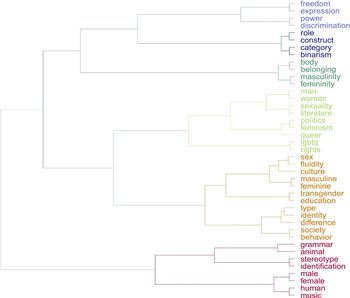
Before applying specific clustering methods, we assessed whether our data could be clustered using Hopkins’ statistic test (Lawson & Jurs, Reference Lawson and Jurs1990), which measures the probability that a given dataset is generated by a uniform data distribution. The results indicated that our data approach a good tendency (H = 0.53). Hierarchical cluster analysis was performed based on the dissimilarity matrix using Ward’s method, based on a sum-of-squares criterion (Murtagh & Legendre, Reference Murtagh and Legendre2014) which minimizes within group dispersion (see also Harpaintner et al., Reference Harpaintner, Trumpp and Kiefer2018). In order to determine the number of clusters and assess cluster validity, we relied on indices that are most frequently used in the literature. We thus computed the Silhouette Index, C-Index, McClain Index, and Dunn Index. Two of the aforementioned indices provided a six-cluster solution (SI = 0.3; CI = 0.3), while the remaining two suggested a two-cluster solution (McClain = 0.3; Dunn = 0.06). We opted for the six-cluster solution (Figure 1), which better illustrates the fine-grained structure of genere ‘gender’. The outcome is represented in the dendrogram as visual proximity of words; namely, words that appear clustered together by short branch lengths are words that were most frequently produced in succession.
Dendrogram representing the six-clusters solution for words produced by at least 5% of participants.

We found that there was no difference across clusters in abstractness ratings (F(5,35) = 1.78, p = .142) or concreteness ratings (F(5,35) = 2.13, p = .084), but there was a significant difference in emotionality rating (F(5,35) = 3.43, p =.012). Pairwise comparisons showed that Cluster 1 was rated as more emotional than Cluster 2 (t(35) = 3.92, p = .004), but there were no other significant differences.
We refer to the clusters in Figure 1 from top to bottom. In the top cluster – Cluster 1 (violet) – and the next Cluster 2 (blue) the terms are consistent with the conceptualization of gender as a social construct. These two clusters represent the most abstract part of the dendrogram, and point to the idea of gender as a social construction (Butler, Reference Butler1990), entrenched in social structures (e.g., power, discrimination; Foucault, Reference Foucault1978). Cluster 1 had a large number of words that were rated as highly emotional (expression, freedom, power, and discrimination).
In Cluster 2 all the words were rated as abstract (construct is the most abstract term in the list; see Table 1). This cluster includes concepts generally used in philosophical and political discourses on gender, and it reveals aspects of the conceptualization of gender derived from shared knowledge and mediated by cultural and social factors (see Shea, Reference Shea2018).
In Cluster 3 (green), features related to the physical, perceptual, and interoceptive characteristics of gender are evident. Words in this set refer to the physical display of gender attitudes (masculinity and femininity), clustered together with sex; body and belonging are linked together. In this cluster, abstract terms (belonging, femininity, and masculinity) are combined with the most concrete term listed (body; see Table 1), suggesting that this cluster is a mix of interoceptive features and physical and perceptual ones.
Cluster 4 (yellow) points to gender as a specifically cultural and social discourse. This is suggested by the presence of sexuality, politics, feminism, and queer (e.g., Foucault, Reference Foucault1978; Butler, Reference Butler1993b; Motschenbacher, Reference Motschenbacher, Barrett and Hall2019), and by the strong associations of the words rights and lgbtq.
Cluster 5 (orange) is the most heterogeneous cluster. Here, terms relating and challenging the normative facet of gender (transgender, fluidity) appear as closely linked to social and cultural terms (culture, education, difference, society, and behavior) and terms indicating identity-related characteristics (feminine, masculine, and identity). This is likely to reflect the relation that exists in people’s minds between education and the development of a gendered identity (for a review, see, e.g., Fausto-Sterling, Reference Fausto-Sterling2012), and it is in line with the notion of socialization (e.g., Witt, Reference Witt1997), according to which parents and peers play a fundamental role in the development of gender-stereotyped self-concepts in children, by reproducing and projecting culturally derived behaviors and norms.
In Cluster 6 (red) a different meaning of the Italian word genere appears. We find words referring to the meaning of ‘genre’ (music), as well as ‘kind’, ‘species’ (animal, human), and grammar. In addition, this cluster includes male and female, likely linguistic associations given that they are clustered closely together with the words human and music. This cluster is the most concrete according to the ratings: of a total of 8 words, only two can be considered abstract (identification and stereotype); all the other words were rated as concrete.
Overall, our results suggest that the concept of gender cannot be considered either a purely abstract or a purely concrete concept. Rather, it encompasses aspects traditionally considered to be both abstract and concrete. Linguistic associations (e.g., Paivio, Reference Paivio1986) such as literature and animal, experiential and situational features like identification and behavior (e.g., Barsalou & Wiemer-Hastings, Reference Barsalou, Wiemer-Hastings, Pecher and Zwaan2005), social and contextual features like binarism and queer (Roversi et al., Reference Roversi, Borghi and Tummolini2013), culturally mediated aspects like politics and feminism (Shea, Reference Shea2018), and bodily or biological properties (e.g., body, female, and male) appear. This result is in line with recent accounts of abstract conceptual knowledge (e.g., Barsalou et al., Reference Barsalou, Dutriaux and Scheepers2018; Borghi et al., Reference Borghi, Barca, Binkofski and Tummolini2018a) and with contemporary debates reconsidering the distinction between sex and gender (e.g., van Anders, Reference Anders2015).
3.4. does the concept of ‘gender’ vary across subgroups?
In the analysis presented so far, we did not distinguish people by gender identity, sexual orientation, or according to gender and sexual norms. However, these aspects are likely to influence the conceptualization of gender. To assess this, participants were divided into three subgroups according to their gender identity (woman, man), sexual orientation (heterosexual, homosexual), and ‘normativity’ (‘normative’, ‘non-normative’) (see Section 3.1). For each of these subgroups, we examined how people conceptualized genere ‘gender’. Relevant words that entered the cluster analysis were items produced at least by 10% of participants in each subgroup. In the subgroups analyses, we raised the threshold for inclusion from 5% to 10% so as to avoid having items produced by only one participant which would have arisen due to the subsetting of the data. Inclusion of unique items would have merely led to more idiosyncratic responses being considered in the analyses, whereas we hope to capture general trends.
3.4.1. The concept of gender as a function of gender identity
Overall, there was no significant difference in the total number of items listed by women (M = 8.90; SD = 2.71) and men (M = 7.84; SD = 2.86) (t(71) = –1.61, p =.111), although women showed higher agreement in the terms they mentioned, with 29 commonly listed words compared to 12 common words produced by men. Among the terms produced by women, 17 were abstract and 12 concrete. Men produced 8 concrete and 4 abstract terms. Chi-squared tests revealed no difference between the two groups in the number of tokens of abstract and concrete terms (χ2(1) = 1.27, p = .258). Comparing all relevant terms produced by women and men also revealed no significant difference in abstractness (t(39) = 1.85, p = .071), concreteness (t(39) = –1.82, p = .076), or emotionality (t(39) = –0.17, p = .863). The most frequently produced words by women (Panel A, Figure 2) were identity (39% of the sample) and sex (27%). For men (Panel B, Figure 2) masculine was the most frequently produced word (22%), followed by identity (19%). Figure 2 shows the dendrograms resulting from Hierarchical Cluster Analysis (HCA) for each group.
Dendrograms of words produced by at least 10% of (A) women and (B) men.

The data from both groups supported a good clustering tendency (women’s H = 0.58; men’s H = 0.69). Even though some words overlapped between the two groups (n = 9), the cluster analyses revealed differences between women and men too. For instance, identity – one of the most frequently produced terms by both groups – was mentioned by men together with feminine, masculine, and sex, suggesting a relation between perceptual and physical properties and gender identities. For women, however, identity appeared closely related to social terms (construct, role, freedom) and subsequently connected with fluidity, sex, behavior, and society, suggesting a non-deterministic perspective on gender identity.
It is also noteworthy that, although traditional bigender terms were mentioned by both groups, they are differently positioned in the dendrograms. On the one hand, male and female are represented in a small biological cluster, in the women’s dendrogram, which in turn is connected to words that seem to challenge a traditional binary conception of gender (transgender). In the men’s dendrogram, however, the clustering of male and female appears as a linguistic association to the grammatical category of gender, as indicated by the link between the two terms and the word grammar. Masculine and feminine are part of a small linguistic cluster for women (indicated by the presence of the word music); for men they are part of a cluster marking the identity-laden value of gender, possibly delimited by sexual differences (sex). Woman co-occurred with man in the men’s responses, while in the women’s dendrogram the word woman was coupled with feminism, along with difference and queer, whereas man does not appear. Difference and culture are both part of a socio-cultural cluster in both groups. While women generally associated culture with sexuality in a cluster including masculinity and femininity, men often mentioned them together with rights, and subsequently man and woman.
In sum, there are notable qualitative differences between the two groups. Although the conceptualization of gender by men included social and cultural features (e.g., rights was mentioned by men, but not women), terms explicitly challenging a binary and heteropatriarchal system were not highly salient: most words referred to the perceptual, biological, and physical sphere; for women, social, cultural, and experiential features played a more central role. Women mentioned words with social and political value (e.g., queer, feminism, construct, stereotype, fluidity, and binarism), consistent perhaps with their social experience of historically being considered a subaltern identity. This relates to the notion of ‘androcentrism’, that implies “the privileging of male experience and the ‘otherizing’ of female experience, such that males and male experience are treated as a neutral standard or norm […] and females and female experience are treated as a sex-specific deviation from that allegedly universal standard” (Bem, Reference Bem1993, p. 41; for a recent review, see Bailey, LaFrance, & Dovidio, Reference Bailey, LaFrance and Dovidio2019).
3.4.2. The concept of gender as a function of sexual orientation
There was no significant difference in the total number of items listed by heterosexual participants (M = 8.64; SD = 2.83) and homosexual participants (M = 8.30; SD = 2.81) (t(71) = 0.51, p = .607), although heterosexual participants showed higher agreement in the terms they mentioned, producing 22 words in common versus 12 words in the homosexual group. There was no significant difference between the two groups in the number of abstract and concrete terms listed (χ2(1) = 0.75, p = .383), with heterosexual participants listing 8 abstract and 14 concrete terms, and homosexual participants listing 7 abstract and 5 concrete terms. Similarly, comparing all relevant terms, there was no significant difference in abstractness (t(32) = –1.10, p = .279), concreteness (t(32) = 1.10, p = .276), or emotionality ratings (t(32) = –1.16, p = .251), of the terms listed by heterosexual and homosexual participants. Sex was the most frequently produced word by the heterosexual group (Panel C, Figure 3) (31% of the sample), followed by culture (19%). The homosexual group (Panel D, Figure 3) produced identity (41%) and masculine (30%) most frequently. Figure 3 shows the dendrograms resulting from HCA performed on target concepts for each group.
Dendrograms of words produced by at least 10% of (C) heterosexuals and (D) homosexuals.

The data from both groups supported a good clustering tendency (heterosexuals’ H = 0.70; homosexuals’ H = 0.60). Even though some words overlapped between the two groups (n = 9), the cluster analyses showed interesting qualitative differences. Sexuality forms a separate cluster in both groups, but in the heterosexual group is paired with gendered terms (man and woman), while in the homosexual group it forms a separate and distinct cluster together with rights and society; culture is instead in a separate cluster connected with fluidity and freedom. Masculine and feminine form a separate small cluster in both groups but are associated with linguistic features such as human and music by the heterosexual group, but with sex by the homosexual group. Sex was instead frequently produced together with masculinity and femininity by the heterosexual group, indicating a connection between biological sex and physical appearance.
The clusters in the heterosexual group’s dendrogram shows a high prevalence of linguistic associations, along with attention to the bipolar structure of the term gender (with the addition of transgender). This suggests that one crucial dimension for this group is the biological one that includes the female/male distinction, and the social roles that this distinction carries. The most abstract cluster in this group can be considered a socio-cultural cluster, centered on culture and society, and encompassing difference and role. In contrast, for the homosexual group the two most abstract clusters specifically address the political and social value of the term gender: we find here terms such as rights, fluidity, and freedom. Interestingly, these are important instances for the LGBTQI community. The fact that they were mainly mentioned by this subgroup suggests that personal experiences and different contexts shape our conceptual system.
3.4.3. The concept of gender as a function of ‘normativity’
There was no significant difference in the total number of items listed by ‘normative’ participants (M = 8.77; SD = 2.49) and ‘non-normative’ participants (M = 8.16; SD = 3.10) (t(78) = 0 .96, p =.337). There was also no significant difference between the two groups in the number of abstract and concrete terms listed (χ2(1) = 0.11, p = .731), with ‘normative’ participants listing 7 abstract and 10 concrete terms, and ‘non-normative’ participants listing 9 abstract and 8 concrete terms. Similarly, comparing all relevant terms there was no significant difference in ratings of abstractness (t(32) = –1.24, p = .222), concreteness (t(32) = 1.42, p =.165), or emotionality (t(32) = –0.08, p = .934), listed by ‘normative’ and ‘non-normative’ participants.
The first two most frequently listed words by the ‘normative’ (Panel E, Figure 4) group were identity (30%) and sex (26%). In the ‘non-normative’ group (Panel F), the most frequently produced words were identity (30%) and culture (24%). Figure 4 shows the dendrograms resulting from HCA performed on target words for each group.
Dendrograms of words produced by at least 10% of (E) ‘normative’ and (F) ‘non-normative’ participants.

The data from both groups supported a good clustering tendency (‘normative’ H = 0.55; ‘non-normative’ H = 0.60). Even though some words overlapped between the two groups (n = 10), the cluster analyses indicated qualitative differences too. Masculine and feminine formed a separate cluster in the ‘normative’ group, suggesting the two terms represent a crucial axis along which the concept of gender is organized; in the ‘non-normative’ group they were instead grouped together with the word expression and subsequently sex and fluidity, in a cluster evoking the idea of traditional gendered roles as social and cultural constructions, and suggesting the idea of femininity and masculinity as performative acts (Butler, Reference Butler1990). Society was mentioned mainly with the word sexuality and education, and then the word identity in the ‘normative’ group, in a cluster that can be labeled as ‘socio-cultural’. In the ‘non-normative’ group, society was also included in a heterogeneous cluster that represents the concept of gender as a social construct. Specifically, the term society was frequently mentioned together with discrimination. Sex was produced in association with role and difference in the ‘normative’ group, while it was paired with the word fluidity in the ‘non-normative’ group.
The words listed by both groups reveal differences in the conceptual representation of gender. The ‘normative’ group frequently mentioned words referring to gender in a binary perspective (e.g., male/female, woman/man). In the ‘non-normative’ group, the experiential and personal domain together with social and cultural aspects emerge more sharply (e.g., discrimination, expression, construct, fluidity, and queer). At the broadest level, two main clusters emerged in the ‘normative’ group: one explicitly referring to a binary perspective on gender which can be considered a more ‘concrete’ cluster, composed of the words that were rated as more concrete (woman, man, male, female) with the addition of the word transgender. The second cluster is a more abstract cluster including words such as sexuality, education, society, stereotype, and culture. In the ‘non-normative’ group, on the other hand, the concrete grounding relies mainly on the experiential corporeity of gender (masculinity and femininity connected to expression), but it is connected with sex and fluidity. Overall, the ‘normative’ group emphasized a bigenderist perspective of gender, while the ‘non-normative’ group referred to contextually dependent and social phenomena challenging traditional bigenderist assumptions.
4. General discussion
Our results demonstrate that the concept of gender is multilayered. According to participants’ responses, biological, perceptual, and social aspects converge in the conceptual representation of genere. When people were asked to produce free associations of the term, both abstract (i.e., social, cultural, and linguistic) and concrete (i.e., physical, biological, and sexual) associations were elicited. Our findings also suggest that the concept of gender is malleable: depending on the characteristics of the individuals, some features of the concept appear more salient than others.
The results do not align well with the traditional view that assumes abstract and concrete concepts are represented distinctly (e.g., Paivio, Reference Paivio1986, Brysbaert et al., Reference Brysbaert, Warriner and Kuperman2014), but are more compatible with the idea of a fuzzy boundary between abstract and concrete concepts (e.g., Barsalou et al., Reference Barsalou, Dutriaux and Scheepers2018). We believe that the concept of gender is particularly illustrative of this haziness, although future research could specifically address whether and to what extent other abstract concepts are differently represented as a function of personal and cultural experiences. Specifically, in the case of gender, we found experiential, bodily, biological, and perceptual features (e.g., female, male, body, sex) were combined with social, cultural, introspective, and linguistic features (e.g., queer, binarism, construct, feminism, rights, fluidity, discrimination). In this light, the boundaries of the concept ‘gender’ seem to also be delineated by ‘social metacognition’ (Shea, Reference Shea2018; Borghi et al., Reference Borghi, Barca, Binkofski and Tummolini2018a), incorporating terms conveyed by specific cultural and social contexts such as academic discussions and public debates.
Our findings shed light on the debate concerning the distinction between sex and gender. Specifically, the results support the claim that sex and gender are entrenched in social context. People’s conceptual knowledge of gender seems to incorporate sexual and biological factors related to gender (e.g., sex, female, male, body), as well as aspects related to the performativity of gender (e.g., femininity, masculinity, role, difference, expression) which are inevitably embedded in social and cultural norms. As Butler (Reference Butler1993a) has argued, the very distinction between sex as the corporeal fact of our existence, and gender as the social conventions shaping traditional femininity and masculinity, is questionable, in that the perception of physical–sexual differences is affected by social conventions. Indeed, the adequacy of a two-sex system has been questioned as it does not include the full spectrum of human sexual configurations, which might be better characterized as lying on a continuum (see, e.g., Fausto-Sterling, Reference Fausto‐Sterling1993). More recently, van Anders (Reference Anders2015, p. 1181) proposed the notion of gender/sex as “an umbrella term for both gender (socialization) and sex (biology, evolution) […] reflects social locations or identities where gender and sex cannot be easily or at all disentangled”. Whatever the underlying ‘reality’, we show that gender/sex is conceptualized by Italian people as a multidimensional, dynamic, and complex construct, reflecting the fact that sex and socio-cultural gender are entwined, and therefore making explicit the ‘being’ and the ‘doing’ of gender at the same time.
According to some proposals, conceptual knowledge is affected by cultural, social, and linguistic factors (e.g., Majid et al., Reference Majid, Bowerman, Kita, Haun and Levinson2004; Casasanto, Reference Casasanto2009; Boroditsky et al., Reference Boroditsky, Fuhrman and McCormick2011), and different populations may categorize things differently depending on the language spoken, and on the experiential (Casasanto & Lupyan, Reference Casasanto, Lupyan, Margolis and Laurence2015) and cultural environment (Majid et al., Reference Majid, Burenhult, Stensmyr, De Valk and Hansson2018) they live in. In this vein, we hypothesized that individuals conforming to a ‘normative’ conception of gender would produce more words related to a bigenderist conception, while ‘non-normative’ individuals would rely more on socio-cultural aspects of gender and on their personal experiences. A comprehensive categorization of gender experiences combining instrumental constructs such as the Kinsey Scale and tick-boxes with pre-given answers arguably rely on a cisgenderist and normative approach. We attempted to overcome this limitation by allowing participants to produce their own label for each variable (assigned birth sex, affirmed gender identity, and sexual orientation), using a blank text box. In spite of this, we are aware that our operationalization of ‘normative’ and ‘non-normative’ individuals is possibly problematic, in that it is not always an explicit assessment by participants of themselves, but an experimenter’s inference from participants’ answers. Nonetheless, in line with recent language and sexuality research (e.g., Motschenbacher, Reference Motschenbacher, Barrett and Hall2019), we aimed at exploring how normativity plays a role in the discursive construction of gender and sexuality. To avoid misconceptions and misgendering phenomena, and to fully account for gender in its full complexity, further research could make different choices for categorizing gender and sexuality experiences (e.g., see new instruments such as the TMF Scale: Kachel, Steffens, & Niedlich, Reference Kachel, Steffens and Niedlich2016; Multi-GIQ questionnaire: Joel et al., Reference Joel, Tarrasch, Berman, Mukamel and Ziv2014; or Sexual-Romantic and Gender-Inclusive Scales: Galupo et al., Reference Galupo, Lomash and Mitchell2017b).
Despite these caveats, we found some interesting differences in how people conceptualize gender. ‘Normative’ individuals were more likely to mention dichotomous terms, while ‘non-normative’ individuals mentioned words related to the social dimension of gender, such as fluidity, construct, and queer, along with terms such as expression and discrimination – pointing at specific personal experiences. Recent findings investigating gender identity among non-binary transgender individuals (Galupo et al., Reference Galupo, Pulice-Farrow, -Ramirez and Sinnott2017a) showed that one central theme in self-descriptions was the notion of fluidity, suggesting that gender identity can fluctuate across time. Our results are in line with these findings, showing that the majority of ‘non-normative’ individuals, in contrast to ‘normative’ individuals, mentioned the term fluidity in their associations with the term gender, along with terms such as construct and queer. In this regard, the inclusion of the term queer in the conceptualization of gender of ‘non-normative’ individuals supports the importance of the social context in the embodiment of specific experiences. Indeed, over history, the term queer acquired the power to give visibility and legitimization to a community of individuals not conforming to bigenderist and heteronormative assumptions. In Butler’s words (Reference Butler1993b, p. 19) the term queer is “a site of collective contestation”, hence a term with a high social and political valence but rooted in personal experiences.
It is also worth noting that, our sample of ‘non-normative’ individuals mentioned binary gendered terms such as feminine and masculine just like our ‘normative’ sample. This is in line with findings from Lederer (Reference Lederer2019), who analyzed the speech and gesture of transgender individuals. Lederer found that, although one person identified as a-gender, the gestures accompanying the elucidation of the term a-gender matched with the conceptual metaphor of gender as two bounded regions delimiting the boundaries between females and males. This suggests that the binary model of gender is so culturally entrenched that even in individuals questioning, rejecting, or moving across a bigendered schema it is still lurking.
This experiential relativism also emerged in our data from the other groups of interest. For example, homosexual individuals mentioned the word rights near society and sexuality, while for the heterosexual group the word rights was not a salient feature of the concept of gender. This could be because in Italy LGBTQI rights are still a matter of debate, and these kinds of issues are strictly related to gender expression and/or gender identity. On the other hand, cisgender heterosexual individuals are usually less likely to see their rights compromised based on their sexual preferences or gender identity/expression.
To conclude, gender is a complex and multifaceted concept, whose intricacy is not exhausted by simplistic dichotomies between biological qualities of the human body and cultural or social aspects of sex expressions. These features interact at different levels and to different extents, depending also on specific experiences, so as to form the representation of the concept of gender.