Cloth pervades all aspects of ancient Mesoamerican life from its role in subsistence economies to its centrality in sumptuous ritual and ceremonial displays. It had significant use values for the daily needs of households and for producing and transmitting information regarding prestige, wealth, and social affiliation (Asturias de Barrios and García Reference Asturias de Barrios and García1992; Hamann Reference Hamann, Claassen and Joyce1997; McCafferty and McCafferty Reference McCafferty, McCafferty, Schevill, Berlo and Dwyer1991). Ethnohistoric, iconographic, and epigraphic evidence indicates that cloth served as a form of standardized currency and was used in local and regional trade networks, for tribute, and in gift exchange (Anawalt Reference Anawalt1990; Berdan Reference Berdan1987; Cano Reference Cano, Bowditch and Rivera1984; Pohl Reference Pohl, Johnson and Sharon1994; Scholes and Roys Reference Scholes and Roys1948; Tozzer Reference Tozzer1941). In the Maya area, for example, Classic-period polychrome vases possess painted inscriptions detailing cloth mantles as tribute items and depict scenes of individuals wearing, holding, and giving intricately made textiles that would have involved high-degrees of labor investment (Foias Reference Foias, Masson and Freidel2002:237–238; Reents-Budet Reference Reents-Budet1994; Stuart Reference Stuart and Houston1998:411–412; Taylor Reference Taylor and Kerr1992). Despite the significance of cloth in political, ritual, and subsistence economies, few studies have focused on the organization of Classic Maya textile production (cf. Hendon Reference Hendon, Barrios and García1992, Reference Hendon1995, Reference Hendon, Claassen and Joyce1997; Ponciano Reference Ponciano1995). In contrast, a growing corpus of literature exists outside the Maya area (Beaudry-Corbett and McCafferty Reference Beaudry-Corbett, McCafferty and Ardren2002; Berdan Reference Berdan1987; Brumfiel Reference Brumfiel, Gero and Conkey1991, Reference Brumfiel1996, Reference Brumfiel2006; Fauman-Fichman Reference Fauman-Fichman1999; Haines et al. Reference Haines, Feinman and Nicholas2004; Hicks Reference Hicks, Hodge and Smith1994; McCafferty and McCafferty Reference McCafferty and McCafferty2000; Nichols et al. Reference Nichols, McLaughlin and Benton2000; Parsons and Parsons Reference Parsons and Parsons1990; Parsons Reference Parsons, Spence, Parsons and Parsons1972, Reference Parsons1975; Smith Reference Smith, Smith and Berdan2003; Smith and Hirth Reference Smith and Hirth1988; Stark et al. Reference Stark, Heller and Ohnersorgen1998).
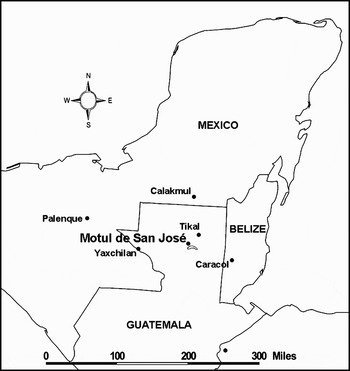
As a means of shedding more light on the role of textile manufacture in Late Classic Maya society, this paper compares elite and commoner textile production through the archaeological evidence for spinning implements and weaving tools. Productive demands, needs, and strategies were not necessarily the same among all households. For example, tribute demands on noble and commoner households may have placed greater obligations to some households to produce (Brumfiel Reference Brumfiel and Brumfiel1994; D'Altroy and Earle Reference D'Altroy and Earle1985). At the same time, both elite and commoner households may have intensified production to bolster their own prestige and wealth (Schortman and Urban Reference Schortman and Urban2004:196–198). Large elite households, however, may have had more success in specializing their production because they may have been able to mobilize more labor and have greater access to resources (McAnany Reference McAnany, Ortiz and Lees1992, Reference McAnany, Ortiz and Lees1993; Wilk and Netting Reference Wilk, Netting, Netting, Wilk and Arnould1984:7–9; Wilk and Rathje Reference Wilk and Rathje1982). This process may have occurred by incorporating landless “client” families or extended kin members. In the Maya area, archaeologists have suggested that larger or elite households included non-kin laborers or servants (Gillespie Reference Gillespie2000:469–470; McAnany Reference McAnany1995:107). To explore these different productive strategies, I outline previous archaeological research on textile production with particular emphasis on spatial patterning of spinning and weaving tools from a number of sites in the Maya area. In addition, I present new data focusing on spinning and weaving tool types, distributions, and tool densities from the Classic-period site of Motul de San José, Guatemala (Figure 1).
Map of the Maya area showing the location of Motul de San José.

UNDERSTANDING THE ORGANIZATION OF PRODUCTION IN THE MAYA AREA
Spinning and weaving were part of a gendered division of labor identified throughout Mesoamerica and beyond. Ethnographic, ethnohistoric, and iconographic evidence suggest that it was often women who spun and wove (Clark and Houston Reference Clark, Houston, Costin and Wright1998; Hicks Reference Hicks, Hodge and Smith1994:94; McCafferty and McCafferty Reference McCafferty, McCafferty, Schevill, Berlo and Dwyer1991, Reference McCafferty, McCafferty, Schevill, Berlo and Dwyer1994; Prechtel and Carlsen Reference Prechtel and Carlsen1988). The rigidity of such a division of labor (and its implications for gender identity), however, is socially and historically variable (Ashmore Reference Ashmore and Ardren2002; Brumfiel Reference Brumfiel, Gero and Conkey1991; Ciaramella Reference Ciaramella1999; Hendon Reference Hendon, Claassen and Joyce1997; Joyce Reference Joyce and Wright1996, Reference Joyce and Wright2000; McCafferty and McCafferty Reference McCafferty, McCafferty, Schevill, Berlo and Dwyer1991, Reference McCafferty, McCafferty, Schevill, Berlo and Dwyer1994). Brumfiel (Reference Brumfiel2006), for example, argues that the role of weaving and spinning in the formation of female gender identity was more pronounced among Postclassic Aztec populations than among the Classic-period Maya where spinning and, in particular, weaving activities were tied more to class than to gender. She suggests that textile production may have been a defining activity and source of prestige among elite women, but not necessarily among non-elite women (see also Hendon Reference Hendon, Claassen and Joyce1997, Reference Hendon and Robb1999; McAnany and Plank Reference McAnany, Plank, Inomata and Houston2001:95–96).
McCafferty and McCafferty (Reference McCafferty, McCaffery, Ardren and Hutson2006:41–42; Reference McCafferty and McCafferty2000:49–50) also note that gender ideals portrayed in ethnohistoric accounts may not have extended to the actual practices of all Mesoamericans. They record the presence of spindle whorls in Postclassic Cholula burials of adult males, adult females, and children, and imply that spinning may have been undertaken by men and children in addition to women. The female-gendered association of weaving and spinning for the Classic-period Maya is also complicated by the recovery of weaving tools in burials of both sexes (Fekete Reference Fekete1996:103, Table 11; Welsh Reference Welsh1988). For example, Welsh's (Reference Welsh1988) compilation of Classic-period burial data across the Maya area indicate that males (n = 1), females (n = 3), and youth/children (n = 3) were interred with spindle whorls (Welsh Reference Welsh1998:276, 286, 255, 271, 301). Bone needles were recovered from male (n = 4), female (n = 2), and youth/child (n = 3) burials (Welsh Reference Welsh1998:261, 291–3, 301, 333, 335), and bone pins have been found in male (n = 1) and female (n = 1) burials (Welsh Reference Welsh1998:295, 319).
Archaeologists consider Classic Maya textile production to have occurred within a domestic setting because production tools are often encountered in domestic activity areas and trash deposits (Hendon Reference Hendon, Barrios and García1992, Reference Hendon1995, Reference Hendon, Claassen and Joyce1997). Household production often implies part-time, small-scale labor and may include production exclusively for a household's own consumption or beyond a household's consumption. Hicks (Reference Hicks, Hodge and Smith1994) and Stark and colleagues (Reference Stark, Heller and Ohnersorgen1998) argue that the domestic context of Mesoamerican textile manufacture relates to its lack of an economy of scale and that it can be easily interspersed with a variety of domestic tasks. It involved high labor inputs, simple technological equipment (e.g., back-strap loom and hand spindles), and relatively low material output, the combination of which, Hicks (Reference Hicks, Hodge and Smith1994) argues, would make it inefficient for full-time specialization. The entire process included plant cultivation, plant harvest or collection, fiber processing (e.g., cleaning and removing seeds for cotton or scraping, trimming, and drying for maguey), spinning, plying, sizing, dyeing, warping, weaving, and sometimes embroidering, stitching, stamping, and other decorative work (Ciaramella Reference Ciaramella1999; Hall Reference Hall1976; Parsons and Parsons Reference Parsons and Parsons1990; Wisdom Reference Wisdom1961:149–166).
The degree to which households specialize, however, may vary spatially and temporally (Costin Reference Costin and Schiffer1991; Costin and Hagstrum Reference Costin and Hagstrum1995). In contrast to Hicks' suggestion that textile production remained a small-scale, part-time affair, recent research indicates that high-intensity multi-crafting was possible within domestic contexts (Feinman Reference Feinman, Skibo and Feinman1999; Feinman and Nicholas Reference Feinman, Nicholas, Feinman and Manzanilla2000). Investigations at the Aztec city-state of Otumba, for example, reveal evidence for highly specialized, full-time household production of maguey textiles among other things, such as figurines and obsidian jewelry. Maguey processing occurred in a nucleated clustering or barrio of household workshops (Nichols et al. Reference Nichols, McLaughlin and Benton2000). In the Maya area, Ponciano (Reference Ponciano1995) encountered evidence of highly specialized textile production at a modest Late Classic period household group at the site of Flamenco on the south Pacific coast of Guatemala. Excavations at the household group recovered 106 molded spindle whorls and three ceramic stamps, which were possibly used for textile decoration. Due to the sampling nature of the research, however, it is unclear whether other households at the site also produced textiles at the same intensity.
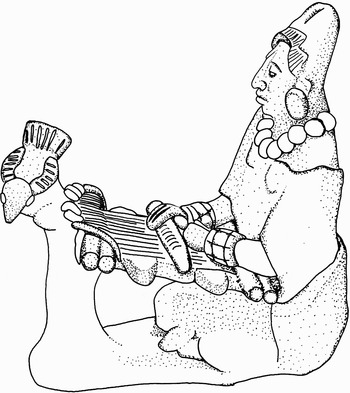
Iconographic, epigraphic and archaeological data indicate that elite Maya women were involved in the production of textiles. A rare set of ceramic figurines depict elaborately adorned women weaving (Goldstein Reference Goldstein1979:82; Piña Chan Reference Piña Chán1996:Figure 6, 8) (Figure 2). Bell (Reference Bell and Ardren2002:97–98) documents the internment of textile tools (three concentrations of bone needles, jade and shell rings that may have served as loom weights, a possible bone weaving pick) in a royal woman's tomb from Copan. It is unclear, however, whether the royal woman used all (or any) of these items to produce textiles as Bell notes that the number of tools present was greater than any single individual could have used at a given time. Dacus (Reference Dacus2005) records a number of bone weaving tools recovered from a royal tomb at the site of Naranjo. They are inscribed with hieroglyphs that label the owner(s) as a royal female(s): u b'aak K'uhul Ix or “the bone of holy lady,” u puuhtz' K'uhul Ix Ajal Tziil(?) or “the needle/pin of holy lady dawn? ?”, and u puuhtz' b'aak K'uhul Ix Chich(?) K'uhul Ix or “the bone needle/pin of holy lady rabbit(?) holy lady” among other name-tagging (Dacus Reference Dacus2005:39, 41, 44; see=also Houston and Stuart Reference Houston and Stuart2001:64–65, Figure 3.2). Joyce (Reference Joyce1993; Reference Joyce and Wright1996; Reference Joyce and Wright2000) points out, however, that the productive roles of royal women are downplayed on stone monuments and other large-scale media where they are depicted wearing and holding elaborate textiles but not producing them. She suggests that non-ruling elite women may have enjoyed more prestige as textile producers than their royal elite counterparts (Joyce Reference Joyce2000:89).
Classic-period Maya figurine from Jaina depicting an elaborately adorned woman weaving on a backstrap loom (after Schmidt et al. Reference Schmidt, de la Garza and Nalda1988: cat. 182).

Archaeological distributions of spinning and weaving implements indicate that Maya commoners, in addition to elite women, engaged in textile manufacture to some degree (Ponciano Reference Ponciano1995; Willey Reference Willey and Willey1978:41–47). At the large urban site of Tikal, archaeologists recovered a suite of textile production implements from the full spectrum of residential mound groups (Moholy-Nagy Reference Moholy-Nagy2003). Stone and ceramic spindle whorls, in use primarily in the Late and Terminal Classic periods, were present in all residential group types although most common in Small Structure Groups, the residences of the lowest social stratum, and Range Structure Groups of the epicenter, the residences of Tikal's royalty and high elite. Corresponding to their association with domestic contexts, they were absent from Civic Ceremonial Groups (Moholy-Nagy Reference Moholy-Nagy2003:46–47, 82). Centrally perforated sherd disks and bone perforators were widely distributed throughout the site (Moholy-Nagy Reference Moholy-Nagy2003:59–60, 76), although a large sample of bone perforators was found in range structures located in the Central Acropolis. A stamp, perhaps used to decorate cloth, was also found in a Late to Terminal Classic excavation context of a Small Structure Group (Moholy-NAgy Reference Moholy-Nagy2003:44).
Textile implements are also found at small commoner residences located in rural areas or settlements some distance from large, regional centers (Johnston Reference Johnston2004:166; Robin Reference Robin and Ardren2002:22; Willey et al. Reference Willey, Bullard, Glass and Gifford1965:402–405; Yaeger Reference Yaeger2000). Commoner households were not necessarily producing cloth for intra-household needs only. Beaudry-Corbett and McCafferty (Reference Beaudry-Corbett, McCafferty and Ardren2002), for example, found evidence of commoner household specialization at the rapidly abandoned site of Cerén, El Salvador, located in the southeastern Maya area. Cotton spindle whorls and fiber dyeing materials were found clustered in and near one of the households (Household 1), and tools to spin feathers or some other specialized fibers were found in a separate household (Household 2). Although it is not entirely clear how the two households' surplus thread or cloth was exchanged or consumed, Beaudry-Corbett and McCafferty suggest that Household 1's cotton products may have been used for ritual purposes at the non-domestic, community structure nearby. In addition, Sheets (Reference Sheets2000) and Sheets and Simmons (Reference Sheets, Simmons and Sheets2002) document vertical exchange with elites and in markets outside their village and horizontal exchange among village households, both possibilities for the textile products.
Classic Maya textile production is further contextualized through spatial analyses of different craft production activities in relation to the wealth or status of the household. Robin (Reference Robin, Hendon and Joyce2004), examining published data from Calakmul, Copan, and her own research at Chan Noohol, suggests that women's work, such as spinning and weaving, was spatially segregated from other craft and daily activities in the highest elite contexts and less spatially segregated in lower-status contexts. At the large, urban site of Calakmul, Mexico, archaeologists recovered on-floor artifact assemblages dating to the Terminal Classic period from Structure II, identified as part of Calakmul's royal court (Folan et al. Reference Folan, Gunn, del Rosario Domínguez Carrasco, Inomata and Houston2001). Textile implements were found in separate rooms and tiers of the pyramid than other artifacts associated with craft production (e.g., lithic production and shell work) (Folan et al. Reference Folan, Gunn, del Rosario Domínguez Carrasco, Inomata and Houston2001:234–242, Figure 8.8).
Similar spatial restrictions of textile tools occurs in on-floor assemblages from elite residences at the rapidly abandoned site of Aguateca, Guatemala (Inomata et al. Reference Takeshi, Triadan, Ponciano, Pinto, Terry and Eberl2002). Investigators found spindle whorls and food preparation objects in rooms separate from adjoining ones used to hold meetings and receptions or for scribal and artistic work. Inomata and colleagues state, “These data indicate that there were relatively clear divisions—but not strict segregation—of spaces associated with men and women” (Inomata et al. Reference Takeshi, Triadan, Ponciano, Pinto, Terry and Eberl2002:324).
Hendon (Reference Hendon, Barrios and García1992; Reference Hendon, Claassen and Joyce1997), however, suggests that women's textile and food production activities occurred in the same residences and patio areas as other craft and ritual activities at Las Sepulturas, Copan, a grouping of noble residences. She provides detailed documentation of the textile implements, which include bone brocade picks (awls), centrally perforated sherd disks, bone needles or pins, and spindle whorls. As Inomata and colleagues (Reference Takeshi, Triadan, Ponciano, Pinto, Terry and Eberl2002:324–325) point out, however, caution must be taken when comparing on-floor deposits from a rapidly abandoned site with the combination of on-floor and trash deposits, the recovery contexts of the Las Sepulturas material.
In parallel with Hendon's research, Robin's excavations (Robin Reference Robin and Ardren2002, Reference Robin, Hendon and Joyce2004) at the commoner farming community of Chan Noohol, Belize, indicates that no clear spatial separations were evident between various domestic activities within a given household. In addition, she finds a “spatial and social commingling” of domestic and agricultural activities, indicating that men's and women's work spheres were not clearly segregated (2002:28). Although spinning tools were recovered at the site, she does not specifically identify spatial overlap of textile production because these tools were found in midden contexts (2002:22). Nevertheless, both Hendon (Reference Hendon, Claassen and Joyce1997) and Robin (Reference Robin and Ardren2002, Reference Robin and Ardren2004) suggest that spatially overlapping work spaces emphasize complementary or collaborative work of men and women, as well as of household members in general. This phenomenon is particularly evident at Chan Noohol where simple pole and thatch architecture created few spatial divisions.
Beyond an understanding of a gendered division of labor, however, differences in spatial analyses also have implications for the degree of household textile specialization. Costin (Reference Costin and Schiffer1991:29) argues that craft production units are relatively more specialized when spatially separated from domestic space than overlapped with domestic space. Costin (Reference Costin and Schiffer1991:30) states, “…we must work under the assumption that there is a correlation between the structure of behavior and the structure of the material record. The more highly structured the organization of production (e.g., into workshops or factories), the more highly organized the space in which those activities took place should be.” In addition, Kent (Reference Kent and Kent1990:127–128) in her cross-cultural research on domestic space correlates increasing segmentation of space (by architecture and other means) with a number of social factors, including increasing economic specialization. Although Maya textile production was associated with both elite and non-elite households, spatial analyses of craft production activity areas hint at the possibility that textile production in elite households may have been more specialized than non-elite households. This idea is further explored below in an examination of elite and commoner textile production from Motul de San José.
MOTUL DE SAN JOSÉ ECOLOGICAL AND CULTURAL CONTEXT
Motul de San José and its nearby satellite centers have been the focus of archaeological and ecological research since 1998 by the Proyecto Arqueológico Motul de San José directed by Antonia Foias and Kitty Emery (Emery Reference Emery2003; Foias Reference Foias2003). The site is a medium-sized, civic-ceremonial center located approximately 3 km from the northwestern shore of Lake Peten Itza in central Peten, Guatemala. The site is often referred to as or one of the “Ik” sites from hieroglyphic inscriptions on monuments and polychrome vessels (Foias Reference Foias2000, Reference Foias2003; Marcus Reference Marcus1976:68, 183–190, Table 13; Rice Reference Rice2004:144–145; Schele and Mathews Reference Schele and Mathews1998:185–187; Stuart and Houston Reference Stuart and Houston1994:28). Motul de San José was most intensely occupied during the Late Classic period (ca. A.D. 600–830), although some evidence exists for occupation as early as the Middle Preclassic period (ca. 600–300 B.C.) and as late as the Early Postclassic period (ca. A.D. 950–1200) (Foias Reference Foias2003:21, Table 1).
Spinning-tool types from Motul de San José

Notes: n = number; CPSD = centrally perforated sherd discs. Table excludes two fragmentary CPSDs.
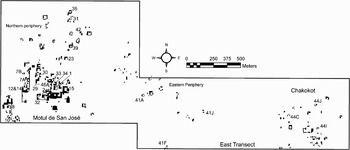
The Proyecto Arqueológico Motul de San José has recovered textile-related tools from excavations during its 1998 through 2005 field seasons (Foias Reference Foias1998, Reference Foias1999, Reference Foias2001, Reference Foias2003; Foias and Castellanos Reference Foias and Castellanos2000). This paper examines artifacts recovered from excavations in the site itself, which covers an area of approximately 2 to 3 km2 as well as in a 0.4–2.0 km survey transect (the ‘East Transect’) running east from Motul de San José (Figure 3). The end of the transect encompasses the small, agricultural settlement of Chakokot (Jensen et al. Reference Jensen, Moriarty, Johnson, Terry, Emery and Nelson2007; Moriarty Reference Moriarty2004; Webb et al. Reference Webb, Schwarcz, Jensen, Terry, Moriarty and Emery2007). Horizontal excavations were undertaken in seven architectural groups at Motul de San José (MSJ operations 2A,15, 29, 31, 39, 42, and 46A) and two architectural groups at the periphery settlement of Chakokot (CHT operations 44C and 44E) (Foias Reference Foias2003; Halperin et al. Reference Halperin, Martínez Salguero, Guzmán, Moriarty, Spensley, Castellanos C. and Foias2007). In addition, an intensive test-pitting program at Motul de San José targeted the architectural groups in the site core and northern periphery (Deter-Wolf and Charland Reference Deter-Wolf, Charland and Foias1999; Halperin et al. Reference Halperin, Luin, McCraken, Wyatt, Morales and Foias2001; Ramírez et al. Reference Purseglove2000). Test pits (1 × 1 m) were placed in the center plaza and behind the largest structure in each architectural group and excavated to bedrock. A series of smaller, shovel-test excavations (0.5 × 0.5 m) were also placed at approximately 3 m intervals and 1 to 3 m from the exterior edge of architecture, forming “lines” of shovel-test units around each group. These shovel-test pits were expanded if middens were located. Along the East Transect, one test pit (1 × 1 m) was placed at the center of each architectural group and excavated to bedrock (Moriarty et al. Reference Moriarty, Ramirez, Spensley, Buechler and Foias2001).
Map of Motul de San José and East Transect showing architectural groups (listed by operation number) where textile production tools were uncovered during excavations (base map provided courtesy of the Proyecto Arqueológico Motul de San José).

Ecological conditions in the Peten Lakes area fall under the parameters for cotton cultivation (Purseglove Reference Purseglove1968:333–363), and ethnohistoric research indicates that inhabitants near Lake Peten Itza region grew cotton and yucca in their maize fields and made extensive use of maguey during the Spanish contact period (Atran et al. Reference Atran, Lois and Ucan Ek'2004:8; Hellmuth Reference Hellmuth and Hammond1977:434–435; Means Reference Means1917:145–146). These products, including a silk-like material produced by caterpillars (family Saturnidae), palm, hemp, hibiscus, cattail, animal fur, fibers from fig trees, and feathers can be spun for textile production (Beaudry-Corbett and McCafferty Reference Beaudry-Corbett, McCafferty and Ardren2002:Table 4.1; Berdan Reference Berdan1987; Nichols et al. Reference Nichols, McLaughlin and Benton2000:267; Osborne Reference Osborne1965:32).
MOTUL DE SAN JOSÉ SPINNING AND WEAVING TOOLS
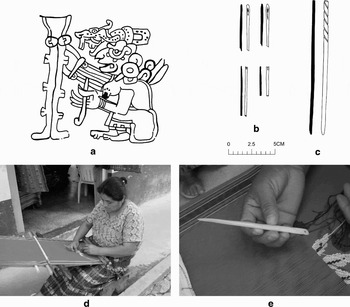
Motul de San José spinning and weaving tools include ceramic spindle whorls, centrally perforated sherd disks, and bone awls, perforators, needles, and pins. Like any tools, these artifacts may have had multiple functions, including those not related to textiles. For example, bone pins or perforators may have been used as hair pins (Moholy-Nagy Reference Moholy-Nagy2003:59; Taschek Reference Taschek1994:113–116) or for applying paint (Halperin and Salguero Reference Halperin and Martínez Salguero2006:7; Inomata Reference Inomata1995:588–589, Figure 8.42a, 8.43c), and awls may have been used for punching through leather (perhaps as part of the production of garments) or husking corn (Hayden Reference Hayden and Hayden1987:181). Ethnographic research (Cordry and Cordry Reference Cordry and Cordry1968:45; Mastache Reference Mastache1996:19; O'Neale Reference O'Neale1945:Figure 75g, 75h) indicates, however, that small, thin pins and longer, thicker bone awls and perforators (also sometimes called picks) could have been used for brocading, weaving gauzes, and lifting warp threads. In fact, the double function of using weaving tools as hair pins would not be surprising as the head throughout Mesoamerica is a focal point for signaling personal identity, and artisans and deities depicted in Classic period iconography often wear their tools (e.g., painter's brush, paint pot, spindle with spun fiber) on their head (Coe and Kerr Reference Coe and Kerr1998:92; Houston and Stuart Reference Houston and Stuart1998; Houston et al. Reference Houston, Stuart and Taube2006:60–72; Taube Reference Taube and Kerr1994:Figure 2a). As mentioned earlier, some archaeological examples of bone pins or perforators are inscribed with glyphs read as “the bone needle/pin of” (Dacus Reference Dacus2005:6, 39–67; Houston and Stuart Reference Houston, Stuart, Inomata and Houston2001:64–66, Figure 3.2). Some of these bone tools possess carved hands or heads on the proximal ends (Dacus Reference Dacus2005; Ishihara Reference Ishihara2007; Figure 7.38). Morris (Reference Morris, Robertson and Benson1985:317, Figure 1) and Ciaramella (Reference Ciaramella1999:39–41, Figure 7) have noted that a hooked implement serves as Goddess O's brocading tool in the Madrid Codex (Figure 4a), and Hendon (Reference Hendon, Barrios and García1992:11–12, Foto 1.3) has identified its archaeological correlate in the form of bone awls from household excavations at Copan. Maya textile producers may have also worked with bone needles for weaving, netting, embroidery and sewing (Ciaramella Reference Ciaramella1999:41–43, Figure 8, 9; Hendon Reference Hendon, Barrios and García1992: Foto 1.2; O'Neale Reference O'Neale1945:34, 58) (Figure 4b).
Bone textile tools: (a) Goddess O with possible bone awl and backstrap loom from the Madrid Codex (after Matul and Fahsen Reference Matul and Fahsen2007:79c); (b) fragmentary bone needles from Motul de San José (Op. 2); (c) fragmented bone perforator from Motul de San José (Op. 2); (d) woman from Santiago Aguas Calientes with deer bone brocading tool; (e) close-up of deer bone brocading tool (drawings and photographs by author).

Emery has provided a list of the bone tools from the analysis of the Motul de San José zooarchaeological assemblage. She has identified a total of 65 bone perforators, awls, needles, and/or pins. She identified perforators by the presence of a fine tip or shaft fragment. Awls possessed a “U” wedge-shaped end and shafts too broad for perforating. Needles possessed an eye hole, and pins were similar to needles, but lacked an eye opening. Most of the bone tools were polished, and all that can be dated by associated ceramic materials (n = 58) pertain to the Late or Terminal Classic periods. Some of the perforators are similar in style to a deer bone brocading tool used by a Guatemalan weaver from Santiago Aguas Calientes (Figure 4c–e).
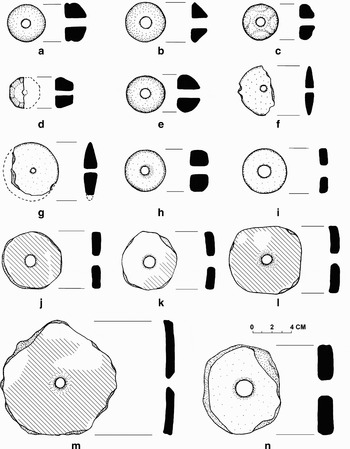
The most common spinning instruments are spindle whorls or centrally perforated sherd disks, which for the Motul de San José assemblage fall under four principal types based on their shape, size, and weight. They include large centrally perforated sherd discs (large CPSD), small centrally perforated sherd discs (small CPSD), disc whorls, and small, bead-shaped whorls (Figure 5, Table 1). Spinners place whorls at the end of a spindle, a slender wooden shaft, in order to provide momentum for the spinning process. Whorl shape, size, and weight are correlated in a general manner with the quality and type of thread produced. Disc-like whorls (low height to diameter ratios) produce a slower spin for a longer period and thus, a looser thread twist than smaller, bead-shaped whorls (high height to diameter ratios) (McCafferty and McCafferty Reference McCafferty and McCafferty2000:43). The weight of the whorl relates to the fineness of the thread and the type of material used. Ethnographic and archaeological data indicate that the spinning of cotton is more common with lighter whorls than heavier whorls used for spinning thicker, longer fibers, such as maguey or yucca (Kent Reference Kent1957; O'Neale Reference O'Neale1945; Parsons Reference Parsons, Spence, Parsons and Parsons1972).
Spinning tool types: (a–e) bead-shaped whorls; (f, g) disc whorls; (h–k) small CPSD; (l–n) large CPSD (drawings by author).

A great deal of flexibility, however, occurs between the size and shape of the spindle whorl and the type of thread produced. For example, Fauman-Fichman's (Reference Fauman-Fichman1999) experimental research demonstrates that North American spinners could produce different thread types on a range of whorls regardless of variations in the whorls' mass moment of inertia (distribution of weight around axis of rotation). Parsons and Parsons' (Reference Parsons and Parsons1990:316–326) experimental research among contemporary maguey spinners from central Mexico also revealed that threads of varying thickness and weight can be spun on the same whorl. Despite this flexibility, however, they found that the thickness of the thread tends to increase linearly with the weight of the whorl. Their informants preferred to spin the fine penca asada maguey fiber with the lighter whorls that weighed between 12.5 and 30 g and to spin the coarse penca grande fiber on heavier whorls that weighed between 23 and 50 g.
The bead-shaped whorls from Motul de San José and its environs are lightweight and have very small diameters and medium heights (Table 1). Their shape include hemispherical, truncated conical, and conical forms (following the terminology of Parsons Reference Parsons, Spence, Parsons and Parsons1972:Figure 2). They correspond generally to Parson's (Reference Parsons and Parsons1972) Type III cotton whorls from the Teotihuacan Valley, McCafferty and McCafferty's (Reference McCafferty and McCafferty2000) Types B and E cotton or rabbit hair whorls from Cholula, and Moholy-Nagy's (Reference Moholy-Nagy2003) Type N, R, and P whorls from Tikal. They were probably used to produce fine, tightly twisted thread. Whorl decorations were minimal: simple incising or grooving. Zaro and Lohse (Reference Zaro and Lohse2005:87, Figure 5) suggest that some incised whorl decorations (see Figure 5c) may represent small-scale versions of the basic quadripartite design of the cosmos with the whorl whole as the cosmic center. Because of their uniformity in shape, it is likely that they were produced using molds. Pastes were generally light red to cream in color and had medium- to fine-sized calcite temper.
The disc whorls had slightly larger diameters, smaller heights, and similar weights to the bead-shaped whorls. Thus, they may have been used to spin the same types of material, like cotton, as the bead-shaped whorls, although, perhaps, with a looser twist. These whorls were not decorated, had light red pastes with medium-sized calcite temper. In shape, size, and weight, they correspond roughly to McCafferty and McCafferty's (Reference McCafferty and McCafferty2000) Type D whorls. Based on Aztec ethnohistorical evidence, they suggest that Type D whorls were used to spin feathers (McCafferty and McCafferty) (Reference McCafferty and McCafferty2000:47).
The small CPSDs share the same general size, shape, and weight characteristics as the disc whorls, but they differ in their more expedient manufacture from already-fired pottery sherds. One of the small CPSDs, however, is more similar to the small, bead-shaped whorls (Figure 5h). Although the identification of centrally perforated sherd discs as spindle whorls is undertaken here, it is recognized that these discs as well as the formed whorls may have had other or multiple uses, such as flywheels for pump drills, counters, tokens, or gaming pieces (Kovacevich Reference Kovacevich, Wells and Davis-Salazar2007:78, Figure 3.6; Moholy-Nagy Reference Moholy-Nagy2003:76). Many researchers consider the CPSDs as whorls because their size and weight fit known, acceptable whorl dimensions (Beaudry-Corbett and McCafferty Reference Beaudry-Corbett, McCafferty and Ardren2002; Smith and Hirth Reference Smith and Hirth1988:402–405; Stark et al. Reference Stark, Heller and Ohnersorgen1998; Willey Reference Willey1972:81–82; Willey et al. Reference Willey, Bullard, Glass and Gifford1965) and some Mesoamerican ethnographic examples of their use as spindle whorls exist (Moholy-Nagy Reference Moholy-Nagy2003:76; Parsons and Parsons Reference Parsons and Parsons1990:314, Figure 39). Hendon (Reference Hendon, Barrios and García1992:10) argues that CPSDs were used for spinning, but with different fibers than those spun with spherical whorls.
Large CPSDs have larger diameters, heavier weights, and similar heights than the small CPSDs. Thus, they may have produced coarser (non-cotton) thread than the other three whorl types or perhaps were used for making cordage. Although some of these large CPSDs have rough edges, Sue Hayes (personal communication, 2004), an experienced weaver and spinner, asserts that perfectly rounded whorls were not necessary for the production of cordage and thicker fibers, but more essential for the production of thinner, shorter fibers, such as cotton. The large CPSD diameters fall within Parson's (Reference Parsons and Parsons1972) Type I fine maguey whorls (although differ in shape). Most of them also fall under Parson and Parson's (Reference Osborne1990:326) weight criteria for the spinning of fine maguey (between 12.5–30 g). Only three of the largest and heaviest whorls from the large CPSD category, however, correspond to McCafferty and McCafferty's (1990) Type J whorls used to spin maguey or cordage.
Most of the large and small CPSDs were manufactured from Late Classic period monochrome or polychrome vessel sherds. Ceramic types were identified on over half of the CPSDs (72%). All ceramic types pertained to the Late Classic period (Tinaja Red, Tialipa Brown, Subin or Chaquiste, Azote Orange, Infierno Black, Zacatel Cream types) except one small CPSD (Late Preclassic Sierra Red), which was recovered from a Late Classic period midden context. The remaining CPSDs had no visible slips or paint, but possessed pastes similar to Late Classic monochrome and polychrome vessels and the other Late Classic CPSDs: ash and medium-fine calcite tempers with light red to tan color pastes. Contextual analysis of most of the CPSDs also confirms their Late or Terminal Classic period use.
The bead-shaped and disc whorls also date to the Late Classic period based on comparative contextual and stylistic data. Formed whorls appear in the Lowland Maya area during the Late Classic period at sites such as Dzibilchaltun, Uaxactun, San Jose, Piedras Negras, Barton Ramie, Seibal, and Altar de Sacrificios (Taschek Reference Taschek1994:215–216; Willey Reference Willey1972:86; Willey et al. Reference Willey, Bullard, Glass and Gifford1965:402) and as early as the Late Early Classic at Tikal with Variety N formed whorls (Moholy-Nagy Reference Moholy-Nagy2003:82) (although see Stark et al. Reference Stark, Heller and Ohnersorgen1998 for whorl chronologies at other sites in Mesoamerica). Although they continued to be used into the Postclassic period (Masson Reference Masson2000:165–166, Figure 5.17; Proskouriakoff Reference Proskouriakoff, Pollock, Roys, Proskouriakoff and Smith1962:400), settlement contexts at Motul de San José and its satellite sites indicate that the formed bead-shaped and disc whorls mentioned here were used during the Late and Terminal Classic periods.
MOTUL DE SAN JOSÉ TEXTILE PRODUCTION TOOL DISTRIBUTION AND DENSITIES
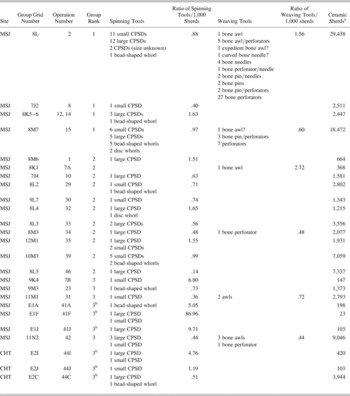
Similar to distributions at other sites in the Maya area, spinning tools from Motul de San José and the East Transect are found from excavations in a range of different residential contexts (Figure 3, Table 2). Unlike the site of Otumba, no apparent clustering of spinning tools, signifying production areas or “barrios,” occurred at Motul de San José or Chakokot. Excavations, however, did not uncover textile implements in all tested groups (39% of all excavation operations at the site of Motul and the East Transect possessed one or more textile-related tools). Not surprisingly, textile production tools were not encountered in ceremonial-type contexts, such as stela platforms and around large pyramid structures in Motul de San José's main plaza. Rather, they were found in trash deposits from architectural groups thought to have represented residences, either in whole or in part. Two centrally perforated sherd discs, however, were encountered within a looted tomb in an eastern pyramid of a royal residential group (Operation 15).
Relative status divisions of households were divided by architectural volume (detected from total station survey and subsequent calculations using 3D Analyst in ArcGIS) and ranked 1 through 3 (see also Sorensen et al. Reference Sorensen, Glover, Fedick, Wien, Erbe and Wien2003). Rank 1 architectural groups, presumably the residences and buildings of the highest elite households, were the largest architectural groups and possessed volumes greater than 6,797 m3. Rank 2 architectural groups ranged between 1,100 and 5,000 m3 and may represent households associated with elite or middle status members of society. The lowest status architectural groups, Rank 3, possessed architectural volumes of less than 1,100 m3 and represent the lower echelons of the social structure. These provide only general and preliminary status parameters as much variability in architectural form and consumption patterns occurs within and between groups.
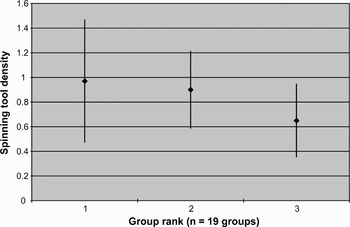
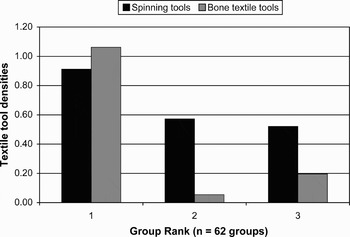
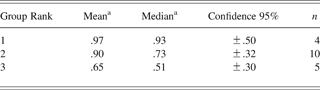
To examine relative differences in the intensity or scale of production, spinning tool densities were calculated for each architectural group possessing one or more spinning tools and then for mean and median densities by architectural group rank (Figure 6, Tables 2, 3). Densities were determined as ratios of the number of spinning or bone textile tools to every 1000 ceramic sherds at each architectural group. Comparing textile tool densities differs from most research on Maya textile production, which provide only raw tool counts, and avoids the problem of different sample sizes based on variations in the amount of soil excavated from each residential area. Nevertheless, some skewed spinning density ratios resulted from groups with small excavation sample sizes (i.e., groups tested with only a single 1 × 1 m test unit) and were treated as outliers (see Groups 9K4, E1A, E1F, E1J, E2I, Table 2). Because so few groups possessed bone tools, comparisons by individual architectural groups were not statistically significant. As an additional comparison, spinning and weaving tool densities were calculated by comparing the combined number of spinning or weaving tools to combined ceramic sherds from all groups excavated by rank category (Rank 1, 2, and 3) (Figure 7, Table 4). The assumption in these comparisons is that higher densities indicate more intense (amount of time devoted to production) or larger scale (e.g., more people devoted to production) production because the more one uses a tool or the more people who use tools will relate to a larger member of tools being discarded (Charlton et al. Reference Charlton, Nicholas and Charlton1991; Costin Reference Costin and Schiffer1991; Reference Costin, Feinman and Price2001:280–281).
Spinning tool means and 95% confidence bars by architectural group rank (only groups with recovered spinning tools included in calculations).

Mean spinning and bone textile tools densities by architectural group rank (all tested groups except public pyramid-type groups included in calculations).

Textile-production-tool types and spinning-tool densities by group

Notes: MSJ = Motul de San José; CPSD = centrally perforated sherd discs; CHT = Chakokot.
aPreclassic sherds excluded.
bArchitectural volume data not available; rank determined by comparing relative size of group with those of known volume.
Means for spinning-tool density by architectural-group rank
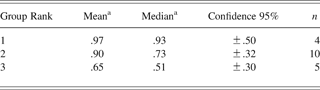
Notes: n = number. Only groups with recovered spinning tools were included in the calculations.
aSpinning-tool calculations exclude outlier Groups 9K4, E1A, E1F, E1J, E2I, whose sherd counts were smaller than the remaining groups and produced skewed ratios.
Mean spinning- and bone-textile-tool densities by architectural-group rank

Notes: n = number. All tested groups except public pyramid-type groups were included in the calculations.
aExcludes Preclassic period ceramic sherds.
Results indicate that household status is positively correlated with spinning tool densities. In comparisons of only architectural groups containing spinning tools, spinning tool density means were highest among Rank 1 architectural groups, representing the highest status households, only slightly lower among Rank 2 architectural groups, and lowest among Rank 3 architectural groups, although much overlap occurs (Figure 6, Tables 2, 3). In the comparison of all tested architectural groups by rank category, spinning tool density means were also highest among Rank 1 groups and lower among Rank 2 and 3 groups. Bone tool density means were disproportionately higher in Rank 1 groups and lower in Rank 2 and 3 groups (Figure 7, Table 4). These patterns suggest that textile production at larger, higher-status households was more intense or larger in scale than smaller, lower-status households. In addition, higher-status households with a greater variety and density of bone needles, pins, perforators and awls may have devoted more time or labor to elaborate design elements and techniques, such as brocading patterns, weaving fine gauzes, or embroidering. It must be noted, however, that part of this variation (especially for the bone tools) may relate to better preservation contexts of larger architectural groups. However, elite households tend to have more ceramic vessels than commoner households and tool ratios may be less accentuated as a result of this trend.
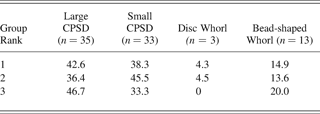
Despite apparent differences in densities of production tools, all architectural group categories possessed relatively similar percentages of spinning tool types (Table 5). Percentages of large CPSDs, small CPSDs, and bead whorls were not drastically different among the three architectural group categories. Disc whorls were uncommon (n = 3) and found primarily in Rank 1 groups. Because of their similar size, shape, and weight to small CPSDs, however, it is possible that the latter types could be used as a substitute for spinning the same or similar fibers as those produced by the former. While McAnany and Plank (Reference McAnany, Plank, Inomata and Houston2001:96) have raised the possibility that common peoples may have relied more on perishable whorls (e.g., wood, gourd, unbaked clay), the slightly higher percentages of the ceramic bead whorls from Rank 3 contexts suggests that common peoples did not have difficulty acquiring non-expedient whorls. Thus, these finds indicate that both elite and commoner households had access to the same general tool types and, by extension, imply that they produced both fine and coarse fiber (or cordage). In addition, most architectural groups possessed a diversity of spinning tools. If a group possessed more than one spinning tool, they were rarely the same type, suggesting that households may have spun a range of different fibers or engaged in multiple spinning techniques.
Percentages of spinning-tool types by architectural-group rank
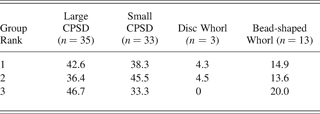
Notes: CPSD = centrally perforated sherd discs; n = number.
DISCUSSION AND CONCLUSIONS
Previous and on-going research of Classic Maya spinning and weaving indicates that these activities were household-based. As many have noted, the domestic context of production is significant in that it allows for greater economic autonomy of individual households from the state (McAnany Reference McAnany, Ortiz and Lees1992, Reference McAnany, Sabloff and Henderson1993; Potter and King Reference Potter, King, Ehrenreich, Crumley and Levy1995; Rice Reference Rice, Brumfiel and Earle1987). This pattern contrasts with the organization of textile production in some societies where state-run facilities for textile production existed. In the Inca Empire, aqllakuna or “chosen females” were taken from their natal communities to weave as full-time specialists in special, state-controlled facilities (Costin Reference Costin1993, Reference Costin, Costin and Wright1998; Silverblatt Reference Silverblatt1987). Full-time production also occurred in Ur III Mesopotamia where women weavers and their sons worked in state-regulated workshops and controlled neither their means of production nor the products of their labor (Wright Reference Wright and Wright1996).
The Classic-period data from the Maya area also contrast with evidence for the organization of textile production in Postclassic central Mexico where production may have been more specialized, especially in rural areas (Brumfiel Reference Brumfiel, Gero and Conkey1991, Reference Brumfiel1996, Reference Brumfiel2006; Nichols et al. Reference Nichols, McLaughlin and Benton2000; Smith and Hirth Reference Smith and Hirth1988; Stark et al. Reference Stark, Heller and Ohnersorgen1998). Correspondingly, high market and tribute demands for textiles are well-documented at the end of this time period in the ethnohistoric literature (Anawalt Reference Anawalt1990; Berdan Reference Berdan1987; Hicks Reference Hicks, Hodge and Smith1994). Brumfiel (Reference Brumfiel2006) articulates this contrast by stressing the significance of textiles as inalienable goods during the Classic period and as commodities during the Postclassic period.
Classic Maya production of textiles, however, cannot be described simply as small-scale production at the household level. Differing needs and obligations of royal, elite, and non-elite households created differing degrees of tension between production strategies to maintain household reproduction, on the one hand, and political or ritual obligations to maintain state and community needs on the other (Levi Reference Levi2002; McAnany Reference McAnany, Ortiz and Lees1992). Futhermore, as many feminist scholars have pointed out (e.g., Hart Reference Hart, Ortiz and Lees1992; Moore Reference Moore, Ortiz and Lees1992), the labor obligations and distribution of the fruits of such labor may not have occurred equally among all household members (whether by gender, age, kin, or non-kin status). Ethnographic data indicate that such internal discrepancies tend to be more pronounced in larger, socially complex households (Wilk and Rathje Reference Wilk and Rathje1982:624). The textile production data from the Maya area highlight some of these possible differences.
For example, spatial analyses reveal that royal and elite Maya residential contexts were more internally heterogeneous than smaller, non-elite ones. In the former, craft activities, including spinning, appear to have been more spatially segmented than noble or commoner residential contexts. Increasing spatial segmentation of craft activities may imply higher levels of economic specialization in those residences. Archaeological data recovered from Motul de San José and its environs indicate that Late and Terminal Classic household spinning and weaving was either more intense or larger in scale in bigger and presumably higher status households as greater densities of textile tools are encountered in these contexts. The Motul de San José finds parallel studies of raw number comparisons. Hendon (Reference Hendon, Claassen and Joyce1997:44, Figure 23–4), for example, found greater quantities of textile tools at a larger, more complex household group (Group 9N-8) than at smaller ones (Groups 9M-22, 9M-24) from the site of Copan, Honduras. Similarly, Morehart and Helmke (Reference Morehart and Helmke2005) note that the more affluent site of Pook's Hill, Belize possessed greater numbers of spindle whorls and bone textile tools than the humbler households from Chan Noohol, which had fewer spinning tools and no bone textile tools. Thus, these data support the notion that elite households could devote more time to crafts (more intensive production) or mobilize more labor (larger scale production) through non-kin networks, such as landless “client” families or servants, or through extended kin alliances and associations. Elsewhere in Mesoamerica, scholars have noted that Aztec noble households possessed a large number of women, including the noble's daughters and unrelated women from distant areas, who spent a great deal of time spinning and weaving (Hicks Reference Hicks, Hodge and Smith1994:95).
The high degree of textile specialization proposed here for Classic Maya elite households suggests that not all household members participated in textile production or even the same part of the production process. The implications of a more accentuated division of labor among elites are bittersweet. The division of labor meant that some members, perhaps non-ruling elite women as Joyce (Reference Joyce and Wright1996, Reference Joyce2000) suggests, were able to use their productive skills and labors to gain social prestige. As Inomata (Reference Inomata2001) points out, skilled crafting and the socially meaningful products of such crafting provided a fundamental basis for gaining and maintaining social and cultural capital in ancient Maya society. Textiles were no exception, as their production, in many cases, involved high labor-investments and skill and their patterns, textures, designs, and colors were infused with ideologically and socially significant meanings.
However, the segmentation of labor also possesses the potential for labor appropriation. Inomata (Reference Inomata2001:332) argues that polychrome vessels depicting males presenting textiles to other males indicate that men, in some cases, had control over products manufactured by women. The appropriation of women's labor by men, however, may be too simplistic, as opportunities for labor appropriation may have occurred on a number of different levels. As mentioned earlier, Joyce (Reference Joyce2000:89) alludes to the idea that royal women who carried textiles in rituals and wore intricately made and labor-intensive huipils, body-wraps, and head-pieces were probably not the producers of these items. Rather, they benefited from the labor of other women in their own households, residential groups, and beyond. At the same time, producers of the final products, such as weavers or those who embroidered or sew the pieces together, may have had more opportunity to gain social prestige than producers involved in earlier steps of the production process, such as those who acquired or cultivated, processed, or spun the fibers. Who was responsible for what step in the manufacturing process was probably determined not only by gender, but also by age, kin vs. non-kin household membership, and the distance as expressed in kin terms from key ancestors.
In addition to class and intra-household variations in textile manufacture, regional differences were probably also present. Ponciano (Reference Ponciano1995) suggested that the south coast of Guatemala, where he encountered high-intensity textile production at a Late Classic commoner household, may have favored more specialized production because ecological conditions in the area permitted both high-quality and high-quantity cotton cultivation. A larger sample size and systematic intra- and inter-site comparison are needed to situate this single household into a regional perspective.
Analysis based on textile tool distributions as presented here, however, can sometimes be problematic because places of tool deposition may not be the same as places of tool use (Costin Reference Costin and Schiffer1991; Reference Costin, Feinman and Price2001:294). In addition, ethnographic and archaeological research indicates that many of the textile production implements were or could have been made with perishable materials (e.g., wooden spindle whorls, pins, awls, and loom parts, unbaked clay whorls), and among modern weavers textile tools are often passed down from one generation to the next (McCafferty and McCafferty Reference McCafferty and McCafferty2000:42; Moholy-Nagy Reference Moholy-Nagy2003:46; Parsons and Parsons Reference Parsons and Parsons1990:315). Nevertheless, data recovered from in and around Motul de San José, provide a baseline for future studies (especially when large sample sizes become more available) because tools densities, not raw counts, are easily comparable between sites. The combination of the inter-household spatial analysis research and synchronic distribution analysis in the Motul de San José region demonstrate that Classic Maya textile production strategies are quite heterogeneous and closer attention to temporal, intrasite, and intersite variability is warranted.
RESUMEN
Los textiles en la antigua Mesoamérica sirvieron como una fuente de recursos económicos y simbólicos indispensables para mostrar status, riqueza y filiación social. La importancia económica de los textiles puede ser explorada, en parte, por la identificación arqueológica y la distribución de herramientas de producción tales como los instrumentos de hilado y tejido. Sin embargo en el área maya pocos estudios han examinado la organización de la producción de textiles, y es carente la documentación sistemática de la distribución de herramientas. El presente trabajo revisa la investigación arqueológica previa sobre la producción de textiles mayas y presenta nuevos datos del sitio clásico de Motul de San José, Guatemala. Esta información complementa el entendimiento de la economía de los asentamientos domésticos del período clásico al enfatizar la relativa autonomía económica de éstos por parte del Estado en la producción textil y la heterogeneidad de estrategias productivas, dentro y entre diferentes asentamientos. Tal heterogeneidad es expresada, al menos en el caso de Motul de San José, por una mayor intensidad o una producción a mayor escala vinculada más a grandes asentamientos de la élite que a pequeños asentamientos de la gente común. Este hallazgo implica que la producción de textiles como fines tributarios no era un tema central entre los grupos de bajo status en esta área como lo fue entre muchos grupos del postclásico y el período del contacto. Al contrario, a ciertos individuos de la realeza y las elites del período clásico maya les fue posible exponer su posición económica y social a través de la producción de textiles, ya que eran ellos quienes tenían mayor acceso a los recursos o a los excendentes de la mano de obra encontrada en o asociada con sus propios asentamientos domésticos.
ACKNOWLEDGMENTS
Thanks are extended to the Institute of Anthropology and History in Guatemala (IDAEH) and its personnel for their support and permission to work at Motul de San José. Research would not be possible without the financial assistance of the National Science Foundation, the Fulbright Scholar Program, the Foundation for the Advancement of Mesoamerican Studies, Inc. (FAMSI), Sigma Xi, and the University of California, Riverside. Data on the bone tools derive from unpublished research graciously provided by Kitty Emery. I thank Timothy Pugh, Elizabeth Brumfiel, Geoff McCafferty, and two anonymous reviewers for their comments on earlier versions of the paper. All errors are my own. I would also like to extend my thanks to Jeanette Castellanos, Crorey Lawton, Melanie Kingsley, Gerson Martínez Salguero, Nancy Monterroso, Matthew Moriarty, Elly Spensley, Erin Thorton, the Hernández González family, and the Alonzo Ramos family for their support in the field and lab, as well as Jesse Kerns and Sue Hayes for advising me on spinning and weaving techniques and Sandra Xochipiltecatl for helping me with the Spanish translation. I am extremely grateful to Kitty Emery and Antonia Foias for their comments and their continual support and encouragement.