Introduction
Mental health literacy has been defined as “knowledge and beliefs about mental disorders which aid their recognition, management, or prevention” (Jorm et al., Reference Jorm1997). It can include the ability to recognize specific disorders, knowledge and beliefs about risk factors, and perceptions about etiology and professional help available.
Investigations of mental health literacy among older minorities may help to explain why they are chronically underserved by the mental health system. Older immigrants are at increased risk of mental health problems (Mui and Kang, Reference Mui and Kang2006; Jimenez et al., Reference Jimenez, Alegria, Chen, Chan and Laderman2010) and often experience barriers to mental health care, particularly if they are not highly acculturated (Gelfand, Reference Gelfand2003). Although attitudinal and structural barriers to care have been studied, little is known about mental health literacy among minority older adults (Li and Browne, Reference Li and Browne2000; Lai and Chau, Reference Lai and Chau2007). The ability to recognize a mental health problem and identify it as such is the first step in accessing appropriate resources and obtaining treatment.
Previous mental health literacy research has largely excluded older adults. To date, only one study has examined cross-sectional age differences in mental health literacy. Older adults (65–74 years old) were found to be somewhat poorer at recognizing depression as depicted in a case vignette compared to participants aged 15–24 years old (Fisher and Goldney, Reference Fisher and Goldney2003). Additional studies have examined the influence of ethnicity and nationality on recognition of mental illness. Some studies have found no effect of national or categorical ethnicity (Parker et al., Reference Parker, Chen, Kua, Loh and Jorm2000; Marie et al., Reference Marie, Forsyth and Miles2004), while others have noted differences in the identification of illnesses and beliefs about treatment across cultures and nations (Jorm et al., Reference Jorm2005; Klimidis et al., Reference Klimidis, Hsiao and Minas2007; Kermode et al., Reference Kermode, Bowen, Arole, Pathare and Jorm2009).
The purpose of this study was to investigate depression literacy among older Chinese Canadian immigrants, and to compare their literacy to a population-based survey. This research is important because the number of older visible minorities in Canada has increased dramatically and will continue to do so (Statistics Canada, 2005). In addition, Asian and/or Chinese immigrant elders report more symptoms of depression when compared to the general population of older adults (Lam et al., Reference Lam, Pacala and Smith1997; Lai, Reference Lai2004; Mui and Kang, Reference Mui and Kang2006). Culturally, holistic views of physiology and psychology in traditional Chinese medicine and the cultural values of not expressing emotions, filial piety, and saving face may influence how older Chinese conceptualize, experience, and express depression (Iwamasa and Hilliard, Reference Iwamasa and Hilliard1999). Among Chinese, psychiatric illnesses have been attributed to ghosts, evil winds, infection, injuries, intoxication, nutritional deficiency, somatic illness, and congenital factors (Liu, Reference Liu1981). Such beliefs likely cultivate feelings of guilt and shame for those with mental illness, increase the degree of stigma attached to mental illness (Lin and Lin, Reference Lin, Lin, Kleinman and Lin1981), influence who Chinese older adults turn to for help, and their willingness to seek help (Abramson et al., Reference Abramson, Trejo and Lai2002). Identification with Chinese health beliefs (e.g. that traditional Chinese herbal medicine can balance yin and yang in the body) and cultural values place older Chinese at increased risk for symptoms of depression (Lai, Reference Lai2004). Furthermore, research also indicates that Chinese elderly have little awareness of appropriate formal mental health services available to them (Sadavoy et al., Reference Sadavoy, Meier and Ong2004), which may explain the under-utilization of professional mental health services by Chinese populations (Li and Browne, Reference Li and Browne2000). Thus, a number of cultural factors may be influencing depression literacy among older Chinese adults.
This study investigated the following questions: (1) What is the depression literacy of older Chinese Canadian immigrants? (2) For older Chinese Canadians, is depression literacy related to their cultural values? and (3) How does the depression literacy of a Chinese Canadian immigrant sample compare with a population-based study of similar-aged peers?
Methods
Consistent with the methodology used by Jorm et al. (Reference Jorm1997), questions were posed to examine the following indices of depression literacy: rates of correct identification of depression presented in a vignette, perceived helpfulness of various people and treatments (including traditional Chinese medicine), and perceptions of etiology and prognosis. In previous research, the depression vignette created by Jorm et al. (Reference Jorm1997) was validated with health professionals in Australia and Singapore and demonstrated high degrees of diagnostic agreement (Parker et al., Reference Parker, Chen, Kua, Loh and Jorm2000).
Chinese sample
A convenience sample of participants, aged 55 years and older, were recruited in Calgary, Alberta from Cantonese and Mandarin-speaking social support programs hosted by Chinese associations, residents of a Chinese seniors' apartment building, and personal contacts of the first author (Y. Tieu). Recruitment was done with a brief presentation in Cantonese or Mandarin that described the project and participation demands. In total, 73 individuals expressed an interest in participating and were contacted for an interview. Of those, 19 could not be reached by telephone or were no longer interested in participating. Thus, 54 people agreed to participate (74% response rate).
Comparison group: population-based survey
Data were collected between February and June 2006 from a probability sampled, population-based telephone survey of 3,047 adults aged between 18 and 74 years residing in Alberta, Canada. Interviewers from the Survey Unit of the Calgary Health Region administered the mental health literacy vignette and related questions by telephone (Wang et al., Reference Wang2007). The interview assessed the correct identification of depression, perceived helpfulness of various people and treatments, and perceptions of etiology and prognosis. A measure of ethnicity was not included; however, participants were asked whether they were born in Canada or were foreign-born (Wang et al., Reference Wang2007). For the purposes of this study, only those between the ages of 55 and 74 who were born in Canada were selected as the comparison group. Of the 3,047 adults in the survey, 731 were between the ages of 55 and 74 years (M = 62.56, SD = 5.48) and were born in Canada.
Procedure
The first author and two research assistants conducted the interviews in the participants' preferred language – either Cantonese or Mandarin. Research assistants were provided with four hours of training. The mental health literacy protocol was translated according to the guidelines of the World Health Organization (2007). An initial translation of the protocol was revised following consultations with two bilingual (Chinese and English-speaking) individuals. The Chinese protocol was pilot-tested with two Chinese seniors, and then back-translated by another bilingual research assistant. The final translated version was again presented to the two bilingual consultants who could find no other areas for improvement. Interviews were conducted in participants' homes or at the group meeting location. Verbal consent was provided and the interviews took between 45 and 60 minutes to complete. One participant withdrew due to a loss of interest, so a total of 53 interviews were completed. Ethics approval for this study was obtained from the Conjoint Health Research Ethics Board at the University of Calgary.
Box: Case vignette
Chan Siu Ming (Cheung May Lee) is currently 30 years old. Over the past few weeks he (she) has felt unusually sad and confused. Even though he (she) often feels tired, he (she) is unable to sleep every night. He (she) feels loss of appetite and is losing weight. He (she) is unable to concentrate and is indecisive. Everyday tasks make him (her) feel as if he (she) cannot breath (has pressure). Chan Siu Ming's (Cheung May Lee's) job performance has been declining everyday and has caused his (her) supervisor to take notice.
Measures
Cultural values
Cultural values were measured with the Belief in Chinese Culture and Values Scale, an 11-item scale that assessed Chinese cultural values on a 5-point Likert scale (1 = strongly disagree, 5 = strongly agree) (Lai and Chau, Reference Lai and Chau2007). Items pertain to language use, gender roles, inter-racial marriage, food and diet, and parent-child relationships. Higher scores indicate a stronger belief in Chinese cultural values. Internal consistency (Cronbach's α) among an older Chinese sample was 0.82 (Lai and Chau, Reference Lai and Chau2007), and in this study was 0.78. This scale was administered to the Chinese sample only.
Depression literacy
Depression literacy was assessed using a translated version of the questionnaire devised by Jorm et al. (Reference Jorm1997). For this study, the names of the characters depicted in the depression vignette were changed from John to Chan Siu Ming and from Mary to Cheung May Lee. These names were chosen due to their familiarity to Chinese populations and due to their reflection of the original English names (e.g., Mary translates to May Lee in Chinese). Respondents were presented with a vignette of an individual, randomly assigned as Chan Siu Ming (male) or Cheung May Lee (female), who presented with symptoms of major depression as defined by the Diagnostic and Statistical Manual for Mental Disorders – 4th edition (DSM-IV; American Psychiatric Association, 1994) (see Box: Case vignette).
Identification of depression: Following the presentation of the vignette, participants were asked the following questions: (1) Do you personally think he/she has a problem? If so, what kind of problem does he/she have? (2) Do you personally think he/she has any psychological disorders and, if so, what type does he/she have? (The second question was asked of Chinese participants only to determine whether this would increase their ability to recognize depression.)
Helpful people and interventions: Participants were provided with a list of people and interventions and asked to rate them as helpful, neither helpful nor harmful, or harmful. In addition to the items used by Jorm et al. (Reference Jorm1997), respondents were asked about the helpfulness of a traditional Chinese doctor, traditional Chinese medicine, and Chinese remedies (acupuncture, Qi gong, etc.).
Etiology: Participants were given a list of causal factors and asked to identify whether they were: very possible, possible, or not possible.
Prognosis: Participants were asked to provide their opinions about the long term outcome for Chan Siu Ming or Cheung May Lee, with and without professional help. The six response options were as follows: completely recovered, no chance of re-occurrence; completely recovered, but chance of re-occurrence; partial recovery; partial recovery, but chance of re-occurrence; no recovery; condition will get worse.
Given that multiple χ2 analyses were performed to assess group differences, and the increased probability of a type 1 error, a significance level of 0.001 was adopted for these analyses. Statistical analyses were performed using the Statistical Package for the Social Sciences Version 16.0 (SPSS Inc., 2008).
Results
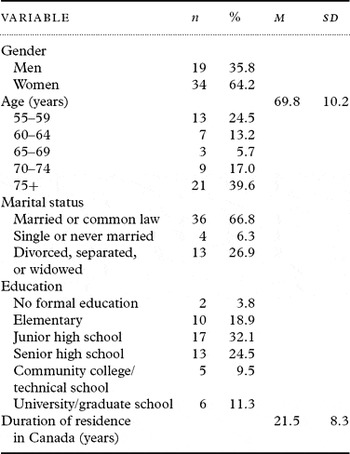
Table 1 provides demographic data for the Chinese sample. All were foreign-born and most were immigrants from Hong Kong (67.9%), followed by mainland China (18.9%), and Vietnam (5.7%). The remaining participants were from Taiwan, Macau, Indonesia, and Malaysia (7.6%). The languages spoken were Cantonese (77.4%), Mandarin (4.0%), Shanghainese (3.8%), and/or some combination (15.1%).
Sociodemographic characteristics for the Chinese sample (N = 53)

Participants in the population-based sample (Wang et al., Reference Wang2007) were all born in Canada, mostly female (62.1%) and married or living common law (66.8%). Approximately one-quarter of the sample had some university education (27.9%), 29.5% had college or technical school training, and 42.6% had high school completion or less. The survey response rate was 76.0%. There were no statistically significant differences between the Chinese and population-based sample on gender or marital status. However, the population-based sample was younger with a mean age of 62.72 years (SD = 5.44), compared to 69.79 years in the Chinese sample (SD = 10.23; t (765) = 8.57, p < 0.001). Moreover, the Chinese sample was less educated with 20.8% having achieved more than a high school education, compared to 57.4% in the comparative sample (χ2 (1) = 9.72 p = 0.002).
Identification of depression
In response to the first question (Did Chan Siu Ming/Cheung May Lee have a problem?), 98.1% of the Chinese sample said “yes”, while 1.9% said “no.” When asked what kind of a problem Chan Siu Ming/Cheung May Lee had, 11.3% of Chinese participants were able to correctly identify depression. An additional 30.2% of Chinese identified either a mental illness or a psychological, mental, or emotional problem. In contrast, 74.0% of population-based sample were able to identify depression as the case vignette's problem, while an additional 3.1% identified either a mental illness or a psychological, mental or emotional problem. Other responses in both groups included “stress”, an unidentified “problem”, other problems, or “don't know.”
In response to the second question (Did Chan Siu Ming/Cheung May Lee have a psychological disorder, and if so, what type of disorder did he/she have?), 20.8% of Chinese participants were able to identify depression.
On the Belief in Chinese Culture and Values Scale, Chinese participants had a mean score of 3.21 (SD = 0.62) out of a possible score of 5, indicating that most of the sample supported Chinese cultural values. However, t-test analyses indicated that there were no significant differences on this scale between Chinese participants who could identify depression and those that could not, in response to either question one or two.
Helpful people and interventions
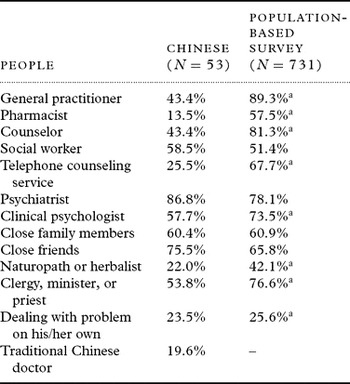
Table 2 indicates the percentages of Chinese and survey participants who rated various people as helpful for the person in the case vignette. Overall, the Chinese participants rarely reported specific people or professions as unhelpful. Thus, groups were compared on their ratings of helpful versus neither helpful nor harmful using 2 × 2 χ2 analyses. All group differences were significant with the exception of social workers, psychiatrists, close family members, and close friends (p < 0.001). For all other professions/people, Chinese participants were more likely to view them as neither helpful nor harmful (rather than helpful).
Percentages of Chinese and survey participants who rated people as “helpful”

Notes. Dashes indicate lack of comparative data.
aGroup differences on helpful versus neither helpful nor harmful that were significant at p < 0.0001.
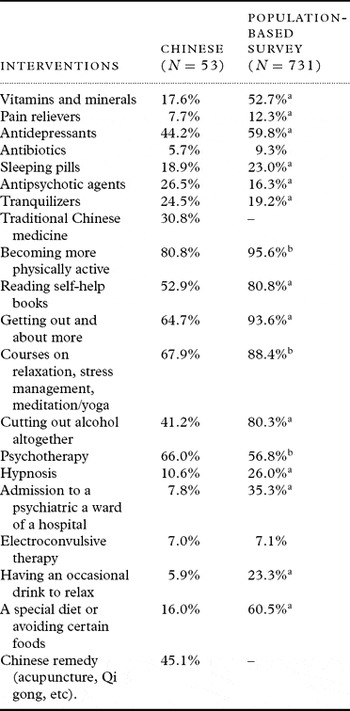
Table 3 indicates the percentages of Chinese and survey participants who rated interventions as helpful. Both groups reported that being more physically active was the most helpful intervention. Groups were compared on their ratings of interventions as either helpful, harmful, or neither helpful nor harmful using 2 × 3 χ2 analyses (with the exception of becoming more physically active, courses on relaxation, etc., and psychotherapy because none of the Chinese participants rated these as harmful). Group differences were significant for all interventions with the exception of antibiotics and electroconvulsive therapy (p < 0.0001). Chinese participants were more likely to rate interventions as neither helpful nor harmful. Eight of the interventions were reported to be neither helpful nor harmful by over half of the Chinese sample. Interestingly, a minority of Chinese participants reported traditional Chinese medicine (30.8%) and Chinese remedies (45.1%) as helpful.
Percentages of Chinese and survey participants who rated interventions as “helpful”

Note. Dashes indicate lack of comparative data.
a2 (group) × 3 (helpful, harmful, neither helpful nor harmful) χ2 analyses significant at p < 0.001.
bNone of the Chinese participants rated these as harmful.
Etiology
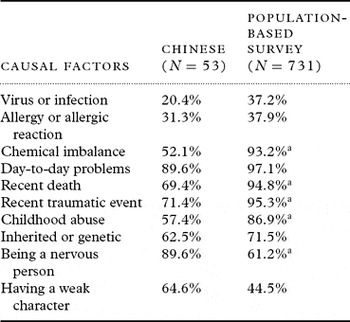
Table 4 provides the percentages of Chinese and survey participants who rated the possibility or likelihood of various causes of the problem represented in the vignette. The results of 2 × 2 χ2 analyses comparing very possible/possible or not possible indicated that Chinese participants were less likely to attribute the etiology to a chemical imbalance, a recent death, a traumatic event, or childhood abuse, but were more likely to attribute it to being a nervous person (p < 0.0001).
Percentages of Chinese and survey participants who rated causal factors as “very possible or possible”

Note: aGroup differences on very possible/possible versus not possible that were significant at p < 0.0001.
Prognosis
When asked what the chances were of Chan Siu Ming/Cheung May Lee recovering if he/she received professional help, all Chinese participants reported a complete or partial recovery, as did all but three survey participants. However, when asked what the chances were of the case recovering without receiving professional help, 52.8% of Chinese predicted full or partial recovery and 45.1% thought there would be no improvement or the case would worsen. In contrast, only 9.4% of survey participants predicted a full or partial recovery and 77.3% predicted no improvement or a worsening of the condition. These group differences were significant (χ2(1, N = 681) = 74.61, p < 0.001).
Discussion
Depression literacy: identification of depression
Chinese immigrants were significantly less able to recognize depression compared to their Canadian-born age peers in the population-based survey. Only 11.3% of the Chinese participants used the words “depression” or “depressed,” while 74.0% of the survey sample correctly identified depression. An additional 30.2% of Chinese respondents were able to identify a mental illness or psychological, mental, or emotional problem, but did not specifically name depression. However, when cued to think about a “psychological disorder,” a total of 20.8% of Chinese respondents identified depression. Although the method of interviewing was different between the two samples (in-person versus telephone), it is unlikely that the magnitude of the group difference in depression recognition can be accounted for by this methodological difference. Depression literacy was unrelated to the endorsement of cultural values by Chinese participants, as those who were able to identify depression did not differ from those who could not identify depression in terms of their level of endorsement of Chinese cultural beliefs or values. However, very few Chinese respondents were able to identify depression; thus, the statistical likelihood of being able to detect a significant difference between the two groups is low. Therefore, the finding that depression literacy is unrelated to the endorsement of cultural beliefs should be viewed with caution and replicated with a larger sample size.
In part, group differences in depression literacy may reflect lower levels of education among Chinese participants. Previous research has indicated that individuals with more education are better able to identify depression than those with less education (Suhail, Reference Suhail2005). Also, all Chinese participants were educated in their countries of origin (e.g. mainland China) during the early to mid-1900s, and the underdeveloped nature of many of these educational systems during this time period may have resulted in even greater educational disparities between the two groups than is reflected in the data. Moreover, the relative lack of mental health facilities and professionals in Asian countries during this same period could also explain Chinese participants' lack of familiarity with issues of mental health (Yip, Reference Yip2005).
Helpful people and interventions
Virtually none of the Chinese respondents reported people as harmful and most were viewed as neither helpful nor harmful. Previous research has indicated the presence of response biases among Chinese participants with the tendency to respond in the middle of a rating scale (Cheng and Song, Reference Cheng and Song1989; Hamid et al., Reference Hamid, Lai and Cheng2001). Such a tendency may be a reflection of the sociocultural norm of valuing social relationships and the cultural value of “saving face” (Hamid et al., Reference Hamid, Lai and Cheng2001). Thus, rather than risk offending particular professions by claiming them to be “harmful” in the treatment of mental illness, participants may have been more likely to choose neither helpful nor harmful to prevent the loss of face. It is also possible that a lack of knowledge regarding mental health professions may have resulted in the majority of Chinese respondents reporting that they were neither helpful nor harmful. However, the attitude of “neither helpful nor harmful” towards health professionals can impede people's willingness to seek professional services when they are in need of such help.
Clearly, the vast majority of older Chinese adults (86.8%) perceived psychiatrists to be helpful, in stark contrast to traditional Chinese doctors who were reported as helpful by only 19.6% of Chinese. Similarly, less than half believed that Chinese remedies (e.g. acupuncture, Qi gong, etc.) would be helpful. Although previous research indicates that traditional Chinese remedies are more popular among Chinese than all other Canadians, the extent to which Chinese remedies are sought for mental health issues is unknown (Roth and Kobayashi, Reference Roth and Kobayashi2008).
Only 43.4% of Chinese participants viewed general practitioners as helpful. However, accessing mental health treatment often requires an initial consultation with a general practitioner. If general practitioners are not viewed as helpful, older Chinese may be less likely to disclose their mental health symptoms. This reduces the likelihood that they will be referred to a mental health specialist for further assessment and treatment.
In terms of helpful interventions, there was overwhelming consensus among both samples that physical activity would be a helpful intervention. In addition, approximately two-thirds of Chinese adults reported that getting out and about more, courses on relaxation, etc., and psychotherapy would be helpful. These findings suggest that older Chinese may be receptive to psychological treatments that incorporate and encourage physical activity, such as behavioral and cognitive-behavioral treatments. Behavioral activation is a key element of these interventions, both of which have shown considerable empirical evidence for their efficacy with older adults (Zarit and Zarit, Reference Zarit and Zarit2007). The results of this study suggest that older Chinese adults may also benefit from these interventions.
Etiology and prognosis
In general, Chinese respondents were less likely to rate risk factors as very possible or possible causes of depression, and these differences were significant for a chemical imbalance, recent death, and a recent traumatic event. This may reflect less knowledge about biological and psychosocial risk factors for depression. However, the Chinese were more likely to identify personality characteristics as causal factors, and this difference was significant for being a nervous person. Interestingly, the research literature does support anxiety as a risk factor for symptoms of depression (Wetherall et al., Reference Wetherall, Gatz and Pedersen2001). Thus, the response that nervousness (a term that is often used by older adults to refer to anxiety) is a causal factor is quite consistent with the empirical literature. The finding that “having a weak character” was identified by about two-thirds of the Chinese sample is troubling, as it invokes an explanation that reflects a constitutional flaw with corresponding moral implications (i.e. individuals are weak and, as a consequence, have emotional problems) and potential stigma against individuals with depression. Among Chinese people, it is often the family's fear of exposing shame to outsiders that perpetuates the stigma of mental illness (Lin and Lin, Reference Lin, Lin, Kleinman and Lin1981). Cultural beliefs regarding mental illness likely play a role in the stigmatization of mental illness (Liu, Reference Liu1981) and may partially explain the underutilization of professional mental health services by Chinese populations (Li and Browne, Reference Li and Browne2000).
When asked about the chances of recovery, both samples reported a positive prognosis upon receiving professional help. The Chinese group was most optimistic about complete or partial recovery without professional help, suggesting that they believed emotional or mental health problems could be remedied without professional assistance. This may be one reason that Chinese immigrants do not utilize mental health services to the same extent as their non-Chinese counterparts, in addition to the cultural/linguistic barriers they encounter when seeking mental health services, their preference to consult family, friends, or traditional healers, and their lack of knowledge regarding mental health services (Chen and Kazanjian, Reference Chen and Kazanjian2005; Li and Browne, 2005; Lai and Chau, Reference Lai and Chau2007). Taken together, Chinese beliefs that mental health problems can be addressed without professional help and their endorsement of self-help interventions (physical activity, getting out and about more, taking courses) suggests that self-help strategies could be quite successful with this population, provided they are adapted in a culturally sensitive manner.
Limitations
The present study has several limitations. First, this is a small sample of convenience, thus limiting its generalizability. Nevertheless, this study begins to address the paucity of research investigating mental health issues among ethnic minority elders (Shah et al., Reference Shah, Doe and Deverill2008). Clearly, studies with larger sample sizes that are more representative of the older Chinese population are needed. Second, because a measure of ethnicity was not included in the population-based survey, the ethnic diversity of this sample is unknown. Thus, the group comparison is between older Chinese immigrants and a population-based sample of individuals born in Canada. While not ideal, this does provide important information about Chinese immigrants' mental health literacy relative to same-age peers who were born in Canada. Third, although the measures and vignette were translated according to the World Health Organization guidelines (2007), the case vignette did not translate perfectly from English to Chinese. For example, the Chinese translated vignette reads “Everyday tasks make him (her) feel as if he (she) cannot breathe (has pressure),” when the same sentence in the English vignette is “Even day-to-day tasks seem too much for him (her).” So, the vignette in English depicts the fatigue or lack of energy that is characteristic of depression, while the Chinese version has a more somatic presentation which may have complicated the interpretation of symptoms for Chinese participants. This illustrates the complicated nature of establishing linguistic equivalence in translated vignettes and measures, and in cross-cultural psychopathology research in general. Finally, an important methodological question is the adequacy of a vignette in assessing depression literacy. Research has noted that the vignette methodology truncates the range of depressive symptoms and therefore reduces recognition among lay people (Parker et al., Reference Parker, Chan and Tully2006). However, there is no reason to believe that this would have influenced one group more than the other, and thus cannot account for the large group differences in depression recognition.
In summary, this is the first study to investigate mental health literacy among older Chinese immigrants. Results indicate that older Chinese immigrants would benefit from mental health education, including specific information regarding symptoms of depression, etiology, and effective treatments for depression. Ideally, this mental health education would be integrated into the supports and services currently available to Chinese elders and their family members. Behavioral, cognitive, and self-help interventions may be particularly promising for older Chinese adults given their beliefs and attitudes about mental health intervention and prognosis. Future research should continue to examine depression literacy among this growing population of older Chinese immigrants, in particular its relationship to help-seeking behavior and mental health service utilization.
Conflict of interest
None.
Description of authors' roles
Y. Tieu formulated the basic premise of the paper and collected data from the Chinese sample. C. Konnert supervised the project, contributed sections of the paper, and made major revisions to it. J. Wang contributed the population-based survey data for comparative purposes and reviewed drafts of the paper.
Acknowledgements
We sincerely thank the participants of this study, the staff and volunteers at the Calgary Chinese Elderly Citizen's Association, Calgary Chinese Community Service Association, Francis Liu of Wai Kwan Manor, Esther Lau, Phyllis Luk, Polly Po, and the volunteer research assistants (Chelsea Lai, Amy Leung, Angelina Tao, and Lily Ye).