I. INTRODUCTION
Development of the modern technologies creates needs for new construction materials with improved mechanical and physical properties. Aluminum matrix composites (AMCs) are found to be potential materials for many applications in automobile, aerospace, military, and other high technology industries because of high specific strength, good wear resistance, high specific modulus, low coefficient of thermal expansion, and also, good electrical and thermal conductivity.Reference Han, Jones and Atkinson1–Reference Sameezadeh, Emamy and Farhangi4 Extensive studies have been carried out to improve their mechanical properties using different ceramic and intermetallic reinforcing materials such as Al2O3,Reference Zhang, Bingchao, Zhang and Cai5 SiC,Reference Qu, Zhang, Wu and Ren6 Ni3Al,Reference Diaz, Gonzalez-Carrasco, Caruana and Lieblich7 and B4C.Reference Alizadeh, Alizadeh and Amini8 MoSi2 is a relatively new reinforcement candidate for AMCs due to its high modulus, high wear properties, and thermal stability in the aluminum alloy matrices which have been partially studied in recent years.Reference Corrochano, Lieblich and Ibanez9–Reference Corrochano, Walker, Lieblich, Ibanez and Rainforth12
A homogeneous distribution of reinforcements is necessary to improve mechanical properties and it is difficult to achieve uniform structure in the case of nanosized particulates. Comprehensive studies have proved that mechanical alloying via ball milling is a suitable technique for this goal and can produce homogeneous microstructures.Reference Suryanarayana13–Reference Jeyasimman, Sivasankaran, Sivaprasad, Narayanasamy and Kambali16
In the present work, attempt was made to produce 2024 aluminum alloy matrix nanocomposites with different volume fractions of MoSi2 particles by the use of mechanical alloying technique. The aim is to study the influences of the particle content and distribution on the mechanical properties of the composites and to determine the optimum condition.
II. EXPERIMENTAL PROCEDURE
AA 2024 aluminum alloy powder with nominal chemical composition of Al–4.1Cu–1.6Mg–0.4Mn (wt%) was used as a composite matrix produced by a nitrogen atomization technique. The particle size distribution of the matrix powder was D 50 = 75 µm with a rather spherical morphology. The nanosized MoSi2 intermetallic reinforcement (n-MoSi2, D 50 = 71 nm) was produced by mechanical milling of the available powder (3 µm) for 100 h as reported in a previous study by the authors.Reference Sameezadeh, Farhangi and Emamy17 Mechanical alloying process of the powders was carried out in an attrition ball mill for milling time of 8 h under high purity argon gas. A stainless steel vial and hardened chromium steel balls (6 and 10 mm diameter) were used for milling of AA 2024 matrix with different volume fractions of nanometric MoSi2 (ranging from 0 to 5 percent). The ball to powder weight ratio and shaft rotational speed were chosen as 12:1 and 4.5 rps (270 rpm), respectively. Also, 2 wt% stearic acid was added as process control agent to avoid excessive sticking and agglomeration of the aluminum alloy powder.Reference Rocha, Leal Neto, Gonçalves, Carvalho and Filho18
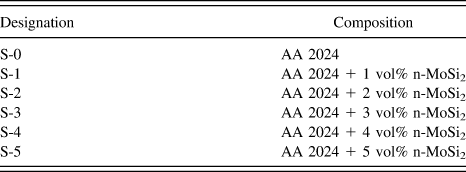
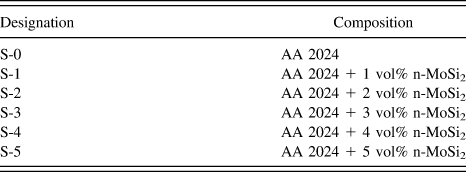
The produced powders were uniaxially cold pressed in a cylindrical steel die at 800 MPa and then hot-pressed at 470 °C under pressure of 450 MPa for 75 minutes. All consolidated materials were then solutionized at 485 °C for 75 minutes followed by artificial aging at 190 °C for 12 h to achieve T6 heat treatment condition. Table I shows the designation and description of different specimens which have been studied in current research.
Designation of the studied specimens.
The microstructure of the nanocomposites was characterized to study the MoSi2 distribution in the matrix by scanning electron microscopy (SEM; CamScan MV2300, TESCAN Brno Company, Brno, Czech Republic) equipped with energy dispersive spectroscopy (EDS). Brinell hardness test was conducted with a load of 294 N (30 kgf) and 2.5 mm ball. Average hardness values obtained using at least five measurements are reported. Pin-on-disc wear test was conducted according to ASTM standard G9919 on a conventional wear testing machine at room temperature (RT) and with a counterface of AISI 52100 steel which was hardened to 62 HRC. The wear specimens were machined from the consolidated specimens in the form of cylindrical pin with 5 mm diameter and 12 mm height and then grinded and polished to a 1 µm finish. The wear test was carried out at a constant sliding velocity of 0.5 m/s (2.9 rps) and under a 10 N normal load with sliding distance of 1000 m. At least three wear samples were tested for each specimen. The pins were cleaned by ultrasonic prior and after the tests with acetone and then were weighed using an electronic balance (GR200-AND, A&D Company, Tokyo, Japan) with an accuracy of 0.1 mg. The volume loss due to the test was calculated from weight loss according to the following equation19:
 $${\rm{volume\ loss}}\left( {{\rm{m}}{{\rm{m}}^3}} \right) = {{{\rm{weight\ loss}}\left( {\rm{g}} \right)} \over {{\rm{density}}\left( {{{\rm{g}} \mathord{\left/ {\vphantom {{\rm{g}} {{\rm{m}}{{\rm{m}}^3}}}} \right. \kern-\nulldelimiterspace} {{\rm{m}}{{\rm{m}}^3}}}} \right)}}\quad .$$
Cylindrical compression test specimens with 7 mm diameter and 11 mm height dimensions were machined and polished from the consolidated samples. The tests were performed at RT, 150 °C and 300 °C using INSTRON 8503 universal testing machine (Instron Corporation, Buckinghamshire, United Kingdom) at a constant cross head speed of 0.3 mm/min according to DIN 50106 standard. Average mechanical properties were obtained from at least three compression tests for each material condition.
III. RESULTS AND DISCUSSION
A. Microstructure characterization
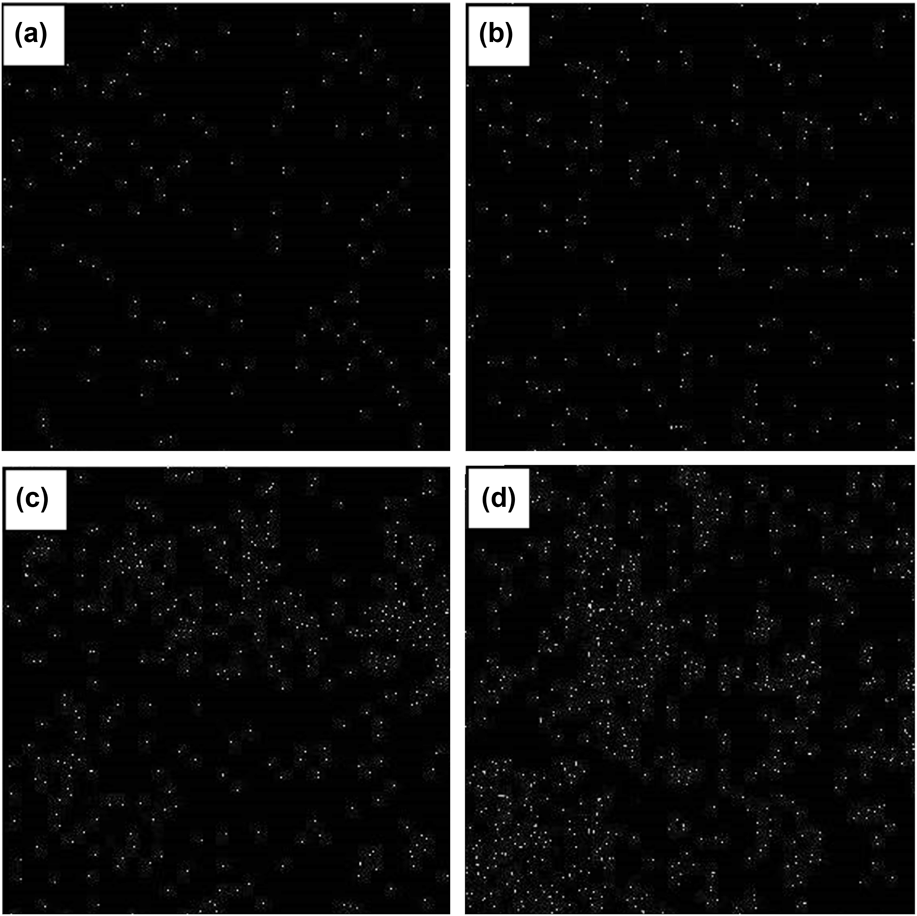
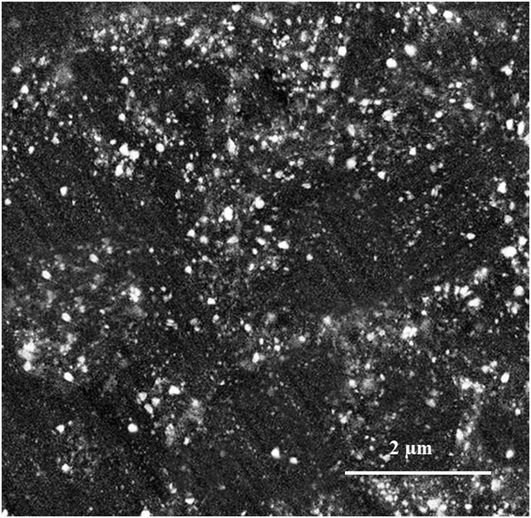
The distribution of nanosized MoSi2 reinforcement in the aluminum matrix was characterized using SEM/EDS mapping. Figure 1 shows SEM micrographs of molybdenum mapping taken from S-2 to S-5 nanocomposites. The distribution of MoSi2 particles in S-2 specimens is relatively uniform but at higher reinforcement contents, the uniformity decreases and gradually changes from random to clustered one. Although decreasing the size of reinforcement to nanometric scale can result in greater enhancement of mechanical properties strength of AMCs, the tendency of particle agglomeration and clustering also increases.Reference Fogagnolo, Robert and Torralba20,Reference Bozic, Dimcic, Dimcic, Stasic and Rajkovic21 This phenomena creates more problem when the reinforcement fraction increases and leads to inhomogeneous structures. Figure 2 displays a SEM micrograph of S-5 composite with several nonuniform and agglomerated regions represent an inhomogeneous microstructure which can negatively affect its mechanical properties.
SEM micrographs of molybdenum mapping for: (a) S-2, (b) S-3, (c) S-4 and (d) S-5 nanocomposites.

Microstructure micrograph of S-5 nanocomposite.Reference Sameezadeh, Emamy and Farhangi4

B. Mechanical properties
The results of hardness and wear tests are shown in Fig. 3. The addition of nanosized MoSi2 particles has brought a considerable increase in the hardness of all composites compared to the matrix alloy. This increase is expected because hard particulate reinforcements act as a barrier to the dislocation movement within the matrix and exhibit greater resistance to indentation of the hardness tester.Reference Sameezadeh, Emamy and Farhangi4,Reference Sharma and Ramesh22 The results also show that the volume loss amount of the composites decreases with increasing MoSi2 fraction and the improvement trend gradually decreases with increasing reinforcement content. Based on the obtained data, S-3 and S-4 specimens have the highest wear resistance among the tested samples; also unreinforced aluminum alloy (S-0) gives the lowest wear resistance. It is generally believed that incorporation of hard particles to aluminum matrices, results in an improvement of the wear resistance of the base alloy to a great extent.Reference Sameezadeh, Emamy and Farhangi4,Reference Lashgari, Sufizadeh and Emamy23 Specially, in accordance with literature, MoSi2 reinforcement significantly improves the sliding wear resistance of aluminum alloys. Hard particles of MoSi2 resist against destructive action of abrasion and protect the surface, so with increasing its volume fraction, the wear resistance enhances but it seems this enhancement continues until the reinforcement can improve the mechanical properties such as hardness. These results are consistent with the rule that in general, materials with higher hardness have better wear and abrasive resistance.Reference Sameezadeh, Emamy and Farhangi4,Reference Walker, Ross, Rainforth and Lieblich11,Reference Lim, Leo, Ang and Gupta24
Results of hardness and wear tests versus MoSi2 content.
Figure 4 represents stress–strain curves of the compression tests at RT, 150 °C and 300 °C. The results derived from these curves are plotted versus MoSi2 content (vol%) in Fig. 5. It can be seen that for RT tests, addition of MoSi2 reinforcing nanoparticles mainly causes a marked increase in compressive strength [Fig. 5(a)]. The strength reaches a peak value of 815 MPa in S-3 nanocomposite, with 3 vol% MoSi2, which exceeds that of S-0 unreinforced alloy by about 40%. At higher contents of the reinforcement, the strength shows a slight decrease to 780 MPa in S-5 specimen which has the highest MoSi2 content. Hardness test results showed a similar trend so, there is a steady increase in hardness up to a peak value at 3 vol% MoSi2 content followed by a small drop at higher reinforcing.
Typical compressive stress–strain curves of the nanocomposites at: (a) RT, (b) 150 °C and (c) 300 °C.
(a) Compressive strength and (b) ductility of the nanocomposites versus MoSi2 content.
On the other hand, as illustrated in Fig. 5(b), the compressive ductility (ΔL/L 0%) continuously drops with increasing the nanosized reinforcement particles. The most significant loss of compressive ductility (which leads to ductility value lower than 10%) is measured in S-5 composite.
The main strengthening mechanisms in the Al matrix composite are coefficient of thermal expansion mismatch, Orowan looping and Hall–Petch grain refinement.Reference Poirier, Drew, Trudeau and Gauvin25 Hard reinforcements act as barriers to dislocation movement within the matrix and also lead to matrix grain refinement during the mechanical milling. These phenomena result in higher hardness and compressive strength, more wear resistance and also, lower ductility of the composite specimens compare to the unreinforced alloy.Reference Li, Lai, Gupta, Chua and Osman26–Reference Sameezadeh, Farhangi and Emamy29
However, it is reported if nanoparticulate content in a composite exceeds a critical value, the improvement in mechanical properties diminishes.Reference Sameezadeh, Farhangi and Emamy29–Reference Rahimian, Ehsani, Parvin and Baharvandi31 Kang et al.Reference Kang and Chan30 have explained that the saturation of grain boundaries with nanoparticles prevents more grain refinement during the composite fabrication and so, impedes further strengthening by the Hall–Petch mechanism. In addition, after a certain amount of added nanoparticles, depending on the particle size, they can easily agglomerate to form clusters and the actual interparticle distance become larger than the expected distance, therefore, the effect of Orowan strengthening mechanism decreases.Reference Sameezadeh, Farhangi and Emamy29,Reference Kang and Chan30
Comparing these mechanical tests results with the micrographs of Figs. 1 and 2 proves the deteriorating effects of agglomeration (clustering) of nanoparticles and inhomogeneous microstructure on the mechanical properties of the studied nanocomposites.
The effect of test temperature on the mechanical properties of the composites can be seen in Fig. 5. Similar to the RT results, enhancement of the composite strengths due to the reinforcing, gradually diminishes after a certain amount of the nanoparticles. In addition, as expected, with increasing the temperature, compressive strengths of all specimens decline and also the ductility values (fracture strains) increase. These variations are lower for the nanocomposites compared to the unreinforced specimen, e.g., at 300 °C, the ductility for S-0 specimen reaches to 46% from 30% (at RT) while for S-4 it is 16% from 10% (RT). This is mainly because of the stability of MoSi2 phase at these test temperatures, results in relatively effective strengthening mechanism for the MoSi2 reinforcement.Reference Sameezadeh, Farhangi and Emamy29
Deformation and flow stress at elevated temperature tests are controlled by two opposing effects at the same time: (i) the strain hardening effect due to plastic deformation and role of dislocations and (ii) the strain softening effect due to dynamic recovery or recrystallization.Reference Avner32 In aluminum alloys which have high stacking fault energy, dynamic recovery has the main role on the softening phenomenon during high temperature deformation results in decreasing the dislocation density and the effective strain hardening rate. In comparison, at low temperature test, strain hardening is the most important phenomenon and leads to enhancement of the flow stress.Reference Reed-hill and Abbaschian33,Reference Blaz, Kaneko, Sugamata, Sierpinski and Tumidajewicz34 Generally, cross slip, climb, and dislocation unlocking take place easier at high temperatures and contribute to active slip systems results in diminishing the effect of reinforcement strengthening. Also, elevated temperature can reduce the effect of precipitation hardening (T6 treatment) via transforming the precipitated phases from incoherent to coherent ones or dissolving them into the matrix.
General views of three fractured specimens of compression test and also schematics of their primary crack orientations are shown in Fig. 6. The unreinforced S-0 specimen exhibits a completely slant macroscopic fracture mode. The fracture surface is inclined roughly at 45° angle with respect to the loading direction, which is normally associated with a typical shear-face compressive fracture in ductile materials.Reference Sameezadeh, Farhangi and Emamy29,Reference Wulpi and K. Mills35 With involving the MoSi2 reinforcement, the crack path shows important local discontinuities or deviations from the general slant orientation. In S-2 composite, two noncoplanar slant crack surfaces are joined by a longitudinal crack parallel to the compression axis, while in S-5 specimen the primary slant crack branches into multiple secondary cracks.
(a) General view and (b) crack schematic drawings of three compression test samples.
Evaluation of crack orientations implies that adding MoSi2 nanoparticles gradually changes the macroscopic fracture mode from fully ductile to a mixed ductile and brittle mode. The influence of increasing MoSi2 content on promoting brittle fracture mode correlates well with the observed significant loss of ductility in Fig. 5(b), particularly in composite specimens with higher MoSi2 contents. It is generally because of the nanoparticle clustering which can act as significant stress concentration zones and promote multiple cracking and brittle fracture behavior (lower ductility).Reference Sameezadeh, Farhangi and Emamy29
According to the mentioned results, it can be concluded that between the studied specimens, S-3 is the optimum nanocomposite especially for ambient temperature applications which simultaneously has the highest hardness and compressive strength, good wear resistance, and also acceptable ductility and fracture behavior.
IV. CONCLUSIONS
Nanocomposites of 2024 aluminum alloy matrix-MoSi2 were prepared using mechanical alloying method followed by cold and hot pressing and precipitation hardening heat treatment. Influences of volume fraction and distribution of nanosized MoSi2 reinforcement on mechanical properties of the composites were investigated. The overall results of this study are as following:
(1) The distribution of low content of MoSi2 nanoparticles in the matrix was random and homogeneous while with increasing the volume fraction of the reinforcement, the tendency of particle clustering and agglomeration was gradually intensified and resulted in nonuniform and inhomogeneous composite microstructure.
(2) The addition of MoSi2 particles continuously brought a considerable enhancement in the mechanical properties (hardness, wear resistance, room and high temperature strength) of the matrix alloy but by exceeding a certain amount of the reinforcement fraction (3–4 vol%), this improvement of the mechanical properties was reduced mainly because of the microstructure inhomogeneity.
(3) Declining of the compressive strength at the elevated temperatures was lower for the composite specimens compared to the unreinforced aluminum alloy due to the relative phase stability of the MoSi2 particles in the matrix at the high temperatures.
(4) The nanocomposite with 3 vol% MoSi2 exhibited the optimum mechanical properties and fracture behavior at ambient temperature.