INTRODUCTION
Intensive agriculture eliminates seed and seedling banks, making seed dispersal the primary source of forest species in land released to ecological succession (Cramer et al. Reference CRAMER, HOBBS and STANDISH2008, Wijdeven & Kuzee Reference WIJDEVEN and KUZEE2000). We have established a novel experiment in recovery of dispersal processes between forest and remnant habitats in an agricultural mosaic of pastures and forest remnants in what was once tropical rain forest in southern Mexico. Remnants of forest in agricultural landscapes include isolated trees in pastures, living fences and stands of trees or habitat fragments of various sizes. Pasture areas that we cleared of isolated trees and living fences that produce fleshy fruits offer the unprecedented opportunity to test the initial seed rain into fenced plots in active pasture as compared with nearby secondary and primary forest. This early phase, before maturation of experimental tree communities alters the system, allows us to ask whether: (1) seed rain differs by habitat and dispersal mode, and (2) species composition and accumulation curves suggest future changes in patterns of seed rain in different habitat types.
Plant recruitment is limited by the number of seeds that arrive at a site and mortality of seeds and seedlings in the site (Schupp et al. Reference SCHUPP, HOWE, AUGSPURGER and LEVEY1989, Svenning & Wright Reference SVENNING and WRIGHT2005, Tilman Reference TILMAN1997). Dispersal limitation reflects the proportion of potential sites not reached by seeds, while establishment limitation is the proportion of sites reached where seedlings do not occur (Norden et al. Reference NORDEN, CHAVE, BELBENOIT, CAUBERE, CHATELET, FORGET, RIERA, VIERS and THEBAUD2009). Seed and seedling mortality from random and non-random factors is immense (Harper Reference HARPER1977), with far more seeds of small-seeded pioneers ‘required’ to ensure establishment of a seedling than most larger-seeded species (Hubbell et al. Reference HUBBELL, FOSTER, O'BRIEN, HARMS, CONDIT, WECHSLER, WRIGHT and LAO1999). The character of ecological succession is profoundly influenced by which species actually arrive in numbers, and which survive early mortality. Not yet clear is how the composition of woody species that potentially could occupy protected sites in open ground reflects differential dispersal, differential seedling establishment, or differential survival in seed and seedling stages.
Here we report rates and habitat structure of seed rain into an experimental grid embedded in active pasture in southern Veracruz, Mexico. We first (1) test the annual contribution of seeds of wind- and animal-dispersed species by habitat type, well before any species in pastures either directly contribute to seed rain, or attract animals that might indirectly have the same effect (Holl Reference HOLL2002). Before fruit-eating animals from forest remnants have an incentive to forage in the landscape, we expect wind-dispersed seeds to predominate. We then (2) ordinate seed rain composition in three contiguous habitats using multidimensional scaling. If all species arrive in all habitats, the composition of seed rain will be similar among habitats. Because we removed seed sources within the experimental grid, associations of early and late-successional species in seed rain patterns reflect proximity of seed sources in secondary or primary forest 90–250 m away, or differential dispersal into the landscape. For our purposes, dispersal limitation in pastures is quantified as the percentage of species and seeds of early and late-successional species reaching pastures in comparison with forested habitats. Lastly, (3) we use species accumulation curves to test the hypothesis that seed rain of woody plants into our fenced plots is substantially less in number and species than in secondary or primary forest nearby.
MATERIALS AND METHODS
Research site
The Los Tuxtlas Biological Station (LTBS) lies within a reserve of 640 ha of lowland tropical rain forest in the state of Veracruz, south-east Mexico. The forest has a closed canopy ~ 35 m high; Nectandra ambigens (Blake) C.K. Allen (Lauraceae) is the most common species in the canopy, Pseudolmedia oxyphyllaria Donn. Sm. (Moraceae) and Astrocaryum mexicanum Liebm. (Arecaceae) are common in the mid-canopy and understorey, respectively (Bongers et al. Reference BONGERS, POPMA, MEAVE-DEL-CASTILLO and CARABIAS1988). Mean annual temperature and mean annual rainfall are 27 °C and 4900 mm, respectively (Martin-Del-Pozzo Reference MARTIN-DEL-POZZO, Gonzélez, Dirzo and Vogt1997). The normal dry season extends from March to May, and a rainy season from June to February.
The study site adjacent to the LTBS includes primary and secondary forest as well as cattle and horse pasture on a hill along an elevational gradient from 180 to 260 m asl in a broad valley facing north-east to the Gulf of Mexico. Pasture grasses are a closely cropped 5–10-cm-high mix of exotic (Cynodon plectostachyus (K. Schum.) Pilger and Urochloa decumbens (Stapf) R. Webster) and native (Axonopus compressus (Sw.) P. Beauv., Panicum spp. and Paspalum conjugatum P.J. Bergius) species. Soil is sandy loam classified as vitric andosols (Martin-Del-Pozzo Reference MARTIN-DEL-POZZO, Gonzélez, Dirzo and Vogt1997). This study differs from another in southern Veracruz (Martínez-Garza & González-Montagut Reference MARTÍNEZ-GARZA and GONZÁLEZ-MONTAGUT1999) in simultaneous sampling of forest and pasture, and with a randomized sampling design that minimizes influence of relict trees and living fence lines that were removed from sample plots.
Design
A 3 × 8 grid of 24 fenced plots (30 × 30 m, each plot separated by 35 m) was established within the pasture of the agricultural Colony of Ruiz Cortínez in July–August 2006. The grid (18°30′–18°40′N, 95°3′–95°10′W) is within 500–1200 m of the edge of the LTBS. The closest secondary forest is 90 m from the south-west corner of the grid.
Four seed traps in each plot were located at random, stratified by plot quarter, for a total of 96 seed traps in fenced enclosures in pastures. Twelve seed traps in each forest habitat (primary and secondary within continuous forest) c. 200 m from the forest edge were located at random in an area corresponding to three plots (90 × 30 m) for a sample of 2700 m2. Each seed trap consisted of four 1-m poles of PVC supporting a 1-m2 frame with a cloth with a rock in the middle for seeds to be trapped under it. Samples were collected monthly and separated, counted and identified to species at the University of the State of Morelos (UAEM), Mexico. Seed identification was done using plant material from the herbarium at LTBS and reference collections from previous studies (Martínez-Garza & González-Montagut Reference MARTÍNEZ-GARZA and GONZÁLEZ-MONTAGUT1999); a sample of seeds of each species was preserved and photographed as a reference collection at UAEM. Species were classified as pioneer or late successionals and dispersed by wind or animals with the help of the literature (Ibarra-Manriquez & Sinaca Reference IBARRA-MANRIQUEZ and SINACA1995, Reference IBARRA-MANRIQUEZ and SINACA1996a, Reference IBARRA-MANRIQUEZ and SINACAb, Martínez-Ramos Reference MARTÍNEZ-RAMOS, Gómez-Pompa and Del-Amo1985, Popma et al. Reference POPMA, BONGERS and WERGER1992).
Analysis
Data included here were collected from December 2006 to January 2008. Some samples were lost when trap cloth tore, when traps were stolen, and in transit from the field site to the University. Incomplete samples from August, September and October 2007 were removed from analysis, leaving 11 mo of seed rain. A randomized-block analysis of variance (Zar Reference ZAR1996) was used to test for differences in (1) richness and (2) density of seeds by dispersal mode with two levels (animals and no-animals (wind, gravity)) and habitat with three levels (pasture, primary forest and secondary forest). The month was used as a block while the average richness or average seed density for all traps in each habitat for each month was used as a dependent variable (N = 66). Analysis for pastures including distance to closest seed sources where not performed due to very few seeds trapped. Data were transformed when needed with the natural logarithm. Mean ± SD are shown for data analysed with parametric tests. Means were back-transformed when necessary.
Kruskal–Wallis one-way analysis of variance on ranks (Zar Reference ZAR1996) tested for differences in richness and density of seed rain with habitat as a main factor for early and late-successionals. This non-parametric test accommodated strong deviations from normality in the residuals. To avoid pseudoreplication in time, the average richness or seed density for each trap through the year was used as a dependent variable. Medians are shown for data analysed with non-parametric tests.
Non-metric multidimensional scaling analysis (NMDS; Gauch Reference GAUCH1982) ordinates seed rain composition of early and late-successional species among habitats. A matrix of similarity coefficients was calculated using the Jaccard similarity index, based on the presence-absence of species in each habitat for each month (Koleff et al. Reference KOLEFF, GASTON and LENNON2003). The number of NMDS dimensions was decided with the lowest stress value; the lower the stress value, the better the fit. Monthly samples with seeds of more than four species were included in this analysis. Parametric and non-parametric ANOVAs and NMDS were performed in STATISTICA 7.0 (StatSoft, Tulsa, OK, USA).
To compare the accumulated species richness of seeds among habitats, rarefaction curves were calculated with EstimateS software (Colwell, R. K., EstimateS, http://viceroy.eeb.uconn.edu/estimates). In this analysis, the month when each seed-trap sample was collected was randomized on the curve 500 times. To estimate expected seed richness in each habitat, we calculated Chao 1 and Chao 2 non-parametric estimators (Magurran Reference MAGURRAN1988). Similar results were obtained with both estimators; therefore we only report Chao 1, which calculates expected richness based on the number of individuals of species with one or two individuals. Friedman repeated-measures analysis of variance on ranks (Zar Reference ZAR1996) compared the monthly accumulated observed and estimated richness (Chao 1) among habitats.
RESULTS
General pattern
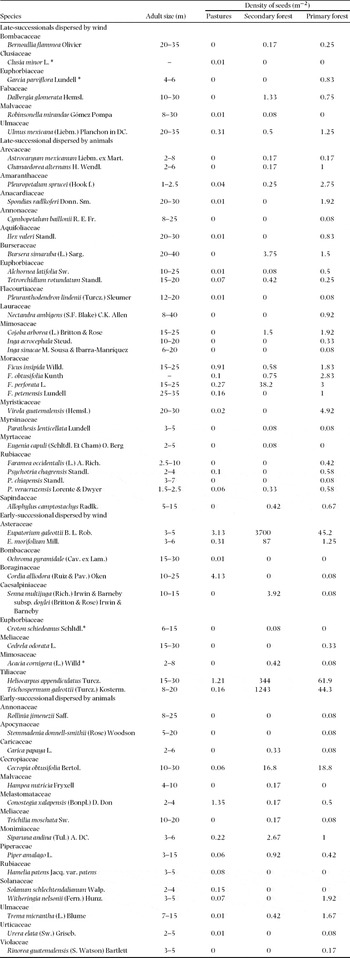
Seed rain over all habitats in all traps after 11 mo included 69 135 seeds from 57 woody species, of which 1162 seeds of 33 species were late-successional trees (Appendix 1). More than 45% of the seeds were of the wind-dispersed pioneer tree Eupatorium galeottii (Asteraceae), which grows in secondary forest but not in pasture. Over all habitats, in 11 mo with complete samples, average seed rain for all species was 33.2 seeds m−2.
Habitats and dispersal modes
The richness of woody species in the seed rain of pastures (0.1 ± 0.03 spp. m−2 mo−1) was more than an order of magnitude lower than that in secondary forest (1.4 ± 0.1 spp. m−2 mo−1), and about an order of magnitude lower than that in primary forest (1.0 ± 0.1 spp. m−2 mo−1). Richness of woody species in the seed rain differed significantly by habitat (randomized-block ANOVA, hereafter F(2,20) = 86.3, P < 0.0001), with lower richness in pastures than secondary and primary forest. The seed density of woody species in the seed rain of pastures (0.4 ± 0.1 seeds m−2 mo−1) was an order of magnitude lower than that of secondary forest (25.2 ± 0.7 seeds m−2 mo−1) and than that in primary forest (4.7 ± 0.3 seeds m−2 mo−1). Seed density of woody species was lower in pastures than in primary and secondary forest (F(2,20) = 56.9, P < 0.0001).
Over all habitats, animals dispersed 1815 seeds of 39 species, and wind or gravity dispersed 56 842 seeds of 18 species (Appendix 1). On average over all habitats, animals dispersed 0.8 ± 0.1 spp. m−2 mo−1 and wind or gravity dispersed 0.7 ± 0.07 spp. m−2 mo−1 (F(1,10) = 0.005, P > 0.5). The density of seeds dispersed by wind (10.6 ± 0.5 seeds m−2 mo−1) was five times higher than that dispersed by animals (2.1 ± 0.2 seeds m−2 mo−1; over all habitats, F(1,10) = 7.46, P < 0.02).
Interaction of habitat and dispersal mode affected seed rain. The significant interaction of habitat and dispersal mode for richness (F(2,20) = 10.5, P < 0.005) reflected a similar number of seeds of animal- and wind-dispersed species in secondary forest and pastures, but a higher number of seeds of animal-dispersed species than wind-dispersed species in primary forest. The significant interaction of habitat and dispersal mode for density of seeds (F(2,20) = 11.2, P < 0.005) reflected a greater number of seeds of wind-dispersed species than animal-dispersed species in secondary forest.
Early and late-successional species
Seed rain of early successional species was substantial throughout the landscape. Over all habitats during the study period, 98% of the seeds were early successionals while 56% of the species were late-successionals.
Richness varied by successional stage of habitat and life-history of species. Median richness of early successional species in secondary forest (2.2 spp. m−2 mo−1) and primary forest (1.3 spp. m−2 mo−1) was 12 and six times higher than median richness in pastures (0.2 spp. m−2 mo−1), respectively (Kruskal–Wallis one-way ANOVA on ranks, hereafter H(2) = 56.6, P < 0.001). Low richness of seed rain of late-successional species was characteristic in all habitats. Median richness of late-successional species in primary forest (1.2 spp. m−2 mo−1) and secondary forest (0.9 spp. m−2 mo−1) was higher than almost negligible seed rain in pastures (< 0.01 species m−2 mo−1, H(2) = 65.7, P < 0.001).
Seed limitation of species in pastures, quantified as the percentage of early and late-successional species reaching pasture compared with forest habitats, was high irrespective of composition. One hundred per cent of 15 early successional species landing in secondary forests, where they were abundant, also reached pastures. Only 48% of 33 late-successional species from the primary forest reached pastures.
Density of seed rain also varied by habitat and successional identity of the seeds. Median density of seeds of early successional species in secondary forest (340 seeds m−2 mo−1) was three orders of magnitude higher than in primary forest (9.4 seeds m−2 mo−1), which was almost two orders of magnitude higher than median seed density in pastures (0.3 seeds m−2 mo−1; H(2) = 56.6, P < 0.001), confirming low input of seeds into fenced plots > 90 m from forest edge. Like richness, median density of seeds of late-successional species in primary forest (2.3 seeds m−2 mo−1) and secondary forest (1.3 seeds m−2 mo−1) was higher than median density in pastures (< 0.01 seeds m−2 mo−1, H(2) = 60.4, P < 0.001). Seed rain of all forest trees was vanishingly sparse in open pasture habitat.
Early successional seeds arriving in pastures represented < 0.1% of those arriving in secondary forest while late-successional seeds arriving in pastures represented < 1% of those arriving in primary forest.
Habitat similarity
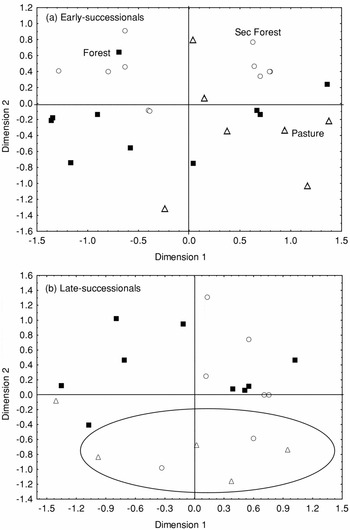
Non-metric multidimensional scaling ordination of the seed rain required two dimensions for early successional species (stress = 0.177) and late-successional species (stress = 0.221) (Figure 1). For early successional species (Figure 1a), the analysis showed a high similarity among the three habitats: early successional species were shared in pastures with both forest habitats. For late-successional species, a high similarity existed between primary and secondary forest, but most seeds of tree species arriving in pastures comprised a different group (circled in Figure 1b). Late-successional species were scarce in the seed rain in pastures and were a small, biased subset of seeds arriving in forest habitats.
Non-metric multidimensional scaling analysis for early (a) and late-successional species (b) in the seed rain of pastures (open triangles), secondary forest (sec forest, open circles) and primary forest (forest, closed squares) at Los Tuxtlas, Veracruz, Mexico. The ellipse indicates that the composition of late-successional species that arrive at pastures comprise a different group of species compared to those landing in secondary and primary forest.

Accumulation of observed and expected richness
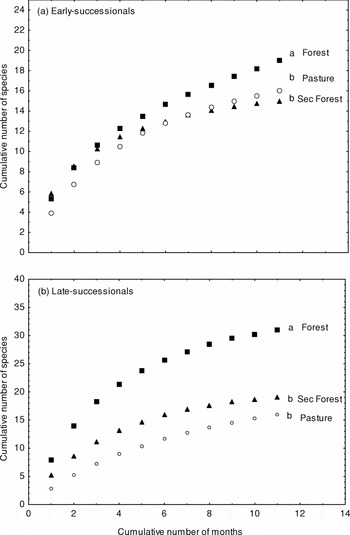
The median observed cumulative richness of early successional species over 11 mo was lower for pastures (12.8 spp. m−2) and secondary forest (13.0 spp. m−2) than for primary forest (14.7 spp. m−2; Friedman repeated-measures ANOVA on ranks, hereafter χ2(2) = 11.4, P < 0.005) (Figure 2a). Observed values of cumulative richness for secondary forest and pastures were indistinguishable.
Observed cumulative richness of early (a), Friedman χ2(2) = 11.4, P < 0.005, and late-successional species (b), Friedman χ2(2) = 22, P < 0.001, in the seed rain of pastures (closed triangles), secondary forest (open circles) and primary forest (closed squares) for 11 mo at Los Tuxtlas, Veracruz, Mexico.

Chao 1 partially adjusts for differences in sampling intensity. Median expected cumulative richness of early successionals, reflecting the number of species with one or two individuals was lower for secondary forest (13.4 spp. m−2) and pastures (16.3 spp. m−2) than for primary forest (22.8 spp. m−2; χ2(2) = 17.6, P < 0.001), with the difference due to higher expected richness in primary forest. Expected cumulative richness for secondary forest and pastures was indistinguishable.
Median observed cumulative richness of late-successionals over the 11 mo with complete samples was lower for pastures (11.6 spp. m−2), despite greater sampling effort, than for secondary (15.9 spp. m−2) and primary forest (25.6 spp. m−2; χ2(2) = 22, P < 0.001). Pairwise multiple comparisons showed observed cumulative richness was significantly different among the three habitats at P < 0.05 (Figure 2b).
The mean and SD of the expected cumulative richness of late-successionals (Chao 1) was lower for pastures (18.0 ± 7.5 spp. m−2) and secondary forest (18.7 ± 5.8 spp. m−2) than primary forest (26.8 ± 7.6 spp. m−2; F(2,20) = 104, P < 0.001). Expected cumulative richness for secondary forest and pastures were indistinguishable.
DISCUSSION
We predict that recruitment limitation due to seed limitation will prove important in all habitats. Seed rain is likely to play an important role in highly diverse forests where fruiting trees are widely scattered and input of seeds of most species to a given spot is improbable (Terborgh et al. Reference TERBORGH, NUNEZ-ITURRI, PITMAN, VALVERDE, ALVAREZ, SWAMY, PRINGLE and PAINE2008). Seed limitation is clearly a force in land long used for intensive agriculture; in our study < 4% of early and late-successional species that arrive in nearby forests actually reach pastures excluded from agriculture. Species in the seed rain represent a small subset of potential immigrants, and most seeds that do arrive and seedlings that do establish in open land are quickly killed by water stress or competition from herbaceous vegetation (Holl et al. Reference HOLL, LOIK, LIN and SAMUELS2000). Seed rain immigration from forests into abandoned agricultural land is both quantitatively small and strongly influenced by sampling effects presumably imposed by dispersal processes.
Seed limitation in high-diversity tropical habitats is profound even when dispersal is extensive. For instance, microsatellite genetic markers indicate that dispersal of Simarouba amara seeds in a Barro Colorado Island (Panama) forest with numerous animal dispersal agents results in mean dispersal distances > 400 m; most seedlings and saplings closer to fruiting adults are offspring of other parents (Hardesty et al. Reference HARDESTY, HUBBELL and BERMINGHAM2006). Because area increases with r2, where r is distance from a fruiting tree, seed dispersal results in seed limitation if fruiting adults are sparse; seeds from a given crop are unlikely to reach all or even many potential sites for establishment. Hundreds of seed traps on Barro Colorado Island show immense differences in seed rain from place to place in continuous forest (Harms et al. Reference HARMS, WRIGHT, CALDERON, HERNANDEZ and HERRE2000), while seed addition experiments at the same site show almost universal seed limitation even where normal dispersal agents are common (Svenning & Wright Reference SVENNING and WRIGHT2005). Dispersal of forest species into pastures is much slower in both density of seed rain and number of species, even as little as 50 m from forest edge (Cubiña & Aide Reference CUBIÑA and AIDE2001, Dosch et al. Reference DOSCH, PETERSON and HAINES2007). The even lower representation of species from forest habitats reaching the pasture (< 4%) alluded to above represents extreme dispersal limitation, as well as apparent bias in dispersal processes.
Tree life history and dispersal mode influence expectations of dispersal and establishment. An immense input of seeds allows pioneer species to recruit in tree-fall gaps inside forests. For example, Cecropia obtusifolia, a mobile pioneer tree dispersed by birds and mammals, has a seed rain of up to 1925 seeds m−2 y−1 in gaps in the Los Tuxtlas forest (Alvarez-Buylla & Martínez-Ramos Reference ALVAREZ-BUYLLA and MARTÍNEZ-RAMOS1990). In pastures > 90 m outside the vegetation border, Cecropia seed rain is less than 0.1% of that in the forest (0.06 seeds m−2 in 11 mo in this study). When Cecropia seeds germinate, early density-dependent or density-independent seedling mortality is extreme (Cecropia peltata; van Breugel et al. Reference VAN BREUGEL, BONGERS and MARTÍNEZ-RAMOS2007). For this and other genera, livestock, competition from grasses, and physiological stress are barriers to recruitment in xeric tropical pastures (Holl Reference HOLL1999). Given exceedingly high mortality of pioneer seeds and small seedlings, and low input of late-successional seeds into open pasture, ecological succession in unobstructed open ground may take from several to many decades.
Calculations of observed and predicted species richness offer insight into dispersal limitation. Observed and expected richness are similar when all the species have been sampled; the measures differ when a non-negligible number of species are missing from samples. In the seed rain of pastures, Chao 1 informs us that richness will soon be reached for pioneers (12.8 observed, 16.3 expected over 11 mo) and late-successionals (11.6 species observed, 18.0 expected). This implies that if conditions do not change, only four pioneers and seven additional late-successional species are likely to reach the open landscape than have to date. In primary forest, 25.6 late-successional species find traps and 26.8 are expected, indicating that almost all species in the local pool likely to arrive in a year, have been sampled. These numbers reflect local diversity within the neighbourhoods of the traps; the entire forest contains over 200 late-successional species, the vast majority of which never reached the traps.
Fat-tailed seed distributions result in much wider seed dispersion than the classic leptokurtic distributions assumed in the past (Clark Reference CLARK1998, Norden et al. Reference NORDEN, CHAVE, BELBENOIT, CAUBERE, CHATELET, FORGET, RIERA, VIERS and THEBAUD2009). Before vegetation provides cover or fruit resources for fruit-eating animals or impedes wide dispersal of seeds carried by wind, seed dispersal is likely to be leptokurtic from the edge, with much higher seed rain near forest edges than in open pasture. We find it especially striking that seed rain of wind-dispersed species into pasture plots > 90 m from forest edge is very low, and not much different than that of animal-dispersed species. Planting trees that provide habitat for seedling establishment and ultimately seed sources re-establishes dispersal processes between habitat remnants (Martínez-Garza & Howe Reference MARTÍNEZ-GARZA and HOWE2003, Vandermeer & Carvajal Reference VANDERMEER and CARVAJAL2001). We expect very low numbers of species and seeds in planted stands while vegetation remains low. As second-growth emerges, however, seed distributions of species carried by animals will increasingly reflect idiosyncrasies of animal movement (Russo et al. Reference RUSSO, PORTNOY and AUGSPURGER2006, Schupp et al. Reference SCHUPP, MILLERON, RUSSO, Levey, Silva and Galetti2002). Accumulation of animal-dispersed seeds will increase in all planted and control stands of juvenile trees and shrubs because birds and terrestrial mammals carrying seeds will find perches or cover in them, essentially making seed dispersion decidedly multimodal (Russo et al. Reference RUSSO, PORTNOY and AUGSPURGER2006). As pioneer and eventually later-successional trees produce fruits that attract fruit-eating birds, bats and ground mammals, accumulation of forest seeds in plots, and dispersal of seeds of planted trees to nearby remnants, will accelerate. In effect, the tails of dispersal distributions of animal-dispersed tree species into our plots will be ‘fatter’ and ‘bumpier’ than those of wind-dispersed trees.
In summary, patterns of seed rain recorded in this experimental landscape are varied and dynamic. Substantial dispersal of species by seed occurs in this agricultural mosaic, from secondary to primary forests and vice versa, and little occurs between either forest type and open pasture. The state is temporary. Little seed rain in open pasture, during the sampling period populated by young (< 1 m) second-growth pioneers, is likely to shift quickly to influx of forest species as stands of fenced land fill with juvenile trees and shrubs, providing cover for seed-bearing animals. Maturation to fruiting of planted animal-dispersed trees will almost certainly quickly skew seed rain towards animal-dispersion as birds, bats and ground mammals arrive to forage in the plots, bring forest seeds with them, and move seeds ingested in the plots throughout the landscape.
ACKNOWLEDGEMENTS
We are grateful to R. Coates for institutional support, Eladio Velasco for expert field assistance and Alvaro Campo for assisting with seed species identification. The help of hundreds of students from population and community ecology classes at UAEM coordinated by Yuliana Urincho and Rene Gadea was essential to process seed rain samples. We are grateful to K. Braunskill, J. Ison, A. Sullivan, M. Valencia and J. Zambrano and two anonymous reviewers for constructive comments on the manuscript. The authors are grateful for financial and logistical support from the University of Illinois, Universidad Autónoma del Estado de Morelos, Universidad Nacional Autónoma de México, and the National Science Foundation of the United States (DEB 0516259).
Adult size (m) and density of seeds of 57 early and late-successional species during 11 mo in the seed rain of pastures and primary and secondary forests at Los Tuxtlas, Veracruz, Mexico. Nomenclature follows Ibarra-Manriquez & Sinaca (Reference IBARRA-MANRIQUEZ and SINACA1995, Reference IBARRA-MANRIQUEZ and SINACA1996a, Reference IBARRA-MANRIQUEZ and SINACAb). For Heliocarpus appendiculatus the number of seeds shown is obtained by the relationship of 1.5 seeds per fruit (Martínez-Ramos Reference MARTÍNEZ-RAMOS, Gómez-Pompa and Del-Amo1985). Those species dispersed by gravity are noted with an asterisk (*).