INTRODUCTION
Rice is an increasingly important commodity in Africa (Balasubramanian et al. Reference Balasubramanian, Sie, Hijmans and Otsuka2007); in 2007, rice production reached 23·5 Mt (FAO 2009). Trends show production is rapidly increasing and African production now rivals that of Latin America (Meinke et al. Reference Meinke, Howden, Struik, Nelson, Rodriguez and Chapman2009a). Five main rice agro-ecosystems are distinguished in sub-Saharan Africa (SSA) based on hydrology and topography: (1) rain-fed uplands and hydromorphic slopes (0·39 of total area under rice), (2) rain-fed lowlands in valley bottoms and floodplains (0·33), (3) irrigated lowlands (deltas and floodplains) and highlands (0·19), (4) deep-water basins along major rivers and (5) mangrove-swamps in lagoons and deltas (4 and 5 combined=0·09) (Balasubramanian et al. Reference Balasubramanian, Sie, Hijmans and Otsuka2007; FAO 2009).
A review of rice yield losses due to uncontrolled weed growth reported losses in the range of 28–74% in transplanted lowland rice, 28–89% in direct-seeded lowland rice and 48–100% in upland ecosystems (Rodenburg & Johnson Reference Rodenburg and Johnson2009). Improving weed control in farmers' fields was shown to increase rice yields by 15–23%, depending on agro-ecosystem, and it is estimated that weeds may account for annual rice yield losses in SSA of at least 2.2 million tonnes equating to US $1.45 billion (Rodenburg & Johnson Reference Rodenburg and Johnson2009). Given that demand for food is projected to rapidly outpace increases in supply (e.g. von Grebmer et al. Reference von Grebmer, Fritschel, Nestorova, Olofinbiyi, Pandya-Lorch and Yohannes2008), effective weed control is a priority in these systems.
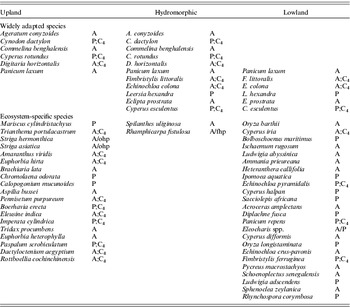
Important weeds of upland rice include the perennials Imperata cylindrica, Cyperus rotundus and Chromolaena odorata, the annuals Digitaria horizontalis and Euphorbia heterophylla and the parasitic weeds Striga hermonthica and Striga asiatica (Table 1). In lowland rice, the perennial weeds Oryza longistaminata and Cyperus spp. and annual weeds Echinochloa spp., Oryza barthii, Ischaemum rugosum, Cyperus difformis, Cyperus iria, Fimbristylis littoralis and Sphenoclea zeylanica cause serious losses. Common weed management practices in rice-based cropping systems include soil tillage, flooding, fallow and crop rotations, clearance by fire, hand- or hoe-weeding and herbicides; these practices are often used in combination (Rodenburg & Johnson Reference Rodenburg and Johnson2009).
Names and biology of important weed species in the three most prevalent rice production ecosystems in Africa (upland, hydromorphic and lowland)

Adapted from: Rodenburg & Johnson (Reference Rodenburg and Johnson2009). Additional sources on C4 species: Downton (Reference Downton1975), Raghavendra & Das (Reference Raghavendra and Das1978), Elmore & Paul (Reference Elmore and Paul1983) and Sage et al. (Reference Sage, Li, Monson, Sage and Monson1999).
A=annual, P=perennial, fhp=facultative hemi-parasitic, ohp=obligate hemi-parasitic, C4=C4 photosynthetic pathway.
Climate change is one of many risk factors affecting rice production and weed management. For the purpose of the present review, ‘climate change’ is used in the broad sense, including direct and indirect impacts of climate on the environment and on people. Major global changes include further increases in atmospheric greenhouse gases and likely changes in temperatures (>0·2°C/decade), soil degradation and competing claims for land and water (IPCC Reference Pachauri and Reisinger2007). For Africa, climate trends suggest that variability in rainfall will increase and monsoon regions may become drier (Giannini et al. Reference Giannini, Biasutti, Held and Sobel2008), leading to a 5–8% increase in drought-prone areas in the Sahel and southern Africa by 2080 (IPCC Reference Pachauri and Reisinger2007). Equatorial zones of Africa may receive more intense rainfall (Christensen et al. Reference Christensen, Hewitson, Busuioc, Chen, Gao, Held, Jones, Kolli, Kwon, Laprise, Magaa Rueda, Mearns, Menendez, Raisanen, Rinke, Sarr, Whetton, Solomon, Qin, Manning, Chen, Marquis, Averyt, Tignor and Miller2007). Spatial distribution of future rainfall, however, remains highly uncertain (Giannini et al. Reference Giannini, Biasutti, Held and Sobel2008), particularly for the Sahel for which there are a number of conflicting projections (e.g. Cook & Vizy Reference Cook and Vizy2006; Hoerling et al. Reference Hoerling, Hurrell, Eischeid and Phillips2006; Biasutti et al. Reference Biasutti, Held, Sobel and Giannini2008).
While many of the aforementioned changes began decades ago, the rates of changes have recently accelerated and impacts are increasingly apparent (Rozenzweig et al. Reference Rozenzweig, Karoly, Vicarelli, Neofotis, Wu, Casassa, Menzel, Root, Estrella, Seguin, Tryjanowski, Liu, Rawlins and Imeson2008). This adds urgency to the required analyses of adaptation options for farmers and for policy and adaptation measures to be introduced (Meinke et al. Reference Meinke, Howden, Struik, Nelson, Rodriguez and Chapman2009b). Changes in atmospheric carbon dioxide (CO2), rainfall and temperature will affect weed species' distribution and prevalence within weed and crop communities. Climate changes may also necessitate adaptation of crop management practices, which in turn affect weed growth and the proliferation of certain species. Environmental conditions will impact on effectiveness of weed management operations such as chemical and mechanical control. Obviously, the magnitude of these effects will largely depend on the extent of local and regional changes to environmental conditions.
The present paper discusses (1) the likely effects of projected climate changes on the competitiveness and distribution of major weeds of African rice ecosystems and (2) the consequences of changing climates and changing weed community compositions for weed management in African rice production systems. The objectives are to describe likely climate change effects on weeds in African rice production systems and to identify potentially effective coping strategies for the resource-poor farmers in these systems.
CLIMATE CHANGE EFFECTS
Direct effects – weed competition, abundance and distribution
Temperatures, atmospheric CO2 concentrations and rainfall irregularities will increase (IPCC Reference Pachauri and Reisinger2007), and this will affect weed species in different ways, depending on their photosynthetic pathways and tolerance to environmental stress. Under drought and high temperatures, plants with the C4 carbon fixation pathway have a competitive advantage over plants possessing the more common C3 pathway (e.g. Yin & Struik Reference Yin and Struik2008). This competitive advantage of C4 weeds diminishes or even reverses under conditions of high soil nitrogen or atmospheric CO2 concentrations (e.g. Carter & Peterson Reference Carter and Peterson1983; Bazzaz & Carlson Reference Bazzaz and Carlson1984). Of the 56 weed species most cited in relevant peer-reviewed literature (Rodenburg & Johnson Reference Rodenburg and Johnson2009), 20 species (0·36 of total weed species) are C4 types (Table 1). The C4-type weed species are most reported in upland rice ecosystems (0·52) and least in the lowlands (0·23). For a C3 crop such as rice, elevated CO2 levels may have positive effects on crop competitiveness with C4 weeds (Patterson et al. Reference Patterson, Westbrook, Joyce, Lingren and Rogasik1999; Fuhrer Reference Fuhrer2003), and tolerance to Striga infection (Watling & Press Reference Watling and Press2000). The latter may be caused by enhanced rates of photosynthesis which have been shown to play an important role in sustaining host tolerance against Striga (Gurney et al. Reference Gurney, Taylor, Mbwaga, Scholes and Press2002; Rodenburg et al. Reference Rodenburg, Bastiaans, Schapendonk, van der Putten, van Ast, Dingemanse and Haussmann2008). Yet empirical evidence also shows that higher CO2 levels stimulate biomass production of both C3 and C4 grasses. C3 grass species have a greater increase in tillering, whereas C4 grass species have a greater increase in leaf area (Wand et al. Reference Wand, Midgley, Jones and Curtis1999). Tillering and leaf canopy development are important traits known to affect interspecific competition (e.g. Johnson et al. Reference Johnson, Dingkuhn, Jones and Mahamane1998; Saito et al. Reference Saito, Azoma and Rodenburg2010). Increased atmospheric CO2 levels are likely to be accompanied by higher temperatures favouring C4 weeds over C3 crops (Fuhrer Reference Fuhrer2003). A similar shift in weed species composition can also be expected under increased or prolonged drought conditions (Bjorkman Reference Bjorkman, Burris and Black1976). Although precise changes in future precipitation are unknown, rainfall is likely to become more erratic with a higher frequency in the occurrences of droughts and floods (Giannini et al. Reference Giannini, Biasutti, Held and Sobel2008). Consequently, weeds adapted to these conditions will gain a comparative advantage. In the dry-land areas, besides drought tolerant C4 weeds, parasitic weeds well adapted to low rainfall environments (e.g. S. hermonthica) or temporary flooded conditions (e.g. Rhamphicarpa fistulosa) could benefit from greater variability in rainfall (Rodenburg et al. Reference Rodenburg, Riches and Kayeke2010). Striga spp. infestations are often associated with low soil fertility (Vogt et al. Reference Vogt, Sauerborn, Honisch, Ransom, Musselman, Worsham and Parker1991; Kroschel Reference Kroschel, Martin, Muther and Auffarth1998), and should climate extremes lead to greater soil degradation (IPCC Reference Pachauri and Reisinger2007) this might favour parasitic weeds. Such a scenario increases the importance of developing improved soil conservation and fertility management. Selection of appropriate soil conservation and fertility measures requires knowledge of local conditions and an understanding of the overall system dynamics. For instance, zero-tillage as a component of conservation agriculture, inappropriate fertilizer applications or the lack of fertilization can all lead to increased weed infestations, which in turn increase herbicide use or reduce fertilizer use efficiencies (e.g. Liebman & Davis Reference Liebman and Davis2000; Giller et al. Reference Giller, Witter, Corbeels and Tittonell2009; Keating et al. Reference Keating, Carberry, Bindraban, Asseng, Meinke and Dixon2010).
Temperature changes will impact the geographic distribution of weeds (Patterson et al. Reference Patterson, Westbrook, Joyce, Lingren and Rogasik1999), with some species moving to higher latitudes (Patterson Reference Patterson1995) and altitudes (Parmesan Reference Parmesan1996). For instance, Witchweeds (Striga spp.) might extend their geographic range in this way (Mohamed et al. Reference Mohamed, Papes, Williams, Benz and Peterson2006). Based on genetic understanding and ecological niche modelling, Mohamed et al. (Reference Mohamed, Bolin, Musselman, Townsend Peterson, Ejeta and Gressel2007) suggest that the Striga area might expand to moderate climate zones. However, S. asiatica has been found to be relatively insensitive to temperature (Patterson et al. Reference Patterson, Musser, Flint and Eplee1982) and distribution may be more affected by changes in the range of the host crop rather than directly by temperature (Cochrane & Press Reference Cochrane and Press1997). Phoenix & Press (Reference Phoenix and Press2005) argued that this could be true for parasitic weeds in general. Recent progress in the development of heat, cold or drought tolerant rice germplasm increases the adaptive capacity of the crop to future environmental stress (Wassmann et al. Reference Wassmann, Jagadish, Heuer, Ismail, Redona, Serraj, Singh, Howell, Pathak and Sumfleth2009). This might enable rice to be grown in previously unfavourable conditions, which may cause a concomitant shift in the range of parasitic weeds.
Indirect effects – crop management adaptations and weed management effectiveness
Water is an increasingly scarce resource in many parts of SSA (Seckler et al. Reference Seckler, Barker and Amarasinghe1999), and rice varieties and cropping methods need to be adapted accordingly (Ingram et al. Reference Ingram, Gregory and Izac2008). For rain-fed rice, drought tolerance will be important not only to reduce losses due to moisture stress but also to maintain or improve the crop's competitiveness against weeds (Asch et al. Reference Asch, Dingkuhn, Sow and Audebert2005). Elsewhere, systems to conserve irrigation water, such as aerobic rice and alternate wetting and drying, may be adopted but will have consequences for weed abundance, and concomitant rice yield losses, due to the extended periods when the soil will not be flooded (Morita & Kabaki Reference Morita and Kabaki2002; de Vries et al. Reference de Vries, Rodenburg, Bado, Sow, Leffelaar and Giller2010; Krupnik et al., Reference Krupnik, Rodenburg, Shennan, Mbaye, Haden, Kiepe, Diatta and Millarin press). Effective weed control technologies for such production systems will be required. Flooding is commonly the primary cultural means to suppress weeds in irrigated rice and even a few millimetres of water depth will prevent germination and emergence of the majority of the weeds, such as annual sedges (e.g. Akobundu Reference Akobundu1987; Chauhan & Johnson Reference Chauhan and Johnson2009a). In Indonesia, Haden et al. (Reference Haden, Duxbury, DiTommaso and Losey2007) observed an increased incidence of sedges due to reduced periods of flooding. Effective weed control by flooding requires the soil to remain flooded for prolonged periods throughout crop establishment. Drainage or shallow flooding may also encourage the emergence of grass weeds such as Leptochloa chinensis and Echinochloa spp. (Chauhan & Johnson Reference Chauhan and Johnson2008, Reference Chauhan and Johnson2009b). A shift to weed communities adapted to hydromorphic conditions may include species such as Acroceras amplectans, Echinochloa spp., Leptochloa spp., Eleusine indica, Panicum repens, Cyperus esculentus, Eleocharis spp., Bolboschoenus maritimus, Ageratum conyzoides and Eclipta prostrata. The need for hand weeding has been reported to increase by 35% as a result of temporary rather than permanent flooding (Latif et al. Reference Latif, Islam, Ali and Saeque2005). Where irrigation water is becoming scarcer, maintaining soil flooding to suppress weeds is likely to be increasingly difficult. In these circumstances, where farmers lack alternative means for effective weed control, yield losses are likely to rise (e.g. Barrett et al. Reference Barrett, Moser, McHugh and Barison2004).
In rain-fed rice fields, a lack of rainfall in the early part of the wet season may result in inadequate land preparation or limited flooding of the soil in the early stages of the crop. In turn, this will limit the opportunity to suppress weeds through early flooding and early crop canopy closure. Such disruption is likely to be most acute in the rain-fed lowlands or inland valley systems, which is a major agro-ecosystem of Africa.
Effectiveness of weed management practices will change according to the environmental conditions. Unfavourable weather may increase the risk of herbicides either causing crop damage or not being effective (Patterson et al. Reference Patterson, Westbrook, Joyce, Lingren and Rogasik1999). Increased temperatures reduce herbicide persistence in the soil and likewise the ‘windows’ for herbicide effectiveness (Bailey Reference Bailey2004). If rainfall becomes more frequent and/or intense, ‘rain-safe’ intervals for herbicides application may become scarce and soil active herbicides may become less effective (e.g. Kanampiu et al. Reference Kanampiu, Kabambe, Massawe, Jasi, Friesen, Ransom and Gressel2003). Herbicide use is expected to increase in the near future and with it resistant weed ecotypes are increasingly likely to emerge. Herbicide efficacy may also be affected by raised CO2 levels, which have been shown to increase the tolerance of weeds to herbicides (Ziska et al. Reference Ziska, Teasdale and Bunce1999; Ziska & Teasdale Reference Ziska and Teasdale2000). Changes in CO2 concentrations may alter transpiration, number of leaf stomata or the thickness of the leaf and through that affect the absorption or uptake of the pesticide (Ziska Reference Ziska2008). In C3 plants, Wong (Reference Wong1990) found increased concentrations of leaf starch under elevated CO2 which in turn might reduce herbicide efficacy (Patterson et al. Reference Patterson, Westbrook, Joyce, Lingren and Rogasik1999).
Greater CO2 concentrations may stimulate below-ground growth relative to that of above-ground growth (Ziska Reference Ziska2003). This will favour rhizome and tuber growth of perennial weeds, in particular those following the C3 photosynthetic pathway (Oechel & Strain Reference Oechel, Strain, Strain and Cure1985), which may render their control more difficult (Patterson Reference Patterson1995; Patterson et al. Reference Patterson, Westbrook, Joyce, Lingren and Rogasik1999). Where tuber and rhizome growth is encouraged, increased tillage could lead to a multiplication of vegetative propagation material (Ziska Reference Ziska2008). This could mean increasing problems with perennial lowland weeds like O. longistaminata, Leersia hexandra, B. maritimus, Sacciolepis africana and Cyperus halpan. Other perennial weeds with difficult to control below-ground structures such as I. cylindrica, Cynodon dactylon, C. esculentus and C. rotundus that are found on upland and hydromorphic soils, are all of the C4 type.
OUTLOOK ON WEEDS AND THEIR MANAGEMENT IN AFRICAN RICE SYSTEMS
Rice is an inherently weak competitor with most weeds (e.g. van Heemst Reference van Heemst1985) and consequently, yield losses due to weed competition can be high. Smallholder rice farmers in Africa have a limited number of options for preventing weed infestations and concomitant crop losses (Rodenburg & Johnson Reference Rodenburg and Johnson2009). Changing environmental conditions may result in reduced efficiencies of existing weed control practices. If so, this requires timely identification and characterization of these emerging problems and the development of acceptable solutions that need to be implemented early to be most effective (Howden et al. Reference Howden, Soussana, Tubiello, Chhetri, Dunlop and Meinke2007).
While there are uncertainties about future climate changes, it is likely that changes will have differential effects on weed species and alter the competitive balance between weed species and between weeds and rice in all production systems. Species response will be differentiated by the impact these changes have on the photosynthesis and resource-acquisition rates. Resulting changes in competitiveness and abundance are likely to differ between parasitic and non-parasitic weeds and between C3- and C4-type weeds. Further, agro-ecosystem characteristics will determine which of the environmental factors will have the dominant effect on crop and weed growth.
Irrigated systems are likely to be impacted mainly by indirect effects of climate change (e.g. reduced availability of irrigation water and increased herbicide tolerance in weeds). In these systems, herbicides are the primary weed control intervention and some of these are likely to become less effective due to CO2 increases and more frequently occurring weather extremes. Moreover, the introduction of water-saving production methods at certain locations will likely cause severe increases in weed competition. In irrigated rice systems, temperature and rainfall variability increases may have less impact on weeds than CO2 increases. Higher CO2 concentrations may make rice and C3 weed species (particularly rhizotomous perennials such as O. longistaminata, L. hexandra, B. maritimus, S. africana and C. halpan) more competitive against C4 weeds, whereas mechanical control may become less effective due to the stimulating effect on their below-ground growth. To address the anticipated changes, integrated weed management strategies need to be developed that target the prevention of weed invasion, recruitment and reproduction. Such strategies may comprise combinations of optimal fertilizer timing and doses (Liebman & Davis Reference Liebman and Davis2000), off-season dry and deep tillage and land preparation (e.g. Sharma Reference Sharma1997), the use of irrigation water and rice seeds free of weed seeds (e.g. Dastgheib Reference Dastgheib1989; Rao & Moody Reference Rao and Moody1990) and stale seed bed techniques (e.g. Rao et al. Reference Rao, Johnson, Sivaprasad, Ladha and Mortimer2007), increased plant densities or improved arrangements (Phuong et al. Reference Phuong, Denich, Vlek and Balasubramanian2005), transplanting of young seedlings (Becker & Johnson Reference Becker and Johnson1999a) and the use of adapted weed competitive rice cultivars (Haefele et al. Reference Haefele, Johnson, M' Bodj, Wopereis and Miézan2004; Rodenburg et al. Reference Rodenburg, Saito, Kakai, Toure, Mariko and Kiepe2009). Effective approaches that harness available synergies could lessen dependency on irrigation water, chemical and mechanical control practices.
Direct effects of climate change are likely to have substantial effects on rain-fed rice areas as these systems harbour most of the C4 and all of the parasitic weed species. These systems are most vulnerable to rainfall irregularities and soil degradation; in such areas infestations with parasitic weeds S. asiatica, S. hermonthica, S. aspera and R. fistulosa could increase (Rodenburg et al. Reference Rodenburg, Riches and Kayeke2010). Furthermore, because of the likely tolerance to drought and heat, C4 species are likely to become more competitive in rain-fed rice. These may include the perennial grasses I. cylindrica, Paspalum scrobiculatum and C. dactylon, the annual grasses Rottboellia cochinchinensis, D. horizontalis, E. indica, Dactyloctenium aegyptium, Pennisetum purpureum, Echinochloa colona and the sedges F. littoralis, C. rotundus and C. esculentus. These weeds could be controlled through integrated approaches that combine preventive and curative measures. Examples of potential practices for these environments are the combined use of organic and inorganic soil fertility enhancers (e.g. Riches et al. Reference Riches, Mbwaga, Mbapila and Ahmed2005) with optimal fertilizer timing and doses (Liebman & Davis Reference Liebman and Davis2000), off-season dry and deep tillage (e.g. Chikoye et al. Reference Chikoye, Manyong and Ekeleme2000), the use of weed (including parasitic species) suppressive intercrops, crop rotations and short fallows (e.g. Becker & Johnson Reference Becker and Johnson1999b) and the use of well-adapted, weed competitive and parasitic weed resistant/tolerant rice cultivars (Rodenburg & Johnson Reference Rodenburg and Johnson2009; Rodenburg et al. Reference Rodenburg, Riches and Kayeke2010). Such cultivars should also possess drought and heat tolerance in order to successfully outcompete or withstand adapted C4 and parasitic weeds under such conditions.
CONCLUSIONS
The net effect of climate change on weeds in rice production systems in Africa will be the result of a complex set of interactions between local environmental, ecological, biological and human factors such as the production ecosystem, the composition of weed communities, the management practices, atmospheric CO2, ambient temperature and soil fertility and water availability. Interaction effects between key environmental factors (temperature, soil, water and CO2) on different dominant weed species and communities should be systematically investigated.
It is desirable that weed management strategies are sufficiently diverse to lessen dependency on single strategies of irrigation water, herbicides and mechanical control, and approaches should target likely problem species such as hemi-parasitic and perennial rhizotomous weeds. Integrated approaches to prevent species invasion, recruitment and reproduction, and based on current knowledge of weed biology and ecology, are potentially most effective and sustainable. Future strategies for climate change adaptation for rice-based production systems, including novel cropping systems or improved stress-tolerant cultivars, should simultaneously address possible implications for weed control.
Current understanding suggests that perennial C3 species such as O. longistaminata, L. hexandra, B. maritimus, S. africana and C. halpan will increase in irrigated rice production systems. Where water-saving production methods are adopted, the hydromorphic conditions will favour species such as A. amplectans, E. colona, Echinochloa crus-pavonis, L. chinensis, Leptochloa caerulescens, E. indica, P. repens, C. esculentus, Eleocharis complanata, B. maritimus, A. conyzoides and E. prostrata.
In rain-fed uplands parasitic weeds, such as S. hermonthica and S. asiatica, and C4 grasses I. cylindrica, P. scrobiculatum and C. dactylon, R. cochinchinensis, D. horizontalis, E. indica, D. aegyptium, P. purpureum and E. colona and the C4 sedges F. littoralis, C. rotundus and C. esculentus will become more dominant.
Timely efforts to fill the most important knowledge gaps on environment, management and weed interactions through strategic and applied research, and to generate and disseminate effective and locally applicable weed management strategies are required in order to raise or even sustain future rice production for the growing populations of Africa under changing climates. Design and implementation of such strategies requires interaction and collaboration between key stakeholders including scientists, extension services and farmers.
While atmospheric CO2 levels and temperatures will increase, the spatial distribution of future rainfall remains much more uncertain. With the uncertainty surrounding water availability, combined with limited understanding of the interactions between changing environmental factors, the projections of future distribution and importance of particular plant species are conjecture and must be regularly reviewed. What is more certain is that in a future characterized by global changes (including climate change) resources such as water, land and labour will become increasingly scarce. Therefore, farmers will require management strategies including a wide range of technology options and decision support tools to tackle weeds and maintain livelihoods.
We thank (in alphabetical order), the UK Biotechnology and Biological Sciences Research Council (BBSRC), Common Fund for Commodities, the UK Department for International Development (DFID), the Dutch Directorate-General for International Cooperation (DGIS), the EU and the Netherlands Organisation for Scientific Research WOTRO Science for Global Development (NWO-WOTRO) for their past and continued financial support to our work. Views presented here are not necessarily shared by our donors or our host institutes.