Introduction
Cannabis use is highly prevalent in people with schizophrenia spectrum disorder (Green et al. Reference Green, Drake, Brunette and Noordsy2007; Hartz et al. Reference Hartz, Pato, Medeiros, Cavazos-Rehg, Sobell, Knowles, Bierut and Pato2014). Δ9-tetrahydrocannabinol (THC), a major constituent of cannabis, has been shown to cause psychotic symptoms in healthy subjects (D'Souza et al. Reference D'Souza, Abi-Saab, Madonick, Forselius-Bielen, Doersch, Braley, Gueorguieva, Cooper and Krystal2005) and cannabis use appears to be associated with psychosis-like symptoms in the general population (van Gastel et al. Reference Van Gastel, Vreeker, Schubart, Maccabe, Kahn and Boks2014). Early use of cannabis seems to increase the risk of later development of a psychotic illness (Moore et al. Reference Moore, Zammit, Lingford-Hughes, Barnes, Jones, Burke and Lewis2007) and a sibling pair analysis performed within a large prospective birth cohort study has shown that early cannabis use was associated with psychosis-related outcomes in young adults (McGrath et al. Reference McGrath, Welham, Scott, Varghese, Degenhardt, Hayatbakhsh, Alati, Williams, Bor and Najman2010). However, the debate about the relationship between cannabis use and development of psychotic disorders is still ongoing (Large et al. Reference Large, Di Forti and Murray2015). Recently a major study was launched to investigate the effect on adolescent drug abuse in the US population, as cannabis has been legalized in several US states (NIoHealth, 2016).
Cannabis use after the onset of the disorder is associated with poorer course and outcome in schizophrenia (Linszen et al. Reference Linszen, Dingemans and Lenior1994; Margolese et al. Reference Margolese, Malchy, Negrete, Tempier and Gill2004; Lambert et al. Reference Lambert, Conus, Lubman, Wade, Yuen, Moritz, Naber, McGorry and Schimmelmann2005; Talamo et al. Reference Talamo, Centorrino, Tondo, Dimitri, Hennen and Baldessarini2006; Ringen et al. Reference Ringen, Melle, Birkenaes, Engh, Faerden, Vaskinn, Friis, Opjordsmoen and Andreassen2008; Large et al. Reference Large, Mullin, Gupta, Harris and Nielssen2014; Manrique-Garcia et al. Reference Manrique-Garcia, Zammit, Dalman, Hemmingsson, Andreasson and Allebeck2014). The findings are, however, unequivocal as studies also report better cognitive and social functioning and less severe negative symptoms in cannabis users (Talamo et al. Reference Talamo, Centorrino, Tondo, Dimitri, Hennen and Baldessarini2006; Jockers-Scherubl et al. Reference Jockers-Scherubl, Wolf, Radzei, Schlattmann, Rentzsch, De Gomez-Carrillo and Kuhl2007; Potvin et al. Reference Potvin, Joyal, Pelletier and Stip2008; DeRosse et al. Reference DeRosse, Kaplan, Burdick, Lencz and Malhotra2010). There are also reports questioning the association between cannabis use and positive symptoms (Barrowclough et al. Reference Barrowclough, Emsley, Eisner, Beardmore and Wykes2013). Despite experiments showing that THC can induce psychotic symptoms, it is not clear to what extent cannabis directly causes increased psychotic symptoms and disability in a clinical population. The alternative hypothesis is that concurrent cannabis use in schizophrenia is an epiphenomenon of factors associated with symptom load or symptom characteristics (Khantzian, Reference Khantzian1985; Kolliakou et al. Reference Kolliakou, Joseph, Ismail, Atakan and Murray2011), or to factors that are more directly causal to symptom development (Zammit et al. Reference Zammit, Moore, Lingford-Hughes, Barnes, Jones, Burke and Lewis2008; DeRosse et al. Reference DeRosse, Kaplan, Burdick, Lencz and Malhotra2010; Auther et al. Reference Auther, McLaughlin, Carrion, Nagachandran, Correll and Cornblatt2012; Barrowclough et al. Reference Barrowclough, Emsley, Eisner, Beardmore and Wykes2013; Ruiz-Veguilla et al. Reference Ruiz-Veguilla, Barrigón, Hernández, Rubio, Gurpegui, Sarramea, Cervilla, Gutiérrez, James and Ferrin2013; Tosato et al. Reference Tosato, Lasalvia, Bonetto, Mazzoncini, Cristofalo, De Santi, Bertani, Bissoli, Lazzarotto, Marrella, Lamonaca, Riolo, Gardellini, Urbani, Tansella and Ruggeri2013). We thus cannot rule out that there are underlying disease factors that increase both the risk for substance use and the risk for a more severe course and outcome of schizophrenia.
Poor premorbid functioning is usually linked to a more severe form of schizophrenia (Brill et al. Reference Brill, Levine, Reichenberg, Lubin, Weiser and Rabinowitz2009; Albert et al. Reference Albert, Bertelsen, Thorup, Petersen, Jeppesen, Le Quack, Krarup, Jørgensen and Nordentoft2011). Poorer premorbid academic functioning has been found to be associated with a higher risk of cannabis use and with an earlier onset of the psychotic illnesses (Compton et al. Reference Compton, Broussard, Ramsay and Stewart2011). However, cannabis use has also been shown to be associated with better premorbid social functioning (Arndt et al. Reference Arndt, Tyrrell, Flaum and Andreasen1992; Compton et al. Reference Compton, Broussard, Ramsay and Stewart2011), possibly by mechanisms related to the social and instrumental skills required to support drug use behaviour (Arndt et al. Reference Arndt, Tyrrell, Flaum and Andreasen1992). We have earlier shown how the symptoms associated with ongoing cannabis use in schizophrenia may be explained by premorbid functioning (Ringen et al. Reference Ringen, Melle, Birkenaes, Engh, Faerden, Vaskinn, Friis, Opjordsmoen and Andreassen2008). Scientific studies also indicate that an early onset of cannabis use, frequent early cannabis use and the use of high-potency cannabis are associated with a higher risk for transition to psychosis and with an earlier age at onset of the psychosis (Dekker et al. Reference Dekker, Meijer, Koeter, Van den Brink, Van Beveren, Kahn, Linszen, Van Os, Wiersma, Bruggeman, Cahn, De Haan, Krabbendam and Myin-Germeys2012; Di Forti et al. Reference Di Forti, Sallis, Allegri, Trotta, Ferraro, Stilo, Marconi, La Cascia, Reis Marques, Pariante, Dazzan, Mondelli, Paparelli, Kolliakou, Prata, Gaughran, David, Morgan, Stahl, Khondoker, MacCabe and Murray2014; Valmaggia et al. Reference Valmaggia, Day, Jones, Bissoli, Pugh, Hall, Bhattacharyya, Howes, Stone, Fusar-Poli, Byrne and McGuire2014). However, there are few studies on the characteristics of cannabis use before the first psychotic episode and the few existing studies have mainly focused on determinants of age at onset (Compton et al. Reference Compton, Broussard, Ramsay and Stewart2011; Power et al. Reference Power, Stefanis, Dragovic, Jablensky, Castle and Morgan2014; Stefanis et al. Reference Stefanis, Dragovic, Power, Jablensky, Castle and Morgan2014).
While the use of several substances is common, most studies of premorbid cannabis use do not take into account potential impact of other drugs. Cannabis is not the only substance that might influence psychosis risk. Amphetamines increase the risk of experiencing psychotic symptoms in healthy individuals (McKetin et al. Reference McKetin, Lubman, Baker, Dawe and Ali2013), and there is also an increased risk of developing schizophrenia after having experienced an amphetamine-induced psychosis (Niemi-Pynttari et al. Reference Niemi-Pynttari, Sund, Putkonen, Vorma, Wahlbeck and Pirkola2013). Poly-substance use has been shown to increase the risk for early onset of psychosis (Power et al. Reference Power, Stefanis, Dragovic, Jablensky, Castle and Morgan2014; Stefanis et al. Reference Stefanis, Dragovic, Power, Jablensky, Castle and Morgan2014). Thus, it would be of interest to also study cannabis in the context of poly-substance use.
In the current study, we used a large, naturalistic sample of patients with schizophrenia spectrum disorder with a comprehensive characterization of illness and substance use history starting from childhood/early adolescence including assessments of premorbid functioning. Our aim was to answer the following research questions: (1) To what extent is age at onset of the first psychotic episode (AOP), the course of illness after the onset, and current illness severity associated with premorbid use of cannabis, and (2) To what extent are there differences related to level of premorbid use and age at first use in premorbid cannabis users?
Method
Setting
The study is a sub-study within the TOP (Thematically Organized Psychosis research) Study, approved by the Regional Committee for Medical Research Ethics and the Norwegian Data Inspectorate. The sample is recruited from a catchment area-based treatment service which allows for a high degree of sample representativity.
Subjects
Recruitment was done from 2004 until 2013 from major hospitals in Eastern and Central Norway. Patients were recruited consecutively from in- and out-patient psychiatric units. There were no other treatment organizations serving these areas, allowing for a high degree of representativity for participating patients. For details, see Ringen et al. (Reference Ringen, Lagerberg, Birkenaes, Engh, Faerden, Jonsdottir, Nesvag, Friis, Opjordsmoen, Larsen, Melle and Andreassen2007).
Each patient was referred to the project by their treating clinician, after an initial evaluation of their eligibility and ability to give informed consent. Emphasis was put on recruiting all patients regardless of the level of adherence to their respective treatment programmes. All patients had given written informed consent for participation. The assessments were conducted by trained clinicians working as research fellows (MDs or clinical psychologists). The recruitment teams were primarily based in the out-patient clinics, where patients are transferred for treatment after the acute illness phases. The study thus mainly includes patients who were symptomatically stable at the point of inclusion to the study.
Further inclusion criteria were: age 17–67 years and meeting DSM-IV criteria for a diagnosis of schizophrenia, schizophreniform disorder or schizoaffective disorder. Exclusion criteria were presence of a diagnosis of a developmental disorder, IQ < 70 or acquired brain damage (head injury with hospitalization), and lack of fluency in a Scandinavian language. There were no exclusion criteria based on course of illness, history of treatment or substance use.
Assessments of diagnosis, illness episodes and remissions
Diagnosis was established using the Structural Clinical Instrument of Diagnosis for DSM-IV Axis I disorders (SCID-I), modules A–E. The SCID-I was also used for assessment of onset of illness, the number of episodes and remission status. All interviewers completed a training course in SCID assessment based on the training programme at UCLA (Ventura et al. Reference Ventura, Liberman, Green, Shaner and Mintz1998) and participated in regular diagnostic consensus meetings led by a clinically experienced professor of psychiatry. To evaluate reliability for actual study interviews a stratified random sample was drawn, consisting of cases from every assessment staff member. Anonymous vignettes describing symptoms and development of the illness were then rated by two experts blind to the study ratings. For the 28 vignettes the overall agreement for the nine DSM-IV diagnostic categories was 82%, and the overall kappa 0.77 (95% confidence interval 0.60–0.94). Age at first psychotic symptoms (AOP) was recorded based on information from the diagnostic interview. Since the TOP study focuses on non-chronic patients, the proportion of first-episode patients in the study sample was high (39%).
Assessments of substance use
Substance use was assessed by using a structured questionnaire designed for the purpose of the project, where age at first exposure and the predominant level of substance use (daily, weekly, sporadic, none) was recorded for each substance for age groups 12–15 years, 16–20 years and 21–27 years. Variables for premorbid substance use type and use levels were generated through a combination of these assessments and data about history of illness from the diagnostic interview. Amount and type of any illicit substance use over the past 2 weeks was recorded. Current or lifetime diagnosis of abuse/dependence of substances was established using the SCID-E module.
Assessment of functioning, symptoms and socio-demographical characteristics
Current global functioning and symptoms were assessed by the Global Assessment of Functioning (GAF) Scale, using the split version of GAF (Pedersen et al. Reference Pedersen, Hagtvet and Karterud2007). Current psychotic symptoms were assessed by the Positive and Negative Syndrome Scale (PANSS; Kay et al. Reference Kay, Fiszbein and Opler1987). Assessment of depression was based on the Calgary Depression Scale for Schizophrenia (CDSS; Addington et al. Reference Addington, Addington and Schissel1990). The inter-rater reliability of the symptom assessments in the TOP study have been shown to be good with an intraclass coefficient (ICC) (Shrout & Fleiss, Reference Shrout and Fleiss1979) of 0.82 for PANSS positive symptoms and 0.86 for GAF (Ringen et al. Reference Ringen, Lagerberg, Birkenaes, Engh, Faerden, Jonsdottir, Nesvag, Friis, Opjordsmoen, Larsen, Melle and Andreassen2007).
Premorbid functioning was assessed by the Premorbid Adjustment Scale (PAS), which assesses the degree of achievement of developmental goals before the onset of illness (Cannon-Spoor et al. Reference Cannon-Spoor, Potkin and Wyatt1982). High PAS scores signify poorer functioning. PAS scores were divided into Academic and Social domains, both according to premorbid age groups (Larsen et al. Reference Larsen, Friis, Haahr, Johannessen, Melle, Opjordsmoen, Rund, Simonsen, Vaglum and McGlashan2004). To ensure that the PAS scores were premorbid, we only used childhood scores (<11 years) in the current sub-study. Data were also collected on current medication, marital status, occupational status, and educational level.
Statistical procedures
All analyses were done using IBM SPSS Statistics for Windows v. 22.0 (IBM Corp., USA). One-way analyses of variance with post-hoc Bonferroni corrections were used to compare continuous variables between groups. Non-parametric tests (Kruskal–Wallis tests followed by Mann–Whitney U tests) were used to assess differences in variables with skewed distributions. Dichotomous variables were analysed using Fisher's exact tests. We used a false discovery rate procedure (Benjamini–Hochberg) to correct for multiple testing in the bivariate analyses. Based on this the significance level (q) for these analyses was set to 0.028, two-tailed.
Associations with course of illness and current illness severity
Subjects were grouped according to premorbid cannabis use: into ‘no use’ and ‘any use’. The ‘any use’ group was further subdivided into ‘sporadic premorbid use’ and ‘weekly or daily premorbid use’, according to the predominant level of cannabis use during the premorbid age group with the highest level of use. To evaluate the impact of characteristics that might confound the relationships between outcome variables and premorbid cannabis use (either any use or level of use) we performed a series of multivariate analyses in the following way. The GAF symptoms and function scales were chosen to represent global symptoms and functioning, the PANSS positive and negative symptoms subscales and the CDSS were chosen to represent specific aspects of psychosis symptomatology and number of lifetime psychotic episodes were chosen to represent illness severity. Independent variables were chosen based on their potential role as a confounder of the relationship between the dependent and cannabis use; either based on theoretical evaluations or because the variable in question had a statistically significant association with both premorbid cannabis use and with the relevant dependent variable in the initial bivariate analyses. This variable set thus included gender, childhood premorbid adjustment, duration of illness (difference between age at investigation and AOP) and current cannabis abuse. Several variables of potential interest, including use of antipsychotic medication, were not associated with the dependent variables and were thus not included in further analyses. We used multiple linear regression analyses for normally distributed dependent variables. The assumption of a linear relationship was evaluated based on examinations of residual plots for each analysis, and of examination of influential observations based on leverages and Cox distances. Number of psychotic episodes could not be transformed to achieve normal distribution and was dichotomized at the median of one episode and analysed using binary logistic regression analysis. The Hosmer–Lemeshow goodness-of-fit test was used to evaluate goodness of fit. In both the linear and the logistic regression analyses we used an approach were the independents were entered hierarchically in several blocks; with gender in the first step, premorbid childhood adjustment (both academic and social) in the second step, current substance abuse or dependency in the third step, duration of illness in the fourth step and premorbid substance use in the last step. This variable consisted of three categories and was transformed into two dummy variables, one representing either use or no use, the other representing either frequent use or infrequent (no or sporadic) use.
Associations with AOP
Dichotomizing the sample based on the presence or absence of a premorbid event (in this case cannabis use) would lead to a higher AOP in the group with the premorbid event because of the censoring AOP imposes on premorbid factors (a low AOP will decrease the chance of experiencing premorbid events due to time constraints). To study the association with AOP, subjects were thus dichotomized based on having a low or high age at onset of their cannabis use, regardless of whether this was before or after the start of psychotic symptoms (using the median for age at onset of cannabis use at 17 years as the cut-off). While removing the direct censoring effects, this does not remove all indirect effects of timing. Cut-offs in this age range have, however, been argued for and used in the existing literature (Malone et al. Reference Malone, Hill and Rubino2010; McGrath et al. Reference McGrath, Welham, Scott, Varghese, Degenhardt, Hayatbakhsh, Alati, Williams, Bor and Najman2010; Griffith-Lendering et al. Reference Griffith-Lendering, Wigman, Prince van Leeuwen, Huijbregts, Huizink, Ormel, Verhulst, Van Os, Swaab and Vollebergh2013; Di Forti et al. 2014).
Survival analyses were then used to test hypotheses about associations between premorbid substance use and AOP. Cox regressions were used for statistical modelling controlling for confounders. Unadjusted Cox proportional hazard regressions were first performed for the exposures of interest (lifetime cannabis use, age at first use <17 years or frequency of use before 17 years). These models were then adjusted for the following covariates: sex, premorbid adjustment (both academic and social), use of other substances and premorbid substance use.
Results
Descriptive characteristics
The study sample included 681 participants. Their mean age was 30.5 years (s.d. = 9.7), 402 (59%) were males. Five hundred and twenty-two (77%) participants had schizophrenia, 42 (6%) schizophreniform disorder and 117 (17%) schizoaffective disorder. Two hundred and twenty-six (33%) participants reported premorbid cannabis use, 78 (11%) reported a period of weekly or daily premorbid cannabis use. One hundred and nineteen (18%) participants reported premorbid amphetamine or cocaine use. The median and mean ages at first use of the different substances as calculated for lifetime users, were 15 years (range 3–32) and 15.5 years (s.d. = 3.2) for alcohol, 17 years (range 10–41) and 17.9 years (s.d. = 5.0) for cannabis, 19 years (range 13–39) and 19.8 years (s.d. = 4.6) for amphetamines and 20 years (14–42) and 20.9 years (s.d. = 4.8) for cocaine. Seventy percent of the participants with lifetime use of cannabis were exposed to cannabis before their first psychotic symptoms. Five hundred and ninety-five (87%) patients were currently using antipsychotic medication, of these, 40 (6% of total), were using long-acting injectable medication.
Premorbid cannabis use
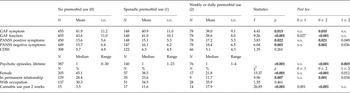
Participants with premorbid cannabis use were more often male, more often single and had more frequent current cannabis use, than patients without premorbid cannabis use. They also had higher levels of current general symptoms and poorer general current functioning as measured by the GAF scale, and higher levels of current positive and negative symptoms as measured by the PANSS, but also reported fewer lifetime psychotic episodes (Table 1).
Cannabis use patterns before onset of psychosis, current functioning and symptoms, sociodemography and course of illness

GAF, Global Assessment of Functioning; PANSS, Positive and Negative Syndrome Scale; CDSS, Calgary Depression Scale for Schizophrenia; n.s., not significant.
Bold: Significant after a false discovery rate procedure (Benjamini–Hochberg) with a q of 0.028.
When comparing different levels of use in the premorbid cannabis users, patients with weekly or daily premorbid cannabis use were more often male, more often single, had higher levels of current positive and negative symptoms and reported fewer lifetime psychotic episodes, compared to patients with sporadic premorbid cannabis use (Table 1). There were no differences in current symptom severity, level of functioning or number of psychotic episodes between those who had premorbid use of cannabis only and those who had premorbid poly-substance use, i.e. cannabis and amphetamine or cocaine (data not shown).
Controlling for confounders
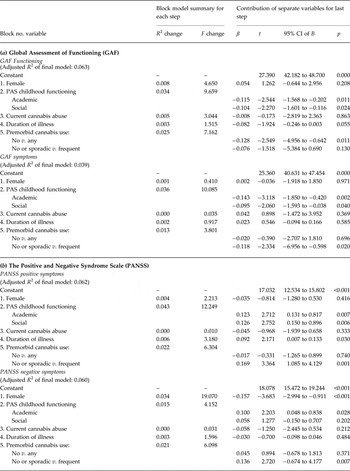
The multiple linear regression analyses controlling for gender, premorbid functioning, current cannabis use disorder, and duration of illness indicated that premorbid cannabis use remained significantly associated with poorer current functioning and that premorbid weekly or daily cannabis use was still associated with higher levels of positive, negative and general symptoms. Follow-up analyses also controlling for the premorbid use of amphetamines or cocaine, for the current abuse of other substances than cannabis, for the use of cannabis during the last 2 weeks or for having a single psychotic episode (v. having ⩾2 psychotic episodes) did not significantly influence these associations. (Table 2)
Linear regression models evaluating the prediction of impaired functioning and symptom severity (significant findings with full models).

CI, Confidence interval; PAS, Premorbid Adjustment Scale.
The logistic regression analysis, controlling for the same parameters, showed that duration of illness explained the associations between premorbid weekly or daily cannabis use and lifetime psychotic episodes.
AOP
The distribution of AOP was skewed, with a long tail towards higher age; the median AOP was 22 (range 6–56). An unadjusted Cox proportional hazards regression for cannabis users only (n = 293) showed a significant relationship between AOP and the start of cannabis use before the age of 17. Subjects who used cannabis before the age of 17 had significantly lower AOP (mean age = 21.0, s.d. = 6.1, median age 20) compared to those who started their use at age ⩾17 [mean age=24.0, s.d. = 7.6, median age 23, hazard ratio (HR) 1.51, p < 0.001]. When adjusting for sex, premorbid functioning and premorbid use of amphetamines or cocaine, the HR for having an earlier onset of psychosis for those starting cannabis use before the age of 17 increased to 2.3 (n = 267, p < 0.001).
Participants who had ever used cannabis (n = 327) had a significantly lower AOP (mean age=22.6, s.d. = 7.1, median years = 21) than those who had never used it (n = 354, mean age = 24.5, s.d. 8.4; median years 23; HR = 1.27; Cox proportional hazards regression, p = 0.003). When adjusting for sex, premorbid functioning and premorbid use of amphetamines or cocaine the HR for lifetime cannabis use and earlier onset of psychosis increased to 1.79 (n = 548, p < 0.001).
Applying the same type of Cox regression models to analyse the effect of the level of premorbid cannabis use we did not find any significant relationship between AOP and level of cannabis use before 17 years (n = 46). Median/mean (s.d.) AOP was 21/20.9 (3.8) in the group with sporadic use, and 20/19.6 (4.8) in the group with weekly or daily use.
Discussion
A clear majority of the participants with lifetime use of cannabis started to use cannabis before their first psychotic symptoms, i.e. had premorbid cannabis use. The main finding of the current study was that patients with schizophrenia spectrum disorders and premorbid cannabis use had higher current illness severity, measured by GAF and PANSS, than those without any premorbid cannabis use. This association remained significant also after controlling for the effects of premorbid functioning and current cannabis abuse. Furthermore, frequent premorbid use was associated with higher severity of current symptomatology than sporadic premorbid use or no use, in a pattern indicating a dose-response relationship. We did not find any difference between patients that only had premorbid use of cannabis and patients with premorbid poly-substance use, indicating that cannabis is the main contributing substance. We also confirmed earlier findings of an association between lower age at onset of cannabis use and lower AOP.
We found that the apparent association between frequent premorbid use and fewer lifetime psychotic episodes was explained by a shorter duration of illness in the participants with premorbid cannabis use.
The findings of significant associations between premorbid cannabis use and current clinical status, independent of premorbid adjustment, suggest that premorbid adjustment did not serve as a mediator in the current study population. The different findings of the role of premorbid adjustment in studies from different areas could however be taken to imply that factors associated with the recruitment of people at risk for schizophrenia into cannabis use may differ in different social contexts, and for example, be dependent on availability of substances and/or characteristics of existing cannabis-using subcultures.
In addition, we did not find any indications that the association was mediated by current cannabis abuse. Taken together, the findings are suggestive of a more direct link between premorbid cannabis use and a more severe outcome, with indications of a dose-response effect, not previously shown.
Level of cannabis use at onset of illness has recently been associated with depression and anxiety (Barrowclough et al. Reference Barrowclough, Gregg, Lobban, Bucci and Emsley2015) and symptoms of mania (Stone et al. Reference Stone, Fisher, Major, Chisholm, Woolley, Lawrence, Rahaman, Joyce, Hinton, Johnson and Young2014) in recent-onset non-affective psychosis patients, however, none of these studies found associations with positive or negative symptoms. These differences in findings on associations between early cannabis use and later symptoms, may be explained by differences in the effects of cannabis use in different age groups, as premorbid use is earlier in life and often more close to important brain maturational processes than use at first episode. The present findings are in line with previous data supporting a dose-response relationship between lifetime cannabis use and psychotic symptoms in the general population (Davis et al. Reference Davis, Compton, Wang, Levin and Blanco2013; Ruiz-Veguilla et al. (Reference Ruiz-Veguilla, Barrigón, Hernández, Rubio, Gurpegui, Sarramea, Cervilla, Gutiérrez, James and Ferrin2013), and findings regarding early cannabis use and later psychotic symptoms in healthy individuals (Miettunen et al. Reference Miettunen, Törmänen, Murray, Jones, Mäki, Ebeling, Moilanen, Taanila, Heinimaa, Joukamaa and Veijola2008). Further, more recent research has outlined plausible biological models for how early cannabis use has effects on brain development (Lopez-Larson et al. Reference Lopez-Larson, Bogorodzki, Rogowska, McGlade, King, Terry and Yurgelun-Todd2011; Alpar et al. Reference Alpar, Di Marzo and Harkany2015; Filbey et al. Reference Filbey, McQueeny, DeWitt and Mishra2015) and how it might interact with risk genes for schizophrenia development (French et al. Reference French, Gray, Leonard, Perron, Pike, Richer, Seguin, Veillette, Evans, Artiges, Banaschewski, Bokde, Bromberg, Bruehl, Buchel, Cattrell, Conrod, Flor, Frouin, Gallinat, Garavan, Gowland, Heinz, Lemaitre, Martinot, Nees, Orfanos, Pangelinan, Poustka, Rietschel, Smolka, Walter, Whelan, Timpson, Schumann, Smith, Pausova and Paus2015).
The main strengths of the present study are the large naturalistic sample of patients with schizophrenia spectrum disorders and the comprehensive clinical characterization including thorough recordings of substance use characteristics from first use of each specific substance, allowing us to quantify the load of substance use in the premorbid period. The main limitation of the study is its cross-sectional design, relying on retrospective self-report with the possibility for recall bias. However, both self-reports of substance use (Weiss et al. Reference Weiss, Najavits, Greenfield, Soto, Shaw and Wyner1998; Van Dorn et al. Reference Van Dorn, Desmarais, Scott Young, Sellers and Swartz2012) and of premorbid functioning (Brill et al. Reference Brill, Reichenberg, Rabinowitz, Harary, Lubin, Davidson and Weiser2007) have previously been shown to be valid in this patient group. A further limitation is a substantial proportion of missing data (20%) on number of psychotic episodes, without information about the length of the episodes. Due to ethical restrictions we were not allowed to keep records of people who refused to participate. This makes clear conclusions about generalizability difficult, but we would argue that our recruitment procedure gives a more representative sample than using samples of convenience. For some of the analyses subgroups were small, and the subsequent lack of statistical power could result in type II errors.
In conclusion, the present findings highlight the role of cannabis use patterns, and specifically the level of use, before onset of illness in schizophrenia spectrum disorders. The finding that premorbid functioning and current substance abuse did not significantly influence the associations between premorbid cannabis use and current clinical status support the notion that early cannabis use may have a negative effect on the course of later psychotic illness. The role of cannabis use in lowering AOP was confirmed, and shown to probably be independent of premorbid factors. Longitudinal studies of functioning, substance use and other stressors from the premorbid phases to established illness in adults would still be needed to determine any causal effects. However, the current findings support the view that there are adverse effects of a widespread use of cannabis in the population.
Acknowledgements
We thank all participants taking part in the study.
This study was funded by Oslo University Hospital and grants from the University of Oslo, the Research Council of Norway (Grant number 223273, NORMENT), the South-East Norway Health Authority (Grant number 2014102, Regional Research Network) and the K. G. Jebsen Foundation.
Declaration of Interest
None.