Introduction
Characterization means the distillation of knowledge, which contributes to the reliable prediction of the genetic performance of an animal genetic resource (AnGR) in a defined environment and provides a basis for distinguishing different AnGR and for assessing available diversity. It involves a clear definition of the genetic attributes of an AnGR and the environments to which it is adapted or known to be partially or not adapted at all (Sponenberg et al., Reference Sponenberg, Hawes, Johnson and Christman2000; Rege and Okeyo, Reference Rege, Okeyo, Ojango, Malmfors and Okeyo2010; Melesse and Negesse, Reference Melesse and Negesse2011). The AnGR of poultry in West Africa are mainly represented by domestic indigenous chicken (Gallus gallus domesticus), guinea fowl (Numida meleagris), duck (Cairina sp.) and turkey (Meleagris gallopavo). With the rapid development of the poultry industry worldwide, especially in developing countries, importation of temperate-zone high-performance stocks to hot regions is on the rise (Melesse, Reference Melesse2011), and this has led to a threat of AnGR as indigenous birds are being excluded from the intensive production systems. One of the most difficult issues to deal with in the context of the management of AnGR is priority setting, both for conservation of endangered or potentially endangered populations or breeds and for breed improvement programmes (Zanetti, Reference Zanetti2009). Managing breeds for a secure future tackles the challenges of maintaining AnGR in species and breeds of livestock and poultry (Sponenberg and Bixby, Reference Sponenberg and Bixby2007). Indigenous birds are a vital reservoir of gene resources and their conservation has a technical role related to the future development of the productive system as well as a social-cultural role (Benabdeljelil and Arfaoui, Reference Benabdeljelil and Arfaoui2001; Camacho-Escobar et al., Reference Camacho-Escobar, Ramirez-Cancino, Lira-Torres and Hernandez-Sanchez2008; Cerolini et al., Reference Cerolini, Madeddu, Zaniboni, Cassinelli, Mangiagalli and Marelli2010; Francesch, Villalba and Cartana, Reference Francesch, Villalba and Cartana2011). Breeding and selection strategies can therefore be exploited to achieve the best possible production in unfavourable environments.
Approximately 70 percent of the world's rural poor depend on livestock as an important component of their livelihoods (Hoffman, Reference Hoffman2010). Turkey production is both an important and a profitable agricultural industry, with a rising global demand for its products (Case, Miller and Wood, Reference Case, Miller and Wood2010). Local turkeys is about 1.05 million in Nigeria, being the smallest when compared with other poultry species such as chicken estimated to be 160 million, guinea fowl 8.3 million and ducks 1.7 million (FAOSTAT, 2011). However, scarce works deal with the characterization of indigenous turkeys in Nigeria. Because the genotypes required for the future are difficult to predict, characterization of indigenous turkey populations can make a major contribution to their effective long-term management and conservation. The first step in such characterization involves the use of morphological traits.
The mechanisms involved in the control of the morphology of a bird are too complex to be explained only under univariate analysis of variance because all related traits are biologically correlated owing to pleiotropy or linkage. Therefore, the univariate analysis does not take account of all the co-variation that exists between the traits. A multivariate approach might offer a better resolution. Multivariate discriminant analysis is currently being employed in evaluating genotypes based on growth, carcass parameters (Rosario et al., Reference Rosario, Silvia, Coelho, Savino and Dias2008; Al-Atiyat, Reference Al-Atiyat2009), morphological variables (FAO, Reference Dinesh, Geerlings, Solkner, Thea, Thieme and Wurzinger2009; Yakubu and Ibrahim, Reference Yakubu and Ibrahim2011) and heat-tolerant traits (Chen et al., Reference Chen, Bordas, Gourichon and Tixier-Boichard2004; Castanheira et al., Reference Castanheira, Paiva, Louvandini, Landim, Fiorvanti, Dallago, Correa and McManus2011). Although attempts have been made at characterizing chickens in Nigeria using the multivariate approach (Yakubu, Kuje and Okpeku, Reference Yakubu, Kuje and Okpeku2009; Yakubu et al., Reference Yakubu, Akinfemi, Abimiku and Hassan2010), there is paucity of information on the multivariate characterization of morphological and heat-tolerant traits for studying diversity in turkeys in Nigeria. Therefore, the present investigation aimed at differentiating indigenous, cross-bred and exotic turkeys using multivariate discriminant analysis. This will assist in initiating a programme for the preservation of AnGR of indigenous turkeys in Nigeria.
Materials and methods
Study area
The research work was carried out at the Turkey Breeding Unit of the Teaching and Research Farm of the College of Animal Science and Livestock Production, University of Agriculture, Abeokuta, Ogun State, Nigeria. The environmental conditions of the study area have been previously described in Ilori et al. (Reference Ilori, Peters, Ikeobi, Bamgbose, Isidahomen and Ozoje2010).
Management of birds
A total of 228 poults consisting of 84 indigenous, 79 indigenous × exotic cross-breds and 65 exotic poults of both sexes (132 males and 96 females) were used. Nigerian indigenous turkeys are a population of birds that have become adapted to the Nigerian environment by some combination of genetic changes occurring over generations and environmentally induced developmental events reoccurring during each generation. The turkeys are reared mostly by the rural folks with little inputs from the owners. A large foundation stock of these indigenous stocks was established at the Poultry Breeding Unit. The exotic turkeys (Nicholas White), on the other hand, were obtained from Obasanjo Farm, the country representative of Nicholas white brand of Aviagen Turkey Ltd Lewisburg, West Virginia, USA. Parent stocks of these exotic turkeys are maintained also at the Poultry Breeding Unit. The male Nicholas White turkeys and the female indigenous turkeys were used to generate the cross-breds through artificial insemination. The poults were brooded in deep litter pens according to their genetic groups. All poults were wing-tagged for proper identification and subjected to the same management practices throughout the experimental period. The essence of rearing the turkeys in pens was to ensure appropriate management and monitoring of their performance. Commercial feeds were provided for the birds ad libitum. Starter mash containing 28 percent crude protein (CP), grower mash 24 percent CP and finisher mash 20 percent CP were fed to the birds from 0 to 6 weeks, 7 to 16 weeks and 17 to 20 weeks, respectively. Clean and cool water was supplied ad libitum. Necessary vaccinations against Newcastle, fowl pox and gumboro diseases as well as prophylactic antibiotics and anticoccidial drugs were administered to the birds.
Data collection
At 20 weeks of age, body weight (BW) (kg) and five morphometric traits (cm) namely the body length (BL) from the base of the comb to the base of the tail around the uropigial gland, the shank length (SL) from the hock joint to the tarsometarsus digit-3 joint, the thigh length (TL) between the hock joint and the pelvic joint, the keel length (KL) of the cartilaginous keel bone or metasternum and the breast girth (BG) were recorded. The heat-tolerant traits measured included rectal temperature (RT), pulse rate (PR) and respiratory rate (RR). The relationship between PR and RR together with their normal average values was used to derive heat stress index (HI). RT was measured by inserting a digital rectal thermometer into the rectum of the birds for 1 min after which the readings were taken. PR was measured by placing finger tips under wing vein and counting the number of beats per minute using a stopwatch while RR was determined for each bird by counting the movement of abdominal region or vent using a stopwatch. RT, PR and RR of all the birds were measured between the hours of 7.00 a.m. and 9.00 a.m. as well as between 1.00 p.m. and 3.00 p.m. at 20 weeks of age as described by Oladimeji et al. (Reference Oladimeji, Osinowo, Alawa and Hambolu1996).
Statistical analysis
Analysis of variance was performed to test the fixed effect of genotype and sex on morphological and heat-tolerant traits of turkeys. Means were separated using Duncan's multiple range test at 95 percent confidence interval. Multivariate analysis was conducted to investigate how similar or different the turkey populations are. Stepwise discriminant analysis of the ten traits using the STEPDISC procedure (SAS, 2010) indicated which variable contributed most to differentiation among the three genetic groups. Canonical discriminant analysis (CANDISC procedure) was performed to obtain canonical variables, canonical coefficients and Mahalanobis distances between the three populations based on the selected traits. The DISCRIM procedure (nearest-neighbour discriminant analysis) was used to find the percentage of correct assignment of each bird to its genetic group.
The linear model employed was

where Y ij is the observed variable, μ is the overall mean, G i is the effect of genotype (i = indigenous, cross-bred, exotic), S j is the effect of sex (j = male, female), e ij is the random error terms such that e ij are independent normally distributed random variables with E (e ij) = 0 and V (e ij) = σ 2.
Results
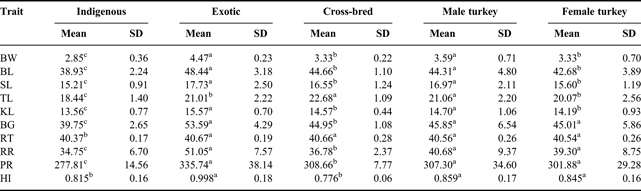
The means and standard deviations of the morphometric and heat-tolerant traits of the indigenous, cross-bred and exotic turkeys are presented in Table 1. The exotic turkeys had significantly (p < 0.05) higher mean values than the indigenous and cross-breds in all the morphological traits with the exception of TL, which was significantly higher in cross-breds than in their parental populations. However, both the indigenous and cross-bred turkeys appeared to tolerate heat better than their exotic counterparts based on HI. Sexual dimorphism was observed in the morphological traits with males having significantly higher (p < 0.05) BW, BL, SL, TL and KL than females. However, the two sexes did not differ (p > 0.05) in the heat-tolerant traits.
Descriptive statistics of the morphological and heat-tolerant traits of turkeys according to genotype and sex.
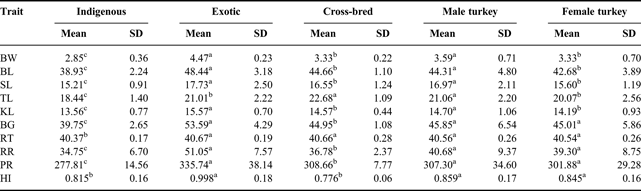
BW: body weight, BL: body length, SL: shank length: TL: thigh length, KL: keel length, BG: breast girth, RT: rectal temperature, RR: respiratory rate, PR: pulse rate, HSI: heat stress index.
abcMeans within the same row having different superscripts differ significantly (p < 0.05) among the three genotypes.
abMeans within the same row having different superscripts differ significantly (p < 0.05) between the two sexes.
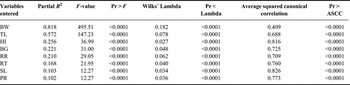
The stepwise discriminant analysis indicated that eight out of the ten original traits were effective at detecting the differences among the three turkey populations. The eight traits showing a partial correlation above 10 percent are shown in Table 2. BW was the most discriminating variable followed by TL, HI, BG, RR, RT, SL and PR, respectively. The first three variables were included in the final model as they were more informative.
Summary of stepwise selection of traits.

BW: body weight, TL: thigh length, HSI: heat stress index, BG: breast girth, RR: respiratory rate, RT: rectal temperature, SL: shank length, PR: pulse rate.
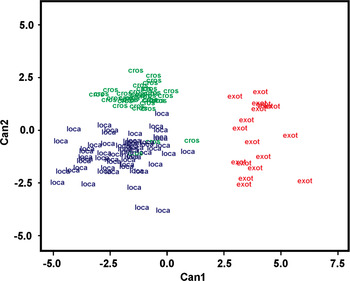
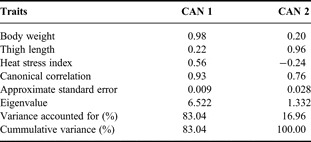
The canonical analysis carried out on the morphological and heat-tolerant variables (BW, TL and HI) identified two statistically significant (p < 0.01) canonical variables that accounted for 83.04 and 16.96 percent of the total variation (Table 3). The first canonical variable (CAN 1) was the linear combination of traits that best discriminates among the three genetic groups. BW and HI were highly correlated to CAN 1. The second canonical variable (CAN 2) was the next best linear combination, orthogonal to the first one. TL was highly associated with CAN 2. A bi-dimensional plot built with the two canonical variables illustrating the relationship between the three genetic groups is shown in Figure 1. The plot exhibited no significant overlap of any kind.
Canonical representation of the three turkey genetic groups. loca = indigenous turkeys, exot = exotic turkeys, cros = cross-bred turkeys.

Total canonical structure of the three turkey populations.

The Mahalanobis distance between the indigenous and exotic turkeys (36.68) was longest while the shortest distance was recorded for the indigenous turkeys and their cross-bred counterparts (7.97). The distance between the exotic turkeys and cross-breds (29.14) was intermediate. All pair-wise distances were significant (p < 0.001), demonstrating that differences between populations are important. However, local and cross-bred turkeys were closer to each other compared with their exotic counterparts.
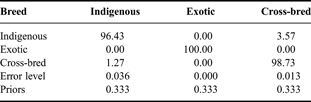
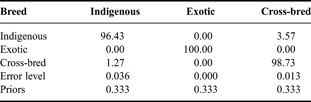
In the nearest-neighbour discriminant analysis, 100.00 percent of exotic, 98.73 percent of cross-bred and 96.43 percent of indigenous turkeys (an average of 98.37 percent for the three populations) were correctly assigned into their genetic groups (Table 4).
Percent (%) of individual turkeys classified into three genetic groups.
Discussion
In the developed world, livestock recording schemes provide a continuous source of data for monitoring trends in the industry, including improved understanding of breeds and production systems. Unfortunately, such structures are not available in most developing countries (Rege and Okeyo, Reference Rege, Okeyo, Ojango, Malmfors and Okeyo2010). Therefore, the implementation of objective methodologies assessing the morphological and physiological parameters of birds is of major importance. While morphological differences can be mainly attributed to genetic differences in the present study, heat-tolerant traits are more likely to be affected by environmental influences. Each breed has a determined morpho-structure, an expression of its quantitative morpho-structure that responds to a particular environment to which it is adapted or being raised. The indigenous turkeys represented a pool of heterogeneous and unimproved individuals unlike their exotic counterparts that have undergone directional selection for high growth rate. However, the indigenous turkeys exhibited better adaptability in terms of heat-tolerant traits compared with their exotic counterparts. It is important to know the tolerant and adaptive capacity of various genetic groups as a technical basis for turkey exploration including the direction of cross-breeding programmes. Different phenotypic expression of a genotype in response to different environments has been reported (Kolmodin et al., Reference Kolmodin, Strandberg, Jorjani and Danell2003). This is more so important because the most notable effect of selective breeding on physiology reduces the responsiveness to stress-evoking stimuli (i.e. environmental stress) as an adaptation to living in a biologically safe environment (Korte et al., Reference Korte, Koolhaas, Wingfield and McEwen2005). According to Dana et al. (Reference Dana, van der Waaij, Dessie and van Arendonk2010), adaptation to the production environment was found as an important attribute of village chickens in Ethiopia, while Kohler-Rollefson, Rathore and Mathias (Reference Kohler-Rollefson, Rathore and Mathias2009) reported that the ability to deal with thermal stress could provide a competitive advantage for indigenous breeds over their temperate counterparts in the event of climate change. The onset of air breathing has also been associated with the pattern of ossification of the uncinate processes in developing turkeys (Tickle and Codd, Reference Tickle and Codd2009), thereby giving an understanding of the skeletal changes during ontogeny and importance of developmental patterns. This might equally have an indirect influence on the adaptive capacity of birds. The better performance of cross-breds over the indigenous birds in body measurements portends hope for the genetic improvement of the native stock for improved productivity.
The wide variations between the sexes might be connected with differences in growth rates, growth strategies, metabolic rates and reproductive strategies. According to Baeza et al. (Reference Baeza, Williams, Guemene and Duclos2001), sexual dimorphism is attributable to the usual between-sex differential hormonal action, which invariably leads to differential growth rates. Similar findings had been reported by other workers (Blondel et al., Reference Blondel, Perret, Anstett and Thebaud2002; Yakubu, Reference Yakubu2011).
Selecting the most important traits that explain the major part of the total phenotypic variability between turkey genotypes is a purposeful step towards selection. Variables of body skeleton sizes could be used as distinguishing variables or markers (Mulyono, Sartika and Nugraha, Reference Mulyono, Sartika and Nugraha2009) that can give an overview of specification of the homogeneity or heterogeneity of birds.
A considerable genetic variability was observed between the three genetic groups. The canonical analysis performed on the complete set of morphometric and heat-tolerant variables produced a grouping which was expected, judging from the univariate test. It showed a clear separation of the three genetic groups in the space created by the two canonical variables. Indigenous turkeys were more separated from their exotic counterparts. The Mahalanobis test established significant differences among the three genetic groups studied. Separate grouping especially of the indigenous and exotic turkeys is an indication that they have different morphometric traits as well as varying response to heat tolerance. This might be attributed to the difference in the geographical origin of the two genetic groups (the indigenous birds are more adaptable to the hot and humid tropical environment while the exotic birds were imported from the temperate region). According to Mulyono et al. (Reference Mulyono, Sartika and Nugraha2009), differences of the origin distinguish the phenotypic response based on the potential for additive genes controlling the body measurements of each bird's genotype to the nature of growth, development and osteogenesis. The nearest-neighbour discriminant analysis revealed that a 98.37 percent correct classification of the samples of the three genetic groups can be achieved using a combination of BW, TL and HI variables. This affirmed the heterogeneity of the turkey populations. The present findings are in consonance with earlier reports on the use of discriminant analysis to separate birds of different genetic groups or ecotypes (Chen et al., Reference Chen, Bordas, Gourichon and Tixier-Boichard2004; Abdelqader, Wollny and Gauly, Reference Abdelqader, Wollny and Gauly2008; Rosario et al., Reference Rosario, Silvia, Coelho, Savino and Dias2008; Yakubu, Kaankuka and Ugbo, Reference Yakubu, Kaankuka and Ugbo2011).
Conclusions
The application of univariate and multivariate statistical methods enabled us to discriminate between the indigenous, exotic and cross-bred turkeys using morphometric and heat-tolerant traits. BW, TL and HI were found as the most discriminating variables in separating the birds. The Mahalanobis distances between the turkey populations were highly significant. The average 98.37 percent of correct assignments was relatively high, thereby justifying the methodology applied in separating the three genetic groups. However, geometric morphometry (shape analysis), molecular genetic analyses with diagnostic marker loci in addition to an increased sample size would be desirable in future research because these might increase the discriminant power and precision of the classification.
Statement of interest: The authors declare that there are no competing interests.